Statistical Concepts: Quiz on Weeks 3, 5, 7, 9 & 11 - Error Analysis
VerifiedAdded on 2023/06/04
|27
|4270
|148
Quiz and Exam
AI Summary
This document presents a quiz focusing on key statistical concepts covered in Weeks 3, 5, 7, 9, and 11. The quiz questions address Type I and Type II errors in hypothesis testing, moderating and mediating variables, research design elements, and the purpose of causal studies. It further explores questionnaire design, including identifying leading and double-barreled questions, and appropriate survey methods. The quiz also covers sampling techniques, sampling errors, and factors affecting sample size, such as population variance and confidence intervals. The questions require an understanding of statistical fluctuations, census applications, and the suitability of different sampling techniques. Desklib offers a wealth of study resources, including past papers and solved assignments, to help students master these concepts.
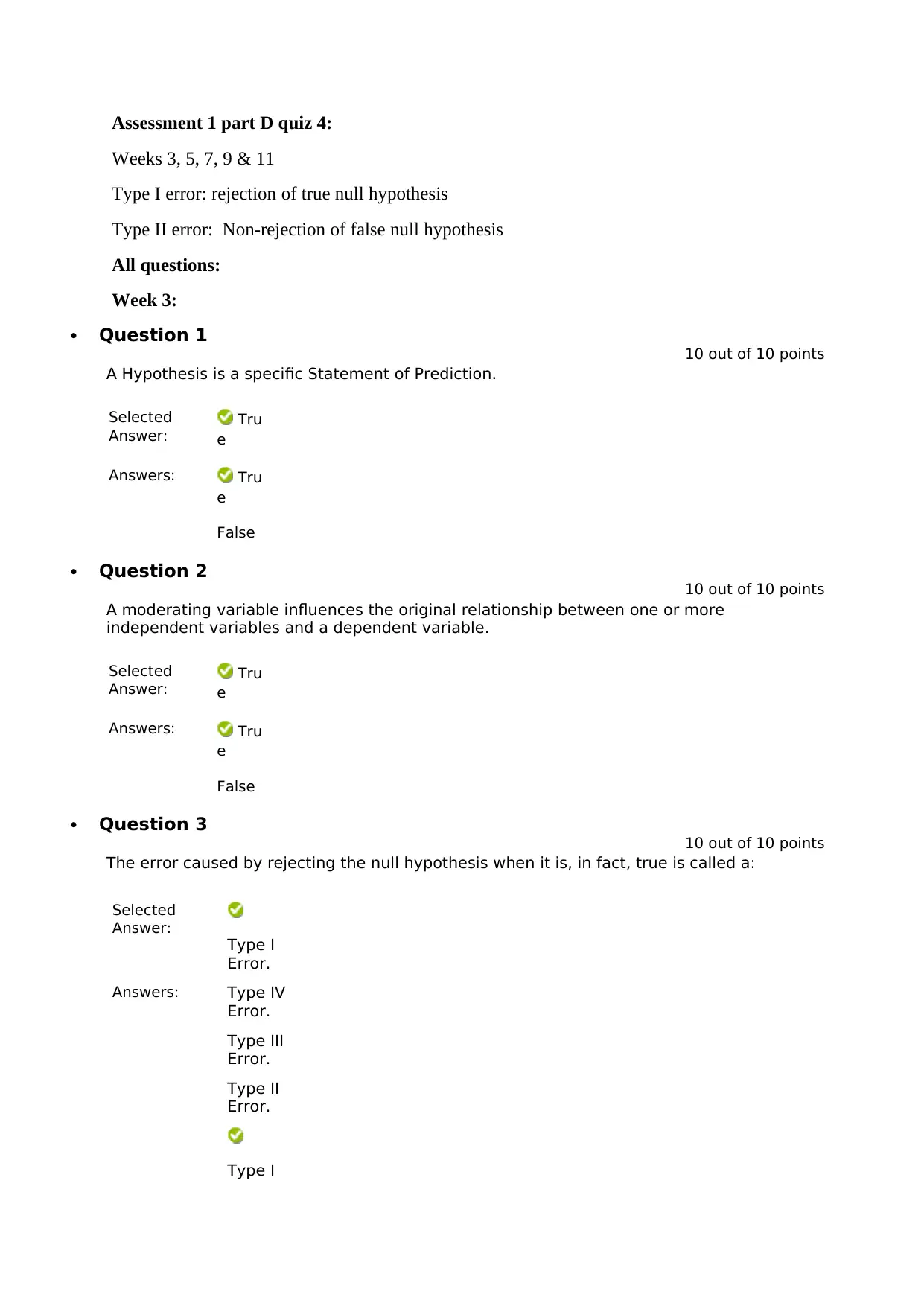
Assessment 1 part D quiz 4:
Weeks 3, 5, 7, 9 & 11
Type I error: rejection of true null hypothesis
Type II error: Non-rejection of false null hypothesis
All questions:
Week 3:
Question 1 10 out of 10 points
A Hypothesis is a specific Statement of Prediction.
Selected
Answer:
Tru
e
Answers: Tru
e
False
Question 2 10 out of 10 points
A moderating variable influences the original relationship between one or more
independent variables and a dependent variable.
Selected
Answer:
Tru
e
Answers: Tru
e
False
Question 3 10 out of 10 points
The error caused by rejecting the null hypothesis when it is, in fact, true is called a:
Selected
Answer:
Type I
Error.
Answers: Type IV
Error.
Type III
Error.
Type II
Error.
Type I
Weeks 3, 5, 7, 9 & 11
Type I error: rejection of true null hypothesis
Type II error: Non-rejection of false null hypothesis
All questions:
Week 3:
Question 1 10 out of 10 points
A Hypothesis is a specific Statement of Prediction.
Selected
Answer:
Tru
e
Answers: Tru
e
False
Question 2 10 out of 10 points
A moderating variable influences the original relationship between one or more
independent variables and a dependent variable.
Selected
Answer:
Tru
e
Answers: Tru
e
False
Question 3 10 out of 10 points
The error caused by rejecting the null hypothesis when it is, in fact, true is called a:
Selected
Answer:
Type I
Error.
Answers: Type IV
Error.
Type III
Error.
Type II
Error.
Type I
Paraphrase This Document
Need a fresh take? Get an instant paraphrase of this document with our AI Paraphraser

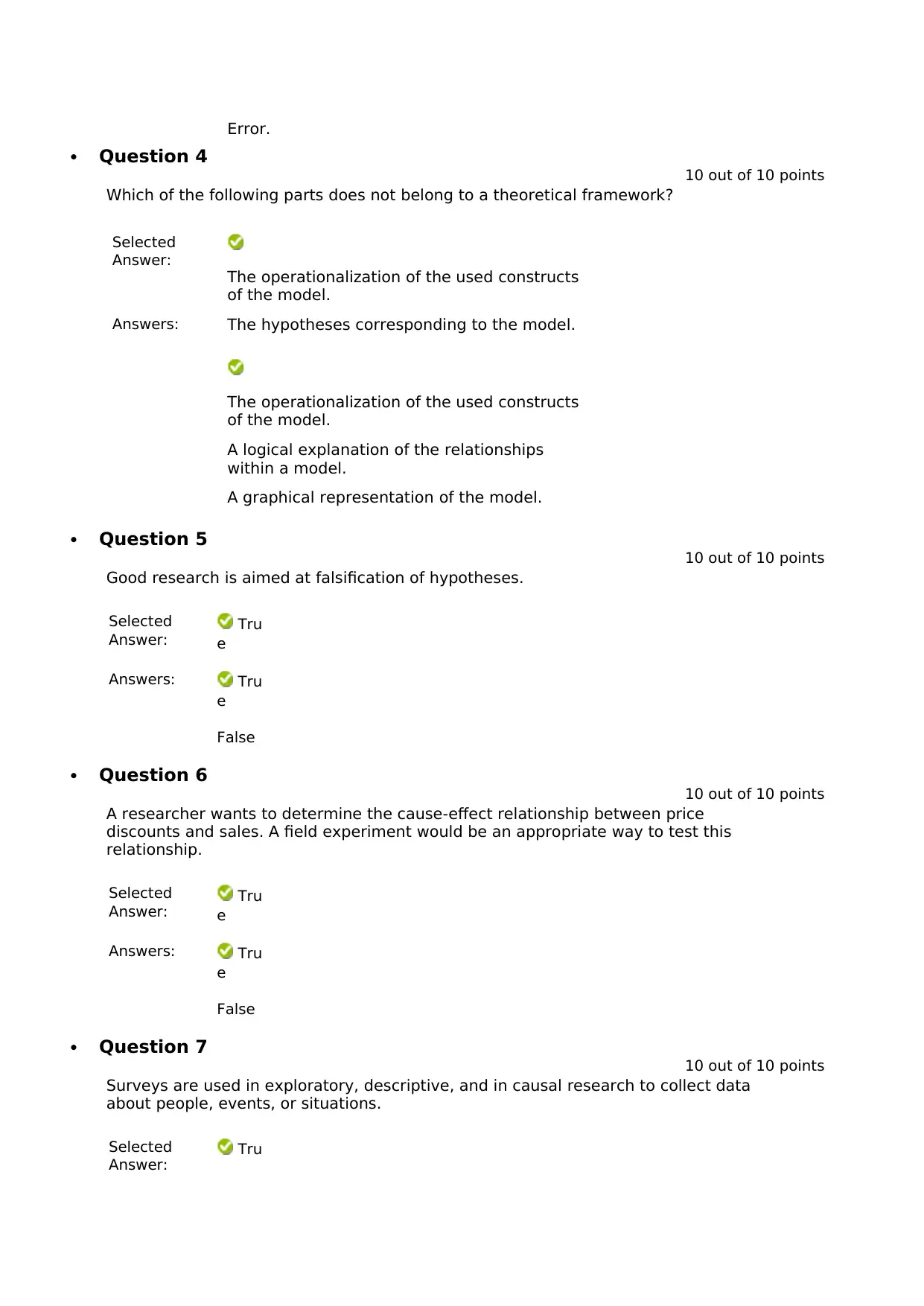
Error.
Question 4 10 out of 10 points
Which of the following parts does not belong to a theoretical framework?
Selected
Answer:
The operationalization of the used constructs
of the model.
Answers: The hypotheses corresponding to the model.
The operationalization of the used constructs
of the model.
A logical explanation of the relationships
within a model.
A graphical representation of the model.
Question 5 10 out of 10 points
Good research is aimed at falsification of hypotheses.
Selected
Answer:
Tru
e
Answers: Tru
e
False
Question 6 10 out of 10 points
A researcher wants to determine the cause-effect relationship between price
discounts and sales. A field experiment would be an appropriate way to test this
relationship.
Selected
Answer:
Tru
e
Answers: Tru
e
False
Question 7 10 out of 10 points
Surveys are used in exploratory, descriptive, and in causal research to collect data
about people, events, or situations.
Selected
Answer:
Tru
Question 4 10 out of 10 points
Which of the following parts does not belong to a theoretical framework?
Selected
Answer:
The operationalization of the used constructs
of the model.
Answers: The hypotheses corresponding to the model.
The operationalization of the used constructs
of the model.
A logical explanation of the relationships
within a model.
A graphical representation of the model.
Question 5 10 out of 10 points
Good research is aimed at falsification of hypotheses.
Selected
Answer:
Tru
e
Answers: Tru
e
False
Question 6 10 out of 10 points
A researcher wants to determine the cause-effect relationship between price
discounts and sales. A field experiment would be an appropriate way to test this
relationship.
Selected
Answer:
Tru
e
Answers: Tru
e
False
Question 7 10 out of 10 points
Surveys are used in exploratory, descriptive, and in causal research to collect data
about people, events, or situations.
Selected
Answer:
Tru

e
Answers: Tru
e
False
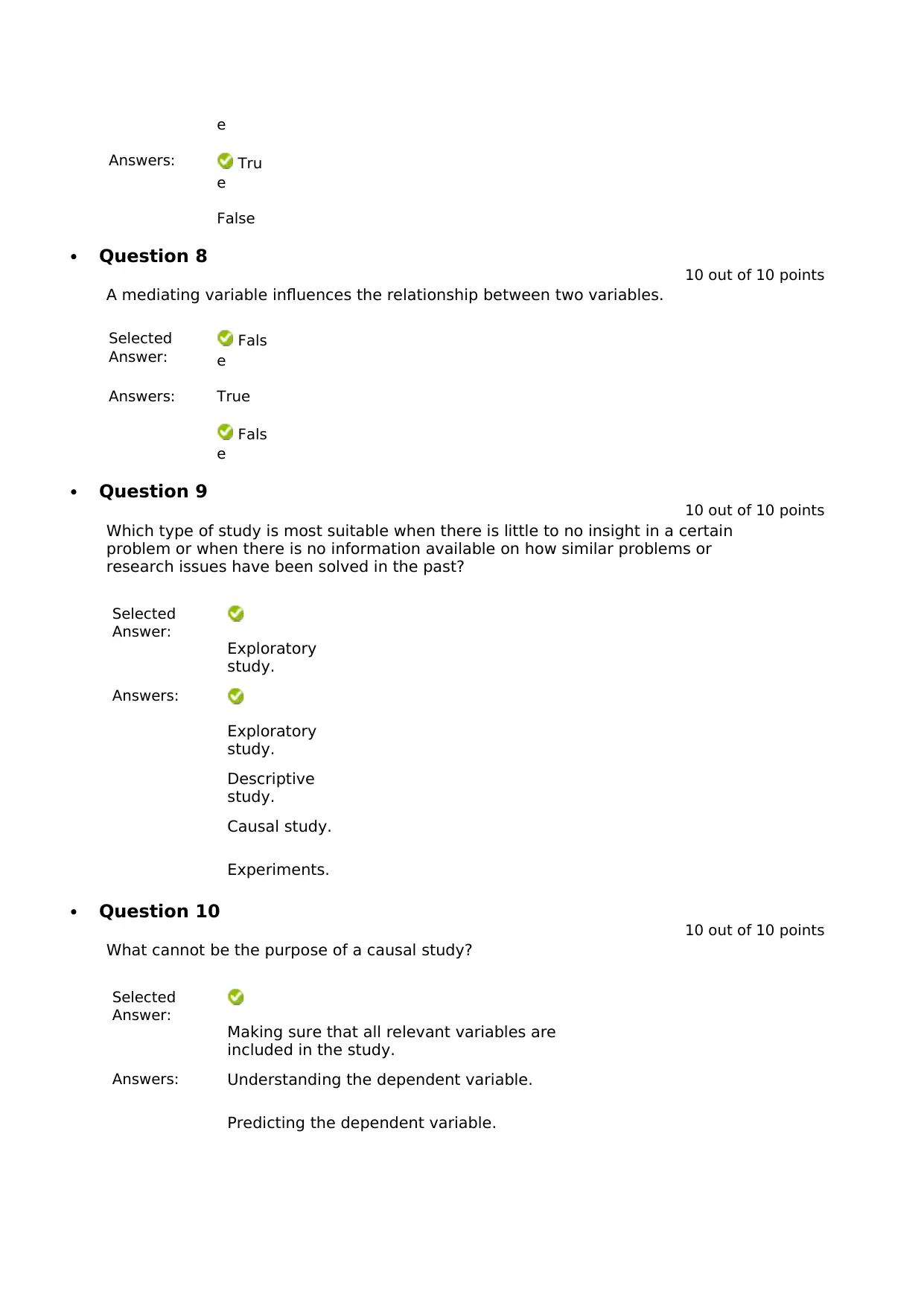
Question 8 10 out of 10 points
A mediating variable influences the relationship between two variables.
Selected
Answer:
Fals
e
Answers: True
Fals
e
Question 9 10 out of 10 points
Which type of study is most suitable when there is little to no insight in a certain
problem or when there is no information available on how similar problems or
research issues have been solved in the past?
Selected
Answer:
Exploratory
study.
Answers:
Exploratory
study.
Descriptive
study.
Causal study.
Experiments.
Question 10 10 out of 10 points
What cannot be the purpose of a causal study?
Selected
Answer:
Making sure that all relevant variables are
included in the study.
Answers: Understanding the dependent variable.
Predicting the dependent variable.
Answers: Tru
e
False
Question 8 10 out of 10 points
A mediating variable influences the relationship between two variables.
Selected
Answer:
Fals
e
Answers: True
Fals
e
Question 9 10 out of 10 points
Which type of study is most suitable when there is little to no insight in a certain
problem or when there is no information available on how similar problems or
research issues have been solved in the past?
Selected
Answer:
Exploratory
study.
Answers:
Exploratory
study.
Descriptive
study.
Causal study.
Experiments.
Question 10 10 out of 10 points
What cannot be the purpose of a causal study?
Selected
Answer:
Making sure that all relevant variables are
included in the study.
Answers: Understanding the dependent variable.
Predicting the dependent variable.
⊘ This is a preview!⊘
Do you want full access?
Subscribe today to unlock all pages.

Trusted by 1+ million students worldwide

Making sure that all relevant variables are
included in the study.
Explaining the variance in the dependent variable.
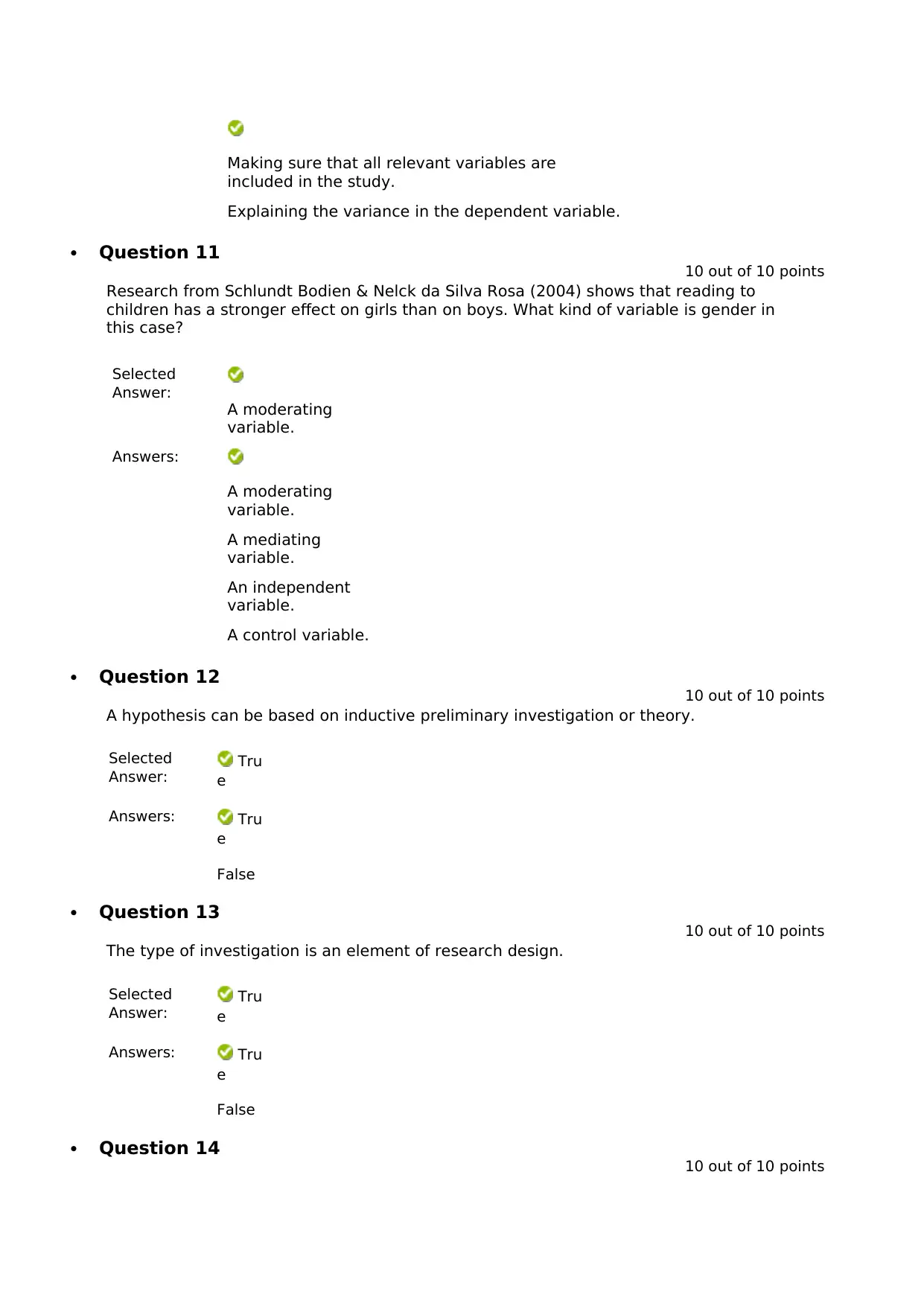
Question 11 10 out of 10 points
Research from Schlundt Bodien & Nelck da Silva Rosa (2004) shows that reading to
children has a stronger effect on girls than on boys. What kind of variable is gender in
this case?
Selected
Answer:
A moderating
variable.
Answers:
A moderating
variable.
A mediating
variable.
An independent
variable.
A control variable.
Question 12 10 out of 10 points
A hypothesis can be based on inductive preliminary investigation or theory.
Selected
Answer:
Tru
e
Answers: Tru
e
False
Question 13 10 out of 10 points
The type of investigation is an element of research design.
Selected
Answer:
Tru
e
Answers: Tru
e
False
Question 14 10 out of 10 points
included in the study.
Explaining the variance in the dependent variable.
Question 11 10 out of 10 points
Research from Schlundt Bodien & Nelck da Silva Rosa (2004) shows that reading to
children has a stronger effect on girls than on boys. What kind of variable is gender in
this case?
Selected
Answer:
A moderating
variable.
Answers:
A moderating
variable.
A mediating
variable.
An independent
variable.
A control variable.
Question 12 10 out of 10 points
A hypothesis can be based on inductive preliminary investigation or theory.
Selected
Answer:
Tru
e
Answers: Tru
e
False
Question 13 10 out of 10 points
The type of investigation is an element of research design.
Selected
Answer:
Tru
e
Answers: Tru
e
False
Question 14 10 out of 10 points
Paraphrase This Document
Need a fresh take? Get an instant paraphrase of this document with our AI Paraphraser

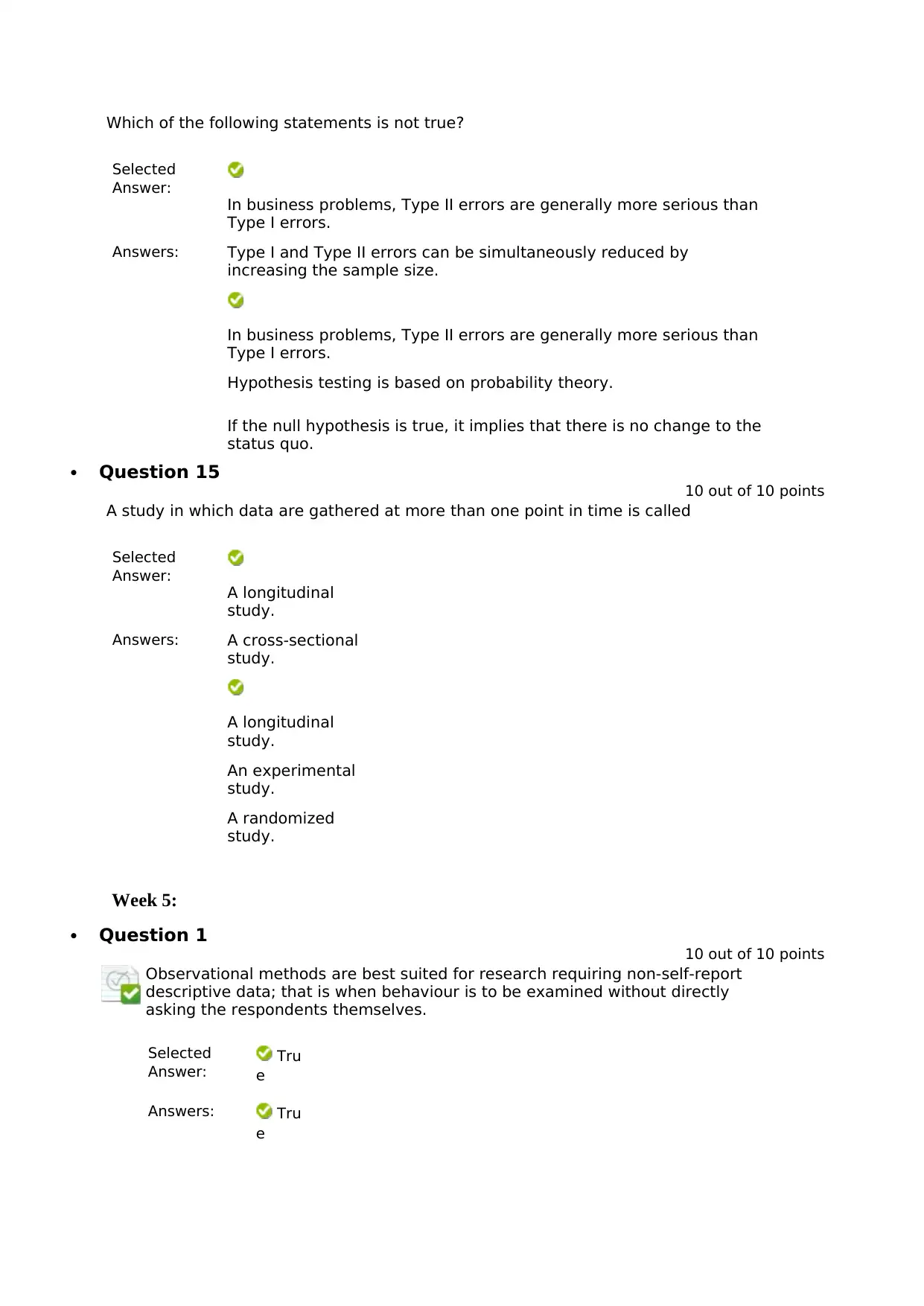
Which of the following statements is not true?
Selected
Answer:
In business problems, Type II errors are generally more serious than
Type I errors.
Answers: Type I and Type II errors can be simultaneously reduced by
increasing the sample size.
In business problems, Type II errors are generally more serious than
Type I errors.
Hypothesis testing is based on probability theory.
If the null hypothesis is true, it implies that there is no change to the
status quo.
Question 15 10 out of 10 points
A study in which data are gathered at more than one point in time is called
Selected
Answer:
A longitudinal
study.
Answers: A cross-sectional
study.
A longitudinal
study.
An experimental
study.
A randomized
study.
Week 5:
Question 1 10 out of 10 points
Observational methods are best suited for research requiring non-self-report
descriptive data; that is when behaviour is to be examined without directly
asking the respondents themselves.
Selected
Answer:
Tru
e
Answers: Tru
e
Selected
Answer:
In business problems, Type II errors are generally more serious than
Type I errors.
Answers: Type I and Type II errors can be simultaneously reduced by
increasing the sample size.
In business problems, Type II errors are generally more serious than
Type I errors.
Hypothesis testing is based on probability theory.
If the null hypothesis is true, it implies that there is no change to the
status quo.
Question 15 10 out of 10 points
A study in which data are gathered at more than one point in time is called
Selected
Answer:
A longitudinal
study.
Answers: A cross-sectional
study.
A longitudinal
study.
An experimental
study.
A randomized
study.
Week 5:
Question 1 10 out of 10 points
Observational methods are best suited for research requiring non-self-report
descriptive data; that is when behaviour is to be examined without directly
asking the respondents themselves.
Selected
Answer:
Tru
e
Answers: Tru
e

False
Response
Feedback:
Correc
t!
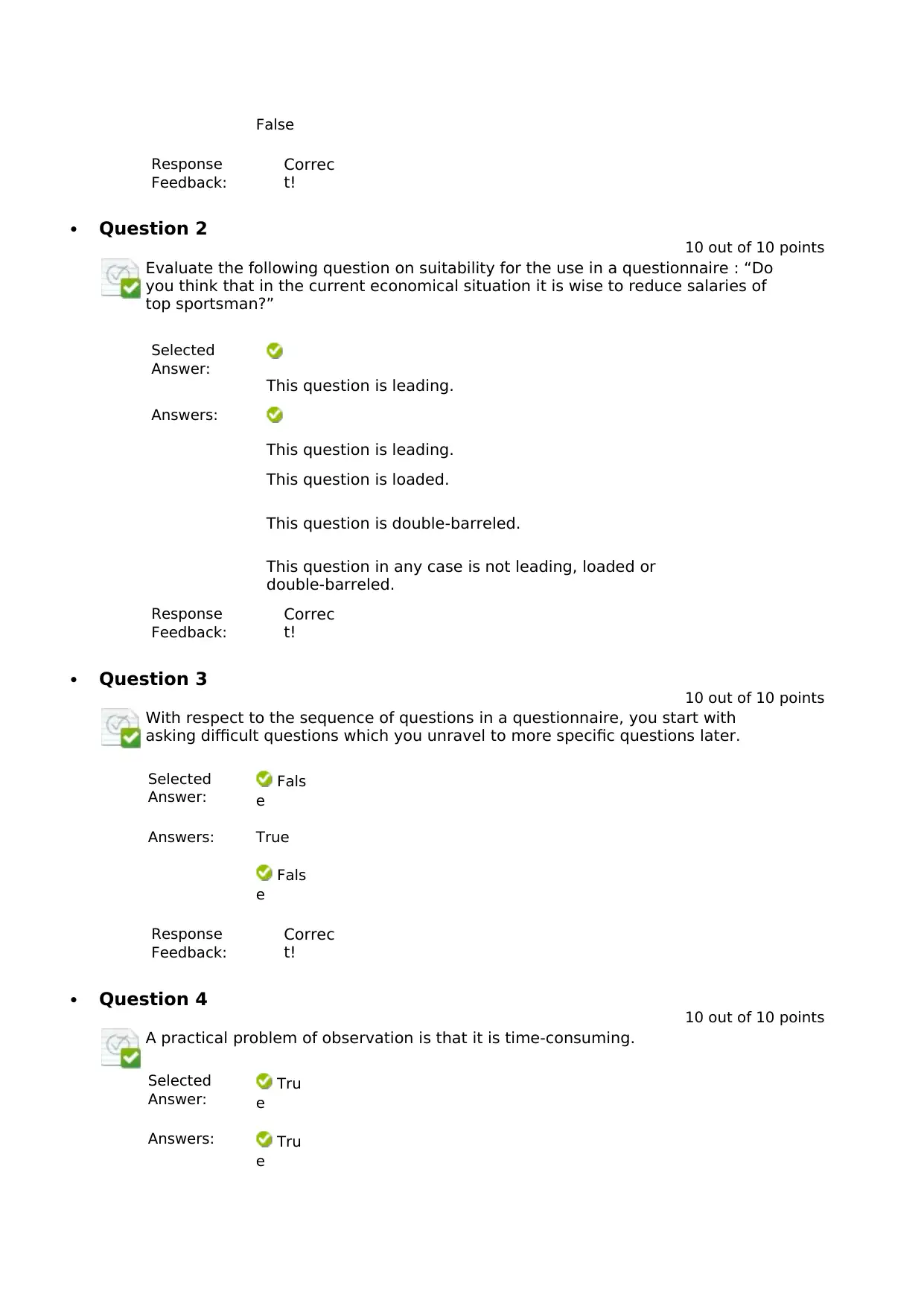
Question 2 10 out of 10 points
Evaluate the following question on suitability for the use in a questionnaire : “Do
you think that in the current economical situation it is wise to reduce salaries of
top sportsman?”
Selected
Answer:
This question is leading.
Answers:
This question is leading.
This question is loaded.
This question is double-barreled.
This question in any case is not leading, loaded or
double-barreled.
Response
Feedback:
Correc
t!
Question 3 10 out of 10 points
With respect to the sequence of questions in a questionnaire, you start with
asking difficult questions which you unravel to more specific questions later.
Selected
Answer:
Fals
e
Answers: True
Fals
e
Response
Feedback:
Correc
t!
Question 4 10 out of 10 points
A practical problem of observation is that it is time-consuming.
Selected
Answer:
Tru
e
Answers: Tru
e
Response
Feedback:
Correc
t!
Question 2 10 out of 10 points
Evaluate the following question on suitability for the use in a questionnaire : “Do
you think that in the current economical situation it is wise to reduce salaries of
top sportsman?”
Selected
Answer:
This question is leading.
Answers:
This question is leading.
This question is loaded.
This question is double-barreled.
This question in any case is not leading, loaded or
double-barreled.
Response
Feedback:
Correc
t!
Question 3 10 out of 10 points
With respect to the sequence of questions in a questionnaire, you start with
asking difficult questions which you unravel to more specific questions later.
Selected
Answer:
Fals
e
Answers: True
Fals
e
Response
Feedback:
Correc
t!
Question 4 10 out of 10 points
A practical problem of observation is that it is time-consuming.
Selected
Answer:
Tru
e
Answers: Tru
e
⊘ This is a preview!⊘
Do you want full access?
Subscribe today to unlock all pages.

Trusted by 1+ million students worldwide

False
Response
Feedback:
Correc
t!
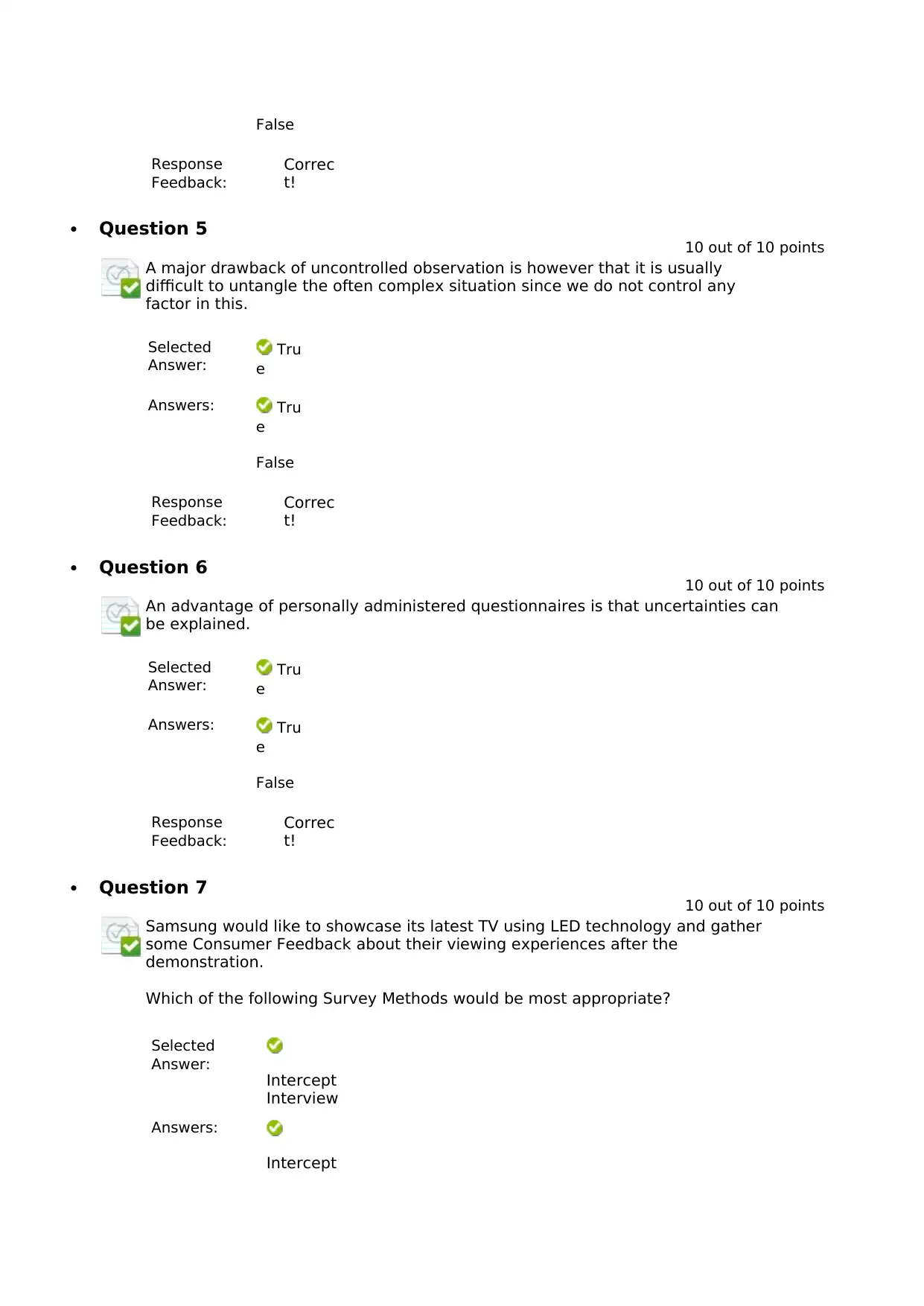
Question 5 10 out of 10 points
A major drawback of uncontrolled observation is however that it is usually
difficult to untangle the often complex situation since we do not control any
factor in this.
Selected
Answer:
Tru
e
Answers: Tru
e
False
Response
Feedback:
Correc
t!
Question 6 10 out of 10 points
An advantage of personally administered questionnaires is that uncertainties can
be explained.
Selected
Answer:
Tru
e
Answers: Tru
e
False
Response
Feedback:
Correc
t!
Question 7 10 out of 10 points
Samsung would like to showcase its latest TV using LED technology and gather
some Consumer Feedback about their viewing experiences after the
demonstration.
Which of the following Survey Methods would be most appropriate?
Selected
Answer:
Intercept
Interview
Answers:
Intercept
Response
Feedback:
Correc
t!
Question 5 10 out of 10 points
A major drawback of uncontrolled observation is however that it is usually
difficult to untangle the often complex situation since we do not control any
factor in this.
Selected
Answer:
Tru
e
Answers: Tru
e
False
Response
Feedback:
Correc
t!
Question 6 10 out of 10 points
An advantage of personally administered questionnaires is that uncertainties can
be explained.
Selected
Answer:
Tru
e
Answers: Tru
e
False
Response
Feedback:
Correc
t!
Question 7 10 out of 10 points
Samsung would like to showcase its latest TV using LED technology and gather
some Consumer Feedback about their viewing experiences after the
demonstration.
Which of the following Survey Methods would be most appropriate?
Selected
Answer:
Intercept
Interview
Answers:
Intercept
Paraphrase This Document
Need a fresh take? Get an instant paraphrase of this document with our AI Paraphraser

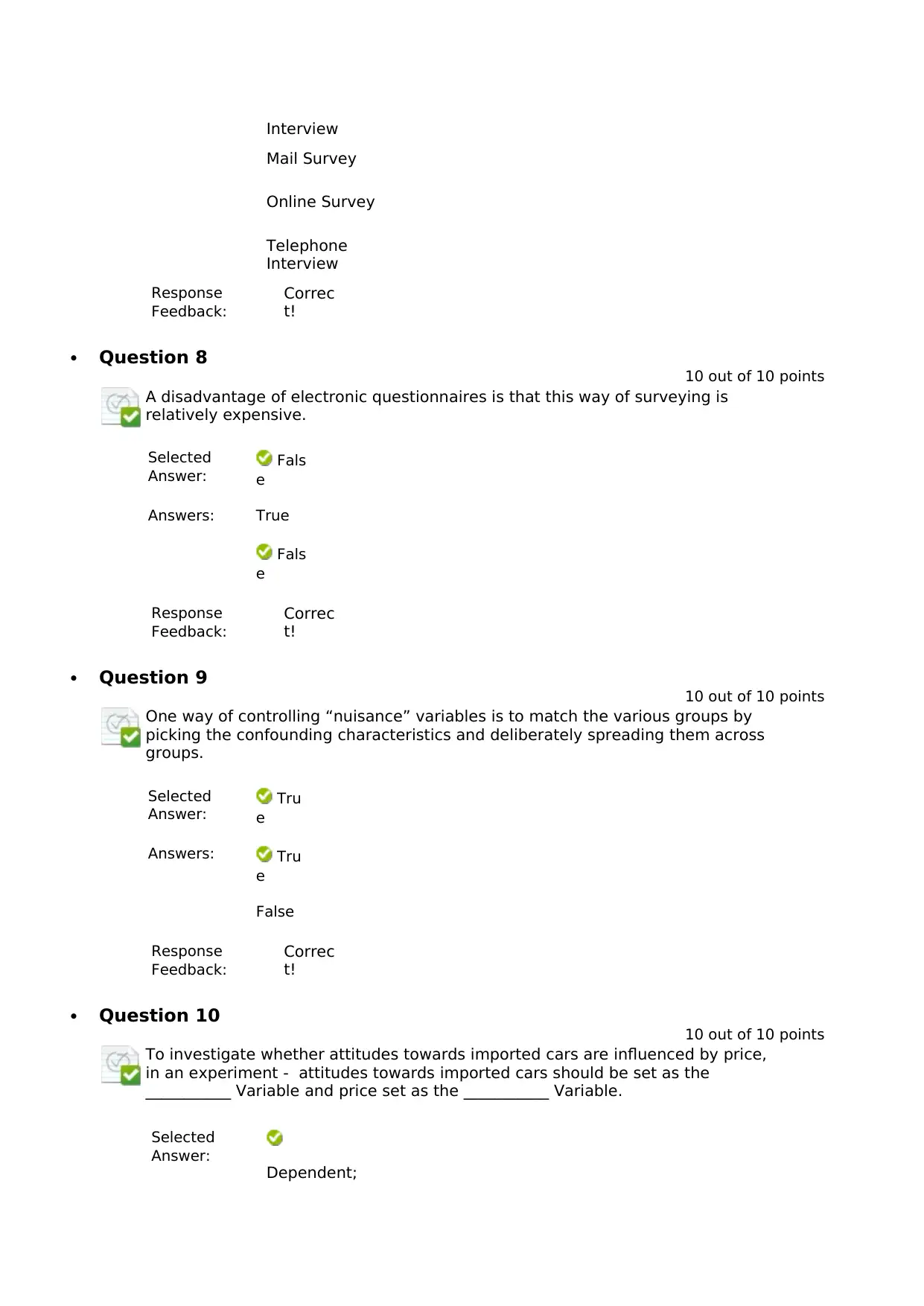
Interview
Mail Survey
Online Survey
Telephone
Interview
Response
Feedback:
Correc
t!
Question 8 10 out of 10 points
A disadvantage of electronic questionnaires is that this way of surveying is
relatively expensive.
Selected
Answer:
Fals
e
Answers: True
Fals
e
Response
Feedback:
Correc
t!
Question 9 10 out of 10 points
One way of controlling “nuisance” variables is to match the various groups by
picking the confounding characteristics and deliberately spreading them across
groups.
Selected
Answer:
Tru
e
Answers: Tru
e
False
Response
Feedback:
Correc
t!
Question 10 10 out of 10 points
To investigate whether attitudes towards imported cars are influenced by price,
in an experiment - attitudes towards imported cars should be set as the
___________ Variable and price set as the ___________ Variable.
Selected
Answer:
Dependent;
Mail Survey
Online Survey
Telephone
Interview
Response
Feedback:
Correc
t!
Question 8 10 out of 10 points
A disadvantage of electronic questionnaires is that this way of surveying is
relatively expensive.
Selected
Answer:
Fals
e
Answers: True
Fals
e
Response
Feedback:
Correc
t!
Question 9 10 out of 10 points
One way of controlling “nuisance” variables is to match the various groups by
picking the confounding characteristics and deliberately spreading them across
groups.
Selected
Answer:
Tru
e
Answers: Tru
e
False
Response
Feedback:
Correc
t!
Question 10 10 out of 10 points
To investigate whether attitudes towards imported cars are influenced by price,
in an experiment - attitudes towards imported cars should be set as the
___________ Variable and price set as the ___________ Variable.
Selected
Answer:
Dependent;

Independent
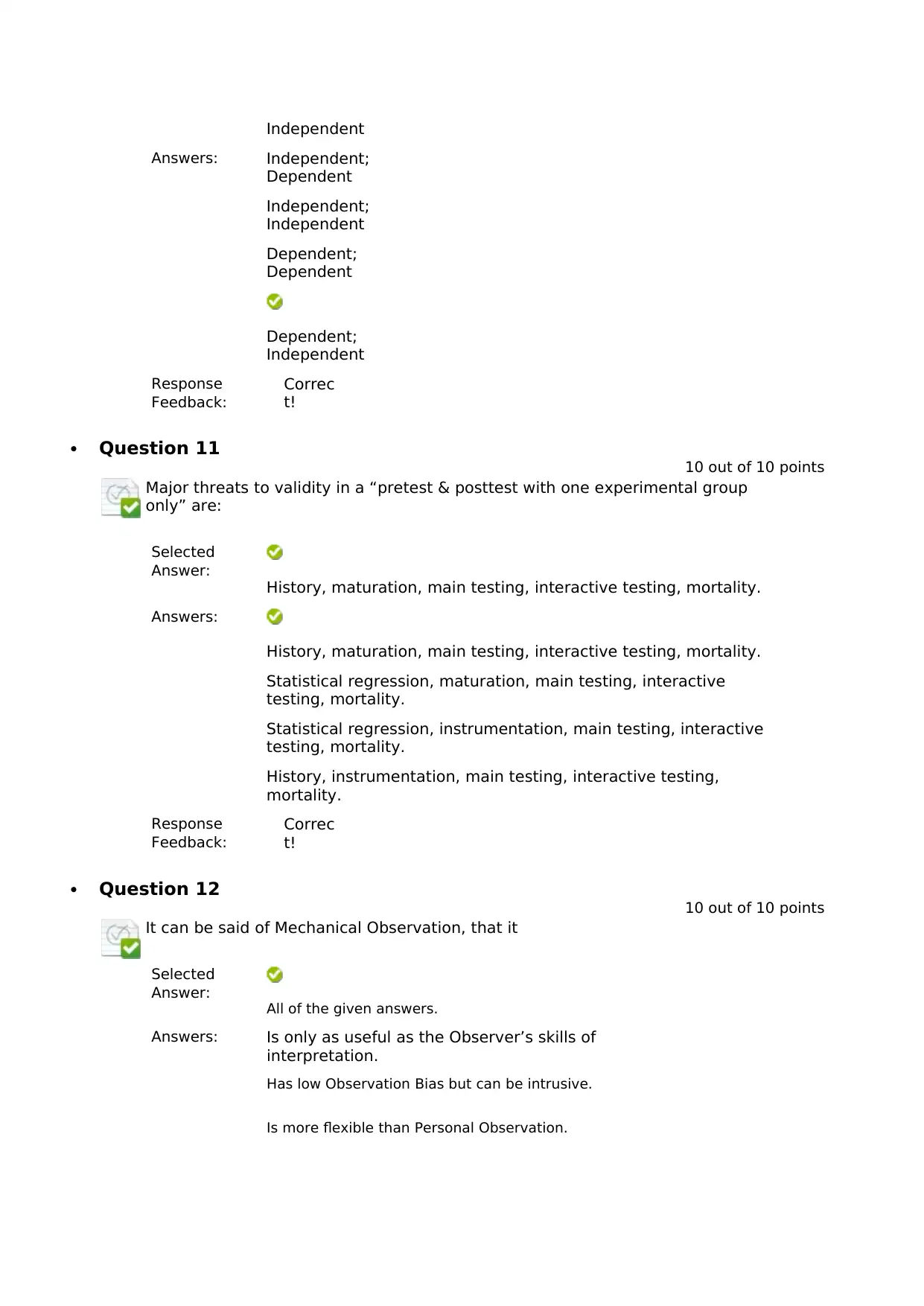
Answers: Independent;
Dependent
Independent;
Independent
Dependent;
Dependent
Dependent;
Independent
Response
Feedback:
Correc
t!
Question 11 10 out of 10 points
Major threats to validity in a “pretest & posttest with one experimental group
only” are:
Selected
Answer:
History, maturation, main testing, interactive testing, mortality.
Answers:
History, maturation, main testing, interactive testing, mortality.
Statistical regression, maturation, main testing, interactive
testing, mortality.
Statistical regression, instrumentation, main testing, interactive
testing, mortality.
History, instrumentation, main testing, interactive testing,
mortality.
Response
Feedback:
Correc
t!
Question 12 10 out of 10 points
It can be said of Mechanical Observation, that it
Selected
Answer:
All of the given answers.
Answers: Is only as useful as the Observer’s skills of
interpretation.
Has low Observation Bias but can be intrusive.
Is more flexible than Personal Observation.
Answers: Independent;
Dependent
Independent;
Independent
Dependent;
Dependent
Dependent;
Independent
Response
Feedback:
Correc
t!
Question 11 10 out of 10 points
Major threats to validity in a “pretest & posttest with one experimental group
only” are:
Selected
Answer:
History, maturation, main testing, interactive testing, mortality.
Answers:
History, maturation, main testing, interactive testing, mortality.
Statistical regression, maturation, main testing, interactive
testing, mortality.
Statistical regression, instrumentation, main testing, interactive
testing, mortality.
History, instrumentation, main testing, interactive testing,
mortality.
Response
Feedback:
Correc
t!
Question 12 10 out of 10 points
It can be said of Mechanical Observation, that it
Selected
Answer:
All of the given answers.
Answers: Is only as useful as the Observer’s skills of
interpretation.
Has low Observation Bias but can be intrusive.
Is more flexible than Personal Observation.
⊘ This is a preview!⊘
Do you want full access?
Subscribe today to unlock all pages.

Trusted by 1+ million students worldwide

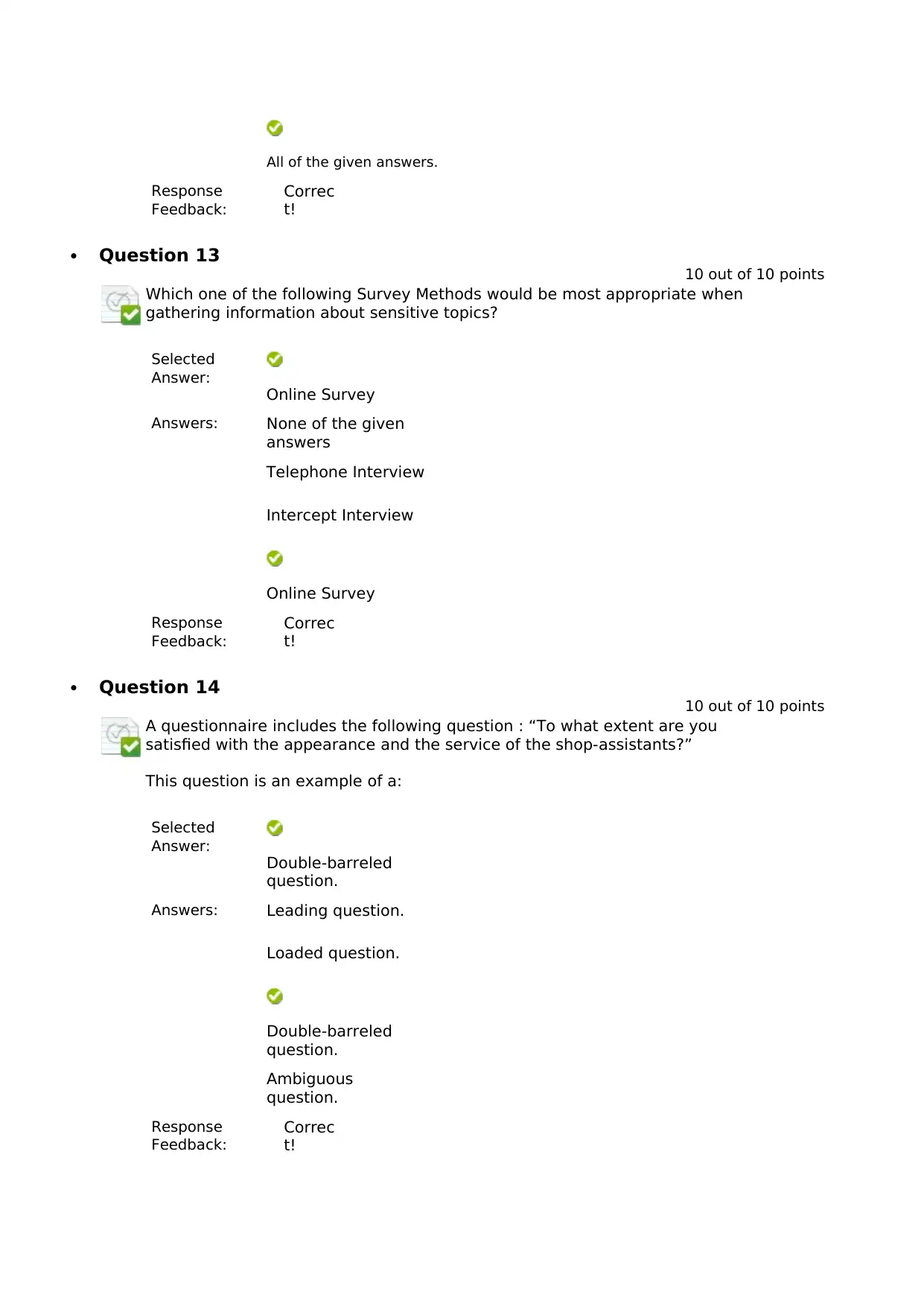
All of the given answers.
Response
Feedback:
Correc
t!
Question 13 10 out of 10 points
Which one of the following Survey Methods would be most appropriate when
gathering information about sensitive topics?
Selected
Answer:
Online Survey
Answers: None of the given
answers
Telephone Interview
Intercept Interview
Online Survey
Response
Feedback:
Correc
t!
Question 14 10 out of 10 points
A questionnaire includes the following question : “To what extent are you
satisfied with the appearance and the service of the shop-assistants?”
This question is an example of a:
Selected
Answer:
Double-barreled
question.
Answers: Leading question.
Loaded question.
Double-barreled
question.
Ambiguous
question.
Response
Feedback:
Correc
t!
Response
Feedback:
Correc
t!
Question 13 10 out of 10 points
Which one of the following Survey Methods would be most appropriate when
gathering information about sensitive topics?
Selected
Answer:
Online Survey
Answers: None of the given
answers
Telephone Interview
Intercept Interview
Online Survey
Response
Feedback:
Correc
t!
Question 14 10 out of 10 points
A questionnaire includes the following question : “To what extent are you
satisfied with the appearance and the service of the shop-assistants?”
This question is an example of a:
Selected
Answer:
Double-barreled
question.
Answers: Leading question.
Loaded question.
Double-barreled
question.
Ambiguous
question.
Response
Feedback:
Correc
t!
Paraphrase This Document
Need a fresh take? Get an instant paraphrase of this document with our AI Paraphraser

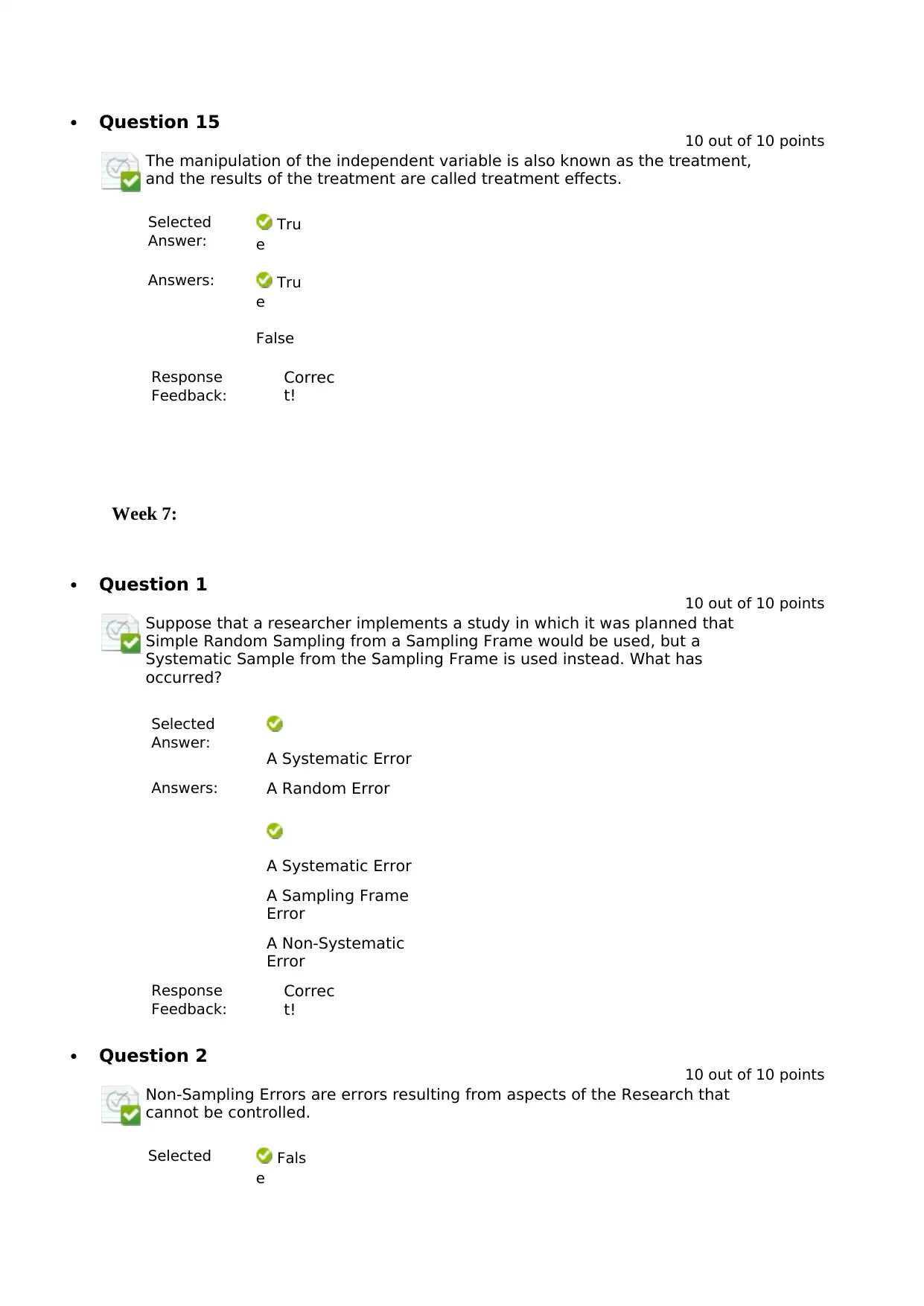
Question 15 10 out of 10 points
The manipulation of the independent variable is also known as the treatment,
and the results of the treatment are called treatment effects.
Selected
Answer:
Tru
e
Answers: Tru
e
False
Response
Feedback:
Correc
t!
Week 7:
Question 1 10 out of 10 points
Suppose that a researcher implements a study in which it was planned that
Simple Random Sampling from a Sampling Frame would be used, but a
Systematic Sample from the Sampling Frame is used instead. What has
occurred?
Selected
Answer:
A Systematic Error
Answers: A Random Error
A Systematic Error
A Sampling Frame
Error
A Non-Systematic
Error
Response
Feedback:
Correc
t!
Question 2 10 out of 10 points
Non-Sampling Errors are errors resulting from aspects of the Research that
cannot be controlled.
Selected Fals
e
The manipulation of the independent variable is also known as the treatment,
and the results of the treatment are called treatment effects.
Selected
Answer:
Tru
e
Answers: Tru
e
False
Response
Feedback:
Correc
t!
Week 7:
Question 1 10 out of 10 points
Suppose that a researcher implements a study in which it was planned that
Simple Random Sampling from a Sampling Frame would be used, but a
Systematic Sample from the Sampling Frame is used instead. What has
occurred?
Selected
Answer:
A Systematic Error
Answers: A Random Error
A Systematic Error
A Sampling Frame
Error
A Non-Systematic
Error
Response
Feedback:
Correc
t!
Question 2 10 out of 10 points
Non-Sampling Errors are errors resulting from aspects of the Research that
cannot be controlled.
Selected Fals
e

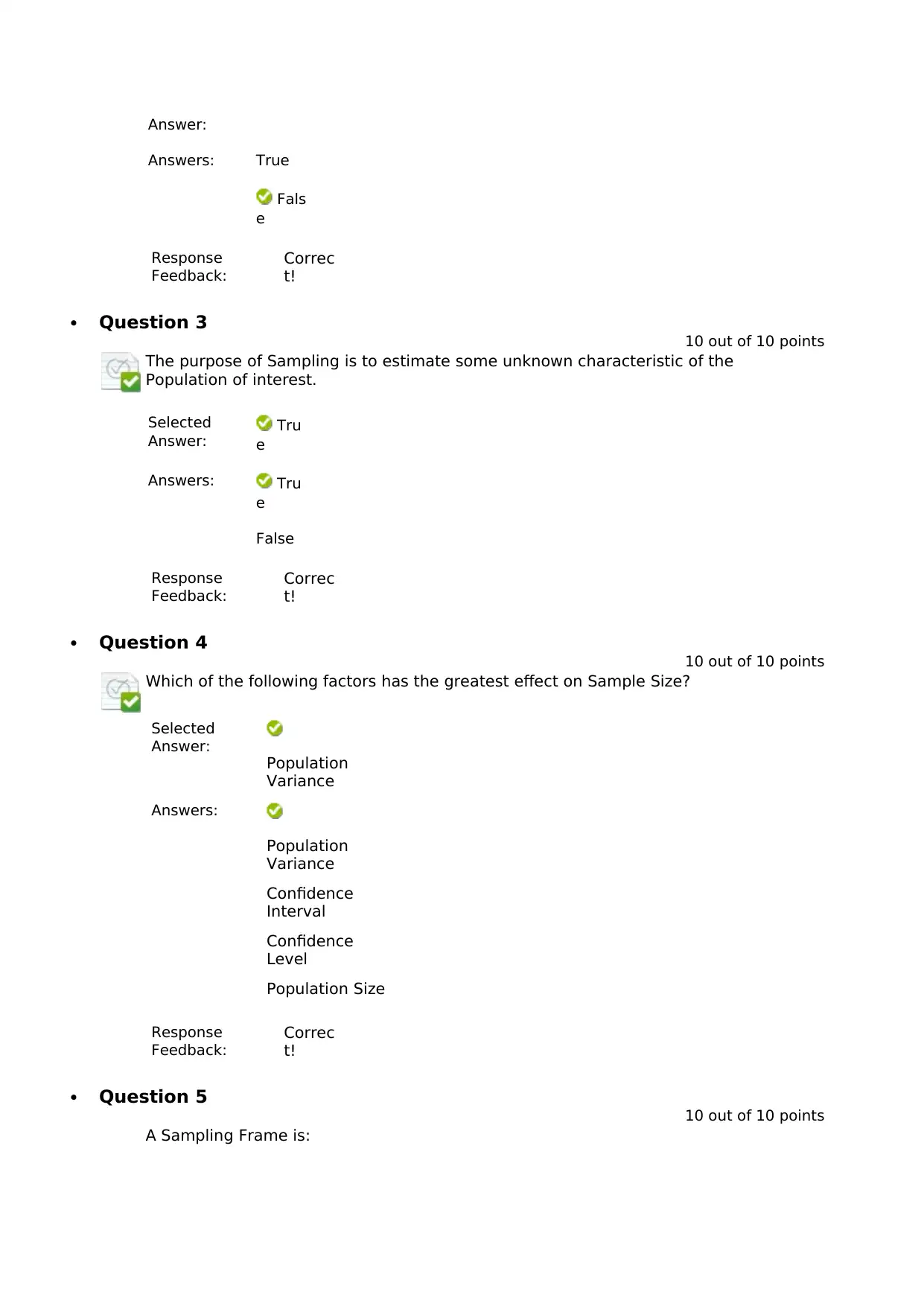
Answer:
Answers: True
Fals
e
Response
Feedback:
Correc
t!
Question 3 10 out of 10 points
The purpose of Sampling is to estimate some unknown characteristic of the
Population of interest.
Selected
Answer:
Tru
e
Answers: Tru
e
False
Response
Feedback:
Correc
t!
Question 4 10 out of 10 points
Which of the following factors has the greatest effect on Sample Size?
Selected
Answer:
Population
Variance
Answers:
Population
Variance
Confidence
Interval
Confidence
Level
Population Size
Response
Feedback:
Correc
t!
Question 5 10 out of 10 points
A Sampling Frame is:
Answers: True
Fals
e
Response
Feedback:
Correc
t!
Question 3 10 out of 10 points
The purpose of Sampling is to estimate some unknown characteristic of the
Population of interest.
Selected
Answer:
Tru
e
Answers: Tru
e
False
Response
Feedback:
Correc
t!
Question 4 10 out of 10 points
Which of the following factors has the greatest effect on Sample Size?
Selected
Answer:
Population
Variance
Answers:
Population
Variance
Confidence
Interval
Confidence
Level
Population Size
Response
Feedback:
Correc
t!
Question 5 10 out of 10 points
A Sampling Frame is:
⊘ This is a preview!⊘
Do you want full access?
Subscribe today to unlock all pages.

Trusted by 1+ million students worldwide
1 out of 27
Related Documents
Your All-in-One AI-Powered Toolkit for Academic Success.
+13062052269
info@desklib.com
Available 24*7 on WhatsApp / Email
Unlock your academic potential
Copyright © 2020–2026 A2Z Services. All Rights Reserved. Developed and managed by ZUCOL.