Statistics and Research Assignment - Statistical Test Analysis
VerifiedAdded on 2022/08/15
|7
|763
|12
Homework Assignment
AI Summary
This assignment solution addresses several statistical problems, identifying independent and dependent variables and the appropriate statistical tests to apply. The assignment covers a range of scenarios, including comparing safety performance between plants using t-tests, predicting flow rates using regression and correlation, analyzing cleaning product effectiveness with ANOVA, assessing DDT concentration using chi-square tests, evaluating the association between exposure methods and lead concentration using chi-square test, and analyzing the impact of scrubber technology on pollutant levels. The solution provides detailed explanations of the variables' formats (nominal, ordinal, and scale) and justifies the selection of specific statistical tests for each problem. The document also includes a bibliography of relevant statistical resources.
Running head: STATISTICS AND RESEARCH
Statistics and Research
Name of the Student:
Name of the University:
Author note:
Statistics and Research
Name of the Student:
Name of the University:
Author note:
Paraphrase This Document
Need a fresh take? Get an instant paraphrase of this document with our AI Paraphraser

1STATISTICS AND RESEARCH
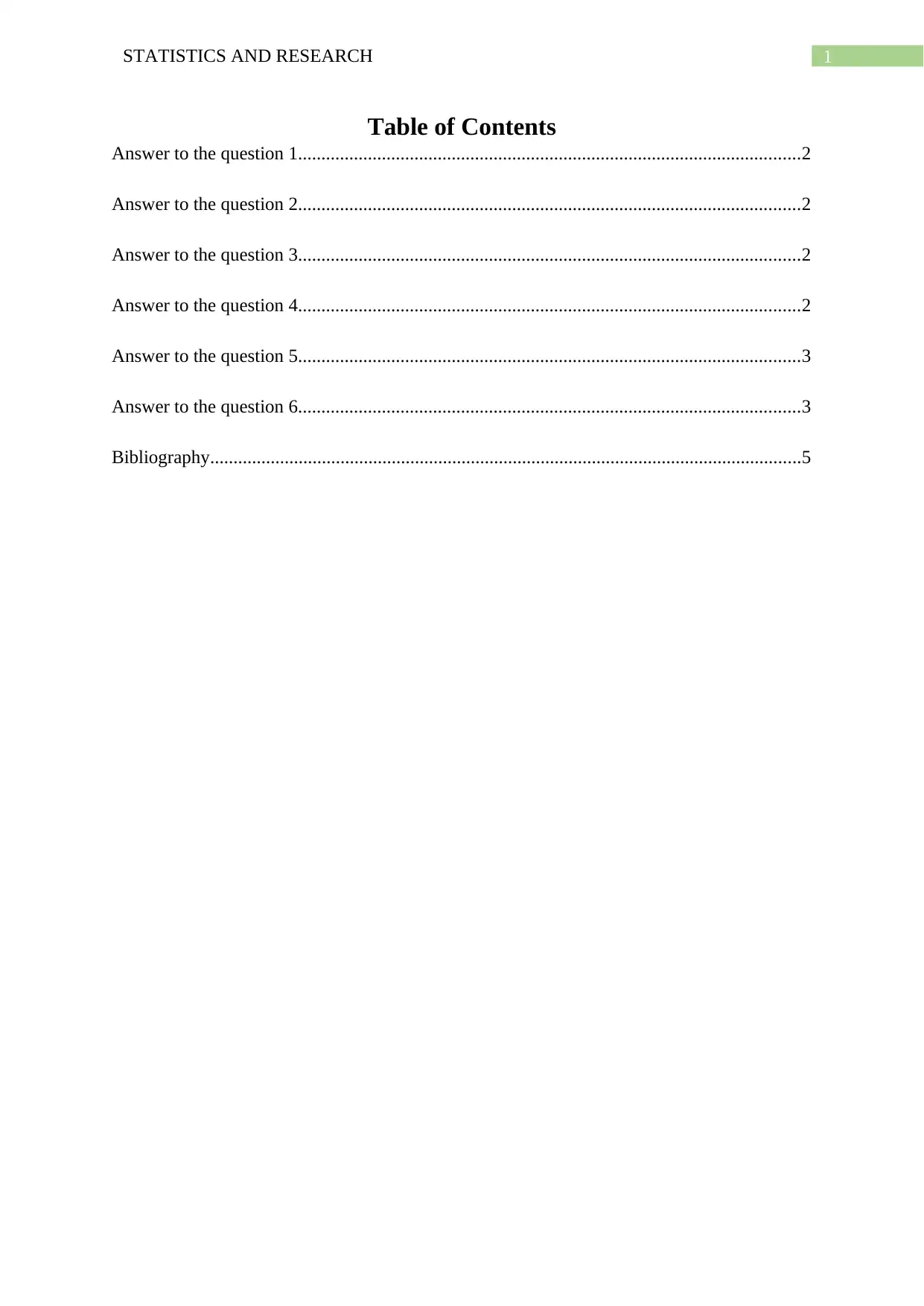
Table of Contents
Answer to the question 1............................................................................................................2
Answer to the question 2............................................................................................................2
Answer to the question 3............................................................................................................2
Answer to the question 4............................................................................................................2
Answer to the question 5............................................................................................................3
Answer to the question 6............................................................................................................3
Bibliography...............................................................................................................................5
Table of Contents
Answer to the question 1............................................................................................................2
Answer to the question 2............................................................................................................2
Answer to the question 3............................................................................................................2
Answer to the question 4............................................................................................................2
Answer to the question 5............................................................................................................3
Answer to the question 6............................................................................................................3
Bibliography...............................................................................................................................5

2STATISTICS AND RESEARCH
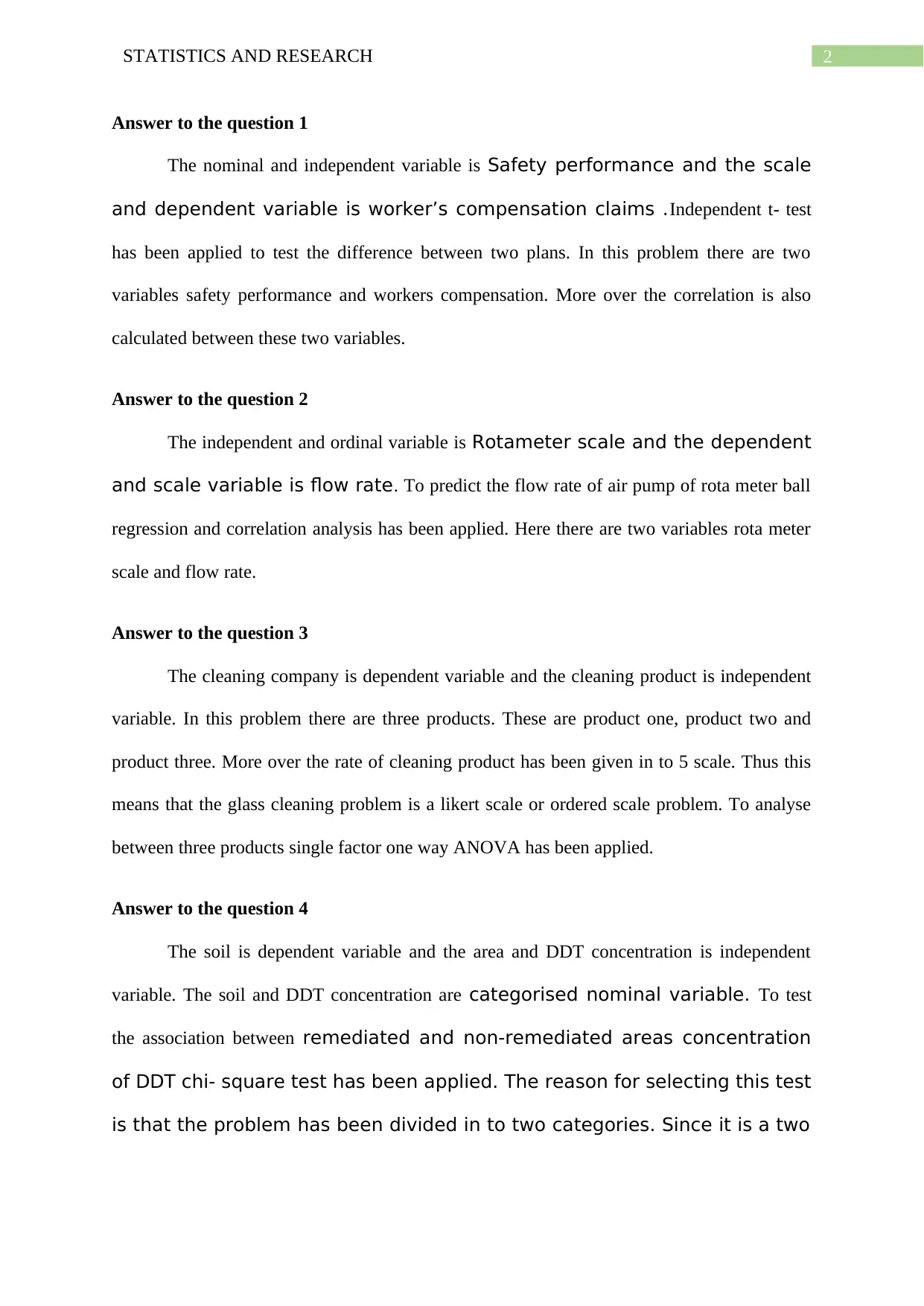
Answer to the question 1
The nominal and independent variable is Safety performance and the scale
and dependent variable is worker’s compensation claims .Independent t- test
has been applied to test the difference between two plans. In this problem there are two
variables safety performance and workers compensation. More over the correlation is also
calculated between these two variables.
Answer to the question 2
The independent and ordinal variable is Rotameter scale and the dependent
and scale variable is flow rate. To predict the flow rate of air pump of rota meter ball
regression and correlation analysis has been applied. Here there are two variables rota meter
scale and flow rate.
Answer to the question 3
The cleaning company is dependent variable and the cleaning product is independent
variable. In this problem there are three products. These are product one, product two and
product three. More over the rate of cleaning product has been given in to 5 scale. Thus this
means that the glass cleaning problem is a likert scale or ordered scale problem. To analyse
between three products single factor one way ANOVA has been applied.
Answer to the question 4
The soil is dependent variable and the area and DDT concentration is independent
variable. The soil and DDT concentration are categorised nominal variable. To test
the association between remediated and non-remediated areas concentration
of DDT chi- square test has been applied. The reason for selecting this test
is that the problem has been divided in to two categories. Since it is a two
Answer to the question 1
The nominal and independent variable is Safety performance and the scale
and dependent variable is worker’s compensation claims .Independent t- test
has been applied to test the difference between two plans. In this problem there are two
variables safety performance and workers compensation. More over the correlation is also
calculated between these two variables.
Answer to the question 2
The independent and ordinal variable is Rotameter scale and the dependent
and scale variable is flow rate. To predict the flow rate of air pump of rota meter ball
regression and correlation analysis has been applied. Here there are two variables rota meter
scale and flow rate.
Answer to the question 3
The cleaning company is dependent variable and the cleaning product is independent
variable. In this problem there are three products. These are product one, product two and
product three. More over the rate of cleaning product has been given in to 5 scale. Thus this
means that the glass cleaning problem is a likert scale or ordered scale problem. To analyse
between three products single factor one way ANOVA has been applied.
Answer to the question 4
The soil is dependent variable and the area and DDT concentration is independent
variable. The soil and DDT concentration are categorised nominal variable. To test
the association between remediated and non-remediated areas concentration
of DDT chi- square test has been applied. The reason for selecting this test
is that the problem has been divided in to two categories. Since it is a two
⊘ This is a preview!⊘
Do you want full access?
Subscribe today to unlock all pages.

Trusted by 1+ million students worldwide

3STATISTICS AND RESEARCH
way categorised nominal data problem. Hence the chi- square test is the
best test to determine the association of DDT concentration.
Remediated Non -remediated
Acceptable
Unacceptable
Table 1 Two way Chi- square table
When P-Value < alpha then the test is significant otherwise not.
Answer to the question 5
Exposure Method and time is independent nominal variable and
Lead concentration is dependent scale variable. To test the association between
exposure method and time of the day chi-square test has been applied. This is nominal
categorical data problem.
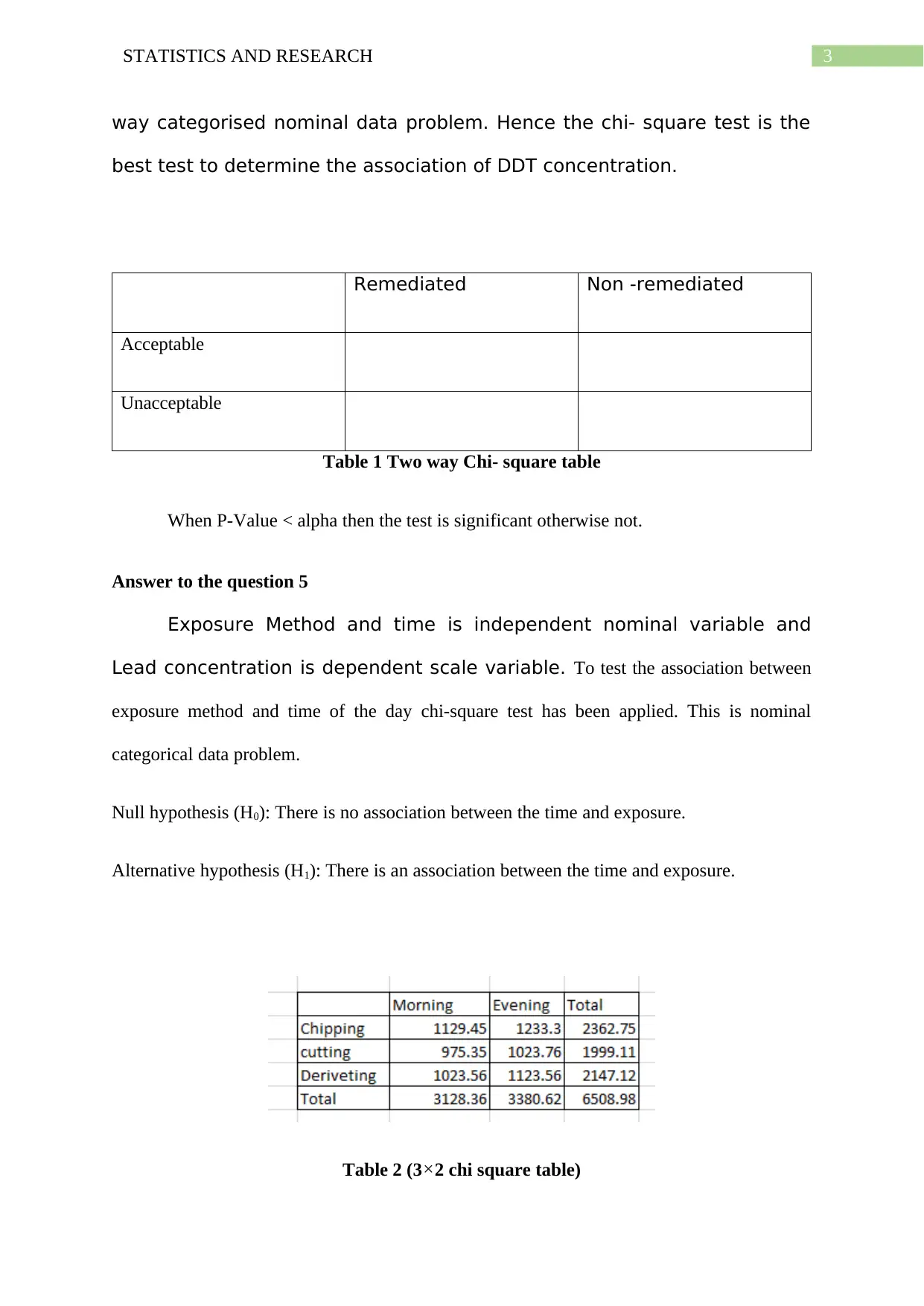
Null hypothesis (H0): There is no association between the time and exposure.
Alternative hypothesis (H1): There is an association between the time and exposure.
Table 2 (3×2 chi square table)
way categorised nominal data problem. Hence the chi- square test is the
best test to determine the association of DDT concentration.
Remediated Non -remediated
Acceptable
Unacceptable
Table 1 Two way Chi- square table
When P-Value < alpha then the test is significant otherwise not.
Answer to the question 5
Exposure Method and time is independent nominal variable and
Lead concentration is dependent scale variable. To test the association between
exposure method and time of the day chi-square test has been applied. This is nominal
categorical data problem.
Null hypothesis (H0): There is no association between the time and exposure.
Alternative hypothesis (H1): There is an association between the time and exposure.
Table 2 (3×2 chi square table)
Paraphrase This Document
Need a fresh take? Get an instant paraphrase of this document with our AI Paraphraser

4STATISTICS AND RESEARCH
Chi square test statistic = 0.62
P- Value =0.73
Degrees of freedom= 2
It has been seen P-Value > alpha (at 5%). Hence the null hypothesis of the test is not
significant. Therefore it may be summarised that there is no association between the time and
exposure.
Answer to the question 6
The scrubber technology is dependent variable and power and
pollutant is dependent variable. The power and pollutant are categorised
nominal variable. To test the association between the capacity and pollutants chi-
square test has been applied. The reason for selecting this test is that the
problem has been divided in to two categories. Since it is a two way
categorised nominal data problem. Hence the chi- square test is the best
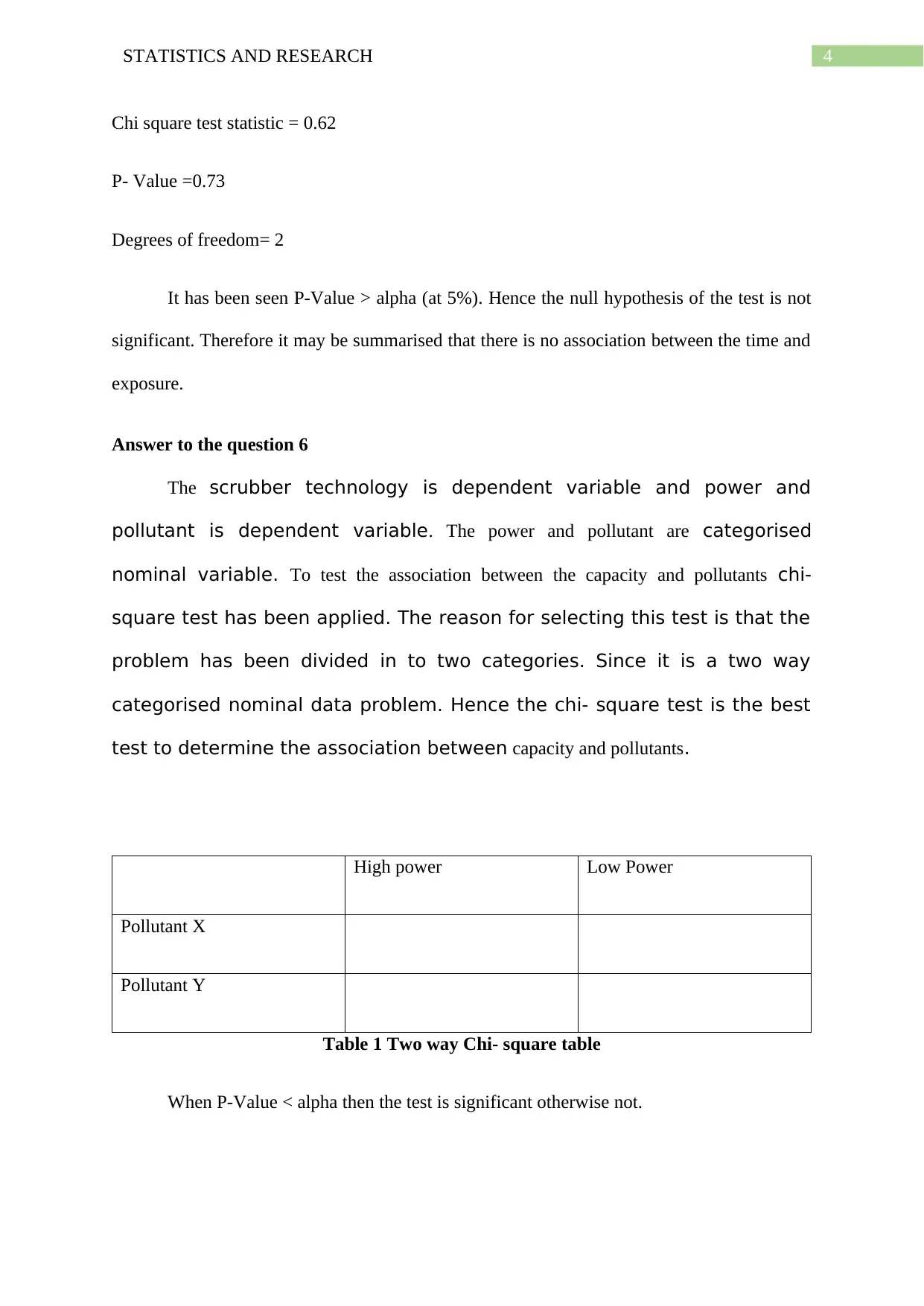
test to determine the association between capacity and pollutants.
High power Low Power
Pollutant X
Pollutant Y
Table 1 Two way Chi- square table
When P-Value < alpha then the test is significant otherwise not.
Chi square test statistic = 0.62
P- Value =0.73
Degrees of freedom= 2
It has been seen P-Value > alpha (at 5%). Hence the null hypothesis of the test is not
significant. Therefore it may be summarised that there is no association between the time and
exposure.
Answer to the question 6
The scrubber technology is dependent variable and power and
pollutant is dependent variable. The power and pollutant are categorised
nominal variable. To test the association between the capacity and pollutants chi-
square test has been applied. The reason for selecting this test is that the
problem has been divided in to two categories. Since it is a two way
categorised nominal data problem. Hence the chi- square test is the best
test to determine the association between capacity and pollutants.
High power Low Power
Pollutant X
Pollutant Y
Table 1 Two way Chi- square table
When P-Value < alpha then the test is significant otherwise not.

5STATISTICS AND RESEARCH
Bibliography
Cardinal, R. N., & Aitken, M. R. (2013). ANOVA for the behavioral sciences researcher.
Psychology Press.
De Winter, J. C. (2013). Using the Student's t-test with extremely small sample sizes.
Practical Assessment, Research, and Evaluation, 18(1), 10.
McHugh, M. L. (2013). The chi-square test of independence. Biochemia medica: Biochemia
medica, 23(2), 143-149.
Pandis, N. (2016). The chi-square test. American journal of orthodontics and dentofacial
orthopedics, 150(5), 898-899.
Bibliography
Cardinal, R. N., & Aitken, M. R. (2013). ANOVA for the behavioral sciences researcher.
Psychology Press.
De Winter, J. C. (2013). Using the Student's t-test with extremely small sample sizes.
Practical Assessment, Research, and Evaluation, 18(1), 10.
McHugh, M. L. (2013). The chi-square test of independence. Biochemia medica: Biochemia
medica, 23(2), 143-149.
Pandis, N. (2016). The chi-square test. American journal of orthodontics and dentofacial
orthopedics, 150(5), 898-899.
⊘ This is a preview!⊘
Do you want full access?
Subscribe today to unlock all pages.

Trusted by 1+ million students worldwide

6STATISTICS AND RESEARCH
1 out of 7
Related Documents
Your All-in-One AI-Powered Toolkit for Academic Success.
+13062052269
info@desklib.com
Available 24*7 on WhatsApp / Email
Unlock your academic potential
Copyright © 2020–2025 A2Z Services. All Rights Reserved. Developed and managed by ZUCOL.