Organisational Behaviour: Stereotyping, Impact & Interventions
VerifiedAdded on 2023/06/12
|7
|2002
|53
Essay
AI Summary
This essay delves into the concept of stereotyping within organisational behaviour, highlighting its potential inaccuracies and negative impacts on workplace dynamics. It examines how stereotypes, influenced by factors like ethnicity, race, and gender, can affect employee morale, teamwork, and overall organisational performance. The essay further explores organisational development interventions designed to improve organisational performance and culture, including individual, team, intergroup, and total organisational level interventions. It concludes that while stereotyping might be perceived as essential in certain situations, it can be a silent destroyer of productivity and that judging individuals based on preconceived notions is detrimental to a healthy work environment. The essay advocates for a non-discriminatory workplace that values individual differences and focuses on competence and performance.
Running head: ORGANISATIONAL BEHAVIOUR
Organisational Behaviour
Name of Student:
Name of University:
Author’s Note:
Organisational Behaviour
Name of Student:
Name of University:
Author’s Note:
Paraphrase This Document
Need a fresh take? Get an instant paraphrase of this document with our AI Paraphraser

1ORGANISATIONAL BEHAVIOUR
The concept of stereotyping can be stated as, “Stereotype is a means of simplifying the
process of simplifying the process of perception and making judgements of other people instead
of dealing with a range of complex and alternative stimuli.” It can on the other hand be stated
that trusting stereotypes a lot might have a chance of leading to certain inaccuracies,
overestimation or underestimation in different organisational situations.
Stereotypes are basically static as well as oversimplified ideas regarding a group or social
category which strongly impact the expectations and behaviours of certain specific categories.
Stereotyping does not actually symbolize an abnormality in the human social behaviours and
standards as there is an observed predisposition regarding the recognition of social and physical
differences in others. It is usually stated that it is human nature for people to form opinions about
others based on no prior knowledge about them. Personal ideas and expectations about people
are so much that it is believed that are already formulations regarding the characteristics of the
specific persons (Rattan 2018).
In this connection stereotypes can be considered, where it is actually the procedure of
obtaining information regarding the world around and making proper sense of it. It is basically
involved with the decision regarding which information to observe and which to sort out that
information and the way in which it can be interpreted within the framework of our existing
knowledge, where there are shaping of opinions, decisions and actions. It can be defined as a
cognitive procedure by which a person selects, organise and interprets stimuli into information
which is meaningful and is connected to their environment. Perception therefore has a direct
connection with the mindset and the prior understanding of the individuals (Kalokerinos, von
Hippel and Zacher 2014).
It is seen that stereotypes occur at times when an individual is stereotyped depending on
the group to which he or she belongs. Specifically when it concerns work, at times it is seen that
for the effective interaction, there needs to be a proper supposition of what a particular person is
likely to think and what the specific behaviours acceptable to them are. Stereotyping helps in this
particular respect because at office there needs to be an idea as to what the other party is going to
think. This idea is important in case of official negotiations and making or breaking deals in the
workplace. Several managers also consider stereotyping to be important at the workplace. It is
always better to make a certain percentage of background check on a particular individual to
The concept of stereotyping can be stated as, “Stereotype is a means of simplifying the
process of simplifying the process of perception and making judgements of other people instead
of dealing with a range of complex and alternative stimuli.” It can on the other hand be stated
that trusting stereotypes a lot might have a chance of leading to certain inaccuracies,
overestimation or underestimation in different organisational situations.
Stereotypes are basically static as well as oversimplified ideas regarding a group or social
category which strongly impact the expectations and behaviours of certain specific categories.
Stereotyping does not actually symbolize an abnormality in the human social behaviours and
standards as there is an observed predisposition regarding the recognition of social and physical
differences in others. It is usually stated that it is human nature for people to form opinions about
others based on no prior knowledge about them. Personal ideas and expectations about people
are so much that it is believed that are already formulations regarding the characteristics of the
specific persons (Rattan 2018).
In this connection stereotypes can be considered, where it is actually the procedure of
obtaining information regarding the world around and making proper sense of it. It is basically
involved with the decision regarding which information to observe and which to sort out that
information and the way in which it can be interpreted within the framework of our existing
knowledge, where there are shaping of opinions, decisions and actions. It can be defined as a
cognitive procedure by which a person selects, organise and interprets stimuli into information
which is meaningful and is connected to their environment. Perception therefore has a direct
connection with the mindset and the prior understanding of the individuals (Kalokerinos, von
Hippel and Zacher 2014).
It is seen that stereotypes occur at times when an individual is stereotyped depending on
the group to which he or she belongs. Specifically when it concerns work, at times it is seen that
for the effective interaction, there needs to be a proper supposition of what a particular person is
likely to think and what the specific behaviours acceptable to them are. Stereotyping helps in this
particular respect because at office there needs to be an idea as to what the other party is going to
think. This idea is important in case of official negotiations and making or breaking deals in the
workplace. Several managers also consider stereotyping to be important at the workplace. It is
always better to make a certain percentage of background check on a particular individual to

2ORGANISATIONAL BEHAVIOUR
gather information about the culture of a person and to ensure whether the person likes a
particular cultural profile or not. Having prior information about the managers a person is going
to meet is always beneficial and makes a person better equipped to handle meetings with the
person. In such cases stereotyping becomes necessary to make an idea about the person with
whom the meeting is going to be made.
There are stereotypes regarding a number of perceptions namely social perceptions,
cultural and ethical concerns. Stereotyping might be positive with regard to certain aspects but it
also is responsible for affecting the environment of the workplace. This is because of the fact that
the concept of stereotyping might be responsible for the treatment of individuals in a particular
way which is based on the pre-conceived ideas or considerations about a particular person or
group. There are several factors of diversity including “ethnicity, race, culture, religion, age and
gender” which all contribute to the “propensity of stereotyping” a particular organisation.
Therefore it is essential to promote a non-discriminatory workplace with a certain openness and
acceptance of individual differences. This assists the prevention of common negative effects
(Jost 2013).
In case there is either active or passive stereotyping, the workplace becomes a place for
probable abuse and mistreatment. Employees who have professional notions about people need
to test the situations which are important for basic comments and actions. In case the employees
sense a certain cultural discrepancy in the procedures this might correspond to problems in the
workplace.
Another problem which arises as an effect of stereotyping is the low level of morale for
individuals or potentially cause the workplace to become problematic. Employees who face
“continuous comments, criticisms or other negative results” can experience a” loss of motivation
and interest” in performing their jobs. Low morale is responsible for indirectly affecting workers
and departments which are not involved with stereotyping of behaviours (Dipboye and Colella
2013).
There are several work scenarios which need team work and collaboration for the success
of the company. In such scenarios, stereotyping is a major problem as this might cause
preconceived notions to arise. Employees who consider stereotypes instead of having faith in the
gather information about the culture of a person and to ensure whether the person likes a
particular cultural profile or not. Having prior information about the managers a person is going
to meet is always beneficial and makes a person better equipped to handle meetings with the
person. In such cases stereotyping becomes necessary to make an idea about the person with
whom the meeting is going to be made.
There are stereotypes regarding a number of perceptions namely social perceptions,
cultural and ethical concerns. Stereotyping might be positive with regard to certain aspects but it
also is responsible for affecting the environment of the workplace. This is because of the fact that
the concept of stereotyping might be responsible for the treatment of individuals in a particular
way which is based on the pre-conceived ideas or considerations about a particular person or
group. There are several factors of diversity including “ethnicity, race, culture, religion, age and
gender” which all contribute to the “propensity of stereotyping” a particular organisation.
Therefore it is essential to promote a non-discriminatory workplace with a certain openness and
acceptance of individual differences. This assists the prevention of common negative effects
(Jost 2013).
In case there is either active or passive stereotyping, the workplace becomes a place for
probable abuse and mistreatment. Employees who have professional notions about people need
to test the situations which are important for basic comments and actions. In case the employees
sense a certain cultural discrepancy in the procedures this might correspond to problems in the
workplace.
Another problem which arises as an effect of stereotyping is the low level of morale for
individuals or potentially cause the workplace to become problematic. Employees who face
“continuous comments, criticisms or other negative results” can experience a” loss of motivation
and interest” in performing their jobs. Low morale is responsible for indirectly affecting workers
and departments which are not involved with stereotyping of behaviours (Dipboye and Colella
2013).
There are several work scenarios which need team work and collaboration for the success
of the company. In such scenarios, stereotyping is a major problem as this might cause
preconceived notions to arise. Employees who consider stereotypes instead of having faith in the
⊘ This is a preview!⊘
Do you want full access?
Subscribe today to unlock all pages.

Trusted by 1+ million students worldwide

3ORGANISATIONAL BEHAVIOUR
capabilities and efforts of group workers, can cause problems in the group progress. This can
hamper the working condition of the employees. There might be problems in asking employees
for groups and so on. In case people assume that a person cannot do a particular task without
even approaching that person, it might cause them to not approach the person at all.
There might also be problems in case of allowance or acceptance of a person which can
result in behaviours which can cause serious issues within the organisation. Some people can
also be harmed by discriminatory behaviours and can sue them as well. In case there is a human
resources department, there might be a failure in implementing and enforcing proper policies and
practices which is a burden for the HR staff and other people as well. There might be lawsuits
which might be responsible for ruining a specific business.
Organisational development interventions comprise of several actions, activities and
events which are used for the improvement of organisational performance. There also needs to
be a proper improvement of organisational culture. There are different aspects of organisational
functions which comprise of individual, group and organisation as a whole. There are several
interventions which have the capability of impacting the individuals working in an organisation
where as some might affect the entire organisation. There are different types of interventions
which are noticeable in organisations which might be “individual or interpersonal interventions”,
“team or group level interventions”, “intergroup level interventions” and “total organisational
level interventions” (Wagner and Hollenbeck 2014).
The concept of interpersonal level interventions comprises of a direct intervention or
stress management. It is basically a sort of face to face or one-to-one interaction between the
specific consultant and their clients. There are also stress management programs which are a part
of employee assistance programs which are useful to help employees in the identification of their
stress level and this can cause them to work at peace in their workplace as they might not have
all conditions conducive for working there (Borkowski 2015).
The team or group level interventions comprise of those intervention which are
applicable at the group level or even at the organisational level for that particular consideration.
There need to be certain specific interventions for the team or group level which might focus on
the synergy of the team or group. There are several stages of the survey feedback which
capabilities and efforts of group workers, can cause problems in the group progress. This can
hamper the working condition of the employees. There might be problems in asking employees
for groups and so on. In case people assume that a person cannot do a particular task without
even approaching that person, it might cause them to not approach the person at all.
There might also be problems in case of allowance or acceptance of a person which can
result in behaviours which can cause serious issues within the organisation. Some people can
also be harmed by discriminatory behaviours and can sue them as well. In case there is a human
resources department, there might be a failure in implementing and enforcing proper policies and
practices which is a burden for the HR staff and other people as well. There might be lawsuits
which might be responsible for ruining a specific business.
Organisational development interventions comprise of several actions, activities and
events which are used for the improvement of organisational performance. There also needs to
be a proper improvement of organisational culture. There are different aspects of organisational
functions which comprise of individual, group and organisation as a whole. There are several
interventions which have the capability of impacting the individuals working in an organisation
where as some might affect the entire organisation. There are different types of interventions
which are noticeable in organisations which might be “individual or interpersonal interventions”,
“team or group level interventions”, “intergroup level interventions” and “total organisational
level interventions” (Wagner and Hollenbeck 2014).
The concept of interpersonal level interventions comprises of a direct intervention or
stress management. It is basically a sort of face to face or one-to-one interaction between the
specific consultant and their clients. There are also stress management programs which are a part
of employee assistance programs which are useful to help employees in the identification of their
stress level and this can cause them to work at peace in their workplace as they might not have
all conditions conducive for working there (Borkowski 2015).
The team or group level interventions comprise of those intervention which are
applicable at the group level or even at the organisational level for that particular consideration.
There need to be certain specific interventions for the team or group level which might focus on
the synergy of the team or group. There are several stages of the survey feedback which
Paraphrase This Document
Need a fresh take? Get an instant paraphrase of this document with our AI Paraphraser

4ORGANISATIONAL BEHAVIOUR
comprises of data collection, feedback of information and follow up action. This is because of
the reason that there might be instances where employees might be facing issues in their place of
work which they might solve at a later date. Their problems are noted and possible modes of
action are selected for the same.
Intergroup level interventions, is basically aimed at the identification and the diagnosis of
inter-group relations as one groups works with other groups for the identification of the goals of
the organisations. The third party interventions involve the influence of mediation to solve the
problems of different organisations. This is aimed at achievement of a sense of peace in all
workplace scenarios. This is not possible to be achieved in case there are existent stereotypes in a
particular organisation (Hogg and Terry 2014).
“Total organisational level interventions” involve grid training, confrontational meetings,
re-engineering technology of organisational structures and so on. These inventions not only
target individuals but also the organisation as a whole. In certain cases there are organisational
confrontation meetings which are arranged at times the organisations are facing any sort of
negative traumatic issues in the organisation.
All in all it can be said that the given statement has both positives and negatives to it.
Stereotyping might be essential under certain selective circumstances where people need to act
according to the needs and requirements of the people around them. However, it is believed that
workplace stereotyping is a silent destroyer of productivity. This is because of the reason that
there is bound to be diversity in the workplace but judging people on the basis of such reasons,
their backgrounds or culture is not really right. The concept of stereotyping might put a lot of
labels on people who work in companies unnecessarily. Therefore it is desirable that people
should not be judged before their competence and performances are analysed. There might be
instances where problems might arise due to differences of culture or issues of change in origin,
but it is not right to judge all individuals in a similar manner.
comprises of data collection, feedback of information and follow up action. This is because of
the reason that there might be instances where employees might be facing issues in their place of
work which they might solve at a later date. Their problems are noted and possible modes of
action are selected for the same.
Intergroup level interventions, is basically aimed at the identification and the diagnosis of
inter-group relations as one groups works with other groups for the identification of the goals of
the organisations. The third party interventions involve the influence of mediation to solve the
problems of different organisations. This is aimed at achievement of a sense of peace in all
workplace scenarios. This is not possible to be achieved in case there are existent stereotypes in a
particular organisation (Hogg and Terry 2014).
“Total organisational level interventions” involve grid training, confrontational meetings,
re-engineering technology of organisational structures and so on. These inventions not only
target individuals but also the organisation as a whole. In certain cases there are organisational
confrontation meetings which are arranged at times the organisations are facing any sort of
negative traumatic issues in the organisation.
All in all it can be said that the given statement has both positives and negatives to it.
Stereotyping might be essential under certain selective circumstances where people need to act
according to the needs and requirements of the people around them. However, it is believed that
workplace stereotyping is a silent destroyer of productivity. This is because of the reason that
there is bound to be diversity in the workplace but judging people on the basis of such reasons,
their backgrounds or culture is not really right. The concept of stereotyping might put a lot of
labels on people who work in companies unnecessarily. Therefore it is desirable that people
should not be judged before their competence and performances are analysed. There might be
instances where problems might arise due to differences of culture or issues of change in origin,
but it is not right to judge all individuals in a similar manner.

5ORGANISATIONAL BEHAVIOUR
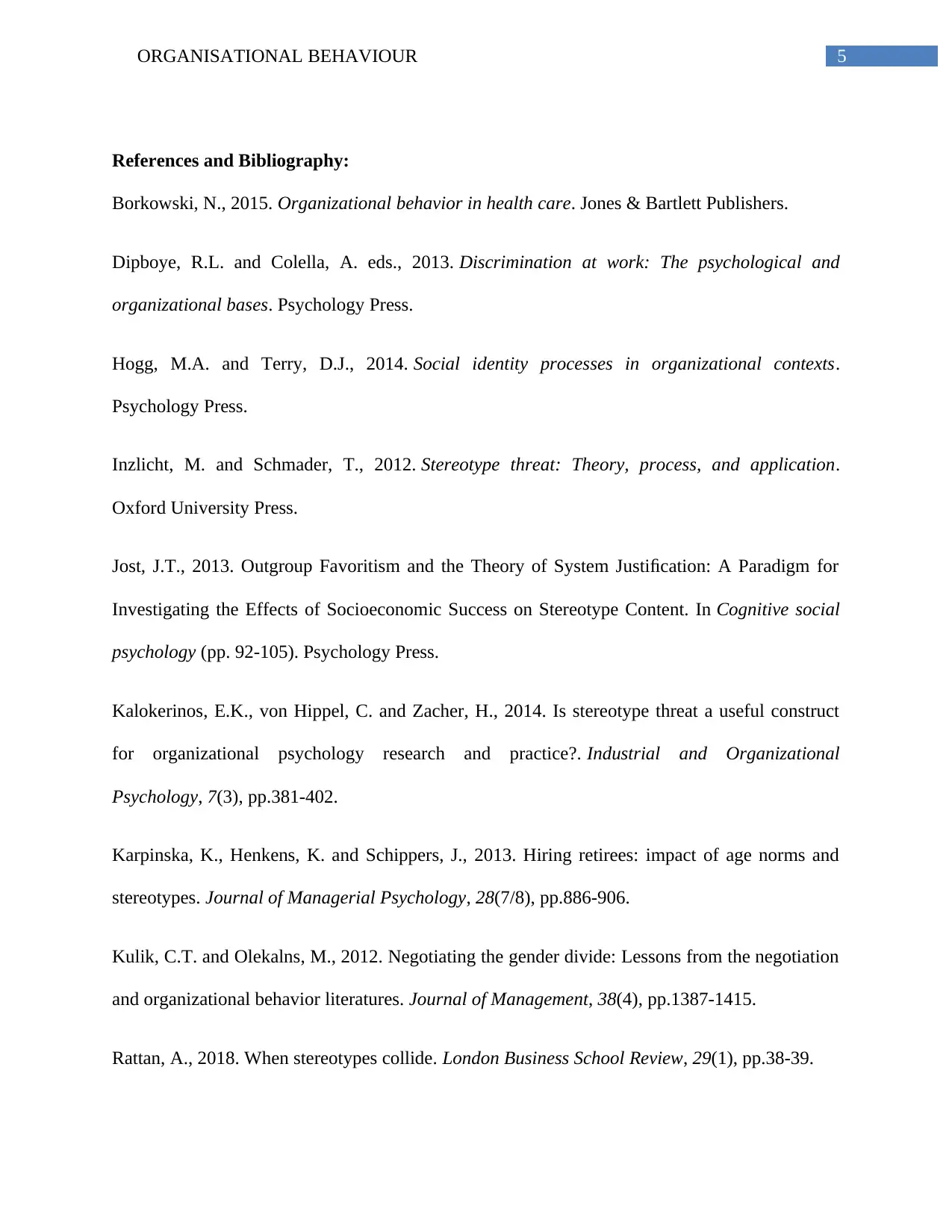
References and Bibliography:
Borkowski, N., 2015. Organizational behavior in health care. Jones & Bartlett Publishers.
Dipboye, R.L. and Colella, A. eds., 2013. Discrimination at work: The psychological and
organizational bases. Psychology Press.
Hogg, M.A. and Terry, D.J., 2014. Social identity processes in organizational contexts.
Psychology Press.
Inzlicht, M. and Schmader, T., 2012. Stereotype threat: Theory, process, and application.
Oxford University Press.
Jost, J.T., 2013. Outgroup Favoritism and the Theory of System Justification: A Paradigm for
Investigating the Effects of Socioeconomic Success on Stereotype Content. In Cognitive social
psychology (pp. 92-105). Psychology Press.
Kalokerinos, E.K., von Hippel, C. and Zacher, H., 2014. Is stereotype threat a useful construct
for organizational psychology research and practice?. Industrial and Organizational
Psychology, 7(3), pp.381-402.
Karpinska, K., Henkens, K. and Schippers, J., 2013. Hiring retirees: impact of age norms and
stereotypes. Journal of Managerial Psychology, 28(7/8), pp.886-906.
Kulik, C.T. and Olekalns, M., 2012. Negotiating the gender divide: Lessons from the negotiation
and organizational behavior literatures. Journal of Management, 38(4), pp.1387-1415.
Rattan, A., 2018. When stereotypes collide. London Business School Review, 29(1), pp.38-39.
References and Bibliography:
Borkowski, N., 2015. Organizational behavior in health care. Jones & Bartlett Publishers.
Dipboye, R.L. and Colella, A. eds., 2013. Discrimination at work: The psychological and
organizational bases. Psychology Press.
Hogg, M.A. and Terry, D.J., 2014. Social identity processes in organizational contexts.
Psychology Press.
Inzlicht, M. and Schmader, T., 2012. Stereotype threat: Theory, process, and application.
Oxford University Press.
Jost, J.T., 2013. Outgroup Favoritism and the Theory of System Justification: A Paradigm for
Investigating the Effects of Socioeconomic Success on Stereotype Content. In Cognitive social
psychology (pp. 92-105). Psychology Press.
Kalokerinos, E.K., von Hippel, C. and Zacher, H., 2014. Is stereotype threat a useful construct
for organizational psychology research and practice?. Industrial and Organizational
Psychology, 7(3), pp.381-402.
Karpinska, K., Henkens, K. and Schippers, J., 2013. Hiring retirees: impact of age norms and
stereotypes. Journal of Managerial Psychology, 28(7/8), pp.886-906.
Kulik, C.T. and Olekalns, M., 2012. Negotiating the gender divide: Lessons from the negotiation
and organizational behavior literatures. Journal of Management, 38(4), pp.1387-1415.
Rattan, A., 2018. When stereotypes collide. London Business School Review, 29(1), pp.38-39.
⊘ This is a preview!⊘
Do you want full access?
Subscribe today to unlock all pages.

Trusted by 1+ million students worldwide

6ORGANISATIONAL BEHAVIOUR
Wagner III, J.A. and Hollenbeck, J.R., 2014. Organizational behavior: Securing competitive
advantage. Routledge.
Wagner III, J.A. and Hollenbeck, J.R., 2014. Organizational behavior: Securing competitive
advantage. Routledge.
1 out of 7
Related Documents
Your All-in-One AI-Powered Toolkit for Academic Success.
+13062052269
info@desklib.com
Available 24*7 on WhatsApp / Email
Unlock your academic potential
Copyright © 2020–2025 A2Z Services. All Rights Reserved. Developed and managed by ZUCOL.