Essay on the Themes and Literary Devices in 'Not Waving but Drowning'
VerifiedAdded on 2022/08/22
|10
|2816
|45
Essay
AI Summary
This essay provides a detailed explication of Stevie Smith's poem, "Not Waving but Drowning." It delves into the poem's themes of death, miscommunication, and the speaker's isolation, analyzing the use of literary devices such as imagery, consonance, and irony to convey these ideas. The essay examines the poem's structure, including its quatrain stanzas and the recurring line, "And not waving but drowning," to highlight the sense of refrain and the poem's overall message. Furthermore, it explores the biographical context of Smith's life, referencing her early life experiences to provide a deeper understanding of her work, while also critiquing the notion that an author's work should be solely based on their life experiences. The analysis also contrasts Smith's work with that of Sylvia Plath and Emily Dickinson, highlighting the unique perspectives on death that each poet brings. The essay concludes by emphasizing Smith's exploration of themes of self-rule and the freedom of choice. The essay also touches upon the accompanying doodles to the poem, the Deleuzian deterritorialization, and the role of the author's voice.
Running Head: ESSAY ON EXPLICATION OF NOT WAVING BUT DROWNING
Essay on explication of Not Waving but Drowning
Name of the Student:
Name of the University:
Author Note:
Essay on explication of Not Waving but Drowning
Name of the Student:
Name of the University:
Author Note:

Paraphrase This Document
Need a fresh take? Get an instant paraphrase of this document with our AI Paraphraser
1ESSAY ON EXPLICATION OF NOT WAVING BUT DROWNING
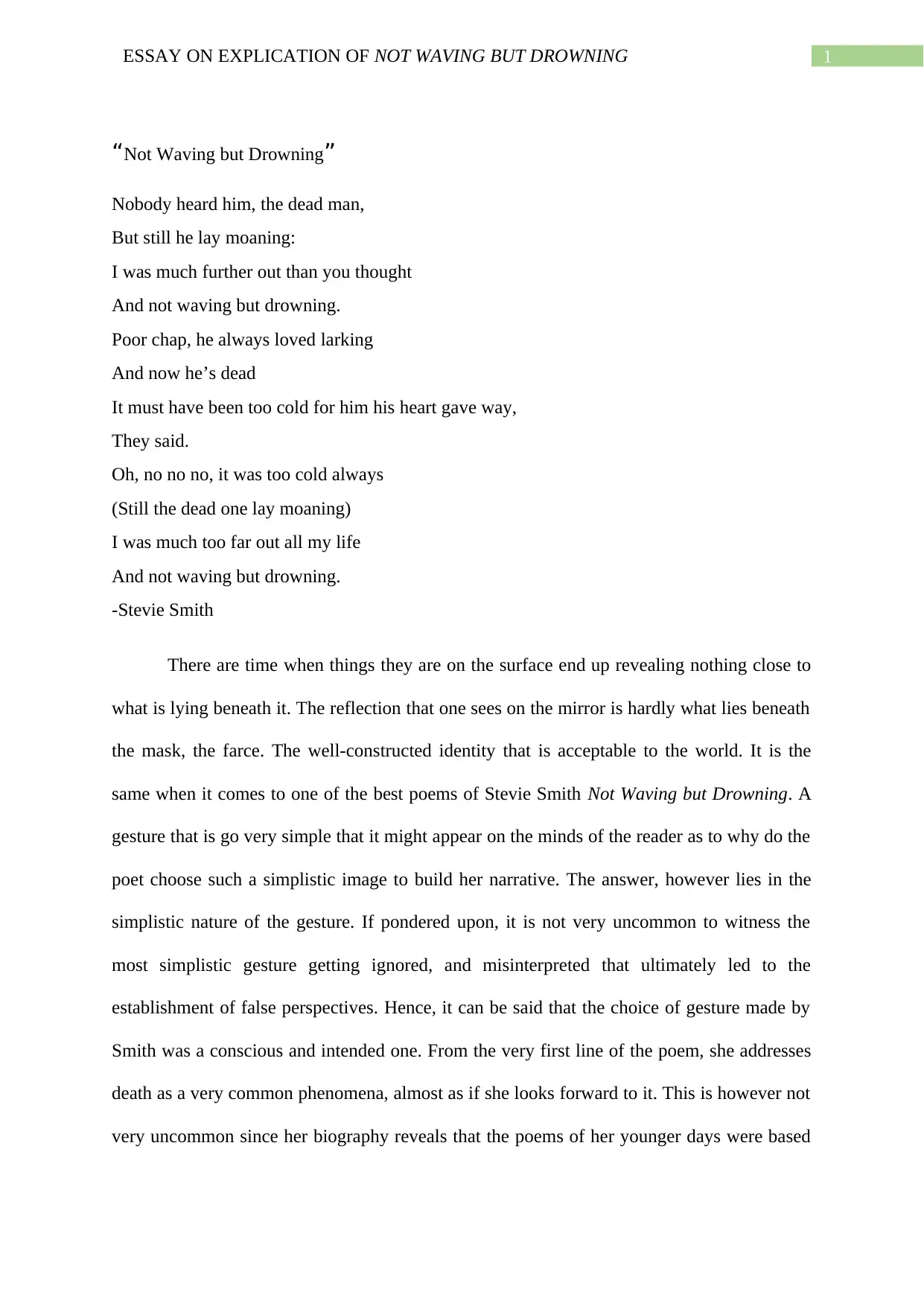
“Not Waving but Drowning”
Nobody heard him, the dead man,
But still he lay moaning:
I was much further out than you thought
And not waving but drowning.
Poor chap, he always loved larking
And now he’s dead
It must have been too cold for him his heart gave way,
They said.
Oh, no no no, it was too cold always
(Still the dead one lay moaning)
I was much too far out all my life
And not waving but drowning.
-Stevie Smith
There are time when things they are on the surface end up revealing nothing close to
what is lying beneath it. The reflection that one sees on the mirror is hardly what lies beneath
the mask, the farce. The well-constructed identity that is acceptable to the world. It is the
same when it comes to one of the best poems of Stevie Smith Not Waving but Drowning. A
gesture that is go very simple that it might appear on the minds of the reader as to why do the
poet choose such a simplistic image to build her narrative. The answer, however lies in the
simplistic nature of the gesture. If pondered upon, it is not very uncommon to witness the
most simplistic gesture getting ignored, and misinterpreted that ultimately led to the
establishment of false perspectives. Hence, it can be said that the choice of gesture made by
Smith was a conscious and intended one. From the very first line of the poem, she addresses
death as a very common phenomena, almost as if she looks forward to it. This is however not
very uncommon since her biography reveals that the poems of her younger days were based
“Not Waving but Drowning”
Nobody heard him, the dead man,
But still he lay moaning:
I was much further out than you thought
And not waving but drowning.
Poor chap, he always loved larking
And now he’s dead
It must have been too cold for him his heart gave way,
They said.
Oh, no no no, it was too cold always
(Still the dead one lay moaning)
I was much too far out all my life
And not waving but drowning.
-Stevie Smith
There are time when things they are on the surface end up revealing nothing close to
what is lying beneath it. The reflection that one sees on the mirror is hardly what lies beneath
the mask, the farce. The well-constructed identity that is acceptable to the world. It is the
same when it comes to one of the best poems of Stevie Smith Not Waving but Drowning. A
gesture that is go very simple that it might appear on the minds of the reader as to why do the
poet choose such a simplistic image to build her narrative. The answer, however lies in the
simplistic nature of the gesture. If pondered upon, it is not very uncommon to witness the
most simplistic gesture getting ignored, and misinterpreted that ultimately led to the
establishment of false perspectives. Hence, it can be said that the choice of gesture made by
Smith was a conscious and intended one. From the very first line of the poem, she addresses
death as a very common phenomena, almost as if she looks forward to it. This is however not
very uncommon since her biography reveals that the poems of her younger days were based
2ESSAY ON EXPLICATION OF NOT WAVING BUT DROWNING
on some sort of youthful exuberance. However, with time, the themes shifted to suffering,
pain and a sense of being preoccupied with death.
While discussing about the richness of Smith’s poems irrespective of their length, it is
also important to point out the application of various literary devices which help to add depth
as well as clarity to the poem. “But still he lay moaning”, “And not waving but drowning”, “I
was much further out than you” are examples of Smith’s use of imagery where she caters to
the imaginative landscape of her readers by painting pictures of the dead man and her
speaker. “Drowning” is also a symbol that carries two possible interpretations- one of the
speaker’s and the man’s inability to keep up with life, while the other is a sense of surrender
to whatever comes to their path. Smith also uses consonance which is the repetition of
consonant sounds namely “/ng/in” which appears in “And not waving but drowning” along
with “/d/” sound that is present in “Nobody heard him, the dead man” (Smith). The poet also
uses irony in the title as well as the entire poem as it is ironical for other people to assume
that the man and the speaker is doing just fine.
The form of the poem is divided in three stanzas where every stanza contains four
lines, namely quatrain. The rhyming scheme that Smith follows throughout the poem is
ABCB with the repetition of the line “And not waving but drowning”. With the repetition of
this line, it forms a sense of refrain in the beginning as well as the end of the poem (Smith).
One of the most striking feature of Smith’s poem is that she demythologises the fairy
tale narratives. Many critics argue that her works are essentially rooted in her own life
experiences. The abandonment of her father at a tender age of 3 followed by the death of her
mother shortly after, Smith’s childhood no doubt was tragic (Barbera and McBrien).
However, as a student of literature I strongly detest that fact that an author’s or poets literary
creations should be solely based on his or her own life. It would be unfair to diminish the
on some sort of youthful exuberance. However, with time, the themes shifted to suffering,
pain and a sense of being preoccupied with death.
While discussing about the richness of Smith’s poems irrespective of their length, it is
also important to point out the application of various literary devices which help to add depth
as well as clarity to the poem. “But still he lay moaning”, “And not waving but drowning”, “I
was much further out than you” are examples of Smith’s use of imagery where she caters to
the imaginative landscape of her readers by painting pictures of the dead man and her
speaker. “Drowning” is also a symbol that carries two possible interpretations- one of the
speaker’s and the man’s inability to keep up with life, while the other is a sense of surrender
to whatever comes to their path. Smith also uses consonance which is the repetition of
consonant sounds namely “/ng/in” which appears in “And not waving but drowning” along
with “/d/” sound that is present in “Nobody heard him, the dead man” (Smith). The poet also
uses irony in the title as well as the entire poem as it is ironical for other people to assume
that the man and the speaker is doing just fine.
The form of the poem is divided in three stanzas where every stanza contains four
lines, namely quatrain. The rhyming scheme that Smith follows throughout the poem is
ABCB with the repetition of the line “And not waving but drowning”. With the repetition of
this line, it forms a sense of refrain in the beginning as well as the end of the poem (Smith).
One of the most striking feature of Smith’s poem is that she demythologises the fairy
tale narratives. Many critics argue that her works are essentially rooted in her own life
experiences. The abandonment of her father at a tender age of 3 followed by the death of her
mother shortly after, Smith’s childhood no doubt was tragic (Barbera and McBrien).
However, as a student of literature I strongly detest that fact that an author’s or poets literary
creations should be solely based on his or her own life. It would be unfair to diminish the
⊘ This is a preview!⊘
Do you want full access?
Subscribe today to unlock all pages.

Trusted by 1+ million students worldwide
3ESSAY ON EXPLICATION OF NOT WAVING BUT DROWNING
calibre of something as gifted as Smith who experimented with the dimension of time along
with poetic tempo while including the snapshots revealing death that is in total contrast with
the universal (Barbera and McBrien). Instead, it is worth saying that she focuses on aspects of
historical temporality and writes poems devoid of apology- she is capable of creating elusive
texts that de-establish themselves on their own and hence turn out to be independent of the
contexts of the society and politics with which writers are usually associated with. “…thereby
embarking on a lifelong dance with Thanatos (Barbera and McBrien)” Smith has been clear
about her adoption of the theme of death in manner that is philosophically charged and
contains multifaceted complexities in terms of symbols used in her poetry.
While considering a detailed explanation of the poem, it is clear to the readers that
Smith has had the intention of talking about theme they society has always regarded to be too
dark- death, suicide, pain, and depression. “Nobody heard him” make it very prominent that
those who have seen the man in a water body with a hand protruding out, has assumed that he
has been waiving to them (Smith). Another implication that could be derived from this line is
the manner in which the men of Smith’s times were treated- mental health of men were not
talked about, or even regarded as an issue. The third line of the first stanza state that the
condition of the poet’s speaker being in a much worse condition than the man. The second
stanza produces a sense of confusion regarding who “he” is being denoted as since the poet
claims that he had been “larking” around. “And now he’s dead” could also be interpreted as a
personification of death itself which has not revealed its true form to the poet (Smith). Third
and last stanza reveals the constant nature of things which have not undergone much change.
“I was much too far out all my life” reveals that the poet has always been this vulnerable yet
assured with the event of death which although might not be seen, heard, and acknowledged
by those around her; she finds true peace and solace in the laps of death (Smith).
calibre of something as gifted as Smith who experimented with the dimension of time along
with poetic tempo while including the snapshots revealing death that is in total contrast with
the universal (Barbera and McBrien). Instead, it is worth saying that she focuses on aspects of
historical temporality and writes poems devoid of apology- she is capable of creating elusive
texts that de-establish themselves on their own and hence turn out to be independent of the
contexts of the society and politics with which writers are usually associated with. “…thereby
embarking on a lifelong dance with Thanatos (Barbera and McBrien)” Smith has been clear
about her adoption of the theme of death in manner that is philosophically charged and
contains multifaceted complexities in terms of symbols used in her poetry.
While considering a detailed explanation of the poem, it is clear to the readers that
Smith has had the intention of talking about theme they society has always regarded to be too
dark- death, suicide, pain, and depression. “Nobody heard him” make it very prominent that
those who have seen the man in a water body with a hand protruding out, has assumed that he
has been waiving to them (Smith). Another implication that could be derived from this line is
the manner in which the men of Smith’s times were treated- mental health of men were not
talked about, or even regarded as an issue. The third line of the first stanza state that the
condition of the poet’s speaker being in a much worse condition than the man. The second
stanza produces a sense of confusion regarding who “he” is being denoted as since the poet
claims that he had been “larking” around. “And now he’s dead” could also be interpreted as a
personification of death itself which has not revealed its true form to the poet (Smith). Third
and last stanza reveals the constant nature of things which have not undergone much change.
“I was much too far out all my life” reveals that the poet has always been this vulnerable yet
assured with the event of death which although might not be seen, heard, and acknowledged
by those around her; she finds true peace and solace in the laps of death (Smith).
Paraphrase This Document
Need a fresh take? Get an instant paraphrase of this document with our AI Paraphraser
4ESSAY ON EXPLICATION OF NOT WAVING BUT DROWNING
This is a particular polyphonic sonnet problematizing her repetitive subjects, the
difficulty of correspondence and the certainty of misunderstanding in the conflicting voices
of suffocating, suffocated man despite everything attempting yet frantically neglecting to
explain his despondency, the observer author thoughtfully hearing the perished's cries, and
the gathering of colleagues despite everything confusing a passing scene with a pointless,
immaterial waving. In addition, these voices are additionally muddled by the disturbing
delineating doodle portraying a quiet young lady remaining in midriff high water, neither
suffocating, nor waving, nor addressing her crowd yet just looking at them. Smith professes
to have composed this sonnet while she felt unreasonably low for words, yet the effective
verbalization of horrendous miscomprehension didn't keep her from endeavouring to end it
all without further ado a short time later. Her verse fixated on depersonalization, vanishing,
and miscommunication gives the feeling that the embodiment stays in the implied, or the
unspeakable domains. Actually, in "Not Waving" we are insulted with a baffling
equivocalness of the graceful self in the circle of the unheard and the inferred: the artist
expect the voice of the misconstrued, unheard dead man suffocating at the edge of
conspicuous signals/signs, yet at the same time the writer additionally emerg(es) in the
nonverbal circle of the going with drawing as a particularly alive lady melancholically or
jokingly grinning at pursuers with shut lips, through her fixed hair (Dowson and Entwistle).
As Huk proposes this quiet doodle courageous woman venturing out of language is oneself
enabling ladylike specialist who prevails with regards to understanding the awful/yearned for
discharge from (the illustrative system's, language's or the poem's) distancing signs and
images and the selves they build. In Leighton's view, the wonderful self's "groaning"
declining to stop for death and demanding staying heard in an incomplete time epitomizes the
sound of verse, of a music past story sense, which gets free precisely by being dead to the
rationale that oversees life. The increased, polyphonic verse "I" venturing out of time-bound,
This is a particular polyphonic sonnet problematizing her repetitive subjects, the
difficulty of correspondence and the certainty of misunderstanding in the conflicting voices
of suffocating, suffocated man despite everything attempting yet frantically neglecting to
explain his despondency, the observer author thoughtfully hearing the perished's cries, and
the gathering of colleagues despite everything confusing a passing scene with a pointless,
immaterial waving. In addition, these voices are additionally muddled by the disturbing
delineating doodle portraying a quiet young lady remaining in midriff high water, neither
suffocating, nor waving, nor addressing her crowd yet just looking at them. Smith professes
to have composed this sonnet while she felt unreasonably low for words, yet the effective
verbalization of horrendous miscomprehension didn't keep her from endeavouring to end it
all without further ado a short time later. Her verse fixated on depersonalization, vanishing,
and miscommunication gives the feeling that the embodiment stays in the implied, or the
unspeakable domains. Actually, in "Not Waving" we are insulted with a baffling
equivocalness of the graceful self in the circle of the unheard and the inferred: the artist
expect the voice of the misconstrued, unheard dead man suffocating at the edge of
conspicuous signals/signs, yet at the same time the writer additionally emerg(es) in the
nonverbal circle of the going with drawing as a particularly alive lady melancholically or
jokingly grinning at pursuers with shut lips, through her fixed hair (Dowson and Entwistle).
As Huk proposes this quiet doodle courageous woman venturing out of language is oneself
enabling ladylike specialist who prevails with regards to understanding the awful/yearned for
discharge from (the illustrative system's, language's or the poem's) distancing signs and
images and the selves they build. In Leighton's view, the wonderful self's "groaning"
declining to stop for death and demanding staying heard in an incomplete time epitomizes the
sound of verse, of a music past story sense, which gets free precisely by being dead to the
rationale that oversees life. The increased, polyphonic verse "I" venturing out of time-bound,
5ESSAY ON EXPLICATION OF NOT WAVING BUT DROWNING
history-bound, sexual orientation bound," standard bound account can split away here from
the misinterpretations and the authorial personas misconstrued by pursuers to constrain her
(Dowson and Entwistle). Fiction can deceive life, where Smith has consistently felt baffled
for her sonnets' being misjudged (regardless of their prominence during the decade prior to
her demise), and gave up over Punch's surveying her "Not Waving" as an "entertaining" piece
since she proposed it as a " most touching," pitiful content (Smith).
When we talk about authors’ and poets’ who were obsessed with death, it would be
unfair not to mention one of the most celebrated American poets of Smith’s time- Sylvia
Plath who had written about her fondness and affection towards Smith and her poems
(Dowson and Entwistle). However, she ended up taking her own life only after a few days of
sending the letter to Smith. In retrospect, if we keep the works of Smith and Plath side by
side, and do not point out to the readers about the poets, it would be a challenge to
differentiate between the two. Emily Dickinson, who wrote during the nineteenth century on
the theme of death too was unapologetic about it such as in celebrated poems such as
Because I could not Stop for Death.
Principally, Smith benefits and generally thematises suicide as a type of death that
symbolizes self-rule, the opportunity to pick how, when and why one needs to take her life.
However, abnormally in the steady despairing of life one stays dubious of how this decision
will happen or whether it would happen by any stretch of the imagination (Dowson and
Entwistle). For Smith—with respect to Plath declaring herself a monstrous admirer of Smith
—suicide is significantly more strengthening, a token of unrestrained choice and independent
freedom than a neurotic manifestation, an impasse of a strayed, degenerate life or a disturbing
danger. As Smith records of this early epiphanic acknowledgment- The idea brightened me
up superbly and very spared my life. For in the event that one can expel oneself whenever
from the world, why especially now?
history-bound, sexual orientation bound," standard bound account can split away here from
the misinterpretations and the authorial personas misconstrued by pursuers to constrain her
(Dowson and Entwistle). Fiction can deceive life, where Smith has consistently felt baffled
for her sonnets' being misjudged (regardless of their prominence during the decade prior to
her demise), and gave up over Punch's surveying her "Not Waving" as an "entertaining" piece
since she proposed it as a " most touching," pitiful content (Smith).
When we talk about authors’ and poets’ who were obsessed with death, it would be
unfair not to mention one of the most celebrated American poets of Smith’s time- Sylvia
Plath who had written about her fondness and affection towards Smith and her poems
(Dowson and Entwistle). However, she ended up taking her own life only after a few days of
sending the letter to Smith. In retrospect, if we keep the works of Smith and Plath side by
side, and do not point out to the readers about the poets, it would be a challenge to
differentiate between the two. Emily Dickinson, who wrote during the nineteenth century on
the theme of death too was unapologetic about it such as in celebrated poems such as
Because I could not Stop for Death.
Principally, Smith benefits and generally thematises suicide as a type of death that
symbolizes self-rule, the opportunity to pick how, when and why one needs to take her life.
However, abnormally in the steady despairing of life one stays dubious of how this decision
will happen or whether it would happen by any stretch of the imagination (Dowson and
Entwistle). For Smith—with respect to Plath declaring herself a monstrous admirer of Smith
—suicide is significantly more strengthening, a token of unrestrained choice and independent
freedom than a neurotic manifestation, an impasse of a strayed, degenerate life or a disturbing
danger. As Smith records of this early epiphanic acknowledgment- The idea brightened me
up superbly and very spared my life. For in the event that one can expel oneself whenever
from the world, why especially now?
⊘ This is a preview!⊘
Do you want full access?
Subscribe today to unlock all pages.
Trusted by 1+ million students worldwide
6ESSAY ON EXPLICATION OF NOT WAVING BUT DROWNING
Smith's verse gives a meta-text on the association of craftsmanship focusing on self-
governance and life requesting responsibility: in the style of Deleuze and Guattari, in a non-
mimetic, rhizomatic relationship, the book fiercely de-territorializes the world, while the
world endeavours at re-territorializing the book up until it prevails in de-territorializing itself
again (Dowson and Entwistle). In this elements of disruption and regulation, this battle
between the workmanship/ist focusing on self-sufficiency and the world/the peruser
requesting duty, Smith finds herself in the in the middle of, picking a promise to self-rule, all
the more explicitly a sceptic pledge to the opportunity of vulnerability. Her duty to free play
and dithering isn't just fuelled by the irritation temptation of the unavoidable grievous, special
normal passing experience depicted above, however it can likewise be identified with the
doodles going with the sonnets (Dowson and Entwistle). The Deleuzian deterritorialization
doesn't stop with the demonstration of abstract creation subverting the business-like, strict
wor(l)d yet it quickens inside the very sonnet itself through the doodles unmaking the idyllic
content on their turn.
Doodles are written down about in an oblivious way, as though by some coincidence,
in a minute's time, by definition they are unconstrained, coincidental, arbitrary and counter-
intuitive, and in this manner negate the cognizant sensible work, the procedure (durée) of
piece and the significance obsession of the idyllic content (Barbera and McBrien). Doodling
is an amazingly close to home, private methods for articulation, rendering generic quality
incomprehensible, yet incomprehensibly it serves Smith's general lovely venture of self-
camouflage and self-sensation. Smith's adoration for vulnerability is additionally outlined by
the technique she used to coordinate her doodles to her sonnets. She was not a gifted cabinet,
yet for an incredible duration she appreciated doodling on backs of wraps, notice cushions,
pieces of paper, and gathered her photos in a crate, with the goal that when she composed
Smith's verse gives a meta-text on the association of craftsmanship focusing on self-
governance and life requesting responsibility: in the style of Deleuze and Guattari, in a non-
mimetic, rhizomatic relationship, the book fiercely de-territorializes the world, while the
world endeavours at re-territorializing the book up until it prevails in de-territorializing itself
again (Dowson and Entwistle). In this elements of disruption and regulation, this battle
between the workmanship/ist focusing on self-sufficiency and the world/the peruser
requesting duty, Smith finds herself in the in the middle of, picking a promise to self-rule, all
the more explicitly a sceptic pledge to the opportunity of vulnerability. Her duty to free play
and dithering isn't just fuelled by the irritation temptation of the unavoidable grievous, special
normal passing experience depicted above, however it can likewise be identified with the
doodles going with the sonnets (Dowson and Entwistle). The Deleuzian deterritorialization
doesn't stop with the demonstration of abstract creation subverting the business-like, strict
wor(l)d yet it quickens inside the very sonnet itself through the doodles unmaking the idyllic
content on their turn.
Doodles are written down about in an oblivious way, as though by some coincidence,
in a minute's time, by definition they are unconstrained, coincidental, arbitrary and counter-
intuitive, and in this manner negate the cognizant sensible work, the procedure (durée) of
piece and the significance obsession of the idyllic content (Barbera and McBrien). Doodling
is an amazingly close to home, private methods for articulation, rendering generic quality
incomprehensible, yet incomprehensibly it serves Smith's general lovely venture of self-
camouflage and self-sensation. Smith's adoration for vulnerability is additionally outlined by
the technique she used to coordinate her doodles to her sonnets. She was not a gifted cabinet,
yet for an incredible duration she appreciated doodling on backs of wraps, notice cushions,
pieces of paper, and gathered her photos in a crate, with the goal that when she composed
Paraphrase This Document
Need a fresh take? Get an instant paraphrase of this document with our AI Paraphraser
7ESSAY ON EXPLICATION OF NOT WAVING BUT DROWNING
enough sonnets to make a book, she just experienced her container to pick a drawing best
showing the inclination or the thought in the sonnet as opposed to any occurrences in it
(Barbera and McBrien). It is extremely significant that she uses doodle in her poem Not
Waving but Drowning where she attached the doodle of a wet haired girl beneath a lake that
is frozen.
Annotated Bibliography
Barbera, Jack, and William McBrien. Stevie, a biography of Stevie Smith. Oxford University
Press, USA, 1987.
The biography talks about Stevie Smith through the lens of Jack Barbera and William
McBrien; however it begins with a strong statement from her executor named James
MacGibbon who states that the biography is in no way authorized and the executor cannot be
held responsible for providing permission that goes beyond the quotation of Stevie Smith’s
works. After such a statement, it is expected that the biography would contain some insight
that would reveal more about the author’s personal life. But nothing of the same is found,
which might be due to MacGibbon’s annoyance. The biography also does not throw much
light into the kind of poet that Stevie Smith actually was, instead skim around the literary
canon.
Dowson, Jane, and Alice Entwistle. A history of twentieth-century British women's poetry.
Cambridge University Press, 2005.
This particular book talks about the history of a number of female voices in Britain in the
twentieth century. Although the structure of the book is considered to be a daring job,
nevertheless it convinces the readers. With the division of the three major periods, the authors
enough sonnets to make a book, she just experienced her container to pick a drawing best
showing the inclination or the thought in the sonnet as opposed to any occurrences in it
(Barbera and McBrien). It is extremely significant that she uses doodle in her poem Not
Waving but Drowning where she attached the doodle of a wet haired girl beneath a lake that
is frozen.
Annotated Bibliography
Barbera, Jack, and William McBrien. Stevie, a biography of Stevie Smith. Oxford University
Press, USA, 1987.
The biography talks about Stevie Smith through the lens of Jack Barbera and William
McBrien; however it begins with a strong statement from her executor named James
MacGibbon who states that the biography is in no way authorized and the executor cannot be
held responsible for providing permission that goes beyond the quotation of Stevie Smith’s
works. After such a statement, it is expected that the biography would contain some insight
that would reveal more about the author’s personal life. But nothing of the same is found,
which might be due to MacGibbon’s annoyance. The biography also does not throw much
light into the kind of poet that Stevie Smith actually was, instead skim around the literary
canon.
Dowson, Jane, and Alice Entwistle. A history of twentieth-century British women's poetry.
Cambridge University Press, 2005.
This particular book talks about the history of a number of female voices in Britain in the
twentieth century. Although the structure of the book is considered to be a daring job,
nevertheless it convinces the readers. With the division of the three major periods, the authors
8ESSAY ON EXPLICATION OF NOT WAVING BUT DROWNING
have been able to effectively mark the assertion of the women in various social and cultural
contexts of Britain. The changes in aesthetics have also been noted along with the
experiments carried out on androgyny as well as the voice of the public with the help of
subversions and disruptions that took place in order to emphasise the local identity,
dialogism, along with transformation.
have been able to effectively mark the assertion of the women in various social and cultural
contexts of Britain. The changes in aesthetics have also been noted along with the
experiments carried out on androgyny as well as the voice of the public with the help of
subversions and disruptions that took place in order to emphasise the local identity,
dialogism, along with transformation.
⊘ This is a preview!⊘
Do you want full access?
Subscribe today to unlock all pages.
Trusted by 1+ million students worldwide
9ESSAY ON EXPLICATION OF NOT WAVING BUT DROWNING
Works Cited
Barbera, Jack, and William McBrien. Stevie, a biography of Stevie Smith. Oxford University
Press, USA, 1987.
Dowson, Jane, and Alice Entwistle. A history of twentieth-century British women's poetry.
Cambridge University Press, 2005.
Smith, Stevie. "Not waving but drowning." Not waving but drowning (1957).
Works Cited
Barbera, Jack, and William McBrien. Stevie, a biography of Stevie Smith. Oxford University
Press, USA, 1987.
Dowson, Jane, and Alice Entwistle. A history of twentieth-century British women's poetry.
Cambridge University Press, 2005.
Smith, Stevie. "Not waving but drowning." Not waving but drowning (1957).

1 out of 10


Your All-in-One AI-Powered Toolkit for Academic Success.
+13062052269
info@desklib.com
Available 24*7 on WhatsApp / Email
![[object Object]](/_next/static/media/star-bottom.7253800d.svg)
Unlock your academic potential
Copyright © 2020–2025 A2Z Services. All Rights Reserved. Developed and managed by ZUCOL.