A Detailed Critical Analysis of Maya Angelou's Poem 'Still I Rise'
VerifiedAdded on 2022/09/03
|10
|2816
|38
Essay
AI Summary
This essay offers a detailed critical analysis of Maya Angelou's poem, 'Still I Rise.' It examines the poem's themes of resilience, racial and gender discrimination, and empowerment. The analysis explores the poem's historical context, literary devices, and its significance in challenging societal prejudices. The essay delves into the poem's structure, symbolism, and the powerful message of overcoming oppression. It highlights Angelou's use of language and imagery to convey her message of hope and determination in the face of adversity. The analysis also discusses the impact of the poem on literature and its continued relevance in contemporary society, emphasizing the ongoing struggle against injustice and the importance of self-worth and dignity. The essay references the poem's stanzas, breaking down Angelou's arguments and the questions she poses to the reader. The conclusion summarizes the poem's lasting influence and the call to action for readers to rise above oppression and embrace their own power.
Running head: CRITICAL ANALYSIS OF “STILL I RISE”
Critical analysis of “Still I Rise”
Name of the Student
Name of the University
Author Note
Critical analysis of “Still I Rise”
Name of the Student
Name of the University
Author Note

Paraphrase This Document
Need a fresh take? Get an instant paraphrase of this document with our AI Paraphraser
1CRITICAL ANALYSIS OF “STILL I RISE”
Table of Contents
Introduction......................................................................................................................................2
Summary and critical analysis of the poem “Still I Rise” written by Maya Angelou.....................2
Conclusion.......................................................................................................................................6
References:......................................................................................................................................8
Table of Contents
Introduction......................................................................................................................................2
Summary and critical analysis of the poem “Still I Rise” written by Maya Angelou.....................2
Conclusion.......................................................................................................................................6
References:......................................................................................................................................8
2CRITICAL ANALYSIS OF “STILL I RISE”
Introduction
The literary pieces in the field of literature and language, helps the society to come to
terms with the existing structuring of the community. The nature of men and women, their
preferences and likings, the prejudices which are held by them and the kind of behavior they
exhibit during certain times, all are mentioned within such literary sources (Igwedibia 2019). The
purpose of any piece of writing is to bring to the fore front a particular aspect of the society. In
this context, while one piece of writing may deal with the human characteristics and human
behavior, another piece of writing may talk about the nature of the surrounding environment.
However, both of them hold true elements within them and are considered to be an important
reflection to the society. In this context, there is an essential need on the part of the individuals of
the society to read such forms of literary sources and to examine the intention with which they
have been written (Permatasari 2016). The purpose of this paper is to analyze one of the most
significant pieces of literature written within the field of literary poems, titled “Still I Rise” as
written by Maya Angelou.
Summary and critical analysis of the poem “Still I Rise” written by Maya
Angelou
The poem, “Still I Rise”, is considered to be one of the most empowering poems as
written by Maya Angelou (Wibowo, Iswanto and Akbar 2017). The poem talks about the
struggle which an individual has to go through in order to overcome the various barriers which
exist in the form of injustice and prejudice. The poem is seen to be a beacon of hope for all those
individuals of a community who have been oppressed or have been the victims of prejudices.
The poem is basically a reminder that the people who are in power, at times, end up exercising
Introduction
The literary pieces in the field of literature and language, helps the society to come to
terms with the existing structuring of the community. The nature of men and women, their
preferences and likings, the prejudices which are held by them and the kind of behavior they
exhibit during certain times, all are mentioned within such literary sources (Igwedibia 2019). The
purpose of any piece of writing is to bring to the fore front a particular aspect of the society. In
this context, while one piece of writing may deal with the human characteristics and human
behavior, another piece of writing may talk about the nature of the surrounding environment.
However, both of them hold true elements within them and are considered to be an important
reflection to the society. In this context, there is an essential need on the part of the individuals of
the society to read such forms of literary sources and to examine the intention with which they
have been written (Permatasari 2016). The purpose of this paper is to analyze one of the most
significant pieces of literature written within the field of literary poems, titled “Still I Rise” as
written by Maya Angelou.
Summary and critical analysis of the poem “Still I Rise” written by Maya
Angelou
The poem, “Still I Rise”, is considered to be one of the most empowering poems as
written by Maya Angelou (Wibowo, Iswanto and Akbar 2017). The poem talks about the
struggle which an individual has to go through in order to overcome the various barriers which
exist in the form of injustice and prejudice. The poem is seen to be a beacon of hope for all those
individuals of a community who have been oppressed or have been the victims of prejudices.
The poem is basically a reminder that the people who are in power, at times, end up exercising
⊘ This is a preview!⊘
Do you want full access?
Subscribe today to unlock all pages.

Trusted by 1+ million students worldwide
3CRITICAL ANALYSIS OF “STILL I RISE”
their power and authority in a wrong manner (Arthami 2017). They over step their boundaries
which means that the common masses get affected in an adverse manner by the way of
abridgement of their rights and freedom. The individuals serving in the governing bodies, the
military officials, the members of the police force and the law enforcement, all have been
accused in this poem by Angelou for contributing, either intentionally or unintentionally to the
obstacles faced by the common public.
In the first stanza of the poem, Angelou begins by saying that no one individual of the
society or any of the acts committed by them would be able to hold her in a suppressed manner
(Bouras, Belgacem and Lobna 2018). She does not place much trust in the history books of the
society for they are written by those scholars who have twisted the truths in order to honor the
lies. The issues of oppression and the way they have been justified, have ensured that the
individuals of the society in the contemporary world order may be downtrodden and this again,
would be justified (Gunibala 2016). However, she has opined that in the event that she is trodden
within the dirt, she would come out even stronger and rise from the same dust.
In the second stanza, the narrator asks a pertinent question to her readers. The success of
a woman is not seen with welcoming eyes in the society since they are considered to be inferior
to that of their male counter parts (Nkopuruk and Odusina 2019). Thus, she asks the members of
the society if her success as a woman writer is bothering them and whether they felt insecure
about the fact that she had oil wells pumping in her room. This stanza shows that the narrator had
adopted an extremely sarcastic tone as she wanted to bring out the prejudices of gender
discrimination that is still prevalent in the society.
In the third stanza, the narrator takes a different turn and compares herself to the heavenly
bodies such as the sun and the moon. This stanza is meant to prove to her readers that the
their power and authority in a wrong manner (Arthami 2017). They over step their boundaries
which means that the common masses get affected in an adverse manner by the way of
abridgement of their rights and freedom. The individuals serving in the governing bodies, the
military officials, the members of the police force and the law enforcement, all have been
accused in this poem by Angelou for contributing, either intentionally or unintentionally to the
obstacles faced by the common public.
In the first stanza of the poem, Angelou begins by saying that no one individual of the
society or any of the acts committed by them would be able to hold her in a suppressed manner
(Bouras, Belgacem and Lobna 2018). She does not place much trust in the history books of the
society for they are written by those scholars who have twisted the truths in order to honor the
lies. The issues of oppression and the way they have been justified, have ensured that the
individuals of the society in the contemporary world order may be downtrodden and this again,
would be justified (Gunibala 2016). However, she has opined that in the event that she is trodden
within the dirt, she would come out even stronger and rise from the same dust.
In the second stanza, the narrator asks a pertinent question to her readers. The success of
a woman is not seen with welcoming eyes in the society since they are considered to be inferior
to that of their male counter parts (Nkopuruk and Odusina 2019). Thus, she asks the members of
the society if her success as a woman writer is bothering them and whether they felt insecure
about the fact that she had oil wells pumping in her room. This stanza shows that the narrator had
adopted an extremely sarcastic tone as she wanted to bring out the prejudices of gender
discrimination that is still prevalent in the society.
In the third stanza, the narrator takes a different turn and compares herself to the heavenly
bodies such as the sun and the moon. This stanza is meant to prove to her readers that the
Paraphrase This Document
Need a fresh take? Get an instant paraphrase of this document with our AI Paraphraser
4CRITICAL ANALYSIS OF “STILL I RISE”
narrator has no alternative choice but to rise from the afflictions and obstacles faced in her life
(Iqbal and Parveen 2018). She took the example of how the moon invariably affects the tides of
the water bodies on Earth. Just as the tides occur as a natural response to the movement of the
moon, it is natural for her to rise out of her oppressive situation in spite of the efforts of the
society to keep her suppressed.
In the fourth stanza, the narrator tries to bring out the racist aspects which are present in
the society. She observes that the members of the society are usually extremely bitter when they
see the success of others (Bugaranti and Setyabudi 2019). This bitterness deepens further when
this success belongs to that of a woman, especially belonging to the ‘black’ ethnic population. In
this stanza, she directly asks certain pertinent questions to such members who have tried to keep
her oppressed. If they indeed did not want to see the success of a ‘black’ woman and see her
rising out of her oppressive situation and earning a name for herself. The questions posed are
rhetoric in nature because the issue of racial discrimination is implicit in the society (Fernandes
2017). No one would explicitly talk about demeaning someone else or the fact that they do not
want to see the success of a ‘black’ person, especially that a woman. However, such questions as
posed by the narrator, are meant to affect the prejudices held by the individuals of the society
within their subconscious mind.
The narrator had continued the questioning of the presence of racist sentiments in the
society in the fifth stanza. She asked her readers if her character of being a haughty person
affected them. Society is quite resentful to see a ‘black’ woman being prideful, especially of her
success in the public sphere of activity (Hughes 2017). The purpose of this question was
supposed to bring out the hypocrisy which exists in the society where its members are embittered
and full of jealousy to see the success of an individual which it had tried to oppress for a long
narrator has no alternative choice but to rise from the afflictions and obstacles faced in her life
(Iqbal and Parveen 2018). She took the example of how the moon invariably affects the tides of
the water bodies on Earth. Just as the tides occur as a natural response to the movement of the
moon, it is natural for her to rise out of her oppressive situation in spite of the efforts of the
society to keep her suppressed.
In the fourth stanza, the narrator tries to bring out the racist aspects which are present in
the society. She observes that the members of the society are usually extremely bitter when they
see the success of others (Bugaranti and Setyabudi 2019). This bitterness deepens further when
this success belongs to that of a woman, especially belonging to the ‘black’ ethnic population. In
this stanza, she directly asks certain pertinent questions to such members who have tried to keep
her oppressed. If they indeed did not want to see the success of a ‘black’ woman and see her
rising out of her oppressive situation and earning a name for herself. The questions posed are
rhetoric in nature because the issue of racial discrimination is implicit in the society (Fernandes
2017). No one would explicitly talk about demeaning someone else or the fact that they do not
want to see the success of a ‘black’ person, especially that a woman. However, such questions as
posed by the narrator, are meant to affect the prejudices held by the individuals of the society
within their subconscious mind.
The narrator had continued the questioning of the presence of racist sentiments in the
society in the fifth stanza. She asked her readers if her character of being a haughty person
affected them. Society is quite resentful to see a ‘black’ woman being prideful, especially of her
success in the public sphere of activity (Hughes 2017). The purpose of this question was
supposed to bring out the hypocrisy which exists in the society where its members are embittered
and full of jealousy to see the success of an individual which it had tried to oppress for a long
5CRITICAL ANALYSIS OF “STILL I RISE”
period of time. The narrator wanted to comfort the readers, but in sarcastic manner. She did not
want to partake of the same racist sentiments which had for so long affected her and yet wanted
to reveal the hypocrisy of the same society.
In the sixth stanza, the narrator reaffirms to the members of the society that it would no
longer be able to success in keeping her oppressed (Mohsin, Waqar and Ali 2018). She has tasted
success and has realized her own worth. Even in the event of her death, society would not win by
holding a grudge or a contempt against her, for she would still rise, from air and from dirt.
The narrator is still questioning the hateful nature of the society in the seventh stanza.
The narrator has placed the members of the society on a trial stand and is almost on the verge of
cross examining them for all the acts of injustice and oppression that it has done against her
being (Husada 2017). The narrator already has some idea of the answers to the questions.
However, the entire purpose of asking the questions is to make the society feel guilty about its
acts of oppression and to take the blame on itself for trying to suppress her and the members of
her ethnic race and gender. However, an intriguing aspect which needs to be noticed is that while
the narrator is asking the incriminating questions to the society, she herself is gaining more and
more confidence. She does not play the victim of the evil of oppression (Gevorgyan 2017). On
the other hand, she emerges to be a confident woman who is proud of her success in spite of all
the efforts on the part of the society to keep her suppressed and prevent her from achieving any
kind of success.
It is in the eighth stanza that the narrator finally reveals the manner in which the society
has kept her oppressed for so long. She refers to the institution of slavery whereby the ‘white’
ethnic individuals of the society have asserted themselves as superior to the ‘black’ ethnic
population based on their skin tone (Swarnalatha 2020). The institution of slavery has its basis in
period of time. The narrator wanted to comfort the readers, but in sarcastic manner. She did not
want to partake of the same racist sentiments which had for so long affected her and yet wanted
to reveal the hypocrisy of the same society.
In the sixth stanza, the narrator reaffirms to the members of the society that it would no
longer be able to success in keeping her oppressed (Mohsin, Waqar and Ali 2018). She has tasted
success and has realized her own worth. Even in the event of her death, society would not win by
holding a grudge or a contempt against her, for she would still rise, from air and from dirt.
The narrator is still questioning the hateful nature of the society in the seventh stanza.
The narrator has placed the members of the society on a trial stand and is almost on the verge of
cross examining them for all the acts of injustice and oppression that it has done against her
being (Husada 2017). The narrator already has some idea of the answers to the questions.
However, the entire purpose of asking the questions is to make the society feel guilty about its
acts of oppression and to take the blame on itself for trying to suppress her and the members of
her ethnic race and gender. However, an intriguing aspect which needs to be noticed is that while
the narrator is asking the incriminating questions to the society, she herself is gaining more and
more confidence. She does not play the victim of the evil of oppression (Gevorgyan 2017). On
the other hand, she emerges to be a confident woman who is proud of her success in spite of all
the efforts on the part of the society to keep her suppressed and prevent her from achieving any
kind of success.
It is in the eighth stanza that the narrator finally reveals the manner in which the society
has kept her oppressed for so long. She refers to the institution of slavery whereby the ‘white’
ethnic individuals of the society have asserted themselves as superior to the ‘black’ ethnic
population based on their skin tone (Swarnalatha 2020). The institution of slavery has its basis in
⊘ This is a preview!⊘
Do you want full access?
Subscribe today to unlock all pages.
Trusted by 1+ million students worldwide
6CRITICAL ANALYSIS OF “STILL I RISE”
the days of colonization whereby the imperial masters of the advanced nation states of the world
wanted to expand their marketing operations by capturing and colonizing the under developed
regions of the world. The natives of such under developed world did not know how to govern
themselves and this reason was used as a political justification for imposing their rule over such
countries. With time, the institution of racial discrimination was formalized and the idea that the
‘black’ ethnic population belonging to the under developed parts of the world are inferior to the
white’ ethnic population because of their barbaric and self-centered nature. This led to the
beginning of slavery. Since the colonizing period was still in existence, the ‘black’ ethnic
individuals were under the control of the imperial masters. However, as observed by the narrator,
this aspect of slavery and racial discrimination has continued even in the present world order.
The white’ ethnic individuals still treat the ‘black’ individuals to be inferior to them. Coupled
with the aspect of gender discrimination, a ‘black’ woman of the society is considered to be the
most oppressed class in any community.
In the last stanza of the poem, the narrator reveals that it is her intention to leave all the
social evils of racial discrimination, gender distinction and slavery back in history. They did not
have any place in the present society, and much less, within her life. Thus, she intends to rise
above all the hatred and oppression of the society (Juan 2016). She would no longer be held
beholden to the terror of the society or the fear of disapproval of its members. Instead, she would
rise above such oppressive activities and pain and try to become a better human being who is at
peace with herself. Repeating the words “I rise” for three times, the narrator brings an end to a
captivating and engrossing poem.
the days of colonization whereby the imperial masters of the advanced nation states of the world
wanted to expand their marketing operations by capturing and colonizing the under developed
regions of the world. The natives of such under developed world did not know how to govern
themselves and this reason was used as a political justification for imposing their rule over such
countries. With time, the institution of racial discrimination was formalized and the idea that the
‘black’ ethnic population belonging to the under developed parts of the world are inferior to the
white’ ethnic population because of their barbaric and self-centered nature. This led to the
beginning of slavery. Since the colonizing period was still in existence, the ‘black’ ethnic
individuals were under the control of the imperial masters. However, as observed by the narrator,
this aspect of slavery and racial discrimination has continued even in the present world order.
The white’ ethnic individuals still treat the ‘black’ individuals to be inferior to them. Coupled
with the aspect of gender discrimination, a ‘black’ woman of the society is considered to be the
most oppressed class in any community.
In the last stanza of the poem, the narrator reveals that it is her intention to leave all the
social evils of racial discrimination, gender distinction and slavery back in history. They did not
have any place in the present society, and much less, within her life. Thus, she intends to rise
above all the hatred and oppression of the society (Juan 2016). She would no longer be held
beholden to the terror of the society or the fear of disapproval of its members. Instead, she would
rise above such oppressive activities and pain and try to become a better human being who is at
peace with herself. Repeating the words “I rise” for three times, the narrator brings an end to a
captivating and engrossing poem.
Paraphrase This Document
Need a fresh take? Get an instant paraphrase of this document with our AI Paraphraser
7CRITICAL ANALYSIS OF “STILL I RISE”
Conclusion
In conclusion, it can be observed that the poem has sought to bring forth, in front of the
members of the society, of their oppressive and hateful nature. A critical analysis of the poem
reveals that the aspects of racial discrimination and gender discrimination is present in the
society even in the contemporary world order. The institution of colonization and slavery has had
a deep impact in the prejudices which are held by the individuals of the society. The colonial
hangover has led to the people to believe that a ‘black’ ethnic individual cannot succeed in life.
Furthermore, in the context of a woman, this issue becomes more concerning. The women
individuals are considered to be belonging within their private household. They have no place in
the public sphere of activity, and in the event that they do, they are not expected to be more
successful than their male counter parts. The issue of the perceived inferior role played by the
women, coupled with the inferior place occupied by the ‘black’ individuals of the society, have
made society quite prejudiced against a ‘black’ woman. Thus, the success of the narrator of
being a successful and well-recognized writer has raised a lot of hatred and opinions in the
society. Through the poem, Maya Angelou tries to reveal this very hypocrisy within the society
and tells them that she would no longer be kept oppressed.
Conclusion
In conclusion, it can be observed that the poem has sought to bring forth, in front of the
members of the society, of their oppressive and hateful nature. A critical analysis of the poem
reveals that the aspects of racial discrimination and gender discrimination is present in the
society even in the contemporary world order. The institution of colonization and slavery has had
a deep impact in the prejudices which are held by the individuals of the society. The colonial
hangover has led to the people to believe that a ‘black’ ethnic individual cannot succeed in life.
Furthermore, in the context of a woman, this issue becomes more concerning. The women
individuals are considered to be belonging within their private household. They have no place in
the public sphere of activity, and in the event that they do, they are not expected to be more
successful than their male counter parts. The issue of the perceived inferior role played by the
women, coupled with the inferior place occupied by the ‘black’ individuals of the society, have
made society quite prejudiced against a ‘black’ woman. Thus, the success of the narrator of
being a successful and well-recognized writer has raised a lot of hatred and opinions in the
society. Through the poem, Maya Angelou tries to reveal this very hypocrisy within the society
and tells them that she would no longer be kept oppressed.
8CRITICAL ANALYSIS OF “STILL I RISE”
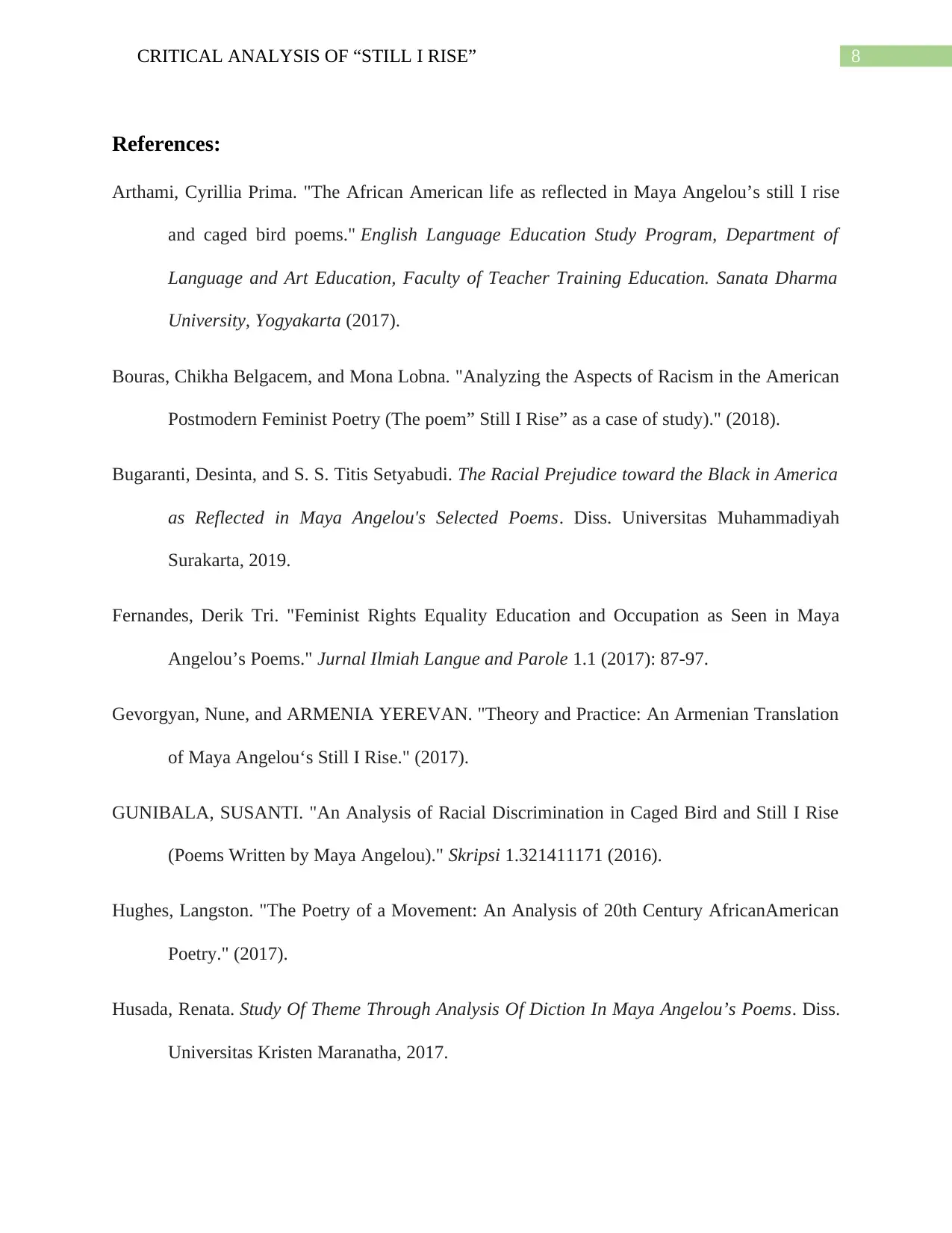
References:
Arthami, Cyrillia Prima. "The African American life as reflected in Maya Angelou’s still I rise
and caged bird poems." English Language Education Study Program, Department of
Language and Art Education, Faculty of Teacher Training Education. Sanata Dharma
University, Yogyakarta (2017).
Bouras, Chikha Belgacem, and Mona Lobna. "Analyzing the Aspects of Racism in the American
Postmodern Feminist Poetry (The poem” Still I Rise” as a case of study)." (2018).
Bugaranti, Desinta, and S. S. Titis Setyabudi. The Racial Prejudice toward the Black in America
as Reflected in Maya Angelou's Selected Poems. Diss. Universitas Muhammadiyah
Surakarta, 2019.
Fernandes, Derik Tri. "Feminist Rights Equality Education and Occupation as Seen in Maya
Angelou’s Poems." Jurnal Ilmiah Langue and Parole 1.1 (2017): 87-97.
Gevorgyan, Nune, and ARMENIA YEREVAN. "Theory and Practice: An Armenian Translation
of Maya Angelou‘s Still I Rise." (2017).
GUNIBALA, SUSANTI. "An Analysis of Racial Discrimination in Caged Bird and Still I Rise
(Poems Written by Maya Angelou)." Skripsi 1.321411171 (2016).
Hughes, Langston. "The Poetry of a Movement: An Analysis of 20th Century AfricanAmerican
Poetry." (2017).
Husada, Renata. Study Of Theme Through Analysis Of Diction In Maya Angelou’s Poems. Diss.
Universitas Kristen Maranatha, 2017.
References:
Arthami, Cyrillia Prima. "The African American life as reflected in Maya Angelou’s still I rise
and caged bird poems." English Language Education Study Program, Department of
Language and Art Education, Faculty of Teacher Training Education. Sanata Dharma
University, Yogyakarta (2017).
Bouras, Chikha Belgacem, and Mona Lobna. "Analyzing the Aspects of Racism in the American
Postmodern Feminist Poetry (The poem” Still I Rise” as a case of study)." (2018).
Bugaranti, Desinta, and S. S. Titis Setyabudi. The Racial Prejudice toward the Black in America
as Reflected in Maya Angelou's Selected Poems. Diss. Universitas Muhammadiyah
Surakarta, 2019.
Fernandes, Derik Tri. "Feminist Rights Equality Education and Occupation as Seen in Maya
Angelou’s Poems." Jurnal Ilmiah Langue and Parole 1.1 (2017): 87-97.
Gevorgyan, Nune, and ARMENIA YEREVAN. "Theory and Practice: An Armenian Translation
of Maya Angelou‘s Still I Rise." (2017).
GUNIBALA, SUSANTI. "An Analysis of Racial Discrimination in Caged Bird and Still I Rise
(Poems Written by Maya Angelou)." Skripsi 1.321411171 (2016).
Hughes, Langston. "The Poetry of a Movement: An Analysis of 20th Century AfricanAmerican
Poetry." (2017).
Husada, Renata. Study Of Theme Through Analysis Of Diction In Maya Angelou’s Poems. Diss.
Universitas Kristen Maranatha, 2017.
⊘ This is a preview!⊘
Do you want full access?
Subscribe today to unlock all pages.
Trusted by 1+ million students worldwide
9CRITICAL ANALYSIS OF “STILL I RISE”
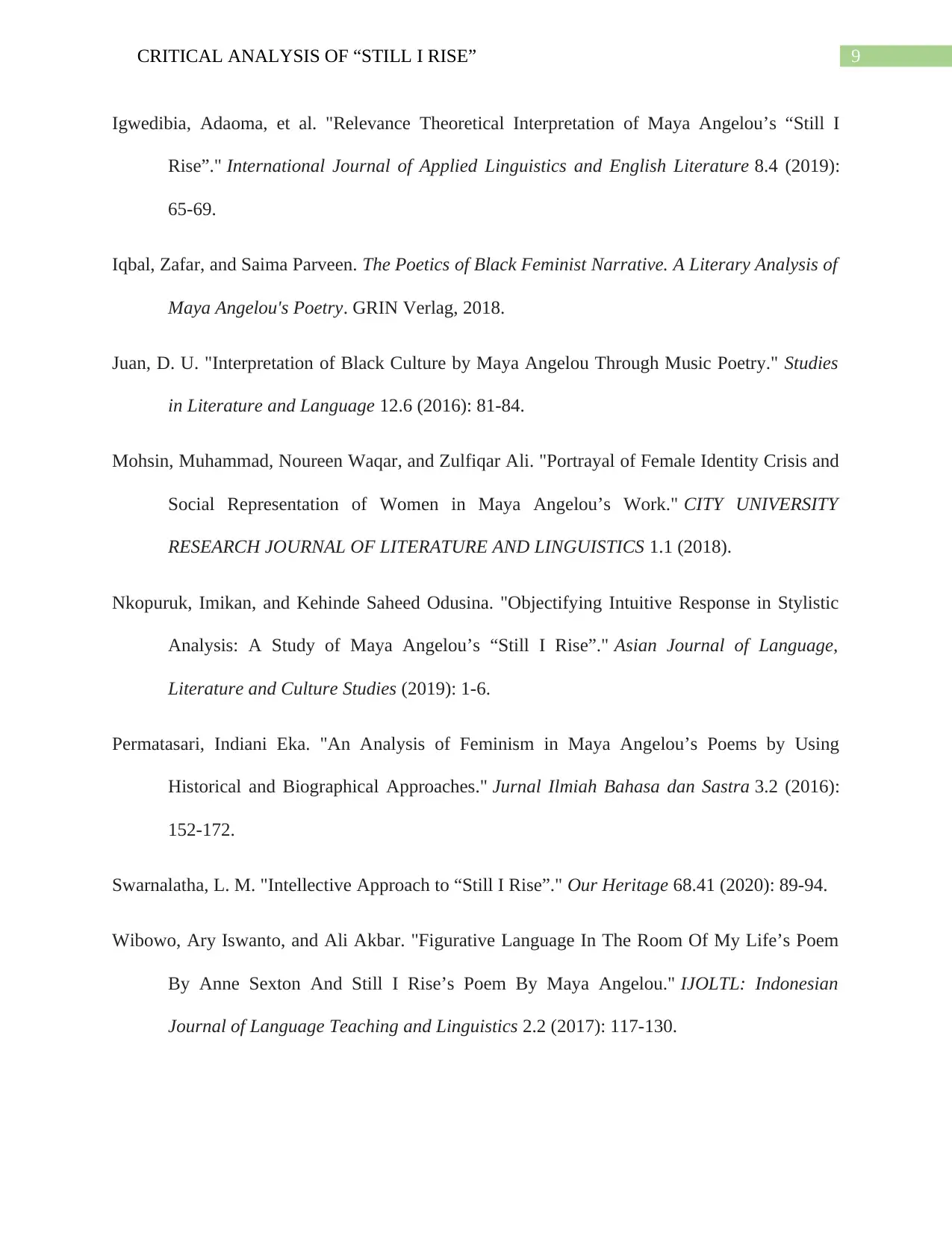
Igwedibia, Adaoma, et al. "Relevance Theoretical Interpretation of Maya Angelou’s “Still I
Rise”." International Journal of Applied Linguistics and English Literature 8.4 (2019):
65-69.
Iqbal, Zafar, and Saima Parveen. The Poetics of Black Feminist Narrative. A Literary Analysis of
Maya Angelou's Poetry. GRIN Verlag, 2018.
Juan, D. U. "Interpretation of Black Culture by Maya Angelou Through Music Poetry." Studies
in Literature and Language 12.6 (2016): 81-84.
Mohsin, Muhammad, Noureen Waqar, and Zulfiqar Ali. "Portrayal of Female Identity Crisis and
Social Representation of Women in Maya Angelou’s Work." CITY UNIVERSITY
RESEARCH JOURNAL OF LITERATURE AND LINGUISTICS 1.1 (2018).
Nkopuruk, Imikan, and Kehinde Saheed Odusina. "Objectifying Intuitive Response in Stylistic
Analysis: A Study of Maya Angelou’s “Still I Rise”." Asian Journal of Language,
Literature and Culture Studies (2019): 1-6.
Permatasari, Indiani Eka. "An Analysis of Feminism in Maya Angelou’s Poems by Using
Historical and Biographical Approaches." Jurnal Ilmiah Bahasa dan Sastra 3.2 (2016):
152-172.
Swarnalatha, L. M. "Intellective Approach to “Still I Rise”." Our Heritage 68.41 (2020): 89-94.
Wibowo, Ary Iswanto, and Ali Akbar. "Figurative Language In The Room Of My Life’s Poem
By Anne Sexton And Still I Rise’s Poem By Maya Angelou." IJOLTL: Indonesian
Journal of Language Teaching and Linguistics 2.2 (2017): 117-130.
Igwedibia, Adaoma, et al. "Relevance Theoretical Interpretation of Maya Angelou’s “Still I
Rise”." International Journal of Applied Linguistics and English Literature 8.4 (2019):
65-69.
Iqbal, Zafar, and Saima Parveen. The Poetics of Black Feminist Narrative. A Literary Analysis of
Maya Angelou's Poetry. GRIN Verlag, 2018.
Juan, D. U. "Interpretation of Black Culture by Maya Angelou Through Music Poetry." Studies
in Literature and Language 12.6 (2016): 81-84.
Mohsin, Muhammad, Noureen Waqar, and Zulfiqar Ali. "Portrayal of Female Identity Crisis and
Social Representation of Women in Maya Angelou’s Work." CITY UNIVERSITY
RESEARCH JOURNAL OF LITERATURE AND LINGUISTICS 1.1 (2018).
Nkopuruk, Imikan, and Kehinde Saheed Odusina. "Objectifying Intuitive Response in Stylistic
Analysis: A Study of Maya Angelou’s “Still I Rise”." Asian Journal of Language,
Literature and Culture Studies (2019): 1-6.
Permatasari, Indiani Eka. "An Analysis of Feminism in Maya Angelou’s Poems by Using
Historical and Biographical Approaches." Jurnal Ilmiah Bahasa dan Sastra 3.2 (2016):
152-172.
Swarnalatha, L. M. "Intellective Approach to “Still I Rise”." Our Heritage 68.41 (2020): 89-94.
Wibowo, Ary Iswanto, and Ali Akbar. "Figurative Language In The Room Of My Life’s Poem
By Anne Sexton And Still I Rise’s Poem By Maya Angelou." IJOLTL: Indonesian
Journal of Language Teaching and Linguistics 2.2 (2017): 117-130.

1 out of 10


Related Documents


Your All-in-One AI-Powered Toolkit for Academic Success.
+13062052269
info@desklib.com
Available 24*7 on WhatsApp / Email
![[object Object]](/_next/static/media/star-bottom.7253800d.svg)
Unlock your academic potential
Copyright © 2020–2025 A2Z Services. All Rights Reserved. Developed and managed by ZUCOL.