Assessment 2: Learning Resource Workbook on Stoma Care and Management
VerifiedAdded on 2023/06/04
|10
|2734
|179
Homework Assignment
AI Summary
This learning resource workbook, designed for first-year registered nursing students, focuses on stoma care and management. It covers essential topics such as stoma types (colostomy, ileostomy, and urostomy), digestive system processes, stoma operations, the role of a stoma care nurse, effective communication, postoperative care, stoma abnormalities, patient self-care, and safe discharge protocols. The workbook aims to develop critical nursing skills, including identifying different types of stoma, describing the role of stoma care nurses, and understanding patient support needs. It also includes information on dietary needs and safe hospital discharge procedures. The workbook provides illustrations, case studies, and challenges related to stoma management, equipping nursing students with the necessary knowledge and skills for clinical practice.

Navigating Transitions 2018: Assessment 2 – Learning Resource Workbook
Navigating Transitions Assessment Task 2: Learning Resource – Short Workbook template
Title of Workbook: Stoma care & management workbook
Student Name: Student Number:
Intended Audience: First Year registered nursing students’
Audience Learning Objectives
- The key objective for the workbook is to develop critical nursing skills to lay a foundation for stoma
care among first-year registered nurses.
Workbook addressing stoma care management
Learning needs to be enjoyable and a challenging process which the learners are able to understand each
other’s roles differently. Various methods are effective in enhancing this; these methods include student
participation, group discussion, workbook assessments, and practice opportunities.
Nurses are paramedics who have appropriate qualifications and the needed technical expertise who can
be able to provide both normal and emergency care services, (Metcalf, 2017). The expected learning
outcomes for this task entail ;
- registered nurse students being able to identify different kinds of stoma and
- Identification of different kinds of stoma abnormalities.
- to describe the role of stoma care nurse for patients with stoma condition, care offered during the
postoperative period,
- description of patient support needs for enhancing independence
- understanding an overview of general dietary needs for stoma care patient
- description of the process of safe hospital discharge (Barnwell, 2015)
Participation statement
Statement of participation will be offered upon successful completion and achievement of the assessment
task.
Course evaluation
Student feedback will be issued to the learner in relation to the course input and output.
Expected learning topics covered towards stoma care management
Contents
1. What is stoma?
2. Digestive system process
3. Stoma operations
Navigating Transitions Assessment Task 2: Learning Resource – Short Workbook template
Title of Workbook: Stoma care & management workbook
Student Name: Student Number:
Intended Audience: First Year registered nursing students’
Audience Learning Objectives
- The key objective for the workbook is to develop critical nursing skills to lay a foundation for stoma
care among first-year registered nurses.
Workbook addressing stoma care management
Learning needs to be enjoyable and a challenging process which the learners are able to understand each
other’s roles differently. Various methods are effective in enhancing this; these methods include student
participation, group discussion, workbook assessments, and practice opportunities.
Nurses are paramedics who have appropriate qualifications and the needed technical expertise who can
be able to provide both normal and emergency care services, (Metcalf, 2017). The expected learning
outcomes for this task entail ;
- registered nurse students being able to identify different kinds of stoma and
- Identification of different kinds of stoma abnormalities.
- to describe the role of stoma care nurse for patients with stoma condition, care offered during the
postoperative period,
- description of patient support needs for enhancing independence
- understanding an overview of general dietary needs for stoma care patient
- description of the process of safe hospital discharge (Barnwell, 2015)
Participation statement
Statement of participation will be offered upon successful completion and achievement of the assessment
task.
Course evaluation
Student feedback will be issued to the learner in relation to the course input and output.
Expected learning topics covered towards stoma care management
Contents
1. What is stoma?
2. Digestive system process
3. Stoma operations

Paraphrase This Document
Need a fresh take? Get an instant paraphrase of this document with our AI Paraphraser

Navigating Transitions 2018: Assessment 2 – Learning Resource Workbook
4. Ileostomy
5. Colostomy
6. Urostomy
7. Role and function of stoma nurse
8. Effective communication
9. Postoperative care
10. Stoma management and related abnormalities
11. Patient self-care
12. Safe discharge protocol (Harrison & Howlett, 2016 pp 37-38)
At the end of the learning sessions, the registered nurse will be able to identify various stomas
affecting patients. In this way will gain an overview of various aspects which are needed on patient
management practices. The students will be able to identify various stoma care management
process and be able to identify various types of the stoma. Further issues surrounding stoma care
will be enhanced. This is geared to offer learners an in-depth understanding prior to their
practicum session, (McGee, 2016 pp 2032).
The workbook is geared in providing the learners with adequate knowledge and skill in handling
stoma patients. The workbook will be able to provide illustration and key case study illustrations
which enhanced registered nurse students in their first year of study, (Burch, 2017 pp 44). Further,
the workbook will offer the learner some of the challenges which often occur when managing
stoma among the patients. Further, an illustration of coping mechanism to enhance patients with
is thoroughly and adequately covered in the workbook.
Hence this workbook is geared towards equipping registered nurse students inadequate skills
which will help them in coping with nursing skills as they prepare themselves for clinical nursing
practice, (Zimnicki & Pieper, 2018).
Expected learning outcome
Learning will be expected to provide a nursing care for the following case study;
4. Ileostomy
5. Colostomy
6. Urostomy
7. Role and function of stoma nurse
8. Effective communication
9. Postoperative care
10. Stoma management and related abnormalities
11. Patient self-care
12. Safe discharge protocol (Harrison & Howlett, 2016 pp 37-38)
At the end of the learning sessions, the registered nurse will be able to identify various stomas
affecting patients. In this way will gain an overview of various aspects which are needed on patient
management practices. The students will be able to identify various stoma care management
process and be able to identify various types of the stoma. Further issues surrounding stoma care
will be enhanced. This is geared to offer learners an in-depth understanding prior to their
practicum session, (McGee, 2016 pp 2032).
The workbook is geared in providing the learners with adequate knowledge and skill in handling
stoma patients. The workbook will be able to provide illustration and key case study illustrations
which enhanced registered nurse students in their first year of study, (Burch, 2017 pp 44). Further,
the workbook will offer the learner some of the challenges which often occur when managing
stoma among the patients. Further, an illustration of coping mechanism to enhance patients with
is thoroughly and adequately covered in the workbook.
Hence this workbook is geared towards equipping registered nurse students inadequate skills
which will help them in coping with nursing skills as they prepare themselves for clinical nursing
practice, (Zimnicki & Pieper, 2018).
Expected learning outcome
Learning will be expected to provide a nursing care for the following case study;

Navigating Transitions 2018: Assessment 2 – Learning Resource Workbook
⊘ This is a preview!⊘
Do you want full access?
Subscribe today to unlock all pages.

Trusted by 1+ million students worldwide
Navigating Transitions 2018: Assessment 2 – Learning Resource Workbook
Workbook
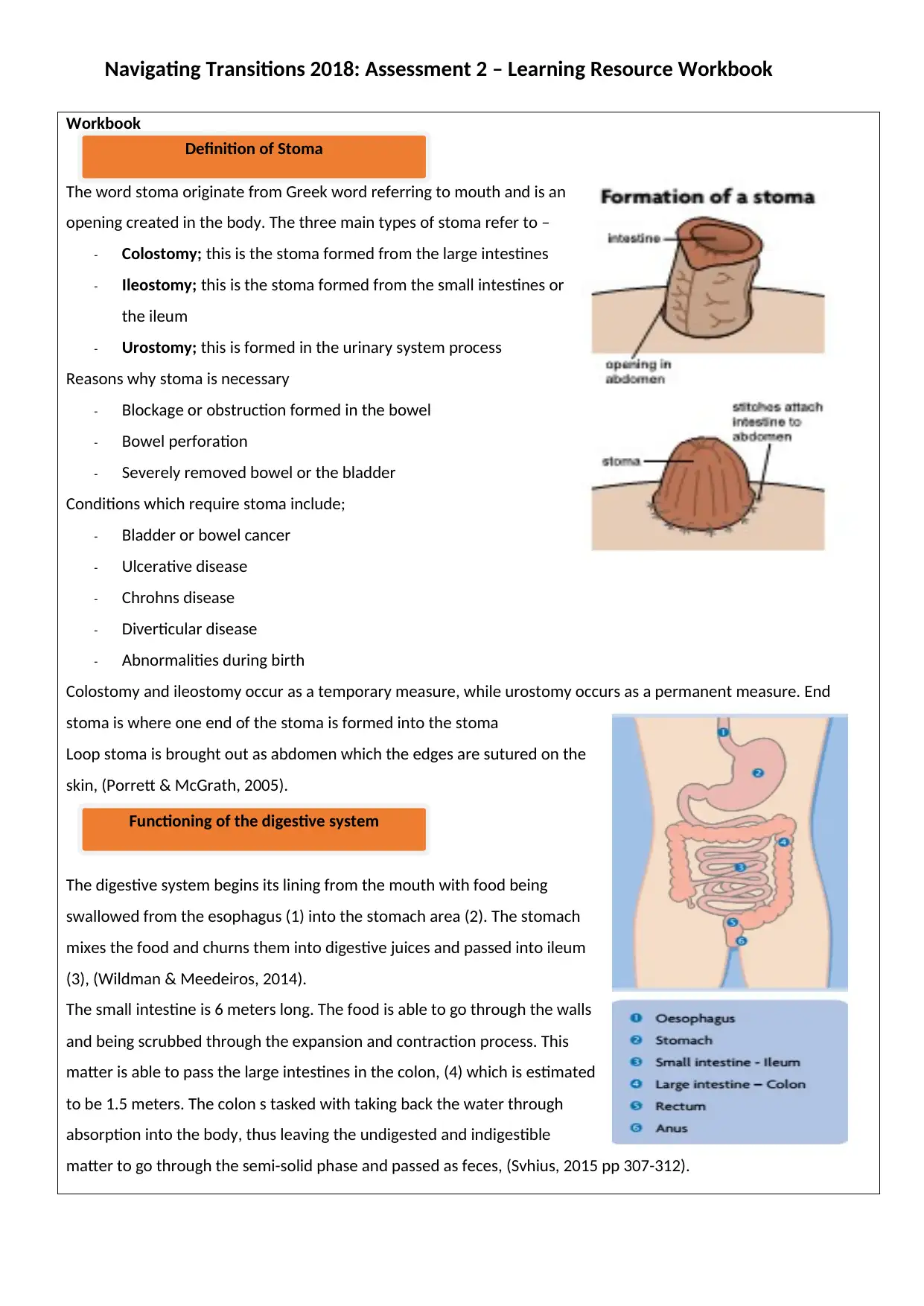
The word stoma originate from Greek word referring to mouth and is an
opening created in the body. The three main types of stoma refer to –
- Colostomy; this is the stoma formed from the large intestines
- Ileostomy; this is the stoma formed from the small intestines or
the ileum
- Urostomy; this is formed in the urinary system process
Reasons why stoma is necessary
- Blockage or obstruction formed in the bowel
- Bowel perforation
- Severely removed bowel or the bladder
Conditions which require stoma include;
- Bladder or bowel cancer
- Ulcerative disease
- Chrohns disease
- Diverticular disease
- Abnormalities during birth
Colostomy and ileostomy occur as a temporary measure, while urostomy occurs as a permanent measure. End
stoma is where one end of the stoma is formed into the stoma
Loop stoma is brought out as abdomen which the edges are sutured on the
skin, (Porrett & McGrath, 2005).
The digestive system begins its lining from the mouth with food being
swallowed from the esophagus (1) into the stomach area (2). The stomach
mixes the food and churns them into digestive juices and passed into ileum
(3), (Wildman & Meedeiros, 2014).
The small intestine is 6 meters long. The food is able to go through the walls
and being scrubbed through the expansion and contraction process. This
matter is able to pass the large intestines in the colon, (4) which is estimated
to be 1.5 meters. The colon s tasked with taking back the water through
absorption into the body, thus leaving the undigested and indigestible
matter to go through the semi-solid phase and passed as feces, (Svhius, 2015 pp 307-312).
Definition of Stoma
Functioning of the digestive system
Workbook
The word stoma originate from Greek word referring to mouth and is an
opening created in the body. The three main types of stoma refer to –
- Colostomy; this is the stoma formed from the large intestines
- Ileostomy; this is the stoma formed from the small intestines or
the ileum
- Urostomy; this is formed in the urinary system process
Reasons why stoma is necessary
- Blockage or obstruction formed in the bowel
- Bowel perforation
- Severely removed bowel or the bladder
Conditions which require stoma include;
- Bladder or bowel cancer
- Ulcerative disease
- Chrohns disease
- Diverticular disease
- Abnormalities during birth
Colostomy and ileostomy occur as a temporary measure, while urostomy occurs as a permanent measure. End
stoma is where one end of the stoma is formed into the stoma
Loop stoma is brought out as abdomen which the edges are sutured on the
skin, (Porrett & McGrath, 2005).
The digestive system begins its lining from the mouth with food being
swallowed from the esophagus (1) into the stomach area (2). The stomach
mixes the food and churns them into digestive juices and passed into ileum
(3), (Wildman & Meedeiros, 2014).
The small intestine is 6 meters long. The food is able to go through the walls
and being scrubbed through the expansion and contraction process. This
matter is able to pass the large intestines in the colon, (4) which is estimated
to be 1.5 meters. The colon s tasked with taking back the water through
absorption into the body, thus leaving the undigested and indigestible
matter to go through the semi-solid phase and passed as feces, (Svhius, 2015 pp 307-312).
Definition of Stoma
Functioning of the digestive system
Paraphrase This Document
Need a fresh take? Get an instant paraphrase of this document with our AI Paraphraser

Navigating Transitions 2018: Assessment 2 – Learning Resource Workbook
This occurs when part of the colon is removed temporarily to act as a bypass. This forces the feces from the body
Stoma Operations
Colostomy
This occurs when part of the colon is removed temporarily to act as a bypass. This forces the feces from the body
Stoma Operations
Colostomy
Navigating Transitions 2018: Assessment 2 – Learning Resource Workbook
not to pass the normal process.
Formation
A colostomy is formed surgically through the creation of the opening of the larger intestines. The colon is directed
towards the abdominal wall and later sutured in the skin. A colostomy can occur anywhere however it is commonly
placed at the left-hand side, (Zanella & Dileo, 2016).
Appearance
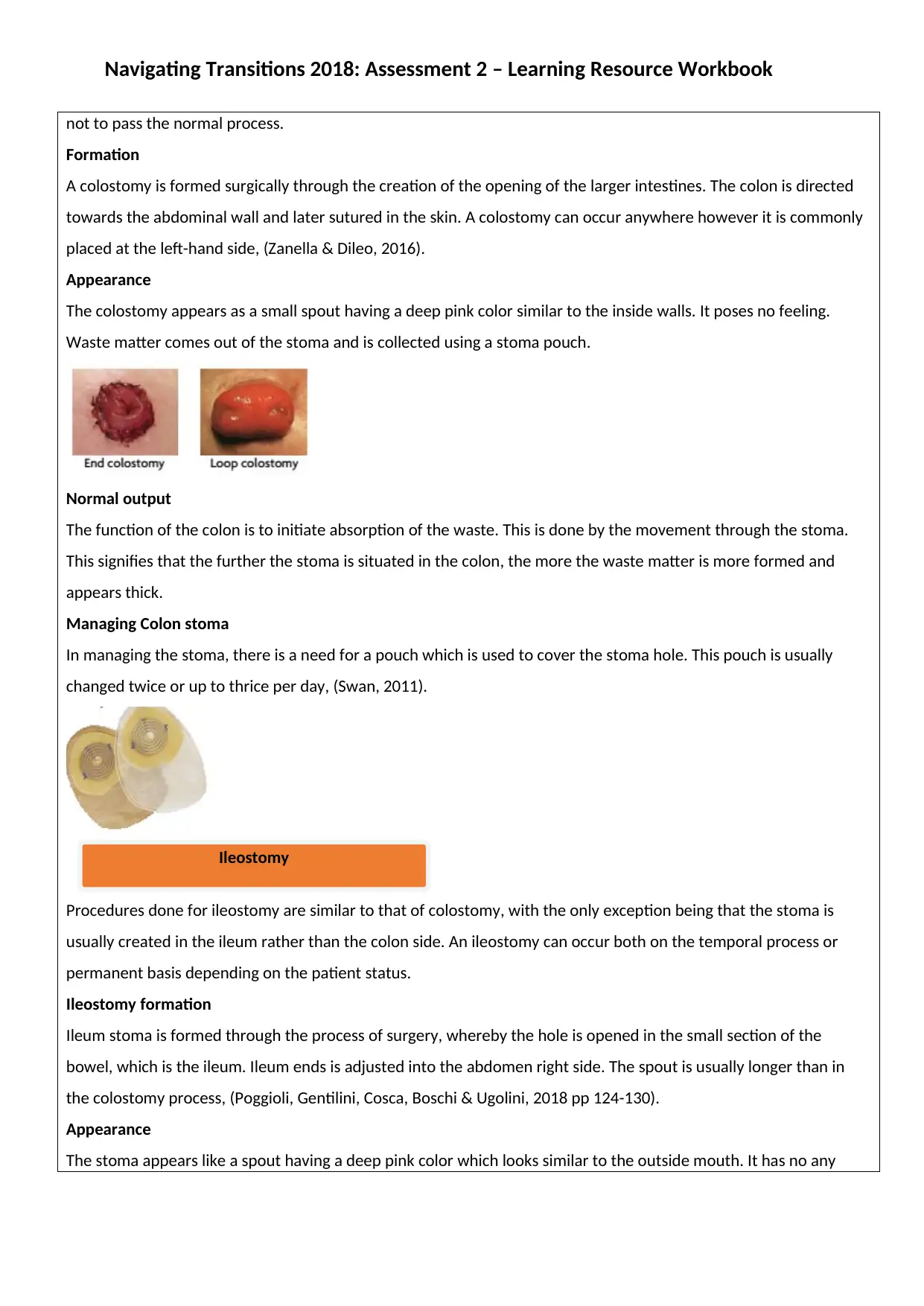
The colostomy appears as a small spout having a deep pink color similar to the inside walls. It poses no feeling.
Waste matter comes out of the stoma and is collected using a stoma pouch.
Normal output
The function of the colon is to initiate absorption of the waste. This is done by the movement through the stoma.
This signifies that the further the stoma is situated in the colon, the more the waste matter is more formed and
appears thick.
Managing Colon stoma
In managing the stoma, there is a need for a pouch which is used to cover the stoma hole. This pouch is usually
changed twice or up to thrice per day, (Swan, 2011).
Procedures done for ileostomy are similar to that of colostomy, with the only exception being that the stoma is
usually created in the ileum rather than the colon side. An ileostomy can occur both on the temporal process or
permanent basis depending on the patient status.
Ileostomy formation
Ileum stoma is formed through the process of surgery, whereby the hole is opened in the small section of the
bowel, which is the ileum. Ileum ends is adjusted into the abdomen right side. The spout is usually longer than in
the colostomy process, (Poggioli, Gentilini, Cosca, Boschi & Ugolini, 2018 pp 124-130).
Appearance
The stoma appears like a spout having a deep pink color which looks similar to the outside mouth. It has no any
Ileostomy
not to pass the normal process.
Formation
A colostomy is formed surgically through the creation of the opening of the larger intestines. The colon is directed
towards the abdominal wall and later sutured in the skin. A colostomy can occur anywhere however it is commonly
placed at the left-hand side, (Zanella & Dileo, 2016).
Appearance
The colostomy appears as a small spout having a deep pink color similar to the inside walls. It poses no feeling.
Waste matter comes out of the stoma and is collected using a stoma pouch.
Normal output
The function of the colon is to initiate absorption of the waste. This is done by the movement through the stoma.
This signifies that the further the stoma is situated in the colon, the more the waste matter is more formed and
appears thick.
Managing Colon stoma
In managing the stoma, there is a need for a pouch which is used to cover the stoma hole. This pouch is usually
changed twice or up to thrice per day, (Swan, 2011).
Procedures done for ileostomy are similar to that of colostomy, with the only exception being that the stoma is
usually created in the ileum rather than the colon side. An ileostomy can occur both on the temporal process or
permanent basis depending on the patient status.
Ileostomy formation
Ileum stoma is formed through the process of surgery, whereby the hole is opened in the small section of the
bowel, which is the ileum. Ileum ends is adjusted into the abdomen right side. The spout is usually longer than in
the colostomy process, (Poggioli, Gentilini, Cosca, Boschi & Ugolini, 2018 pp 124-130).
Appearance
The stoma appears like a spout having a deep pink color which looks similar to the outside mouth. It has no any
Ileostomy
⊘ This is a preview!⊘
Do you want full access?
Subscribe today to unlock all pages.
Trusted by 1+ million students worldwide

Navigating Transitions 2018: Assessment 2 – Learning Resource Workbook
feeling of touch. It releases waste and collected through
the special pouch which is fixed on it.
The normal output of stoma
Due to the waste not able to travel through the section
well, a small volume of water is absorbed and the feces
released from the ileostomy usually in liquid form. The
average output of an abnormal stoma is estimated to be
around 500-800 mls in a period of 24 hours, with more
content of the liquid form.
Mucous fistula
This occurs when the rectum has not been completely
been removed but is left on the side need, this can be
brought to the surface through small opening referred to
as mucous fistula. Normally after surgery, the excess is
drained through the mucous fistula and this can be
mitigated through the emergency procedure.
Normally it is can be mitigated using a small pouch, which
allows for dressing after a few weeks.
Management appliance
An opening of the ileum is usually managed using a drainable pouch, which can be emptied between 4-6 times in a
day. The pouch can be changed any day every time with the patient.
(Ashburn & Hull, 2018)
Working of the urinary system
The urinary carries out various functions. The body function is engaged with the process of producing waste
chemicals which are channeled through the blood. The kidneys in the body continue to filter the blood in order to
purify it. The urine content formed is passed through the kidneys and goes to the uterus and filled into the bladder,
where storage occurs. This is then passed through the ureter and it goes to the urethra.
Occurrence of urostomy
During the urostomy process, the urine is channelled through other ways. Instead of the bladder process and
urethra, the urine is passed to the uterus and is diverted to the surface through the opening in the abdomen.
Normally the stoma is placed on the right-hand side facing the abdomen, (Arolfo et al., 2018).
Formation of stoma
Urostomy
feeling of touch. It releases waste and collected through
the special pouch which is fixed on it.
The normal output of stoma
Due to the waste not able to travel through the section
well, a small volume of water is absorbed and the feces
released from the ileostomy usually in liquid form. The
average output of an abnormal stoma is estimated to be
around 500-800 mls in a period of 24 hours, with more
content of the liquid form.
Mucous fistula
This occurs when the rectum has not been completely
been removed but is left on the side need, this can be
brought to the surface through small opening referred to
as mucous fistula. Normally after surgery, the excess is
drained through the mucous fistula and this can be
mitigated through the emergency procedure.
Normally it is can be mitigated using a small pouch, which
allows for dressing after a few weeks.
Management appliance
An opening of the ileum is usually managed using a drainable pouch, which can be emptied between 4-6 times in a
day. The pouch can be changed any day every time with the patient.
(Ashburn & Hull, 2018)
Working of the urinary system
The urinary carries out various functions. The body function is engaged with the process of producing waste
chemicals which are channeled through the blood. The kidneys in the body continue to filter the blood in order to
purify it. The urine content formed is passed through the kidneys and goes to the uterus and filled into the bladder,
where storage occurs. This is then passed through the ureter and it goes to the urethra.
Occurrence of urostomy
During the urostomy process, the urine is channelled through other ways. Instead of the bladder process and
urethra, the urine is passed to the uterus and is diverted to the surface through the opening in the abdomen.
Normally the stoma is placed on the right-hand side facing the abdomen, (Arolfo et al., 2018).
Formation of stoma
Urostomy
Paraphrase This Document
Need a fresh take? Get an instant paraphrase of this document with our AI Paraphraser

Navigating Transitions 2018: Assessment 2 – Learning Resource Workbook
Creation of the stoma which cuts through the abdomen, small
pieces of the ileum is removed and used to fashion the tube in
the ileal conduit. The two formed ureters are then channeled
through to the ileal conduit which is open as a stoma.
Normal output occurrence
The normal output process occurs as an occurrence of
continuous urine flow which has mucus.
Management appliance
Its management is undertaken using a pouch which requires
emptying several times a day. Urostomy has been made to have
continuous drainable bag during night times. The pouch needs
changing every day.
Patients with stoma need constant attention of a specialist nurse
with adequate skills and to offer technical and special support to
the patient. Nurses offer the following component of care to the
patients with a stoma.
Clinical care
- The nurse provides patient care and guides stoma management
Education
- The nurse provides assessment and teaching the patient and develop educational based resources for the
patient to enhance self-care
Management
- Facilitates management both at the ward and administration stoma care services for the patients.
(Bhargava, Chasen & Feldstain, 2018 pp 640-650)
- Stoma has a great impact on a nurse image and patient self-image and self-esteem
- Incorporating practical and emotional needs of the patient while communicating stoma care. Emotional
needs entail how the patient is feeling while the practical needs entail how the stoma is managed
Communication needs for the nurse
Role of a nurse
Creation of the stoma which cuts through the abdomen, small
pieces of the ileum is removed and used to fashion the tube in
the ileal conduit. The two formed ureters are then channeled
through to the ileal conduit which is open as a stoma.
Normal output occurrence
The normal output process occurs as an occurrence of
continuous urine flow which has mucus.
Management appliance
Its management is undertaken using a pouch which requires
emptying several times a day. Urostomy has been made to have
continuous drainable bag during night times. The pouch needs
changing every day.
Patients with stoma need constant attention of a specialist nurse
with adequate skills and to offer technical and special support to
the patient. Nurses offer the following component of care to the
patients with a stoma.
Clinical care
- The nurse provides patient care and guides stoma management
Education
- The nurse provides assessment and teaching the patient and develop educational based resources for the
patient to enhance self-care
Management
- Facilitates management both at the ward and administration stoma care services for the patients.
(Bhargava, Chasen & Feldstain, 2018 pp 640-650)
- Stoma has a great impact on a nurse image and patient self-image and self-esteem
- Incorporating practical and emotional needs of the patient while communicating stoma care. Emotional
needs entail how the patient is feeling while the practical needs entail how the stoma is managed
Communication needs for the nurse
Role of a nurse

Navigating Transitions 2018: Assessment 2 – Learning Resource Workbook
- Being sensitive in communicating using the right language and being in cognisant with facial expression.
- Supporting the patient in enhancing stoma care management and assisting the patients enhancing
independence.
- Incorporating effective communication for the patient and notifying stoma care upon the admission of a
stoma patient.
This relies on the nurses to offer care for the patient. This will be enhanced through two processes which entail
monitoring and redoing stoma conditions. This entails the color, size and skin touch.
Secondly entails monitoring and measuring the stoma output of the patient. This is done through regular emptying
of the stoma output. (Gibson & Hardy, 2007)
Recognizing stoma care abnormalities is very crucial for stoma care. Notices on the skin, edema and bleeding stoma
are the key factors to assess common complications of the stoma.
Other abnormalities include;
- Relapse,
- Retraction
- Skin creases
- Stenosis
- Mucocutaneous separation process
- A parastomal hernia
It is important to teach the patient on self-care process. This details to;
- Good hygiene
- Pouch emptying process
Enabling safe discharge process.
Postoperative care for the patient
Stoma abnormalities
Patient self-care
- Being sensitive in communicating using the right language and being in cognisant with facial expression.
- Supporting the patient in enhancing stoma care management and assisting the patients enhancing
independence.
- Incorporating effective communication for the patient and notifying stoma care upon the admission of a
stoma patient.
This relies on the nurses to offer care for the patient. This will be enhanced through two processes which entail
monitoring and redoing stoma conditions. This entails the color, size and skin touch.
Secondly entails monitoring and measuring the stoma output of the patient. This is done through regular emptying
of the stoma output. (Gibson & Hardy, 2007)
Recognizing stoma care abnormalities is very crucial for stoma care. Notices on the skin, edema and bleeding stoma
are the key factors to assess common complications of the stoma.
Other abnormalities include;
- Relapse,
- Retraction
- Skin creases
- Stenosis
- Mucocutaneous separation process
- A parastomal hernia
It is important to teach the patient on self-care process. This details to;
- Good hygiene
- Pouch emptying process
Enabling safe discharge process.
Postoperative care for the patient
Stoma abnormalities
Patient self-care
⊘ This is a preview!⊘
Do you want full access?
Subscribe today to unlock all pages.
Trusted by 1+ million students worldwide

Navigating Transitions 2018: Assessment 2 – Learning Resource Workbook
References:
Arolfo, S., Borgiotto, C., Bosio, G., Mistrangelo, M., Allaix, M.E. and Morino, M., 2018. Preoperative stoma
site marking: a simple practice to reduce stoma-related complications. Techniques in Coloproctology, pp.1-
5.
Ashburn, J.H. and Hull, T.L., 2018. Management of Ileal Pouch Strictures and Anal Stricturing Disease: A
Clinical Challenge. In Fibrostenotic Inflammatory Bowel Disease (pp. 253-266). Springer, Cham.
Barnwell, A., 2015. Advanced nursing practice in colorectal and stoma care. Gastrointestinal Nursing,
13(1), pp.42-48.
Bhargava, R., Chasen, M.R. and Feldstain, A., 2018. Rehabilitation and Survivorship. In The MASCC
Textbook of Cancer Supportive Care and Survivorship (pp. 635-651). Springer, Cham.
Burch, J., 2017. Care of patients undergoing stoma formation: what the nurse needs to know. Nursing
standard (Royal College of Nursing (Great Britain): 1987), 31(41), pp.40-45.
Gibson, P. & Hardy, L (007. Cumbria Competence and Training: Assisting clients with stoma management.
Cumbria Changing Workforce Project, 64(8), pp.35-42.
Harrison, P. and Howlett, K., 2016. Developing a stoma care training programme through a unique
university–industry collaboration. Gastrointestinal Nursing, 14(1), pp.36-42.
McGee, M.F., 2016. Stomas. Jama, 315(18), pp.2032-2032.
Metcalf, C., 2017. Evaluating nursing standards in a stoma care service: results of an internal audit.
Gastrointestinal Nursing, 15(4), pp.35-41.
Poggioli, G., Gentilini, L., Coscia, M., Boschi, L. and Ugolini, F., 2018. Surgical Treatment of Ulcerative
Colitis: Indications and Techniques. In Ulcerative Colitis (pp. 123-138). Springer, Milano.
Porrett, T. & McGrath, A. eds. 2005. Stoma Care. Blackwell Publishing, Oxford
Stephenson, N 2008. Self-directed learning: communication. British Journal of Healthcare Assistants, 2(6),
p301-303
Svihus, B., 2014. Function of the digestive system. Journal of Applied Poultry Research, 23(2), pp.306-314.
Swan, E., 2011. Colostomy, management and quality of life for the patient. British Journal of Nursing,
20(1), pp.22-28.
Wildman, R.E. and Medeiros, D.M., 2014. Advanced human nutrition. CRC press.
Zanella, S. and Di Leo, A., 2016. Use of Vacuum-Assisted Closure in the Management of Colostomy.
Surgical Infections Case Reports, 1(1), pp.165-168.
Zimnicki, K. and Pieper, B., 2018. Assessment of Prelicensure Undergraduate Baccalaureate Nursing
Students: Ostomy Knowledge, Skill Experiences, and Confidence in Care. Ostomy/wound management,
64(8), pp.35-42
References:
Arolfo, S., Borgiotto, C., Bosio, G., Mistrangelo, M., Allaix, M.E. and Morino, M., 2018. Preoperative stoma
site marking: a simple practice to reduce stoma-related complications. Techniques in Coloproctology, pp.1-
5.
Ashburn, J.H. and Hull, T.L., 2018. Management of Ileal Pouch Strictures and Anal Stricturing Disease: A
Clinical Challenge. In Fibrostenotic Inflammatory Bowel Disease (pp. 253-266). Springer, Cham.
Barnwell, A., 2015. Advanced nursing practice in colorectal and stoma care. Gastrointestinal Nursing,
13(1), pp.42-48.
Bhargava, R., Chasen, M.R. and Feldstain, A., 2018. Rehabilitation and Survivorship. In The MASCC
Textbook of Cancer Supportive Care and Survivorship (pp. 635-651). Springer, Cham.
Burch, J., 2017. Care of patients undergoing stoma formation: what the nurse needs to know. Nursing
standard (Royal College of Nursing (Great Britain): 1987), 31(41), pp.40-45.
Gibson, P. & Hardy, L (007. Cumbria Competence and Training: Assisting clients with stoma management.
Cumbria Changing Workforce Project, 64(8), pp.35-42.
Harrison, P. and Howlett, K., 2016. Developing a stoma care training programme through a unique
university–industry collaboration. Gastrointestinal Nursing, 14(1), pp.36-42.
McGee, M.F., 2016. Stomas. Jama, 315(18), pp.2032-2032.
Metcalf, C., 2017. Evaluating nursing standards in a stoma care service: results of an internal audit.
Gastrointestinal Nursing, 15(4), pp.35-41.
Poggioli, G., Gentilini, L., Coscia, M., Boschi, L. and Ugolini, F., 2018. Surgical Treatment of Ulcerative
Colitis: Indications and Techniques. In Ulcerative Colitis (pp. 123-138). Springer, Milano.
Porrett, T. & McGrath, A. eds. 2005. Stoma Care. Blackwell Publishing, Oxford
Stephenson, N 2008. Self-directed learning: communication. British Journal of Healthcare Assistants, 2(6),
p301-303
Svihus, B., 2014. Function of the digestive system. Journal of Applied Poultry Research, 23(2), pp.306-314.
Swan, E., 2011. Colostomy, management and quality of life for the patient. British Journal of Nursing,
20(1), pp.22-28.
Wildman, R.E. and Medeiros, D.M., 2014. Advanced human nutrition. CRC press.
Zanella, S. and Di Leo, A., 2016. Use of Vacuum-Assisted Closure in the Management of Colostomy.
Surgical Infections Case Reports, 1(1), pp.165-168.
Zimnicki, K. and Pieper, B., 2018. Assessment of Prelicensure Undergraduate Baccalaureate Nursing
Students: Ostomy Knowledge, Skill Experiences, and Confidence in Care. Ostomy/wound management,
64(8), pp.35-42

1 out of 10


Related Documents


Your All-in-One AI-Powered Toolkit for Academic Success.
+13062052269
info@desklib.com
Available 24*7 on WhatsApp / Email
![[object Object]](/_next/static/media/star-bottom.7253800d.svg)
Unlock your academic potential
Copyright © 2020–2025 A2Z Services. All Rights Reserved. Developed and managed by ZUCOL.