PS1010 Semester 2 Developmental Psychology: Child Observation Lab

Verified

Added on  2023/06/15

|13
|2023
|191
Report
AI Summary
This report details a child observation lab experiment based on the "strange situation" model, examining preschool children's social and emotional development in relation to their caregivers. The study involved observing ten preschool children in eight different scenarios, including interactions with their caregiver and a stranger, as well as periods of being alone. The children's locomotion, visual exploration, exploratory manipulation, and social acts were recorded and analyzed. Statistical analysis using the Wilcoxon signed-rank test revealed significant differences in the children's behavior depending on the presence or absence of the caregiver and the stranger. The results indicated that children exhibited better locomotion and social interaction when with their caregiver compared to being alone or in the presence of a stranger, highlighting the importance of a secure caregiver relationship for healthy social and emotional development. Appendices include detailed descriptions of the experimental episodes, data tables, reliability scores, and statistical test results. Desklib provides access to similar reports and study tools for students.
Document Page
P a g e | 1
OBSERVATIONS OF PRE-SCHOOL
CHILDREN
IN THE “STRANGE SITUATION”
Student Name: Student ID:
Subject Name: Subject ID:
Due Date:
tabler-icon-diamond-filled.svg

Paraphrase This Document

Need a fresh take? Get an instant paraphrase of this document with our AI Paraphraser
Document Page
P a g e | 2
ABSTRACT
Social and emotional development of a child greatly depends on the relationship with its
caregiver in early stages of childhood. The behavioral problem in pre-school stages is the root of
future socio and emotional problems. The adaptability of a child in presence of a stranger reflects
the healthy relation with the primary caregiver. A child will explore the world with confidence
and balanced emotion if it fells secured at loved at an early stages of life. On the contrary a child
with bad memories of early life becomes restless and unpredictable in school life and or in later
stages of life. The social and exploratory behavior of the child under the scope of the study have
been observed and recorded. The child was observed to behave and explore well with the
caregiver rather in the presence of the stranger or in alone situation. Bonding of the child with
the carer was keenly observed.
Document Page
P a g e | 3
METHOD
Participants
Pre-school children were selected for the purpose of the study. Parents were invited by the school
of psychology and they were informed about the activity and told that the activity of the child
will be recorded for the purpose of education. The parents were asked to send their kids with its
primary caregiver. It was assured that the recorded DVD will be stored in the department of
psychology and not distributed for any purpose. Total ten pre-school kids participated in the
activity.
Design
The experiment setup was done inside the play-room of the university main building. The
strange situation was repeated for the subjects completing the entire session of the experiment.
Locomotion, visual exploration, exploratory manipulation and social acts of the child were
observed. Two observers were there to observe and note the scores for the above for categories.
Materials
A one way mirror was installed for monitoring purpose. The floor of the room was a clear space
with toys and play kitchen set at one corner. Multicolor toys were also arranged for the purpose
and were placed on the floor in a scattered manner. A chair for the carer was placed in the middle
of the room. Another chair was placed near the door for the stranger. Instruction sheets were
provided to the carer and the stranger well before the start of the study sessions. A female student
Document Page
P a g e | 4
with a prior experience of young children was selected from the university to act as a stranger in
the entire episode. Video cameras were installed to record the entire situation. Technician Chloe
Ord. was present during the experiment to support the recording team.
Procedure
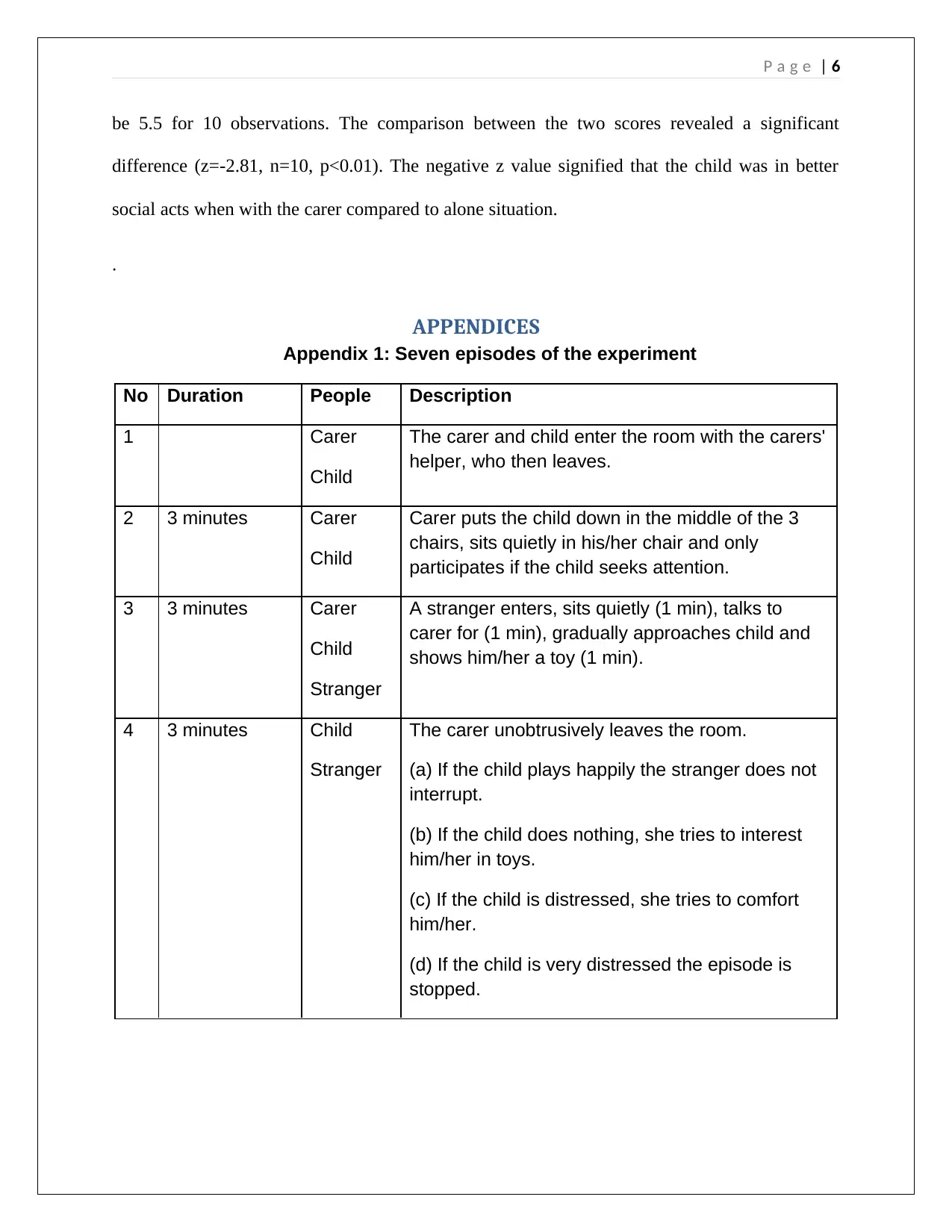
The entire episode was subdivided in eight sessions with different situations for the child, the
carer and the stranger. The behavior of the child was observed through the one-way mirror fitted
in the room and noted for the purpose of the study. Every sub session lasted for three minutes
and the readings of the behavior score of the child were taken in an interval of fifteen seconds.
The eighth session score was not taken into consideration. The subsections were arranged in
order of difficult situation for the child. The experiment started with the most comfortable
situation with the carer and the child. The stranger came in front of the child only in the third
session. The carer left the child in the fourth episode only to reunite in the fifth episode after 3
minutes. The situation was repeated if the child did not get distressed. The uncomfortable level
of the child was observed in every episode. Continuation of any of the episode was stopped in
case of distress caused to the child. Four main behaviors of the child were recorded. They were
locomotion, visual exploration, exploratory manipulation and social acts.
Reliability of data
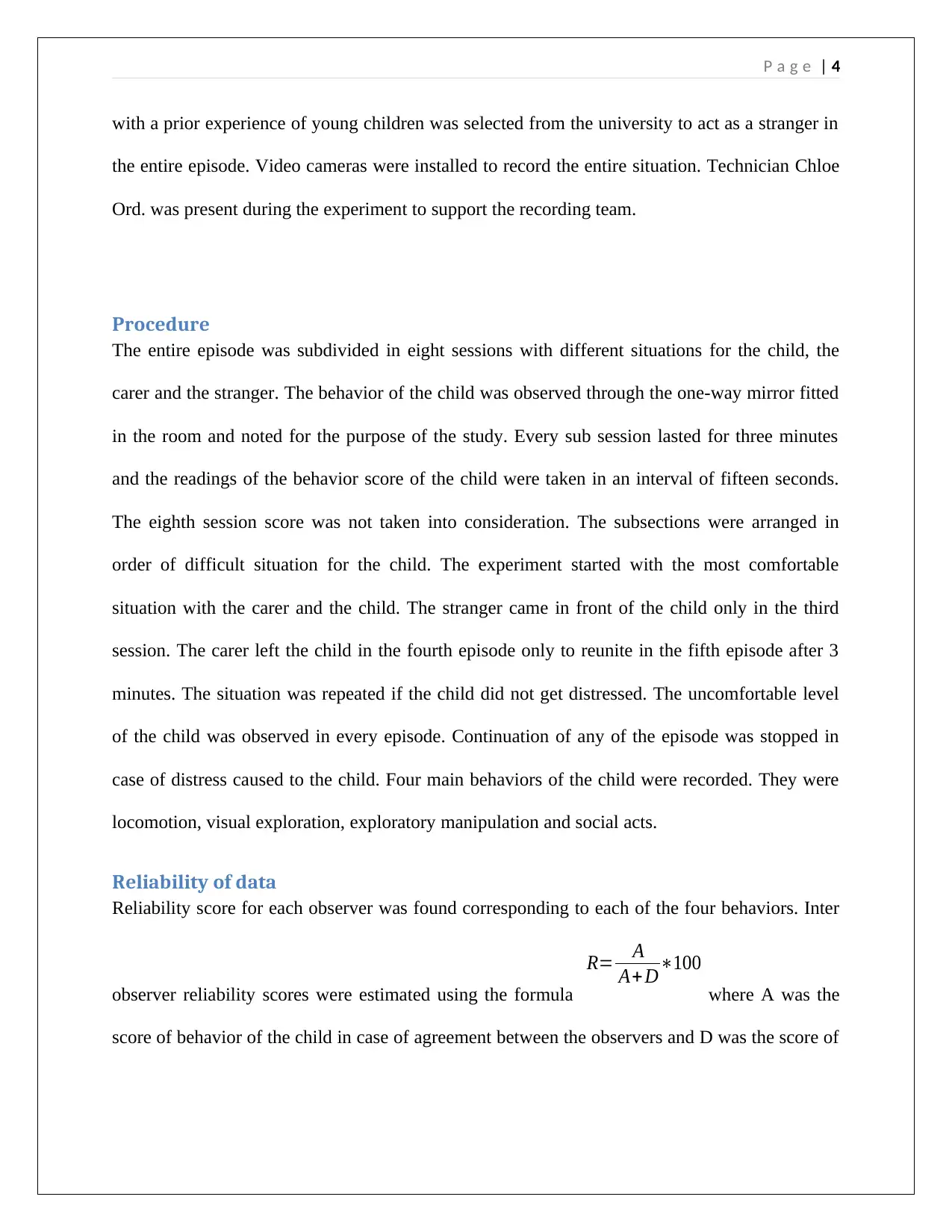
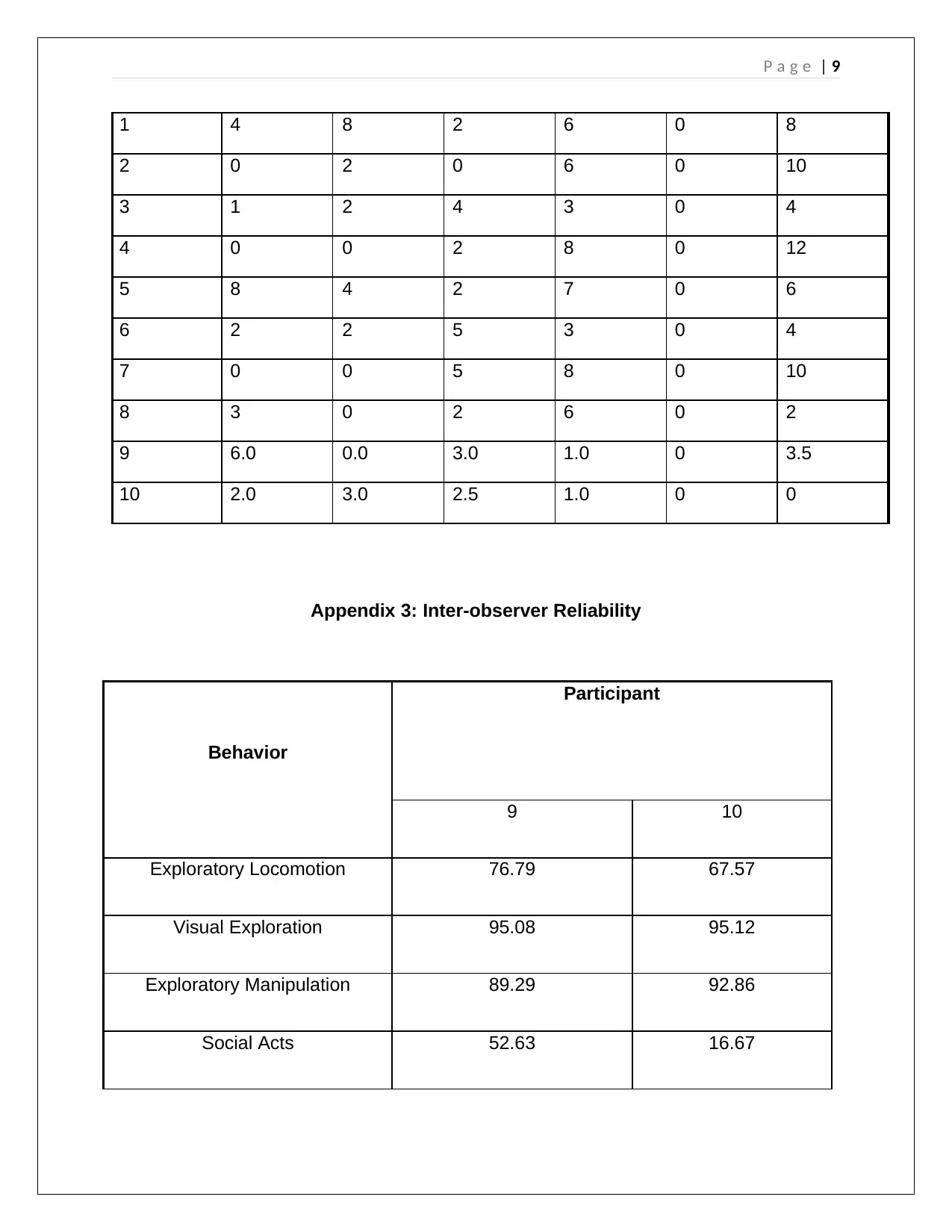
Reliability score for each observer was found corresponding to each of the four behaviors. Inter
observer reliability scores were estimated using the formula
R= A
A+ D100
where A was the
score of behavior of the child in case of agreement between the observers and D was the score of
tabler-icon-diamond-filled.svg

Paraphrase This Document

Need a fresh take? Get an instant paraphrase of this document with our AI Paraphraser
Document Page
P a g e | 5
individual observations of the observers. The scores were found to be reliable for further
analysis.
RESULTS
The scores for each behavior were found for ten children and were used for further analysis.
Exploration with carer’s presence and absence
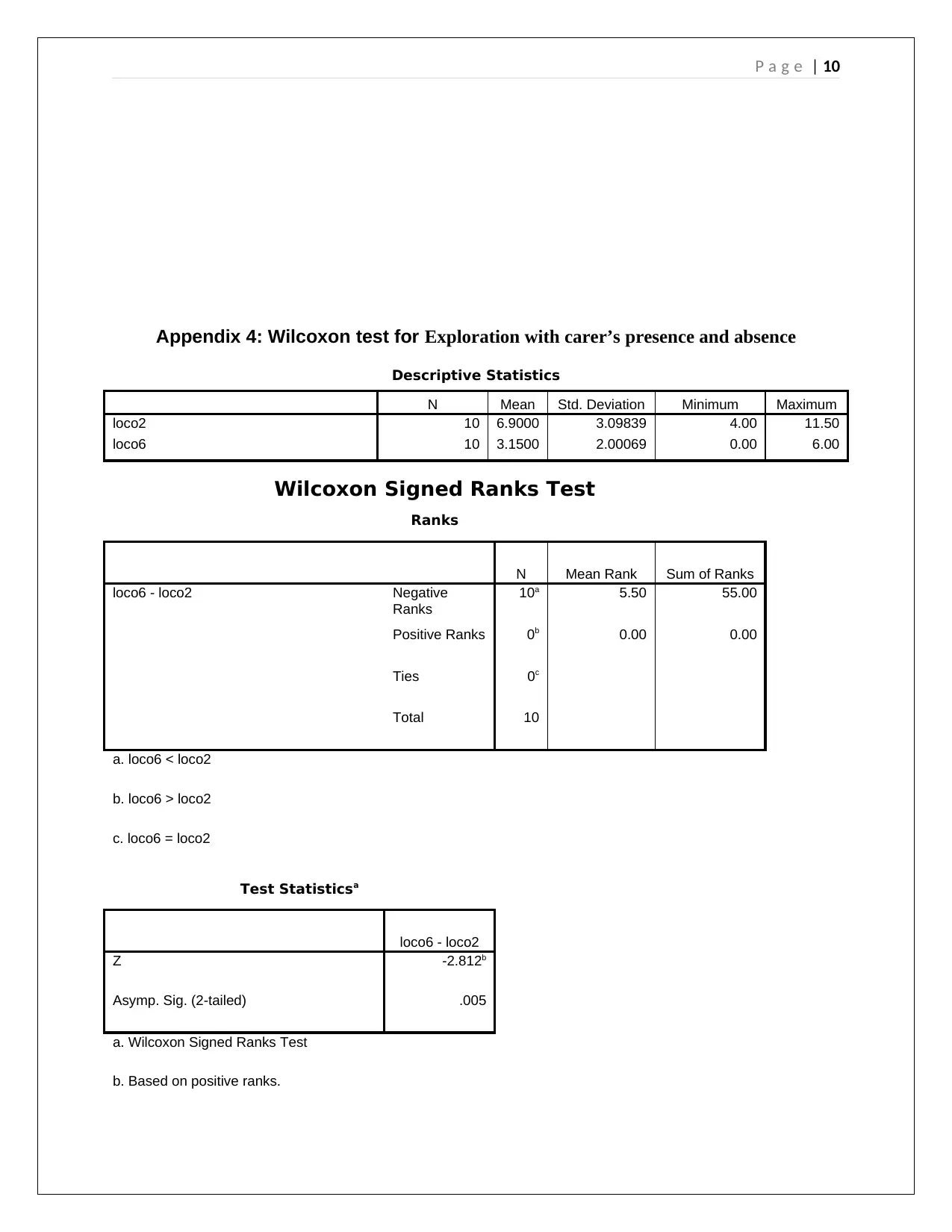
The locomotion scores for second episode and sixth episode were compared. A non parametric
test was used for the purpose. Wilcoxon signed rank test was used for the repeated measures for
loco2 and loco6 scores. Negative mean rank was found to be 5.5 for 10 observations. The
comparison between the two scores revealed a significant difference (z=-2.81, n=10, p<0.01).
The negative z value signified that the child was in better locomotion when with the carer
compared to alone situation.
Exploration with carer’s and stranger’s presence
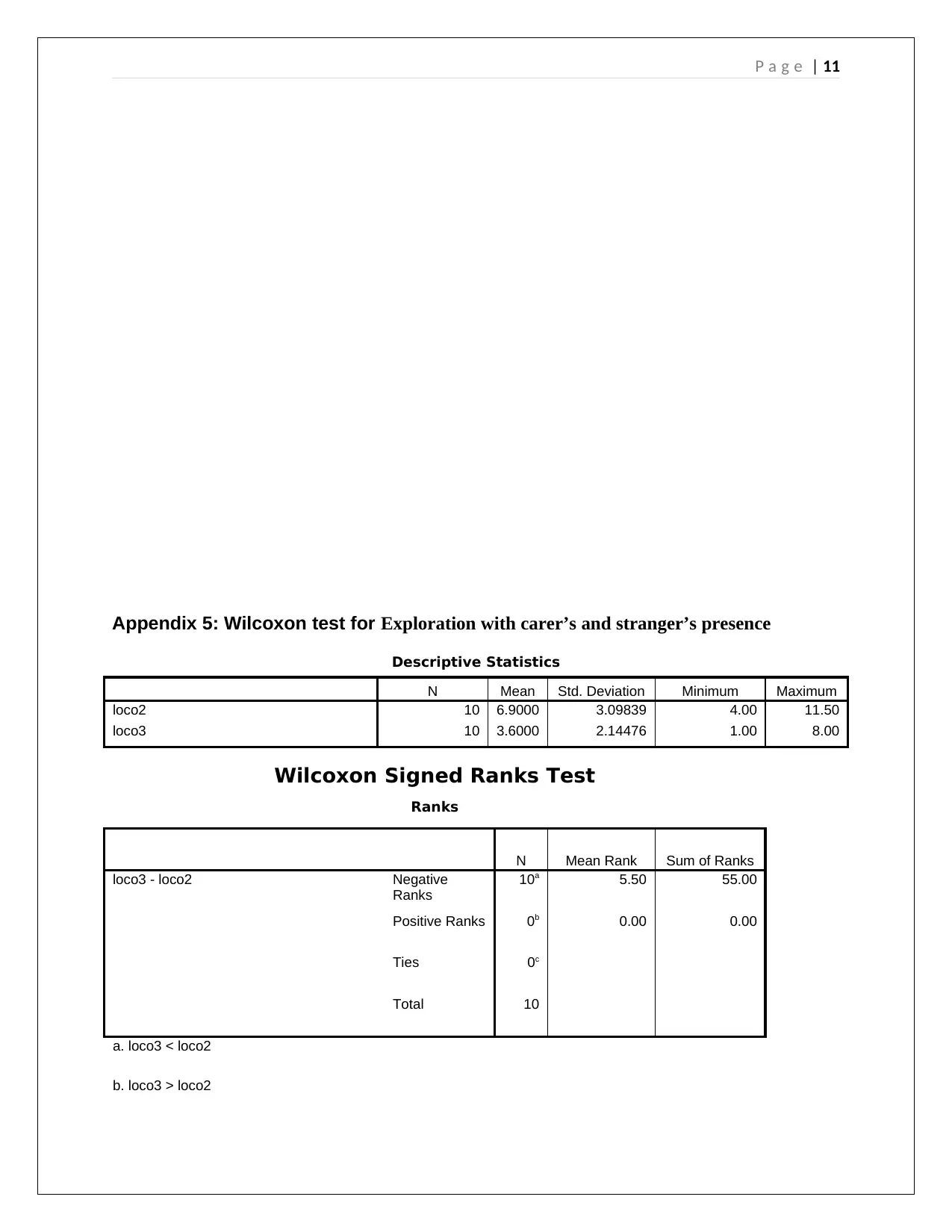
The locomotion scores for second and third episodes were compared. Wilcoxon signed rank test
was used for the repeated measures for loco2 and loco3 scores. Negative mean rank was found to
be 5.5 for 10 observations. The comparison between the two scores revealed a significant
difference (z=-2.81, n=10, p<0.01). The negative z value signified that the child was in better
locomotion when with the carer compared to the presence of the stranger.
Social act in alone and reunion with carer
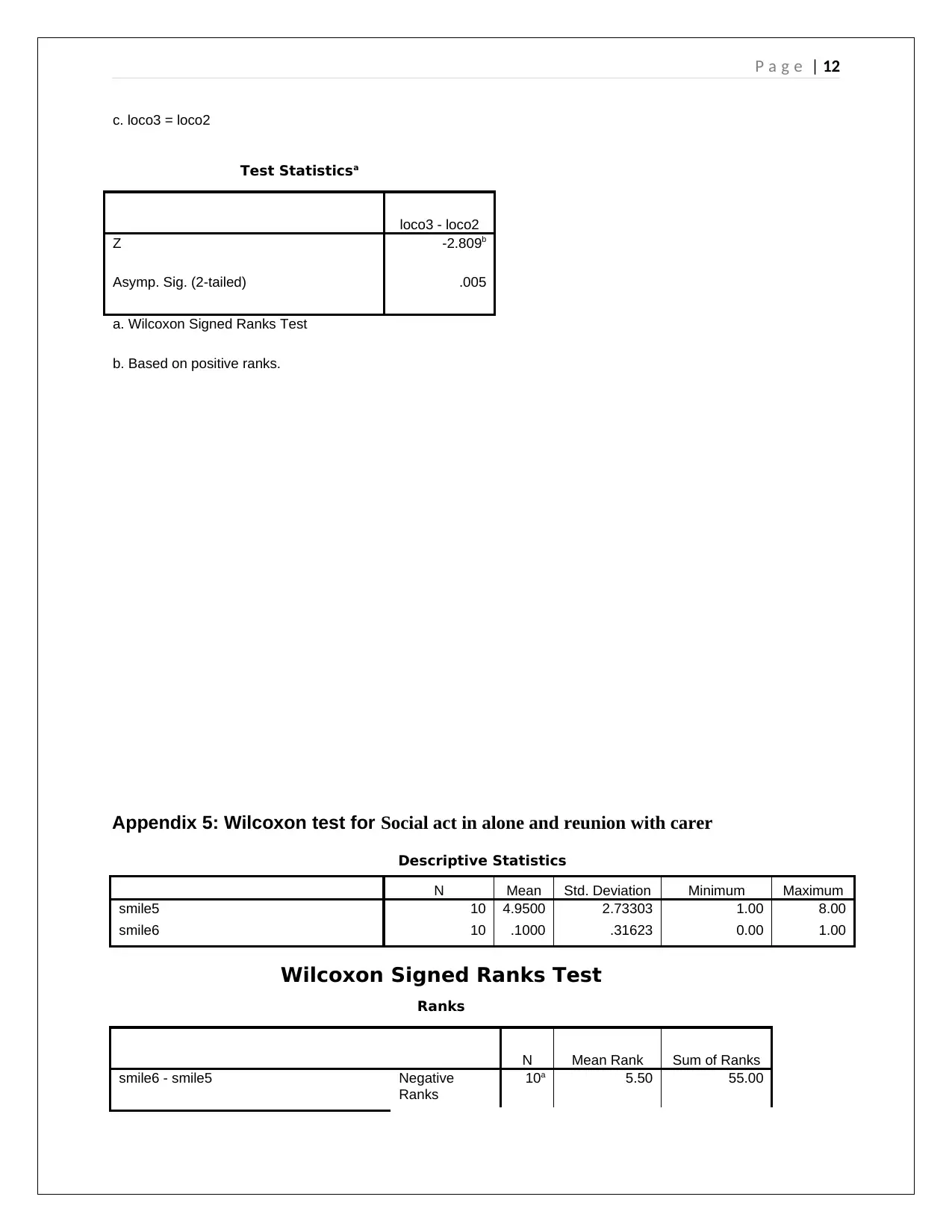
The social acts scores for fifth and sixth episodes were compared. Wilcoxon signed rank test was
used for the repeated measures for smile5 and smile6 scores. Negative mean rank was found to
Document Page
P a g e | 6
be 5.5 for 10 observations. The comparison between the two scores revealed a significant
difference (z=-2.81, n=10, p<0.01). The negative z value signified that the child was in better
social acts when with the carer compared to alone situation.
.
APPENDICES
Appendix 1: Seven episodes of the experiment
No Duration People Description
1 Carer
Child
The carer and child enter the room with the carers'
helper, who then leaves.
2 3 minutes Carer
Child
Carer puts the child down in the middle of the 3
chairs, sits quietly in his/her chair and only
participates if the child seeks attention.
3 3 minutes Carer
Child
Stranger
A stranger enters, sits quietly (1 min), talks to
carer for (1 min), gradually approaches child and
shows him/her a toy (1 min).
4 3 minutes Child
Stranger
The carer unobtrusively leaves the room.
(a) If the child plays happily the stranger does not
interrupt.
(b) If the child does nothing, she tries to interest
him/her in toys.
(c) If the child is distressed, she tries to comfort
him/her.
(d) If the child is very distressed the episode is
stopped.
Document Page
P a g e | 7
5 Undetermined Carer
Child
The carer enters, pausing in doorway so the child
can give a spontaneous response. The stranger
leaves. The carer is told to leave again once the
child is settled in play.
6 3 minutes Child The child is left alone for 3 minutes, unless he/she
is distressed, when the episode is stopped
7 3 minutes Child
Stranger
The stranger enters and repeats episode 4.
8 Carer The carer returns, the stranger leaves and the
reunion are observed.
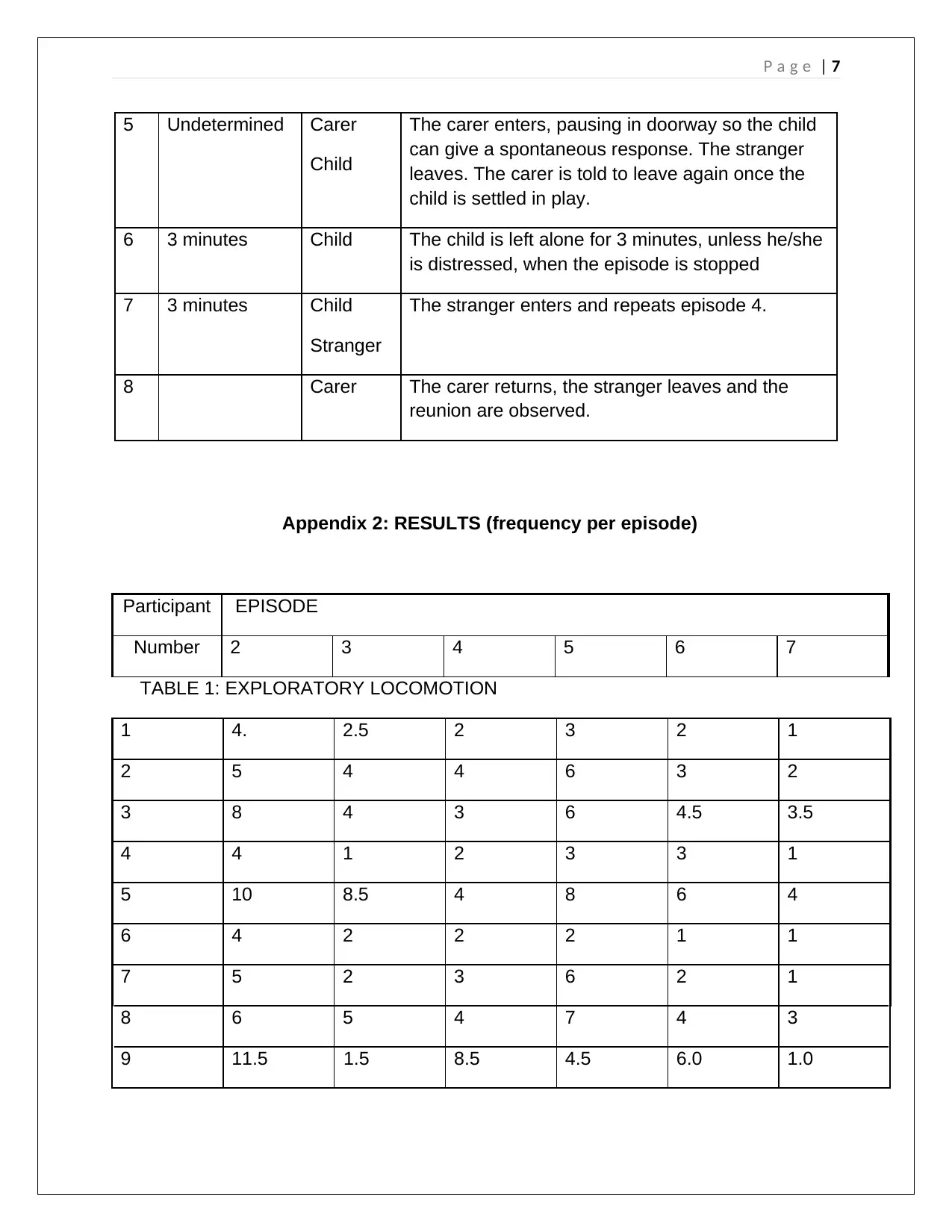
Appendix 2: RESULTS (frequency per episode)
Participant EPISODE
Number 2 3 4 5 6 7
TABLE 1: EXPLORATORY LOCOMOTION
1 4. 2.5 2 3 2 1
2 5 4 4 6 3 2
3 8 4 3 6 4.5 3.5
4 4 1 2 3 3 1
5 10 8.5 4 8 6 4
6 4 2 2 2 1 1
7 5 2 3 6 2 1
8 6 5 4 7 4 3
9 11.5 1.5 8.5 4.5 6.0 1.0
tabler-icon-diamond-filled.svg

Paraphrase This Document

Need a fresh take? Get an instant paraphrase of this document with our AI Paraphraser
Document Page
P a g e | 8
10 11.5 5.5 6.5 2.5 0.0 0.0
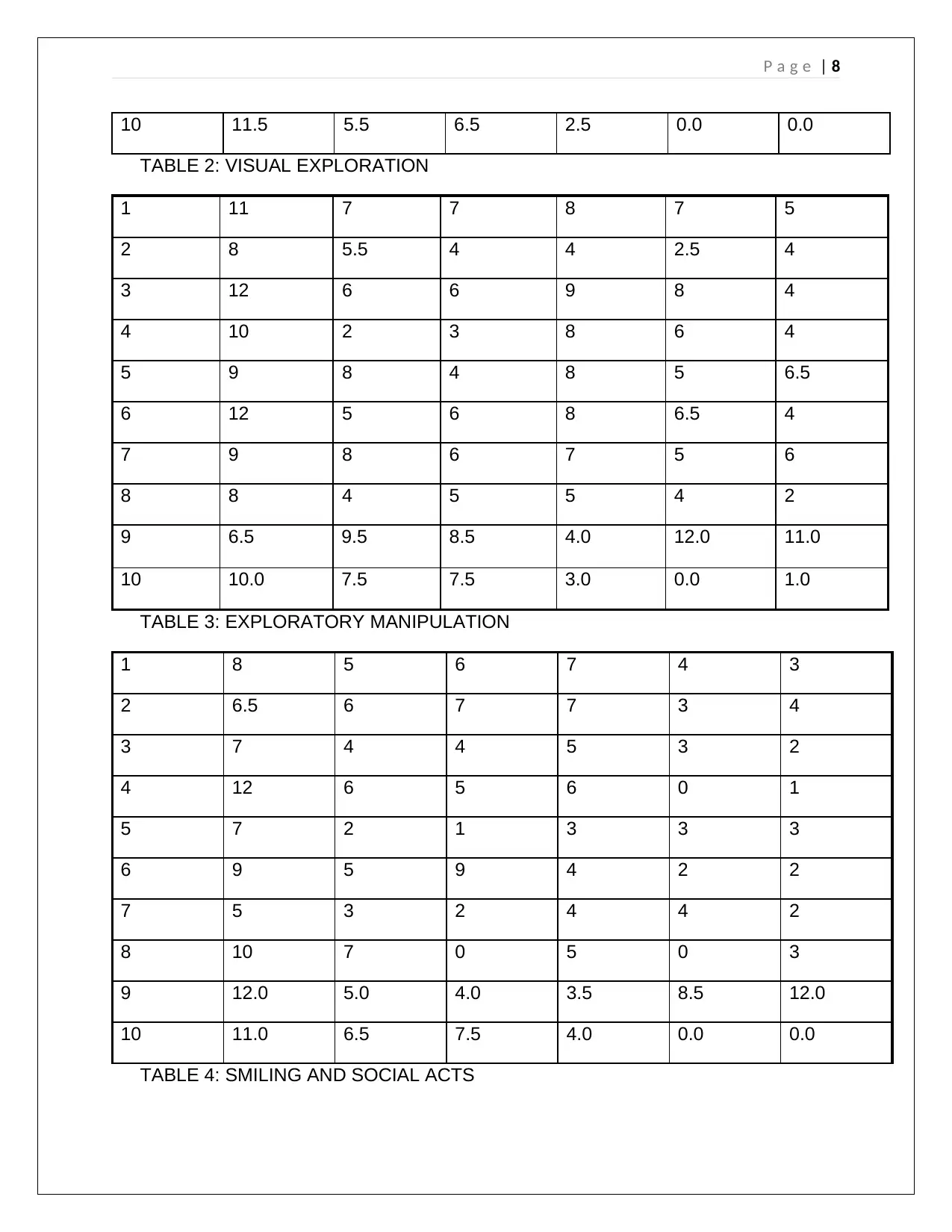
TABLE 2: VISUAL EXPLORATION
1 11 7 7 8 7 5
2 8 5.5 4 4 2.5 4
3 12 6 6 9 8 4
4 10 2 3 8 6 4
5 9 8 4 8 5 6.5
6 12 5 6 8 6.5 4
7 9 8 6 7 5 6
8 8 4 5 5 4 2
9 6.5 9.5 8.5 4.0 12.0 11.0
10 10.0 7.5 7.5 3.0 0.0 1.0
TABLE 3: EXPLORATORY MANIPULATION
1 8 5 6 7 4 3
2 6.5 6 7 7 3 4
3 7 4 4 5 3 2
4 12 6 5 6 0 1
5 7 2 1 3 3 3
6 9 5 9 4 2 2
7 5 3 2 4 4 2
8 10 7 0 5 0 3
9 12.0 5.0 4.0 3.5 8.5 12.0
10 11.0 6.5 7.5 4.0 0.0 0.0
TABLE 4: SMILING AND SOCIAL ACTS
Document Page
P a g e | 9
1 4 8 2 6 0 8
2 0 2 0 6 0 10
3 1 2 4 3 0 4
4 0 0 2 8 0 12
5 8 4 2 7 0 6
6 2 2 5 3 0 4
7 0 0 5 8 0 10
8 3 0 2 6 0 2
9 6.0 0.0 3.0 1.0 0 3.5
10 2.0 3.0 2.5 1.0 0 0
Appendix 3: Inter-observer Reliability
Behavior
Participant
9 10
Exploratory Locomotion 76.79 67.57
Visual Exploration 95.08 95.12
Exploratory Manipulation 89.29 92.86
Social Acts 52.63 16.67
Document Page
P a g e | 10
Appendix 4: Wilcoxon test for Exploration with carer’s presence and absence
Descriptive Statistics
N Mean Std. Deviation Minimum Maximum
loco2 10 6.9000 3.09839 4.00 11.50
loco6 10 3.1500 2.00069 0.00 6.00
Wilcoxon Signed Ranks Test
Ranks
N Mean Rank Sum of Ranks
loco6 - loco2 Negative
Ranks
10a 5.50 55.00
Positive Ranks 0b 0.00 0.00
Ties 0c
Total 10
a. loco6 < loco2
b. loco6 > loco2
c. loco6 = loco2
Test Statisticsa
loco6 - loco2
Z -2.812b
Asymp. Sig. (2-tailed) .005
a. Wilcoxon Signed Ranks Test
b. Based on positive ranks.
tabler-icon-diamond-filled.svg

Paraphrase This Document

Need a fresh take? Get an instant paraphrase of this document with our AI Paraphraser
Document Page
P a g e | 11
Appendix 5: Wilcoxon test for Exploration with carer’s and stranger’s presence
Descriptive Statistics
N Mean Std. Deviation Minimum Maximum
loco2 10 6.9000 3.09839 4.00 11.50
loco3 10 3.6000 2.14476 1.00 8.00
Wilcoxon Signed Ranks Test
Ranks
N Mean Rank Sum of Ranks
loco3 - loco2 Negative
Ranks
10a 5.50 55.00
Positive Ranks 0b 0.00 0.00
Ties 0c
Total 10
a. loco3 < loco2
b. loco3 > loco2
Document Page
P a g e | 12
c. loco3 = loco2
Test Statisticsa
loco3 - loco2
Z -2.809b
Asymp. Sig. (2-tailed) .005
a. Wilcoxon Signed Ranks Test
b. Based on positive ranks.
Appendix 5: Wilcoxon test for Social act in alone and reunion with carer
Descriptive Statistics
N Mean Std. Deviation Minimum Maximum
smile5 10 4.9500 2.73303 1.00 8.00
smile6 10 .1000 .31623 0.00 1.00
Wilcoxon Signed Ranks Test
Ranks
N Mean Rank Sum of Ranks
smile6 - smile5 Negative
Ranks
10a 5.50 55.00
chevron_up_icon
1 out of 13
circle_padding
hide_on_mobile
zoom_out_icon
[object Object]