Strata Property: Negligence and Legal Advice - Course Code: LAW201

Verified

Added on  2020/04/15

|3
|310
|39
Case Study
AI Summary
This assignment presents a case study centered on strata property law, specifically addressing the issues of negligence and legal advice. The scenario involves a homeowner, Tom, who seeks professional advice from Stephen, a conveyancer, regarding a strata property purchase. Tom subsequently incurs unexpected costs due to undisclosed information about levies and insurance coverage, leading to financial losses. The case explores the concept of professional negligence, emphasizing the duty of care owed by Stephen to Tom. It examines whether Stephen's actions, including giving advice in an informal setting like a golf club, constitute a breach of this duty. The analysis considers the potential for legal action against Stephen, highlighting the importance of full disclosure and the impact of professional advice on property transactions. The assignment underscores the legal ramifications of inadequate information and the responsibility of professionals to provide accurate and comprehensive guidance.
Document Page
1
Law
Name:
Course
Professor’s name
University name
City, State
Date of submission
tabler-icon-diamond-filled.svg

Paraphrase This Document

Need a fresh take? Get an instant paraphrase of this document with our AI Paraphraser
Document Page
2
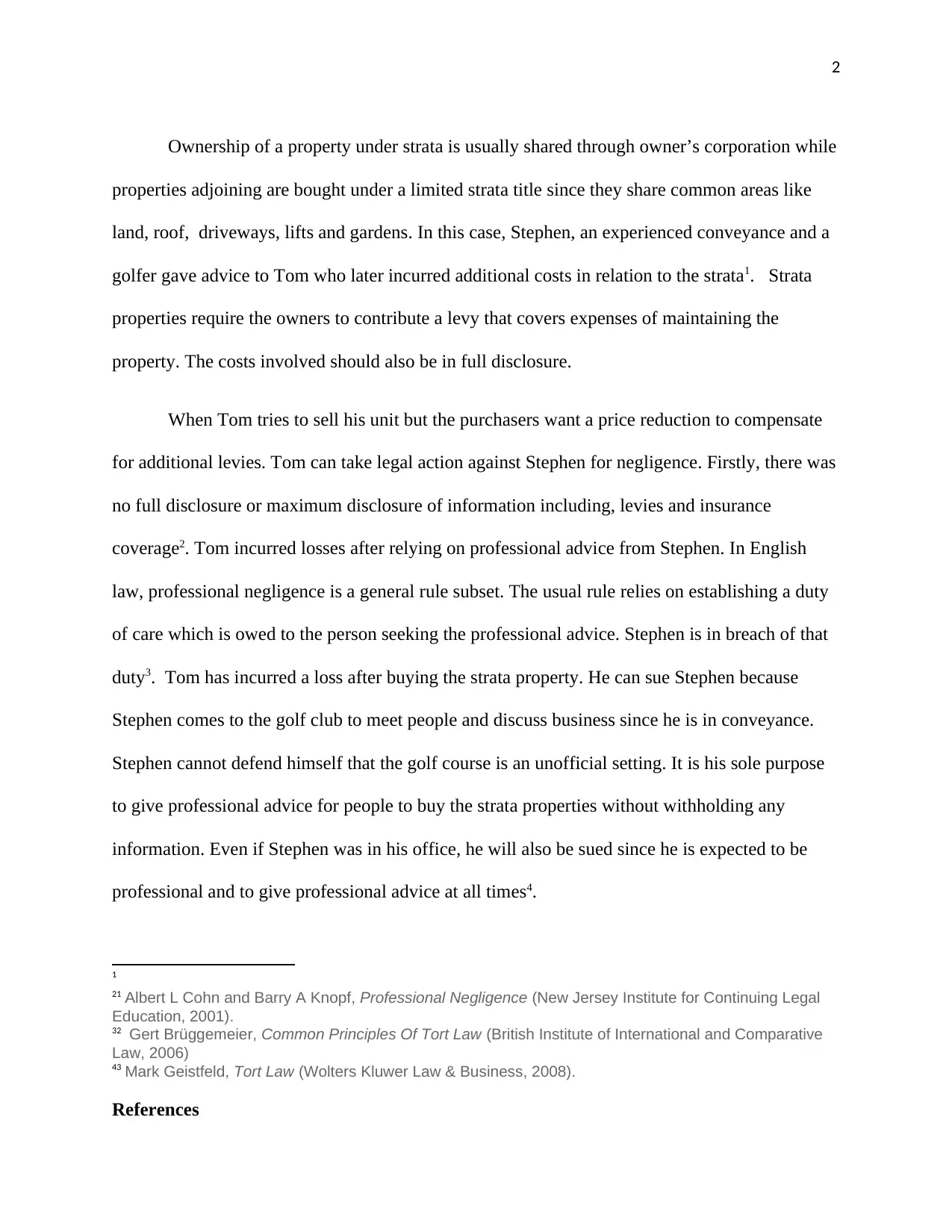
Ownership of a property under strata is usually shared through owner’s corporation while
properties adjoining are bought under a limited strata title since they share common areas like
land, roof, driveways, lifts and gardens. In this case, Stephen, an experienced conveyance and a
golfer gave advice to Tom who later incurred additional costs in relation to the strata1. Strata
properties require the owners to contribute a levy that covers expenses of maintaining the
property. The costs involved should also be in full disclosure.
When Tom tries to sell his unit but the purchasers want a price reduction to compensate
for additional levies. Tom can take legal action against Stephen for negligence. Firstly, there was
no full disclosure or maximum disclosure of information including, levies and insurance
coverage2. Tom incurred losses after relying on professional advice from Stephen. In English
law, professional negligence is a general rule subset. The usual rule relies on establishing a duty
of care which is owed to the person seeking the professional advice. Stephen is in breach of that
duty3. Tom has incurred a loss after buying the strata property. He can sue Stephen because
Stephen comes to the golf club to meet people and discuss business since he is in conveyance.
Stephen cannot defend himself that the golf course is an unofficial setting. It is his sole purpose
to give professional advice for people to buy the strata properties without withholding any
information. Even if Stephen was in his office, he will also be sued since he is expected to be
professional and to give professional advice at all times4.
1
21 Albert L Cohn and Barry A Knopf, Professional Negligence (New Jersey Institute for Continuing Legal
Education, 2001).
32 Gert Brüggemeier, Common Principles Of Tort Law (British Institute of International and Comparative
Law, 2006)
43 Mark Geistfeld, Tort Law (Wolters Kluwer Law & Business, 2008).
References
Document Page
3
Brüggemeier, Gert, Common Principles Of Tort Law (British Institute of International and
Comparative Law, 2006)
Cohn, Albert L and Barry A Knopf, Professional Negligence (New Jersey Institute for
Continuing Legal Education, 2001)
Geistfeld, Mark, Tort Law (Wolters Kluwer Law & Business, 2008)
chevron_up_icon
1 out of 3
circle_padding
hide_on_mobile
zoom_out_icon
[object Object]