Strategic Analysis: Business Mission, Policy, Strategy, and Vision
VerifiedAdded on 2021/09/30
|9
|3394
|82
Homework Assignment
AI Summary
This assignment, prepared for the Master in Development Administration program at Don Mariano Marcos Memorial State University, focuses on strategic analysis, business missions, policies, strategies, and the importance of vision and mission statements. The paper defines strategic analysis, discussing internal and external environments, and the use of tools like SWOT analysis. It explores the need for strategic analysis to predict future events and plan alternative approaches. The assignment also defines business policy, outlining its features and relationship to strategy. It further explains strategy as a plan of action to achieve organizational goals, differentiating it from policy. Finally, the assignment emphasizes the importance of vision and mission statements in developing a business strategy, highlighting their roles in guiding organizational direction and decision-making. It also includes the features of an effective vision statement and the advantages of having a vision.
Republic of the Philippines
Don Mariano Marcos Memorial State University
Mid La Union Campus
COLLEGE OF GRADUATE STUDIES
City of San Fernando, 2500 La Union, Philippines
Telefax: 072 700 4516 http://www.dmmmsu.edu.ph/gs/
__ . . . designing change!___
Subject: DAP 237 – Strategic and Contingency Management
Degree: Master in Development Administration
Professor: Dr. Estrella N. Perez
Name of Student: Mike M. Flores
Strategy Analysis: The Business Mission
A. Strategy Analysis
Improvement is a constant idea in any organization. So, to educate oneself, organizations
must periodically conduct strategic analysis. This will then help the organization to plan ahead
and determine which areas need improvement.
Strategic analysis refers to the process of conducting research on a company and its
operating environment to formulate a strategy. The definition of strategic analysis may differ
from an academic or business perspective, but the process involves several common factors:
a. Identifying and evaluating data relevant to the company’s strategy;
b. Defining the internal and external environments to be analyzed; and
c. Using several analytic methods such as Porter’s five forces analysis, SWOT analysis,
and value chain analysis.
A strategic analysis is also an external review of what is happening in the environment in
which an organization operates now, as well as short, medium- and long-term futures. It
requires looking at several situations:
a. What is happening now that may impact the organization?
b. What might happen that could impact the organization?
c. What is the organizations response likely to be to change?
d. How well prepared are the people in the organization to respond to change?
Understanding the meaning of Strategic Analysis:
a. Strategic: as it is high level, deep and about the future
b. Analysis: the act of breaking something large into smaller, understandable pieces
There is a need to consider three (3) main groups in any analysis or review:
a. The people and their skills and competencies;
b. The customers: What do they want now, and what will they want in the future; and
Don Mariano Marcos Memorial State University
Mid La Union Campus
COLLEGE OF GRADUATE STUDIES
City of San Fernando, 2500 La Union, Philippines
Telefax: 072 700 4516 http://www.dmmmsu.edu.ph/gs/
__ . . . designing change!___
Subject: DAP 237 – Strategic and Contingency Management
Degree: Master in Development Administration
Professor: Dr. Estrella N. Perez
Name of Student: Mike M. Flores
Strategy Analysis: The Business Mission
A. Strategy Analysis
Improvement is a constant idea in any organization. So, to educate oneself, organizations
must periodically conduct strategic analysis. This will then help the organization to plan ahead
and determine which areas need improvement.
Strategic analysis refers to the process of conducting research on a company and its
operating environment to formulate a strategy. The definition of strategic analysis may differ
from an academic or business perspective, but the process involves several common factors:
a. Identifying and evaluating data relevant to the company’s strategy;
b. Defining the internal and external environments to be analyzed; and
c. Using several analytic methods such as Porter’s five forces analysis, SWOT analysis,
and value chain analysis.
A strategic analysis is also an external review of what is happening in the environment in
which an organization operates now, as well as short, medium- and long-term futures. It
requires looking at several situations:
a. What is happening now that may impact the organization?
b. What might happen that could impact the organization?
c. What is the organizations response likely to be to change?
d. How well prepared are the people in the organization to respond to change?
Understanding the meaning of Strategic Analysis:
a. Strategic: as it is high level, deep and about the future
b. Analysis: the act of breaking something large into smaller, understandable pieces
There is a need to consider three (3) main groups in any analysis or review:
a. The people and their skills and competencies;
b. The customers: What do they want now, and what will they want in the future; and

Paraphrase This Document
Need a fresh take? Get an instant paraphrase of this document with our AI Paraphraser
c. The competitors and the competitive environment in which the organization operates.
What are they doing, what may impact the sector (legal, etc.)? There must be good
knowledge of the competitors to easily define a strategy that will help the organization
stand apart from them and remain competitive.
Strategic analysis of an organization is an essential factor when it comes to formulating a plan
for the smoother working of a company. With the help of strategic planning, the organization
can achieve its set goals or objectives. One of the most critical functions of strategic analysis
is the prediction of future events and the planning of an alternative approach if the first
strategy doesn't work out.
There are a few types of strategic analysis anyone should consider:
a. Internal strategic analysis
Internal strategic analysis gives an overview of the functioning of your own company.
In this analysis, an organization assesses and analyzes its strengths and weaknesses,
and establish a strategy that will help improve its image.
The internal investigation starts with evaluating the performance and future potential
of the company and its capacity to grow.
Analysis of strengths and weaknesses of the company should be solely based on the
market situation and client response. The strengths only make sense when they are
giving client complete satisfaction with its services.
Along with the strengths, the strategist should also be aware of the weaknesses and
liabilities of the company at that moment. The company can grow at an exponential
rate if it has a sound strategy planned.
b. External strategic analysis
Once the organization has completed its internal analysis, they can move on to the
external review. Many external factors can act as a roadblock to the organization's
growth.
To conduct an external strategic analysis, one needs to know how the market functions
and what the consumers require. There is a need to measure customer satisfaction
towards its competitors' products so that it can get an overview of how the market
functions.
What are they doing, what may impact the sector (legal, etc.)? There must be good
knowledge of the competitors to easily define a strategy that will help the organization
stand apart from them and remain competitive.
Strategic analysis of an organization is an essential factor when it comes to formulating a plan
for the smoother working of a company. With the help of strategic planning, the organization
can achieve its set goals or objectives. One of the most critical functions of strategic analysis
is the prediction of future events and the planning of an alternative approach if the first
strategy doesn't work out.
There are a few types of strategic analysis anyone should consider:
a. Internal strategic analysis
Internal strategic analysis gives an overview of the functioning of your own company.
In this analysis, an organization assesses and analyzes its strengths and weaknesses,
and establish a strategy that will help improve its image.
The internal investigation starts with evaluating the performance and future potential
of the company and its capacity to grow.
Analysis of strengths and weaknesses of the company should be solely based on the
market situation and client response. The strengths only make sense when they are
giving client complete satisfaction with its services.
Along with the strengths, the strategist should also be aware of the weaknesses and
liabilities of the company at that moment. The company can grow at an exponential
rate if it has a sound strategy planned.
b. External strategic analysis
Once the organization has completed its internal analysis, they can move on to the
external review. Many external factors can act as a roadblock to the organization's
growth.
To conduct an external strategic analysis, one needs to know how the market functions
and what the consumers require. There is a need to measure customer satisfaction
towards its competitors' products so that it can get an overview of how the market
functions.
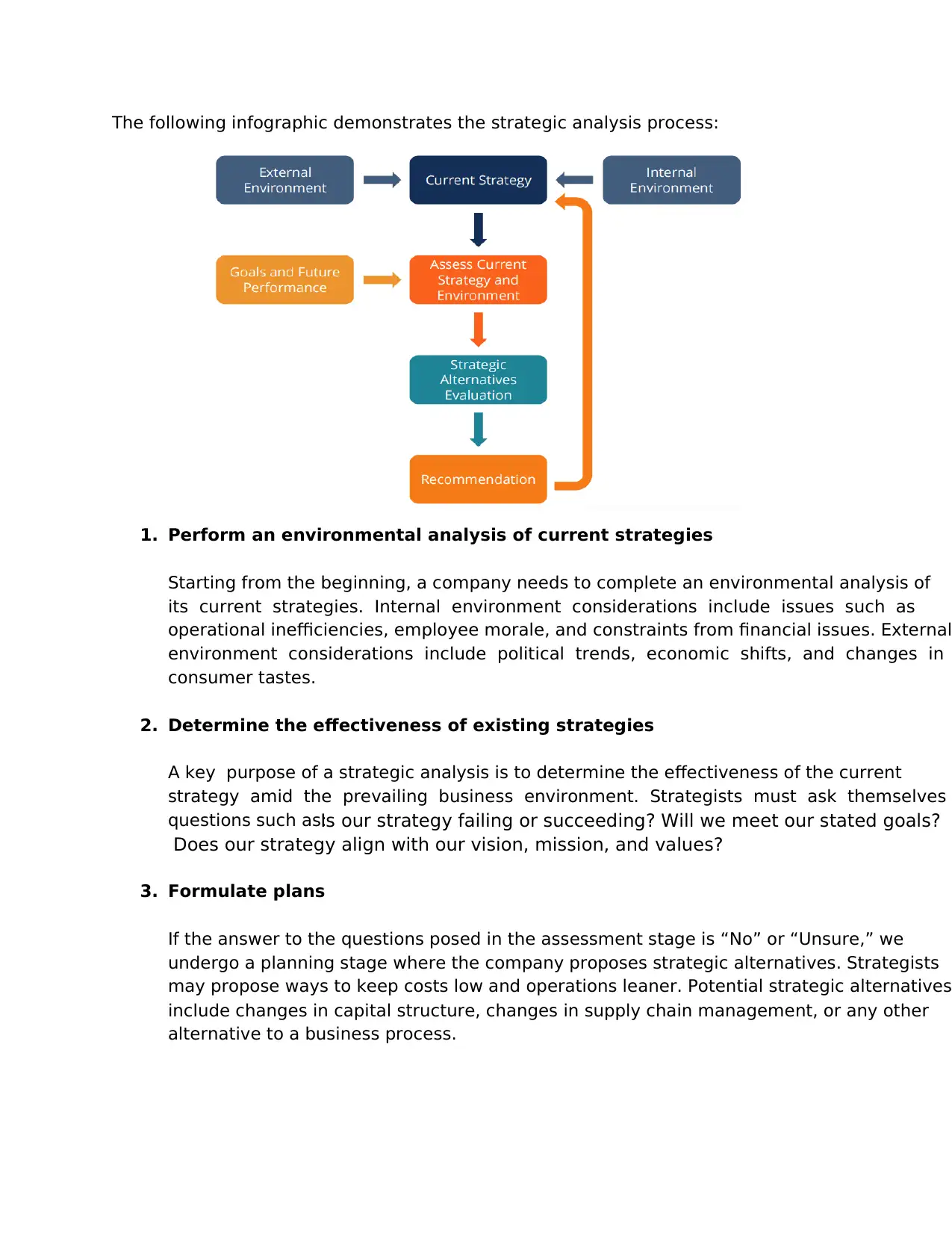
The following infographic demonstrates the strategic analysis process:
1. Perform an environmental analysis of current strategies
Starting from the beginning, a company needs to complete an environmental analysis of
its current strategies. Internal environment considerations include issues such as
operational inefficiencies, employee morale, and constraints from financial issues. External
environment considerations include political trends, economic shifts, and changes in
consumer tastes.
2. Determine the effectiveness of existing strategies
A key purpose of a strategic analysis is to determine the effectiveness of the current
strategy amid the prevailing business environment. Strategists must ask themselves
questions such as:Is our strategy failing or succeeding? Will we meet our stated goals?
Does our strategy align with our vision, mission, and values?
3. Formulate plans
If the answer to the questions posed in the assessment stage is “No” or “Unsure,” we
undergo a planning stage where the company proposes strategic alternatives. Strategists
may propose ways to keep costs low and operations leaner. Potential strategic alternatives
include changes in capital structure, changes in supply chain management, or any other
alternative to a business process.
1. Perform an environmental analysis of current strategies
Starting from the beginning, a company needs to complete an environmental analysis of
its current strategies. Internal environment considerations include issues such as
operational inefficiencies, employee morale, and constraints from financial issues. External
environment considerations include political trends, economic shifts, and changes in
consumer tastes.
2. Determine the effectiveness of existing strategies
A key purpose of a strategic analysis is to determine the effectiveness of the current
strategy amid the prevailing business environment. Strategists must ask themselves
questions such as:Is our strategy failing or succeeding? Will we meet our stated goals?
Does our strategy align with our vision, mission, and values?
3. Formulate plans
If the answer to the questions posed in the assessment stage is “No” or “Unsure,” we
undergo a planning stage where the company proposes strategic alternatives. Strategists
may propose ways to keep costs low and operations leaner. Potential strategic alternatives
include changes in capital structure, changes in supply chain management, or any other
alternative to a business process.
⊘ This is a preview!⊘
Do you want full access?
Subscribe today to unlock all pages.

Trusted by 1+ million students worldwide
4. Recommend and implement the most viable strategy
Lastly, after assessing strategies and proposing alternatives, we reach a recommendation.
After assessing all possible strategic alternatives, we choose to implement the most viable
and quantitatively profitable strategy. After producing a recommendation, we iteratively
repeat the entire process. Strategies must be implemented, assessed, and re-assessed.
They must change because business environments are not static.
B. Business Policy
Business Policy defines the scope or spheres within which decisions can be taken by the
subordinates in an organization. It permits the lower level management to deal with the
problems and issues without consulting top level management every time for decisions.
Business policies are the guidelines developed by an organization to govern its actions. They
define the limits within which decisions must be made. Business policy also deals with
acquisition of resources with which organizational goals can be achieved.
Business policy is the study of the roles and responsibilities of top-level management, the
significant issues affecting organizational success and the decisions affecting organization in
the long-run.
Features of Business Policy
An effective business policy must have following features:
a. Specific: Policy should be specific/definite. If it is uncertain, then the implementation
will become difficult.
b. Clear: Policy must be unambiguous. It should avoid use of jargons and connotations.
There should be no misunderstandings in following the policy.
c. Reliable/Uniform: Policy must be uniform enough so that it can be efficiently followed
by the subordinates.
d. Appropriate: Policy should be appropriate to the present organizational goal.
e. Simple: A policy should be simple and easily understood by all in the organization.
f. Inclusive/Comprehensive: In order to have a wide scope, a policy must be
comprehensive.
g. Flexible: Policy should be flexible in operation/application. This does not imply that a
policy should be altered always, but it should be wide in scope so as to ensure that the
line managers use them in repetitive/routine scenarios.
h. Stable: Policy should be stable. Otherwise, it will lead to indecisiveness and uncertainty
in minds of those who look into it for guidance.
Lastly, after assessing strategies and proposing alternatives, we reach a recommendation.
After assessing all possible strategic alternatives, we choose to implement the most viable
and quantitatively profitable strategy. After producing a recommendation, we iteratively
repeat the entire process. Strategies must be implemented, assessed, and re-assessed.
They must change because business environments are not static.
B. Business Policy
Business Policy defines the scope or spheres within which decisions can be taken by the
subordinates in an organization. It permits the lower level management to deal with the
problems and issues without consulting top level management every time for decisions.
Business policies are the guidelines developed by an organization to govern its actions. They
define the limits within which decisions must be made. Business policy also deals with
acquisition of resources with which organizational goals can be achieved.
Business policy is the study of the roles and responsibilities of top-level management, the
significant issues affecting organizational success and the decisions affecting organization in
the long-run.
Features of Business Policy
An effective business policy must have following features:
a. Specific: Policy should be specific/definite. If it is uncertain, then the implementation
will become difficult.
b. Clear: Policy must be unambiguous. It should avoid use of jargons and connotations.
There should be no misunderstandings in following the policy.
c. Reliable/Uniform: Policy must be uniform enough so that it can be efficiently followed
by the subordinates.
d. Appropriate: Policy should be appropriate to the present organizational goal.
e. Simple: A policy should be simple and easily understood by all in the organization.
f. Inclusive/Comprehensive: In order to have a wide scope, a policy must be
comprehensive.
g. Flexible: Policy should be flexible in operation/application. This does not imply that a
policy should be altered always, but it should be wide in scope so as to ensure that the
line managers use them in repetitive/routine scenarios.
h. Stable: Policy should be stable. Otherwise, it will lead to indecisiveness and uncertainty
in minds of those who look into it for guidance.
Paraphrase This Document
Need a fresh take? Get an instant paraphrase of this document with our AI Paraphraser
C. Strategy
A strategy is a plan of actions taken by managers to achieve the company’s overall goal and
other subsidiary goals. It often determines the success of a company. In strategy, a company
is essentially asking itself,“Where do you want to play and how are you going to win?”
The word “strategy” has many definitions, but generally involves setting strategic goals,
determining actions to achieve the goals, and mobilizing resources to execute the actions. A
strategy describes how the ends (goals) will be achieved by the means (resources). The senior
leadership of an organization is generally tasked with determining strategy. Strategy can be
planned (intended) or can be observed as a pattern of activity (emergent) as the organization
adapts to its environment.
Strategy is a well-defined roadmap of an organization. It defines the overall mission, vision
and direction of an organization. The objective of a strategy is to maximize an organization’s
strengths and to minimize the strengths of the competitors.
Strategy, in short, bridges the gap between “where we are” and “where we want to be”.
D. Difference between Policy and Strategy
The term “policy” should not be considered as synonymous to the term “strategy”.
The difference between policy and strategy can be summarized as follows:
a. Policy is a blueprint of the organizational activities which are repetitive/routinary in
nature while strategy is concerned with those organizational decisions which have not
been dealt/faced before in same form.
b. Policy formulation is responsibility of top-level management while strategy formulation
is basically done by middle-level management.
c. Policy deals with routine/daily activities essential for effective and efficient running of
an organization while strategy deals with strategic decisions.
d. Policy is concerned with both thought and actions while strategy is concerned mostly
with action.
e. A policy is what is, or what is not done while a strategy is the methodology used to
achieve a target as prescribed by a policy.
E. Importance of Vision and Mission Statements
To develop a business strategy, a company needs a very well-defined understanding of what
it is and what it represents. Strategists need to look at the following:
A strategy is a plan of actions taken by managers to achieve the company’s overall goal and
other subsidiary goals. It often determines the success of a company. In strategy, a company
is essentially asking itself,“Where do you want to play and how are you going to win?”
The word “strategy” has many definitions, but generally involves setting strategic goals,
determining actions to achieve the goals, and mobilizing resources to execute the actions. A
strategy describes how the ends (goals) will be achieved by the means (resources). The senior
leadership of an organization is generally tasked with determining strategy. Strategy can be
planned (intended) or can be observed as a pattern of activity (emergent) as the organization
adapts to its environment.
Strategy is a well-defined roadmap of an organization. It defines the overall mission, vision
and direction of an organization. The objective of a strategy is to maximize an organization’s
strengths and to minimize the strengths of the competitors.
Strategy, in short, bridges the gap between “where we are” and “where we want to be”.
D. Difference between Policy and Strategy
The term “policy” should not be considered as synonymous to the term “strategy”.
The difference between policy and strategy can be summarized as follows:
a. Policy is a blueprint of the organizational activities which are repetitive/routinary in
nature while strategy is concerned with those organizational decisions which have not
been dealt/faced before in same form.
b. Policy formulation is responsibility of top-level management while strategy formulation
is basically done by middle-level management.
c. Policy deals with routine/daily activities essential for effective and efficient running of
an organization while strategy deals with strategic decisions.
d. Policy is concerned with both thought and actions while strategy is concerned mostly
with action.
e. A policy is what is, or what is not done while a strategy is the methodology used to
achieve a target as prescribed by a policy.
E. Importance of Vision and Mission Statements
To develop a business strategy, a company needs a very well-defined understanding of what
it is and what it represents. Strategists need to look at the following:
a. Vision: What it wants to achieve in the future (5-10 years)
b. Mission Statement: What business a company is in and how it rallies people
c. Values: The fundamental beliefs of an organization reflecting its commitments and
ethics
After gaining a deep understanding of the company’s vision, mission, and values, strategists
can help the business undergo a strategic analysis. The purpose of a strategic analysis is to
analyze an organization’s external and internal environment, assess current strategies, and
generate and evaluate the most successful strategic alternatives.
Vision
A vision statement identifies where the organization wants or intends to be in future or where
it should be to best meet the needs of the stakeholders. It describes dreams and aspirations
for future. For instance, Microsoft's vision is to empower people through great software, any
time, any place, or any device." Wal-Mart's vision is to become worldwide leader in retailing.
A vision is the potential to view things ahead of themselves. It answers the question "where
we want to be". It gives us a reminder about what we attempt to develop. A vision statement
is for the organization and its members, unlike the mission statement which is for the
customers/clients. It contributes in effective decision making as well as effective business
planning. It incorporates a shared understanding about the nature and aim of the organization
and utilizes this understanding to direct and guide the organization towards a better purpose.
It describes that on achieving the mission, how the organizational future would appear to be.
It is at the top in the hierarchy of strategic intent. It is what the firm would ultimately like to
become. It is a description of something (an organization, corporate culture, a business, a
technology, an activity) in the future. The definition itself is comprehensive and states clearly
the futuristic position (Kotter). It is defined as the "category of intentions that are broad, all-
inclusive and forward thinking" (Miler and Dess).
An effective vision statement must have following features:
a. It must be unambiguous.
b. It must be clear.
c. It must harmonize with organization's culture and values.
d. The dreams and aspirations must be rational/realistic.
e. Vision statements should be shorter so that they are easier to memorize.
Note: In order to realize the vision, it must be deeply instilled in the organization,
being owned and shared by everyone involved in the organization.
b. Mission Statement: What business a company is in and how it rallies people
c. Values: The fundamental beliefs of an organization reflecting its commitments and
ethics
After gaining a deep understanding of the company’s vision, mission, and values, strategists
can help the business undergo a strategic analysis. The purpose of a strategic analysis is to
analyze an organization’s external and internal environment, assess current strategies, and
generate and evaluate the most successful strategic alternatives.
Vision
A vision statement identifies where the organization wants or intends to be in future or where
it should be to best meet the needs of the stakeholders. It describes dreams and aspirations
for future. For instance, Microsoft's vision is to empower people through great software, any
time, any place, or any device." Wal-Mart's vision is to become worldwide leader in retailing.
A vision is the potential to view things ahead of themselves. It answers the question "where
we want to be". It gives us a reminder about what we attempt to develop. A vision statement
is for the organization and its members, unlike the mission statement which is for the
customers/clients. It contributes in effective decision making as well as effective business
planning. It incorporates a shared understanding about the nature and aim of the organization
and utilizes this understanding to direct and guide the organization towards a better purpose.
It describes that on achieving the mission, how the organizational future would appear to be.
It is at the top in the hierarchy of strategic intent. It is what the firm would ultimately like to
become. It is a description of something (an organization, corporate culture, a business, a
technology, an activity) in the future. The definition itself is comprehensive and states clearly
the futuristic position (Kotter). It is defined as the "category of intentions that are broad, all-
inclusive and forward thinking" (Miler and Dess).
An effective vision statement must have following features:
a. It must be unambiguous.
b. It must be clear.
c. It must harmonize with organization's culture and values.
d. The dreams and aspirations must be rational/realistic.
e. Vision statements should be shorter so that they are easier to memorize.
Note: In order to realize the vision, it must be deeply instilled in the organization,
being owned and shared by everyone involved in the organization.
⊘ This is a preview!⊘
Do you want full access?
Subscribe today to unlock all pages.
Trusted by 1+ million students worldwide
Advantages of having a Vision:
A few benefits accruing to an organization having a vision are as follows:
a. They foster experimentation.
b. Vision promotes long term thinking.
c. Visions fosters risk taking.
d. They can be used for the benefit of the people.
e. The make organizations competitive, original and unique.
f. Good vision represent integrity.
g. They are inspiring and motivating to people working in an organization
Mission Statement
Mission statement is the statement of the role by which an organization intends to serve its
stakeholders. It describes why an organization is operating and thus provides a framework
within which strategies are formulated. It describes what the organization does (i.e., present
capabilities), who all it serves (i.e., stakeholders) and what makes an organization unique
(i.e., reason for existence).
The mission statements stage the role that organization plays in society. It is one of the
popular philosophical issue, which is being looked into by business managers since last the
two decades. It is a "purpose or reason for the organization's existence (Hynger and
Wheelen). "A mission provides the basis of awareness of a sense of purpose, the competitive
environment, degree to which the firm's mission fits its capabilities and the opportunities
which the government offers (David F. Harvey). It is the "essential purpose of the
organization, concerning particularly why it is in existence, the nature of the business it is in,
and the customers it seeks to serve and satisfy (Thompson).
A mission statement differentiates an organization from others by explaining its broad scope
of activities, its products, and technologies it uses to achieve its goals and objectives. It talks
about an organization's present (ie.. "about where we are"). For instance, Microsoft's mission
is to help people and businesses throughout the world to realize their full potential. Wal-Mart's
mission is "To give ordinary folk the chance to buy the same thing as rich people." Mission
statements always exist at top level of an organization, but may also be made for various
organizational levels. Chief executive plays a significant role in formulation of mission
statement. Once the mission statement is formulated, it serves the organization in the long
run, but it may become ambiguous with organizational growth and innovations.
In today's dynamic and competitive environment, mission may need to be redefined.
However, care must be taken that the redefined mission statement should have origina
fundamentals/components. Mission statement has three main components: a statement of
mission or vision of the company, a statement of the core values that shape the acts and
behavior of the employees, and a statement of the goals and objectives
A few benefits accruing to an organization having a vision are as follows:
a. They foster experimentation.
b. Vision promotes long term thinking.
c. Visions fosters risk taking.
d. They can be used for the benefit of the people.
e. The make organizations competitive, original and unique.
f. Good vision represent integrity.
g. They are inspiring and motivating to people working in an organization
Mission Statement
Mission statement is the statement of the role by which an organization intends to serve its
stakeholders. It describes why an organization is operating and thus provides a framework
within which strategies are formulated. It describes what the organization does (i.e., present
capabilities), who all it serves (i.e., stakeholders) and what makes an organization unique
(i.e., reason for existence).
The mission statements stage the role that organization plays in society. It is one of the
popular philosophical issue, which is being looked into by business managers since last the
two decades. It is a "purpose or reason for the organization's existence (Hynger and
Wheelen). "A mission provides the basis of awareness of a sense of purpose, the competitive
environment, degree to which the firm's mission fits its capabilities and the opportunities
which the government offers (David F. Harvey). It is the "essential purpose of the
organization, concerning particularly why it is in existence, the nature of the business it is in,
and the customers it seeks to serve and satisfy (Thompson).
A mission statement differentiates an organization from others by explaining its broad scope
of activities, its products, and technologies it uses to achieve its goals and objectives. It talks
about an organization's present (ie.. "about where we are"). For instance, Microsoft's mission
is to help people and businesses throughout the world to realize their full potential. Wal-Mart's
mission is "To give ordinary folk the chance to buy the same thing as rich people." Mission
statements always exist at top level of an organization, but may also be made for various
organizational levels. Chief executive plays a significant role in formulation of mission
statement. Once the mission statement is formulated, it serves the organization in the long
run, but it may become ambiguous with organizational growth and innovations.
In today's dynamic and competitive environment, mission may need to be redefined.
However, care must be taken that the redefined mission statement should have origina
fundamentals/components. Mission statement has three main components: a statement of
mission or vision of the company, a statement of the core values that shape the acts and
behavior of the employees, and a statement of the goals and objectives
Paraphrase This Document
Need a fresh take? Get an instant paraphrase of this document with our AI Paraphraser
Features of a Mission
a. Mission must be able and attainable. It should be possible to achieve it.
b. Mission should be clear enough so that any action can be taken.
c. It should be inspiring for the management, staff and society at large.
d. It should be precise enough, i.e., should be neither too broad nor too narrow.
e. It should be unique and distinctive to leave an impact in everyone's mind.
f. It should be analytical, i.e., it should analyze the key components of the strategy.
g. It should be credible, i.e., all stakeholders should be able to believe it.
Nature of Mission Statement
a. It gives social reasoning. It specifies the role which the organization plays in society.
It is the basic reason for existence.
b. It is philosophical and visionary. It relates to top management values. It has long-
term perspective.
c. It legitimizes societal existence.
d. It has stylistic objectives. It reflects corporate philosophy, identity, character and
image of organization.
Formulation of Mission Statement
a. National Priorities projected in plan documents and industrial policy statements.
b. Corporate philosophy as developed over the years.
c. Major strategists have vision to develop mission statements.
d. The services of consultants may be hired.
Some of the benefits of having a vision and mission statement are discussed below:
a. Above everything else, vision and mission statements provide unanimity of purpose to
organizations and imbue the employees with a sense of belonging and identity. Indeed,
vision and mission statements are embodiments of organizational identity and carry the
organizations creed and motto. For this purpose, they are also called as statements of
creed.
b. Vision and mission statements spell out the context in which the organization operates
and provides the employees with a tone that is to be followed in the organizational climate.
Since they define the reason for existence of the organization, they are indicators of the
direction in which the organization must move to actualize the goals in the vision and
mission statements.
c. The vision and mission statements serve as focal points for individuals to identify
themselves with the organizational processes and to give them a sense of direction while
a. Mission must be able and attainable. It should be possible to achieve it.
b. Mission should be clear enough so that any action can be taken.
c. It should be inspiring for the management, staff and society at large.
d. It should be precise enough, i.e., should be neither too broad nor too narrow.
e. It should be unique and distinctive to leave an impact in everyone's mind.
f. It should be analytical, i.e., it should analyze the key components of the strategy.
g. It should be credible, i.e., all stakeholders should be able to believe it.
Nature of Mission Statement
a. It gives social reasoning. It specifies the role which the organization plays in society.
It is the basic reason for existence.
b. It is philosophical and visionary. It relates to top management values. It has long-
term perspective.
c. It legitimizes societal existence.
d. It has stylistic objectives. It reflects corporate philosophy, identity, character and
image of organization.
Formulation of Mission Statement
a. National Priorities projected in plan documents and industrial policy statements.
b. Corporate philosophy as developed over the years.
c. Major strategists have vision to develop mission statements.
d. The services of consultants may be hired.
Some of the benefits of having a vision and mission statement are discussed below:
a. Above everything else, vision and mission statements provide unanimity of purpose to
organizations and imbue the employees with a sense of belonging and identity. Indeed,
vision and mission statements are embodiments of organizational identity and carry the
organizations creed and motto. For this purpose, they are also called as statements of
creed.
b. Vision and mission statements spell out the context in which the organization operates
and provides the employees with a tone that is to be followed in the organizational climate.
Since they define the reason for existence of the organization, they are indicators of the
direction in which the organization must move to actualize the goals in the vision and
mission statements.
c. The vision and mission statements serve as focal points for individuals to identify
themselves with the organizational processes and to give them a sense of direction while
at the same time deterring those who do not wish to follow them from participating in the
organization’s activities.
d. The vision and mission statements help to translate the objectives of the organization into
work structures and to assign tasks to the elements in the organization that are
responsible for actualizing them in practice.
e. The vision and mission statements specify the core structure on which the organizational
edifice stands and to help in the translationof objectivesinto actionablecost,
performance, and time related measures.
f. Finally, vision and mission statements provide a philosophy of existence to the employees,
which is very crucial because as humans, we need meaning from the work we do and the
vision and mission statements provide the necessary meaning for working in a particular
organization.
As can be seen from the above, articulate, coherent, and meaningful vision and missio
statements go a long way in setting the base performance and actionable parameters and
embody the spirit of the organization. In other words, vision and mission statements are as
important as the various identities that individuals have in their everyday lives.
It is for this reason that organizations spend a lot of time in defining their vision and mission
statements and ensure that they come up with the statements that provide meaning instead
of being mere sentences that are devoid of any meaning.
F. References:
https://corporatefinanceinstitute.com/resources/knowledge/strategy/strategic-analysis/
https://www.smartinsights.com/marketplace-analysis/swot-analysis/ultimate-guide-to-
strategic-analysis/
https://www.managementstudyguide.com/business-policy.htm
organization’s activities.
d. The vision and mission statements help to translate the objectives of the organization into
work structures and to assign tasks to the elements in the organization that are
responsible for actualizing them in practice.
e. The vision and mission statements specify the core structure on which the organizational
edifice stands and to help in the translationof objectivesinto actionablecost,
performance, and time related measures.
f. Finally, vision and mission statements provide a philosophy of existence to the employees,
which is very crucial because as humans, we need meaning from the work we do and the
vision and mission statements provide the necessary meaning for working in a particular
organization.
As can be seen from the above, articulate, coherent, and meaningful vision and missio
statements go a long way in setting the base performance and actionable parameters and
embody the spirit of the organization. In other words, vision and mission statements are as
important as the various identities that individuals have in their everyday lives.
It is for this reason that organizations spend a lot of time in defining their vision and mission
statements and ensure that they come up with the statements that provide meaning instead
of being mere sentences that are devoid of any meaning.
F. References:
https://corporatefinanceinstitute.com/resources/knowledge/strategy/strategic-analysis/
https://www.smartinsights.com/marketplace-analysis/swot-analysis/ultimate-guide-to-
strategic-analysis/
https://www.managementstudyguide.com/business-policy.htm
⊘ This is a preview!⊘
Do you want full access?
Subscribe today to unlock all pages.
Trusted by 1+ million students worldwide

1 out of 9


Related Documents


Your All-in-One AI-Powered Toolkit for Academic Success.
+13062052269
info@desklib.com
Available 24*7 on WhatsApp / Email
![[object Object]](/_next/static/media/star-bottom.7253800d.svg)
Unlock your academic potential
Copyright © 2020–2026 A2Z Services. All Rights Reserved. Developed and managed by ZUCOL.