Strategic Business Analysis: Emergent, Deliberate Strategies & Culture

Verified

Added on  2023/06/10

|7
|2056
|125
Essay
AI Summary
This essay provides a strategic business analysis by comparing and contrasting emergent and deliberate processes of strategy development, using examples such as Honda and Walmart to illustrate the concepts. It defines emergent strategy as a flexible, action-based approach often used when specific goals are unclear, while deliberate strategy is a thoughtful, data-driven approach aimed at achieving intended business objectives. The analysis emphasizes that the choice between these strategies depends on the company's situation and maturity level. Furthermore, the essay explores the significance of organizational culture in strategic development, highlighting its role in employee engagement, productivity, and overall business performance, citing examples like Airbus and Disney to demonstrate how different cultures can influence a company's strategic direction and success. Desklib offers a wealth of similar resources for students.
Document Page
Strategic business analysis
1
tabler-icon-diamond-filled.svg

Paraphrase This Document

Need a fresh take? Get an instant paraphrase of this document with our AI Paraphraser
Document Page
TABLE OF CONTENTS
TABLE OF CONTENTS................................................................................................................2
QUESTION 1..................................................................................................................................3
Comparing and contrasting the emergent and deliberate process of strategy development........3
QUESTION 4..................................................................................................................................4
Significance of 'Culture' as an influence on the strategic development of organisations............4
REFERENCES................................................................................................................................7
2
Document Page
QUESTION 1
Comparing and contrasting the emergent and deliberate process of strategy development
An emergent strategy is a pattern of action which is mainly develop in a time when the
organisation does not have any specific mission and goals. This is also known as realized
strategy because it is mainly different from an intended strategy. In an organisation this is used in
order to develop a strategy that emerges during a process instances. This strategy is quite flexible
and provide an opportunities to improve the results (Soliman, Anchor and Taylor, 2019). For
example, in Honda Motor Corporations who decided to enter in US market and the company
main aim is to focus on the selling of 250cc and 350cc cubs instead of 50cc Honda Cubs because
it may fall in Japan. However, this strategy is also not suitable for US market because people live
in this area prefer luxurious products. As a result, the sales of the company decreases and so
bikes themselves were overwhelmed by a mechanical problem which in turn decline the new
market of Honda in US.
After analysing the decline in sales of Honda, company again decided to sell 50 cc cubs
in US market and this strategy work for the profit of the company and this shows that within next
4 years, the sales of the company highly increases and this shows that company need to make
planning in an effective manner because a carefully planned intended strategy is a failure for the
firm but opting emergent strategy is considered as a best option for the business to grow again
(Legun and Sautier, 2018). Another example is Motorola that successfully met its need of
emerging market by using its fundamental technological strength in its electronic components by
supply TV and car radio. This clearly reflected that during a strategy development process,
company need to ensure that there should a proper planning and use of emergent planning help to
successfully run in a new market.
On the other side, deliberate process of strategy development is a thoughtful action which
is arise within a business and its leadership. Or else, it can be stated that this strategy is an
approach of a strategic planning which lay emphasize on attaining an intended business objective
(Fischer and et.al., 2022). This is different from emergent planning approach because it provide
accurate results whereas emergent do not. Deliberate strategy is mainly develop by large
business because it is based upon the data analysis which help the company to provide better
information by considering the market growth, segment size and customer needs. There are
3
Document Page
many company that developed so long within a market but it does not grow because leaders do
not opt for the right strategy that help to create a better outcome.
For example, Walmart that is well known for embracing a deliberate strategy of building
large stores in a small town. Eventually, the company observed this strategy is best way to
expanding a business and somehow company uses both emergent and deliberate strategy. Such
that an unplanned initiative of building new stores in small communities is recognised as an
emergent but its transition into a thoughtful and organised action is considered as a deliberate
strategy (Vătămănescu and et.al., 2020). The company is at its maturity stage and that is why, it
become quite difficult for the company to select which strategy need to be used to improve the
business. This in turn shows that company need to opt best strategy that help to create a better
outcome i.e. deliberate strategy.
Comparing both strategy, it has been identified it is depend upon the company’s situation
to use the strategy because an emergent strategy is a right choice for the company only when the
future is uncertain and it is not clear for the firm to adopt the right term strategy. This time,
company need to adopt this strategy that helps to make adjustment so that effective outcome can
be generated. On the other side, comparing the same with deliberate method, it has been
identified that it is a winning strategy where company know how to attain the goals of a
company when it reached to a certain level of maturity (Fischer and Boossabong, 2018). This in
turn reflected that company shift away from the survival towards growth. So, both strategy help a
company to create a better outcome but it is depend upon the business how they use the strategy
so that effective outcome can be generated. That is why, leaders and managers need to be aware
with the same that helps to create a better outcome.
QUESTION 4
Significance of 'Culture' as an influence on the strategic development of organisations
In the today’s competitive environment, company have their own unique corporate culture
and that is why, business work in a diversified way that helps to attain the set goals. According to
Mulyono and Wekke (2018) culture affect the organization performance and as well as its value
in order to meet the defined aim. Also, culture does not only reflect the position of power but it
4
tabler-icon-diamond-filled.svg

Paraphrase This Document

Need a fresh take? Get an instant paraphrase of this document with our AI Paraphraser
Document Page
also drives employee engagement and satisfaction. Therefore, to retain as well as attract
professionals, it is essential for the company to adopt the better company culture. The
significance of culture of the company is to provide how people behave and work together so
that all the business function can work as a team. Also, it can be stated that there is a positive
relationship between the culture and strategy such that strategy set the directions and focus which
further elaborates plans and formal environment so employees of the company can understand
the organization goals. On the other side, culture helps a business to accomplish goals by
encompassing them where organization shared values and beliefs.
The organization culture mainly help to improve the employee productivity and provide
effective onboarding that assist business to create a better outcome. Also, it can be stated that if
the culture adopted by company is right then the chances of retaining top performers are high and
it creates a better outcome for the business. As, organizational culture builds a high performance
culture and strengthen the work performance that create a positive experience and improve the
business performance as well (Xu and et.al., 2022). Therefore, it can be stated that a strong
organizational culture always create a better outcome and provide a better way through which
company can develop a better organizational goal as well. Hence, it can be stated that it promotes
employee longevity and reduce the negative working environment. That is why, culture of the
company always have a positive impact over the organization performance and company’s
strategy so that effective outcome can be generated.
This in turn reflected that culture have their own importance and it has a direct influence
over the company’s strategy. For example, leader ask questions which align with culture during
an interview process so that it will help to determine whether the employees are suitable and fit
for the present job or not. In addition to this, when workplace culture aligns with an employee
then they are more likely to feel comfortable and supported so that company can improve the
work place environment (James and Derrick, 2020). Moreover, the organization culture is also an
important determiner in a successful execution and that is why, it is a foundation of strategies as
well as affect the element of communication process while developing a strategy.
Different companies follow the unique corporate cultures such that Airbus adopted the
culture as reform and innovation whereas Disney provide the joy equals wealth so that
employees can perform the work effectually and sustain the long term relationship with firm. It is
not necessary for the company to have a strong culture assist company to run in a perfect manner
5
Document Page
but for an enterprise it also have benefits as well as drawbacks that exist at the same time and it
might increase when the company does not have a good social image, though it’s offering is
good enough. So, it has been analysed that with the effective culture in a company, an enterprise
can generate a better outcome by improving the operations which in turn causes positive impact
(Weissenberger-Eibl, Almeida and Seus, 2019). Also, corporate culture also have a great impact
over the company’s future and creating this will assist the employees to get better rewards so that
brand image of the company can be sustained.
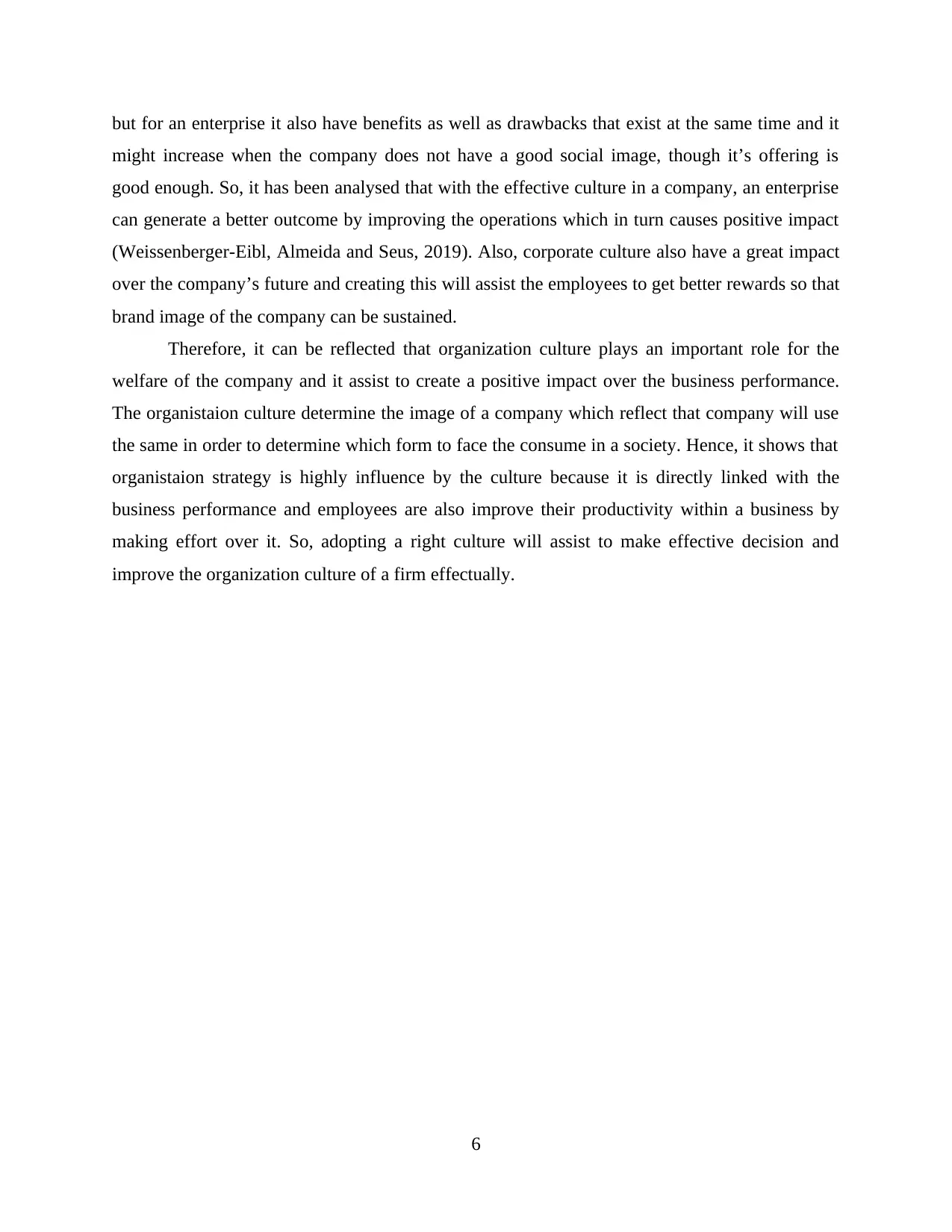
Therefore, it can be reflected that organization culture plays an important role for the
welfare of the company and it assist to create a positive impact over the business performance.
The organistaion culture determine the image of a company which reflect that company will use
the same in order to determine which form to face the consume in a society. Hence, it shows that
organistaion strategy is highly influence by the culture because it is directly linked with the
business performance and employees are also improve their productivity within a business by
making effort over it. So, adopting a right culture will assist to make effective decision and
improve the organization culture of a firm effectually.
6
Document Page
REFERENCES
Books and Journal
Fischer, F. and Boossabong, P., 2018. Deliberative policy analysis. The Oxford Handbook of
Deliberative Democracy, pp.584-594.
Fischer, K. and et.al., 2022. A Typology of Reasoning in Deliberative Processes: A Study of the
2010 Oregon Citizens’ Initiative Review. Journal of Deliberative Democracy. 18(2).
James, M. A. and Derrick, G. E., 2020. When “culture trumps strategy”: higher education
institutional strategic plans and their influence on international student recruitment
practice. Higher Education. 79(4). pp.569-588.
Legun, K. and Sautier, M., 2018. Sustainability programs and deliberative processes: assembling
sustainable winegrowing in New Zealand. Agriculture and Human Values. 35(4).
pp.837-852.
Mulyono, M. and Wekke, I.S., 2018, July. Academic and culture development strategy
management for islamic higher education in indonesian. In IOP Conference Series:
Earth and Environmental Science (Vol. 175, No. 1, p. 012163). IOP Publishing.
Soliman, S., Anchor, J. and Taylor, D., 2019. The international strategies of universities:
deliberate or emergent?. Studies in Higher Education. 44(8). pp.1413-1424.
Vătămănescu, E.M. and et.al., 2020. From the deliberate managerial strategy towards
international business performance: A psychic distance vs. global mindset
approach. Systems Research and Behavioral Science. 37(2). pp.374-387.
Weissenberger-Eibl, M. A., Almeida, A. and Seus, F., 2019. A systems thinking approach to
corporate strategy development. Systems. 7(1). p.16.
Xu, J. and et.al., 2022, December. Upstream cell culture process characterization and in-process
control strategy development at pandemic speed. In MAbs (Vol. 14, No. 1, p. 2060724).
Taylor & Francis.
7
chevron_up_icon
1 out of 7
circle_padding
hide_on_mobile
zoom_out_icon
[object Object]