Strategic Analysis of Honda Motor Company Limited: A Report
VerifiedAdded on 2021/05/31
|16
|2565
|313
Report
AI Summary
This report conducts a strategic analysis of Honda Motor Company Limited, a prominent Japanese multinational corporation in the automobile, motorcycle, aircraft, and power equipment sectors. The analysis begins with an examination of Honda's external environment, utilizing PESTEL and Porter's Five Forces models to assess political, economic, social, technological, legal, and environmental factors, as well as competitive forces within the global automobile industry. The report then evaluates Honda's capabilities, including a financial analysis based on trend and ratio analysis from 2013-2017, to identify key strengths and weaknesses, such as its healthy financial position and the need to manage its debt burden. The analysis also encompasses Honda's product/service portfolio and operational processes, including financing services. The report concludes that while Honda maintains a strong position due to innovative technology, it faces increasing competition and must develop new strategies to maintain profitability.
Running head: STRATEGIC ANALYSIS OF HONDA
Strategic Analysis of Honda
Name of the Student:
Name of the University:
Author’s Note:
Course ID:
Strategic Analysis of Honda
Name of the Student:
Name of the University:
Author’s Note:
Course ID:

Paraphrase This Document
Need a fresh take? Get an instant paraphrase of this document with our AI Paraphraser
1STRATEGIC ANALYSIS OF HONDA
Executive Summary:
The current report would focus on analysing the external environment in the context of
Honda Motor Company Limited, which is a Japanese multinational entity popular for
manufacturing automobiles, motorcycles, aircraft and power equipment. It could be stated that
Honda is enjoying stable position in the global automobile industry due to the adoption of
innovative technologies in manufacturing its main products. However, it is facing increased
competition from the global rivals, which might minimise its profit in future. As a result, it has to
come up with new strategies for coping up with such increased rivalry. Moreover, the financial
analysis conducted states that the organisation has a healthy financial position in the market;
however, it needs to focus on minimising its debt burden, as it would help in eliminating the
financial risk.
Executive Summary:
The current report would focus on analysing the external environment in the context of
Honda Motor Company Limited, which is a Japanese multinational entity popular for
manufacturing automobiles, motorcycles, aircraft and power equipment. It could be stated that
Honda is enjoying stable position in the global automobile industry due to the adoption of
innovative technologies in manufacturing its main products. However, it is facing increased
competition from the global rivals, which might minimise its profit in future. As a result, it has to
come up with new strategies for coping up with such increased rivalry. Moreover, the financial
analysis conducted states that the organisation has a healthy financial position in the market;
however, it needs to focus on minimising its debt burden, as it would help in eliminating the
financial risk.
2STRATEGIC ANALYSIS OF HONDA
Table of Contents
1. Introduction:................................................................................................................................3
2. Analysis of the external environment of Honda:.........................................................................3
2.1 PESTEL analysis of Honda:..................................................................................................3
2.2 Porter’s five forces model of Honda:.....................................................................................5
2.3 Opportunities and challenges (threats) to Honda and global automobile industry:...............7
3. Analysis of the capabilities of Honda and its key strengths and weaknesses:.............................8
3.1 Financial analysis:.................................................................................................................8
3.2 Product/service portfolio and operational analyses:..............................................................9
4. Conclusion:..................................................................................................................................9
References:....................................................................................................................................11
Appendices:...................................................................................................................................13
Table of Contents
1. Introduction:................................................................................................................................3
2. Analysis of the external environment of Honda:.........................................................................3
2.1 PESTEL analysis of Honda:..................................................................................................3
2.2 Porter’s five forces model of Honda:.....................................................................................5
2.3 Opportunities and challenges (threats) to Honda and global automobile industry:...............7
3. Analysis of the capabilities of Honda and its key strengths and weaknesses:.............................8
3.1 Financial analysis:.................................................................................................................8
3.2 Product/service portfolio and operational analyses:..............................................................9
4. Conclusion:..................................................................................................................................9
References:....................................................................................................................................11
Appendices:...................................................................................................................................13
⊘ This is a preview!⊘
Do you want full access?
Subscribe today to unlock all pages.

Trusted by 1+ million students worldwide
3STRATEGIC ANALYSIS OF HONDA
1. Introduction:
The current report would focus on analysing the external environment in the context of
Honda Motor Company Limited, which is a Japanese multinational entity popular for
manufacturing automobiles, motorcycles, aircraft and power equipment. It is the biggest global
manufacturer of internal combustion engines in terms of volume and eighth biggest global
automobile manufacturer since 1959 (Global.honda 2018). The external analysis would use
PESTEL and Porter’s five forces model along with the opportunities and threats inherent in the
global automobile industry. The latter segment of the report would focus on analysing the key
capabilities of Honda by using trend analysis, ratio analysis, product/service portfolio and
operations for identifying its key strengths and weaknesses.
2. Analysis of the external environment of Honda:
2.1 PESTEL analysis of Honda:
There are six macro-environmental factors, which could have direct impact on the
business operations of Honda in the global marketplace and they are evaluated briefly as follows:
Political factors:
In UK, there has been decline in the sale of cars after the enforcement of the new
proposal of the government. This would have negative impact on the revenue of Honda, as they
might not be able to manufacture the same number of cars like before. Moreover, the individuals
residing in Europe and in some Asian nations like Australia have to incur higher tax payments.
The stability in the political environment would formulate the modern standards while boosting
the endowment (Frynas and Mellahi 2015). Since the political changes would have direct
1. Introduction:
The current report would focus on analysing the external environment in the context of
Honda Motor Company Limited, which is a Japanese multinational entity popular for
manufacturing automobiles, motorcycles, aircraft and power equipment. It is the biggest global
manufacturer of internal combustion engines in terms of volume and eighth biggest global
automobile manufacturer since 1959 (Global.honda 2018). The external analysis would use
PESTEL and Porter’s five forces model along with the opportunities and threats inherent in the
global automobile industry. The latter segment of the report would focus on analysing the key
capabilities of Honda by using trend analysis, ratio analysis, product/service portfolio and
operations for identifying its key strengths and weaknesses.
2. Analysis of the external environment of Honda:
2.1 PESTEL analysis of Honda:
There are six macro-environmental factors, which could have direct impact on the
business operations of Honda in the global marketplace and they are evaluated briefly as follows:
Political factors:
In UK, there has been decline in the sale of cars after the enforcement of the new
proposal of the government. This would have negative impact on the revenue of Honda, as they
might not be able to manufacture the same number of cars like before. Moreover, the individuals
residing in Europe and in some Asian nations like Australia have to incur higher tax payments.
The stability in the political environment would formulate the modern standards while boosting
the endowment (Frynas and Mellahi 2015). Since the political changes would have direct
Paraphrase This Document
Need a fresh take? Get an instant paraphrase of this document with our AI Paraphraser
4STRATEGIC ANALYSIS OF HONDA
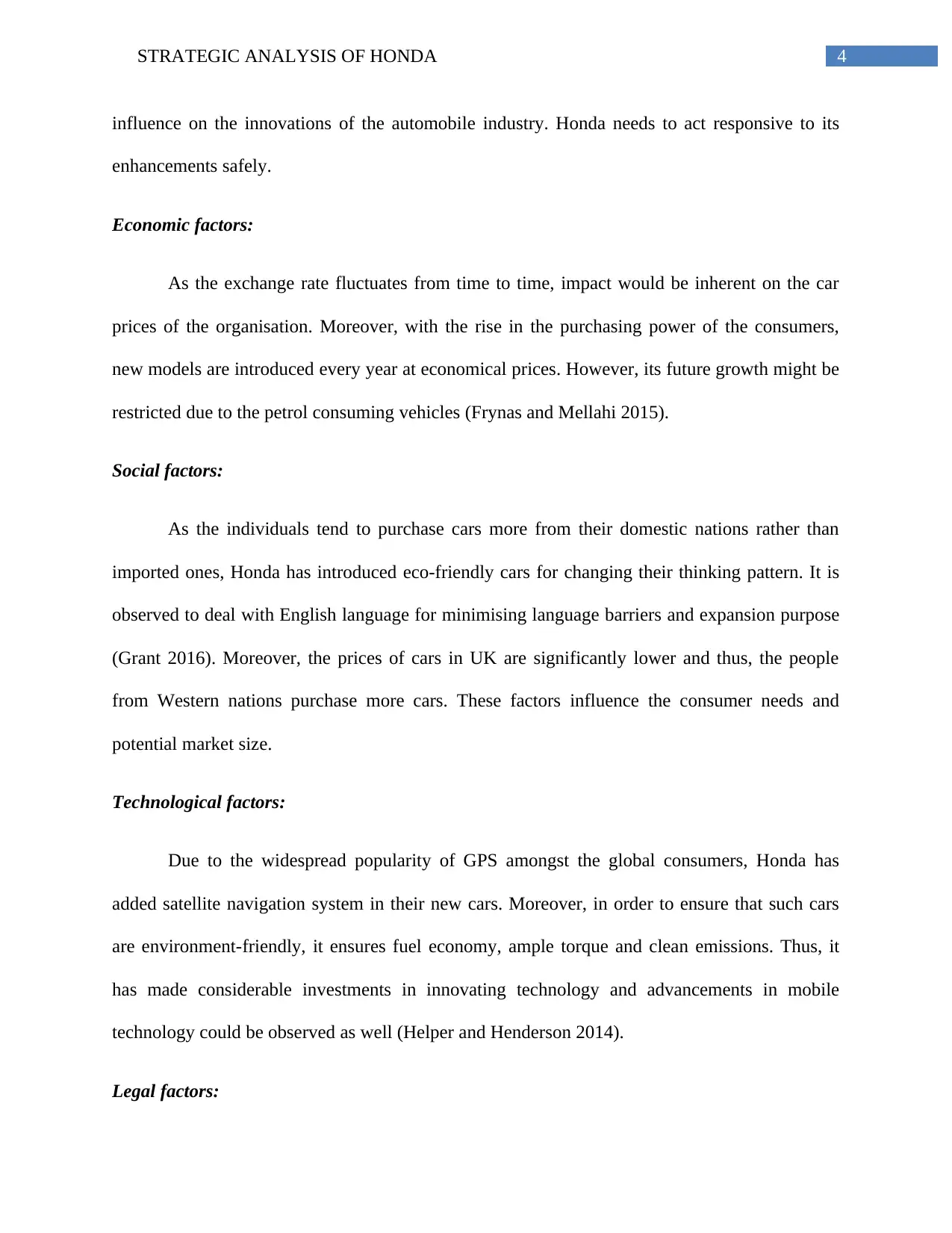
influence on the innovations of the automobile industry. Honda needs to act responsive to its
enhancements safely.
Economic factors:
As the exchange rate fluctuates from time to time, impact would be inherent on the car
prices of the organisation. Moreover, with the rise in the purchasing power of the consumers,
new models are introduced every year at economical prices. However, its future growth might be
restricted due to the petrol consuming vehicles (Frynas and Mellahi 2015).
Social factors:
As the individuals tend to purchase cars more from their domestic nations rather than
imported ones, Honda has introduced eco-friendly cars for changing their thinking pattern. It is
observed to deal with English language for minimising language barriers and expansion purpose
(Grant 2016). Moreover, the prices of cars in UK are significantly lower and thus, the people
from Western nations purchase more cars. These factors influence the consumer needs and
potential market size.
Technological factors:
Due to the widespread popularity of GPS amongst the global consumers, Honda has
added satellite navigation system in their new cars. Moreover, in order to ensure that such cars
are environment-friendly, it ensures fuel economy, ample torque and clean emissions. Thus, it
has made considerable investments in innovating technology and advancements in mobile
technology could be observed as well (Helper and Henderson 2014).
Legal factors:
influence on the innovations of the automobile industry. Honda needs to act responsive to its
enhancements safely.
Economic factors:
As the exchange rate fluctuates from time to time, impact would be inherent on the car
prices of the organisation. Moreover, with the rise in the purchasing power of the consumers,
new models are introduced every year at economical prices. However, its future growth might be
restricted due to the petrol consuming vehicles (Frynas and Mellahi 2015).
Social factors:
As the individuals tend to purchase cars more from their domestic nations rather than
imported ones, Honda has introduced eco-friendly cars for changing their thinking pattern. It is
observed to deal with English language for minimising language barriers and expansion purpose
(Grant 2016). Moreover, the prices of cars in UK are significantly lower and thus, the people
from Western nations purchase more cars. These factors influence the consumer needs and
potential market size.
Technological factors:
Due to the widespread popularity of GPS amongst the global consumers, Honda has
added satellite navigation system in their new cars. Moreover, in order to ensure that such cars
are environment-friendly, it ensures fuel economy, ample torque and clean emissions. Thus, it
has made considerable investments in innovating technology and advancements in mobile
technology could be observed as well (Helper and Henderson 2014).
Legal factors:
5STRATEGIC ANALYSIS OF HONDA
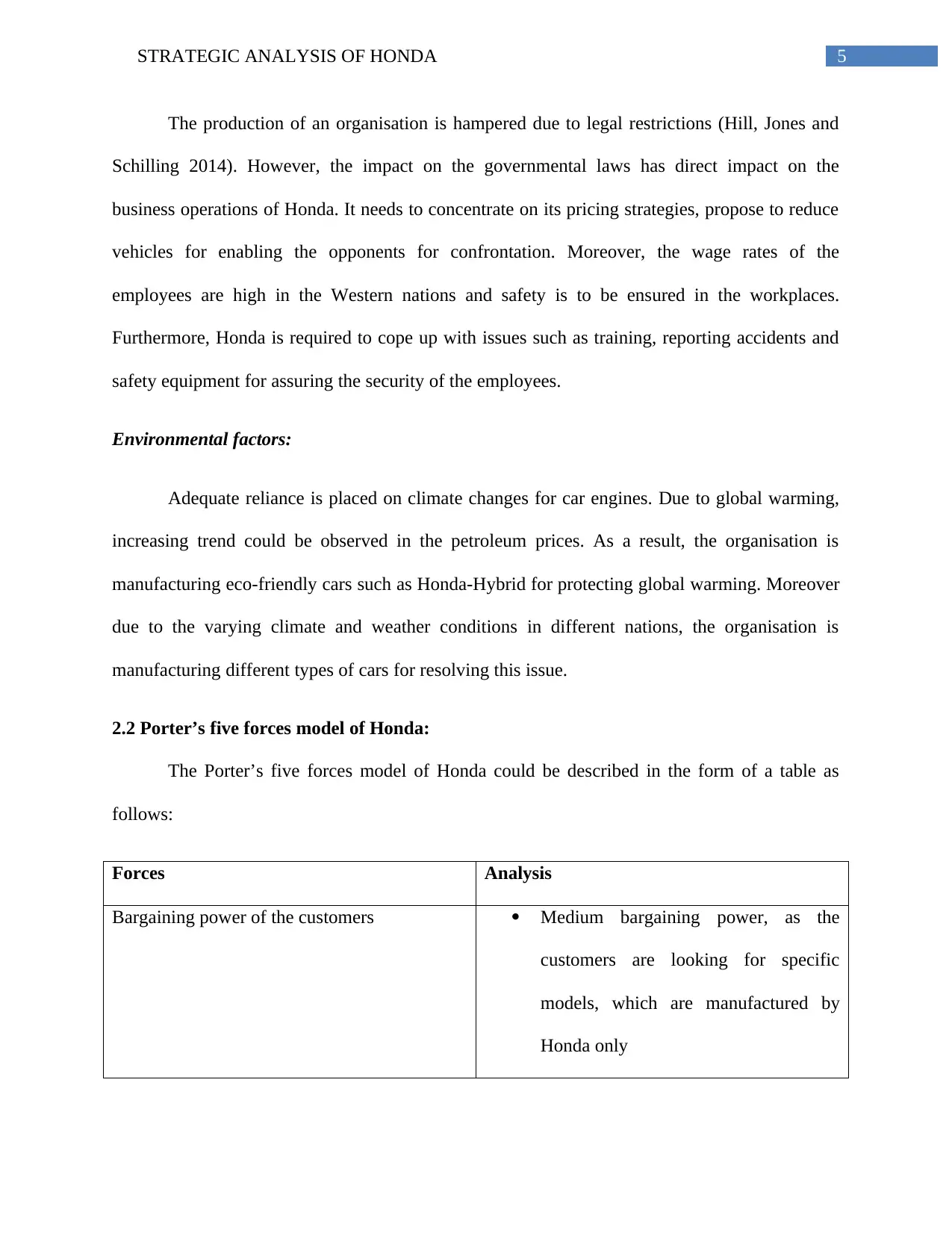
The production of an organisation is hampered due to legal restrictions (Hill, Jones and
Schilling 2014). However, the impact on the governmental laws has direct impact on the
business operations of Honda. It needs to concentrate on its pricing strategies, propose to reduce
vehicles for enabling the opponents for confrontation. Moreover, the wage rates of the
employees are high in the Western nations and safety is to be ensured in the workplaces.
Furthermore, Honda is required to cope up with issues such as training, reporting accidents and
safety equipment for assuring the security of the employees.
Environmental factors:
Adequate reliance is placed on climate changes for car engines. Due to global warming,
increasing trend could be observed in the petroleum prices. As a result, the organisation is
manufacturing eco-friendly cars such as Honda-Hybrid for protecting global warming. Moreover
due to the varying climate and weather conditions in different nations, the organisation is
manufacturing different types of cars for resolving this issue.
2.2 Porter’s five forces model of Honda:
The Porter’s five forces model of Honda could be described in the form of a table as
follows:
Forces Analysis
Bargaining power of the customers Medium bargaining power, as the
customers are looking for specific
models, which are manufactured by
Honda only
The production of an organisation is hampered due to legal restrictions (Hill, Jones and
Schilling 2014). However, the impact on the governmental laws has direct impact on the
business operations of Honda. It needs to concentrate on its pricing strategies, propose to reduce
vehicles for enabling the opponents for confrontation. Moreover, the wage rates of the
employees are high in the Western nations and safety is to be ensured in the workplaces.
Furthermore, Honda is required to cope up with issues such as training, reporting accidents and
safety equipment for assuring the security of the employees.
Environmental factors:
Adequate reliance is placed on climate changes for car engines. Due to global warming,
increasing trend could be observed in the petroleum prices. As a result, the organisation is
manufacturing eco-friendly cars such as Honda-Hybrid for protecting global warming. Moreover
due to the varying climate and weather conditions in different nations, the organisation is
manufacturing different types of cars for resolving this issue.
2.2 Porter’s five forces model of Honda:
The Porter’s five forces model of Honda could be described in the form of a table as
follows:
Forces Analysis
Bargaining power of the customers Medium bargaining power, as the
customers are looking for specific
models, which are manufactured by
Honda only
⊘ This is a preview!⊘
Do you want full access?
Subscribe today to unlock all pages.
Trusted by 1+ million students worldwide
6STRATEGIC ANALYSIS OF HONDA
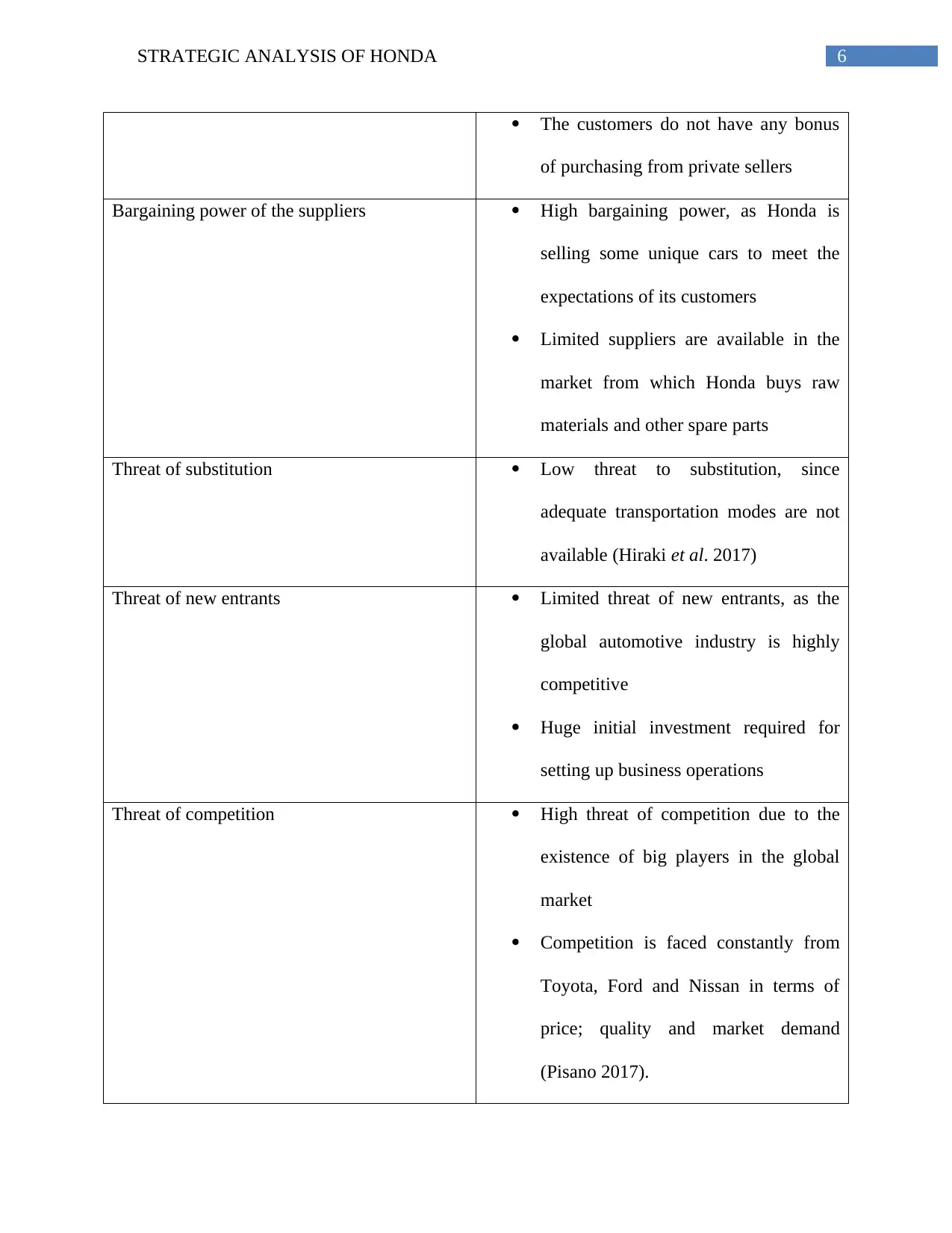
The customers do not have any bonus
of purchasing from private sellers
Bargaining power of the suppliers High bargaining power, as Honda is
selling some unique cars to meet the
expectations of its customers
Limited suppliers are available in the
market from which Honda buys raw
materials and other spare parts
Threat of substitution Low threat to substitution, since
adequate transportation modes are not
available (Hiraki et al. 2017)
Threat of new entrants Limited threat of new entrants, as the
global automotive industry is highly
competitive
Huge initial investment required for
setting up business operations
Threat of competition High threat of competition due to the
existence of big players in the global
market
Competition is faced constantly from
Toyota, Ford and Nissan in terms of
price; quality and market demand
(Pisano 2017).
The customers do not have any bonus
of purchasing from private sellers
Bargaining power of the suppliers High bargaining power, as Honda is
selling some unique cars to meet the
expectations of its customers
Limited suppliers are available in the
market from which Honda buys raw
materials and other spare parts
Threat of substitution Low threat to substitution, since
adequate transportation modes are not
available (Hiraki et al. 2017)
Threat of new entrants Limited threat of new entrants, as the
global automotive industry is highly
competitive
Huge initial investment required for
setting up business operations
Threat of competition High threat of competition due to the
existence of big players in the global
market
Competition is faced constantly from
Toyota, Ford and Nissan in terms of
price; quality and market demand
(Pisano 2017).
Paraphrase This Document
Need a fresh take? Get an instant paraphrase of this document with our AI Paraphraser
7STRATEGIC ANALYSIS OF HONDA
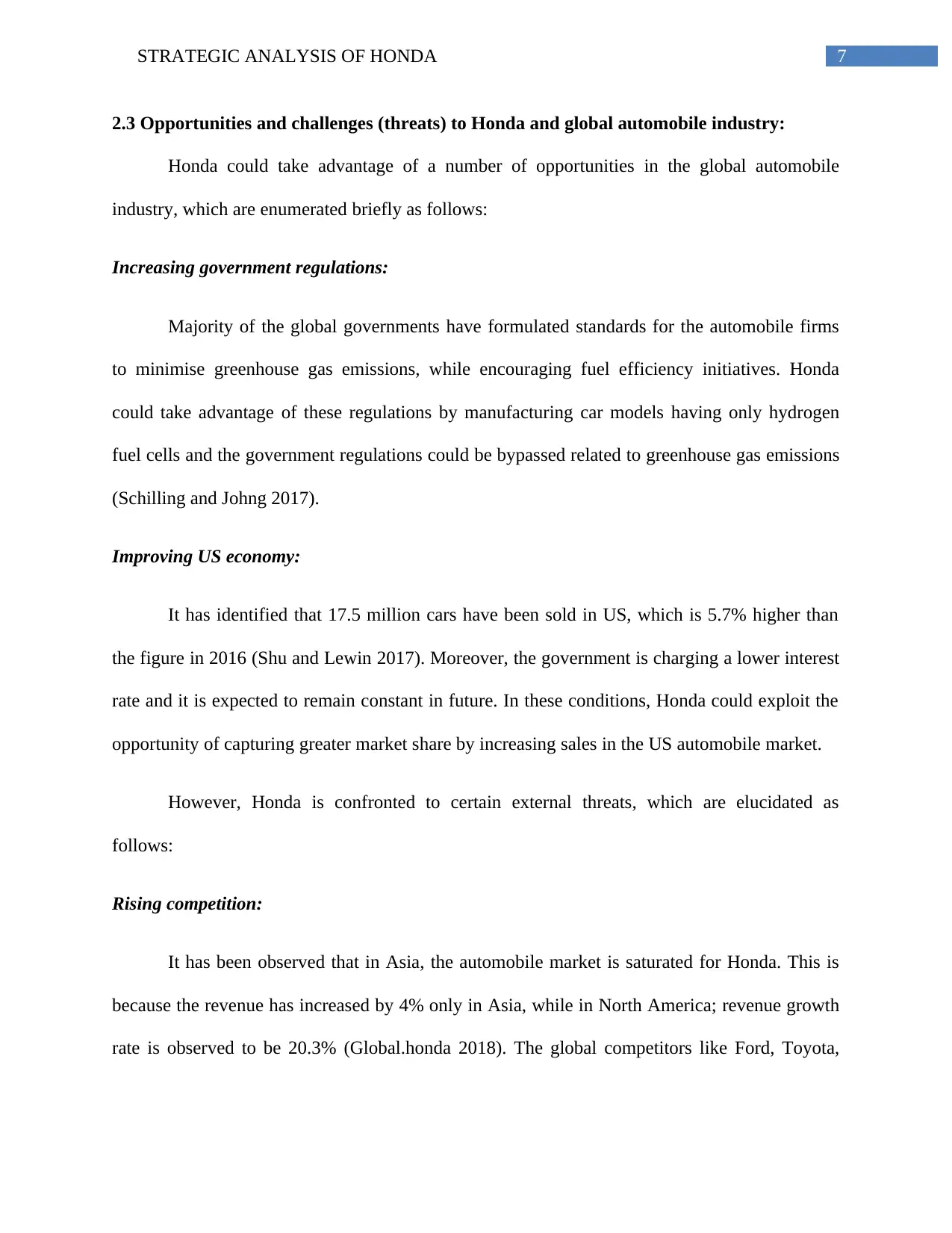
2.3 Opportunities and challenges (threats) to Honda and global automobile industry:
Honda could take advantage of a number of opportunities in the global automobile
industry, which are enumerated briefly as follows:
Increasing government regulations:
Majority of the global governments have formulated standards for the automobile firms
to minimise greenhouse gas emissions, while encouraging fuel efficiency initiatives. Honda
could take advantage of these regulations by manufacturing car models having only hydrogen
fuel cells and the government regulations could be bypassed related to greenhouse gas emissions
(Schilling and Johng 2017).
Improving US economy:
It has identified that 17.5 million cars have been sold in US, which is 5.7% higher than
the figure in 2016 (Shu and Lewin 2017). Moreover, the government is charging a lower interest
rate and it is expected to remain constant in future. In these conditions, Honda could exploit the
opportunity of capturing greater market share by increasing sales in the US automobile market.
However, Honda is confronted to certain external threats, which are elucidated as
follows:
Rising competition:
It has been observed that in Asia, the automobile market is saturated for Honda. This is
because the revenue has increased by 4% only in Asia, while in North America; revenue growth
rate is observed to be 20.3% (Global.honda 2018). The global competitors like Ford, Toyota,
2.3 Opportunities and challenges (threats) to Honda and global automobile industry:
Honda could take advantage of a number of opportunities in the global automobile
industry, which are enumerated briefly as follows:
Increasing government regulations:
Majority of the global governments have formulated standards for the automobile firms
to minimise greenhouse gas emissions, while encouraging fuel efficiency initiatives. Honda
could take advantage of these regulations by manufacturing car models having only hydrogen
fuel cells and the government regulations could be bypassed related to greenhouse gas emissions
(Schilling and Johng 2017).
Improving US economy:
It has identified that 17.5 million cars have been sold in US, which is 5.7% higher than
the figure in 2016 (Shu and Lewin 2017). Moreover, the government is charging a lower interest
rate and it is expected to remain constant in future. In these conditions, Honda could exploit the
opportunity of capturing greater market share by increasing sales in the US automobile market.
However, Honda is confronted to certain external threats, which are elucidated as
follows:
Rising competition:
It has been observed that in Asia, the automobile market is saturated for Honda. This is
because the revenue has increased by 4% only in Asia, while in North America; revenue growth
rate is observed to be 20.3% (Global.honda 2018). The global competitors like Ford, Toyota,
8STRATEGIC ANALYSIS OF HONDA
Volkswaagen and others have high budgets and such budgets could be used to capture greater
portion of market share from Honda.
Increasing Japanese Yen exchange rates:
Honda generates nearly 88% of its revenues from the global markets, which denotes that
it needs to convert cross-border currencies to Japanese Yen for computing its revenues in order
to send the profits back to Japan. If the Japanese Yen exchange rates rise significantly, drastic
decline could be observed in its profit level and as a result, its business operations might be
hampered in future.
3. Analysis of the capabilities of Honda and its key strengths and weaknesses:
3.1 Financial analysis:
Trend analysis and ratio analysis of Honda for the years 2013-2017:
The trend analysis of the financial performance and ratio analysis of Honda have been
depicted in the form of tables (Refer to Appendices, Appendix 3 and Appendix 4). From the
trend analysis, it could be observed that both revenue and gross margin have experienced
fluctuations in growth over the past five years, in which gross profit has declined in 2017 due to
rise in cost of revenue. However, significant fall could be observed in the overall expenses in
2017 due to which Honda has earned sufficient net profit in the year. Hence, from the trend
analysis, it is evident that the organisation has performed strongly in the global market.
Various ratios are computed for evaluating the current financial standing of Honda in the
global automotive industry. From the profitability ratios, it could be observed that increase in net
margin is evident followed by return on equity and return on assets. This is because it has
Volkswaagen and others have high budgets and such budgets could be used to capture greater
portion of market share from Honda.
Increasing Japanese Yen exchange rates:
Honda generates nearly 88% of its revenues from the global markets, which denotes that
it needs to convert cross-border currencies to Japanese Yen for computing its revenues in order
to send the profits back to Japan. If the Japanese Yen exchange rates rise significantly, drastic
decline could be observed in its profit level and as a result, its business operations might be
hampered in future.
3. Analysis of the capabilities of Honda and its key strengths and weaknesses:
3.1 Financial analysis:
Trend analysis and ratio analysis of Honda for the years 2013-2017:
The trend analysis of the financial performance and ratio analysis of Honda have been
depicted in the form of tables (Refer to Appendices, Appendix 3 and Appendix 4). From the
trend analysis, it could be observed that both revenue and gross margin have experienced
fluctuations in growth over the past five years, in which gross profit has declined in 2017 due to
rise in cost of revenue. However, significant fall could be observed in the overall expenses in
2017 due to which Honda has earned sufficient net profit in the year. Hence, from the trend
analysis, it is evident that the organisation has performed strongly in the global market.
Various ratios are computed for evaluating the current financial standing of Honda in the
global automotive industry. From the profitability ratios, it could be observed that increase in net
margin is evident followed by return on equity and return on assets. This is because it has
⊘ This is a preview!⊘
Do you want full access?
Subscribe today to unlock all pages.
Trusted by 1+ million students worldwide
9STRATEGIC ANALYSIS OF HONDA
managed to minimise its expenses, while the asset base is increased due to which greater returns
are provided to the shareholders of the organisation (World.honda.com 2018). The liquidity
ratios computed imply that the organisation has maintained its inventory base adequately by
rightly estimating the market demand. Furthermore, the efficiency ratios suggest that Honda is
able to roll out its manufactured cars from the factories at a faster rate and cash base is increased
due to fast recovery of the credit sales. Finally, the debt ratios suggest that it has placed adequate
emphasis on raising funds through debt, which has increased its overall financial risk. Based on
the above evaluation, it could be inferred that Honda is enjoying stable position in the global
automobile industry.
3.2 Product/service portfolio and operational analyses:
Honda manufactures different types of vehicles like motorcycles, pick-up trucks, small
cars and large trucks. Majority of its service portfolio is targeted towards the common
individuals and for encouraging the customers in purchasing its products, it provides financing
services through Honda Financial Services (Wagner et al. 2015). These services include retail
lending and leasing to customers for purchasing or leasing Honda products and wholesale
financing to the dealers for aiding them in maintaining effective inventory at different dealership
locations (Petty et al. 2015). This denotes that Honda lays adequate emphasis on the customer
needs before design any product and process selection as the main aspect of its operational
process.
4. Conclusion:
Based on the above discussion, it could be stated that Honda is enjoying stable position in
the global automobile industry due to the adoption of innovative technologies in manufacturing
managed to minimise its expenses, while the asset base is increased due to which greater returns
are provided to the shareholders of the organisation (World.honda.com 2018). The liquidity
ratios computed imply that the organisation has maintained its inventory base adequately by
rightly estimating the market demand. Furthermore, the efficiency ratios suggest that Honda is
able to roll out its manufactured cars from the factories at a faster rate and cash base is increased
due to fast recovery of the credit sales. Finally, the debt ratios suggest that it has placed adequate
emphasis on raising funds through debt, which has increased its overall financial risk. Based on
the above evaluation, it could be inferred that Honda is enjoying stable position in the global
automobile industry.
3.2 Product/service portfolio and operational analyses:
Honda manufactures different types of vehicles like motorcycles, pick-up trucks, small
cars and large trucks. Majority of its service portfolio is targeted towards the common
individuals and for encouraging the customers in purchasing its products, it provides financing
services through Honda Financial Services (Wagner et al. 2015). These services include retail
lending and leasing to customers for purchasing or leasing Honda products and wholesale
financing to the dealers for aiding them in maintaining effective inventory at different dealership
locations (Petty et al. 2015). This denotes that Honda lays adequate emphasis on the customer
needs before design any product and process selection as the main aspect of its operational
process.
4. Conclusion:
Based on the above discussion, it could be stated that Honda is enjoying stable position in
the global automobile industry due to the adoption of innovative technologies in manufacturing
Paraphrase This Document
Need a fresh take? Get an instant paraphrase of this document with our AI Paraphraser
10STRATEGIC ANALYSIS OF HONDA
its main products. However, it is facing increased competition from the global rivals, which
might minimise its profit in future. As a result, it has to come up with new strategies for coping
up with such increased rivalry. Moreover, the financial analysis conducted states that the
organisation has a healthy financial position in the market; however, it needs to focus on
minimising its debt burden, as it would help in eliminating the financial risk.
its main products. However, it is facing increased competition from the global rivals, which
might minimise its profit in future. As a result, it has to come up with new strategies for coping
up with such increased rivalry. Moreover, the financial analysis conducted states that the
organisation has a healthy financial position in the market; however, it needs to focus on
minimising its debt burden, as it would help in eliminating the financial risk.
11STRATEGIC ANALYSIS OF HONDA
References:
Frynas, J.G. and Mellahi, K., 2015. Global strategic management. Oxford University Press,
USA.
Global.honda., 2018. Honda Global | Honda Motor Co.,Ltd.. [online] Available at:
https://global.honda/ [Accessed 17 May 2018].
Grant, R.M., 2016. Contemporary strategy analysis: Text and cases edition. John Wiley & Sons.
Helper, S. and Henderson, R., 2014. Management practices, relational contracts, and the decline
of General Motors. Journal of Economic Perspectives, 28(1), pp.49-72.
Hill, C.W., Jones, G.R. and Schilling, M.A., 2014. Strategic management: theory: an integrated
approach. Cengage Learning.
Hiraki, T., Honda, T., Ito, A. and Liu, M., 2017. Financial Conglomeration, IPO Underwriting,
and Allocation in Japan.
Petty, J.W., Titman, S., Keown, A.J., Martin, P., Martin, J.D. and Burrow, M., 2015. Financial
management: Principles and applications. Pearson Higher Education AU.
Pisano, G.P., 2017. Toward a prescriptive theory of dynamic capabilities: connecting strategic
choice, learning, and competition. Industrial and Corporate Change, 26(5), pp.747-762.
Schilling, M.A. and Johng, J., 2017. Honda insight: Development and launch of a hybrid electric
vehicle. In New Horizons in Research on Sustainable Organisations (pp. 125-145). Routledge.
References:
Frynas, J.G. and Mellahi, K., 2015. Global strategic management. Oxford University Press,
USA.
Global.honda., 2018. Honda Global | Honda Motor Co.,Ltd.. [online] Available at:
https://global.honda/ [Accessed 17 May 2018].
Grant, R.M., 2016. Contemporary strategy analysis: Text and cases edition. John Wiley & Sons.
Helper, S. and Henderson, R., 2014. Management practices, relational contracts, and the decline
of General Motors. Journal of Economic Perspectives, 28(1), pp.49-72.
Hill, C.W., Jones, G.R. and Schilling, M.A., 2014. Strategic management: theory: an integrated
approach. Cengage Learning.
Hiraki, T., Honda, T., Ito, A. and Liu, M., 2017. Financial Conglomeration, IPO Underwriting,
and Allocation in Japan.
Petty, J.W., Titman, S., Keown, A.J., Martin, P., Martin, J.D. and Burrow, M., 2015. Financial
management: Principles and applications. Pearson Higher Education AU.
Pisano, G.P., 2017. Toward a prescriptive theory of dynamic capabilities: connecting strategic
choice, learning, and competition. Industrial and Corporate Change, 26(5), pp.747-762.
Schilling, M.A. and Johng, J., 2017. Honda insight: Development and launch of a hybrid electric
vehicle. In New Horizons in Research on Sustainable Organisations (pp. 125-145). Routledge.
⊘ This is a preview!⊘
Do you want full access?
Subscribe today to unlock all pages.
Trusted by 1+ million students worldwide

1 out of 16


Related Documents


Your All-in-One AI-Powered Toolkit for Academic Success.
+13062052269
info@desklib.com
Available 24*7 on WhatsApp / Email
![[object Object]](/_next/static/media/star-bottom.7253800d.svg)
Unlock your academic potential
Copyright © 2020–2026 A2Z Services. All Rights Reserved. Developed and managed by ZUCOL.