Strategic Analysis: Macro Environment of Mr. Empanada, Tampa, Florida
VerifiedAdded on 2023/06/03
|10
|2226
|315
Report
AI Summary
This report provides a comprehensive macro environment analysis of Mr. Empanada, a fast-casual restaurant business in Tampa, Florida. It examines six key dimensions: Political, Economic, Socio-Cultural, Technological, Ecological, and Demographic factors. The political analysis focuses on food safety regulations and their impact on Mr. Empanada. The economic analysis considers inflation, unemployment rates, and tax policies affecting the restaurant industry. The socio-cultural section discusses changing consumer preferences towards healthier lifestyles. The technological aspect highlights the influence of social media on the restaurant industry. Demographic factors, including the millennial generation and changing household structures, are also analyzed. The report uses data and statistics to support its findings, providing a detailed overview of the external factors influencing Mr. Empanada's business operations. Desklib provides a platform to explore more solved assignments and past papers.

Business 1
Business
Business

Paraphrase This Document
Need a fresh take? Get an instant paraphrase of this document with our AI Paraphraser
Business 2
Discussion
Macro environment analysis includes a number of factors in its ambit such as Demographic,
Economic, Socio-Cultural, Technological, Ecological, and Political. All these elements in terms
of Mr. Empanada are defined below.
Political factors
As per the recent 2018 data published by the Centers for Disease Control and Prevention, almost
48 million people in the U.S. get sick, 128,000 are hospitalized, and 3000 deaths occurred each
year because of the diseases occurred from food (FDA). In terms of dealing with this issue, the
Food Safety Modernization Act (FSMA) is used to transform the food safety system of the
country by imposing a number of obligations on the organizations engaged in the fast food
industry. Following are the regulations which are introduced by the FSMA in terms of ensuring
the health and safety of the people of the U.S. All of these regulations impose extra burden on
Mr. Empanada-
Accredited Third-Party Certification- FSMA introduced this rule in November 2015, and
though this a voluntary program it is established for the accreditation of third-party
certification bodies which are also known as third-party auditors in terms of conducting
the food safety audits (FDA).
Risk based preventive controls- Usually, facilities related to domestic and foreign food
need to be registered with section 415 of the Food, Drug, & Cosmetic Act. This section
imposes obligations on the organization to comply with the requirements related to the
risk-based preventive controls. All these controls are mandated by the FSMA and
modernized Current Good Manufacturing Practices (CGMPs) (FDA).
Discussion
Macro environment analysis includes a number of factors in its ambit such as Demographic,
Economic, Socio-Cultural, Technological, Ecological, and Political. All these elements in terms
of Mr. Empanada are defined below.
Political factors
As per the recent 2018 data published by the Centers for Disease Control and Prevention, almost
48 million people in the U.S. get sick, 128,000 are hospitalized, and 3000 deaths occurred each
year because of the diseases occurred from food (FDA). In terms of dealing with this issue, the
Food Safety Modernization Act (FSMA) is used to transform the food safety system of the
country by imposing a number of obligations on the organizations engaged in the fast food
industry. Following are the regulations which are introduced by the FSMA in terms of ensuring
the health and safety of the people of the U.S. All of these regulations impose extra burden on
Mr. Empanada-
Accredited Third-Party Certification- FSMA introduced this rule in November 2015, and
though this a voluntary program it is established for the accreditation of third-party
certification bodies which are also known as third-party auditors in terms of conducting
the food safety audits (FDA).
Risk based preventive controls- Usually, facilities related to domestic and foreign food
need to be registered with section 415 of the Food, Drug, & Cosmetic Act. This section
imposes obligations on the organization to comply with the requirements related to the
risk-based preventive controls. All these controls are mandated by the FSMA and
modernized Current Good Manufacturing Practices (CGMPs) (FDA).
Business 3
Some other regulations are laws related to wages, quality of food, packaging of food, etc..
Packaging regulations related to the food are other factors which impose extra burdens on Mr.
Empanada and this regulation is introduced by the FDA in Food, Drug, and Cosmetic Act 1958.
This act introduces the basic regulations related to the food contact materials and other relevant
acts.
Economic factors
There are number of economic factors which directly affect this industry such as inflation rates,
unemployment rates, wages, prices, spending, etc.. Tampa experienced the average inflation of
2.44% each year, and this rate of change reflects the significant inflation. In other words, $20 in
Tampa (year 2000) would cost $30.13 in the year 2017 in terms of equal purchase. In
comparison of the overall inflation rate of the U.S. that is 2.10% during the similar period, it can
be said that inflation in Tampa was higher. Because of this high inflation, price of the ingredients
increased and this automatically enhances the price of the food products and leads to a decrease
in their margin of profit (Florida Inflation 2017).
Another economic factor which affects the business of this industry is the unemployment rates,
as people do not have as much money to spend on the restaurants. The unemployment rate in
Tampa was 3.7% in the year 2016-17 and 2.9% in the year 2017-18. Because of this, individuals
preferred ready-to-cook meals and packed foods in comparison to the food offered by restaurants
(BLS).
Another economic factor is tax rate, which directly affects the operations of Mr. Empanada.
Recently, bill has been passed which reduced the corporate tax rates from 35% to 21%, and this
affects the fast food industry in a similar manner like any other industries in the U.S. This bill is
Some other regulations are laws related to wages, quality of food, packaging of food, etc..
Packaging regulations related to the food are other factors which impose extra burdens on Mr.
Empanada and this regulation is introduced by the FDA in Food, Drug, and Cosmetic Act 1958.
This act introduces the basic regulations related to the food contact materials and other relevant
acts.
Economic factors
There are number of economic factors which directly affect this industry such as inflation rates,
unemployment rates, wages, prices, spending, etc.. Tampa experienced the average inflation of
2.44% each year, and this rate of change reflects the significant inflation. In other words, $20 in
Tampa (year 2000) would cost $30.13 in the year 2017 in terms of equal purchase. In
comparison of the overall inflation rate of the U.S. that is 2.10% during the similar period, it can
be said that inflation in Tampa was higher. Because of this high inflation, price of the ingredients
increased and this automatically enhances the price of the food products and leads to a decrease
in their margin of profit (Florida Inflation 2017).
Another economic factor which affects the business of this industry is the unemployment rates,
as people do not have as much money to spend on the restaurants. The unemployment rate in
Tampa was 3.7% in the year 2016-17 and 2.9% in the year 2017-18. Because of this, individuals
preferred ready-to-cook meals and packed foods in comparison to the food offered by restaurants
(BLS).
Another economic factor is tax rate, which directly affects the operations of Mr. Empanada.
Recently, bill has been passed which reduced the corporate tax rates from 35% to 21%, and this
affects the fast food industry in a similar manner like any other industries in the U.S. This bill is
⊘ This is a preview!⊘
Do you want full access?
Subscribe today to unlock all pages.

Trusted by 1+ million students worldwide
Business 4
also welcomed and appreciated by the food and grocery industry. This lower rate of tax allows
the organizations to invest more money on other operations of their business and ensures
effectiveness (Liem).
As stated by the National Restaurant Association, the total sales of this industry in 2017 are
almost $799 billion. This industry gives employment to almost 16.3 million people in the United
States. The main issue in this context faced by the organization is the increase of wages of
employees, however, the prices of the food remain same. In other words, organizations are
pressured to not increase the price of the food because of the immense competition (NRA).
The size of individual spending on fast food options has always been dependent on the economic
conditions of particular markets. In the U.S., almost 50 million people are fed by 200,000
restaurants on a daily basis.
Increase in wages of restaurant industry
also welcomed and appreciated by the food and grocery industry. This lower rate of tax allows
the organizations to invest more money on other operations of their business and ensures
effectiveness (Liem).
As stated by the National Restaurant Association, the total sales of this industry in 2017 are
almost $799 billion. This industry gives employment to almost 16.3 million people in the United
States. The main issue in this context faced by the organization is the increase of wages of
employees, however, the prices of the food remain same. In other words, organizations are
pressured to not increase the price of the food because of the immense competition (NRA).
The size of individual spending on fast food options has always been dependent on the economic
conditions of particular markets. In the U.S., almost 50 million people are fed by 200,000
restaurants on a daily basis.
Increase in wages of restaurant industry
Paraphrase This Document
Need a fresh take? Get an instant paraphrase of this document with our AI Paraphraser
Business 5
Figure 1: Aaron Allen & Associates. Economic Factors Affecting the U.S. Restaurant Industry. eHow,
https://aaronallen.com/blog/us-restaurant-analysis-2017.
Socio-Cultural Factors
Social factors affect the organization in an indirect manner, as customers are adopting a healthy
lifestyle and becoming educated, as this makes them conscious about the food products. Florida
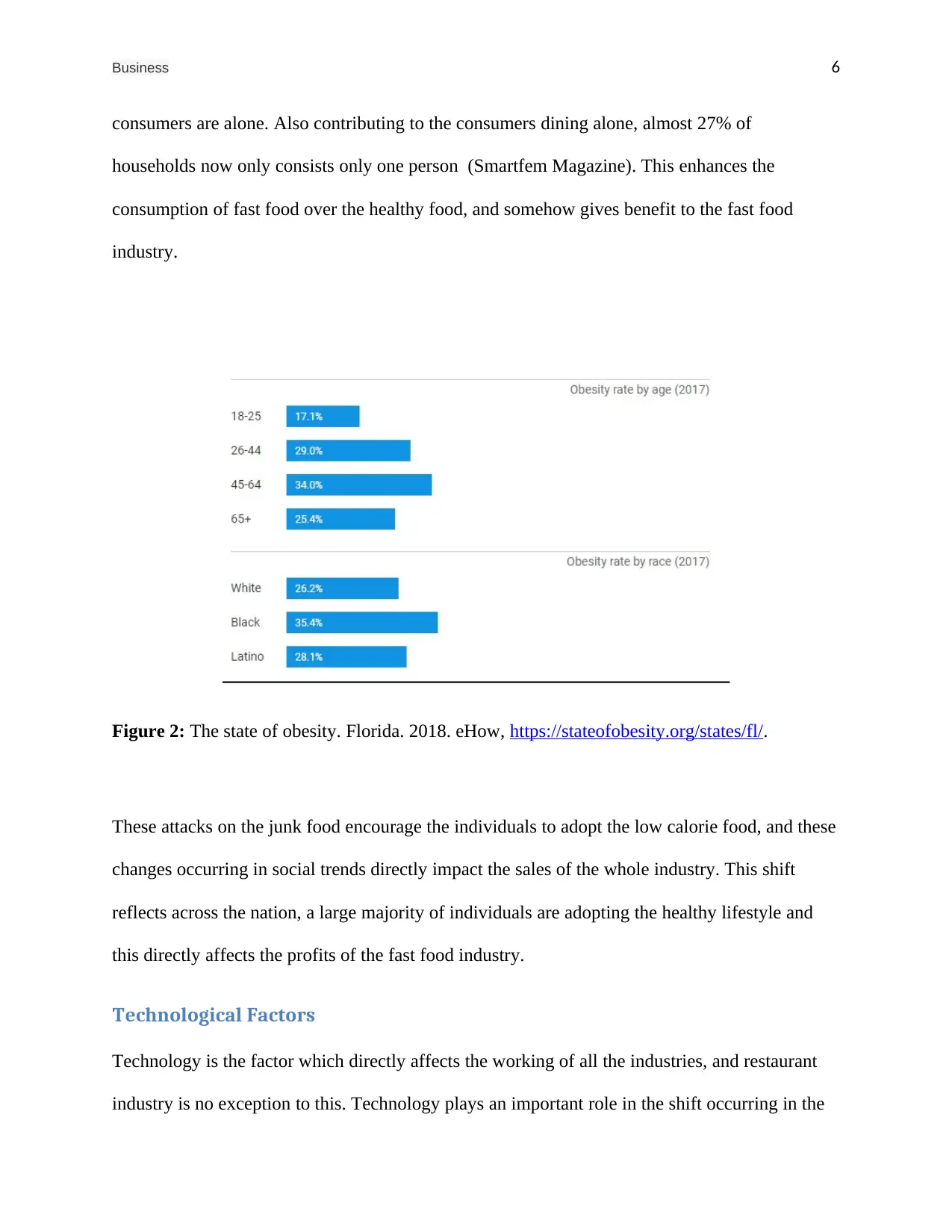
has the lowest adult obesity rate that is 10 to 17. Currently, Florida adult obesity rate is almost
28.4% which is high in comparison of the 18.4% in the year 2000. There are a number of
individuals who are adopting the healthy lifestyle and food habits for getting away from these
issues (The State of Obesity). Currently the existing customers of this organization are those
people who are young and more health conscious (Jack).
Obesity increases the risk of heart diseases, diabetes, high blood pressure, and other health
issues. This directly affects the purchasing power of the organization because their existing
customers are avoiding the food with high calories and fat. In other words, customers are
avoiding junk food and unhealthy food. This industry was held liable for increasing the
childhood obesity rates and because of this, the industry needs to adopt measures like showing
the nutritional content on the label and reducing the calories in the items. Cultural factors may
also a play very important role in the society even though some cultures in the U.S. do not
encourage the consumption of fast food.
The average American spends almost $1200 each year on fast food. Children in America
consume almost 12% of the calories from fast food. Another change which affects the fast food
industry is the changing household structure, as consumption behaviors in the USA have become
less household oriented and more individualized in comparison to the previous generations.
More than 50% of occasions related to eating and beverages happened at the time when
Figure 1: Aaron Allen & Associates. Economic Factors Affecting the U.S. Restaurant Industry. eHow,
https://aaronallen.com/blog/us-restaurant-analysis-2017.
Socio-Cultural Factors
Social factors affect the organization in an indirect manner, as customers are adopting a healthy
lifestyle and becoming educated, as this makes them conscious about the food products. Florida
has the lowest adult obesity rate that is 10 to 17. Currently, Florida adult obesity rate is almost
28.4% which is high in comparison of the 18.4% in the year 2000. There are a number of
individuals who are adopting the healthy lifestyle and food habits for getting away from these
issues (The State of Obesity). Currently the existing customers of this organization are those
people who are young and more health conscious (Jack).
Obesity increases the risk of heart diseases, diabetes, high blood pressure, and other health
issues. This directly affects the purchasing power of the organization because their existing
customers are avoiding the food with high calories and fat. In other words, customers are
avoiding junk food and unhealthy food. This industry was held liable for increasing the
childhood obesity rates and because of this, the industry needs to adopt measures like showing
the nutritional content on the label and reducing the calories in the items. Cultural factors may
also a play very important role in the society even though some cultures in the U.S. do not
encourage the consumption of fast food.
The average American spends almost $1200 each year on fast food. Children in America
consume almost 12% of the calories from fast food. Another change which affects the fast food
industry is the changing household structure, as consumption behaviors in the USA have become
less household oriented and more individualized in comparison to the previous generations.
More than 50% of occasions related to eating and beverages happened at the time when
Business 6
consumers are alone. Also contributing to the consumers dining alone, almost 27% of
households now only consists only one person (Smartfem Magazine). This enhances the
consumption of fast food over the healthy food, and somehow gives benefit to the fast food
industry.
Figure 2: The state of obesity. Florida. 2018. eHow, https://stateofobesity.org/states/fl/.
These attacks on the junk food encourage the individuals to adopt the low calorie food, and these
changes occurring in social trends directly impact the sales of the whole industry. This shift
reflects across the nation, a large majority of individuals are adopting the healthy lifestyle and
this directly affects the profits of the fast food industry.
Technological Factors
Technology is the factor which directly affects the working of all the industries, and restaurant
industry is no exception to this. Technology plays an important role in the shift occurring in the
consumers are alone. Also contributing to the consumers dining alone, almost 27% of
households now only consists only one person (Smartfem Magazine). This enhances the
consumption of fast food over the healthy food, and somehow gives benefit to the fast food
industry.
Figure 2: The state of obesity. Florida. 2018. eHow, https://stateofobesity.org/states/fl/.
These attacks on the junk food encourage the individuals to adopt the low calorie food, and these
changes occurring in social trends directly impact the sales of the whole industry. This shift
reflects across the nation, a large majority of individuals are adopting the healthy lifestyle and
this directly affects the profits of the fast food industry.
Technological Factors
Technology is the factor which directly affects the working of all the industries, and restaurant
industry is no exception to this. Technology plays an important role in the shift occurring in the
⊘ This is a preview!⊘
Do you want full access?
Subscribe today to unlock all pages.
Trusted by 1+ million students worldwide
Business 7
trends of the restaurant industry. Previously, the only focus of the restaurants is to get the
customers and serve them food, but now things are completely changed. Now, restaurants need
to focus on some other factors also, such as best experience and services to the customers, unique
experience, best food, etc.
The most important aspect which affects the restaurant industry is the growing trend of social
media platforms. Presently, social media platforms are considered as a basic requirement of
society and it is not possible to escape it even for an hour. As per one research shows that in
2018 almost 68% of Americans are active on Facebook, 35% are active on Instagram, and 24%
have a Twitter account (Single platform 2018). An average person in America uses three social
accounts and accesses their social channels at least once per day.
The authority of social media directly affects the restaurant industry as well, as almost 171
million posts related to restaurants of America are trending on Instagram alone (Single platform
2018). Each individual follow at least 1-3 accounts related to food and restaurants, food
magazines, bloggers or influencers. As there is trend to post the picture or comment of what they
are eating, all these things increase the expectations of the consumers.
Marketing related to the restaurant industry in the U.S. also faced a major shift over the years,
and they believe that traditional techniques of advertisements are not enough anymore. Digital
technology needs to be used by the organization in terms of marketing, as social media is
considered a big platform and used by many restaurants for attracting new customers (Single
platform 2018).
trends of the restaurant industry. Previously, the only focus of the restaurants is to get the
customers and serve them food, but now things are completely changed. Now, restaurants need
to focus on some other factors also, such as best experience and services to the customers, unique
experience, best food, etc.
The most important aspect which affects the restaurant industry is the growing trend of social
media platforms. Presently, social media platforms are considered as a basic requirement of
society and it is not possible to escape it even for an hour. As per one research shows that in
2018 almost 68% of Americans are active on Facebook, 35% are active on Instagram, and 24%
have a Twitter account (Single platform 2018). An average person in America uses three social
accounts and accesses their social channels at least once per day.
The authority of social media directly affects the restaurant industry as well, as almost 171
million posts related to restaurants of America are trending on Instagram alone (Single platform
2018). Each individual follow at least 1-3 accounts related to food and restaurants, food
magazines, bloggers or influencers. As there is trend to post the picture or comment of what they
are eating, all these things increase the expectations of the consumers.
Marketing related to the restaurant industry in the U.S. also faced a major shift over the years,
and they believe that traditional techniques of advertisements are not enough anymore. Digital
technology needs to be used by the organization in terms of marketing, as social media is
considered a big platform and used by many restaurants for attracting new customers (Single
platform 2018).
Paraphrase This Document
Need a fresh take? Get an instant paraphrase of this document with our AI Paraphraser
Business 8
Demographic Factors
The changing demographics of USA, including enhancing influence of millennial, changes
occurred in the life stages of households, considered as major factor which drive the shift in the
food habits of the consumers. The millennial generation is the most important factor which must
be considered while framing the strategy, as it includes the group of 20-35 years old individuals.
This group not only influences the technology trends but also culinary trends. Almost 22% of the
population of the U.S., almost 68 million people, falls under this group. There are number of
experts which state that, millennials generally preferred the healthy eating habits and desire more
unprocessed, natural foods. However, there are some aspects which affect the food habits of
millennials, such as recession (CS News 2015).
Recession is hard on millennials, as this generation commits the largest portion of their food
expenditure on the food which they take away from home. Almost 45.2% of individuals between
the ages of 25-34 years spent a large amount of money on the food which they take away from
home. This is the major factor because almost 54% of fast food users who consume fast food at
least once a day and 37% of fast food users who consume fast food almost 2-6 times in a week
are between the ages of 18-34.
Another demographic factor which affects the fast food industry of USA is the changing
household structure, as consumption behaviors in the U.S. have become less household oriented
and more individualized in comparison to the previous generations. This can be understood with
the help of an example: more than 50% of occasions related to eating and beverages happened at
the time when consumers were alone. Also contributing to the consumers dining alone, almost
27% of households now only consist of only one person (QSR).
Demographic Factors
The changing demographics of USA, including enhancing influence of millennial, changes
occurred in the life stages of households, considered as major factor which drive the shift in the
food habits of the consumers. The millennial generation is the most important factor which must
be considered while framing the strategy, as it includes the group of 20-35 years old individuals.
This group not only influences the technology trends but also culinary trends. Almost 22% of the
population of the U.S., almost 68 million people, falls under this group. There are number of
experts which state that, millennials generally preferred the healthy eating habits and desire more
unprocessed, natural foods. However, there are some aspects which affect the food habits of
millennials, such as recession (CS News 2015).
Recession is hard on millennials, as this generation commits the largest portion of their food
expenditure on the food which they take away from home. Almost 45.2% of individuals between
the ages of 25-34 years spent a large amount of money on the food which they take away from
home. This is the major factor because almost 54% of fast food users who consume fast food at
least once a day and 37% of fast food users who consume fast food almost 2-6 times in a week
are between the ages of 18-34.
Another demographic factor which affects the fast food industry of USA is the changing
household structure, as consumption behaviors in the U.S. have become less household oriented
and more individualized in comparison to the previous generations. This can be understood with
the help of an example: more than 50% of occasions related to eating and beverages happened at
the time when consumers were alone. Also contributing to the consumers dining alone, almost
27% of households now only consist of only one person (QSR).
Business 9
References
Aaron Allen & Associates. Economic Factors Affecting the U.S. Restaurant Industry. eHow,
https://aaronallen.com/blog/us-restaurant-analysis-2017.
BLS. Tampa Area Economic Summary. 2018. eHow,
https://www.bls.gov/regions/southeast/summary/blssummary_tampa.pdf.
CS News. Demographic Changes Among Key Trends Shaping Foodservice. 2015. eHow,
https://csnews.com/demographic-changes-among-key-trends-shaping-foodservice.
Emma. Liem. How the GOP tax overhaul could affect the food industry. 2017. eHow.
https://www.fooddive.com/news/how-the-gop-tax-overhaul-could-affect-the-food-industry/
513323/.
FDA. FDA Food Safety Modernization Act (FSMA). 2018. eHow,
https://www.fda.gov/Food/GuidanceRegulation/FSMA/default.htm.
FDA. FSMA Final Rule for Preventive Controls for Human Food. 2018. eHow,
https://www.fda.gov/Food/GuidanceRegulation/FSMA/ucm334115.htm.
FDA. FSMA Final Rule on Accredited Third-Party Certification. 2018. eHow,
https://www.fda.gov/Food/GuidanceRegulation/FSMA/ucm361903.htm.
Florida Inflation. Tampa, Florida prices: $20 in 2000 → $30.13 in 2017. 2017. eHow,
http://www.in2013dollars.com/Tampa-Florida/price-inflation.
NRA. News & Research. 2017. eHow, https://www.restaurant.org/News-Research/Research/soi.
QSR. Meet Your Consumer. 2012. eHow. https://www.qsrmagazine.com/consumer-trends/meet-
your-consumer.
Single platform. 5 Ways America’s Restaurant Industry Has Changed Over the Last Decade.
2018. eHow, https://www.singleplatform.com/blog/5-ways-americas-restaurant-industry-has-
changed-over-the-last-decade.
Statista. Restaurant industry in the U.S. - Statistics & Facts. eHow,
https://www.statista.com/topics/1135/us-restaurants/.
The state of obesity. Florida. 2018. eHow, https://stateofobesity.org/states/fl/.
References
Aaron Allen & Associates. Economic Factors Affecting the U.S. Restaurant Industry. eHow,
https://aaronallen.com/blog/us-restaurant-analysis-2017.
BLS. Tampa Area Economic Summary. 2018. eHow,
https://www.bls.gov/regions/southeast/summary/blssummary_tampa.pdf.
CS News. Demographic Changes Among Key Trends Shaping Foodservice. 2015. eHow,
https://csnews.com/demographic-changes-among-key-trends-shaping-foodservice.
Emma. Liem. How the GOP tax overhaul could affect the food industry. 2017. eHow.
https://www.fooddive.com/news/how-the-gop-tax-overhaul-could-affect-the-food-industry/
513323/.
FDA. FDA Food Safety Modernization Act (FSMA). 2018. eHow,
https://www.fda.gov/Food/GuidanceRegulation/FSMA/default.htm.
FDA. FSMA Final Rule for Preventive Controls for Human Food. 2018. eHow,
https://www.fda.gov/Food/GuidanceRegulation/FSMA/ucm334115.htm.
FDA. FSMA Final Rule on Accredited Third-Party Certification. 2018. eHow,
https://www.fda.gov/Food/GuidanceRegulation/FSMA/ucm361903.htm.
Florida Inflation. Tampa, Florida prices: $20 in 2000 → $30.13 in 2017. 2017. eHow,
http://www.in2013dollars.com/Tampa-Florida/price-inflation.
NRA. News & Research. 2017. eHow, https://www.restaurant.org/News-Research/Research/soi.
QSR. Meet Your Consumer. 2012. eHow. https://www.qsrmagazine.com/consumer-trends/meet-
your-consumer.
Single platform. 5 Ways America’s Restaurant Industry Has Changed Over the Last Decade.
2018. eHow, https://www.singleplatform.com/blog/5-ways-americas-restaurant-industry-has-
changed-over-the-last-decade.
Statista. Restaurant industry in the U.S. - Statistics & Facts. eHow,
https://www.statista.com/topics/1135/us-restaurants/.
The state of obesity. Florida. 2018. eHow, https://stateofobesity.org/states/fl/.
⊘ This is a preview!⊘
Do you want full access?
Subscribe today to unlock all pages.
Trusted by 1+ million students worldwide

Business 10
Smartfem magazine. Americans Spend $1,200 A Year On Fast Food. 2017. eHow
https://www.smartfem.com/health/americans-spend-1200-a-year-on-fast-food/.
Smartfem magazine. Americans Spend $1,200 A Year On Fast Food. 2017. eHow
https://www.smartfem.com/health/americans-spend-1200-a-year-on-fast-food/.

1 out of 10


Your All-in-One AI-Powered Toolkit for Academic Success.
+13062052269
info@desklib.com
Available 24*7 on WhatsApp / Email
![[object Object]](/_next/static/media/star-bottom.7253800d.svg)
Unlock your academic potential
Copyright © 2020–2025 A2Z Services. All Rights Reserved. Developed and managed by ZUCOL.