Strategic Analysis: Comparing Strategic Choices of Tesco and Sainsbury
VerifiedAdded on 2020/01/28
|12
|3398
|189
Report
AI Summary
This report presents a strategic analysis of two major retail companies, Tesco and Sainsbury, examining their strategic choices and their impact on market positioning and competitive advantage. The report utilizes the Ansoff matrix to evaluate the companies' market penetration, market development, product development, and diversification strategies. It analyzes how Tesco's focus on market development and Sainsbury's emphasis on product development have influenced their operations, profit margins, and market presence. The report also explores the concepts of Blue Ocean and Red Ocean strategies, categorizing the companies' strategic decisions accordingly. Ultimately, the analysis highlights the extent to which these strategic decisions have aided or disrupted the pursuit of competitive advantages within the retail industry. The report provides a comprehensive overview of the strategic landscape and decision-making processes of these two key players.
Strategic Analysis
1
1

Paraphrase This Document
Need a fresh take? Get an instant paraphrase of this document with our AI Paraphraser
TABLE OF CONTENTS
INTRODUCTION........................................................................................................... 3
Strategic choices taken by the companies..............................................................3
The impact of strategic decisions on the selected company...................................6
Blue oceans and red oceans................................................................................... 7
What extent decisions has aided or disrupted the pursuit of competitive
advantages............................................................................................................. 8
CONCLUSION ............................................................................................................. 9
REFERENCES............................................................................................................. 10
2
INTRODUCTION........................................................................................................... 3
Strategic choices taken by the companies..............................................................3
The impact of strategic decisions on the selected company...................................6
Blue oceans and red oceans................................................................................... 7
What extent decisions has aided or disrupted the pursuit of competitive
advantages............................................................................................................. 8
CONCLUSION ............................................................................................................. 9
REFERENCES............................................................................................................. 10
2
INTRODUCTION
Strategic analysis is considered as a procedure for processing and developing
the strategies for the organization through researching and investigating the
internal and external business environment under which they operate their
operations and activities (Janczak, 2005). There are diverse strategic tools and
techniques through which management can measure their capability to sustain in
the market. Presently, the report focuses on two different companies that operate
within retail industry that is Tesco and Sainsbury. With the help of using different
tools and models company can easily compare and contrast their strategic choices
and decisions with the rival companies. Lastly, the report will also analyse that how
product and market decisions has supported the company in meeting their vision
and objectives.
Strategic choices taken by the companies
In order to succeed in the competitive market, management have to take
different strategic decisions that will directly impact the direction of company in the
long run (Ashill, Frederikson and Davies, 2003). However, these decisions are often
concerned with measuring the whole environment under which the retail firm
operates their activities so that they can easily manage overall resources to ensure
optimum utilization of the resources. In order to achieve success in the global world,
it is significant for the management to focus on appropriate strategic choices.
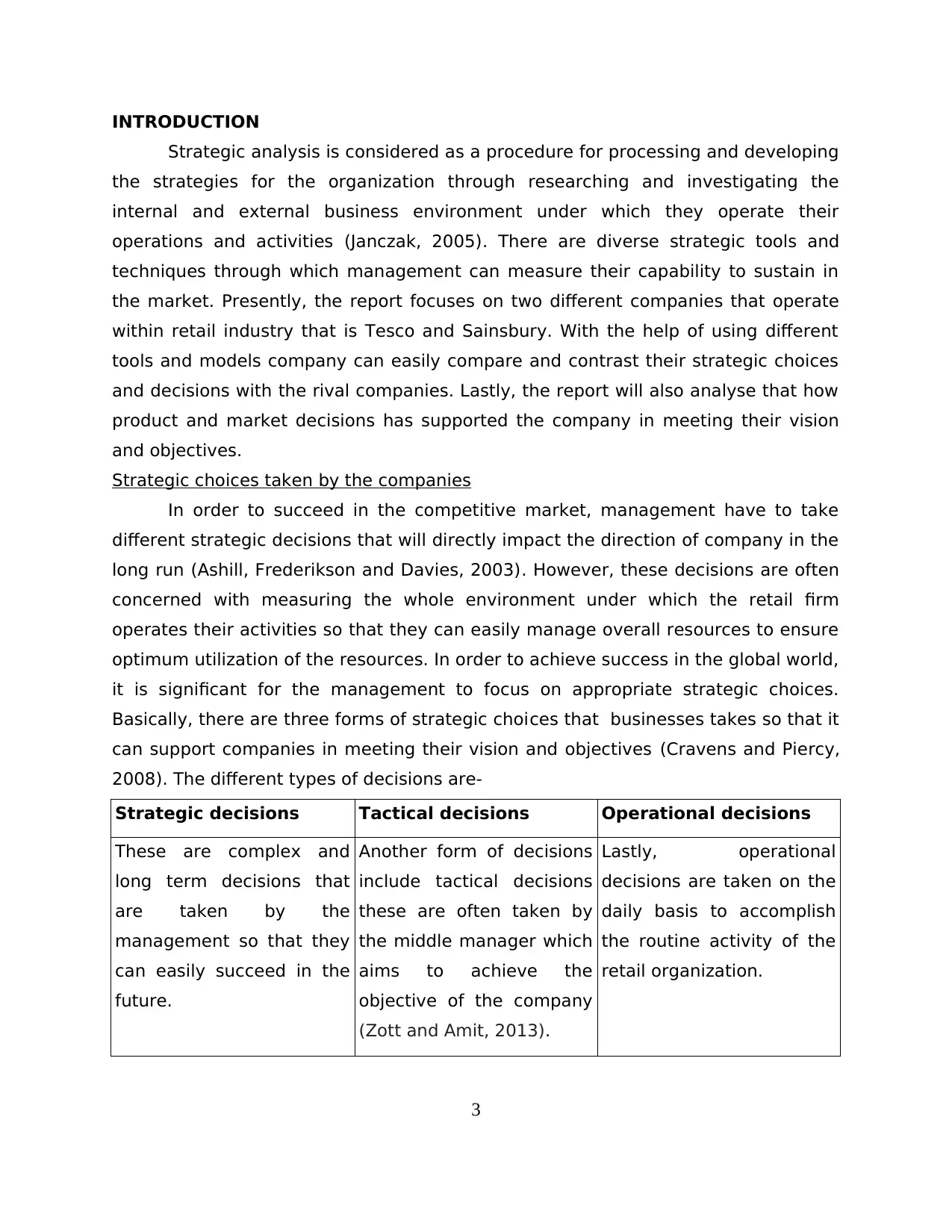
Basically, there are three forms of strategic choices that businesses takes so that it
can support companies in meeting their vision and objectives (Cravens and Piercy,
2008). The different types of decisions are-
Strategic decisions Tactical decisions Operational decisions
These are complex and
long term decisions that
are taken by the
management so that they
can easily succeed in the
future.
Another form of decisions
include tactical decisions
these are often taken by
the middle manager which
aims to achieve the
objective of the company
(Zott and Amit, 2013).
Lastly, operational
decisions are taken on the
daily basis to accomplish
the routine activity of the
retail organization.
3
Strategic analysis is considered as a procedure for processing and developing
the strategies for the organization through researching and investigating the
internal and external business environment under which they operate their
operations and activities (Janczak, 2005). There are diverse strategic tools and
techniques through which management can measure their capability to sustain in
the market. Presently, the report focuses on two different companies that operate
within retail industry that is Tesco and Sainsbury. With the help of using different
tools and models company can easily compare and contrast their strategic choices
and decisions with the rival companies. Lastly, the report will also analyse that how
product and market decisions has supported the company in meeting their vision
and objectives.
Strategic choices taken by the companies
In order to succeed in the competitive market, management have to take
different strategic decisions that will directly impact the direction of company in the
long run (Ashill, Frederikson and Davies, 2003). However, these decisions are often
concerned with measuring the whole environment under which the retail firm
operates their activities so that they can easily manage overall resources to ensure
optimum utilization of the resources. In order to achieve success in the global world,
it is significant for the management to focus on appropriate strategic choices.
Basically, there are three forms of strategic choices that businesses takes so that it
can support companies in meeting their vision and objectives (Cravens and Piercy,
2008). The different types of decisions are-
Strategic decisions Tactical decisions Operational decisions
These are complex and
long term decisions that
are taken by the
management so that they
can easily succeed in the
future.
Another form of decisions
include tactical decisions
these are often taken by
the middle manager which
aims to achieve the
objective of the company
(Zott and Amit, 2013).
Lastly, operational
decisions are taken on the
daily basis to accomplish
the routine activity of the
retail organization.
3
⊘ This is a preview!⊘
Do you want full access?
Subscribe today to unlock all pages.

Trusted by 1+ million students worldwide
There are assorted models that support the management of chosen company
to take effective strategic choice which support them in gaining competitive
advantage (Papadakis and Barwise, 2012). Ansoff matrix is an effective strategic
planning instrument that supports both the companies in providing model that help
the management in devising and developing effective strategy for enabling the
future growth. The Ansoff matrix basically provides four alternative choices to Tesco
and Sainsbury so that they can ensure corporate growth in the competitive
marketplace. The foremost organization is Tesco. This is one of the renowned food
retailers in the UK region that operates 2,318 stores worldwide. The key objective of
Tesco supermarket is to become successful worldwide, another objective is to
expand their core business in the UK as almost 70% of gross sales and profit that
company earns is from the operations of UK business. Therefore, with the help of
different growth strategies they can easily attain objectives and this also result in
gaining competitive advantage (Chen, 2011). The Ansoff matrix focuses on four
growth strategies that is-
Market Penetration: The foremost strategy within Ansoff matrix is market
penetration strategy under which Tesco generally seeks to attain
development with their present products in the existing market segment.
Therefore, management of Tesco focuses on using competitive pricing
strategies for their products so that large customers get attracted towards it.
However, the firm often uses sales promotional techniques like offering
discounts, free products etc. to sell their existing products in the current
segmented market (Bell, Masaoka and Zimmerman, 2010).
Market development: Another growth strategy of Ansoff matrix includes
market development under which chosen firm seeks growth and
development by targeting new market segment with the existing products so
that they can easily achieve their objective to expand their core business
within UK region. The key mission of Tesco is to become the leading retailer
in international market for accomplishing the above mission statement of the
chosen firm market development is fruitful strategy.
Product development: Another strategy within matrix includes product
development strategy under which Tesco creates new products to target
4
to take effective strategic choice which support them in gaining competitive
advantage (Papadakis and Barwise, 2012). Ansoff matrix is an effective strategic
planning instrument that supports both the companies in providing model that help
the management in devising and developing effective strategy for enabling the
future growth. The Ansoff matrix basically provides four alternative choices to Tesco
and Sainsbury so that they can ensure corporate growth in the competitive
marketplace. The foremost organization is Tesco. This is one of the renowned food
retailers in the UK region that operates 2,318 stores worldwide. The key objective of
Tesco supermarket is to become successful worldwide, another objective is to
expand their core business in the UK as almost 70% of gross sales and profit that
company earns is from the operations of UK business. Therefore, with the help of
different growth strategies they can easily attain objectives and this also result in
gaining competitive advantage (Chen, 2011). The Ansoff matrix focuses on four
growth strategies that is-
Market Penetration: The foremost strategy within Ansoff matrix is market
penetration strategy under which Tesco generally seeks to attain
development with their present products in the existing market segment.
Therefore, management of Tesco focuses on using competitive pricing
strategies for their products so that large customers get attracted towards it.
However, the firm often uses sales promotional techniques like offering
discounts, free products etc. to sell their existing products in the current
segmented market (Bell, Masaoka and Zimmerman, 2010).
Market development: Another growth strategy of Ansoff matrix includes
market development under which chosen firm seeks growth and
development by targeting new market segment with the existing products so
that they can easily achieve their objective to expand their core business
within UK region. The key mission of Tesco is to become the leading retailer
in international market for accomplishing the above mission statement of the
chosen firm market development is fruitful strategy.
Product development: Another strategy within matrix includes product
development strategy under which Tesco creates new products to target
4
Paraphrase This Document
Need a fresh take? Get an instant paraphrase of this document with our AI Paraphraser
their existing segment (Taylor, 2012). In the product mix of the chosen firm
product development plays vital role in capturing and expanding the current
market by providing new range of products.
Diversification: Last, strategy within Ansoff matrix includes diversification
that is investing in capturing new segment with the help of using new
products and services (Shaw, 2012). For instance; Tesco has also diversified
their services in financial sector by offering personal finance services to the
market customers.
From the above statement it has been analysed that currently Tesco’s
business activities are focusing on market development growth strategy as they are
mainly targeting new areas and markets for expanding their products and services
so that chosen firm can easily seek the competitive advantage.
In comparison with Tesco, another chosen organization of retail industry is
Sainsbury. This is also a leading supermarket chain in UK whose main competitors
within retail industry is Tesco, Asda and Morrison as they sell identical products and
services to customers (Ginevičius and Auškalnytė, 2012). The mission statement of
Sainsbury is to become the customer’s prime choice in food items, delivering and
supplying quality services and products at the competitive cost. For accomplishing
mission of Sainsbury, management focuses on strategic choices that are available
to them so that it assists the chosen firm in gaining competitive edge among their
rival companies. Ansoff matrix tool will also support Sainsbury management in
deciding their product as well as market growth strategy which help the overall
company in improving their performance and supporting them in accomplishing
their objectives. Market penetration- This strategy of Ansoff matrix is used by Sainsbury
management so that they can increase the sales of their existing products in
the current market (Janczak, 2005). For instance; Sainsbury with the help of
designing their own mobile application will easily penetrate the market that
allows the UK customers to purchase the products in convenient manner. Market development- Another growth strategy is market development
strategy through which the company can easily enter into the new
marketplace with the existing products and services. For instance; through
5
product development plays vital role in capturing and expanding the current
market by providing new range of products.
Diversification: Last, strategy within Ansoff matrix includes diversification
that is investing in capturing new segment with the help of using new
products and services (Shaw, 2012). For instance; Tesco has also diversified
their services in financial sector by offering personal finance services to the
market customers.
From the above statement it has been analysed that currently Tesco’s
business activities are focusing on market development growth strategy as they are
mainly targeting new areas and markets for expanding their products and services
so that chosen firm can easily seek the competitive advantage.
In comparison with Tesco, another chosen organization of retail industry is
Sainsbury. This is also a leading supermarket chain in UK whose main competitors
within retail industry is Tesco, Asda and Morrison as they sell identical products and
services to customers (Ginevičius and Auškalnytė, 2012). The mission statement of
Sainsbury is to become the customer’s prime choice in food items, delivering and
supplying quality services and products at the competitive cost. For accomplishing
mission of Sainsbury, management focuses on strategic choices that are available
to them so that it assists the chosen firm in gaining competitive edge among their
rival companies. Ansoff matrix tool will also support Sainsbury management in
deciding their product as well as market growth strategy which help the overall
company in improving their performance and supporting them in accomplishing
their objectives. Market penetration- This strategy of Ansoff matrix is used by Sainsbury
management so that they can increase the sales of their existing products in
the current market (Janczak, 2005). For instance; Sainsbury with the help of
designing their own mobile application will easily penetrate the market that
allows the UK customers to purchase the products in convenient manner. Market development- Another growth strategy is market development
strategy through which the company can easily enter into the new
marketplace with the existing products and services. For instance; through
5
enabling joint venture or merger with another firm, Sainsbury can easily
develop and grow their market in different countries. Product development- Ansoff matrix has also defined another strategy that
is beneficial for Sainsbury which includes product development that focuses
on processing new offering in the existing marketplace. This strategy also
includes improvement or amendment in the product so that it can attract the
customers (Ivan and Ivana, 2012). For example, Sainsbury has introduced
new services that are nectar credit card which has attracted the customers
by offering loyalty points for each and every purchase conducted by the
customers as this often result in increasing their brand loyalty.
Diversification- Last growth strategy of Ansoff matrix is diversification as it
focuses on entering into totally new market with the new products and
services. For instance; Sainsbury has introduced new services to capture the
new market through launching financial services (Grant, 2015).
From the above strategic analysis with the help of Ansoff matrix Sainsbury
management can use strategic decisions related with the product development so
that they can attract large number of customers that support chosen firm in gaining
competitive advantage.
The impact of strategic decisions on the selected company
From the above strategic analysis tool Ansoff matrix it can be stated that
both the retail firm has chosen different decisions to sustain in the competing
environment that is Tesco management has selected the market development
strategy to hold their position in the retail industry (Teece, 2010). The strategic
decisions taken by management of Tesco that include developing market through
expanding their business activities, merger and acquisition with other supermarket,
enabling partnership etc. it will directly impact the operations of selected countries
that is- Increase in the profit ratio as well as market area- Strategic decisions
taken by Tesco management to achieve the objective to become the leading
supermarket in international market must on market development strategy
(Ginevičius and Auškalnytė, 2012). With the help of introducing market
development strategy it will positively impact the operations of selected
6
develop and grow their market in different countries. Product development- Ansoff matrix has also defined another strategy that
is beneficial for Sainsbury which includes product development that focuses
on processing new offering in the existing marketplace. This strategy also
includes improvement or amendment in the product so that it can attract the
customers (Ivan and Ivana, 2012). For example, Sainsbury has introduced
new services that are nectar credit card which has attracted the customers
by offering loyalty points for each and every purchase conducted by the
customers as this often result in increasing their brand loyalty.
Diversification- Last growth strategy of Ansoff matrix is diversification as it
focuses on entering into totally new market with the new products and
services. For instance; Sainsbury has introduced new services to capture the
new market through launching financial services (Grant, 2015).
From the above strategic analysis with the help of Ansoff matrix Sainsbury
management can use strategic decisions related with the product development so
that they can attract large number of customers that support chosen firm in gaining
competitive advantage.
The impact of strategic decisions on the selected company
From the above strategic analysis tool Ansoff matrix it can be stated that
both the retail firm has chosen different decisions to sustain in the competing
environment that is Tesco management has selected the market development
strategy to hold their position in the retail industry (Teece, 2010). The strategic
decisions taken by management of Tesco that include developing market through
expanding their business activities, merger and acquisition with other supermarket,
enabling partnership etc. it will directly impact the operations of selected countries
that is- Increase in the profit ratio as well as market area- Strategic decisions
taken by Tesco management to achieve the objective to become the leading
supermarket in international market must on market development strategy
(Ginevičius and Auškalnytė, 2012). With the help of introducing market
development strategy it will positively impact the operations of selected
6
⊘ This is a preview!⊘
Do you want full access?
Subscribe today to unlock all pages.
Trusted by 1+ million students worldwide
company in terms of increasing or growing the market area and generating
huge profit ratio. With the help of market development strategy Tesco
management can easily capture the new market area with existing products
and services provided by Tesco.
Increases the cost of operations- Another impact of strategic decisions on
the selected company result in increasing the additional cost of operations
(Shaw, 2012). As, Tesco is expanding their business activities through
establishing new store within the new market area with the current products
and services it result in enhancing the overall cost associated with setting the
store in new market. Thus, it will negatively impact the Tesco as it requires
huge financial resources for setting up the new store in the new region and
country.
On the other hand, Sainsbury management has taken strategic decisions
regarding developing their products and services so that with the help of modifying
or new services they can easily target the existing market customers (Taylor, 2012).
In order to satisfy and meet the demand of the immediate customers it is essential
for management to focus on product development strategy that support Sainsbury
in achieving their objectives that is to sustain in the contemporary scenario. For
example, strategic decisions of Sainsbury focuses on product development strategy
that is introducing new distribution strategy of Sainsbury that is Direct Distribution
System (DDS) that support in distributing the products and services ultimately to
the customers with introduction of no intermediaries or any agent (Bell, Masaoka
and Zimmerman, 2010). Therefore, introduction of new services result in attracting
large customers that ultimately affect the profit ratio of the company. Impact of
strategic decisions on the selected company result in enhancing the distribution
channel of Sainsbury that ultimately remove the intermediaries which further
reduces the additional cost or commission of the products.
Blue oceans and red oceans
The strategic choices that are made by Tesco and Sainsbury companies has
lead them into the Blue ocean as well as red ocean categories (Kim and Mauborgne,
2014). Blue ocean strategy focuses on the environment under which business
organization create their own market and initiate the demand of products and
7
huge profit ratio. With the help of market development strategy Tesco
management can easily capture the new market area with existing products
and services provided by Tesco.
Increases the cost of operations- Another impact of strategic decisions on
the selected company result in increasing the additional cost of operations
(Shaw, 2012). As, Tesco is expanding their business activities through
establishing new store within the new market area with the current products
and services it result in enhancing the overall cost associated with setting the
store in new market. Thus, it will negatively impact the Tesco as it requires
huge financial resources for setting up the new store in the new region and
country.
On the other hand, Sainsbury management has taken strategic decisions
regarding developing their products and services so that with the help of modifying
or new services they can easily target the existing market customers (Taylor, 2012).
In order to satisfy and meet the demand of the immediate customers it is essential
for management to focus on product development strategy that support Sainsbury
in achieving their objectives that is to sustain in the contemporary scenario. For
example, strategic decisions of Sainsbury focuses on product development strategy
that is introducing new distribution strategy of Sainsbury that is Direct Distribution
System (DDS) that support in distributing the products and services ultimately to
the customers with introduction of no intermediaries or any agent (Bell, Masaoka
and Zimmerman, 2010). Therefore, introduction of new services result in attracting
large customers that ultimately affect the profit ratio of the company. Impact of
strategic decisions on the selected company result in enhancing the distribution
channel of Sainsbury that ultimately remove the intermediaries which further
reduces the additional cost or commission of the products.
Blue oceans and red oceans
The strategic choices that are made by Tesco and Sainsbury companies has
lead them into the Blue ocean as well as red ocean categories (Kim and Mauborgne,
2014). Blue ocean strategy focuses on the environment under which business
organization create their own market and initiate the demand of products and
7
Paraphrase This Document
Need a fresh take? Get an instant paraphrase of this document with our AI Paraphraser
services among the customers in the market. Under this category organization
generally focuses on introducing innovative services generate the demand in
market and even break the trade-off. On the other hand, red ocean strategy under
which there is cut throat competition in the market. Organization compete their
products and services into the existing market that result in exploiting the current
demand within the industry (Roth, 2014).
From the above strategic decisions taken by both the companies that is
Tesco and Sainsbury it has been assessed that Tesco has focused on market
development strategy that lead them into the red ocean categories. Introducing
market development strategy within Tesco to expand the products and services in
the different countries it is consider as red ocean strategy as there are already
other organization that focuses on same strategies to be succeed in the
marketplace. On the other hand, after analyzing the strategy of Sainsbury that is
product development it has been examined as effective strategy that led the
company in attaining blue ocean category (Blue Ocean Strategy: Creating Your Own
Market, 2015). However,with the help of product development strategy they
introduces new services that is they introduce direct distribution system for selling
products directly to the ultimate customers (Chen, 2011). Thus, this product
development strategy is not been used by Tesco. Therefore, Sainsbury product
development strategy assist the company to be in the blue ocean as the service is
innovative and create demand among the customer so they get attracted towards
their products and services.
What extent decisions has aided or disrupted the pursuit of competitive advantages
The different decisions taken by companies that Tesco and Sainsbury has
affected their products, market as well as structure of the organization (Robert
Mitchell, Shepherd and Sharfman, 2011). The chosen firm Tesco focuses on
ensuring market development strategy that pursuit them in gaining competitive
advantage from their rival companies. The decision taken by Tesco result in
developing the market with the help of expanding their services in the new market
in form of setting up new stores, forming joint venture, enabling partnership among
the companies etc. that result in changing the overall services and structure of the
organization. For example, Tesco is planning to expand their business activities in
8
generally focuses on introducing innovative services generate the demand in
market and even break the trade-off. On the other hand, red ocean strategy under
which there is cut throat competition in the market. Organization compete their
products and services into the existing market that result in exploiting the current
demand within the industry (Roth, 2014).
From the above strategic decisions taken by both the companies that is
Tesco and Sainsbury it has been assessed that Tesco has focused on market
development strategy that lead them into the red ocean categories. Introducing
market development strategy within Tesco to expand the products and services in
the different countries it is consider as red ocean strategy as there are already
other organization that focuses on same strategies to be succeed in the
marketplace. On the other hand, after analyzing the strategy of Sainsbury that is
product development it has been examined as effective strategy that led the
company in attaining blue ocean category (Blue Ocean Strategy: Creating Your Own
Market, 2015). However,with the help of product development strategy they
introduces new services that is they introduce direct distribution system for selling
products directly to the ultimate customers (Chen, 2011). Thus, this product
development strategy is not been used by Tesco. Therefore, Sainsbury product
development strategy assist the company to be in the blue ocean as the service is
innovative and create demand among the customer so they get attracted towards
their products and services.
What extent decisions has aided or disrupted the pursuit of competitive advantages
The different decisions taken by companies that Tesco and Sainsbury has
affected their products, market as well as structure of the organization (Robert
Mitchell, Shepherd and Sharfman, 2011). The chosen firm Tesco focuses on
ensuring market development strategy that pursuit them in gaining competitive
advantage from their rival companies. The decision taken by Tesco result in
developing the market with the help of expanding their services in the new market
in form of setting up new stores, forming joint venture, enabling partnership among
the companies etc. that result in changing the overall services and structure of the
organization. For example, Tesco is planning to expand their business activities in
8
china and US through setting their own stores and outlets. Thus, it will assist the
company in affecting their products as well as services that is the demand in the
market keeps on changing with the need and preferences of customers (Papadakis
and Barwise, 2012). Therefore, it may result in changing or modifying the products
and services according to the demand of customers. In addition to this, in the
contemporary scenario customers often prefer to purchase Tesco products through
online medium. Therefore, management should also change or modify their
distribution channel according to the demand of customers. On other hand,
following market development strategy also support the Tesco in gaining
competitive advantage as it is the leading supermarket chain that operates in the
numerous countries as compare to other supermarket chain (Zott and Amit, 2013).
Thus, it may act as competitive advantage for Tesco as it would keep their position
in the contending market.
On the contrary, Sainsbury has focused on product development decisions to
met their vision and mission has also supported the company in attaining the
competitive advantage. With the help of selecting product development strategy it
will affect the operations as well as product and services of the company that they
render to their ultimate customers. In order to gain the competitive edge the
selected decisions related with the product and services development is beneficial
for Sainsbury (Cravens and Piercy, 2008). For example, company has introduced
Direct Distribution system in their supply management system that has benefited
the company in improving their delivery system. Furthermore, with the product
development decisions in Sainsbury it has also benefited the business in reducing
the extra or commission cost that were associated with different intermediaries and
agents. In addition to this, the decisions made by the company has also supported
them in gaining competitive advantage as it has been introduced by Sainsbury that
result in enhancing the delivery system of the organization and reduces the overall
price of the commodity (Ashill, Frederikson and Davies, 2003).
CONCLUSION
From the above report it can be summarized that management of the
company must focus on assessing the internal and external environment through
different tools and techniques of strategic analysis that support them in taking
9
company in affecting their products as well as services that is the demand in the
market keeps on changing with the need and preferences of customers (Papadakis
and Barwise, 2012). Therefore, it may result in changing or modifying the products
and services according to the demand of customers. In addition to this, in the
contemporary scenario customers often prefer to purchase Tesco products through
online medium. Therefore, management should also change or modify their
distribution channel according to the demand of customers. On other hand,
following market development strategy also support the Tesco in gaining
competitive advantage as it is the leading supermarket chain that operates in the
numerous countries as compare to other supermarket chain (Zott and Amit, 2013).
Thus, it may act as competitive advantage for Tesco as it would keep their position
in the contending market.
On the contrary, Sainsbury has focused on product development decisions to
met their vision and mission has also supported the company in attaining the
competitive advantage. With the help of selecting product development strategy it
will affect the operations as well as product and services of the company that they
render to their ultimate customers. In order to gain the competitive edge the
selected decisions related with the product and services development is beneficial
for Sainsbury (Cravens and Piercy, 2008). For example, company has introduced
Direct Distribution system in their supply management system that has benefited
the company in improving their delivery system. Furthermore, with the product
development decisions in Sainsbury it has also benefited the business in reducing
the extra or commission cost that were associated with different intermediaries and
agents. In addition to this, the decisions made by the company has also supported
them in gaining competitive advantage as it has been introduced by Sainsbury that
result in enhancing the delivery system of the organization and reduces the overall
price of the commodity (Ashill, Frederikson and Davies, 2003).
CONCLUSION
From the above report it can be summarized that management of the
company must focus on assessing the internal and external environment through
different tools and techniques of strategic analysis that support them in taking
9
⊘ This is a preview!⊘
Do you want full access?
Subscribe today to unlock all pages.
Trusted by 1+ million students worldwide
effective decisions for the organization. It has also been concluded that selecting an
effective strategy for the organization results in influencing the overall way of the
business whereas it also focuses on taking operational decisions as well as tactical
decisions that support the chosen companies in achieving their objectives and
goals. Furthermore, the report has also examine the overall impact of the strategic
decisions taken by both the companies on the operations, activities and structure of
the overall organization.
10
effective strategy for the organization results in influencing the overall way of the
business whereas it also focuses on taking operational decisions as well as tactical
decisions that support the chosen companies in achieving their objectives and
goals. Furthermore, the report has also examine the overall impact of the strategic
decisions taken by both the companies on the operations, activities and structure of
the overall organization.
10
Paraphrase This Document
Need a fresh take? Get an instant paraphrase of this document with our AI Paraphraser
REFERENCES
Books and Journals
Ashill, N. J., Frederikson, M.. and Davies, J 2003. Strategic marketing planning: a
grounded investigation. European Journal of Marketing. 37(3/4 ). pp. 30-460.
Bell, J., Masaoka, J. and Zimmerman, S., 2010. Nonprofit sustainability: Making
strategic decisions for financial viability. John Wiley & Sons.
Chen, H. L., 2011. Does board independence influence the top management team?
Evidence from strategic decisions toward internationalization.Corporate
Governance: An International Review. 19(4). pp.334-350.
Cravens, D. and Piercy, N. F, 2008. Strategic marketing. McGraw-Hill Irwin.
Ginevičius, R. and Auškalnytė, R., 2012. The evaluation of a company's strategy by
the ansoff's product market matrix. Statyba. 12(1). pp. 21-25.
Grant, R. M., 2015. Contemporary Strategy Analysis 9e Text Only. John Wiley &
Sons.
Kim, W. C. and Mauborgne, R., 2014. Blue Ocean Strategy, Expanded Edition: How
to Create Uncontested Market Space and Make the Competition Irrelevant.
Harvard Business Review Press.
Papadakis, V. and Barwise, P., 2012. Strategic decisions. Springer Science &
Business Media.
Robert Mitchell, J., Shepherd, D. A. and Sharfman, M. P., 2011. Erratic strategic
decisions: when and why managers are inconsistent in strategic decision
making. Strategic Management Journal. 32(7). pp.683-704.
Roth, S., 2014. Booties, bounties, business models: a map to the next red
oceans. International Journal of Entrepreneurship and Small Business. 22(4).
pp.439-448.
Shaw, E. H., 2012. Marketing strategy: from the origin of the concept to the
development of a conceptual framework. Journal of Historical Research in
Marketing. 4(1). pp.30-55.
Taylor, E. C., 2012. Competitive improvement planning: using ansoff's matrix with
abell's model to inform the strategic management process. In Allied Academies
International Conference. Academy of Strategic Management. Proceedings.
11(1). pp. 21.
Teece, D. J., 2010. Business models, business strategy and innovation. Long range
planning. 43(2). pp.172-194.
Zott, C. and Amit, R., 2013. The business model: A theoretically anchored robust
construct for strategic analysis. Strategic Organization. 11(4). pp.403-411.
Online
Blue Ocean Strategy: Creating Your Own Market. 2015. [Online]. Available through:
<http://www.businessnewsdaily.com/5647-blue-ocean-strategy.html>.
[Accessed on 17th February 2016].
Ivan, M. and Ivana, B., 2012. The Nature of Strategic Decision Making – Exploiting
the role of managers’ incremental and radical learning. [Pdf]. Available
through: <http://www.jimsjournal.org/2%20Ivan%20Matic.pdf>. [Accessed on
17th February 2016].
Janczak, S., 2005. The Strategic Decision-Making Process in Organizations. [Pdf].
Available through:
11
Books and Journals
Ashill, N. J., Frederikson, M.. and Davies, J 2003. Strategic marketing planning: a
grounded investigation. European Journal of Marketing. 37(3/4 ). pp. 30-460.
Bell, J., Masaoka, J. and Zimmerman, S., 2010. Nonprofit sustainability: Making
strategic decisions for financial viability. John Wiley & Sons.
Chen, H. L., 2011. Does board independence influence the top management team?
Evidence from strategic decisions toward internationalization.Corporate
Governance: An International Review. 19(4). pp.334-350.
Cravens, D. and Piercy, N. F, 2008. Strategic marketing. McGraw-Hill Irwin.
Ginevičius, R. and Auškalnytė, R., 2012. The evaluation of a company's strategy by
the ansoff's product market matrix. Statyba. 12(1). pp. 21-25.
Grant, R. M., 2015. Contemporary Strategy Analysis 9e Text Only. John Wiley &
Sons.
Kim, W. C. and Mauborgne, R., 2014. Blue Ocean Strategy, Expanded Edition: How
to Create Uncontested Market Space and Make the Competition Irrelevant.
Harvard Business Review Press.
Papadakis, V. and Barwise, P., 2012. Strategic decisions. Springer Science &
Business Media.
Robert Mitchell, J., Shepherd, D. A. and Sharfman, M. P., 2011. Erratic strategic
decisions: when and why managers are inconsistent in strategic decision
making. Strategic Management Journal. 32(7). pp.683-704.
Roth, S., 2014. Booties, bounties, business models: a map to the next red
oceans. International Journal of Entrepreneurship and Small Business. 22(4).
pp.439-448.
Shaw, E. H., 2012. Marketing strategy: from the origin of the concept to the
development of a conceptual framework. Journal of Historical Research in
Marketing. 4(1). pp.30-55.
Taylor, E. C., 2012. Competitive improvement planning: using ansoff's matrix with
abell's model to inform the strategic management process. In Allied Academies
International Conference. Academy of Strategic Management. Proceedings.
11(1). pp. 21.
Teece, D. J., 2010. Business models, business strategy and innovation. Long range
planning. 43(2). pp.172-194.
Zott, C. and Amit, R., 2013. The business model: A theoretically anchored robust
construct for strategic analysis. Strategic Organization. 11(4). pp.403-411.
Online
Blue Ocean Strategy: Creating Your Own Market. 2015. [Online]. Available through:
<http://www.businessnewsdaily.com/5647-blue-ocean-strategy.html>.
[Accessed on 17th February 2016].
Ivan, M. and Ivana, B., 2012. The Nature of Strategic Decision Making – Exploiting
the role of managers’ incremental and radical learning. [Pdf]. Available
through: <http://www.jimsjournal.org/2%20Ivan%20Matic.pdf>. [Accessed on
17th February 2016].
Janczak, S., 2005. The Strategic Decision-Making Process in Organizations. [Pdf].
Available through:
11

<http://businessperspectives.org/journals_free/ppm/2005/PPM_EN_2005_03_Ja
nczak.pdf>. [Accessed on 17th February 2016].
12
nczak.pdf>. [Accessed on 17th February 2016].
12
⊘ This is a preview!⊘
Do you want full access?
Subscribe today to unlock all pages.
Trusted by 1+ million students worldwide

1 out of 12


Related Documents


Your All-in-One AI-Powered Toolkit for Academic Success.
+13062052269
info@desklib.com
Available 24*7 on WhatsApp / Email
![[object Object]](/_next/static/media/star-bottom.7253800d.svg)
Unlock your academic potential
Copyright © 2020–2026 A2Z Services. All Rights Reserved. Developed and managed by ZUCOL.