Strategic Choice Development for Thorntons Chocolate Company
VerifiedAdded on 2020/02/05
|14
|3167
|65
Report
AI Summary
This report provides a strategic management analysis of Thorntons, a British chocolate company. It begins with an introduction to strategic management and the company. The report then delves into an external and internal environmental analysis of Thorntons, utilizing SWOT, PESTEL, and Porter's Five Forces frameworks to assess its strengths, weaknesses, opportunities, and threats, as well as the broader political, economic, social, technological, environmental, and legal factors impacting the business. The core of the report focuses on developing strategic choices using Bowman's Strategic Clock, evaluating the implications of each position on the clock for Thorntons, and ultimately selecting an optimum strategy for the company. The report concludes with a summary of the findings and recommendations.
Strategic Management

Paraphrase This Document
Need a fresh take? Get an instant paraphrase of this document with our AI Paraphraser
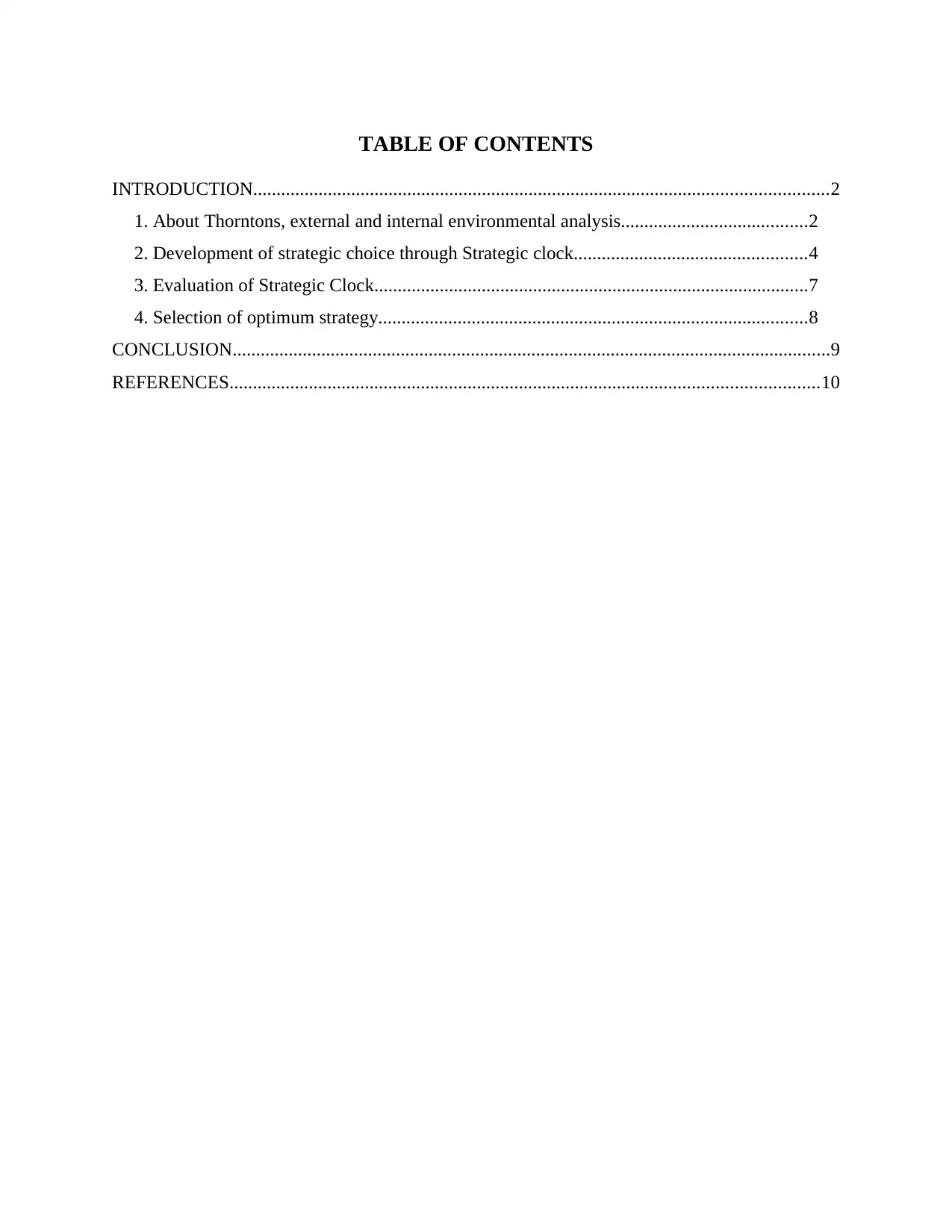
TABLE OF CONTENTS
INTRODUCTION...........................................................................................................................2
1. About Thorntons, external and internal environmental analysis........................................2
2. Development of strategic choice through Strategic clock..................................................4
3. Evaluation of Strategic Clock.............................................................................................7
4. Selection of optimum strategy............................................................................................8
CONCLUSION................................................................................................................................9
REFERENCES..............................................................................................................................10
INTRODUCTION...........................................................................................................................2
1. About Thorntons, external and internal environmental analysis........................................2
2. Development of strategic choice through Strategic clock..................................................4
3. Evaluation of Strategic Clock.............................................................................................7
4. Selection of optimum strategy............................................................................................8
CONCLUSION................................................................................................................................9
REFERENCES..............................................................................................................................10

ILLUSTRATION INDEX
Illustration 1: Bowman's strategic clock..........................................................................................5
1
Illustration 1: Bowman's strategic clock..........................................................................................5
1
⊘ This is a preview!⊘
Do you want full access?
Subscribe today to unlock all pages.

Trusted by 1+ million students worldwide
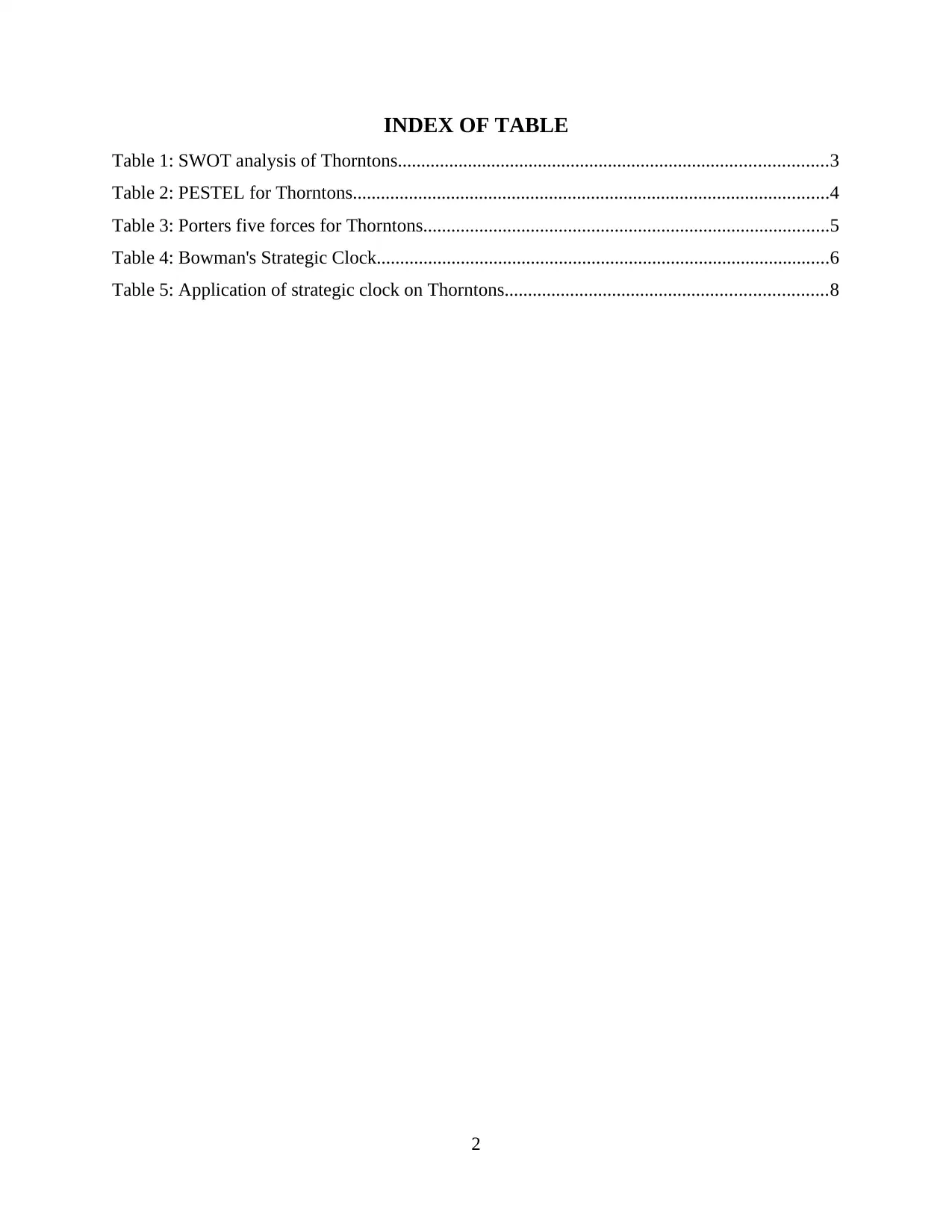
INDEX OF TABLE
Table 1: SWOT analysis of Thorntons............................................................................................3
Table 2: PESTEL for Thorntons......................................................................................................4
Table 3: Porters five forces for Thorntons.......................................................................................5
Table 4: Bowman's Strategic Clock.................................................................................................6
Table 5: Application of strategic clock on Thorntons.....................................................................8
2
Table 1: SWOT analysis of Thorntons............................................................................................3
Table 2: PESTEL for Thorntons......................................................................................................4
Table 3: Porters five forces for Thorntons.......................................................................................5
Table 4: Bowman's Strategic Clock.................................................................................................6
Table 5: Application of strategic clock on Thorntons.....................................................................8
2
Paraphrase This Document
Need a fresh take? Get an instant paraphrase of this document with our AI Paraphraser
INTRODUCTION
Strategic management can be defined as a continuous process in which organization is
monitored, assessed and analysed so as to achieve goals and objectives (Cohn, 2016). Through
using such type of management, firm gets to know the areas in which they need improvement
and accordingly changes are made so that they could develop path to achieve goals and
objectives (Moon and et.al., 2014). Present report is about Thorntons which is a British chocolate
company and was founded by Joseph William in the year 1911. This report covers the analysis of
environmental factors which affects Thorntons internally and externally. Use of strategic models
for developing strategic choice for the organization has also been discussed.
1. About Thorntons, external and internal environmental analysis
As it was discussed in the introduction, Thorntons is a chocolate company in Britain
which was founded in the year 1911 by Joseph William. It has 186 franchises and 249 shops of
its own. Further, they focus on providing their customers with quality products. Their vision is to
become the most preferred chocolate brand in Britain. In this context, they try on understanding
the needs and wants of the clients and accordingly provide their products and services which
would satisfy them. In this respect, they conduct market research and surveys in order to know
the areas in which they lack and take appropriate steps to overcome them (Eden and Ackermann,
2013). The company is very selective in hiring employees as they emphasise on finding
individuals who are cheerful, passionate, dedicated and are diligent.
In growth perspective, Thorntons is going on very well. Hence, in order to know the
performance and growth of the firm more closely, analysis of internal and external environment
would be helpful (Jones, 2009). In this context, there are various tools that are available which
would help in knowing the performance. With this respect, SWOT analysis, PESTLE and Porters
five forces would be used, which are as follows:
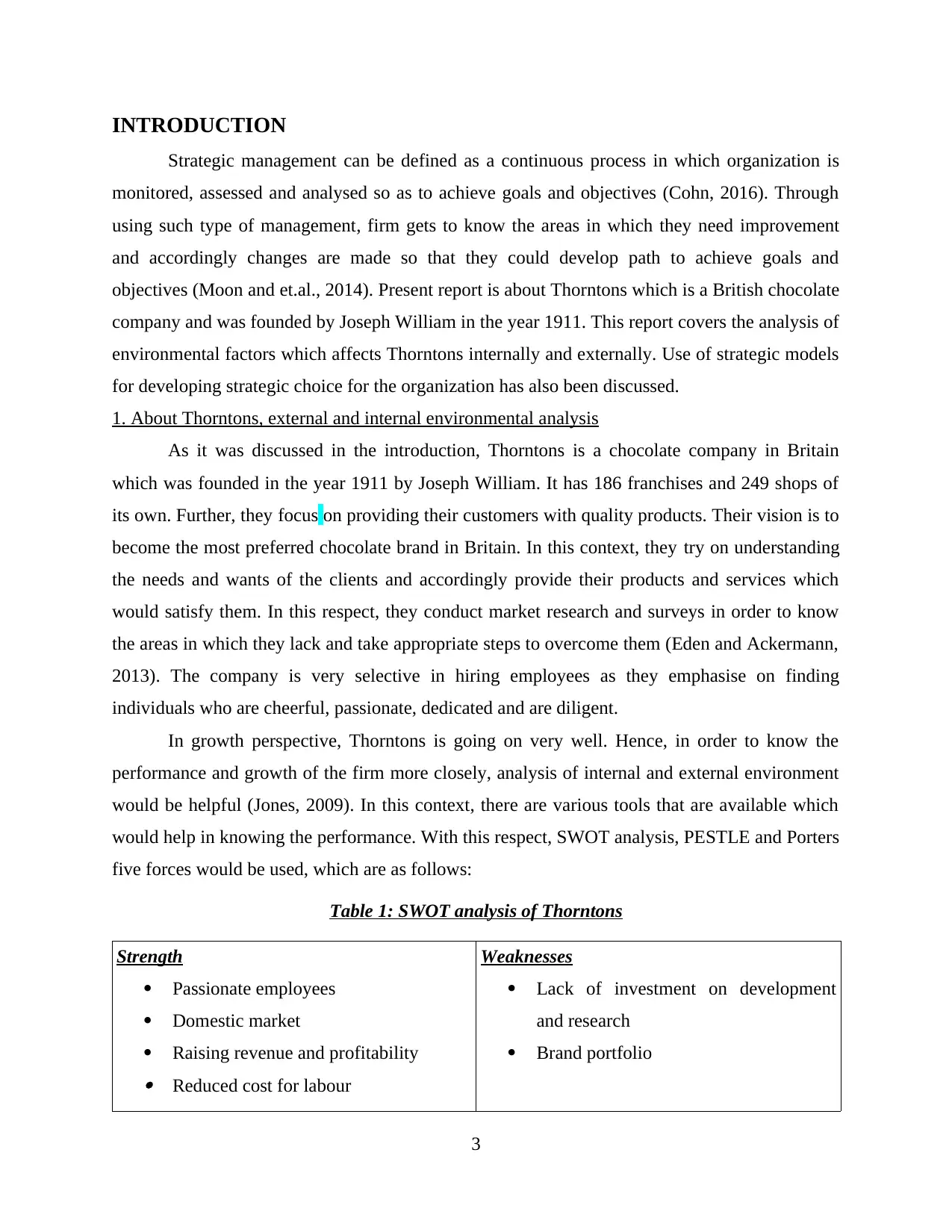
Table 1: SWOT analysis of Thorntons
Strength
Passionate employees
Domestic market
Raising revenue and profitability Reduced cost for labour
Weaknesses
Lack of investment on development
and research
Brand portfolio
3
Strategic management can be defined as a continuous process in which organization is
monitored, assessed and analysed so as to achieve goals and objectives (Cohn, 2016). Through
using such type of management, firm gets to know the areas in which they need improvement
and accordingly changes are made so that they could develop path to achieve goals and
objectives (Moon and et.al., 2014). Present report is about Thorntons which is a British chocolate
company and was founded by Joseph William in the year 1911. This report covers the analysis of
environmental factors which affects Thorntons internally and externally. Use of strategic models
for developing strategic choice for the organization has also been discussed.
1. About Thorntons, external and internal environmental analysis
As it was discussed in the introduction, Thorntons is a chocolate company in Britain
which was founded in the year 1911 by Joseph William. It has 186 franchises and 249 shops of
its own. Further, they focus on providing their customers with quality products. Their vision is to
become the most preferred chocolate brand in Britain. In this context, they try on understanding
the needs and wants of the clients and accordingly provide their products and services which
would satisfy them. In this respect, they conduct market research and surveys in order to know
the areas in which they lack and take appropriate steps to overcome them (Eden and Ackermann,
2013). The company is very selective in hiring employees as they emphasise on finding
individuals who are cheerful, passionate, dedicated and are diligent.
In growth perspective, Thorntons is going on very well. Hence, in order to know the
performance and growth of the firm more closely, analysis of internal and external environment
would be helpful (Jones, 2009). In this context, there are various tools that are available which
would help in knowing the performance. With this respect, SWOT analysis, PESTLE and Porters
five forces would be used, which are as follows:
Table 1: SWOT analysis of Thorntons
Strength
Passionate employees
Domestic market
Raising revenue and profitability Reduced cost for labour
Weaknesses
Lack of investment on development
and research
Brand portfolio
3
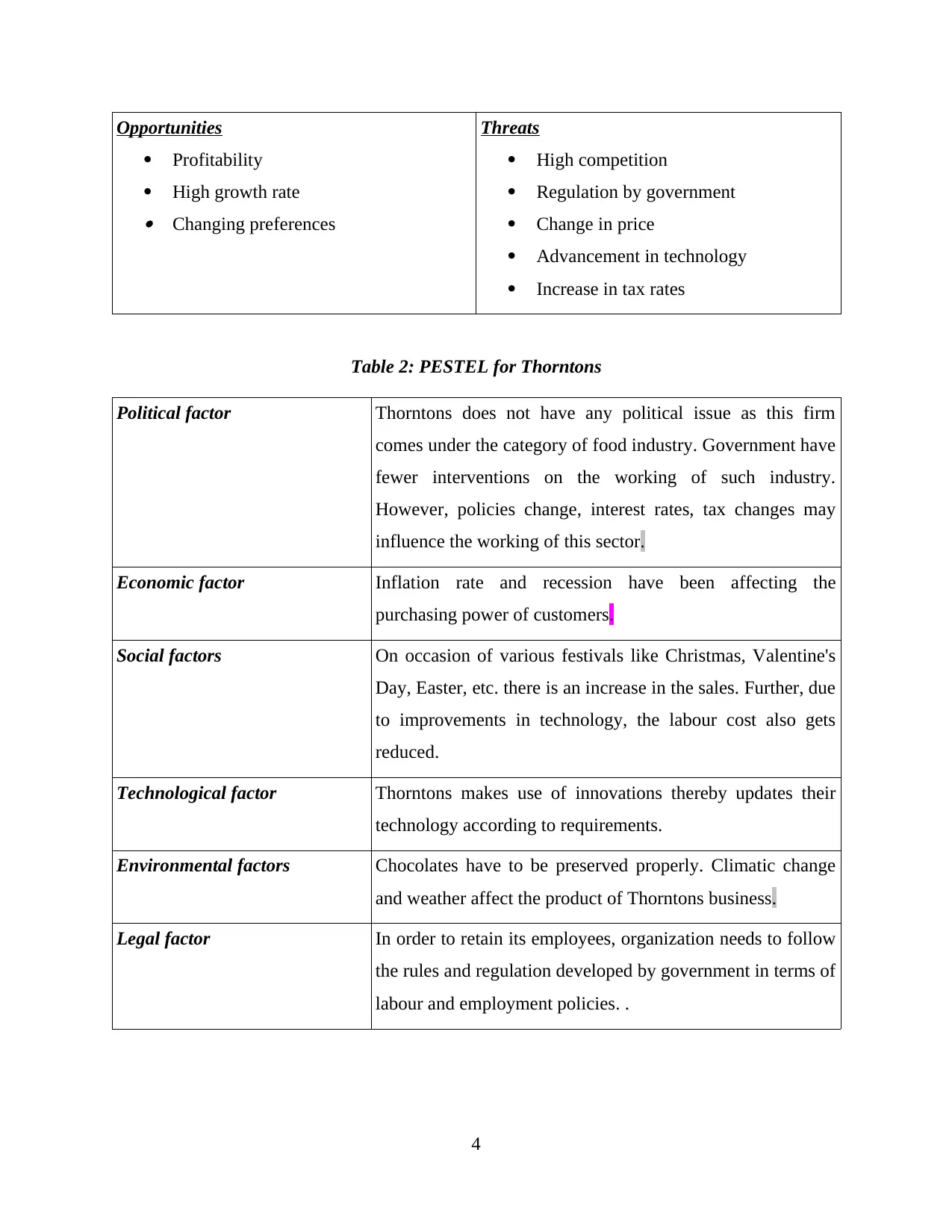
Opportunities
Profitability
High growth rate Changing preferences
Threats
High competition
Regulation by government
Change in price
Advancement in technology
Increase in tax rates
Table 2: PESTEL for Thorntons
Political factor Thorntons does not have any political issue as this firm
comes under the category of food industry. Government have
fewer interventions on the working of such industry.
However, policies change, interest rates, tax changes may
influence the working of this sector.
Economic factor Inflation rate and recession have been affecting the
purchasing power of customers.
Social factors On occasion of various festivals like Christmas, Valentine's
Day, Easter, etc. there is an increase in the sales. Further, due
to improvements in technology, the labour cost also gets
reduced.
Technological factor Thorntons makes use of innovations thereby updates their
technology according to requirements.
Environmental factors Chocolates have to be preserved properly. Climatic change
and weather affect the product of Thorntons business.
Legal factor In order to retain its employees, organization needs to follow
the rules and regulation developed by government in terms of
labour and employment policies. .
4
Profitability
High growth rate Changing preferences
Threats
High competition
Regulation by government
Change in price
Advancement in technology
Increase in tax rates
Table 2: PESTEL for Thorntons
Political factor Thorntons does not have any political issue as this firm
comes under the category of food industry. Government have
fewer interventions on the working of such industry.
However, policies change, interest rates, tax changes may
influence the working of this sector.
Economic factor Inflation rate and recession have been affecting the
purchasing power of customers.
Social factors On occasion of various festivals like Christmas, Valentine's
Day, Easter, etc. there is an increase in the sales. Further, due
to improvements in technology, the labour cost also gets
reduced.
Technological factor Thorntons makes use of innovations thereby updates their
technology according to requirements.
Environmental factors Chocolates have to be preserved properly. Climatic change
and weather affect the product of Thorntons business.
Legal factor In order to retain its employees, organization needs to follow
the rules and regulation developed by government in terms of
labour and employment policies. .
4
⊘ This is a preview!⊘
Do you want full access?
Subscribe today to unlock all pages.
Trusted by 1+ million students worldwide
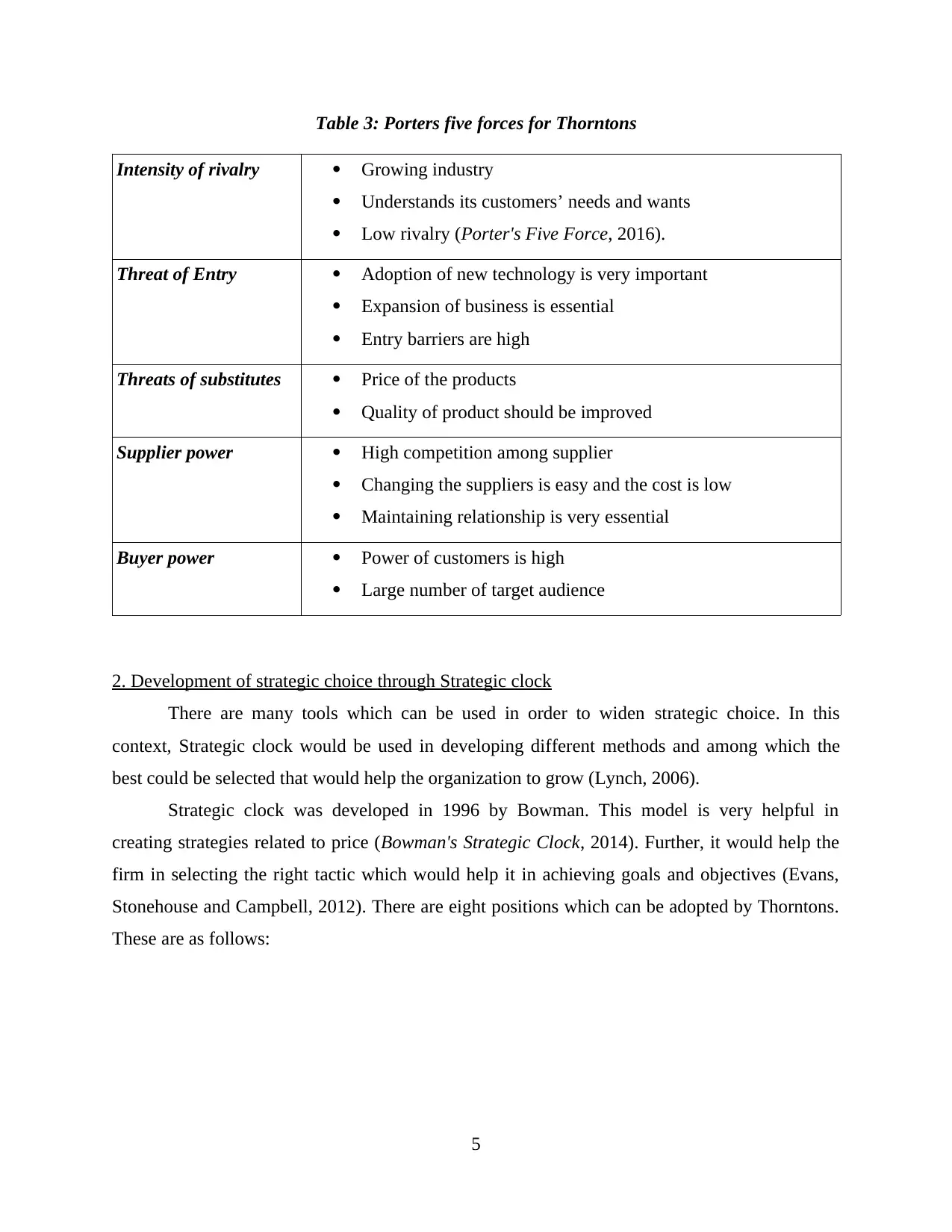
Table 3: Porters five forces for Thorntons
Intensity of rivalry Growing industry
Understands its customers’ needs and wants
Low rivalry (Porter's Five Force, 2016).
Threat of Entry Adoption of new technology is very important
Expansion of business is essential
Entry barriers are high
Threats of substitutes Price of the products
Quality of product should be improved
Supplier power High competition among supplier
Changing the suppliers is easy and the cost is low
Maintaining relationship is very essential
Buyer power Power of customers is high
Large number of target audience
2. Development of strategic choice through Strategic clock
There are many tools which can be used in order to widen strategic choice. In this
context, Strategic clock would be used in developing different methods and among which the
best could be selected that would help the organization to grow (Lynch, 2006).
Strategic clock was developed in 1996 by Bowman. This model is very helpful in
creating strategies related to price (Bowman's Strategic Clock, 2014). Further, it would help the
firm in selecting the right tactic which would help it in achieving goals and objectives (Evans,
Stonehouse and Campbell, 2012). There are eight positions which can be adopted by Thorntons.
These are as follows:
5
Intensity of rivalry Growing industry
Understands its customers’ needs and wants
Low rivalry (Porter's Five Force, 2016).
Threat of Entry Adoption of new technology is very important
Expansion of business is essential
Entry barriers are high
Threats of substitutes Price of the products
Quality of product should be improved
Supplier power High competition among supplier
Changing the suppliers is easy and the cost is low
Maintaining relationship is very essential
Buyer power Power of customers is high
Large number of target audience
2. Development of strategic choice through Strategic clock
There are many tools which can be used in order to widen strategic choice. In this
context, Strategic clock would be used in developing different methods and among which the
best could be selected that would help the organization to grow (Lynch, 2006).
Strategic clock was developed in 1996 by Bowman. This model is very helpful in
creating strategies related to price (Bowman's Strategic Clock, 2014). Further, it would help the
firm in selecting the right tactic which would help it in achieving goals and objectives (Evans,
Stonehouse and Campbell, 2012). There are eight positions which can be adopted by Thorntons.
These are as follows:
5
Paraphrase This Document
Need a fresh take? Get an instant paraphrase of this document with our AI Paraphraser
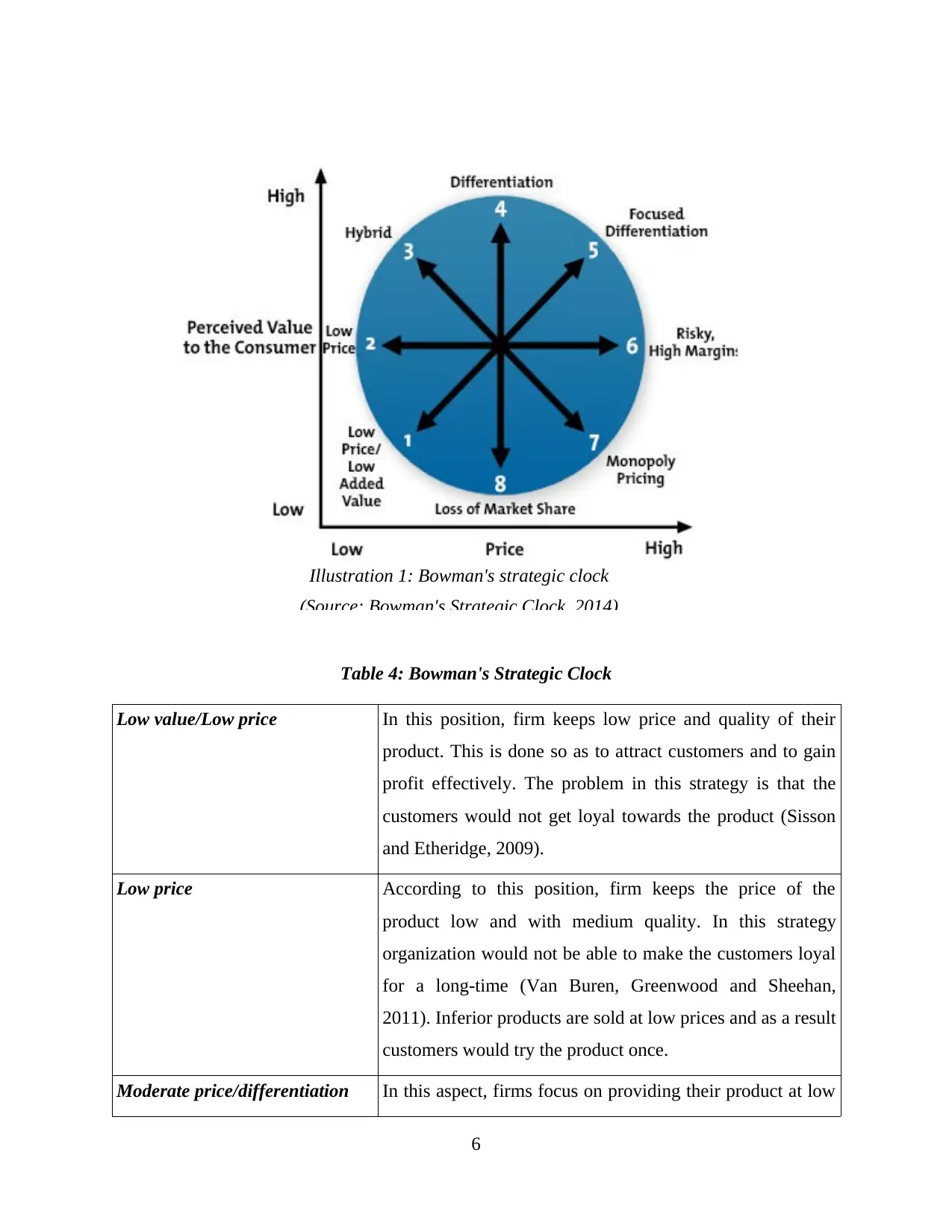
Table 4: Bowman's Strategic Clock
Low value/Low price In this position, firm keeps low price and quality of their
product. This is done so as to attract customers and to gain
profit effectively. The problem in this strategy is that the
customers would not get loyal towards the product (Sisson
and Etheridge, 2009).
Low price According to this position, firm keeps the price of the
product low and with medium quality. In this strategy
organization would not be able to make the customers loyal
for a long-time (Van Buren, Greenwood and Sheehan,
2011). Inferior products are sold at low prices and as a result
customers would try the product once.
Moderate price/differentiation In this aspect, firms focus on providing their product at low
6
Illustration 1: Bowman's strategic clock
(Source: Bowman's Strategic Clock, 2014)
Low value/Low price In this position, firm keeps low price and quality of their
product. This is done so as to attract customers and to gain
profit effectively. The problem in this strategy is that the
customers would not get loyal towards the product (Sisson
and Etheridge, 2009).
Low price According to this position, firm keeps the price of the
product low and with medium quality. In this strategy
organization would not be able to make the customers loyal
for a long-time (Van Buren, Greenwood and Sheehan,
2011). Inferior products are sold at low prices and as a result
customers would try the product once.
Moderate price/differentiation In this aspect, firms focus on providing their product at low
6
Illustration 1: Bowman's strategic clock
(Source: Bowman's Strategic Clock, 2014)
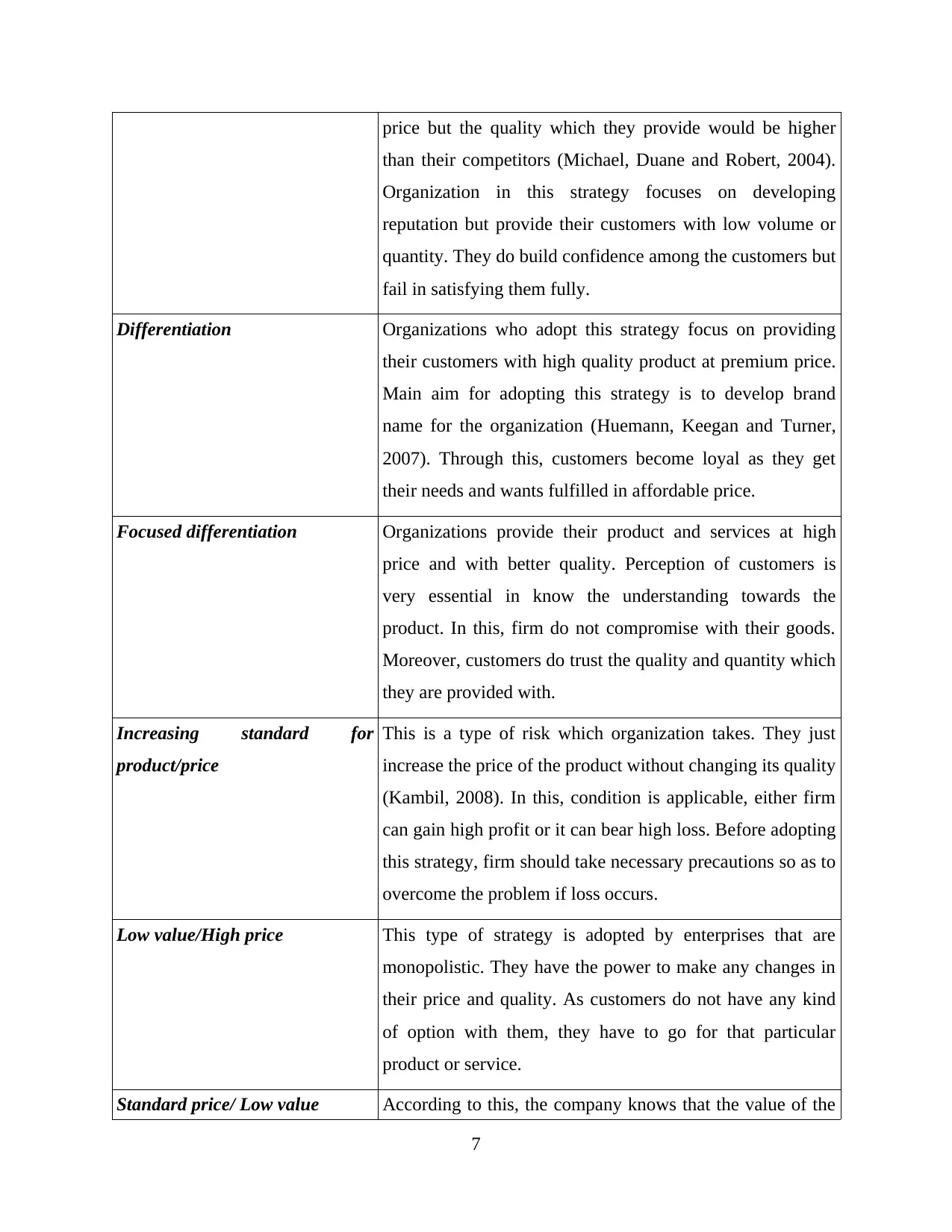
price but the quality which they provide would be higher
than their competitors (Michael, Duane and Robert, 2004).
Organization in this strategy focuses on developing
reputation but provide their customers with low volume or
quantity. They do build confidence among the customers but
fail in satisfying them fully.
Differentiation Organizations who adopt this strategy focus on providing
their customers with high quality product at premium price.
Main aim for adopting this strategy is to develop brand
name for the organization (Huemann, Keegan and Turner,
2007). Through this, customers become loyal as they get
their needs and wants fulfilled in affordable price.
Focused differentiation Organizations provide their product and services at high
price and with better quality. Perception of customers is
very essential in know the understanding towards the
product. In this, firm do not compromise with their goods.
Moreover, customers do trust the quality and quantity which
they are provided with.
Increasing standard for
product/price
This is a type of risk which organization takes. They just
increase the price of the product without changing its quality
(Kambil, 2008). In this, condition is applicable, either firm
can gain high profit or it can bear high loss. Before adopting
this strategy, firm should take necessary precautions so as to
overcome the problem if loss occurs.
Low value/High price This type of strategy is adopted by enterprises that are
monopolistic. They have the power to make any changes in
their price and quality. As customers do not have any kind
of option with them, they have to go for that particular
product or service.
Standard price/ Low value According to this, the company knows that the value of the
7
than their competitors (Michael, Duane and Robert, 2004).
Organization in this strategy focuses on developing
reputation but provide their customers with low volume or
quantity. They do build confidence among the customers but
fail in satisfying them fully.
Differentiation Organizations who adopt this strategy focus on providing
their customers with high quality product at premium price.
Main aim for adopting this strategy is to develop brand
name for the organization (Huemann, Keegan and Turner,
2007). Through this, customers become loyal as they get
their needs and wants fulfilled in affordable price.
Focused differentiation Organizations provide their product and services at high
price and with better quality. Perception of customers is
very essential in know the understanding towards the
product. In this, firm do not compromise with their goods.
Moreover, customers do trust the quality and quantity which
they are provided with.
Increasing standard for
product/price
This is a type of risk which organization takes. They just
increase the price of the product without changing its quality
(Kambil, 2008). In this, condition is applicable, either firm
can gain high profit or it can bear high loss. Before adopting
this strategy, firm should take necessary precautions so as to
overcome the problem if loss occurs.
Low value/High price This type of strategy is adopted by enterprises that are
monopolistic. They have the power to make any changes in
their price and quality. As customers do not have any kind
of option with them, they have to go for that particular
product or service.
Standard price/ Low value According to this, the company knows that the value of the
7
⊘ This is a preview!⊘
Do you want full access?
Subscribe today to unlock all pages.
Trusted by 1+ million students worldwide
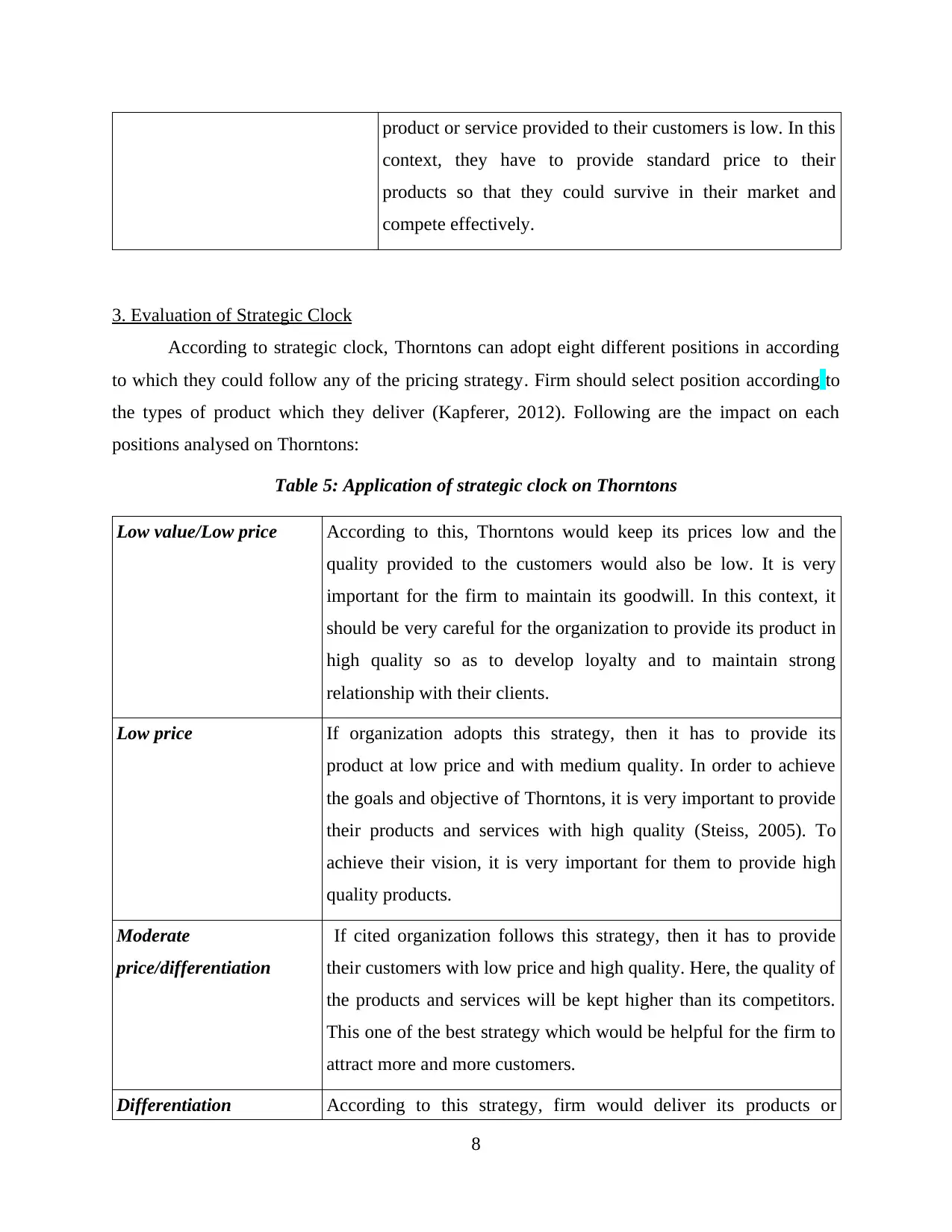
product or service provided to their customers is low. In this
context, they have to provide standard price to their
products so that they could survive in their market and
compete effectively.
3. Evaluation of Strategic Clock
According to strategic clock, Thorntons can adopt eight different positions in according
to which they could follow any of the pricing strategy. Firm should select position according to
the types of product which they deliver (Kapferer, 2012). Following are the impact on each
positions analysed on Thorntons:
Table 5: Application of strategic clock on Thorntons
Low value/Low price According to this, Thorntons would keep its prices low and the
quality provided to the customers would also be low. It is very
important for the firm to maintain its goodwill. In this context, it
should be very careful for the organization to provide its product in
high quality so as to develop loyalty and to maintain strong
relationship with their clients.
Low price If organization adopts this strategy, then it has to provide its
product at low price and with medium quality. In order to achieve
the goals and objective of Thorntons, it is very important to provide
their products and services with high quality (Steiss, 2005). To
achieve their vision, it is very important for them to provide high
quality products.
Moderate
price/differentiation
If cited organization follows this strategy, then it has to provide
their customers with low price and high quality. Here, the quality of
the products and services will be kept higher than its competitors.
This one of the best strategy which would be helpful for the firm to
attract more and more customers.
Differentiation According to this strategy, firm would deliver its products or
8
context, they have to provide standard price to their
products so that they could survive in their market and
compete effectively.
3. Evaluation of Strategic Clock
According to strategic clock, Thorntons can adopt eight different positions in according
to which they could follow any of the pricing strategy. Firm should select position according to
the types of product which they deliver (Kapferer, 2012). Following are the impact on each
positions analysed on Thorntons:
Table 5: Application of strategic clock on Thorntons
Low value/Low price According to this, Thorntons would keep its prices low and the
quality provided to the customers would also be low. It is very
important for the firm to maintain its goodwill. In this context, it
should be very careful for the organization to provide its product in
high quality so as to develop loyalty and to maintain strong
relationship with their clients.
Low price If organization adopts this strategy, then it has to provide its
product at low price and with medium quality. In order to achieve
the goals and objective of Thorntons, it is very important to provide
their products and services with high quality (Steiss, 2005). To
achieve their vision, it is very important for them to provide high
quality products.
Moderate
price/differentiation
If cited organization follows this strategy, then it has to provide
their customers with low price and high quality. Here, the quality of
the products and services will be kept higher than its competitors.
This one of the best strategy which would be helpful for the firm to
attract more and more customers.
Differentiation According to this strategy, firm would deliver its products or
8
Paraphrase This Document
Need a fresh take? Get an instant paraphrase of this document with our AI Paraphraser
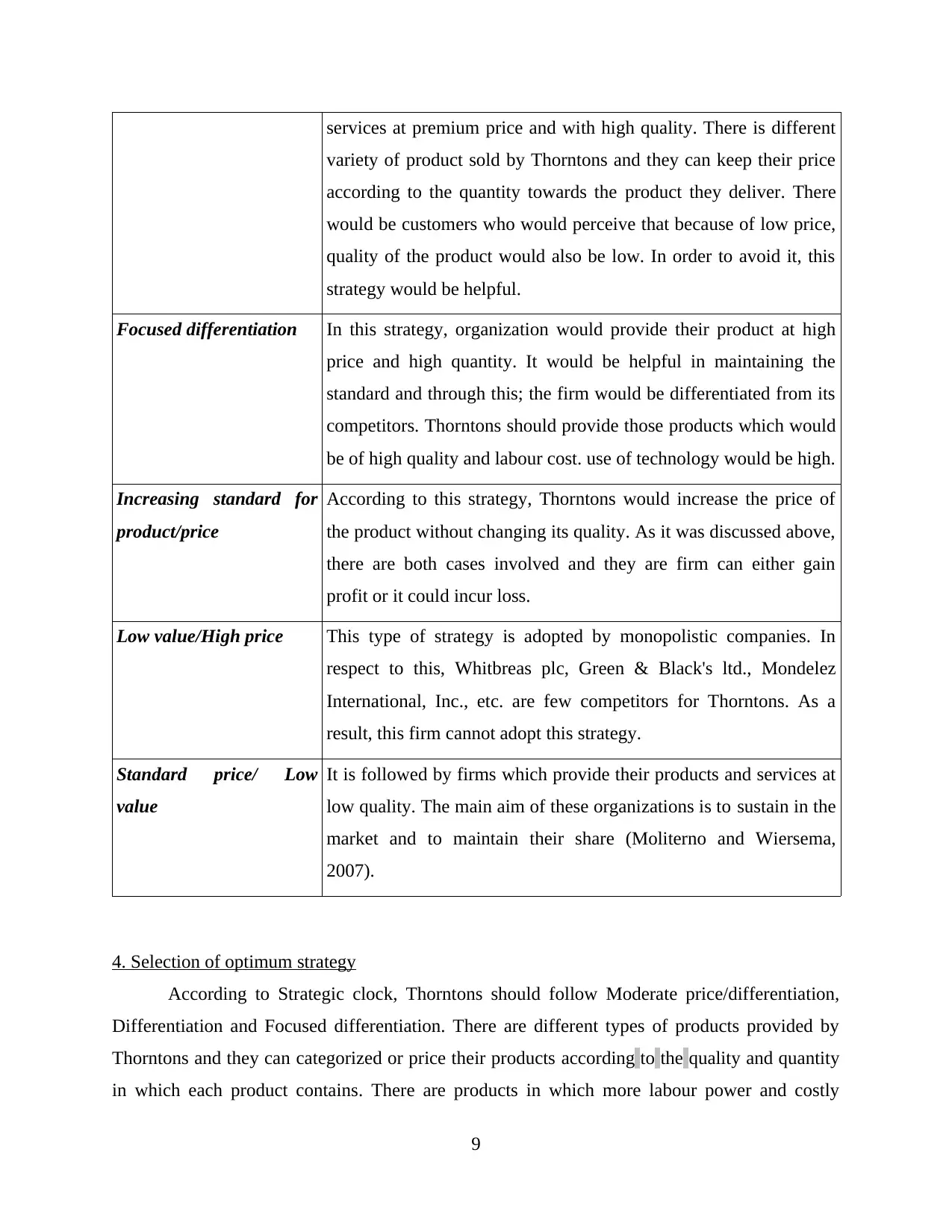
services at premium price and with high quality. There is different
variety of product sold by Thorntons and they can keep their price
according to the quantity towards the product they deliver. There
would be customers who would perceive that because of low price,
quality of the product would also be low. In order to avoid it, this
strategy would be helpful.
Focused differentiation In this strategy, organization would provide their product at high
price and high quantity. It would be helpful in maintaining the
standard and through this; the firm would be differentiated from its
competitors. Thorntons should provide those products which would
be of high quality and labour cost. use of technology would be high.
Increasing standard for
product/price
According to this strategy, Thorntons would increase the price of
the product without changing its quality. As it was discussed above,
there are both cases involved and they are firm can either gain
profit or it could incur loss.
Low value/High price This type of strategy is adopted by monopolistic companies. In
respect to this, Whitbreas plc, Green & Black's ltd., Mondelez
International, Inc., etc. are few competitors for Thorntons. As a
result, this firm cannot adopt this strategy.
Standard price/ Low
value
It is followed by firms which provide their products and services at
low quality. The main aim of these organizations is to sustain in the
market and to maintain their share (Moliterno and Wiersema,
2007).
4. Selection of optimum strategy
According to Strategic clock, Thorntons should follow Moderate price/differentiation,
Differentiation and Focused differentiation. There are different types of products provided by
Thorntons and they can categorized or price their products according to the quality and quantity
in which each product contains. There are products in which more labour power and costly
9
variety of product sold by Thorntons and they can keep their price
according to the quantity towards the product they deliver. There
would be customers who would perceive that because of low price,
quality of the product would also be low. In order to avoid it, this
strategy would be helpful.
Focused differentiation In this strategy, organization would provide their product at high
price and high quantity. It would be helpful in maintaining the
standard and through this; the firm would be differentiated from its
competitors. Thorntons should provide those products which would
be of high quality and labour cost. use of technology would be high.
Increasing standard for
product/price
According to this strategy, Thorntons would increase the price of
the product without changing its quality. As it was discussed above,
there are both cases involved and they are firm can either gain
profit or it could incur loss.
Low value/High price This type of strategy is adopted by monopolistic companies. In
respect to this, Whitbreas plc, Green & Black's ltd., Mondelez
International, Inc., etc. are few competitors for Thorntons. As a
result, this firm cannot adopt this strategy.
Standard price/ Low
value
It is followed by firms which provide their products and services at
low quality. The main aim of these organizations is to sustain in the
market and to maintain their share (Moliterno and Wiersema,
2007).
4. Selection of optimum strategy
According to Strategic clock, Thorntons should follow Moderate price/differentiation,
Differentiation and Focused differentiation. There are different types of products provided by
Thorntons and they can categorized or price their products according to the quality and quantity
in which each product contains. There are products in which more labour power and costly
9
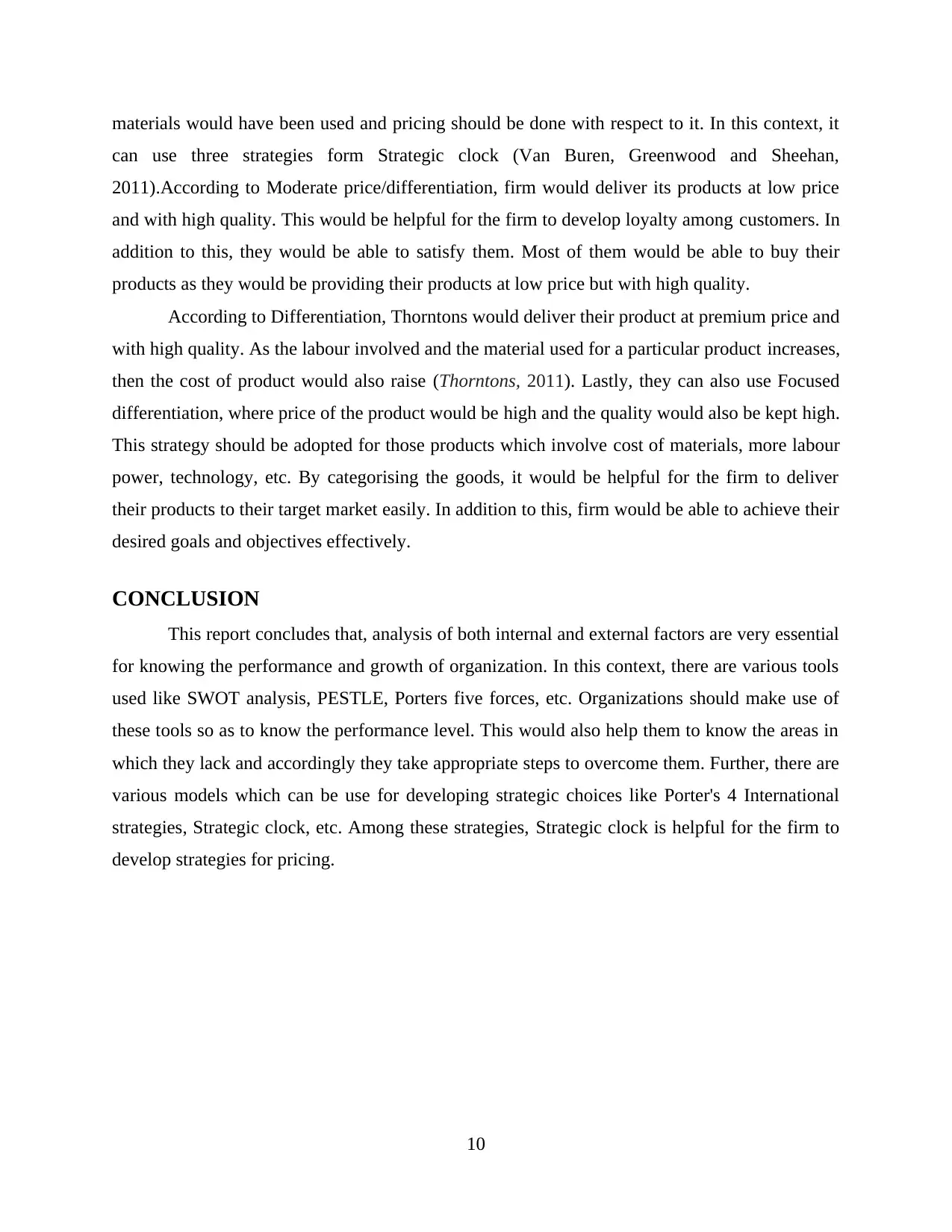
materials would have been used and pricing should be done with respect to it. In this context, it
can use three strategies form Strategic clock (Van Buren, Greenwood and Sheehan,
2011).According to Moderate price/differentiation, firm would deliver its products at low price
and with high quality. This would be helpful for the firm to develop loyalty among customers. In
addition to this, they would be able to satisfy them. Most of them would be able to buy their
products as they would be providing their products at low price but with high quality.
According to Differentiation, Thorntons would deliver their product at premium price and
with high quality. As the labour involved and the material used for a particular product increases,
then the cost of product would also raise (Thorntons, 2011). Lastly, they can also use Focused
differentiation, where price of the product would be high and the quality would also be kept high.
This strategy should be adopted for those products which involve cost of materials, more labour
power, technology, etc. By categorising the goods, it would be helpful for the firm to deliver
their products to their target market easily. In addition to this, firm would be able to achieve their
desired goals and objectives effectively.
CONCLUSION
This report concludes that, analysis of both internal and external factors are very essential
for knowing the performance and growth of organization. In this context, there are various tools
used like SWOT analysis, PESTLE, Porters five forces, etc. Organizations should make use of
these tools so as to know the performance level. This would also help them to know the areas in
which they lack and accordingly they take appropriate steps to overcome them. Further, there are
various models which can be use for developing strategic choices like Porter's 4 International
strategies, Strategic clock, etc. Among these strategies, Strategic clock is helpful for the firm to
develop strategies for pricing.
10
can use three strategies form Strategic clock (Van Buren, Greenwood and Sheehan,
2011).According to Moderate price/differentiation, firm would deliver its products at low price
and with high quality. This would be helpful for the firm to develop loyalty among customers. In
addition to this, they would be able to satisfy them. Most of them would be able to buy their
products as they would be providing their products at low price but with high quality.
According to Differentiation, Thorntons would deliver their product at premium price and
with high quality. As the labour involved and the material used for a particular product increases,
then the cost of product would also raise (Thorntons, 2011). Lastly, they can also use Focused
differentiation, where price of the product would be high and the quality would also be kept high.
This strategy should be adopted for those products which involve cost of materials, more labour
power, technology, etc. By categorising the goods, it would be helpful for the firm to deliver
their products to their target market easily. In addition to this, firm would be able to achieve their
desired goals and objectives effectively.
CONCLUSION
This report concludes that, analysis of both internal and external factors are very essential
for knowing the performance and growth of organization. In this context, there are various tools
used like SWOT analysis, PESTLE, Porters five forces, etc. Organizations should make use of
these tools so as to know the performance level. This would also help them to know the areas in
which they lack and accordingly they take appropriate steps to overcome them. Further, there are
various models which can be use for developing strategic choices like Porter's 4 International
strategies, Strategic clock, etc. Among these strategies, Strategic clock is helpful for the firm to
develop strategies for pricing.
10
⊘ This is a preview!⊘
Do you want full access?
Subscribe today to unlock all pages.
Trusted by 1+ million students worldwide

1 out of 14


Related Documents


Your All-in-One AI-Powered Toolkit for Academic Success.
+13062052269
info@desklib.com
Available 24*7 on WhatsApp / Email
![[object Object]](/_next/static/media/star-bottom.7253800d.svg)
Unlock your academic potential
Copyright © 2020–2026 A2Z Services. All Rights Reserved. Developed and managed by ZUCOL.