Strategic Business Management Report: IDP Education Week 10 Analysis

Verified

Added on  2023/04/25

|4
|641
|449
Report
AI Summary
This report analyzes the business level strategies employed by IDP Education, an institute specializing in IELTS coaching and testing. It focuses on two key strategies: cost leadership and differentiation. Cost leadership is explored in the context of offering competitive pricing for IELTS coaching, particularly for Australian students, to gain a market advantage. The report highlights how IDP Education can leverage this strategy by adjusting prices based on the equipment and resources required for course delivery. The differentiation strategy is discussed in terms of providing unique value to the students. The report suggests that IDP Education can differentiate itself from competitors by offering practice tests, such as audio recordings, to help students prepare for the IELTS exam. The conclusion emphasizes that the application of these strategies can aid IDP Education in enhancing its coaching classes, with the success of the institute being determined by the profits generated. The report also includes a bibliography of relevant academic sources.

Document Page
STRATEGIC BUSINESS MANAGEMENT
Navroop Singh Gill
124148
Week 10
IDP EDUCATION
23rd January’2019
tabler-icon-diamond-filled.svg

Paraphrase This Document

Need a fresh take? Get an instant paraphrase of this document with our AI Paraphraser
Document Page
1
STRATEGIC BUSINESS MANAGEMENT
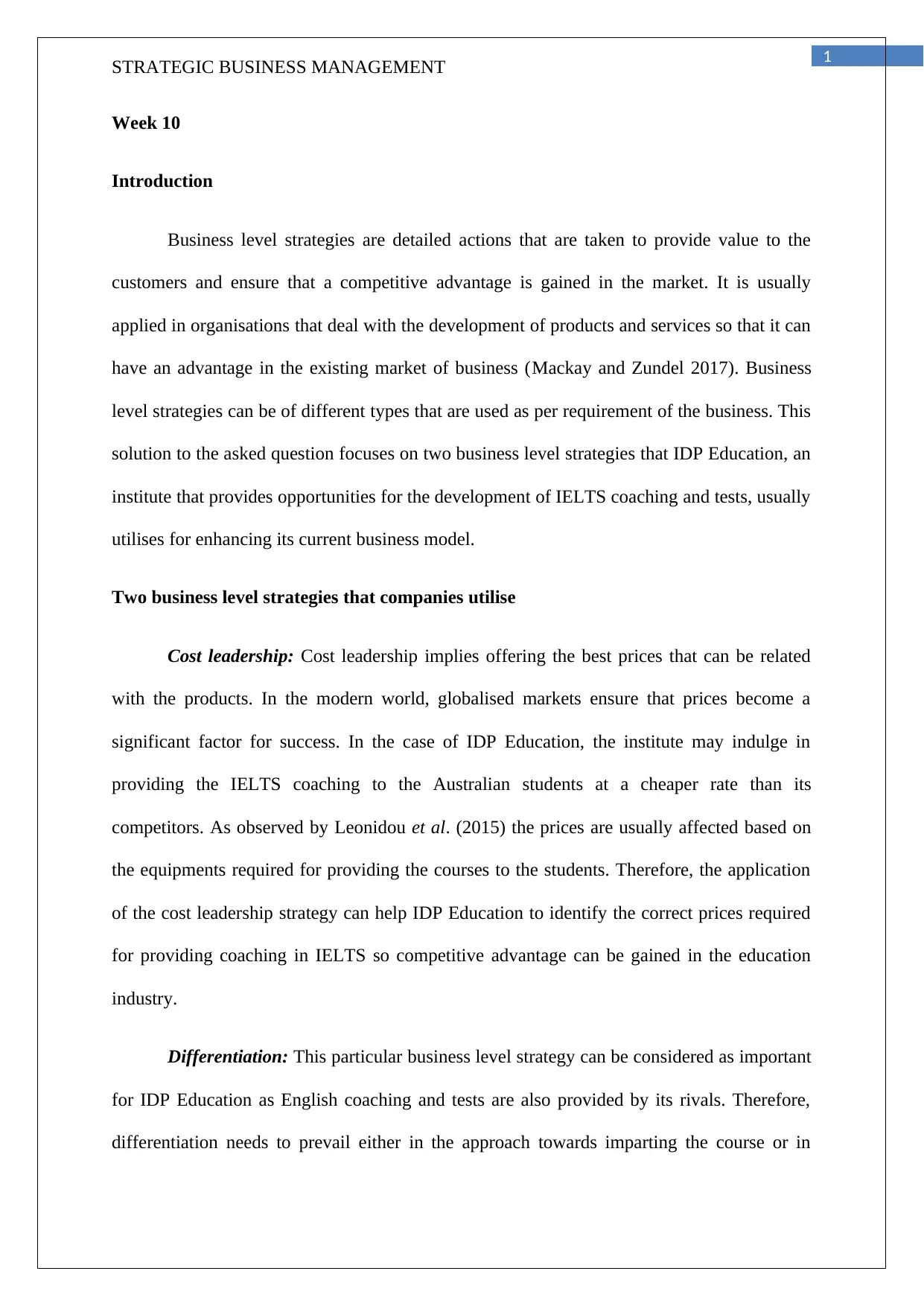
Week 10
Introduction
Business level strategies are detailed actions that are taken to provide value to the
customers and ensure that a competitive advantage is gained in the market. It is usually
applied in organisations that deal with the development of products and services so that it can
have an advantage in the existing market of business (Mackay and Zundel 2017). Business
level strategies can be of different types that are used as per requirement of the business. This
solution to the asked question focuses on two business level strategies that IDP Education, an
institute that provides opportunities for the development of IELTS coaching and tests, usually
utilises for enhancing its current business model.
Two business level strategies that companies utilise
Cost leadership: Cost leadership implies offering the best prices that can be related
with the products. In the modern world, globalised markets ensure that prices become a
significant factor for success. In the case of IDP Education, the institute may indulge in
providing the IELTS coaching to the Australian students at a cheaper rate than its
competitors. As observed by Leonidou et al. (2015) the prices are usually affected based on
the equipments required for providing the courses to the students. Therefore, the application
of the cost leadership strategy can help IDP Education to identify the correct prices required
for providing coaching in IELTS so competitive advantage can be gained in the education
industry.
Differentiation: This particular business level strategy can be considered as important
for IDP Education as English coaching and tests are also provided by its rivals. Therefore,
differentiation needs to prevail either in the approach towards imparting the course or in
Document Page
2
STRATEGIC BUSINESS MANAGEMENT
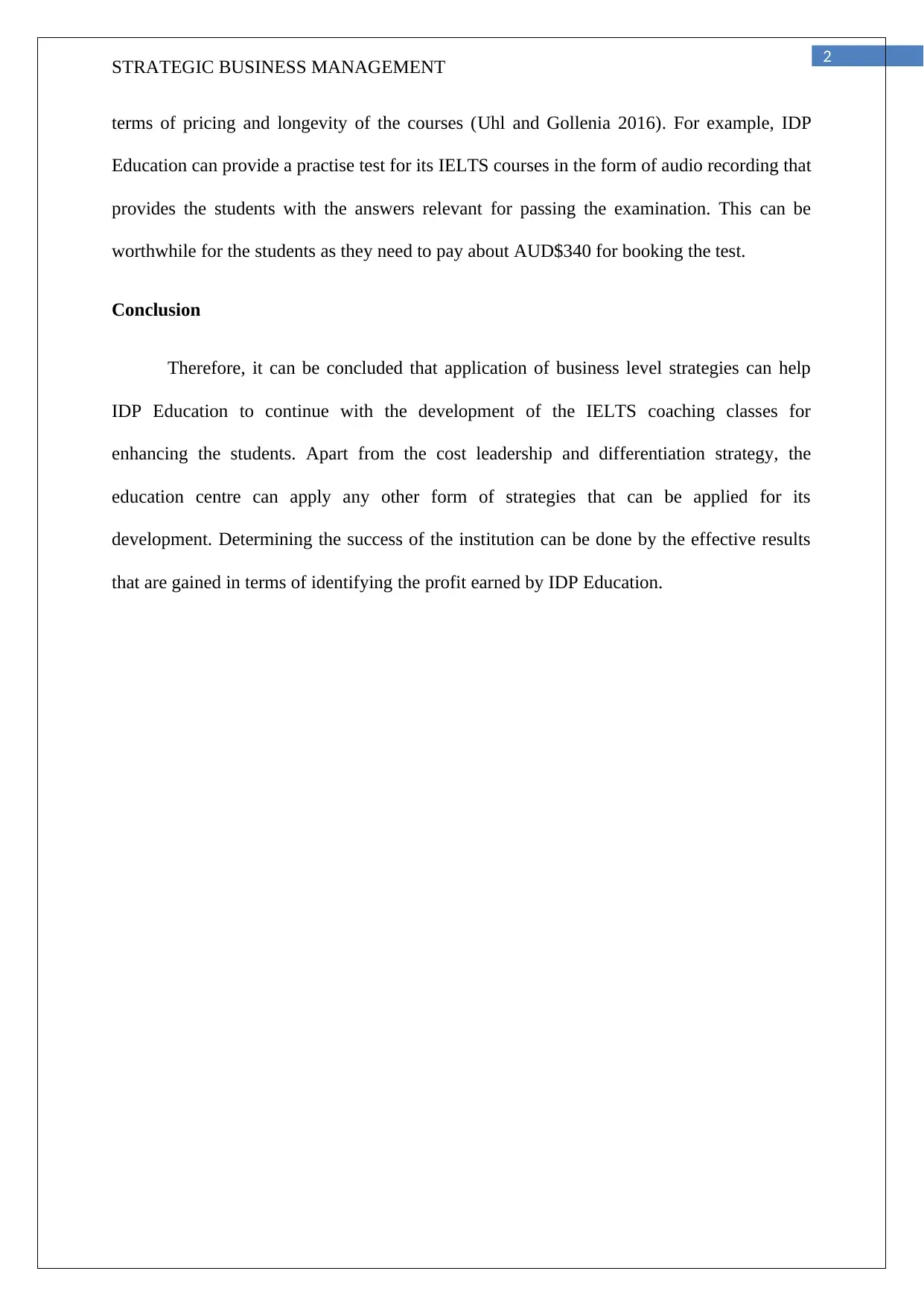
terms of pricing and longevity of the courses (Uhl and Gollenia 2016). For example, IDP
Education can provide a practise test for its IELTS courses in the form of audio recording that
provides the students with the answers relevant for passing the examination. This can be
worthwhile for the students as they need to pay about AUD$340 for booking the test.
Conclusion
Therefore, it can be concluded that application of business level strategies can help
IDP Education to continue with the development of the IELTS coaching classes for
enhancing the students. Apart from the cost leadership and differentiation strategy, the
education centre can apply any other form of strategies that can be applied for its
development. Determining the success of the institution can be done by the effective results
that are gained in terms of identifying the profit earned by IDP Education.
Document Page
3
STRATEGIC BUSINESS MANAGEMENT
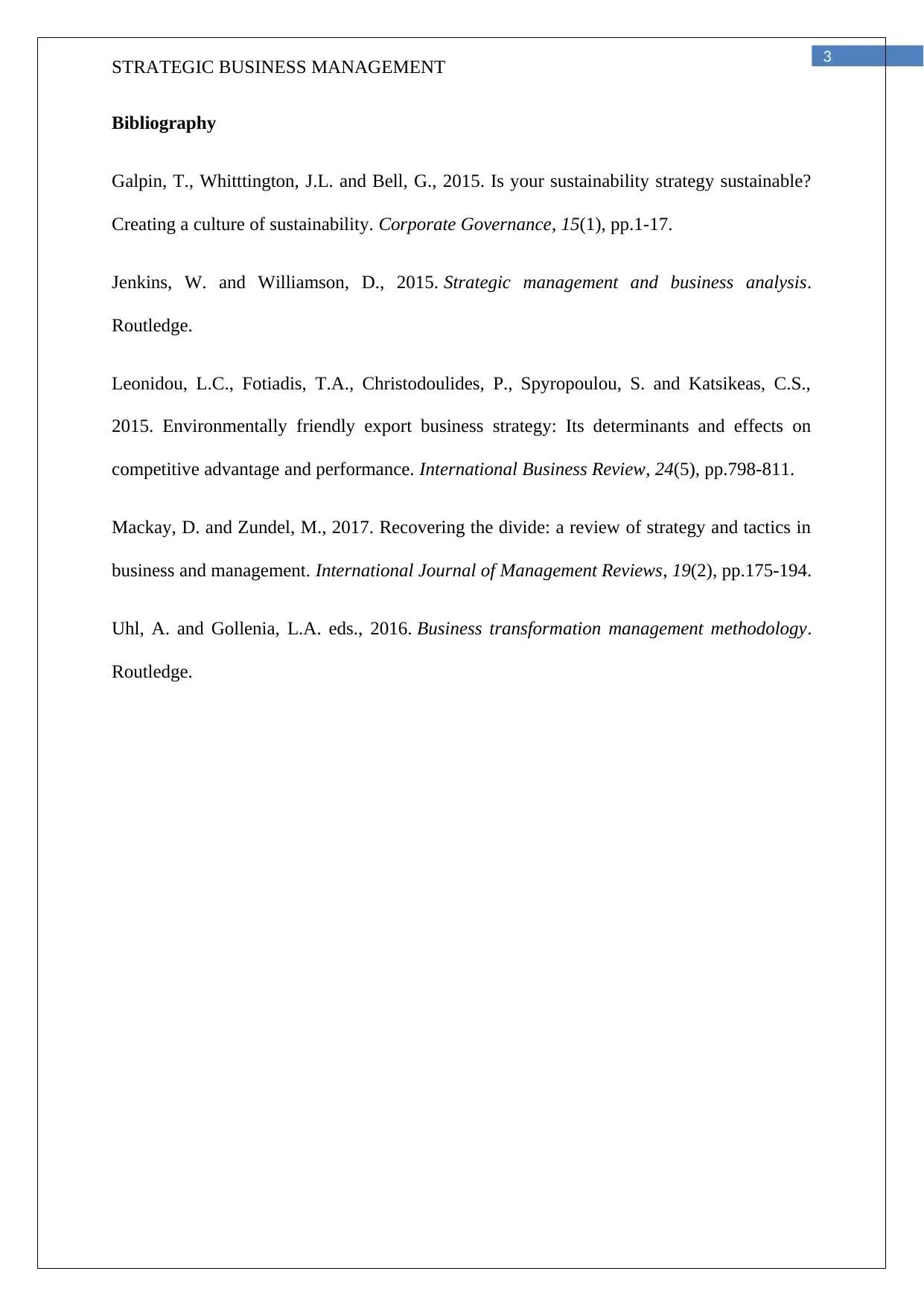
Bibliography
Galpin, T., Whitttington, J.L. and Bell, G., 2015. Is your sustainability strategy sustainable?
Creating a culture of sustainability. Corporate Governance, 15(1), pp.1-17.
Jenkins, W. and Williamson, D., 2015. Strategic management and business analysis.
Routledge.
Leonidou, L.C., Fotiadis, T.A., Christodoulides, P., Spyropoulou, S. and Katsikeas, C.S.,
2015. Environmentally friendly export business strategy: Its determinants and effects on
competitive advantage and performance. International Business Review, 24(5), pp.798-811.
Mackay, D. and Zundel, M., 2017. Recovering the divide: a review of strategy and tactics in
business and management. International Journal of Management Reviews, 19(2), pp.175-194.
Uhl, A. and Gollenia, L.A. eds., 2016. Business transformation management methodology.
Routledge.
chevron_up_icon
1 out of 4
circle_padding
hide_on_mobile
zoom_out_icon
[object Object]