Strategic Management Industry Project: Caffiend Revenue Strategies
VerifiedAdded on 2020/04/01
|63
|14873
|157
Project
AI Summary
This industry project focuses on the strategic management and revenue generation strategies for Caffiend, a cafe located in Petone, New Zealand. The study begins with an executive summary that highlights the economic and technological landscape of New Zealand, emphasizing the opportunities for small and medium-sized businesses. It identifies the need for Caffiend to adapt to technological advancements, particularly in online ordering, to remain competitive. The project includes an introduction to the coffee industry background in New Zealand, the organization's background, and the scope of the project. The project's scope involves analyzing the challenges faced by Caffiend, such as the lack of a dedicated website and mobile app for online orders, and the need to reduce reliance on third-party vendors. The project undertakes a literature review, discussing relevant concepts and research methodologies. The project also includes primary research, such as a customer survey, to understand customer preferences and demands, including the desire for home delivery and online ordering options. The project offers recommendations for both short-term and long-term strategies to enhance revenue streams, such as developing a website and mobile application. The project concludes with a discussion of the findings, limitations, and ethical considerations, providing a comprehensive analysis of Caffiend's current business practices and future opportunities.
Running head: INDUSTRY PROJECT (STRATEGIC MANAGEMENT
Industry Project (Strategic Management)
Name of the Student
Name of the University
Author Note
Industry Project (Strategic Management)
Name of the Student
Name of the University
Author Note

Paraphrase This Document
Need a fresh take? Get an instant paraphrase of this document with our AI Paraphraser
2INDUSTRY PROJECT (STRATEGIC MANAGEMENT)
Executive Summary
The present study revolves around the proposed marketing strategies of the organization
Caffiend, Peton, New Zealand. New Zealand is economically and technologically developed as
well as the nation offers significant business opportunities for small and medium size
organizations. However, the firm Caffiend is not technologically developed and compared to
other firms, it might lose its market share. This study investigates the possible revenue streams
that Caffiend might use to make positive differences in the business. However, as the strategic
approach, it was important to learn the current market situations such as customer demands and
expectations. Thereby, an analysis among the customers of Caffiend has been conducted and it
was found that a large percentage of the customers want the service to be improved; such as the
customers want the service to be delivered at home. In addition, the customers mostly prefer to
place the order online through their Smartphone App.
Executive Summary
The present study revolves around the proposed marketing strategies of the organization
Caffiend, Peton, New Zealand. New Zealand is economically and technologically developed as
well as the nation offers significant business opportunities for small and medium size
organizations. However, the firm Caffiend is not technologically developed and compared to
other firms, it might lose its market share. This study investigates the possible revenue streams
that Caffiend might use to make positive differences in the business. However, as the strategic
approach, it was important to learn the current market situations such as customer demands and
expectations. Thereby, an analysis among the customers of Caffiend has been conducted and it
was found that a large percentage of the customers want the service to be improved; such as the
customers want the service to be delivered at home. In addition, the customers mostly prefer to
place the order online through their Smartphone App.
3INDUSTRY PROJECT (STRATEGIC MANAGEMENT)
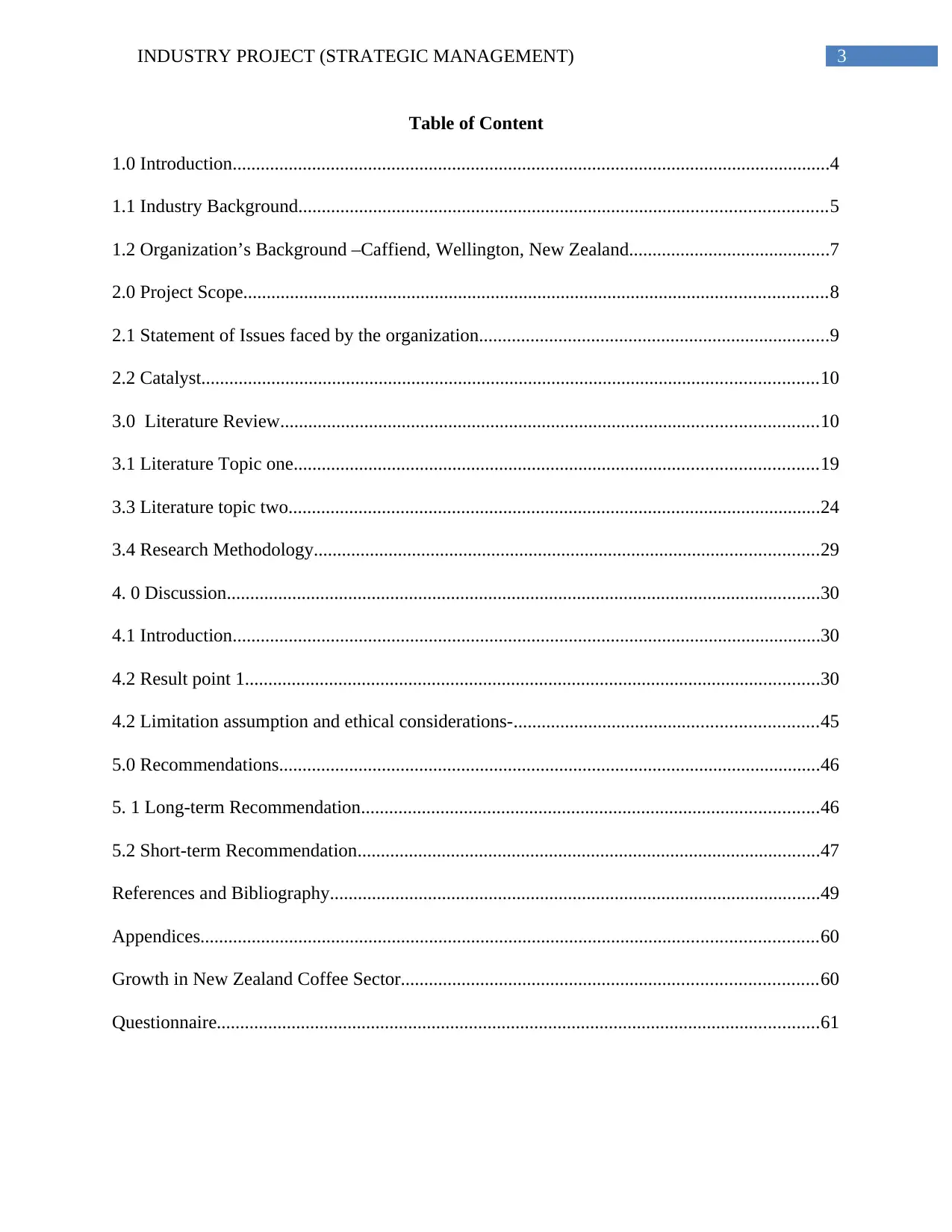
Table of Content
1.0 Introduction................................................................................................................................4
1.1 Industry Background.................................................................................................................5
1.2 Organization’s Background –Caffiend, Wellington, New Zealand...........................................7
2.0 Project Scope.............................................................................................................................8
2.1 Statement of Issues faced by the organization...........................................................................9
2.2 Catalyst....................................................................................................................................10
3.0 Literature Review...................................................................................................................10
3.1 Literature Topic one................................................................................................................19
3.3 Literature topic two..................................................................................................................24
3.4 Research Methodology............................................................................................................29
4. 0 Discussion...............................................................................................................................30
4.1 Introduction..............................................................................................................................30
4.2 Result point 1...........................................................................................................................30
4.2 Limitation assumption and ethical considerations-.................................................................45
5.0 Recommendations....................................................................................................................46
5. 1 Long-term Recommendation..................................................................................................46
5.2 Short-term Recommendation...................................................................................................47
References and Bibliography.........................................................................................................49
Appendices....................................................................................................................................60
Growth in New Zealand Coffee Sector.........................................................................................60
Questionnaire.................................................................................................................................61
Table of Content
1.0 Introduction................................................................................................................................4
1.1 Industry Background.................................................................................................................5
1.2 Organization’s Background –Caffiend, Wellington, New Zealand...........................................7
2.0 Project Scope.............................................................................................................................8
2.1 Statement of Issues faced by the organization...........................................................................9
2.2 Catalyst....................................................................................................................................10
3.0 Literature Review...................................................................................................................10
3.1 Literature Topic one................................................................................................................19
3.3 Literature topic two..................................................................................................................24
3.4 Research Methodology............................................................................................................29
4. 0 Discussion...............................................................................................................................30
4.1 Introduction..............................................................................................................................30
4.2 Result point 1...........................................................................................................................30
4.2 Limitation assumption and ethical considerations-.................................................................45
5.0 Recommendations....................................................................................................................46
5. 1 Long-term Recommendation..................................................................................................46
5.2 Short-term Recommendation...................................................................................................47
References and Bibliography.........................................................................................................49
Appendices....................................................................................................................................60
Growth in New Zealand Coffee Sector.........................................................................................60
Questionnaire.................................................................................................................................61
⊘ This is a preview!⊘
Do you want full access?
Subscribe today to unlock all pages.

Trusted by 1+ million students worldwide
4INDUSTRY PROJECT (STRATEGIC MANAGEMENT)
Topic- Strategic approaches for increasing the revenue streams for Caffiend, Petone, New
Zealand
1.0 Introduction
The following study is based on the existing business practice of café bars and other
organization in the section. The study investigates how the café in Wellington, New Zealand is
serving the customers. The study examines whether the café in Wellington is serving the
customers with the traditional practice of taking orders or they are using the websites to reach the
customers. Likewise, the study leans towards the solutions that Caffiend Wellington, New
Zealand could apply to generate more revenue. The purpose of the report is to gain an
understanding about how a business follows a current trend and applies it to the operation and
make profits. It is observed that business industry in each sector has become dynamic. The
organizations are in the rush of adopting innovation to the business. In such a dynamic
environment, technology plays a big role- it helps to change mode of operation, which is
observed in the case of Caffiend, Wellington, New Zealand. Caffiend is a beverage firm and it
started the operation with traditional practice of operation but due to the advancement of
technology, the organization adapts to the online platform. The following report provides a
critical analysis Caffiend with respect to possible income stream and revenue generation. In
order to conduct the analysis with the real world context, the report includes both an analysis of
previous studies and an analysis of primary data. Based on the analysis a suitable
recommendation has been provided in the following.
Topic- Strategic approaches for increasing the revenue streams for Caffiend, Petone, New
Zealand
1.0 Introduction
The following study is based on the existing business practice of café bars and other
organization in the section. The study investigates how the café in Wellington, New Zealand is
serving the customers. The study examines whether the café in Wellington is serving the
customers with the traditional practice of taking orders or they are using the websites to reach the
customers. Likewise, the study leans towards the solutions that Caffiend Wellington, New
Zealand could apply to generate more revenue. The purpose of the report is to gain an
understanding about how a business follows a current trend and applies it to the operation and
make profits. It is observed that business industry in each sector has become dynamic. The
organizations are in the rush of adopting innovation to the business. In such a dynamic
environment, technology plays a big role- it helps to change mode of operation, which is
observed in the case of Caffiend, Wellington, New Zealand. Caffiend is a beverage firm and it
started the operation with traditional practice of operation but due to the advancement of
technology, the organization adapts to the online platform. The following report provides a
critical analysis Caffiend with respect to possible income stream and revenue generation. In
order to conduct the analysis with the real world context, the report includes both an analysis of
previous studies and an analysis of primary data. Based on the analysis a suitable
recommendation has been provided in the following.
Paraphrase This Document
Need a fresh take? Get an instant paraphrase of this document with our AI Paraphraser
5INDUSTRY PROJECT (STRATEGIC MANAGEMENT)
1.1 Industry Background
It has been identified that people in New Zealand maintains a strong coffee culture,
which is reflected in their disposable income (NZD 28.3%). The disposable income here is one-
step behind Australia. Going forward, there is an increasing demand and trend of sustainable the
products that hold a social responsibility in world’s market but particularly in new Zealand such
trend certainly impact on how customers are selecting their coffee items. As put forward by
Noone, McGuire and Rohlfs (2011), there has been temporary slowdown in the coffee industry
of NZ because of the increase in international coffee price, but this fact does not affect the fresh
organic coffee, as it increases up to 12% with respect to value. Furthermore, the bars as well
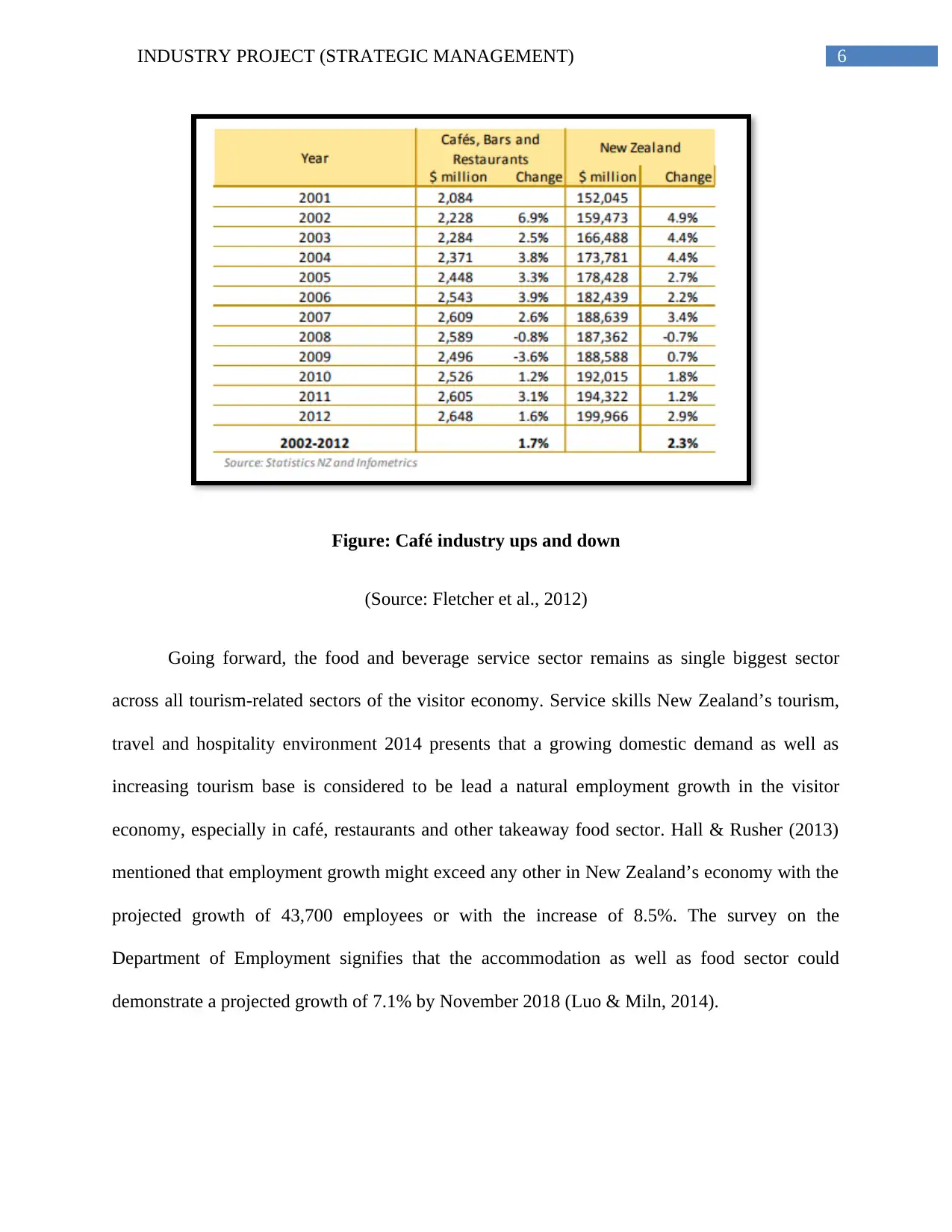
restaurants contributed nearly $2,647 million to New Zealand economy in 2012. Moreover, the
economic status was stabilized with the increase rate of 3.2%pa in the last five years to 2007 but
at nearly 0.3% per year over the next five years (Hall & Rusher, 2013). This is because the
recession has caused customers to slash discretionary expenditure on entertainment.
Furthermore, the café bars and hospitality industry has much higher proportion of younger
workers than the national economy. Thus, due to the availability of workforce and the
technological base, the industry is rapidly growing. Fletcher et al., (2012) mentioned that driving
growth in employment in the sector could be increasing patronage in cafes. Nonetheless, it is
expected that the industry has been growing rapidly and many small and medium size
organizations coffee organizations are entering the industry due to low cost model of café
business. This increases the level of competitiveness in the market.
1.1 Industry Background
It has been identified that people in New Zealand maintains a strong coffee culture,
which is reflected in their disposable income (NZD 28.3%). The disposable income here is one-
step behind Australia. Going forward, there is an increasing demand and trend of sustainable the
products that hold a social responsibility in world’s market but particularly in new Zealand such
trend certainly impact on how customers are selecting their coffee items. As put forward by
Noone, McGuire and Rohlfs (2011), there has been temporary slowdown in the coffee industry
of NZ because of the increase in international coffee price, but this fact does not affect the fresh
organic coffee, as it increases up to 12% with respect to value. Furthermore, the bars as well
restaurants contributed nearly $2,647 million to New Zealand economy in 2012. Moreover, the
economic status was stabilized with the increase rate of 3.2%pa in the last five years to 2007 but
at nearly 0.3% per year over the next five years (Hall & Rusher, 2013). This is because the
recession has caused customers to slash discretionary expenditure on entertainment.
Furthermore, the café bars and hospitality industry has much higher proportion of younger
workers than the national economy. Thus, due to the availability of workforce and the
technological base, the industry is rapidly growing. Fletcher et al., (2012) mentioned that driving
growth in employment in the sector could be increasing patronage in cafes. Nonetheless, it is
expected that the industry has been growing rapidly and many small and medium size
organizations coffee organizations are entering the industry due to low cost model of café
business. This increases the level of competitiveness in the market.
6INDUSTRY PROJECT (STRATEGIC MANAGEMENT)
Figure: Café industry ups and down
(Source: Fletcher et al., 2012)
Going forward, the food and beverage service sector remains as single biggest sector
across all tourism-related sectors of the visitor economy. Service skills New Zealand’s tourism,
travel and hospitality environment 2014 presents that a growing domestic demand as well as
increasing tourism base is considered to be lead a natural employment growth in the visitor
economy, especially in café, restaurants and other takeaway food sector. Hall & Rusher (2013)
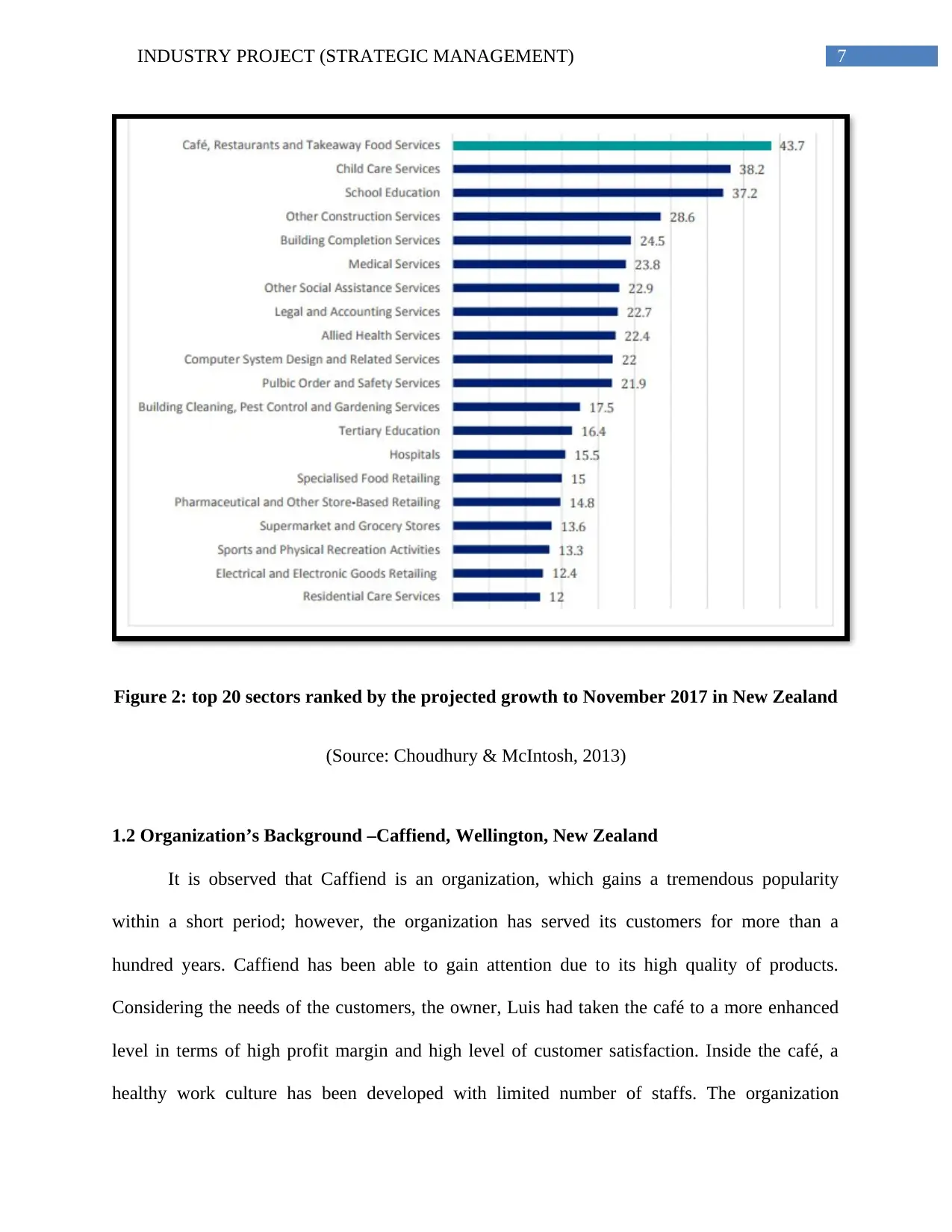
mentioned that employment growth might exceed any other in New Zealand’s economy with the
projected growth of 43,700 employees or with the increase of 8.5%. The survey on the
Department of Employment signifies that the accommodation as well as food sector could
demonstrate a projected growth of 7.1% by November 2018 (Luo & Miln, 2014).
Figure: Café industry ups and down
(Source: Fletcher et al., 2012)
Going forward, the food and beverage service sector remains as single biggest sector
across all tourism-related sectors of the visitor economy. Service skills New Zealand’s tourism,
travel and hospitality environment 2014 presents that a growing domestic demand as well as
increasing tourism base is considered to be lead a natural employment growth in the visitor
economy, especially in café, restaurants and other takeaway food sector. Hall & Rusher (2013)
mentioned that employment growth might exceed any other in New Zealand’s economy with the
projected growth of 43,700 employees or with the increase of 8.5%. The survey on the
Department of Employment signifies that the accommodation as well as food sector could
demonstrate a projected growth of 7.1% by November 2018 (Luo & Miln, 2014).
⊘ This is a preview!⊘
Do you want full access?
Subscribe today to unlock all pages.
Trusted by 1+ million students worldwide
7INDUSTRY PROJECT (STRATEGIC MANAGEMENT)
Figure 2: top 20 sectors ranked by the projected growth to November 2017 in New Zealand
(Source: Choudhury & McIntosh, 2013)
1.2 Organization’s Background –Caffiend, Wellington, New Zealand
It is observed that Caffiend is an organization, which gains a tremendous popularity
within a short period; however, the organization has served its customers for more than a
hundred years. Caffiend has been able to gain attention due to its high quality of products.
Considering the needs of the customers, the owner, Luis had taken the café to a more enhanced
level in terms of high profit margin and high level of customer satisfaction. Inside the café, a
healthy work culture has been developed with limited number of staffs. The organization
Figure 2: top 20 sectors ranked by the projected growth to November 2017 in New Zealand
(Source: Choudhury & McIntosh, 2013)
1.2 Organization’s Background –Caffiend, Wellington, New Zealand
It is observed that Caffiend is an organization, which gains a tremendous popularity
within a short period; however, the organization has served its customers for more than a
hundred years. Caffiend has been able to gain attention due to its high quality of products.
Considering the needs of the customers, the owner, Luis had taken the café to a more enhanced
level in terms of high profit margin and high level of customer satisfaction. Inside the café, a
healthy work culture has been developed with limited number of staffs. The organization
Paraphrase This Document
Need a fresh take? Get an instant paraphrase of this document with our AI Paraphraser
8INDUSTRY PROJECT (STRATEGIC MANAGEMENT)
followed and implemented an open management style considering the goals of teamwork. Even,
sometime of the owner of the company is observed to be working with the front managers. The
organization has a large customer base due to the attractive location. The café is located near the
Wellington Institute of Technology, the institute has more than 6000 students and they crowd at
Caffiend.
2.0 Project Scope
The following project investigates how the café and beverage firms in Wellington, New
Zealand is serving their customers; this means the study finds out whether customers prefer to
purchase coffee visiting the outlet and or they prefer sending orders online. The study is
developed in such a manner that helps to develop the possible ways of generating revenue stream
for Caffiend Wellington, New Zealand. To meet the research goals and objectives, a primary
analysis has been conducted. In order to collect the primary data, both quantitative and
qualitative data collection techniques have been applied. Following the guidelines of quantitative
data collection, a survey has been conducted among the customers of Caffiend while
implementing the guidelines of qualitative method an interview has been conducted among the
organizational members of Caffiend.
Moreover, to conduct the survey and interview method, two different type of research
questionnaire has been formed- such as the close-ended questions for the survey and the open-
ended questions for the interview. In order to conduct the literature review, 40 different journals
have been selected that are conducted on the present topic of the study. Nonetheless, five
journals have been rejected due to the lack of relevancy, validity and reliability; the data
provided in those journals were not reliable. Besides these facts, the current study is limited to
followed and implemented an open management style considering the goals of teamwork. Even,
sometime of the owner of the company is observed to be working with the front managers. The
organization has a large customer base due to the attractive location. The café is located near the
Wellington Institute of Technology, the institute has more than 6000 students and they crowd at
Caffiend.
2.0 Project Scope
The following project investigates how the café and beverage firms in Wellington, New
Zealand is serving their customers; this means the study finds out whether customers prefer to
purchase coffee visiting the outlet and or they prefer sending orders online. The study is
developed in such a manner that helps to develop the possible ways of generating revenue stream
for Caffiend Wellington, New Zealand. To meet the research goals and objectives, a primary
analysis has been conducted. In order to collect the primary data, both quantitative and
qualitative data collection techniques have been applied. Following the guidelines of quantitative
data collection, a survey has been conducted among the customers of Caffiend while
implementing the guidelines of qualitative method an interview has been conducted among the
organizational members of Caffiend.
Moreover, to conduct the survey and interview method, two different type of research
questionnaire has been formed- such as the close-ended questions for the survey and the open-
ended questions for the interview. In order to conduct the literature review, 40 different journals
have been selected that are conducted on the present topic of the study. Nonetheless, five
journals have been rejected due to the lack of relevancy, validity and reliability; the data
provided in those journals were not reliable. Besides these facts, the current study is limited to
9INDUSTRY PROJECT (STRATEGIC MANAGEMENT)
primary analysis, which means the research lacks a comparative analysis between two
organizations. In addition to this, the sample size for collecting data is very limited. The analysis
would have been more extensive, had the sample been extended.
2.1 Statement of Issues faced by the organization
Even though, Caffiend has a large customer base, the firm is facing certain issues in
terms of enhancing the level of services. New Zealand is technologically a developed nation and
people access to technology but Caffiend has yet not developed its own website to take orders. In
order to increase the sales margin, the café decided to take orders online as well but it has to rely
on www.menulog.co.nz, which is a third party vendor taking order from the customers on behalf
of many organization in the sector. Moreover, the organization has to spend a large amount of
money as the charges for using the website.
This is certainly affecting the organizational operation; nowadays people are more
attached to the technology- smart phone devices. However, Caffiend did not develop a smart-
phone app which would help the customers to order online. The customers will find it easy to
take their beverage items. In addition to this, in the era of smart-phone app, people do not follow
the traditional trend of ordering on calls. It is also observed that due to the stability in the
economy, people have more enhanced lifestyle and they do prefer to go out for beverage items;
instead, they would find an easy option to get their work done. Caffiend Wellington is trying to
create a strong awareness among the customers about their products and services. The firm is
determined to adopt the online system to penetrate in the large market. As the consequence, the
organization felt the need of diversification in the business by developing a website and mobile
application app for taking orders online.
primary analysis, which means the research lacks a comparative analysis between two
organizations. In addition to this, the sample size for collecting data is very limited. The analysis
would have been more extensive, had the sample been extended.
2.1 Statement of Issues faced by the organization
Even though, Caffiend has a large customer base, the firm is facing certain issues in
terms of enhancing the level of services. New Zealand is technologically a developed nation and
people access to technology but Caffiend has yet not developed its own website to take orders. In
order to increase the sales margin, the café decided to take orders online as well but it has to rely
on www.menulog.co.nz, which is a third party vendor taking order from the customers on behalf
of many organization in the sector. Moreover, the organization has to spend a large amount of
money as the charges for using the website.
This is certainly affecting the organizational operation; nowadays people are more
attached to the technology- smart phone devices. However, Caffiend did not develop a smart-
phone app which would help the customers to order online. The customers will find it easy to
take their beverage items. In addition to this, in the era of smart-phone app, people do not follow
the traditional trend of ordering on calls. It is also observed that due to the stability in the
economy, people have more enhanced lifestyle and they do prefer to go out for beverage items;
instead, they would find an easy option to get their work done. Caffiend Wellington is trying to
create a strong awareness among the customers about their products and services. The firm is
determined to adopt the online system to penetrate in the large market. As the consequence, the
organization felt the need of diversification in the business by developing a website and mobile
application app for taking orders online.
⊘ This is a preview!⊘
Do you want full access?
Subscribe today to unlock all pages.
Trusted by 1+ million students worldwide
10INDUSTRY PROJECT (STRATEGIC MANAGEMENT)
2.2 Catalyst
It is necessary for Caffiend to examine the issue and find a speedy solution, which would
increase the sales and customer base. Hence, the investigation is necessary because technology is
the only thing now that is rapidly evolving. Besides the large firms, many small and medium size
organizations have started adopting the technology in their operation to have more control over
the operation. Due to the adoption of technology, the level of competition is high in each sector
and the organizations are rushing towards the innovation. In such a context, Caffiend will lag
behind if it does not go with the flow. The organization has a large customer base, which enables
them to run the operation with traditional practice, but traditional practice remains as the threat to
the organization in the field of modern digital practice of operation. Thus, if the organization
does not wish to apply innovation to its business, it might have to lose its existing customer base.
Once the customers start visiting other nearby café bars, they might not come.
3.0 Literature Review
This section presents the facts and findings provided in the previous studies related to
generation of multiple revenue streams. The studies claim that most business models look for
ways to genera revenue stream. Nevertheless, this might not always be the standard technique in
restaurant business. Noone, McGuire and Rohlfs (2011) put emphasis on the fact that café bars
get bogged down trying to do best for a market that is less receptive than the anticipated. The
studies have mentioned that diversifying revenue stream is something that most small businesses
consider; though not all restaurants consider the same. Zott, Amit and Massa (2011) mentioned
that progress of the coffee segment, in which the consumers tend to look for more than coffee
from such brands and increased the range of competition from other fast services. A study
performed by Fletcher et al., (2012) mentioned that multiple revenue streams could be significant
2.2 Catalyst
It is necessary for Caffiend to examine the issue and find a speedy solution, which would
increase the sales and customer base. Hence, the investigation is necessary because technology is
the only thing now that is rapidly evolving. Besides the large firms, many small and medium size
organizations have started adopting the technology in their operation to have more control over
the operation. Due to the adoption of technology, the level of competition is high in each sector
and the organizations are rushing towards the innovation. In such a context, Caffiend will lag
behind if it does not go with the flow. The organization has a large customer base, which enables
them to run the operation with traditional practice, but traditional practice remains as the threat to
the organization in the field of modern digital practice of operation. Thus, if the organization
does not wish to apply innovation to its business, it might have to lose its existing customer base.
Once the customers start visiting other nearby café bars, they might not come.
3.0 Literature Review
This section presents the facts and findings provided in the previous studies related to
generation of multiple revenue streams. The studies claim that most business models look for
ways to genera revenue stream. Nevertheless, this might not always be the standard technique in
restaurant business. Noone, McGuire and Rohlfs (2011) put emphasis on the fact that café bars
get bogged down trying to do best for a market that is less receptive than the anticipated. The
studies have mentioned that diversifying revenue stream is something that most small businesses
consider; though not all restaurants consider the same. Zott, Amit and Massa (2011) mentioned
that progress of the coffee segment, in which the consumers tend to look for more than coffee
from such brands and increased the range of competition from other fast services. A study
performed by Fletcher et al., (2012) mentioned that multiple revenue streams could be significant
Paraphrase This Document
Need a fresh take? Get an instant paraphrase of this document with our AI Paraphraser
11INDUSTRY PROJECT (STRATEGIC MANAGEMENT)
in any franchise because they provide a time effective way for an employer to reduce the risk and
allow an anticipated cash flow from different sources; instead of depending on a single and
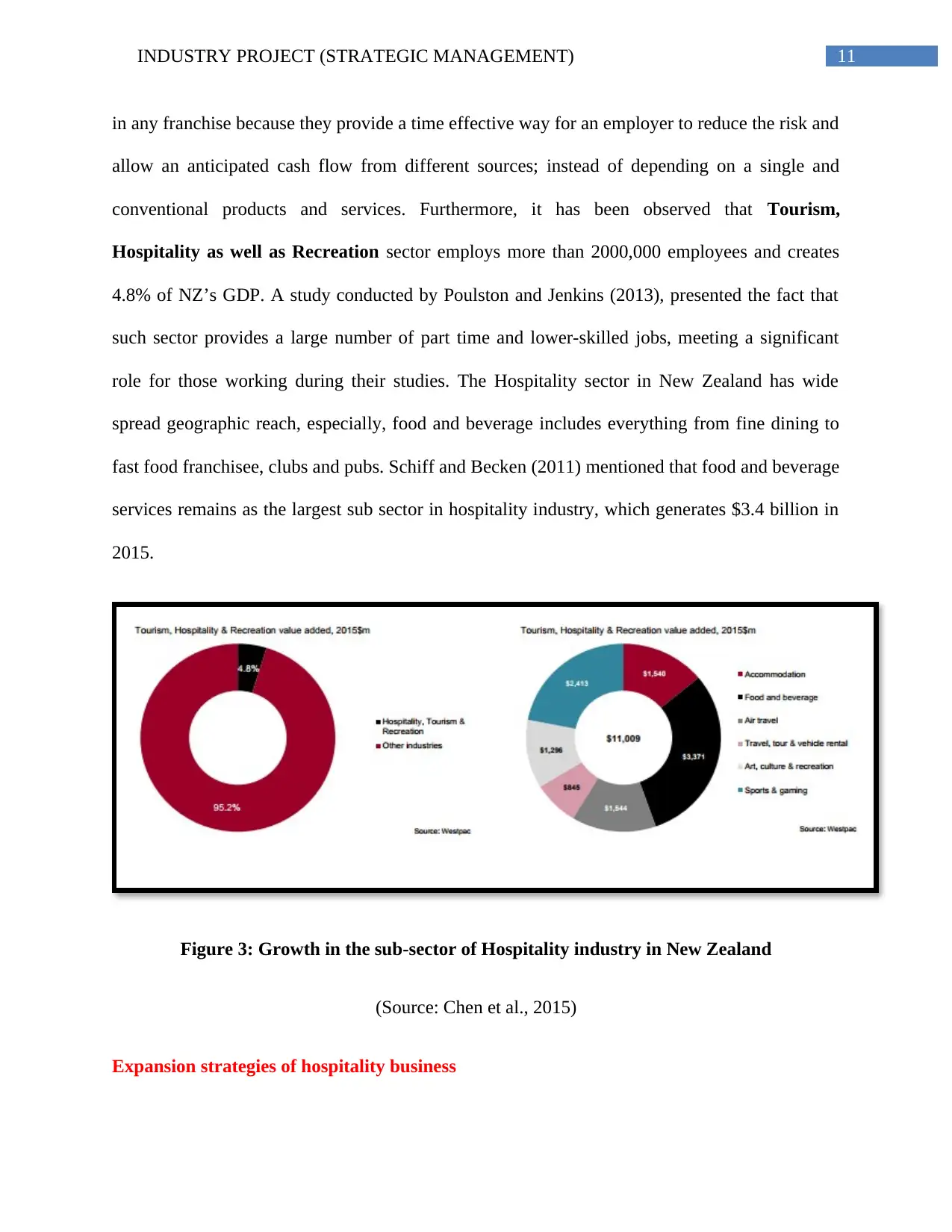
conventional products and services. Furthermore, it has been observed that Tourism,
Hospitality as well as Recreation sector employs more than 2000,000 employees and creates
4.8% of NZ’s GDP. A study conducted by Poulston and Jenkins (2013), presented the fact that
such sector provides a large number of part time and lower-skilled jobs, meeting a significant
role for those working during their studies. The Hospitality sector in New Zealand has wide
spread geographic reach, especially, food and beverage includes everything from fine dining to
fast food franchisee, clubs and pubs. Schiff and Becken (2011) mentioned that food and beverage
services remains as the largest sub sector in hospitality industry, which generates $3.4 billion in
2015.
Figure 3: Growth in the sub-sector of Hospitality industry in New Zealand
(Source: Chen et al., 2015)
Expansion strategies of hospitality business
in any franchise because they provide a time effective way for an employer to reduce the risk and
allow an anticipated cash flow from different sources; instead of depending on a single and
conventional products and services. Furthermore, it has been observed that Tourism,
Hospitality as well as Recreation sector employs more than 2000,000 employees and creates
4.8% of NZ’s GDP. A study conducted by Poulston and Jenkins (2013), presented the fact that
such sector provides a large number of part time and lower-skilled jobs, meeting a significant
role for those working during their studies. The Hospitality sector in New Zealand has wide
spread geographic reach, especially, food and beverage includes everything from fine dining to
fast food franchisee, clubs and pubs. Schiff and Becken (2011) mentioned that food and beverage
services remains as the largest sub sector in hospitality industry, which generates $3.4 billion in
2015.
Figure 3: Growth in the sub-sector of Hospitality industry in New Zealand
(Source: Chen et al., 2015)
Expansion strategies of hospitality business
12INDUSTRY PROJECT (STRATEGIC MANAGEMENT)
When the business reaches the peak point, it has to develop or arrange an alternative
strategy to grow further and sustain the business. Especially, in hospitality sector, if the
customers embrace the quality of service, the business is usually considered to be sustainable in
the market. However, to remain active or keep this sustainability, the business must think of a
sustainable or expansion strategy. Kim and Mauborgne (2014) argued that when it comes to
expansion of strategy, the small business may find it difficult, as to make a competitive position
in the market, the small businesses have to offer specialized products, serve the regional or local
market first and provide an individual level of customer service. Supporting the above-
mentioned statement, Howard and Jaffee (2013) mentioned that large businesses have the
advantages in finance, purchasing marketing, which means small business certainly have to face
the difficulty of budget. Levy, Reinecke and Manning (2016) proposed some of the important
ways of expanding business in the coffee sector that are analyzed in the following.
Open up food cart in a new market: As discussed above, the small firm in the coffee
sector needs to serve the local market by providing them with a specialized product. As put
forward by Elder, Lister and Dauvergne (2014) the coffee shops mostly depend largely on
customer traffic as well as they are mostly located in areas with the most convenient access for
pedestrians. The major location for opening up a coffee shop usually include downtown, retail
centre, office building, college campus and shopping malls. An experimental study conducted
by Alejandra Gonzalez-Perez and Fernando Velez-Ocampo (2014) mentioned that it is always
effective for a coffee organization to select the crowded location. For example, if an organization
is located at the downturn of the city, to expand the service area or market, it can open up
another shop at University Campus establishing a food cart. To be more specific, it was
observed that the organization Coffee Club presently has 62 stores throughout New Zealand;
When the business reaches the peak point, it has to develop or arrange an alternative
strategy to grow further and sustain the business. Especially, in hospitality sector, if the
customers embrace the quality of service, the business is usually considered to be sustainable in
the market. However, to remain active or keep this sustainability, the business must think of a
sustainable or expansion strategy. Kim and Mauborgne (2014) argued that when it comes to
expansion of strategy, the small business may find it difficult, as to make a competitive position
in the market, the small businesses have to offer specialized products, serve the regional or local
market first and provide an individual level of customer service. Supporting the above-
mentioned statement, Howard and Jaffee (2013) mentioned that large businesses have the
advantages in finance, purchasing marketing, which means small business certainly have to face
the difficulty of budget. Levy, Reinecke and Manning (2016) proposed some of the important
ways of expanding business in the coffee sector that are analyzed in the following.
Open up food cart in a new market: As discussed above, the small firm in the coffee
sector needs to serve the local market by providing them with a specialized product. As put
forward by Elder, Lister and Dauvergne (2014) the coffee shops mostly depend largely on
customer traffic as well as they are mostly located in areas with the most convenient access for
pedestrians. The major location for opening up a coffee shop usually include downtown, retail
centre, office building, college campus and shopping malls. An experimental study conducted
by Alejandra Gonzalez-Perez and Fernando Velez-Ocampo (2014) mentioned that it is always
effective for a coffee organization to select the crowded location. For example, if an organization
is located at the downturn of the city, to expand the service area or market, it can open up
another shop at University Campus establishing a food cart. To be more specific, it was
observed that the organization Coffee Club presently has 62 stores throughout New Zealand;
⊘ This is a preview!⊘
Do you want full access?
Subscribe today to unlock all pages.
Trusted by 1+ million students worldwide

1 out of 63


Related Documents


Your All-in-One AI-Powered Toolkit for Academic Success.
+13062052269
info@desklib.com
Available 24*7 on WhatsApp / Email
![[object Object]](/_next/static/media/star-bottom.7253800d.svg)
Unlock your academic potential
Copyright © 2020–2026 A2Z Services. All Rights Reserved. Developed and managed by ZUCOL.