Evaluating Strategic Decision Making at HSBC: A Detailed Analysis
VerifiedAdded on 2020/01/07
|12
|3000
|494
Report
AI Summary
This assignment provides a comprehensive analysis of strategic decision-making within HSBC, a global financial institution. It begins with an introduction to HSBC, including a SWOT analysis to identify its strengths, weaknesses, opportunities, and threats. The report then delves into the development of strategic choices for HSBC, utilizing Porter's four Generic International strategies. These choices are evaluated using the SAFe (Suitability, Acceptability, Feasibility) framework to determine their viability and potential impact. The evaluation considers factors such as market opportunities, stakeholder acceptance, and financial feasibility. Finally, the assignment offers preferred recommendations for strategic choices, focusing on market penetration, organizational growth, and competitive positioning, concluding that a strategic move is essential for HSBC to maintain its image in the global financial system. This analysis encompasses both internal and external factors influencing HSBC's strategic decisions.
STRATEGIC DECISION MAKING
1
1

Paraphrase This Document
Need a fresh take? Get an instant paraphrase of this document with our AI Paraphraser
Abstract
In this assignment the aspect of strategic decision making for a particular organisation has been
discussed. There are different types of organisations with the prospect of their own decision
making process for talking strategic moves. In this assignment the core competence of eth
business strategy making process is analysed. Firstly, the organisation such as HSBC has been
chosen for the entire discussions. The environmental, strategic and industry completive analysis
has been accumulated with the process of different technical theories for strategic decision
making in order to identify the actual strategic condition of the business. Thereafter, the
development of different strategic choices as utilisation of SAFe are discussed. Then the
evaluation of the existing strategic choices of the organisation is done within the coursework of
different aliment preferred strategies. The strategic choices are need to be analysed to elaborate
the conceptual formation of the business actual status determination. Finally, the recommended
choices for the strategies are used to identify with the suitability of the organisation. The
conclusions are constructed with the aspect of strategic choices are fulfilled or not are described
within the assignment. Therefore, the overall conceptualisation for strategic decision making for
an organisation are described with positive and negative impacts for internal and external are
constructed.
2
In this assignment the aspect of strategic decision making for a particular organisation has been
discussed. There are different types of organisations with the prospect of their own decision
making process for talking strategic moves. In this assignment the core competence of eth
business strategy making process is analysed. Firstly, the organisation such as HSBC has been
chosen for the entire discussions. The environmental, strategic and industry completive analysis
has been accumulated with the process of different technical theories for strategic decision
making in order to identify the actual strategic condition of the business. Thereafter, the
development of different strategic choices as utilisation of SAFe are discussed. Then the
evaluation of the existing strategic choices of the organisation is done within the coursework of
different aliment preferred strategies. The strategic choices are need to be analysed to elaborate
the conceptual formation of the business actual status determination. Finally, the recommended
choices for the strategies are used to identify with the suitability of the organisation. The
conclusions are constructed with the aspect of strategic choices are fulfilled or not are described
within the assignment. Therefore, the overall conceptualisation for strategic decision making for
an organisation are described with positive and negative impacts for internal and external are
constructed.
2
Table of Contents
a. Introduction to the HSBC Company with identifying the SWOT...............................................4
b. Developing the strategic choices for HSBC................................................................................6
c. Evaluation of the available strategic choices for HSBC..............................................................8
d. Preferred recommendations for strategic choices in HSBC and conclusions..............................9
References......................................................................................................................................11
3
a. Introduction to the HSBC Company with identifying the SWOT...............................................4
b. Developing the strategic choices for HSBC................................................................................6
c. Evaluation of the available strategic choices for HSBC..............................................................8
d. Preferred recommendations for strategic choices in HSBC and conclusions..............................9
References......................................................................................................................................11
3
⊘ This is a preview!⊘
Do you want full access?
Subscribe today to unlock all pages.

Trusted by 1+ million students worldwide
a. Introduction to the HSBC Company with identifying the SWOT
Strategic decision making aspect is very important for every organisation. There are several
types of strategic decision making process for a particular organisation. In the context of
discussion then selected organisation is named as HSBC. HSBC started its business in the year
1865 as the Hong Kong financial institution and then its has grow the business in Europe, India
and China. The framework of then HSBC decision making for having a strategic move within the
organisation as well as outside the organisation are quite innovative (www.hsbc.co.uk, 2016).
The HSBC Company is regarded as a financial institution n which allows the banking process in
UK. For the part of discussion there are different analyses that are made within the prospect of
HSBC in UK. This analysis can be discussed as follows:
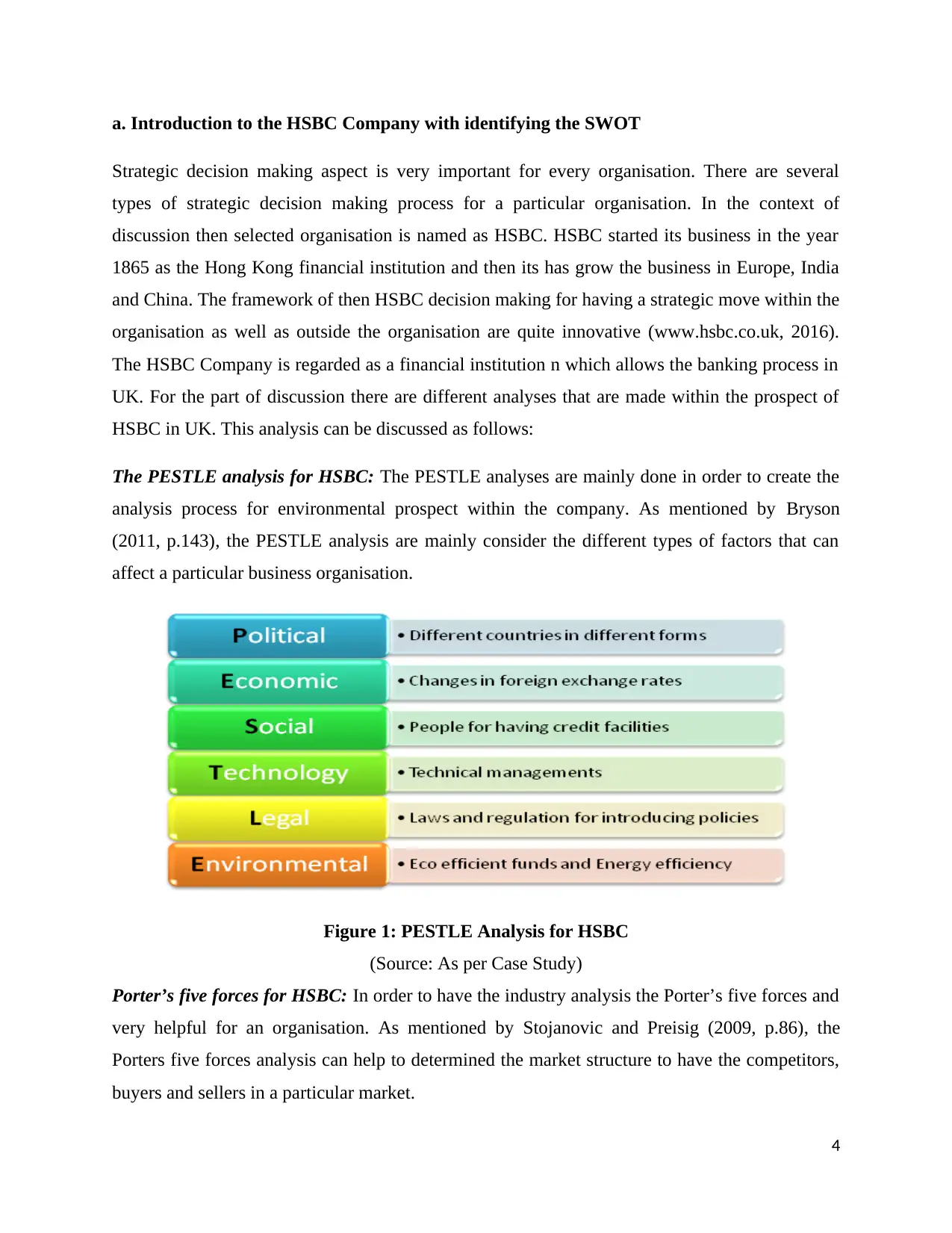
The PESTLE analysis for HSBC: The PESTLE analyses are mainly done in order to create the
analysis process for environmental prospect within the company. As mentioned by Bryson
(2011, p.143), the PESTLE analysis are mainly consider the different types of factors that can
affect a particular business organisation.
Figure 1: PESTLE Analysis for HSBC
(Source: As per Case Study)
Porter’s five forces for HSBC: In order to have the industry analysis the Porter’s five forces and
very helpful for an organisation. As mentioned by Stojanovic and Preisig (2009, p.86), the
Porters five forces analysis can help to determined the market structure to have the competitors,
buyers and sellers in a particular market.
4
Strategic decision making aspect is very important for every organisation. There are several
types of strategic decision making process for a particular organisation. In the context of
discussion then selected organisation is named as HSBC. HSBC started its business in the year
1865 as the Hong Kong financial institution and then its has grow the business in Europe, India
and China. The framework of then HSBC decision making for having a strategic move within the
organisation as well as outside the organisation are quite innovative (www.hsbc.co.uk, 2016).
The HSBC Company is regarded as a financial institution n which allows the banking process in
UK. For the part of discussion there are different analyses that are made within the prospect of
HSBC in UK. This analysis can be discussed as follows:
The PESTLE analysis for HSBC: The PESTLE analyses are mainly done in order to create the
analysis process for environmental prospect within the company. As mentioned by Bryson
(2011, p.143), the PESTLE analysis are mainly consider the different types of factors that can
affect a particular business organisation.
Figure 1: PESTLE Analysis for HSBC
(Source: As per Case Study)
Porter’s five forces for HSBC: In order to have the industry analysis the Porter’s five forces and
very helpful for an organisation. As mentioned by Stojanovic and Preisig (2009, p.86), the
Porters five forces analysis can help to determined the market structure to have the competitors,
buyers and sellers in a particular market.
4
Paraphrase This Document
Need a fresh take? Get an instant paraphrase of this document with our AI Paraphraser
Figure 2: Porter’s five forces analysis for HSBC
(Source: As per case study)
These five forces can show that a particular market have different types of factors that can affect
the growth and development of a particular company. In HSBC, the competitor’s threats are
involved in order to spread of different banks in the market.
Threshold distinctive capabilities: The threshold distinctive recourses can help to analyse the
strategic capabilities of a particular organisation. As commented by Jarratt and Stiles (2010,
p.34), in order to have the overall analysis of companies strategic capabilities to manage the
competitors in a particular market, there should be use of threshold distinctive capabilities with
the market. In the given scenario there are different competitors which can resist the growth of
HSBC.
SWOT Analysis: The analysis of different weaknesses and strength of an organisation, it
necessary to proceed with a SWOT analysis. As supported by Singh (2004, p.665), the SWOT
analysis is a process in which the particular aspects of indication point for strength and
weaknesses are raised must be identified.
5
(Source: As per case study)
These five forces can show that a particular market have different types of factors that can affect
the growth and development of a particular company. In HSBC, the competitor’s threats are
involved in order to spread of different banks in the market.
Threshold distinctive capabilities: The threshold distinctive recourses can help to analyse the
strategic capabilities of a particular organisation. As commented by Jarratt and Stiles (2010,
p.34), in order to have the overall analysis of companies strategic capabilities to manage the
competitors in a particular market, there should be use of threshold distinctive capabilities with
the market. In the given scenario there are different competitors which can resist the growth of
HSBC.
SWOT Analysis: The analysis of different weaknesses and strength of an organisation, it
necessary to proceed with a SWOT analysis. As supported by Singh (2004, p.665), the SWOT
analysis is a process in which the particular aspects of indication point for strength and
weaknesses are raised must be identified.
5
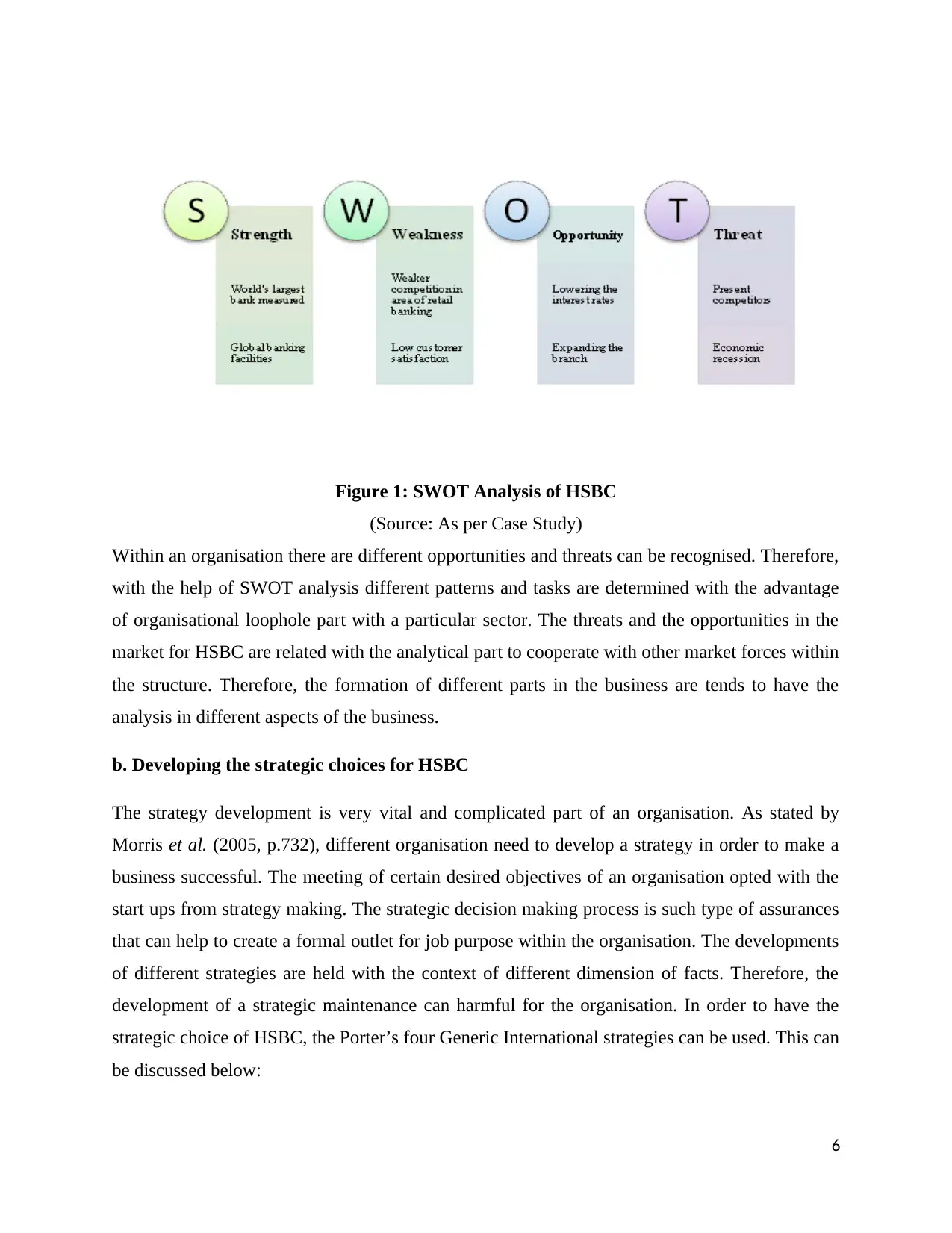
Figure 1: SWOT Analysis of HSBC
(Source: As per Case Study)
Within an organisation there are different opportunities and threats can be recognised. Therefore,
with the help of SWOT analysis different patterns and tasks are determined with the advantage
of organisational loophole part with a particular sector. The threats and the opportunities in the
market for HSBC are related with the analytical part to cooperate with other market forces within
the structure. Therefore, the formation of different parts in the business are tends to have the
analysis in different aspects of the business.
b. Developing the strategic choices for HSBC
The strategy development is very vital and complicated part of an organisation. As stated by
Morris et al. (2005, p.732), different organisation need to develop a strategy in order to make a
business successful. The meeting of certain desired objectives of an organisation opted with the
start ups from strategy making. The strategic decision making process is such type of assurances
that can help to create a formal outlet for job purpose within the organisation. The developments
of different strategies are held with the context of different dimension of facts. Therefore, the
development of a strategic maintenance can harmful for the organisation. In order to have the
strategic choice of HSBC, the Porter’s four Generic International strategies can be used. This can
be discussed below:
6
(Source: As per Case Study)
Within an organisation there are different opportunities and threats can be recognised. Therefore,
with the help of SWOT analysis different patterns and tasks are determined with the advantage
of organisational loophole part with a particular sector. The threats and the opportunities in the
market for HSBC are related with the analytical part to cooperate with other market forces within
the structure. Therefore, the formation of different parts in the business are tends to have the
analysis in different aspects of the business.
b. Developing the strategic choices for HSBC
The strategy development is very vital and complicated part of an organisation. As stated by
Morris et al. (2005, p.732), different organisation need to develop a strategy in order to make a
business successful. The meeting of certain desired objectives of an organisation opted with the
start ups from strategy making. The strategic decision making process is such type of assurances
that can help to create a formal outlet for job purpose within the organisation. The developments
of different strategies are held with the context of different dimension of facts. Therefore, the
development of a strategic maintenance can harmful for the organisation. In order to have the
strategic choice of HSBC, the Porter’s four Generic International strategies can be used. This can
be discussed below:
6
⊘ This is a preview!⊘
Do you want full access?
Subscribe today to unlock all pages.
Trusted by 1+ million students worldwide
Target Scope
Advantages
Low Cost Uniqueness of Products
Broad
(Industry Wide)
Cost Leadership Strategy Strategy of Differentiation
Narrow
(Market Segmentation)
Focus Strategy
(Low Cost)
Focus Strategy
(Differentiation)
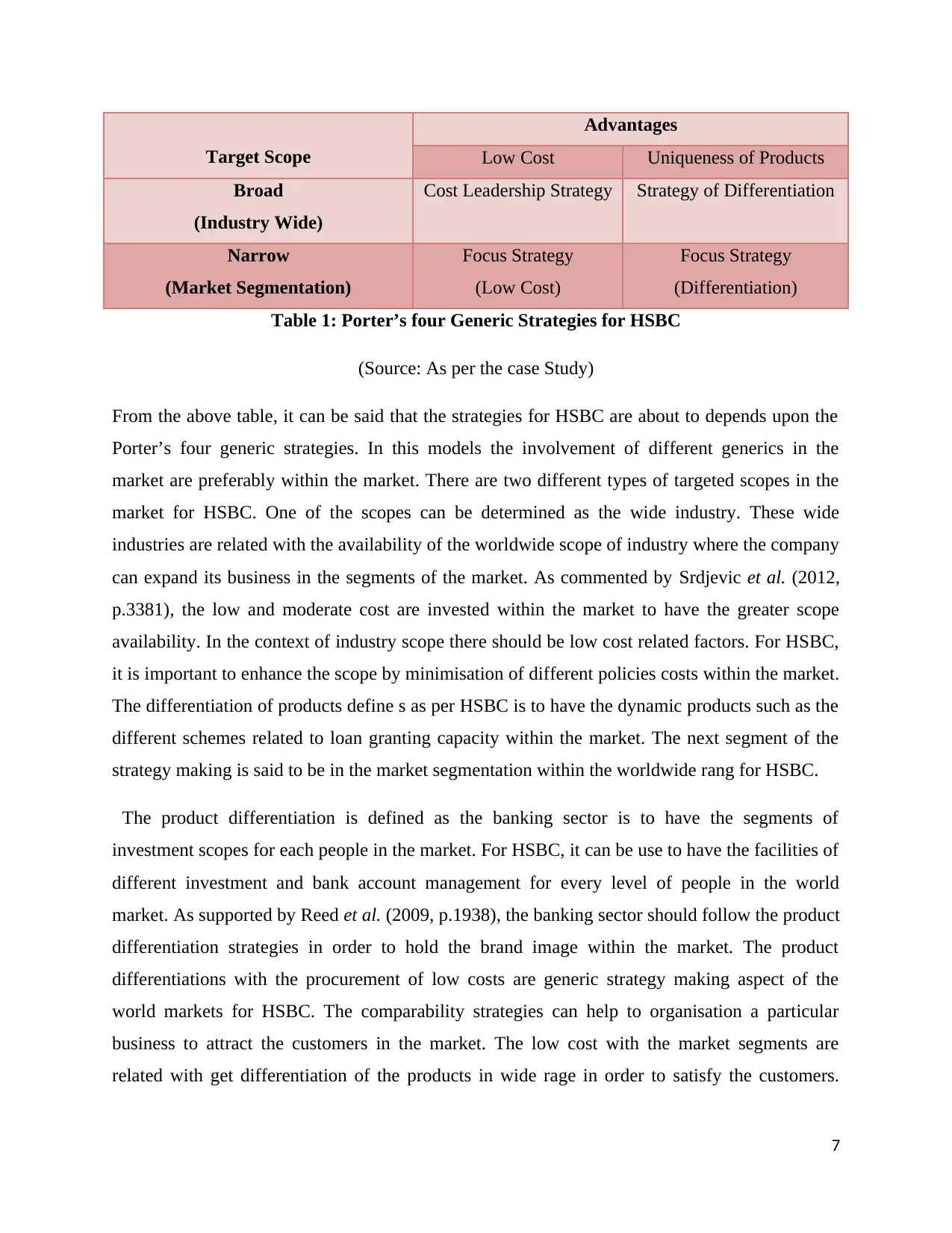
Table 1: Porter’s four Generic Strategies for HSBC
(Source: As per the case Study)
From the above table, it can be said that the strategies for HSBC are about to depends upon the
Porter’s four generic strategies. In this models the involvement of different generics in the
market are preferably within the market. There are two different types of targeted scopes in the
market for HSBC. One of the scopes can be determined as the wide industry. These wide
industries are related with the availability of the worldwide scope of industry where the company
can expand its business in the segments of the market. As commented by Srdjevic et al. (2012,
p.3381), the low and moderate cost are invested within the market to have the greater scope
availability. In the context of industry scope there should be low cost related factors. For HSBC,
it is important to enhance the scope by minimisation of different policies costs within the market.
The differentiation of products define s as per HSBC is to have the dynamic products such as the
different schemes related to loan granting capacity within the market. The next segment of the
strategy making is said to be in the market segmentation within the worldwide rang for HSBC.
The product differentiation is defined as the banking sector is to have the segments of
investment scopes for each people in the market. For HSBC, it can be use to have the facilities of
different investment and bank account management for every level of people in the world
market. As supported by Reed et al. (2009, p.1938), the banking sector should follow the product
differentiation strategies in order to hold the brand image within the market. The product
differentiations with the procurement of low costs are generic strategy making aspect of the
world markets for HSBC. The comparability strategies can help to organisation a particular
business to attract the customers in the market. The low cost with the market segments are
related with get differentiation of the products in wide rage in order to satisfy the customers.
7
Advantages
Low Cost Uniqueness of Products
Broad
(Industry Wide)
Cost Leadership Strategy Strategy of Differentiation
Narrow
(Market Segmentation)
Focus Strategy
(Low Cost)
Focus Strategy
(Differentiation)
Table 1: Porter’s four Generic Strategies for HSBC
(Source: As per the case Study)
From the above table, it can be said that the strategies for HSBC are about to depends upon the
Porter’s four generic strategies. In this models the involvement of different generics in the
market are preferably within the market. There are two different types of targeted scopes in the
market for HSBC. One of the scopes can be determined as the wide industry. These wide
industries are related with the availability of the worldwide scope of industry where the company
can expand its business in the segments of the market. As commented by Srdjevic et al. (2012,
p.3381), the low and moderate cost are invested within the market to have the greater scope
availability. In the context of industry scope there should be low cost related factors. For HSBC,
it is important to enhance the scope by minimisation of different policies costs within the market.
The differentiation of products define s as per HSBC is to have the dynamic products such as the
different schemes related to loan granting capacity within the market. The next segment of the
strategy making is said to be in the market segmentation within the worldwide rang for HSBC.
The product differentiation is defined as the banking sector is to have the segments of
investment scopes for each people in the market. For HSBC, it can be use to have the facilities of
different investment and bank account management for every level of people in the world
market. As supported by Reed et al. (2009, p.1938), the banking sector should follow the product
differentiation strategies in order to hold the brand image within the market. The product
differentiations with the procurement of low costs are generic strategy making aspect of the
world markets for HSBC. The comparability strategies can help to organisation a particular
business to attract the customers in the market. The low cost with the market segments are
related with get differentiation of the products in wide rage in order to satisfy the customers.
7
Paraphrase This Document
Need a fresh take? Get an instant paraphrase of this document with our AI Paraphraser
Therefore, it can be said the the strategies are need to be very specific to achieve the overall goal
of a particular company.
c. Evaluation of the available strategic choices for HSBC
The evaluations of the selected strategies are needed to be specific in the context of different
market association for a particular company. As mentioned by Conley et al. (2008, p.1183), the
strategy formulation for a company are always about to take have the results band outcomes for
the proposed strategies. In the context of HSBC, the strategies that are adapted within the
business are evaluated with the course of business expansions in market worldwide. In order to
have the evaluation of the strategies, the SAFe analysis can be proceeding with the company
point of view. This can be discussed as follows:
Suitability of the strategy is regarded as the forts that then strategy is suitable for the address of
opportunities in the market or not. As mentioned by Peng et al. (2008, p.930), the suitability of
the market expansions are relatively applicable for each business units in the market. In the
context of HSBC, the suitability of the proposed strategy bare quite effective in relation with the
policy renovation and the policy differentiation in the market globally. The proposed strategies
are suitable for HSBC in the sense of the profitability concerns within the business organisation.
The opportunities regarding the strategies preferred for the companies are expected to be very
positive in order to have acquired the results in the business structure. The business structure
may get benefited with the accumulation of the policy enhancement of HSBC.
Acceptability of a particular strategies are tends to have the repercussion from the existing
stakeholders in the market. As supported by Alvarez and Barney (2007, p.22), the stakeholder
are mainly rely on the strategies of a particular business organisation. In the context of HSBC,
the stakeholders are mainly shorted as the customers and account holders of HSBC in the market.
With the change of policies different customers can attract to invest o n the segment of different
dynamic plan. Therefore, this can help the company to evaluate for the context of the strategy
acceptation within the market. The levels of the risk management in the ma kept for preferred
strategy are likely to have the return from the engaged marketing of the business policies within
the market. The returns from the policy change are likely to be acceptable by the customer
because it will give them low cost in high return in the market.
8
of a particular company.
c. Evaluation of the available strategic choices for HSBC
The evaluations of the selected strategies are needed to be specific in the context of different
market association for a particular company. As mentioned by Conley et al. (2008, p.1183), the
strategy formulation for a company are always about to take have the results band outcomes for
the proposed strategies. In the context of HSBC, the strategies that are adapted within the
business are evaluated with the course of business expansions in market worldwide. In order to
have the evaluation of the strategies, the SAFe analysis can be proceeding with the company
point of view. This can be discussed as follows:
Suitability of the strategy is regarded as the forts that then strategy is suitable for the address of
opportunities in the market or not. As mentioned by Peng et al. (2008, p.930), the suitability of
the market expansions are relatively applicable for each business units in the market. In the
context of HSBC, the suitability of the proposed strategy bare quite effective in relation with the
policy renovation and the policy differentiation in the market globally. The proposed strategies
are suitable for HSBC in the sense of the profitability concerns within the business organisation.
The opportunities regarding the strategies preferred for the companies are expected to be very
positive in order to have acquired the results in the business structure. The business structure
may get benefited with the accumulation of the policy enhancement of HSBC.
Acceptability of a particular strategies are tends to have the repercussion from the existing
stakeholders in the market. As supported by Alvarez and Barney (2007, p.22), the stakeholder
are mainly rely on the strategies of a particular business organisation. In the context of HSBC,
the stakeholders are mainly shorted as the customers and account holders of HSBC in the market.
With the change of policies different customers can attract to invest o n the segment of different
dynamic plan. Therefore, this can help the company to evaluate for the context of the strategy
acceptation within the market. The levels of the risk management in the ma kept for preferred
strategy are likely to have the return from the engaged marketing of the business policies within
the market. The returns from the policy change are likely to be acceptable by the customer
because it will give them low cost in high return in the market.
8
Feasibility in the structure of different strategies is considering the applicability of the segments
in the business. As asserted by Teusink et al. (2009, p.1041), the feasibility in the aspect of the
business analysis are depends upon the financial availability of the business. The existing skills
within HSBC employees are quite enough to create the opportunities min the market. Therefore,
in need to adapt the employee for skill requirement of the business settings in the market for
HSBC. The initiative is about to launch the policies that can be financed with the company
shareholders to attain the required situation in the marketing strategies for decision making.
Therefore, the strategy evaluation is about to be identical in the course of different market
analysis within the business.
d. Preferred recommendations for strategic choices in HSBC and conclusions
The preferred growth in the market of the different capitalised position of HSBC denotes the
overall acceptability often business strategic decision in the market. From the above analysis it
can be recommended that the forms of market penetrations for HSBC are relatively low in the
context of product launching aspect, the low cost products and policies are helps to evaluate the
people consideration from the company in the world. The company only stick to the point of
acquiring the affluent customers from the market in worldwide criteria. In the context of
organisational growth there are different skilled employees can perform their activities in the
policy making aspect. Therefore, it can help the overall organisational growth in the company.
The overall business aspects are related with the growth and core competence of HSBC.
It can be recommended that the company proceed with strategic move in order to create the
image in world financial system in the context of the other competitors. The competitors in the
market can solicited with the reflecting outcomes of the strategies used by the company. It can
also be recommended that the accesses of the company in the context of retail banking criteria
can be improved by the company in order to secure the future growth possibilities. The low
customer satisfactions regarding the schemes of granting loans can be improved by the
companies I n future financial flows. The requirement of different core strategic plans should be
inaugurated with the business so that the business can tackle strategic moves regarding the
changes in its policies.
9
in the business. As asserted by Teusink et al. (2009, p.1041), the feasibility in the aspect of the
business analysis are depends upon the financial availability of the business. The existing skills
within HSBC employees are quite enough to create the opportunities min the market. Therefore,
in need to adapt the employee for skill requirement of the business settings in the market for
HSBC. The initiative is about to launch the policies that can be financed with the company
shareholders to attain the required situation in the marketing strategies for decision making.
Therefore, the strategy evaluation is about to be identical in the course of different market
analysis within the business.
d. Preferred recommendations for strategic choices in HSBC and conclusions
The preferred growth in the market of the different capitalised position of HSBC denotes the
overall acceptability often business strategic decision in the market. From the above analysis it
can be recommended that the forms of market penetrations for HSBC are relatively low in the
context of product launching aspect, the low cost products and policies are helps to evaluate the
people consideration from the company in the world. The company only stick to the point of
acquiring the affluent customers from the market in worldwide criteria. In the context of
organisational growth there are different skilled employees can perform their activities in the
policy making aspect. Therefore, it can help the overall organisational growth in the company.
The overall business aspects are related with the growth and core competence of HSBC.
It can be recommended that the company proceed with strategic move in order to create the
image in world financial system in the context of the other competitors. The competitors in the
market can solicited with the reflecting outcomes of the strategies used by the company. It can
also be recommended that the accesses of the company in the context of retail banking criteria
can be improved by the company in order to secure the future growth possibilities. The low
customer satisfactions regarding the schemes of granting loans can be improved by the
companies I n future financial flows. The requirement of different core strategic plans should be
inaugurated with the business so that the business can tackle strategic moves regarding the
changes in its policies.
9
⊘ This is a preview!⊘
Do you want full access?
Subscribe today to unlock all pages.
Trusted by 1+ million students worldwide
From the above discussion it can be concluded that the company strategic decision making
should enables with respect of the need and facts of company in the market. Therefore, different
analysis that can be said to have its impact of the strategic moves for company as a whole. The
factual description regarding company’s’ core competences are related with the strategic plan
that it should be facilitate the changes. The conceptualisation of each prospect and facts, the
preferred strategy can enable to the company for creating benefits from the market. The needs for
changing of strategy are related with the profit maximisation of the company. This can help the
people to encourage themselves for creating investment within the company. The strategic move
as per the suitability and acceptability in the market seems to have the analytical review of the
decision making for HSBC. In the context of the marketing strategy for the company need to be
facilitate the broader aspects of product differentiation.
10
should enables with respect of the need and facts of company in the market. Therefore, different
analysis that can be said to have its impact of the strategic moves for company as a whole. The
factual description regarding company’s’ core competences are related with the strategic plan
that it should be facilitate the changes. The conceptualisation of each prospect and facts, the
preferred strategy can enable to the company for creating benefits from the market. The needs for
changing of strategy are related with the profit maximisation of the company. This can help the
people to encourage themselves for creating investment within the company. The strategic move
as per the suitability and acceptability in the market seems to have the analytical review of the
decision making for HSBC. In the context of the marketing strategy for the company need to be
facilitate the broader aspects of product differentiation.
10
Paraphrase This Document
Need a fresh take? Get an instant paraphrase of this document with our AI Paraphraser
References
Alvarez, S.A. and Barney, J.B., (2007). Discovery and creation: Alternative theories of
entrepreneurial action. Strategic entrepreneurship journal, 1(1‐2), pp.11-26.
Bryson, J.M., (2011). Strategic planning for public and nonprofit organizations: A guide to
strengthening and sustaining organizational achievement (Vol. 1). New Jersey: John Wiley &
Sons.
Conley, J.M., Symes, S.J., Schorr, M.S. and Richards, S.M., (2008). Spatial and temporal
analysis of pharmaceutical concentrations in the upper Tennessee River basin. Chemosphere,
73(8), pp.1178-1187.
Jarratt, D. and Stiles, D., (2010). How are methodologies and tools framing managers'
strategizing practice in competitive strategy development?. British Journal of Management,
21(1), pp.28-43.
Morris, M., Schindehutte, M. and Allen, J., (2005). The entrepreneur's business model: toward a
unified perspective. Journal of business research, 58(6), pp.726-735.
Peng, M.W., Wang, D.Y. and Jiang, Y., (2008). An institution-based view of international
business strategy: A focus on emerging economies. Journal of international business studies,
39(5), pp.920-936.
Reed, M.S., Graves, A., Dandy, N., Posthumus, H., Hubacek, K., Morris, J., Prell, C., Quinn,
C.H. and Stringer, L.C., (2009). Who's in and why? A typology of stakeholder analysis methods
for natural resource management. Journal of environmental management, 90(5), pp.1933-1949.
Singh, J.P., (2004). Development trends in the sensor technology: a new BCG matrix analysis as
a potential tool of technology selection for a sensor suite. IEEE Sensors Journal, 4(5), pp.664-
669.
Srdjevic, Z., Bajcetic, R. and Srdjevic, B., (2012). Identifying the criteria set for multicriteria
decision making based on SWOT/PESTLE analysis: A case study of reconstructing a water
intake structure. Water resources management, 26(12), pp.3379-3393.
Stojanovic, M. and Preisig, J., (2009). Underwater acoustic communication channels:
Propagation models and statistical characterization. IEEE Communications Magazine, 47(1),
pp.84-89.
11
Alvarez, S.A. and Barney, J.B., (2007). Discovery and creation: Alternative theories of
entrepreneurial action. Strategic entrepreneurship journal, 1(1‐2), pp.11-26.
Bryson, J.M., (2011). Strategic planning for public and nonprofit organizations: A guide to
strengthening and sustaining organizational achievement (Vol. 1). New Jersey: John Wiley &
Sons.
Conley, J.M., Symes, S.J., Schorr, M.S. and Richards, S.M., (2008). Spatial and temporal
analysis of pharmaceutical concentrations in the upper Tennessee River basin. Chemosphere,
73(8), pp.1178-1187.
Jarratt, D. and Stiles, D., (2010). How are methodologies and tools framing managers'
strategizing practice in competitive strategy development?. British Journal of Management,
21(1), pp.28-43.
Morris, M., Schindehutte, M. and Allen, J., (2005). The entrepreneur's business model: toward a
unified perspective. Journal of business research, 58(6), pp.726-735.
Peng, M.W., Wang, D.Y. and Jiang, Y., (2008). An institution-based view of international
business strategy: A focus on emerging economies. Journal of international business studies,
39(5), pp.920-936.
Reed, M.S., Graves, A., Dandy, N., Posthumus, H., Hubacek, K., Morris, J., Prell, C., Quinn,
C.H. and Stringer, L.C., (2009). Who's in and why? A typology of stakeholder analysis methods
for natural resource management. Journal of environmental management, 90(5), pp.1933-1949.
Singh, J.P., (2004). Development trends in the sensor technology: a new BCG matrix analysis as
a potential tool of technology selection for a sensor suite. IEEE Sensors Journal, 4(5), pp.664-
669.
Srdjevic, Z., Bajcetic, R. and Srdjevic, B., (2012). Identifying the criteria set for multicriteria
decision making based on SWOT/PESTLE analysis: A case study of reconstructing a water
intake structure. Water resources management, 26(12), pp.3379-3393.
Stojanovic, M. and Preisig, J., (2009). Underwater acoustic communication channels:
Propagation models and statistical characterization. IEEE Communications Magazine, 47(1),
pp.84-89.
11

Teusink, B., Wiersma, A., Jacobs, L., Notebaart, R.A. and Smid, E.J., (2009). Understanding the
adaptive growth strategy of Lactobacillus plantarum by in silico optimisation. PLoS Comput
Biol, 5(6), p.1041.
www.hsbc.co.uk, (2016) HSBC The World’s Local Bank Available at:
http://www.hsbc.co.uk/1/2/about [Accessed on 18 Jan 2017]
12
adaptive growth strategy of Lactobacillus plantarum by in silico optimisation. PLoS Comput
Biol, 5(6), p.1041.
www.hsbc.co.uk, (2016) HSBC The World’s Local Bank Available at:
http://www.hsbc.co.uk/1/2/about [Accessed on 18 Jan 2017]
12
⊘ This is a preview!⊘
Do you want full access?
Subscribe today to unlock all pages.
Trusted by 1+ million students worldwide

1 out of 12


Related Documents


Your All-in-One AI-Powered Toolkit for Academic Success.
+13062052269
info@desklib.com
Available 24*7 on WhatsApp / Email
![[object Object]](/_next/static/media/star-bottom.7253800d.svg)
Unlock your academic potential
Copyright © 2020–2025 A2Z Services. All Rights Reserved. Developed and managed by ZUCOL.