Strategic Compensation Case Study: Plastco Packaging Ltd. - HRPD 705

Verified

Added on  2022/11/28

|4
|740
|376
Case Study
AI Summary
This case study examines Plastco Packaging Ltd., a plastic bag manufacturer, and its challenges related to compensation. The assignment identifies management and business problems stemming from the compensation system, such as high employee turnover, low production levels, poor interpersonal relationships among workers, and customer complaints about product quality. It delves into the compensation-related root causes of these issues, including hourly-based pay, perceived underpayment, and limited career growth. The analysis suggests that the payment system, lack of control over operators, poor communication, and employee dissatisfaction contribute to these problems. The assignment then proposes solutions, focusing on compensation system design and implementation, to address the identified issues and improve employee performance, satisfaction, and overall business outcomes. The recommendations are justified by established findings in the field of compensation studies.
Document Page
Running head: STRATEGIC COMPENSATION
STRATEGIC COMPENSATION
Name of the Student
Name of the University
Author Note
tabler-icon-diamond-filled.svg

Paraphrase This Document

Need a fresh take? Get an instant paraphrase of this document with our AI Paraphraser
Document Page
1STRATEGIC COMPENSATION
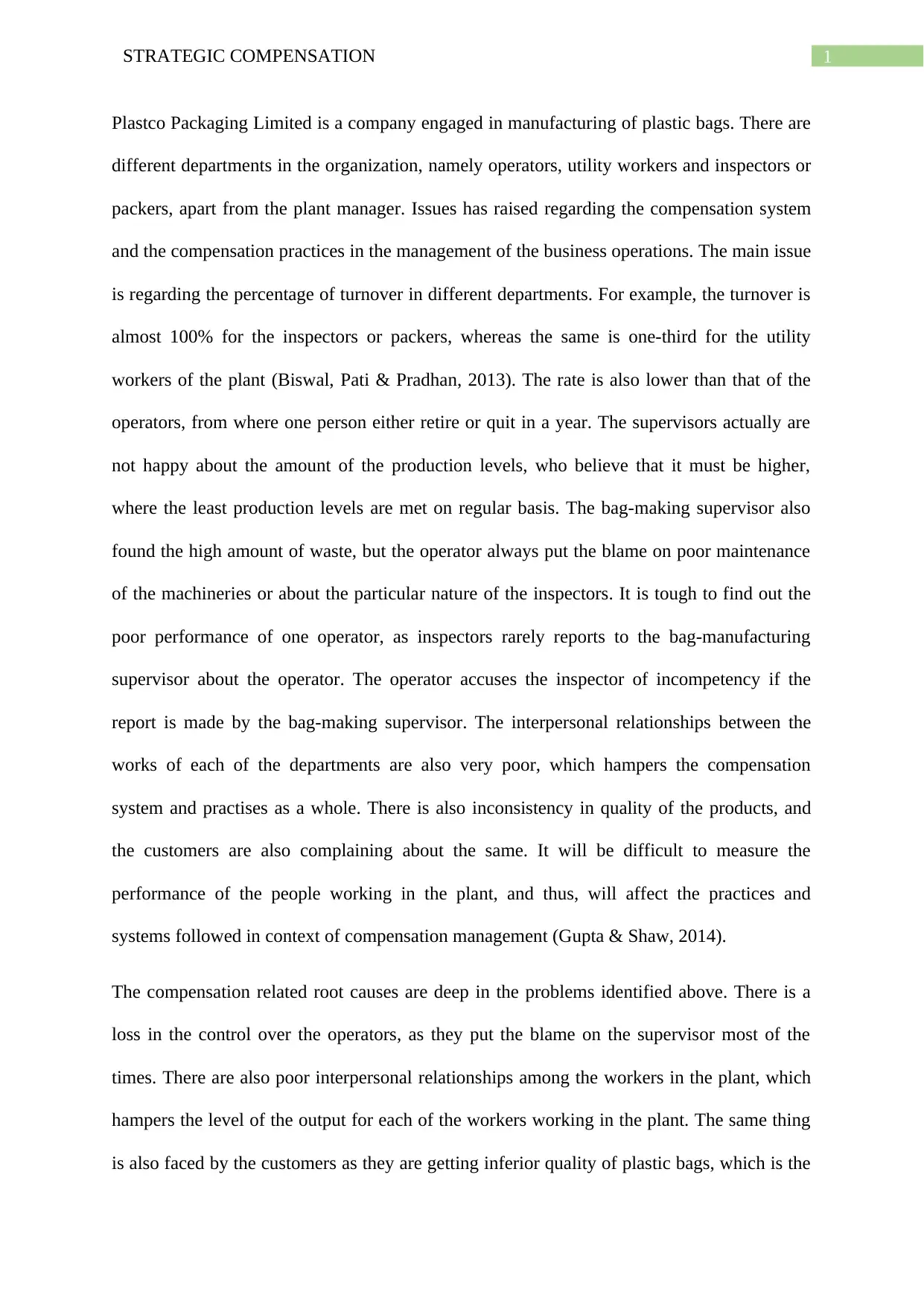
Plastco Packaging Limited is a company engaged in manufacturing of plastic bags. There are
different departments in the organization, namely operators, utility workers and inspectors or
packers, apart from the plant manager. Issues has raised regarding the compensation system
and the compensation practices in the management of the business operations. The main issue
is regarding the percentage of turnover in different departments. For example, the turnover is
almost 100% for the inspectors or packers, whereas the same is one-third for the utility
workers of the plant (Biswal, Pati & Pradhan, 2013). The rate is also lower than that of the
operators, from where one person either retire or quit in a year. The supervisors actually are
not happy about the amount of the production levels, who believe that it must be higher,
where the least production levels are met on regular basis. The bag-making supervisor also
found the high amount of waste, but the operator always put the blame on poor maintenance
of the machineries or about the particular nature of the inspectors. It is tough to find out the
poor performance of one operator, as inspectors rarely reports to the bag-manufacturing
supervisor about the operator. The operator accuses the inspector of incompetency if the
report is made by the bag-making supervisor. The interpersonal relationships between the
works of each of the departments are also very poor, which hampers the compensation
system and practises as a whole. There is also inconsistency in quality of the products, and
the customers are also complaining about the same. It will be difficult to measure the
performance of the people working in the plant, and thus, will affect the practices and
systems followed in context of compensation management (Gupta & Shaw, 2014).
The compensation related root causes are deep in the problems identified above. There is a
loss in the control over the operators, as they put the blame on the supervisor most of the
times. There are also poor interpersonal relationships among the workers in the plant, which
hampers the level of the output for each of the workers working in the plant. The same thing
is also faced by the customers as they are getting inferior quality of plastic bags, which is the
Document Page
2STRATEGIC COMPENSATION
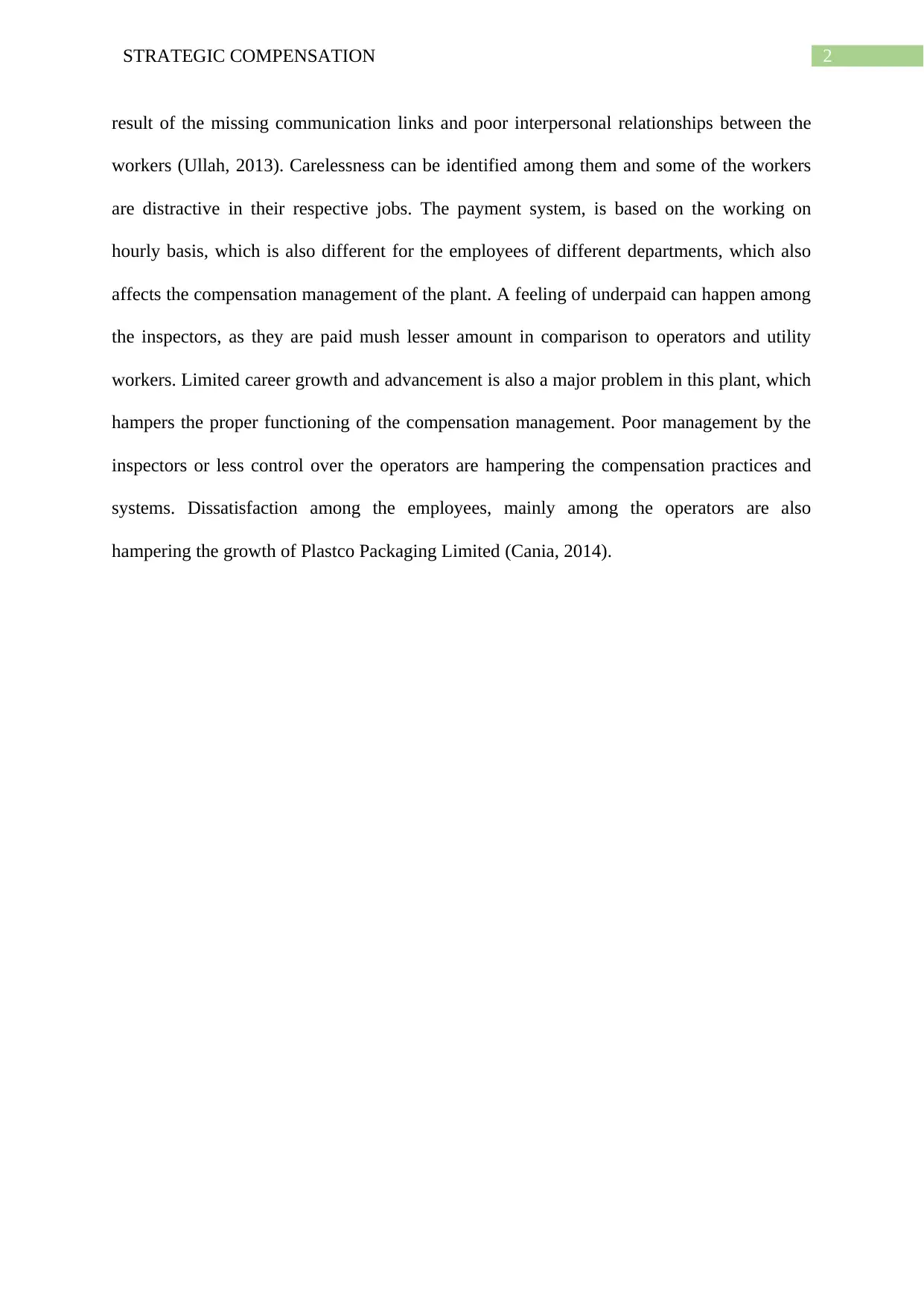
result of the missing communication links and poor interpersonal relationships between the
workers (Ullah, 2013). Carelessness can be identified among them and some of the workers
are distractive in their respective jobs. The payment system, is based on the working on
hourly basis, which is also different for the employees of different departments, which also
affects the compensation management of the plant. A feeling of underpaid can happen among
the inspectors, as they are paid mush lesser amount in comparison to operators and utility
workers. Limited career growth and advancement is also a major problem in this plant, which
hampers the proper functioning of the compensation management. Poor management by the
inspectors or less control over the operators are hampering the compensation practices and
systems. Dissatisfaction among the employees, mainly among the operators are also
hampering the growth of Plastco Packaging Limited (Cania, 2014).
Document Page
3STRATEGIC COMPENSATION
References
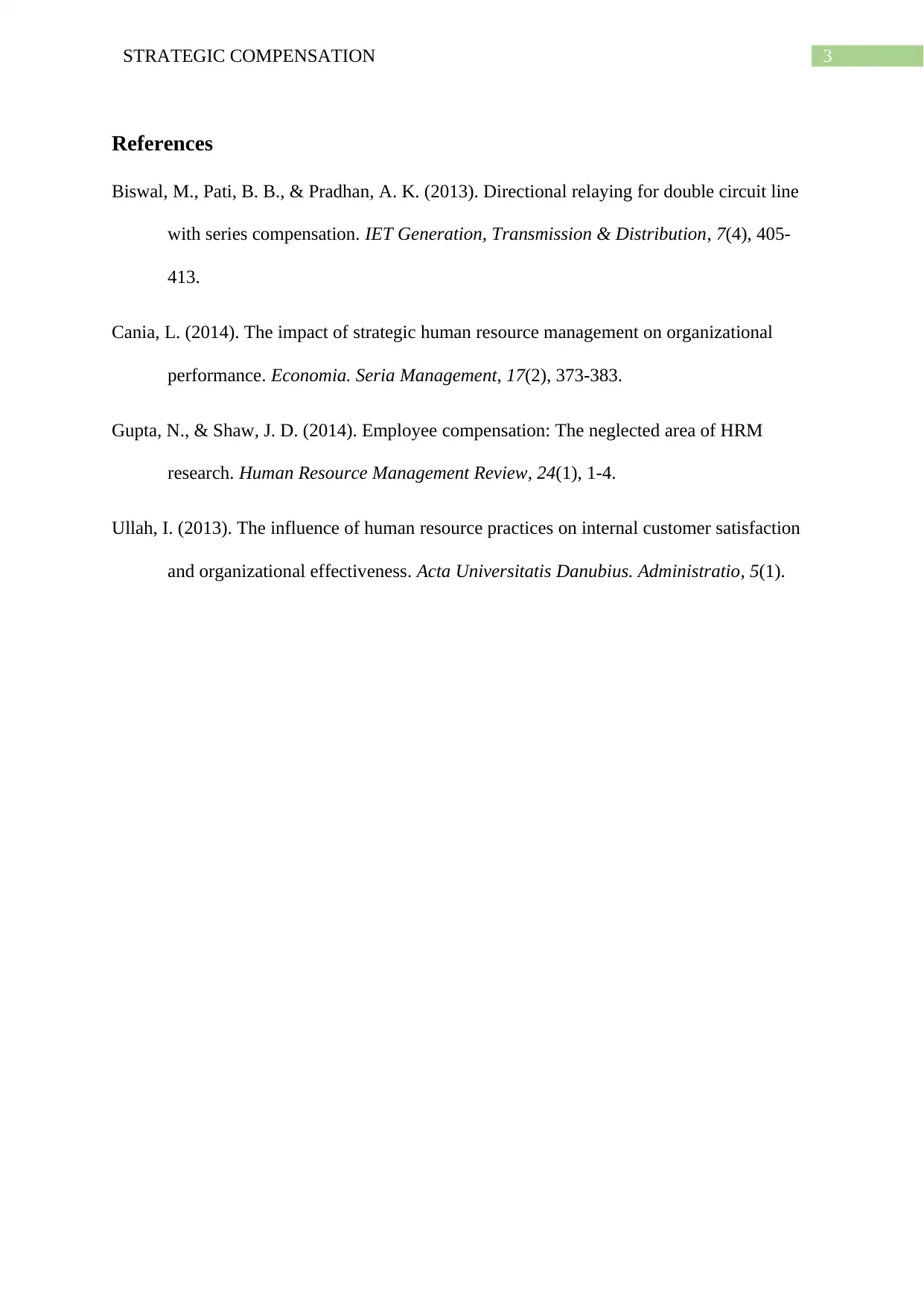
Biswal, M., Pati, B. B., & Pradhan, A. K. (2013). Directional relaying for double circuit line
with series compensation. IET Generation, Transmission & Distribution, 7(4), 405-
413.
Cania, L. (2014). The impact of strategic human resource management on organizational
performance. Economia. Seria Management, 17(2), 373-383.
Gupta, N., & Shaw, J. D. (2014). Employee compensation: The neglected area of HRM
research. Human Resource Management Review, 24(1), 1-4.
Ullah, I. (2013). The influence of human resource practices on internal customer satisfaction
and organizational effectiveness. Acta Universitatis Danubius. Administratio, 5(1).
chevron_up_icon
1 out of 4
circle_padding
hide_on_mobile
zoom_out_icon
[object Object]