Strategic Decision Making in Digital Economy: Report and Analysis
VerifiedAdded on 2021/05/31
|12
|2469
|75
Report
AI Summary
This report delves into the critical aspects of strategic decision-making within the digital economy. It examines the impact of changing customer behavior, the implications of IT infrastructure, and the importance of maximizing consumer influence. The report highlights key issues such as the need for creativity in digital channels and the application of decision-making theories like prospect and satisficing theories. It explores how businesses can adapt to evolving customer expectations and leverage digital technologies to enhance customer engagement and service delivery. The analysis includes real-world examples and case studies to illustrate the challenges and opportunities organizations face in making strategic decisions in the dynamic digital landscape. The report emphasizes the need for businesses to develop effective digital strategies to understand customer needs, incorporate creativity, and ensure robust IT infrastructure to support customer interactions. This report is designed to provide a comprehensive understanding of the strategic decision-making process in the digital economy, providing valuable insights for business professionals and students alike. Visit Desklib for more resources.
Running head: STRATEGIC DECISION MAKING
Strategic Decision Making in Digital Economy
Name of the Student:
Name of the University:
Author’s Note:
Strategic Decision Making in Digital Economy
Name of the Student:
Name of the University:
Author’s Note:

Paraphrase This Document
Need a fresh take? Get an instant paraphrase of this document with our AI Paraphraser
2STRATEGIC DECISION MAKING
Executive Summary
This present report deals with the four major issues of strategic decision-making in the digital
economy. It has been received that changing consumer behavior, It implication and customer
influence are the major issues of strategic decision-making in a digital economy. For an
organization it is important to deliver the customer experience properly through digital channel
otherwise they may face issues in their organization. On the other hand, creativity is crucial in
strategic decision-making in the context of digital economy. By using creative channel an
organization is able to influence their consumers by using various digital devices.
Executive Summary
This present report deals with the four major issues of strategic decision-making in the digital
economy. It has been received that changing consumer behavior, It implication and customer
influence are the major issues of strategic decision-making in a digital economy. For an
organization it is important to deliver the customer experience properly through digital channel
otherwise they may face issues in their organization. On the other hand, creativity is crucial in
strategic decision-making in the context of digital economy. By using creative channel an
organization is able to influence their consumers by using various digital devices.
3STRATEGIC DECISION MAKING
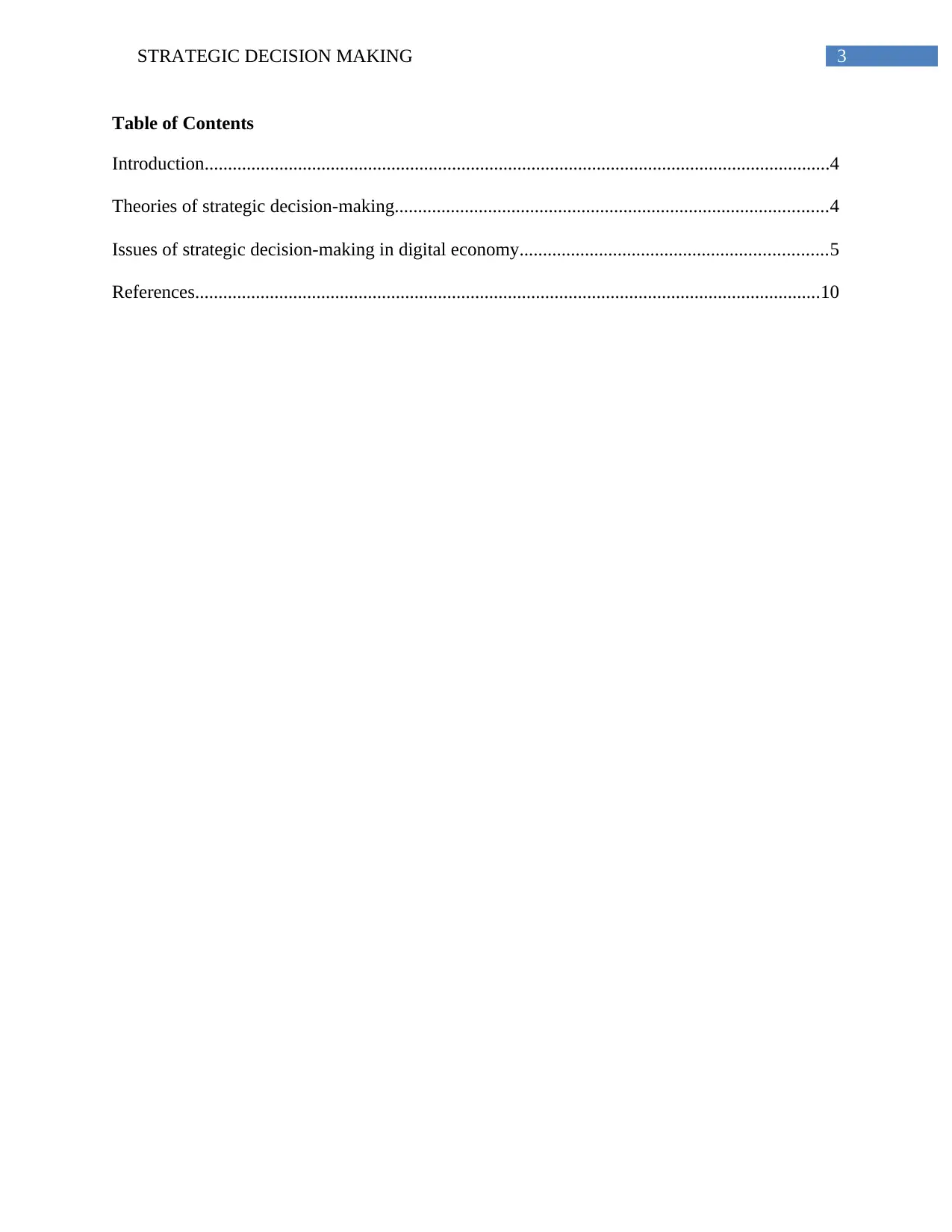
Table of Contents
Introduction......................................................................................................................................4
Theories of strategic decision-making.............................................................................................4
Issues of strategic decision-making in digital economy..................................................................5
References......................................................................................................................................10
Table of Contents
Introduction......................................................................................................................................4
Theories of strategic decision-making.............................................................................................4
Issues of strategic decision-making in digital economy..................................................................5
References......................................................................................................................................10
⊘ This is a preview!⊘
Do you want full access?
Subscribe today to unlock all pages.

Trusted by 1+ million students worldwide
4STRATEGIC DECISION MAKING
Introduction
Modern business is technology oriented and digitalization is a vital part of the business.
Digital is not the part of an economy however, it is an economy. This economy offers limitless
opportunities to the organization to improve their customer satisfaction level (Kane et al., 2015).
No transformation in the business is a big problem to satisfy the customers. However, digital
technologies allow the organization to establish a better engagement with their customers.
Therefore, they can offer superior experience at low cost. However, often strategic decision-
making in digital economy develops various issues, which hamper the effectiveness of digital
economy. This study deals with the strategic decision-making in digital economy.
Theories of strategic decision-making
One of the major theories of decision-making is the prospect theory. This theory
highlights the way through which the people take their decision. According to this theory, people
always take a risk while taking a strategic decision (Vătămănescu, Nistoreanu & Mitan, 2017). It
is important for people to take challenges during their decision-making. However, strategic
decision-making in the digital economy is associated with risk. However, several challenges
occur when an organization is going to take strategic decision-making in digital economy.
Satisficing theory is another vital theory of decision-making. This theory highlights that
the decision-maker has the intellectual ability to take a decision within the limited time and
limited information (Keegan & Rowley, 2017). This theory will be helpful for the decision-
maker while making a strategic decision in digital economy. However, this theory is effective to
enhance the ability of the decision-maker to take right strategic decision during the crisis.
Introduction
Modern business is technology oriented and digitalization is a vital part of the business.
Digital is not the part of an economy however, it is an economy. This economy offers limitless
opportunities to the organization to improve their customer satisfaction level (Kane et al., 2015).
No transformation in the business is a big problem to satisfy the customers. However, digital
technologies allow the organization to establish a better engagement with their customers.
Therefore, they can offer superior experience at low cost. However, often strategic decision-
making in digital economy develops various issues, which hamper the effectiveness of digital
economy. This study deals with the strategic decision-making in digital economy.
Theories of strategic decision-making
One of the major theories of decision-making is the prospect theory. This theory
highlights the way through which the people take their decision. According to this theory, people
always take a risk while taking a strategic decision (Vătămănescu, Nistoreanu & Mitan, 2017). It
is important for people to take challenges during their decision-making. However, strategic
decision-making in the digital economy is associated with risk. However, several challenges
occur when an organization is going to take strategic decision-making in digital economy.
Satisficing theory is another vital theory of decision-making. This theory highlights that
the decision-maker has the intellectual ability to take a decision within the limited time and
limited information (Keegan & Rowley, 2017). This theory will be helpful for the decision-
maker while making a strategic decision in digital economy. However, this theory is effective to
enhance the ability of the decision-maker to take right strategic decision during the crisis.
Paraphrase This Document
Need a fresh take? Get an instant paraphrase of this document with our AI Paraphraser

5STRATEGIC DECISION MAKING
6STRATEGIC DECISION MAKING
Issues of strategic decision-making in digital economy
In order to increase the delivery of the customer service, many business organizations
have been using digital channels to enhance the customer experience in their organization
(Nudurupati, Tebboune & Hardman, 2016). On the other hand, digital channel helps the
organization to enhance their customer engagement. By creating a mobile app is a vital decision-
making process to boost the customer engagement. However, it is important for the business
organization to take proper strategy to improve their customer engagement. However, various
issues occur that affect the strategic decision-making in a digital economy. The issues are as
follow:
To understand the customer changing behavior
The behavior of the customer is changing rapidly. In the recent years, individuals try to
interact with an organization by using different types of devices. Various communication
channels are used by the organization to interact with the customers. Digitalization enables the
organization to allow the customers to interact with the organization at different times in a day.
On the other hand, the customer has the expectation that the organization should deliver a high
level of consistent and cross-channel service (Vătămănescu, Nistoreanu & Mitan, 2017).
However, the customers show a positive response to the creativity in the digital economy.
Consumer prefers creative engagement. Customers often share their experiences through using
social networking sites and they recommend the brand, which delivers excellent service.
Maximum organizations use digital technology to reduce the interaction cost. As a result,
there is lack of creativity, which hampers the strategic decision-making in digital economy
(Letaifa, 2015). Often the organization focuses on the use of digital channel to encourage the
Issues of strategic decision-making in digital economy
In order to increase the delivery of the customer service, many business organizations
have been using digital channels to enhance the customer experience in their organization
(Nudurupati, Tebboune & Hardman, 2016). On the other hand, digital channel helps the
organization to enhance their customer engagement. By creating a mobile app is a vital decision-
making process to boost the customer engagement. However, it is important for the business
organization to take proper strategy to improve their customer engagement. However, various
issues occur that affect the strategic decision-making in a digital economy. The issues are as
follow:
To understand the customer changing behavior
The behavior of the customer is changing rapidly. In the recent years, individuals try to
interact with an organization by using different types of devices. Various communication
channels are used by the organization to interact with the customers. Digitalization enables the
organization to allow the customers to interact with the organization at different times in a day.
On the other hand, the customer has the expectation that the organization should deliver a high
level of consistent and cross-channel service (Vătămănescu, Nistoreanu & Mitan, 2017).
However, the customers show a positive response to the creativity in the digital economy.
Consumer prefers creative engagement. Customers often share their experiences through using
social networking sites and they recommend the brand, which delivers excellent service.
Maximum organizations use digital technology to reduce the interaction cost. As a result,
there is lack of creativity, which hampers the strategic decision-making in digital economy
(Letaifa, 2015). Often the organization focuses on the use of digital channel to encourage the
⊘ This is a preview!⊘
Do you want full access?
Subscribe today to unlock all pages.
Trusted by 1+ million students worldwide
7STRATEGIC DECISION MAKING
customers. This decision-making is not effective. However, the organization needs to develop
some effective digital strategy, which will allow the organization to deliver excellent customer
service through using multiple channels. Business organization uses the various app to
communicate with their customers (Kenney & Zysman, 2015). Therefore, a large number of
customers communicate at different time through different devices with an organization. Hence,
by using simple digital channel it is difficult for the organization to understand the changing
behavior of the customers. However, modern customers prefer more creativity in digital channel
as well as in mobile app. This hampers the strategic decision-making in digital economy in an
organization. By using the simple digital channel an organization is not able to identify the
changing demand of the customers.
More creativity is the major demand of the modern customers, which affect the decision-
making process in digital economy (Ostrom et al., 2015). Hence, by incorporating the creativity
into the digital channel an organization is able to understand the changing behavior of the
customers.Application of prospect theory will be helpful for an organization to take the strategic
decision properly while using digital channel to enhance the customer relationship. This theory
will enable the decision-maker to take risk while making any decision. Hence, by following this
concept the decision-makers are able to take challenges in order to make creative channels to
improve the customer experience.
As for example, in Woolworths the changing behavior of the consumer has affected the
strategic decision-making as modern consumers are more heath conscious and want healthy
products from the retailers. In order to deal with this issue Woolworths has used creative strategy
in digital channel to understand the changing behavior of the consumers. Woolworths has used
customers. This decision-making is not effective. However, the organization needs to develop
some effective digital strategy, which will allow the organization to deliver excellent customer
service through using multiple channels. Business organization uses the various app to
communicate with their customers (Kenney & Zysman, 2015). Therefore, a large number of
customers communicate at different time through different devices with an organization. Hence,
by using simple digital channel it is difficult for the organization to understand the changing
behavior of the customers. However, modern customers prefer more creativity in digital channel
as well as in mobile app. This hampers the strategic decision-making in digital economy in an
organization. By using the simple digital channel an organization is not able to identify the
changing demand of the customers.
More creativity is the major demand of the modern customers, which affect the decision-
making process in digital economy (Ostrom et al., 2015). Hence, by incorporating the creativity
into the digital channel an organization is able to understand the changing behavior of the
customers.Application of prospect theory will be helpful for an organization to take the strategic
decision properly while using digital channel to enhance the customer relationship. This theory
will enable the decision-maker to take risk while making any decision. Hence, by following this
concept the decision-makers are able to take challenges in order to make creative channels to
improve the customer experience.
As for example, in Woolworths the changing behavior of the consumer has affected the
strategic decision-making as modern consumers are more heath conscious and want healthy
products from the retailers. In order to deal with this issue Woolworths has used creative strategy
in digital channel to understand the changing behavior of the consumers. Woolworths has used
Paraphrase This Document
Need a fresh take? Get an instant paraphrase of this document with our AI Paraphraser
8STRATEGIC DECISION MAKING
unique data asset to deal with the consumer changing behavior as these data assets are not
present in other consumers (Cmo.com.au, 2018).
Implication of IT
Information technology is the main element of digital economy. However, IT provides an
opportunity to the customers to interact with the organization through the changing way. In order
to get success in a new era, every business requires a proper IT structure. Poor infrastructure of
the IT leaves an effect on the decision-making process in digital economy (Kagermann, 2015).
Rigid IT structure of an organization allows the organization to respond to the evolving behavior
of the customers. If an organization has no proper IT infrastructure then it will create challenges
for the organization to react to changing the customer experience. Hence, it has been found that
IT has a great implication on strategic decision-making of an organization. If the organization
does not incorporate the digital media into their core business then it will be difficult for them to
utilize the significant impact of IT. Many organizations focus on the establishment of the user
interaction via digital media or mobile apps. This is not enough for the business as they need to
include it in their core business.
Customer wants 24*7 hour interaction with the organization. For the organization, it is
important to ensure the 24*7 infrastructure to communicate with the customers at any time via
any device. If it is not possible then the strategic decision-making will be affected. Establishment
of 24*7 hour service creates issue reading the delivery of the business and managing the
customer devices fragmentation (Ng, 2014). A fundamental requirement highlights the strategy
that should the business organization take to deliver the proofed application among the
customers. Application of satisficing theory will be beneficial for the decision-maker to increase
unique data asset to deal with the consumer changing behavior as these data assets are not
present in other consumers (Cmo.com.au, 2018).
Implication of IT
Information technology is the main element of digital economy. However, IT provides an
opportunity to the customers to interact with the organization through the changing way. In order
to get success in a new era, every business requires a proper IT structure. Poor infrastructure of
the IT leaves an effect on the decision-making process in digital economy (Kagermann, 2015).
Rigid IT structure of an organization allows the organization to respond to the evolving behavior
of the customers. If an organization has no proper IT infrastructure then it will create challenges
for the organization to react to changing the customer experience. Hence, it has been found that
IT has a great implication on strategic decision-making of an organization. If the organization
does not incorporate the digital media into their core business then it will be difficult for them to
utilize the significant impact of IT. Many organizations focus on the establishment of the user
interaction via digital media or mobile apps. This is not enough for the business as they need to
include it in their core business.
Customer wants 24*7 hour interaction with the organization. For the organization, it is
important to ensure the 24*7 infrastructure to communicate with the customers at any time via
any device. If it is not possible then the strategic decision-making will be affected. Establishment
of 24*7 hour service creates issue reading the delivery of the business and managing the
customer devices fragmentation (Ng, 2014). A fundamental requirement highlights the strategy
that should the business organization take to deliver the proofed application among the
customers. Application of satisficing theory will be beneficial for the decision-maker to increase
9STRATEGIC DECISION MAKING
their decision-making capacity by using their intellectual ability. In order to manage the IT
devices, the decision-maker can use this theory to deliver the service properly.
As for example Newland has faced challenges due to the poor infrastructure of their IT
while communicating with the consumers via digital channel. Due to poor infrastructure they
have faced issues in accessing the social media while communicating with the customers
(Ntegrity.com.au, 2018).On the other hand, the digital maturity of this organization is not
adequate to support the customers. Lack of adequate IT experience leads the organization to face
challenges in maximizing the customer experience through digitalization. Hence, it can be said
that such organization faced challenges due to the poor infrastructure of the IT, which also
hampers their decision-making process in digital economy. However, to utilize the IT properly it
is crucial for this organization to improve the infrastructure level of the IT. This will improve the
customer experience as well as the strategic decision-making.
Maximize the consumer influence
To maximize the customer influence is a big issue that affects the strategic decision-
making in an organization. However, for the organization customer engagement is crucial to
enhance the revenue generation in an organization. Hence, if the customers are not engaged
properly with the organization then it hampers the effectiveness of the strategic decision in an
organization. For every business organization, it is important to engage the customers through
social sharing. This sharing needs to be done through proper way as it will leave a significant
effect on the organization (Ostrom et al., 2015). However, often the organizations rely on the
focus group or the marketing group to maximize the consumer influence. This hampers the
strategic decision-making in an organization. Hence, to influence the customers in the digital
economy is a big challenge for the organization, which can affect their decision-making process.
their decision-making capacity by using their intellectual ability. In order to manage the IT
devices, the decision-maker can use this theory to deliver the service properly.
As for example Newland has faced challenges due to the poor infrastructure of their IT
while communicating with the consumers via digital channel. Due to poor infrastructure they
have faced issues in accessing the social media while communicating with the customers
(Ntegrity.com.au, 2018).On the other hand, the digital maturity of this organization is not
adequate to support the customers. Lack of adequate IT experience leads the organization to face
challenges in maximizing the customer experience through digitalization. Hence, it can be said
that such organization faced challenges due to the poor infrastructure of the IT, which also
hampers their decision-making process in digital economy. However, to utilize the IT properly it
is crucial for this organization to improve the infrastructure level of the IT. This will improve the
customer experience as well as the strategic decision-making.
Maximize the consumer influence
To maximize the customer influence is a big issue that affects the strategic decision-
making in an organization. However, for the organization customer engagement is crucial to
enhance the revenue generation in an organization. Hence, if the customers are not engaged
properly with the organization then it hampers the effectiveness of the strategic decision in an
organization. For every business organization, it is important to engage the customers through
social sharing. This sharing needs to be done through proper way as it will leave a significant
effect on the organization (Ostrom et al., 2015). However, often the organizations rely on the
focus group or the marketing group to maximize the consumer influence. This hampers the
strategic decision-making in an organization. Hence, to influence the customers in the digital
economy is a big challenge for the organization, which can affect their decision-making process.
⊘ This is a preview!⊘
Do you want full access?
Subscribe today to unlock all pages.
Trusted by 1+ million students worldwide
10STRATEGIC DECISION MAKING
In order to deal with the challenge, an organization can introduce their product through social
media as it will help the organization to gain feedbacks regarding their new service or product.
This will influence the customers towards the decision of an organization.
As for example, in Wesfarmers, the employees try to engage their customers properly in
the digital economy. However, in this organization the digital disconnect in customer
engagement hampers the decision-making process of this organization (wesfarmers.com, 2018).
It has been received that if the customer are not fully engaged in an organization then it is
difficult to gain success in digital economy through strategic decision-making. Digital disconnect
affects the decision-making process of Wesfarmers as the communication with the consumers is
hampered through digital disconnect. As a result, their strategic decision-making regarding the
use of digital channel is interrupted.
Conclusion
The entire piece of work highlights the issues related to strategic decision-making in
digital economy. However, it has been found that the organization needs to focus where the
technical expertise is able to manage the enterprise successfully through digitalization.
Therefore, the changing behavior of the customers shows that the desktop is declining and the
use of mobile devices is increasing rapidly. Hence, the organization needs to include creative
feature in their digitalization to influence the customers. To improve the IT use the organization
needs to new the new IT infrastructure to make an innovative customer engagement in their
business. Therefore, this will enable the organization to cope with the evolving customer in the
global market.
In order to deal with the challenge, an organization can introduce their product through social
media as it will help the organization to gain feedbacks regarding their new service or product.
This will influence the customers towards the decision of an organization.
As for example, in Wesfarmers, the employees try to engage their customers properly in
the digital economy. However, in this organization the digital disconnect in customer
engagement hampers the decision-making process of this organization (wesfarmers.com, 2018).
It has been received that if the customer are not fully engaged in an organization then it is
difficult to gain success in digital economy through strategic decision-making. Digital disconnect
affects the decision-making process of Wesfarmers as the communication with the consumers is
hampered through digital disconnect. As a result, their strategic decision-making regarding the
use of digital channel is interrupted.
Conclusion
The entire piece of work highlights the issues related to strategic decision-making in
digital economy. However, it has been found that the organization needs to focus where the
technical expertise is able to manage the enterprise successfully through digitalization.
Therefore, the changing behavior of the customers shows that the desktop is declining and the
use of mobile devices is increasing rapidly. Hence, the organization needs to include creative
feature in their digitalization to influence the customers. To improve the IT use the organization
needs to new the new IT infrastructure to make an innovative customer engagement in their
business. Therefore, this will enable the organization to cope with the evolving customer in the
global market.
Paraphrase This Document
Need a fresh take? Get an instant paraphrase of this document with our AI Paraphraser
11STRATEGIC DECISION MAKING
References
Cmo.com.au. (2018). Woolworths details 3-year strategy to become customer centric. Retrieved
29 April 2018, from https://www.cmo.com.au/article/574302/woolworths-details-3-year-
strategy-become-customer-centric/
Kagermann, H. (2015). Change through digitization—Value creation in the age of Industry 4.0.
In Management of permanent change (pp. 23-45). Springer Gabler, Wiesbaden.
Kane, G. C., Palmer, D., Phillips, A. N., Kiron, D., & Buckley, N. (2015). Strategy, not
technology, drives digital transformation. MIT Sloan Management Review and Deloitte
University Press, 14.
Keegan, B. J., & Rowley, J. (2017). Evaluation and decision making in social media
marketing. Management Decision, 55(1), 15-31.
Kenney, M., & Zysman, J. (2015, June). Choosing a future in the platform economy: the
implications and consequences of digital platforms. In Kauffman Foundation New
Entrepreneurial Growth Conference (Vol. 156160).
Letaifa, S. B. (2015). How to strategize smart cities: Revealing the SMART model. Journal of
Business Research, 68(7), 1414-1419.
Ng, I. C. (2014). Creating new markets in the digital economy. Cambridge University Press.
Ntegrity.com.au. (2018). Starting right: Assessing Newland’s digital confidence . Retrieved 29
April 2018, from https://ntegrity.com.au/case-studies/newland/
References
Cmo.com.au. (2018). Woolworths details 3-year strategy to become customer centric. Retrieved
29 April 2018, from https://www.cmo.com.au/article/574302/woolworths-details-3-year-
strategy-become-customer-centric/
Kagermann, H. (2015). Change through digitization—Value creation in the age of Industry 4.0.
In Management of permanent change (pp. 23-45). Springer Gabler, Wiesbaden.
Kane, G. C., Palmer, D., Phillips, A. N., Kiron, D., & Buckley, N. (2015). Strategy, not
technology, drives digital transformation. MIT Sloan Management Review and Deloitte
University Press, 14.
Keegan, B. J., & Rowley, J. (2017). Evaluation and decision making in social media
marketing. Management Decision, 55(1), 15-31.
Kenney, M., & Zysman, J. (2015, June). Choosing a future in the platform economy: the
implications and consequences of digital platforms. In Kauffman Foundation New
Entrepreneurial Growth Conference (Vol. 156160).
Letaifa, S. B. (2015). How to strategize smart cities: Revealing the SMART model. Journal of
Business Research, 68(7), 1414-1419.
Ng, I. C. (2014). Creating new markets in the digital economy. Cambridge University Press.
Ntegrity.com.au. (2018). Starting right: Assessing Newland’s digital confidence . Retrieved 29
April 2018, from https://ntegrity.com.au/case-studies/newland/
12STRATEGIC DECISION MAKING
Nudurupati, S. S., Tebboune, S., & Hardman, J. (2016). Contemporary performance
measurement and management (PMM) in digital economies. Production Planning &
Control, 27(3), 226-235.
Ostrom, A. L., Parasuraman, A., Bowen, D. E., Patricio, L., & Voss, C. A. (2015). Service
research priorities in a rapidly changing context. Journal of Service Research, 18(2), 127-
159.
Roberts, E., & Townsend, L. (2016). The contribution of the creative economy to the resilience
of rural communities: exploring cultural and digital capital. Sociologia Ruralis, 56(2),
197-219.
Vătămănescu, E. M., Nistoreanu, B. G., & Mitan, A. (2017). Competition and consumer
behavior in the context of the digital economy. Amfiteatru Econ, 19, 354-366.
wesfarmers.com. (2018). Wesfarmers. Retrieved 29 April 2018, from http://wesfarmers.com/
Nudurupati, S. S., Tebboune, S., & Hardman, J. (2016). Contemporary performance
measurement and management (PMM) in digital economies. Production Planning &
Control, 27(3), 226-235.
Ostrom, A. L., Parasuraman, A., Bowen, D. E., Patricio, L., & Voss, C. A. (2015). Service
research priorities in a rapidly changing context. Journal of Service Research, 18(2), 127-
159.
Roberts, E., & Townsend, L. (2016). The contribution of the creative economy to the resilience
of rural communities: exploring cultural and digital capital. Sociologia Ruralis, 56(2),
197-219.
Vătămănescu, E. M., Nistoreanu, B. G., & Mitan, A. (2017). Competition and consumer
behavior in the context of the digital economy. Amfiteatru Econ, 19, 354-366.
wesfarmers.com. (2018). Wesfarmers. Retrieved 29 April 2018, from http://wesfarmers.com/
⊘ This is a preview!⊘
Do you want full access?
Subscribe today to unlock all pages.
Trusted by 1+ million students worldwide

1 out of 12


Related Documents


Your All-in-One AI-Powered Toolkit for Academic Success.
+13062052269
info@desklib.com
Available 24*7 on WhatsApp / Email
![[object Object]](/_next/static/media/star-bottom.7253800d.svg)
Unlock your academic potential
Copyright © 2020–2026 A2Z Services. All Rights Reserved. Developed and managed by ZUCOL.