Strategic Development Report: Roadside Petroleum, Oil and Gas Industry
VerifiedAdded on 2023/01/23
|20
|4294
|41
Report
AI Summary
This report presents a strategic development plan for Roadside Petroleum Limited, a new venture in Australia's oil and gas industry. The report begins with an introduction outlining the business's focus on LNG assets and its strategic management process. It defines the company's mission to become a global leader by maximizing shareholder returns and leveraging its resources. A SWOT analysis identifies internal strengths, such as high-quality assets and technological capabilities, and weaknesses, including legal issues and market saturation. Opportunities include technological advancements and increasing energy demand, while threats encompass competition, natural disasters, and operational risks. A PESTLE analysis examines political, economic, social, technological, legal, and environmental factors influencing the business. The report then outlines long-term objectives, including return on investment, new revenue streams, and acquisitions. Finally, it proposes generic strategies, functional tactics, and policies to achieve these objectives. Appendices include a budget, breakeven point analysis, and sales forecasts, providing a comprehensive overview of the company's strategic direction.
Running Head: STRATEGIC DEVELOPMENT 0
STRATEGIC DEVELOPMENT
student name
4/27/2019
STRATEGIC DEVELOPMENT
student name
4/27/2019

Paraphrase This Document
Need a fresh take? Get an instant paraphrase of this document with our AI Paraphraser
STRATEGIC DEVELOPMENT 1
Contents
Introduction......................................................................................................................................2
Company mission............................................................................................................................3
Swot analysis...................................................................................................................................3
Strengths......................................................................................................................................4
Weakness.....................................................................................................................................4
Opportunities...............................................................................................................................5
Threats.........................................................................................................................................5
PESTLE analysis.............................................................................................................................6
Political........................................................................................................................................6
Economical..................................................................................................................................6
Social...........................................................................................................................................8
Technological..............................................................................................................................8
Legal............................................................................................................................................8
Environmental..............................................................................................................................9
Long term objectives.......................................................................................................................9
Generic strategies...........................................................................................................................10
Short term objectives.....................................................................................................................12
Functional tactics...........................................................................................................................12
Policies that empower action.........................................................................................................13
Strategic Control and Continuous Improvement...........................................................................13
Conclusion.....................................................................................................................................15
References......................................................................................................................................16
Appendix 1 Budget........................................................................................................................18
Breakeven point.........................................................................................................................18
Sales forecast for next two years...................................................................................................18
Contents
Introduction......................................................................................................................................2
Company mission............................................................................................................................3
Swot analysis...................................................................................................................................3
Strengths......................................................................................................................................4
Weakness.....................................................................................................................................4
Opportunities...............................................................................................................................5
Threats.........................................................................................................................................5
PESTLE analysis.............................................................................................................................6
Political........................................................................................................................................6
Economical..................................................................................................................................6
Social...........................................................................................................................................8
Technological..............................................................................................................................8
Legal............................................................................................................................................8
Environmental..............................................................................................................................9
Long term objectives.......................................................................................................................9
Generic strategies...........................................................................................................................10
Short term objectives.....................................................................................................................12
Functional tactics...........................................................................................................................12
Policies that empower action.........................................................................................................13
Strategic Control and Continuous Improvement...........................................................................13
Conclusion.....................................................................................................................................15
References......................................................................................................................................16
Appendix 1 Budget........................................................................................................................18
Breakeven point.........................................................................................................................18
Sales forecast for next two years...................................................................................................18
STRATEGIC DEVELOPMENT 2
Introduction
Start up business requires major strategic planning as it is a crucial decision to be made.
This would include analysing the external and internal environment of the company to create a
strategy for the company. In the report, a business plan will be developed for a new venture
name “Roadside Petroleum limited” based in Australia. The company is part of the Oil and Gas
Industry, for which the report will discuss the strategy that the company will adopt, considering
the initial budget for the company to be $150,000. Roadside petroleum will be an explorer,
producer, developer, and supplier of various energies. The company will be producing LNG
assets and focus on three major aspects cash generation, creating value, and repetitive success
(Feng & Chari, 2018).
The strategic management process includes defining the strategy of an organization and a
process through which management would decide on a set of strategies for the company to
enable it to achieve better results and performance. The report will discuss the strategic
management process for roadside petroleum, after conducting internal and external analysis
using tools like SWOT and PESTLE analysis respectively. Moreover, the mission and objectives
of the company would also be considered for deciding the set of strategies for the company
(Hunt & Bicen, 2017).
Introduction
Start up business requires major strategic planning as it is a crucial decision to be made.
This would include analysing the external and internal environment of the company to create a
strategy for the company. In the report, a business plan will be developed for a new venture
name “Roadside Petroleum limited” based in Australia. The company is part of the Oil and Gas
Industry, for which the report will discuss the strategy that the company will adopt, considering
the initial budget for the company to be $150,000. Roadside petroleum will be an explorer,
producer, developer, and supplier of various energies. The company will be producing LNG
assets and focus on three major aspects cash generation, creating value, and repetitive success
(Feng & Chari, 2018).
The strategic management process includes defining the strategy of an organization and a
process through which management would decide on a set of strategies for the company to
enable it to achieve better results and performance. The report will discuss the strategic
management process for roadside petroleum, after conducting internal and external analysis
using tools like SWOT and PESTLE analysis respectively. Moreover, the mission and objectives
of the company would also be considered for deciding the set of strategies for the company
(Hunt & Bicen, 2017).
⊘ This is a preview!⊘
Do you want full access?
Subscribe today to unlock all pages.

Trusted by 1+ million students worldwide
STRATEGIC DEVELOPMENT 3
Company mission
The company’s mission is to deliver extraordinary returns to the shareholders and making
Roadside petroleum as global leaders in the oil and gas industry. The company would position
with distinctive capabilities and reliable asset base, and stronger relations in the industry. The
company would optimally use finances, people, and resources to gain opportunities around the
globe. Another purpose of the company would include:
High quality of resource base
Capabilities to be aligned to the opportunities
Increase in demand for LNG from various markets
Increase in shareholders fund by optimally investing in business
Higher margin producer and lowering the cost
Flexible marketing solution (Schlegelmilch B. , 2016).
Therefore, it can be said that the company would prefer to enhance the shareholder fund in
the near future. For this, the company would consider various actions to be taken. The company
would be initiated in Australia and the company would be expanding business in various
horizons to become a global leader (Oral, 2014).
SWOT analysis
Internal analysis can be done by analysing the strengths and weakness of the company in
order to gain opportunities and mitigate threats for the company. The SWOT analysis for
roadside petroleum include
Company mission
The company’s mission is to deliver extraordinary returns to the shareholders and making
Roadside petroleum as global leaders in the oil and gas industry. The company would position
with distinctive capabilities and reliable asset base, and stronger relations in the industry. The
company would optimally use finances, people, and resources to gain opportunities around the
globe. Another purpose of the company would include:
High quality of resource base
Capabilities to be aligned to the opportunities
Increase in demand for LNG from various markets
Increase in shareholders fund by optimally investing in business
Higher margin producer and lowering the cost
Flexible marketing solution (Schlegelmilch B. , 2016).
Therefore, it can be said that the company would prefer to enhance the shareholder fund in
the near future. For this, the company would consider various actions to be taken. The company
would be initiated in Australia and the company would be expanding business in various
horizons to become a global leader (Oral, 2014).
SWOT analysis
Internal analysis can be done by analysing the strengths and weakness of the company in
order to gain opportunities and mitigate threats for the company. The SWOT analysis for
roadside petroleum include
Paraphrase This Document
Need a fresh take? Get an instant paraphrase of this document with our AI Paraphraser
STRATEGIC DEVELOPMENT 4
Strengths
Increase in the requirement for energy – With the increase in the use of vehicles and other
sources for use of energy has been increasing, which is one of the strengths for the
company.
High quality assets of oil and gas – The assets used by the company are of higher quality
that makes the production better to keep the cost lower for the production (Boone, 2016).
Technology and innovation capability of the company – The capability of the company
when it comes to innovation in product development and processing using technology is
high.
Active exploration – The exploration of the company is good which reflect that the
sources for oil would be identified at a greater pace. For instance with pipe lay barges and
subsea construction vessels would add the production reliability and competitive
advantage.
Risk management framework – The risk involved in the oils and gas industry is very
high, for which the company would be creating a risk management framework that will
act as strength for roadside petroleum. The framework will be aligned with ISO31000
that is the risk management international standard. This would cover the operational risk,
cyber security risk, exploration risk, loss of containment risk, commercial transaction
risk, regulatory and government risk, market risk, and hydrocarbons commercialization
risk.
Weakness
The threat of legal issues – The legal rule and regulations seems to be strict when it
comes to energy production and the problem occurs considering a land acquisition, for
Strengths
Increase in the requirement for energy – With the increase in the use of vehicles and other
sources for use of energy has been increasing, which is one of the strengths for the
company.
High quality assets of oil and gas – The assets used by the company are of higher quality
that makes the production better to keep the cost lower for the production (Boone, 2016).
Technology and innovation capability of the company – The capability of the company
when it comes to innovation in product development and processing using technology is
high.
Active exploration – The exploration of the company is good which reflect that the
sources for oil would be identified at a greater pace. For instance with pipe lay barges and
subsea construction vessels would add the production reliability and competitive
advantage.
Risk management framework – The risk involved in the oils and gas industry is very
high, for which the company would be creating a risk management framework that will
act as strength for roadside petroleum. The framework will be aligned with ISO31000
that is the risk management international standard. This would cover the operational risk,
cyber security risk, exploration risk, loss of containment risk, commercial transaction
risk, regulatory and government risk, market risk, and hydrocarbons commercialization
risk.
Weakness
The threat of legal issues – The legal rule and regulations seems to be strict when it
comes to energy production and the problem occurs considering a land acquisition, for
STRATEGIC DEVELOPMENT 5
natural gas processing browsing that could also affect negatively on roadside financial
performance.
Non-diversified business – The business is limited to the energy production and supply
and there would not be any diversification for the business, which could make the profits
or revenue of the firm to be stagnant
Saturated market – The Australian market is concentrated, which means that the chances
for growth reduce when it comes to the oil and gas industry in Australia (Bruns, 2013).
Opportunities
Technological up gradation – The company can gain opportunity while investing more on
the latest technology that is changing technology with environment and availability so
that the company can enhance the production while keeping the cost low as possible to
increase the profits for the company.
Increase in demand – The Company could increase the sale of its product with an
increase in demand for energy. This can be done if the use of energy in various industries,
the use of logistics and transportation is increased in Australia.
Expansion in LNG capabilities – The Company can increase the LNG capability of the
company in the near future to enhance the company’s revenue from the market
(Chatzoglou & Chatzoudes, 2018).
Threats
Competition – There are some competitors for Roadside petroleum like Exxon Mobile
Australia Pvt Ltd that is one of the largest companies in oil and Gas Company in
Australia. In addition, ROC oil and co. ltd would be major competitors.
natural gas processing browsing that could also affect negatively on roadside financial
performance.
Non-diversified business – The business is limited to the energy production and supply
and there would not be any diversification for the business, which could make the profits
or revenue of the firm to be stagnant
Saturated market – The Australian market is concentrated, which means that the chances
for growth reduce when it comes to the oil and gas industry in Australia (Bruns, 2013).
Opportunities
Technological up gradation – The company can gain opportunity while investing more on
the latest technology that is changing technology with environment and availability so
that the company can enhance the production while keeping the cost low as possible to
increase the profits for the company.
Increase in demand – The Company could increase the sale of its product with an
increase in demand for energy. This can be done if the use of energy in various industries,
the use of logistics and transportation is increased in Australia.
Expansion in LNG capabilities – The Company can increase the LNG capability of the
company in the near future to enhance the company’s revenue from the market
(Chatzoglou & Chatzoudes, 2018).
Threats
Competition – There are some competitors for Roadside petroleum like Exxon Mobile
Australia Pvt Ltd that is one of the largest companies in oil and Gas Company in
Australia. In addition, ROC oil and co. ltd would be major competitors.
⊘ This is a preview!⊘
Do you want full access?
Subscribe today to unlock all pages.
Trusted by 1+ million students worldwide
STRATEGIC DEVELOPMENT 6
The threat of natural disasters – the threat of natural disaster is high in this industry in
Australia. For instance, Australia usually has floods, earthquakes, cyclones, bushfires,
severe storms, and landslides.
High operating risk – The operating risk like production activities and exploration
activities could include high risk, which could be threat for the company as the risk
associated are uncertain (Bull & Sitas, 2016).
PESTLE analysis
Political
The political factors of the nation will affect the business. In case the nation is politically
stable, the business conduct would be less prone to threats. One of the major factors that will be
responsible to influence the business of roadside petroleum would be the tax rate of the nation,
which will affect the profit margin for the company. For example, the corporate tax in Australia
is thirty percent since 2006, which means that the tax rate is constant. This indicated that the
company can strategies the business, as per this rate and since there are no major fluctuations, the
chances change in strategy due to tax rate would not affect much (theglobaleconomy,
Australia/corporate_tax_rate, 2019). However, the political stability of the company is not very
high that means the political system of the nation is not stable and can affect the business in the
nation, which make this factor as high threat to Roadside petroleum (Findlay & Garnaut, 2017).
Economical
The economic factors would influence the consumption level of people of a nation, which
will also influence the demand for oil and gas in the nation. This will be reflected through the
The threat of natural disasters – the threat of natural disaster is high in this industry in
Australia. For instance, Australia usually has floods, earthquakes, cyclones, bushfires,
severe storms, and landslides.
High operating risk – The operating risk like production activities and exploration
activities could include high risk, which could be threat for the company as the risk
associated are uncertain (Bull & Sitas, 2016).
PESTLE analysis
Political
The political factors of the nation will affect the business. In case the nation is politically
stable, the business conduct would be less prone to threats. One of the major factors that will be
responsible to influence the business of roadside petroleum would be the tax rate of the nation,
which will affect the profit margin for the company. For example, the corporate tax in Australia
is thirty percent since 2006, which means that the tax rate is constant. This indicated that the
company can strategies the business, as per this rate and since there are no major fluctuations, the
chances change in strategy due to tax rate would not affect much (theglobaleconomy,
Australia/corporate_tax_rate, 2019). However, the political stability of the company is not very
high that means the political system of the nation is not stable and can affect the business in the
nation, which make this factor as high threat to Roadside petroleum (Findlay & Garnaut, 2017).
Economical
The economic factors would influence the consumption level of people of a nation, which
will also influence the demand for oil and gas in the nation. This will be reflected through the
Paraphrase This Document
Need a fresh take? Get an instant paraphrase of this document with our AI Paraphraser
STRATEGIC DEVELOPMENT 7
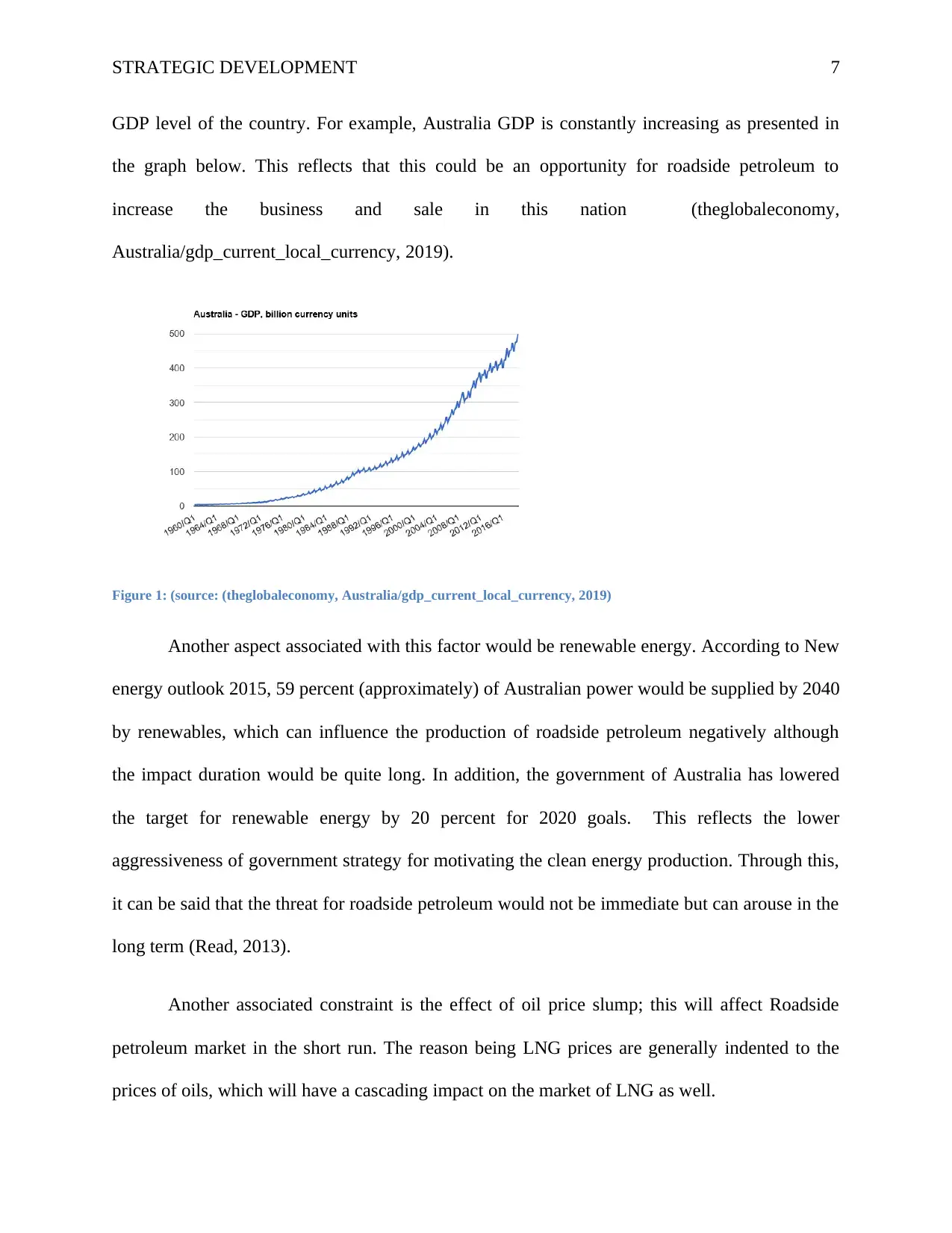
GDP level of the country. For example, Australia GDP is constantly increasing as presented in
the graph below. This reflects that this could be an opportunity for roadside petroleum to
increase the business and sale in this nation (theglobaleconomy,
Australia/gdp_current_local_currency, 2019).
Figure 1: (source: (theglobaleconomy, Australia/gdp_current_local_currency, 2019)
Another aspect associated with this factor would be renewable energy. According to New
energy outlook 2015, 59 percent (approximately) of Australian power would be supplied by 2040
by renewables, which can influence the production of roadside petroleum negatively although
the impact duration would be quite long. In addition, the government of Australia has lowered
the target for renewable energy by 20 percent for 2020 goals. This reflects the lower
aggressiveness of government strategy for motivating the clean energy production. Through this,
it can be said that the threat for roadside petroleum would not be immediate but can arouse in the
long term (Read, 2013).
Another associated constraint is the effect of oil price slump; this will affect Roadside
petroleum market in the short run. The reason being LNG prices are generally indented to the
prices of oils, which will have a cascading impact on the market of LNG as well.
GDP level of the country. For example, Australia GDP is constantly increasing as presented in
the graph below. This reflects that this could be an opportunity for roadside petroleum to
increase the business and sale in this nation (theglobaleconomy,
Australia/gdp_current_local_currency, 2019).
Figure 1: (source: (theglobaleconomy, Australia/gdp_current_local_currency, 2019)
Another aspect associated with this factor would be renewable energy. According to New
energy outlook 2015, 59 percent (approximately) of Australian power would be supplied by 2040
by renewables, which can influence the production of roadside petroleum negatively although
the impact duration would be quite long. In addition, the government of Australia has lowered
the target for renewable energy by 20 percent for 2020 goals. This reflects the lower
aggressiveness of government strategy for motivating the clean energy production. Through this,
it can be said that the threat for roadside petroleum would not be immediate but can arouse in the
long term (Read, 2013).
Another associated constraint is the effect of oil price slump; this will affect Roadside
petroleum market in the short run. The reason being LNG prices are generally indented to the
prices of oils, which will have a cascading impact on the market of LNG as well.
STRATEGIC DEVELOPMENT 8
Social
The social trends of the nation will affect the business. The major factor that will be
associated with the Roadside petroleum business would be the effect of people of increasing
environmental concern. People are now considering the effect of the use of energy and oils
consumption over the environment that made them use more of public transport and take
initiative to reduce consumption of non-renewable energy. This could be the reason for the
decreasing demand in the Asian market (theglobaleconomy, Australia/Energy_use_per_capita,
2019).
Technological
The technological factors that will be associated with Roadside petroleum would be:
Floating production system - Australia would be the initial nation to deploy this system,
according to Australian trade commission report, which will help Roadside petroleum to explore
the reserves, which are untapped in the oceans in a better and more profitable method.
Research for optimizing processing of LNG – CSIRO has developed the new
technologies breakdown, which will make the use of transport and natural gas conveniently and
faster. The use of technology will increase the research process in the nation and target at the
modification of LN G processing to a clearer one (Baker & Bowen, 2015).
Legal
The legal factors that would be associated with roadside petroleum is “oil spill response
forum.” APPEA had initiated a forum in 2013 for oil spill response (Chari & Feng, 2018). The
objective of this forum was collaboration among major player in the oil and gas industry and for
the facilitation of information in response to oil ship mishaps. Moreover, the legal requirements
Social
The social trends of the nation will affect the business. The major factor that will be
associated with the Roadside petroleum business would be the effect of people of increasing
environmental concern. People are now considering the effect of the use of energy and oils
consumption over the environment that made them use more of public transport and take
initiative to reduce consumption of non-renewable energy. This could be the reason for the
decreasing demand in the Asian market (theglobaleconomy, Australia/Energy_use_per_capita,
2019).
Technological
The technological factors that will be associated with Roadside petroleum would be:
Floating production system - Australia would be the initial nation to deploy this system,
according to Australian trade commission report, which will help Roadside petroleum to explore
the reserves, which are untapped in the oceans in a better and more profitable method.
Research for optimizing processing of LNG – CSIRO has developed the new
technologies breakdown, which will make the use of transport and natural gas conveniently and
faster. The use of technology will increase the research process in the nation and target at the
modification of LN G processing to a clearer one (Baker & Bowen, 2015).
Legal
The legal factors that would be associated with roadside petroleum is “oil spill response
forum.” APPEA had initiated a forum in 2013 for oil spill response (Chari & Feng, 2018). The
objective of this forum was collaboration among major player in the oil and gas industry and for
the facilitation of information in response to oil ship mishaps. Moreover, the legal requirements
⊘ This is a preview!⊘
Do you want full access?
Subscribe today to unlock all pages.
Trusted by 1+ million students worldwide
STRATEGIC DEVELOPMENT 9
as discussed in the previous section as well would be a threat to the company like new legal
regulation in the nation (theglobaleconomy, Australia/Energy_use_per_capita, 2019).
Environmental
The environmental factors that will influence the roadside petroleum would be the major
threat as the business is all interlinked to the environmental impact. This will emphasise the
sustain ability goals of the business (Ho, 2014). For this the company would be working for
saving the environment and minimize the negative impact of the environment while producing
forms of energy (theglobaleconomy, Australia/Energy_use_per_capita, 2019).
Long term objectives
The long-term objectives of the company would be
Return on investment – The company mission is to increase the shareholder fund. This
will include the return on investment in the next two years. This would be one of the
major objectives of the company (Schlegelmilch B. , 2016).
New revenue streams – The objective for roadside petroleum from 2020 to 2025 would
be to search for new revenue streams. This would include product and service
diversification and overcome the non-diversified weakness of the company.
Competitive position through Acquisitions – Another long-term objective for roadside
would be to acquire business to become the global leader in the oil and gas industry. For
this, the company needs to be established and increase the revenue and become capable
to acquire other company to lead in this industry. This objective for the company is from
2025 to 2030 (Schlegelmilch B. , 2016).
as discussed in the previous section as well would be a threat to the company like new legal
regulation in the nation (theglobaleconomy, Australia/Energy_use_per_capita, 2019).
Environmental
The environmental factors that will influence the roadside petroleum would be the major
threat as the business is all interlinked to the environmental impact. This will emphasise the
sustain ability goals of the business (Ho, 2014). For this the company would be working for
saving the environment and minimize the negative impact of the environment while producing
forms of energy (theglobaleconomy, Australia/Energy_use_per_capita, 2019).
Long term objectives
The long-term objectives of the company would be
Return on investment – The company mission is to increase the shareholder fund. This
will include the return on investment in the next two years. This would be one of the
major objectives of the company (Schlegelmilch B. , 2016).
New revenue streams – The objective for roadside petroleum from 2020 to 2025 would
be to search for new revenue streams. This would include product and service
diversification and overcome the non-diversified weakness of the company.
Competitive position through Acquisitions – Another long-term objective for roadside
would be to acquire business to become the global leader in the oil and gas industry. For
this, the company needs to be established and increase the revenue and become capable
to acquire other company to lead in this industry. This objective for the company is from
2025 to 2030 (Schlegelmilch B. , 2016).
Paraphrase This Document
Need a fresh take? Get an instant paraphrase of this document with our AI Paraphraser
STRATEGIC DEVELOPMENT 10
Generic strategies
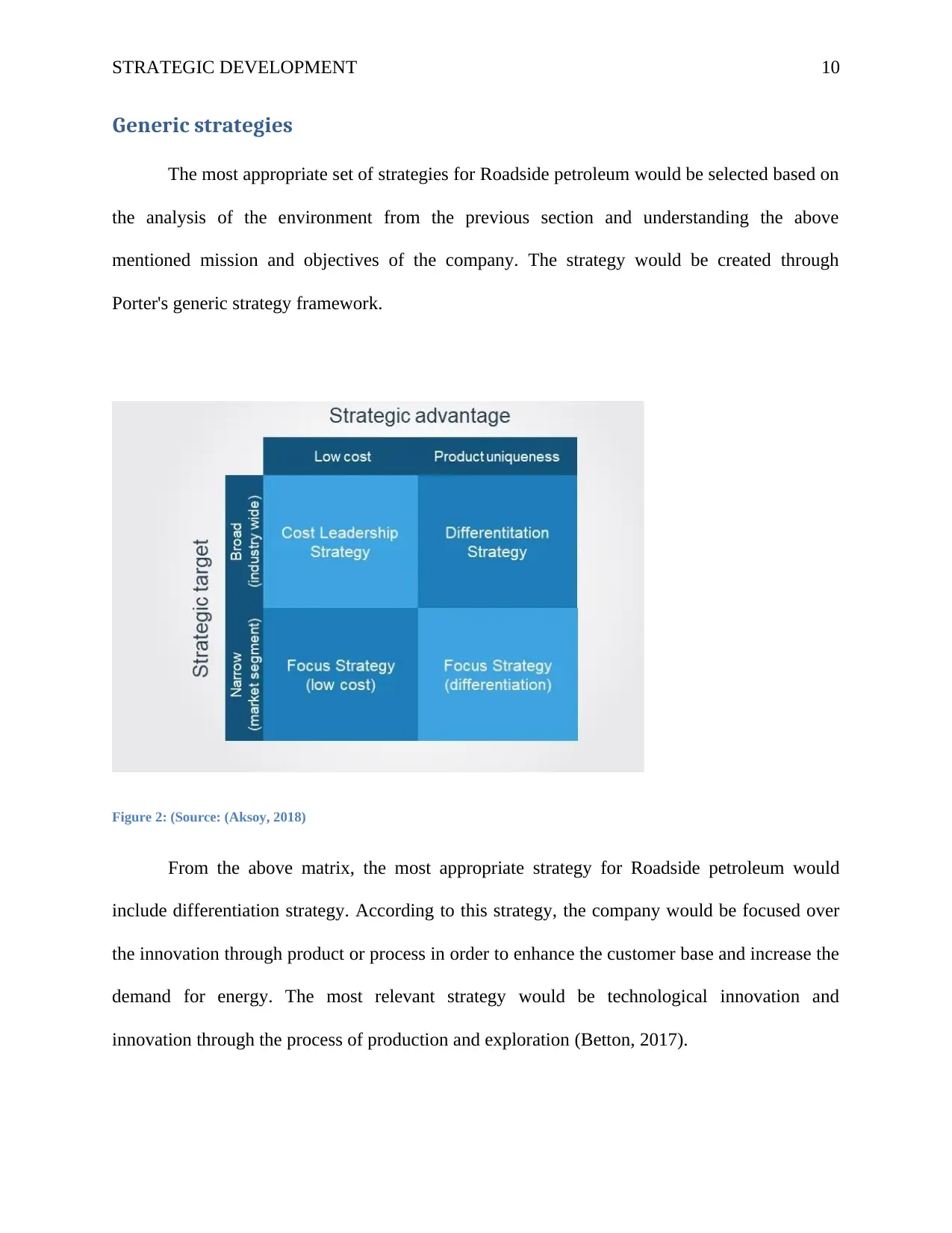
The most appropriate set of strategies for Roadside petroleum would be selected based on
the analysis of the environment from the previous section and understanding the above
mentioned mission and objectives of the company. The strategy would be created through
Porter's generic strategy framework.
Figure 2: (Source: (Aksoy, 2018)
From the above matrix, the most appropriate strategy for Roadside petroleum would
include differentiation strategy. According to this strategy, the company would be focused over
the innovation through product or process in order to enhance the customer base and increase the
demand for energy. The most relevant strategy would be technological innovation and
innovation through the process of production and exploration (Betton, 2017).
Generic strategies
The most appropriate set of strategies for Roadside petroleum would be selected based on
the analysis of the environment from the previous section and understanding the above
mentioned mission and objectives of the company. The strategy would be created through
Porter's generic strategy framework.
Figure 2: (Source: (Aksoy, 2018)
From the above matrix, the most appropriate strategy for Roadside petroleum would
include differentiation strategy. According to this strategy, the company would be focused over
the innovation through product or process in order to enhance the customer base and increase the
demand for energy. The most relevant strategy would be technological innovation and
innovation through the process of production and exploration (Betton, 2017).
STRATEGIC DEVELOPMENT 11
It was observed that innovation would enable roadside petroleum to develop and test new
solutions that will be responsible for improving the method across the business. Innovative
thinking will consider facilities design of roadside to the arrangements in commercials that
would underpin them. In addition, it would consider the method of interaction with other
business partners and joint ventures in resource development. It will not only include the
development of industry sector but also include developing the workforce to promote innovation.
The differentiation strategy of the company would also include the use of conventional
technology along with upgraded technology quickly. In addition, it will also include an increase
in intelligent assets which means that the requirement for the manpower would be reduced and
the work with the latest technical machine would be increased which will reduce the cost of
production, and will increase the time for completion of the production process.
New energy exploration would also be part of this strategy for roadside petroleum. This
would include exploring the use of energy in a different form and introducing new energy like in
transportation mode, or in factories, or any other industry using energy that could increase the
revenue stream for the company. For example, the company can explore and produce
“hydrogen.” This would include two major kinds of technology that are green hydrogen and blue
hydrogen. It was found that hydrogen is a versatile, abundant, clean burning, and reliable source
of fuel and power.
Therefore, it can be said that the grand strategy for roadside petroleum limited would be a
differentiation strategy that it will target the broad market while considering the product
uniqueness as the key.
It was observed that innovation would enable roadside petroleum to develop and test new
solutions that will be responsible for improving the method across the business. Innovative
thinking will consider facilities design of roadside to the arrangements in commercials that
would underpin them. In addition, it would consider the method of interaction with other
business partners and joint ventures in resource development. It will not only include the
development of industry sector but also include developing the workforce to promote innovation.
The differentiation strategy of the company would also include the use of conventional
technology along with upgraded technology quickly. In addition, it will also include an increase
in intelligent assets which means that the requirement for the manpower would be reduced and
the work with the latest technical machine would be increased which will reduce the cost of
production, and will increase the time for completion of the production process.
New energy exploration would also be part of this strategy for roadside petroleum. This
would include exploring the use of energy in a different form and introducing new energy like in
transportation mode, or in factories, or any other industry using energy that could increase the
revenue stream for the company. For example, the company can explore and produce
“hydrogen.” This would include two major kinds of technology that are green hydrogen and blue
hydrogen. It was found that hydrogen is a versatile, abundant, clean burning, and reliable source
of fuel and power.
Therefore, it can be said that the grand strategy for roadside petroleum limited would be a
differentiation strategy that it will target the broad market while considering the product
uniqueness as the key.
⊘ This is a preview!⊘
Do you want full access?
Subscribe today to unlock all pages.
Trusted by 1+ million students worldwide

1 out of 20


Related Documents


Your All-in-One AI-Powered Toolkit for Academic Success.
+13062052269
info@desklib.com
Available 24*7 on WhatsApp / Email
![[object Object]](/_next/static/media/star-bottom.7253800d.svg)
Unlock your academic potential
Copyright © 2020–2026 A2Z Services. All Rights Reserved. Developed and managed by ZUCOL.