Strategic Hospitality Management: A Detailed Analysis and Plan
VerifiedAdded on 2024/05/14
|11
|2264
|62
Report
AI Summary
This report provides a detailed analysis of strategic hospitality management, focusing on key objectives, stakeholder analysis, and the application of PESTLE and SWOT frameworks. It identifies ten stakeholders of the Hilton organization and assesses the impact of political, economic, social, technological, and legal factors on these stakeholders using PESTLE analysis and Mendelow’s Power-Interest Grid. The report also examines internal factors such as strengths, weaknesses, opportunities, and threats, and their influence on strategic management techniques, aiming to provide insights for maximizing profit margins and market position.

Strategic Hospitality Management
1
1

Paraphrase This Document
Need a fresh take? Get an instant paraphrase of this document with our AI Paraphraser
Table of Contents
Introduction......................................................................................................................................3
Mission of the organization.............................................................................................................4
Strategic Management.....................................................................................................................9
Conclusion.....................................................................................................................................10
2
Introduction......................................................................................................................................3
Mission of the organization.............................................................................................................4
Strategic Management.....................................................................................................................9
Conclusion.....................................................................................................................................10
2

Introduction
Strategic management is branch of study that helps an organization to design strategies that
would enable the company to achieve its objectives. In order to enable an organization to achieve
its objectives, a successful strategic management aims at conducting an extensive market
research and identifying the key competitors of the organization, and assessing the business
environment of the particular nation and therefore helps the organization to frame strategies in a
way so that it can achieve its goals in the shortest possible span of time. The strategic
management team considers the business environment in which an organization is flourishing in
terms of political, economic, social, technological, environmental and legal environment.
Analyzing the environment, and the strengths, weaknesses, opportunities and threats of the
company, the strategic management team develops a plan to best suits the needs of the
organization and the one that is best aligned with goals of the company is adopted and
implemented.
3
Strategic management is branch of study that helps an organization to design strategies that
would enable the company to achieve its objectives. In order to enable an organization to achieve
its objectives, a successful strategic management aims at conducting an extensive market
research and identifying the key competitors of the organization, and assessing the business
environment of the particular nation and therefore helps the organization to frame strategies in a
way so that it can achieve its goals in the shortest possible span of time. The strategic
management team considers the business environment in which an organization is flourishing in
terms of political, economic, social, technological, environmental and legal environment.
Analyzing the environment, and the strengths, weaknesses, opportunities and threats of the
company, the strategic management team develops a plan to best suits the needs of the
organization and the one that is best aligned with goals of the company is adopted and
implemented.
3
⊘ This is a preview!⊘
Do you want full access?
Subscribe today to unlock all pages.

Trusted by 1+ million students worldwide

Objectives of the organization
Objectives: The main objectives of the organization are as follows:
To increase its profit margins by 6% by the next one year
To increase the market share by 3% by the next one year
To make the services available at affordable prices
To provide offers to customers, on accommodation and luxury dining in order to target
consumers all across the globe.
Stakeholders of the organization
Hilton has multiple stakeholders who play an important role for the business. Stakeholder is not
always equity shareholders but they influence the business decisions and strategies of the
organization. They can also be employees, who have a stake in the company's success, or
government officials who regulate business and customers who visit the hotel. According to
Mendelow's Power-Interest Grid, the following stakeholders are important for the business of
Hilton (Lin, X, et al, 2018)
Government – Payment system Regulators, Pay Regulators, Department of Business
Development and Skill and tax department are some of the key government bodies Hilton works
with.
Employees- An organization is known, by its people and product. For Hilton, its service is most
important for customer satisfaction. The employees of Hilton are concerned for their job
security, compensations and pay, truthfulness, recognition and appreciation respect and all these
factors are important for Hilton to maintain proper business and increase turnover of customers.
Employee satisfaction is therefore, directly linked to the growth of the organization.
Consumer- Hospitality industry largely depended on the customers. Customers for Hilton are
concerned about the quality of product served in Hilton and the service Hilton offers. They
always care for value for money. Unsatisfactory experience of customers spread bad reputation
about the company and will disrupt the growth.
4
Objectives: The main objectives of the organization are as follows:
To increase its profit margins by 6% by the next one year
To increase the market share by 3% by the next one year
To make the services available at affordable prices
To provide offers to customers, on accommodation and luxury dining in order to target
consumers all across the globe.
Stakeholders of the organization
Hilton has multiple stakeholders who play an important role for the business. Stakeholder is not
always equity shareholders but they influence the business decisions and strategies of the
organization. They can also be employees, who have a stake in the company's success, or
government officials who regulate business and customers who visit the hotel. According to
Mendelow's Power-Interest Grid, the following stakeholders are important for the business of
Hilton (Lin, X, et al, 2018)
Government – Payment system Regulators, Pay Regulators, Department of Business
Development and Skill and tax department are some of the key government bodies Hilton works
with.
Employees- An organization is known, by its people and product. For Hilton, its service is most
important for customer satisfaction. The employees of Hilton are concerned for their job
security, compensations and pay, truthfulness, recognition and appreciation respect and all these
factors are important for Hilton to maintain proper business and increase turnover of customers.
Employee satisfaction is therefore, directly linked to the growth of the organization.
Consumer- Hospitality industry largely depended on the customers. Customers for Hilton are
concerned about the quality of product served in Hilton and the service Hilton offers. They
always care for value for money. Unsatisfactory experience of customers spread bad reputation
about the company and will disrupt the growth.
4
Paraphrase This Document
Need a fresh take? Get an instant paraphrase of this document with our AI Paraphraser
Suppliers-The companies who supply items of daily use , for example vegetables, fish , meat
and other food items, furnishings, furniture, items of interior decorations like florist and others.
Any break in the chain of supply or unsatisfactory suppliers can lead to disruption of services to
customers.
Creditors- Bank of England, financial Policy Committee, and The treasury, are the creditors for
Hilton. These bodies are related to new contracts and provide financial support to Hilton when
required.
Community- The people of UK are also related to business as they look forward for jobs
opportunities in Hilton. Environmental protection is also a concern for the residents. Hilton has
also Corporate Social Responsibility. It includes the energy consumption policy, water
consumption policy, and waste management and recycling policy. Apart from this, hospitality
industry also has roles to play in spreading awareness about environmental protection.
Trade Union- The trade unions of UK are trying to improve the membership among the
employees of hospitality industry. Hospitality industry has less number of people who participate
in trade union activities. Trade unions fight for right of job protection and rectification of wages
for the labors.
Owners- Christopher J. Nassetta the owner of Hilton has concerns with profitability, market
share, growth, and raising capital.
Investors- Multiple third party investors other than Bank and shareholders are considered as
investors. Investors have concern about the income and return on investment.
5
and other food items, furnishings, furniture, items of interior decorations like florist and others.
Any break in the chain of supply or unsatisfactory suppliers can lead to disruption of services to
customers.
Creditors- Bank of England, financial Policy Committee, and The treasury, are the creditors for
Hilton. These bodies are related to new contracts and provide financial support to Hilton when
required.
Community- The people of UK are also related to business as they look forward for jobs
opportunities in Hilton. Environmental protection is also a concern for the residents. Hilton has
also Corporate Social Responsibility. It includes the energy consumption policy, water
consumption policy, and waste management and recycling policy. Apart from this, hospitality
industry also has roles to play in spreading awareness about environmental protection.
Trade Union- The trade unions of UK are trying to improve the membership among the
employees of hospitality industry. Hospitality industry has less number of people who participate
in trade union activities. Trade unions fight for right of job protection and rectification of wages
for the labors.
Owners- Christopher J. Nassetta the owner of Hilton has concerns with profitability, market
share, growth, and raising capital.
Investors- Multiple third party investors other than Bank and shareholders are considered as
investors. Investors have concern about the income and return on investment.
5
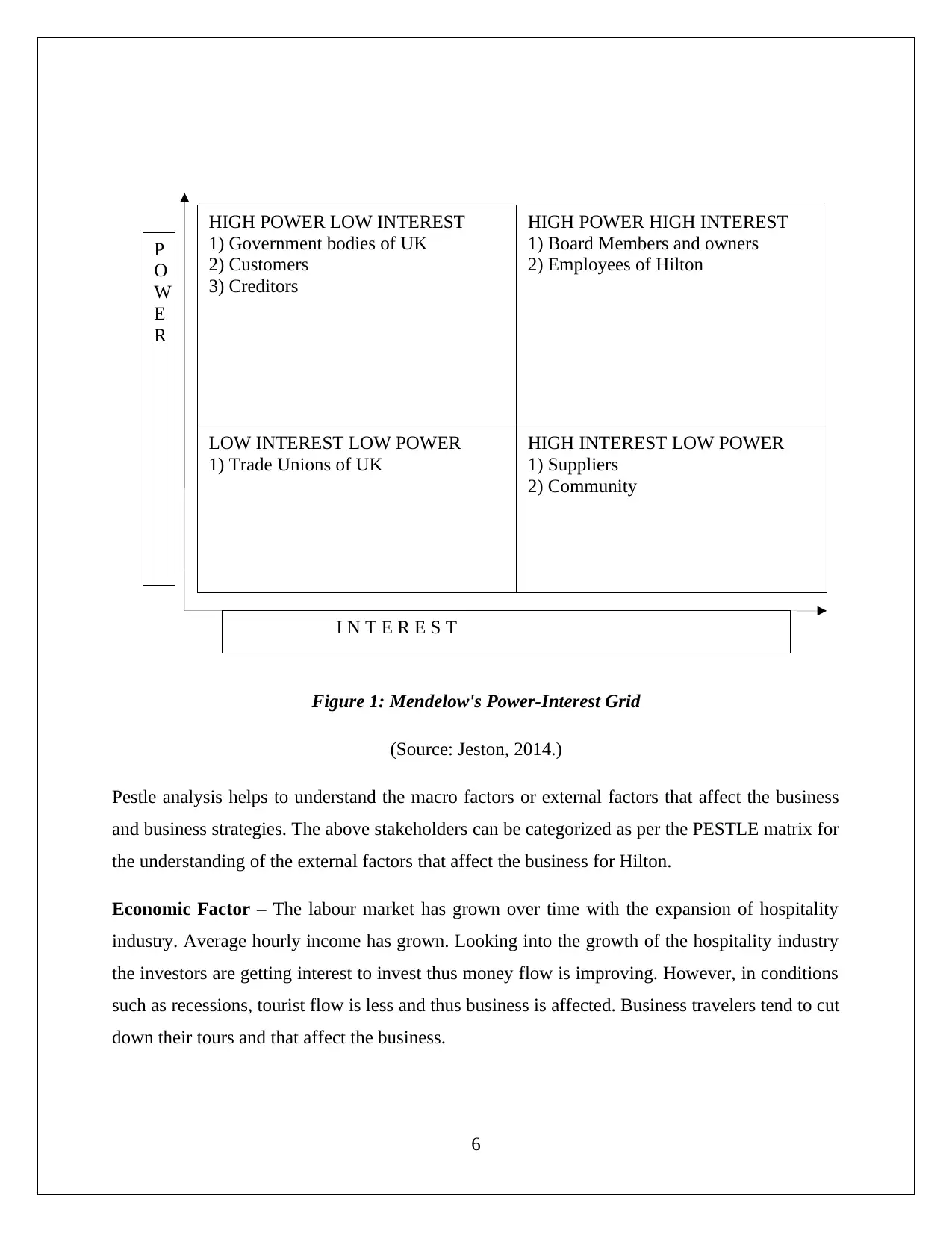
HIGH POWER LOW INTEREST
1) Government bodies of UK
2) Customers
3) Creditors
HIGH POWER HIGH INTEREST
1) Board Members and owners
2) Employees of Hilton
HIGH INTEREST LOW POWER
1) Suppliers
2) Community
LOW INTEREST LOW POWER
1) Trade Unions of UK
P
O
W
E
R
I N T E R E S T
Figure 1: Mendelow's Power-Interest Grid
(Source: Jeston, 2014.)
Pestle analysis helps to understand the macro factors or external factors that affect the business
and business strategies. The above stakeholders can be categorized as per the PESTLE matrix for
the understanding of the external factors that affect the business for Hilton.
Economic Factor – The labour market has grown over time with the expansion of hospitality
industry. Average hourly income has grown. Looking into the growth of the hospitality industry
the investors are getting interest to invest thus money flow is improving. However, in conditions
such as recessions, tourist flow is less and thus business is affected. Business travelers tend to cut
down their tours and that affect the business.
6
1) Government bodies of UK
2) Customers
3) Creditors
HIGH POWER HIGH INTEREST
1) Board Members and owners
2) Employees of Hilton
HIGH INTEREST LOW POWER
1) Suppliers
2) Community
LOW INTEREST LOW POWER
1) Trade Unions of UK
P
O
W
E
R
I N T E R E S T
Figure 1: Mendelow's Power-Interest Grid
(Source: Jeston, 2014.)
Pestle analysis helps to understand the macro factors or external factors that affect the business
and business strategies. The above stakeholders can be categorized as per the PESTLE matrix for
the understanding of the external factors that affect the business for Hilton.
Economic Factor – The labour market has grown over time with the expansion of hospitality
industry. Average hourly income has grown. Looking into the growth of the hospitality industry
the investors are getting interest to invest thus money flow is improving. However, in conditions
such as recessions, tourist flow is less and thus business is affected. Business travelers tend to cut
down their tours and that affect the business.
6
⊘ This is a preview!⊘
Do you want full access?
Subscribe today to unlock all pages.
Trusted by 1+ million students worldwide

Political Factor- Stability of UK government is a key factor that affects the business. Political
stability allows inflow of more tourists and business travelers. People visiting to North Ireland
also take the UK route therefore; it has impact on the number of visitors at Hilton. Unstable
political situations in other countries deeply affect the business as the inflow of customer is
reduced.
Social factor– Consumer preference is affected by the cultural aspect of the place and the
tourists. While more tourists try to avoid city crowd for holiday business travelers are still
helping to maintain the business. Customers also prefer stays in secluded places while budget cut
in many organizations make the business travelers choose budget hotels.
Legal – Payment system Regulators, Pay Regulators, Department of Business Development and
Skill and tax department keep a track of the business health, policies on employee management
and guard for the shareholders stake (Johan, et al, 2018).
Environmental factor – Hilton as one of the prestigious hotels has also following the business
processes to maintain healthy environment. The CSR policy includes, saving energy, reduce
water consumption and manage and recycle wastes .Since 2009 Hilton has reduces consumption
of energy by 14.5% and water consumption by 14.1%. It has also achieved proper waste
management and collaborated with WWF to educate people on such environmental issues
(Rosso, et al, 2014)
Technological factor: Hilton, being one of the reputed named in the hospitality industry, needs
to adopt to the latest technologies, such as digital technology which includes social media in
order to gather the feedback of its most important stakeholders the customers and address their
grievances and therefore improve its products according to the preferences of the consumers;.
7
stability allows inflow of more tourists and business travelers. People visiting to North Ireland
also take the UK route therefore; it has impact on the number of visitors at Hilton. Unstable
political situations in other countries deeply affect the business as the inflow of customer is
reduced.
Social factor– Consumer preference is affected by the cultural aspect of the place and the
tourists. While more tourists try to avoid city crowd for holiday business travelers are still
helping to maintain the business. Customers also prefer stays in secluded places while budget cut
in many organizations make the business travelers choose budget hotels.
Legal – Payment system Regulators, Pay Regulators, Department of Business Development and
Skill and tax department keep a track of the business health, policies on employee management
and guard for the shareholders stake (Johan, et al, 2018).
Environmental factor – Hilton as one of the prestigious hotels has also following the business
processes to maintain healthy environment. The CSR policy includes, saving energy, reduce
water consumption and manage and recycle wastes .Since 2009 Hilton has reduces consumption
of energy by 14.5% and water consumption by 14.1%. It has also achieved proper waste
management and collaborated with WWF to educate people on such environmental issues
(Rosso, et al, 2014)
Technological factor: Hilton, being one of the reputed named in the hospitality industry, needs
to adopt to the latest technologies, such as digital technology which includes social media in
order to gather the feedback of its most important stakeholders the customers and address their
grievances and therefore improve its products according to the preferences of the consumers;.
7
Paraphrase This Document
Need a fresh take? Get an instant paraphrase of this document with our AI Paraphraser

Figure 2: PESTLE analysis
(Source: Johan, et al, 2018)
Strategic Management
Strategic analysis helps in understanding and identifying the strengths, address the weaknesses,
identify the threats and accordingly take the right actions from the opportunities. The SWOT
analysis of the Hilton industry has been discussed below:
Strengths: In the market position, the brand of the company is high worldwide. The brand has
created a positive perception and influences the customers positively. The industry is popular for
having a high-class management and authority (Jeston, 2014). The management focuses on
bringing in innovative concepts in the industry. The company is renowned of having high
revenue with the perspective of growing worldwide and expanding the business. The company
focuses on taking into account of each and every customer’s feedback. The company ensures that
the deliveries of the services are as per the requirements of the customers.
The company emphasize on the concept of having a strong emotional bond with the customers.
Thus strategic analysis of the company will be effective as the company utilizes the strengths at
the right moment to expand the brand worldwide. The strategy of the company will be to identify
the strength and use it accordingly. Strategic analysis will help the company to grow at a faster
rate and influence the customers.
8
(Source: Johan, et al, 2018)
Strategic Management
Strategic analysis helps in understanding and identifying the strengths, address the weaknesses,
identify the threats and accordingly take the right actions from the opportunities. The SWOT
analysis of the Hilton industry has been discussed below:
Strengths: In the market position, the brand of the company is high worldwide. The brand has
created a positive perception and influences the customers positively. The industry is popular for
having a high-class management and authority (Jeston, 2014). The management focuses on
bringing in innovative concepts in the industry. The company is renowned of having high
revenue with the perspective of growing worldwide and expanding the business. The company
focuses on taking into account of each and every customer’s feedback. The company ensures that
the deliveries of the services are as per the requirements of the customers.
The company emphasize on the concept of having a strong emotional bond with the customers.
Thus strategic analysis of the company will be effective as the company utilizes the strengths at
the right moment to expand the brand worldwide. The strategy of the company will be to identify
the strength and use it accordingly. Strategic analysis will help the company to grow at a faster
rate and influence the customers.
8
Weaknesses: The Company is not well known in having a developed network, thereby resulting
in being one of the weaknesses. The Company has a weak network or rather it can be said the
company has poor networks in inn of Europe and North America. Due to its poor network, the
company fails to compete with other five star hotels in the same area. As it has a poor lodging
network, the Company has been dependent in other inn proprietor. Poor decisions are taken by
the cutting edge workers and this serves to be one of the leading issues of China. While framing
strategic analysis, the weaknesses must be highlighted and measures must be taken to overcome
the issue.
Opportunities: Hilton can make use of the resources and skills in a wider scale to expand the
business worldwide. Hilton can use the resources in overseas like Australia, having high
economic condition. The Company can explore the Australian market, as it has been considered
as the standout place famous for tourism (Johan et al., 2018). To foster relationship with the
customers, program offices can be launched with the help of first line representatives.
Collaboration with the right partners will help the company to expand and capture the games as
the opportunity. Good partnership will help to have an efficient customer base and establish solid
position in the market. The scope to acquire the local hotels will help to eradicate the fact of
competition with local hotels and inns.
Threats: This is the most vital part to be included in strategic analysis as it impacts the business
either currently or in future. The company faces a high competition in terms of revenue and
customer base in the market. New entrants are posing threats for the hotel as they are making
strategy to incorporate innovation and shape the organization as well. Rival companies with the
introduction of globalization, has incorporated new techniques to develop its position in the
market, thereby appearing as the threats for Hilton. Increasing salary has been considered as one
of the major issue in many companies due to the weight in offering compensation to the
employees. Employee satisfaction has been increased leading to high cost of the company.
Strategy analysis will allow the hotel to identify the strengths and the weakness, identifying the
threats will definitely help the hotel to grow across the world.
9
in being one of the weaknesses. The Company has a weak network or rather it can be said the
company has poor networks in inn of Europe and North America. Due to its poor network, the
company fails to compete with other five star hotels in the same area. As it has a poor lodging
network, the Company has been dependent in other inn proprietor. Poor decisions are taken by
the cutting edge workers and this serves to be one of the leading issues of China. While framing
strategic analysis, the weaknesses must be highlighted and measures must be taken to overcome
the issue.
Opportunities: Hilton can make use of the resources and skills in a wider scale to expand the
business worldwide. Hilton can use the resources in overseas like Australia, having high
economic condition. The Company can explore the Australian market, as it has been considered
as the standout place famous for tourism (Johan et al., 2018). To foster relationship with the
customers, program offices can be launched with the help of first line representatives.
Collaboration with the right partners will help the company to expand and capture the games as
the opportunity. Good partnership will help to have an efficient customer base and establish solid
position in the market. The scope to acquire the local hotels will help to eradicate the fact of
competition with local hotels and inns.
Threats: This is the most vital part to be included in strategic analysis as it impacts the business
either currently or in future. The company faces a high competition in terms of revenue and
customer base in the market. New entrants are posing threats for the hotel as they are making
strategy to incorporate innovation and shape the organization as well. Rival companies with the
introduction of globalization, has incorporated new techniques to develop its position in the
market, thereby appearing as the threats for Hilton. Increasing salary has been considered as one
of the major issue in many companies due to the weight in offering compensation to the
employees. Employee satisfaction has been increased leading to high cost of the company.
Strategy analysis will allow the hotel to identify the strengths and the weakness, identifying the
threats will definitely help the hotel to grow across the world.
9
⊘ This is a preview!⊘
Do you want full access?
Subscribe today to unlock all pages.
Trusted by 1+ million students worldwide

Conclusion
Strategic management refers to the development of certain strategies to ensure that the company
maximizes profit margins and occupies a higher position in the market. The objectives of the
company have been framed according to the SMART framework of designing objectives and ten
stakeholders of the organization have been identified in this study. The impact of various
political, economical, social, technological and legal factors on the stakeholders have been
determined using PESTLE analysis and Mendelow’s Power interest grid .The various internal
factors of the organization such as its Strengths, weaknesses, Opportunities and Threats have
been extensively studied and its impact on the various strategic management techniques have
been carefully analyzed.
10
Strategic management refers to the development of certain strategies to ensure that the company
maximizes profit margins and occupies a higher position in the market. The objectives of the
company have been framed according to the SMART framework of designing objectives and ten
stakeholders of the organization have been identified in this study. The impact of various
political, economical, social, technological and legal factors on the stakeholders have been
determined using PESTLE analysis and Mendelow’s Power interest grid .The various internal
factors of the organization such as its Strengths, weaknesses, Opportunities and Threats have
been extensively studied and its impact on the various strategic management techniques have
been carefully analyzed.
10
Paraphrase This Document
Need a fresh take? Get an instant paraphrase of this document with our AI Paraphraser
References
Font, X., Guix, M. and Bonilla-Priego, M.J., 2016. Corporate social responsibility in cruising:
Using materiality analysis to create shared value. Tourism Management, 53, pp.175-186.
Jeston, J., 2014. Business process management. Routledge.
Johan, A.W., Baga, L.M. and Asmara, A., 2018. COMPETITIVENESS IMPROVEMENT
STRATEGY FORMULATION ON INDIVIDUAL HOTEL: CASE OF XYZ HOTEL AT CITY
OF BOGOR. European Journal of Hospitality and Tourism Research, 6(2), pp.1-15.
Lin, X., Ho, C.M.F. and Shen, G.Q., 2018. For the balance of stakeholders’ power and
responsibility: A collaborative framework for implementing social responsibility issues in
construction projects. Management Decision, 56(3), pp.550-569.
Rosso, Maurizio, M. Bottero, S. Pomarico, S. La Ferlita, and Elena Comino. "Integrating
multicriteria evaluation and stakeholders analysis for assessing hydropower projects." Energy
Policy 67 (2014): 870-881.
11
Font, X., Guix, M. and Bonilla-Priego, M.J., 2016. Corporate social responsibility in cruising:
Using materiality analysis to create shared value. Tourism Management, 53, pp.175-186.
Jeston, J., 2014. Business process management. Routledge.
Johan, A.W., Baga, L.M. and Asmara, A., 2018. COMPETITIVENESS IMPROVEMENT
STRATEGY FORMULATION ON INDIVIDUAL HOTEL: CASE OF XYZ HOTEL AT CITY
OF BOGOR. European Journal of Hospitality and Tourism Research, 6(2), pp.1-15.
Lin, X., Ho, C.M.F. and Shen, G.Q., 2018. For the balance of stakeholders’ power and
responsibility: A collaborative framework for implementing social responsibility issues in
construction projects. Management Decision, 56(3), pp.550-569.
Rosso, Maurizio, M. Bottero, S. Pomarico, S. La Ferlita, and Elena Comino. "Integrating
multicriteria evaluation and stakeholders analysis for assessing hydropower projects." Energy
Policy 67 (2014): 870-881.
11

1 out of 11


Related Documents


Your All-in-One AI-Powered Toolkit for Academic Success.
+13062052269
info@desklib.com
Available 24*7 on WhatsApp / Email
![[object Object]](/_next/static/media/star-bottom.7253800d.svg)
Unlock your academic potential
Copyright © 2020–2026 A2Z Services. All Rights Reserved. Developed and managed by ZUCOL.