Strategic Human Resource Management: IPRP, Performance, and Motivation
VerifiedAdded on 2023/01/07
|10
|2699
|60
Essay
AI Summary
This essay delves into the realm of Strategic Human Resource Management, focusing on the application and impact of Individual Performance Related Pay (IPRP). It explores how IPRP can enhance employee performance by providing financial incentives and linking pay directly to the quality and quantity of work. The essay examines the circumstances under which IPRP proves effective, such as in sales and marketing, and where it may be less successful, particularly when measuring individual contributions is challenging or when market conditions fluctuate. It also highlights the importance of HRM in implementing IPRP, emphasizing the need to consider employee well-being and manage potential workplace conflicts. The analysis covers both the advantages and disadvantages of IPRP, offering a comprehensive understanding of its strategic implications for organizational productivity and employee motivation.

STRATEGIC HUMAN
RESOURCE
MANAGEMENT
RESOURCE
MANAGEMENT

Paraphrase This Document
Need a fresh take? Get an instant paraphrase of this document with our AI Paraphraser
TABLE OF CONTENTS
INTRODUCTION...........................................................................................................................3
INDIVIDUAL PERFORMANCE REALTED PAY (IPRP)...........................................................3
Extent to which IPRP enhances the Employees' Performance....................................................3
Circumstances in which IPRP works well and in which it does not, in order to enhance the
employees' motivation.................................................................................................................6
CONCLUSION................................................................................................................................8
REFERENCES................................................................................................................................1
INTRODUCTION...........................................................................................................................3
INDIVIDUAL PERFORMANCE REALTED PAY (IPRP)...........................................................3
Extent to which IPRP enhances the Employees' Performance....................................................3
Circumstances in which IPRP works well and in which it does not, in order to enhance the
employees' motivation.................................................................................................................6
CONCLUSION................................................................................................................................8
REFERENCES................................................................................................................................1
INTRODUCTION
Strategies are basically the concepts which goes beyond the traditional concepts in order
to gain a competitive advantage by setting particular direction. Strategic Human Resource
Management mainly focuses on developing and implementing the strategies keeping in mind the
fulfilment of needs of employees and the goals of the organization.
It mainly lays emphasis on all the aspects which affects the employees in any way whether it is
hiring and firing, benefits, training, payment etc. SHRM links the HRM with the strategies and
objectives in order to improve the organizational performance and productivity (Bano, 2018).
Many organizations have improved their HRM department and analyses the external business
obstacles to improve the employees' performance.
The essay underneath will evaluate the ways in which Individual Performance Related Pay
(IPRP) can be proved beneficial in stimulating higher level of performance from the employees.
It will also discuss the situations in which the IPRP helps in motivating the employees and the
circumstances in which it does not go well regarding the employees' performance.
INDIVIDUAL PERFORMANCE REALTED PAY (IPRP)
Extent to which IPRP enhances the Employees' Performance
IPRP is basically a system adapted by some organizations where the employees are paid
according to the quality of the work. It mainly benefits the employers as it becomes easy for
them to measure the employees' marginal product and pay according to the same. For
example, if the employees are given a task to sell 100 accessories and will be paid £50 for
completing the task, then it becomes easy for the employers to provide the payment as if they
have sold 50 accessories then they will be paid just half of the amount (Ogbonnaya, Daniels and
Nielsen, 2017).
IPRP mainly provides the financial rewards to the individual employees by assessing their
performance in completing the tasks such as reaching the targets, financial profit sharing,
targeted sales and many more. It is appreciable for some employees whereas the others don't
accept it. Some think that it can motivate the employees to achieve the organizational goals
believing that they will get financial incentives for reaching targets. Others may feel that this
system will create pressure among the employees making the management poor with a money-
driven organizational culture.
Strategies are basically the concepts which goes beyond the traditional concepts in order
to gain a competitive advantage by setting particular direction. Strategic Human Resource
Management mainly focuses on developing and implementing the strategies keeping in mind the
fulfilment of needs of employees and the goals of the organization.
It mainly lays emphasis on all the aspects which affects the employees in any way whether it is
hiring and firing, benefits, training, payment etc. SHRM links the HRM with the strategies and
objectives in order to improve the organizational performance and productivity (Bano, 2018).
Many organizations have improved their HRM department and analyses the external business
obstacles to improve the employees' performance.
The essay underneath will evaluate the ways in which Individual Performance Related Pay
(IPRP) can be proved beneficial in stimulating higher level of performance from the employees.
It will also discuss the situations in which the IPRP helps in motivating the employees and the
circumstances in which it does not go well regarding the employees' performance.
INDIVIDUAL PERFORMANCE REALTED PAY (IPRP)
Extent to which IPRP enhances the Employees' Performance
IPRP is basically a system adapted by some organizations where the employees are paid
according to the quality of the work. It mainly benefits the employers as it becomes easy for
them to measure the employees' marginal product and pay according to the same. For
example, if the employees are given a task to sell 100 accessories and will be paid £50 for
completing the task, then it becomes easy for the employers to provide the payment as if they
have sold 50 accessories then they will be paid just half of the amount (Ogbonnaya, Daniels and
Nielsen, 2017).
IPRP mainly provides the financial rewards to the individual employees by assessing their
performance in completing the tasks such as reaching the targets, financial profit sharing,
targeted sales and many more. It is appreciable for some employees whereas the others don't
accept it. Some think that it can motivate the employees to achieve the organizational goals
believing that they will get financial incentives for reaching targets. Others may feel that this
system will create pressure among the employees making the management poor with a money-
driven organizational culture.
⊘ This is a preview!⊘
Do you want full access?
Subscribe today to unlock all pages.

Trusted by 1+ million students worldwide
This system can be used by the managers in such a way that they can give targets to the
employees and ensures that they are paid according to the achievement of their target. This will
force the employees to perform more tasks with a thought to earn more money neglecting its
capabilities to do work. For example, if the marketing department of retail sectors come in play
then this thing can be proved so well. The person who is responsible for door to door marketing
will be given a commitment that if that person goes to 100 houses and market the goods and
services of the company then the manager will give £100 and if more houses are addressed then
there will be increase in the payment accordingly (Khan and et.al., 2017). So, the sales person
will try to reach more houses because it is known that the incentive will be made. This increases
the performance of that person and the productivity of that organization.
The employees get a clear idea about the ways in which they can improve their performance
because the payment is linked to it. This is mainly done by the individuals whose sole focus is to
earn money. But, it is must for the company that if it exercises such system then it must reward
the best performers as they are highly dedicated to make money by performing more.
It also proves to be beneficial for the company as the employees who do not perform well will
also try to perform better in order to get financial rewards. This also helps in retaining the best
performers as the more reward can force the employees to stick to the same company rather
than swiping to the company who pays more (Herhausen, De Luca and Weibel, 2018). It can be
beneficial for both the employees and employers as the employees who perform more will be
paid high and will not search for other options to earn money and can dedicate themselves in one
job. Employers can be benefited by this as they will have more dedicated and hard-working
employees who know that they have to perform in order to earn money.
This will create more healthy culture in the organization as the employees who are money-
making will perform much better thereby leading to skilled workforce. This will develop a
competitive spirit among the employees as all tries to earn more money than others which will
enhance the overall performance of all the employees thereby increasing the productivity and
efficiency.
This also helps by weeding out the lazy workers as they will be paid very less according to
their less work which will result in a better staff with all the employees determined towards
work. The hard-working employees try to put in all their efforts without thinking about their
comfortability because they have to enhance their performance in order to receive the rewards
employees and ensures that they are paid according to the achievement of their target. This will
force the employees to perform more tasks with a thought to earn more money neglecting its
capabilities to do work. For example, if the marketing department of retail sectors come in play
then this thing can be proved so well. The person who is responsible for door to door marketing
will be given a commitment that if that person goes to 100 houses and market the goods and
services of the company then the manager will give £100 and if more houses are addressed then
there will be increase in the payment accordingly (Khan and et.al., 2017). So, the sales person
will try to reach more houses because it is known that the incentive will be made. This increases
the performance of that person and the productivity of that organization.
The employees get a clear idea about the ways in which they can improve their performance
because the payment is linked to it. This is mainly done by the individuals whose sole focus is to
earn money. But, it is must for the company that if it exercises such system then it must reward
the best performers as they are highly dedicated to make money by performing more.
It also proves to be beneficial for the company as the employees who do not perform well will
also try to perform better in order to get financial rewards. This also helps in retaining the best
performers as the more reward can force the employees to stick to the same company rather
than swiping to the company who pays more (Herhausen, De Luca and Weibel, 2018). It can be
beneficial for both the employees and employers as the employees who perform more will be
paid high and will not search for other options to earn money and can dedicate themselves in one
job. Employers can be benefited by this as they will have more dedicated and hard-working
employees who know that they have to perform in order to earn money.
This will create more healthy culture in the organization as the employees who are money-
making will perform much better thereby leading to skilled workforce. This will develop a
competitive spirit among the employees as all tries to earn more money than others which will
enhance the overall performance of all the employees thereby increasing the productivity and
efficiency.
This also helps by weeding out the lazy workers as they will be paid very less according to
their less work which will result in a better staff with all the employees determined towards
work. The hard-working employees try to put in all their efforts without thinking about their
comfortability because they have to enhance their performance in order to receive the rewards
Paraphrase This Document
Need a fresh take? Get an instant paraphrase of this document with our AI Paraphraser
(Kulikowski and Sedlak, 2020). The employees also value the rewards much as they know the
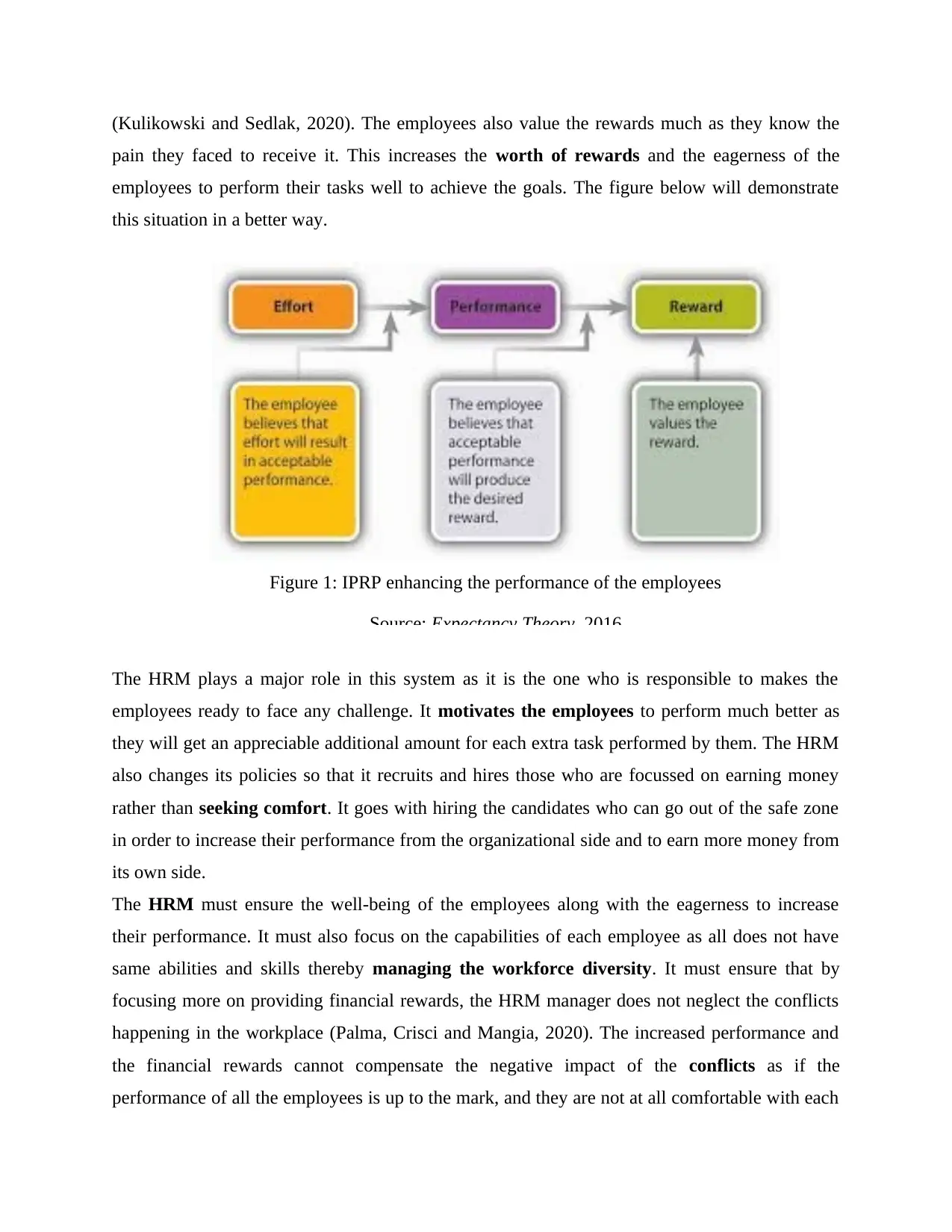
pain they faced to receive it. This increases the worth of rewards and the eagerness of the
employees to perform their tasks well to achieve the goals. The figure below will demonstrate
this situation in a better way.
The HRM plays a major role in this system as it is the one who is responsible to makes the
employees ready to face any challenge. It motivates the employees to perform much better as
they will get an appreciable additional amount for each extra task performed by them. The HRM
also changes its policies so that it recruits and hires those who are focussed on earning money
rather than seeking comfort. It goes with hiring the candidates who can go out of the safe zone
in order to increase their performance from the organizational side and to earn more money from
its own side.
The HRM must ensure the well-being of the employees along with the eagerness to increase
their performance. It must also focus on the capabilities of each employee as all does not have
same abilities and skills thereby managing the workforce diversity. It must ensure that by
focusing more on providing financial rewards, the HRM manager does not neglect the conflicts
happening in the workplace (Palma, Crisci and Mangia, 2020). The increased performance and
the financial rewards cannot compensate the negative impact of the conflicts as if the
performance of all the employees is up to the mark, and they are not at all comfortable with each
Figure 1: IPRP enhancing the performance of the employees
Source: Expectancy Theory, 2016
pain they faced to receive it. This increases the worth of rewards and the eagerness of the
employees to perform their tasks well to achieve the goals. The figure below will demonstrate
this situation in a better way.
The HRM plays a major role in this system as it is the one who is responsible to makes the
employees ready to face any challenge. It motivates the employees to perform much better as
they will get an appreciable additional amount for each extra task performed by them. The HRM
also changes its policies so that it recruits and hires those who are focussed on earning money
rather than seeking comfort. It goes with hiring the candidates who can go out of the safe zone
in order to increase their performance from the organizational side and to earn more money from
its own side.
The HRM must ensure the well-being of the employees along with the eagerness to increase
their performance. It must also focus on the capabilities of each employee as all does not have
same abilities and skills thereby managing the workforce diversity. It must ensure that by
focusing more on providing financial rewards, the HRM manager does not neglect the conflicts
happening in the workplace (Palma, Crisci and Mangia, 2020). The increased performance and
the financial rewards cannot compensate the negative impact of the conflicts as if the
performance of all the employees is up to the mark, and they are not at all comfortable with each
Figure 1: IPRP enhancing the performance of the employees
Source: Expectancy Theory, 2016
other showing the absenteeism than the overall culture and productivity gets destroyed. So, all
these factors becomes the barriers in the strategic implementation of Individual Performance
Related Pay which puts question marks on the policies and practices of HRM.
Circumstances in which IPRP works well and in which it does not, in order to enhance the
employees' motivation
The employers and the employees both are highly impacted by the system of Individual
Performance Related Pay. It is beneficial for some organizations and certain departments while it
proves to affect oppositely in others. For example, in the retail sectors and the sales department
specially, it becomes easy for the employers to measure their performance according to the
achievement of their targets. But in sectors outside the sales and marketing, employees' marginal
product is harder to measure.
In the retail sector also, the output of the workers working in manufacturing department is not at
all clearly defined and is not depended on the performance instead it depends on the number of
customers coming to that shop. So, the financial rewards can be calculated according to the
overall profitability rather than individual's performance (Minasyan And et.al., 2017). This
motivates the employees as they feel that their contribution play a major role in the overall
progress of the company. But this is not the complete IPRP instead a small part of it.
But this does not work good in the case of the lazy employees who try to run from doing hard
work because they think that their less work will not affect the overall productivity of the
company, and they keep doing the less work and receive the payment which is equal to the
payment of the ones who contributed majorly in the overall profitability. This de-motivates the
hard workers and create the sense of discontentment among them.
Sometimes, this system of IPRP is only applicable to the senior authorities like Mangers and
Executives whose performance plays a major role in all the activities of the firm. If the financial
rewards are given to the managers for their performance, then it creates a positive impact on all
the employees and the complete workplace because they work for the welfare of the company so
their increased performance can enhance the overall productivity of the form and the employee's
motivation.
If the system of IPRP is applicable to the employees who are money-minded, then it proves to be
highly beneficial for the company as in order to earn more money the employees will try to
these factors becomes the barriers in the strategic implementation of Individual Performance
Related Pay which puts question marks on the policies and practices of HRM.
Circumstances in which IPRP works well and in which it does not, in order to enhance the
employees' motivation
The employers and the employees both are highly impacted by the system of Individual
Performance Related Pay. It is beneficial for some organizations and certain departments while it
proves to affect oppositely in others. For example, in the retail sectors and the sales department
specially, it becomes easy for the employers to measure their performance according to the
achievement of their targets. But in sectors outside the sales and marketing, employees' marginal
product is harder to measure.
In the retail sector also, the output of the workers working in manufacturing department is not at
all clearly defined and is not depended on the performance instead it depends on the number of
customers coming to that shop. So, the financial rewards can be calculated according to the
overall profitability rather than individual's performance (Minasyan And et.al., 2017). This
motivates the employees as they feel that their contribution play a major role in the overall
progress of the company. But this is not the complete IPRP instead a small part of it.
But this does not work good in the case of the lazy employees who try to run from doing hard
work because they think that their less work will not affect the overall productivity of the
company, and they keep doing the less work and receive the payment which is equal to the
payment of the ones who contributed majorly in the overall profitability. This de-motivates the
hard workers and create the sense of discontentment among them.
Sometimes, this system of IPRP is only applicable to the senior authorities like Mangers and
Executives whose performance plays a major role in all the activities of the firm. If the financial
rewards are given to the managers for their performance, then it creates a positive impact on all
the employees and the complete workplace because they work for the welfare of the company so
their increased performance can enhance the overall productivity of the form and the employee's
motivation.
If the system of IPRP is applicable to the employees who are money-minded, then it proves to be
highly beneficial for the company as in order to earn more money the employees will try to
⊘ This is a preview!⊘
Do you want full access?
Subscribe today to unlock all pages.
Trusted by 1+ million students worldwide
perform more efficiently as their payment is counted according to their performance. Whereas if
this is applied to the employees who focus more on the comfortability and the luxury in
performing the tasks, then it doesn't motivate them to perform better as they do not want to work
coming out of the safe zone and want to remain inside the boundaries not wanting to go beyond
limits.
Individual Performance related Pay is not successful for the companies which are totally
depended on the market conditions and the demands of the customers because the employees
cannot increase their performance in this case as they are restricted by the changing demands of
the people. The market conditions sometimes rise and other times fall which de-motivates the
employees even if they are money-minded they cannot perform efficiently because the market
does not demand for it (Papenfuß and Keppeler, 2020). This can also become difficult for the
company as even if the inflation rate or climate is low, then also the employees demand for
additional payout for their performance which makes the company suffer.
For example, if the retail sector of UK is under concern, then the demands of the customers are
changing day by day. Earlier, the majority of the customers demanded the junk food and its
varieties which increased the sales in the well-known companies like Tesco, Sainsbury etc. But
now, the customers are becoming more health conscious and started preferring healthy food.
This change in demand will highly impact all the departments of the company including the
manufacturing department, sales department and others too. If the sales person in this case are
given a target to market its junk products then it becomes too difficult for them because the
customers do not demand for it. This de-motivates the employees thereby diminishing their
performance which leads to lower productivity of the company (Owenvbiugie and Ekhaise,
2020). The employees also do not get the financial rewards because they have not performed
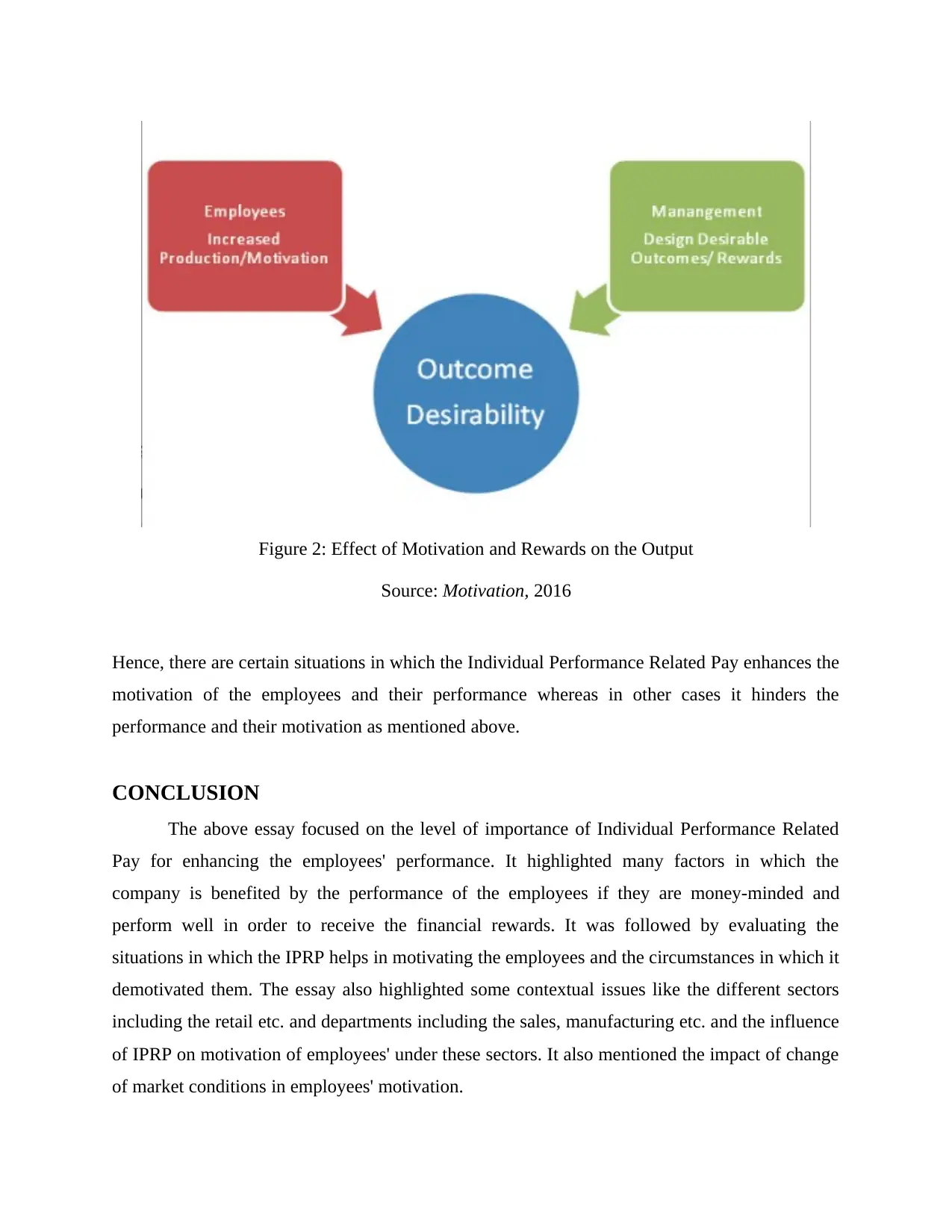
well because of the opposite market demands. Therefore, the motivation of the employees and
the rewards together results in the better output which can enhance the overall progress of the
firm. This can be demonstrated well by the following figure.
this is applied to the employees who focus more on the comfortability and the luxury in
performing the tasks, then it doesn't motivate them to perform better as they do not want to work
coming out of the safe zone and want to remain inside the boundaries not wanting to go beyond
limits.
Individual Performance related Pay is not successful for the companies which are totally
depended on the market conditions and the demands of the customers because the employees
cannot increase their performance in this case as they are restricted by the changing demands of
the people. The market conditions sometimes rise and other times fall which de-motivates the
employees even if they are money-minded they cannot perform efficiently because the market
does not demand for it (Papenfuß and Keppeler, 2020). This can also become difficult for the
company as even if the inflation rate or climate is low, then also the employees demand for
additional payout for their performance which makes the company suffer.
For example, if the retail sector of UK is under concern, then the demands of the customers are
changing day by day. Earlier, the majority of the customers demanded the junk food and its
varieties which increased the sales in the well-known companies like Tesco, Sainsbury etc. But
now, the customers are becoming more health conscious and started preferring healthy food.
This change in demand will highly impact all the departments of the company including the
manufacturing department, sales department and others too. If the sales person in this case are
given a target to market its junk products then it becomes too difficult for them because the
customers do not demand for it. This de-motivates the employees thereby diminishing their
performance which leads to lower productivity of the company (Owenvbiugie and Ekhaise,
2020). The employees also do not get the financial rewards because they have not performed
well because of the opposite market demands. Therefore, the motivation of the employees and
the rewards together results in the better output which can enhance the overall progress of the
firm. This can be demonstrated well by the following figure.
Paraphrase This Document
Need a fresh take? Get an instant paraphrase of this document with our AI Paraphraser
Hence, there are certain situations in which the Individual Performance Related Pay enhances the
motivation of the employees and their performance whereas in other cases it hinders the
performance and their motivation as mentioned above.
CONCLUSION
The above essay focused on the level of importance of Individual Performance Related
Pay for enhancing the employees' performance. It highlighted many factors in which the
company is benefited by the performance of the employees if they are money-minded and
perform well in order to receive the financial rewards. It was followed by evaluating the
situations in which the IPRP helps in motivating the employees and the circumstances in which it
demotivated them. The essay also highlighted some contextual issues like the different sectors
including the retail etc. and departments including the sales, manufacturing etc. and the influence
of IPRP on motivation of employees' under these sectors. It also mentioned the impact of change
of market conditions in employees' motivation.
Figure 2: Effect of Motivation and Rewards on the Output
Source: Motivation, 2016
motivation of the employees and their performance whereas in other cases it hinders the
performance and their motivation as mentioned above.
CONCLUSION
The above essay focused on the level of importance of Individual Performance Related
Pay for enhancing the employees' performance. It highlighted many factors in which the
company is benefited by the performance of the employees if they are money-minded and
perform well in order to receive the financial rewards. It was followed by evaluating the
situations in which the IPRP helps in motivating the employees and the circumstances in which it
demotivated them. The essay also highlighted some contextual issues like the different sectors
including the retail etc. and departments including the sales, manufacturing etc. and the influence
of IPRP on motivation of employees' under these sectors. It also mentioned the impact of change
of market conditions in employees' motivation.
Figure 2: Effect of Motivation and Rewards on the Output
Source: Motivation, 2016
REFERENCES
Books and journals
Bano, A., 2018. Individual Performance Related to Pay and Motivation. Available at SSRN
3129568.
Herhausen, D., De Luca, L.M. and Weibel, M., 2018. The interplay between employee and firm
customer orientation: Substitution effect and the contingency role of performance‐
related rewards. British journal of management. 29(3). pp.534-553.
Khan, A. and et.al., 2017, July. Factors affecting employee motivation towards employee
performance: A study on banking industry of Pakistan. In International conference on
management science and engineering management (pp. 615-625). Springer, Cham.
Kulikowski, K. and Sedlak, P., 2020. Can you buy work engagement? the relationship between
pay, fringe benefits, financial bonuses and work engagement. Current
Psychology. 39(1). pp.343-353.
Minasyan, E.T. And et.al., 2017. Implementing New Performance Pay-Based Schemes in Higher
Educational Institutions. European Journal of Contemporary Education. 6(4). pp.748-
756.
Ogbonnaya, C., Daniels, K. and Nielsen, K., 2017. Does contingent pay encourage positive
employee attitudes and intensify work?. Human Resource Management Journal. 27(1).
pp.94-112.
Owenvbiugie, R.O. and Ekhaise, R.E., 2020. Human resource management motivational
strategies for enhancing business educators’ job performance in tertiary institutions in
Edo and Delta States, Nigeria. Journal of Education and Learning (EduLearn). 14(1).
pp.140-147.
Palma, R., Crisci, A. and Mangia, G., 2020. Public service motivation-individual performance
relationship: Does user orientation matter?. Socio-Economic Planning Sciences,
p.100818.
Papenfuß, U. and Keppeler, F., 2020. Does performance-related pay and public service
motivation research treat state-owned enterprises like a neglected Cinderella? A
systematic literature review and agenda for future research on performance
effects. Public Management Review, pp.1-27.
Online
Expectancy Theory, 2016. [Online]. Available through:
<https://wikispaces.psu.edu/display/PSYCH484/4.+Expectancy+Theory>
Motivation, 2016. [Online]. Available through:
<https://wikispaces.psu.edu/display/PSYCH484/4.+Expectancy+Theory>
1
Books and journals
Bano, A., 2018. Individual Performance Related to Pay and Motivation. Available at SSRN
3129568.
Herhausen, D., De Luca, L.M. and Weibel, M., 2018. The interplay between employee and firm
customer orientation: Substitution effect and the contingency role of performance‐
related rewards. British journal of management. 29(3). pp.534-553.
Khan, A. and et.al., 2017, July. Factors affecting employee motivation towards employee
performance: A study on banking industry of Pakistan. In International conference on
management science and engineering management (pp. 615-625). Springer, Cham.
Kulikowski, K. and Sedlak, P., 2020. Can you buy work engagement? the relationship between
pay, fringe benefits, financial bonuses and work engagement. Current
Psychology. 39(1). pp.343-353.
Minasyan, E.T. And et.al., 2017. Implementing New Performance Pay-Based Schemes in Higher
Educational Institutions. European Journal of Contemporary Education. 6(4). pp.748-
756.
Ogbonnaya, C., Daniels, K. and Nielsen, K., 2017. Does contingent pay encourage positive
employee attitudes and intensify work?. Human Resource Management Journal. 27(1).
pp.94-112.
Owenvbiugie, R.O. and Ekhaise, R.E., 2020. Human resource management motivational
strategies for enhancing business educators’ job performance in tertiary institutions in
Edo and Delta States, Nigeria. Journal of Education and Learning (EduLearn). 14(1).
pp.140-147.
Palma, R., Crisci, A. and Mangia, G., 2020. Public service motivation-individual performance
relationship: Does user orientation matter?. Socio-Economic Planning Sciences,
p.100818.
Papenfuß, U. and Keppeler, F., 2020. Does performance-related pay and public service
motivation research treat state-owned enterprises like a neglected Cinderella? A
systematic literature review and agenda for future research on performance
effects. Public Management Review, pp.1-27.
Online
Expectancy Theory, 2016. [Online]. Available through:
<https://wikispaces.psu.edu/display/PSYCH484/4.+Expectancy+Theory>
Motivation, 2016. [Online]. Available through:
<https://wikispaces.psu.edu/display/PSYCH484/4.+Expectancy+Theory>
1
⊘ This is a preview!⊘
Do you want full access?
Subscribe today to unlock all pages.
Trusted by 1+ million students worldwide

2

1 out of 10


Related Documents


Your All-in-One AI-Powered Toolkit for Academic Success.
+13062052269
info@desklib.com
Available 24*7 on WhatsApp / Email
![[object Object]](/_next/static/media/star-bottom.7253800d.svg)
Unlock your academic potential
Copyright © 2020–2026 A2Z Services. All Rights Reserved. Developed and managed by ZUCOL.