Comprehensive Report: HR and People Management in Organizations
VerifiedAdded on 2020/10/05
|11
|2044
|237
Report
AI Summary
This report provides a comprehensive overview of HR and People Management within organizations. It begins by defining human resources and their importance, highlighting the evolution of the field and its focus on employee motivation and organizational behavior. The main body delves into core and non-core activities, including strategic HR planning, change management, and succession planning, and their impact on organizational goals. The report examines the organizational structure of the HR department, the roles and responsibilities within it, and the importance of employee retention and ethical considerations. It also addresses risk management, including strategic, estimation, implementation, and ongoing risks. The report concludes by emphasizing the significance of HR and people management in fostering organizational success and adapting to challenges.
HR AND PEOPLE
MANAGEMENT
MANAGEMENT

Paraphrase This Document
Need a fresh take? Get an instant paraphrase of this document with our AI Paraphraser
Table of Contents
INTRODUCTION...........................................................................................................................3
MAIN BODY..............................................................................................................................3
CONCLUSION................................................................................................................................6
REFERENCES................................................................................................................................7
INTRODUCTION...........................................................................................................................3
MAIN BODY..............................................................................................................................3
CONCLUSION................................................................................................................................6
REFERENCES................................................................................................................................7
INTRODUCTION
Human source defines as both the people who indulge in working with a company or an
organization and the department which work as to take all responsibility in managing the
department of employees. Labour relation is much important part of an organization which
noticed in the year 1960s as a term known as human resource (Michie, et.al., 2016). It begin to
maintain an image in the form of motivation, behavioural organization and different kind of
assessments starts taking place for the growth of a company.
This report focus on various part of human resource management as to showcase the
functionality of work in a way to tackle barriers in an organization. Core and Non-core activities
are to be identifies in the human resource department. Department organizational chart and
related to the various work which has to be allotted in a company.
MAIN BODY
Human resource management defines as a successful implication on an organization as to
get the efficient people to attain a work in an appropriate manner. It helps in fulfilling
organizational goal with proper skill and given period of time. Human resource management has
focused on various goal in an organization.
Human Resource function as to define the structure of an organization and maintain a
driving productivity for future growth. It clarifies every cultural norms of an organization which
works as a formal way of communication in doing the work in an appropriate manner. To build
an organization an effective working department, develop a proper coordination with every
department which function as a bridge of success in a company. It creates an enormous effect for
the future growth of a company (Knies and Leisink 2014). Organized way of working is much
preferable in an organization as to achieve objective on time. Retention of employees in an
organization is much beneficiary for future growth in an organization. Offering satisfaction to
employees and design policies as to keep them on first place as a priority is much important for a
company. Keeping an eye on the societal and ethical model of working as to get a proper
working style towards the growth of a company. It maintain every individual task and delegate
authority to every individual in a company. Social responsibility is also important as to keep an
impact on society to build a goodwill in market.
A core activity defines as a function of different services, merchandise and other different
activities as to get a proper management to achieve a desire goal of an organization (Taylor,
Human source defines as both the people who indulge in working with a company or an
organization and the department which work as to take all responsibility in managing the
department of employees. Labour relation is much important part of an organization which
noticed in the year 1960s as a term known as human resource (Michie, et.al., 2016). It begin to
maintain an image in the form of motivation, behavioural organization and different kind of
assessments starts taking place for the growth of a company.
This report focus on various part of human resource management as to showcase the
functionality of work in a way to tackle barriers in an organization. Core and Non-core activities
are to be identifies in the human resource department. Department organizational chart and
related to the various work which has to be allotted in a company.
MAIN BODY
Human resource management defines as a successful implication on an organization as to
get the efficient people to attain a work in an appropriate manner. It helps in fulfilling
organizational goal with proper skill and given period of time. Human resource management has
focused on various goal in an organization.
Human Resource function as to define the structure of an organization and maintain a
driving productivity for future growth. It clarifies every cultural norms of an organization which
works as a formal way of communication in doing the work in an appropriate manner. To build
an organization an effective working department, develop a proper coordination with every
department which function as a bridge of success in a company. It creates an enormous effect for
the future growth of a company (Knies and Leisink 2014). Organized way of working is much
preferable in an organization as to achieve objective on time. Retention of employees in an
organization is much beneficiary for future growth in an organization. Offering satisfaction to
employees and design policies as to keep them on first place as a priority is much important for a
company. Keeping an eye on the societal and ethical model of working as to get a proper
working style towards the growth of a company. It maintain every individual task and delegate
authority to every individual in a company. Social responsibility is also important as to keep an
impact on society to build a goodwill in market.
A core activity defines as a function of different services, merchandise and other different
activities as to get a proper management to achieve a desire goal of an organization (Taylor,
⊘ This is a preview!⊘
Do you want full access?
Subscribe today to unlock all pages.

Trusted by 1+ million students worldwide
Doherty and McGraw, 2015). This has a vital role in an organization as it clarifies every details
between various agencies about its services and product features. The core activities are strategic
HR planning, change management and succession planning.
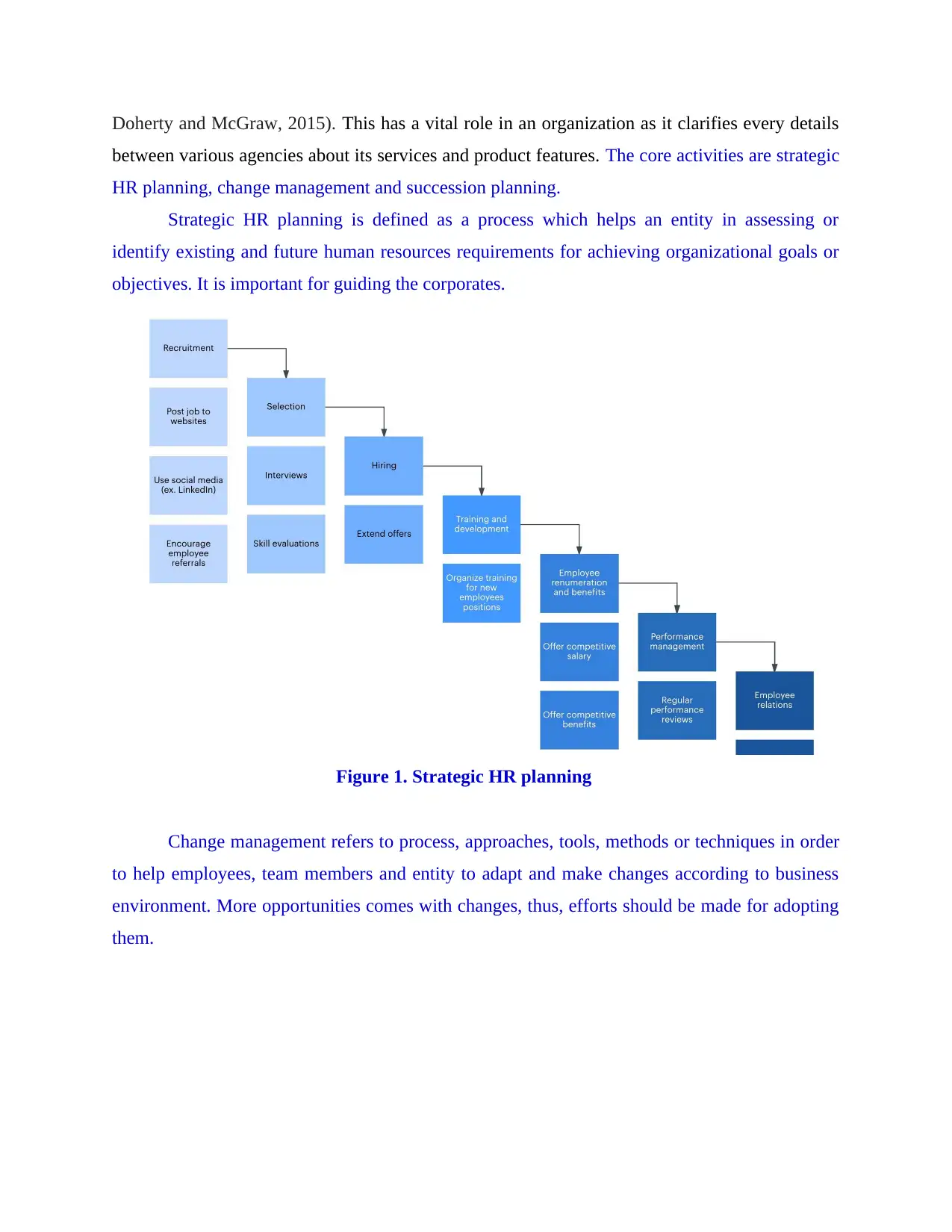
Strategic HR planning is defined as a process which helps an entity in assessing or
identify existing and future human resources requirements for achieving organizational goals or
objectives. It is important for guiding the corporates.
Figure 1. Strategic HR planning
Change management refers to process, approaches, tools, methods or techniques in order
to help employees, team members and entity to adapt and make changes according to business
environment. More opportunities comes with changes, thus, efforts should be made for adopting
them.
between various agencies about its services and product features. The core activities are strategic
HR planning, change management and succession planning.
Strategic HR planning is defined as a process which helps an entity in assessing or
identify existing and future human resources requirements for achieving organizational goals or
objectives. It is important for guiding the corporates.
Figure 1. Strategic HR planning
Change management refers to process, approaches, tools, methods or techniques in order
to help employees, team members and entity to adapt and make changes according to business
environment. More opportunities comes with changes, thus, efforts should be made for adopting
them.
Paraphrase This Document
Need a fresh take? Get an instant paraphrase of this document with our AI Paraphraser
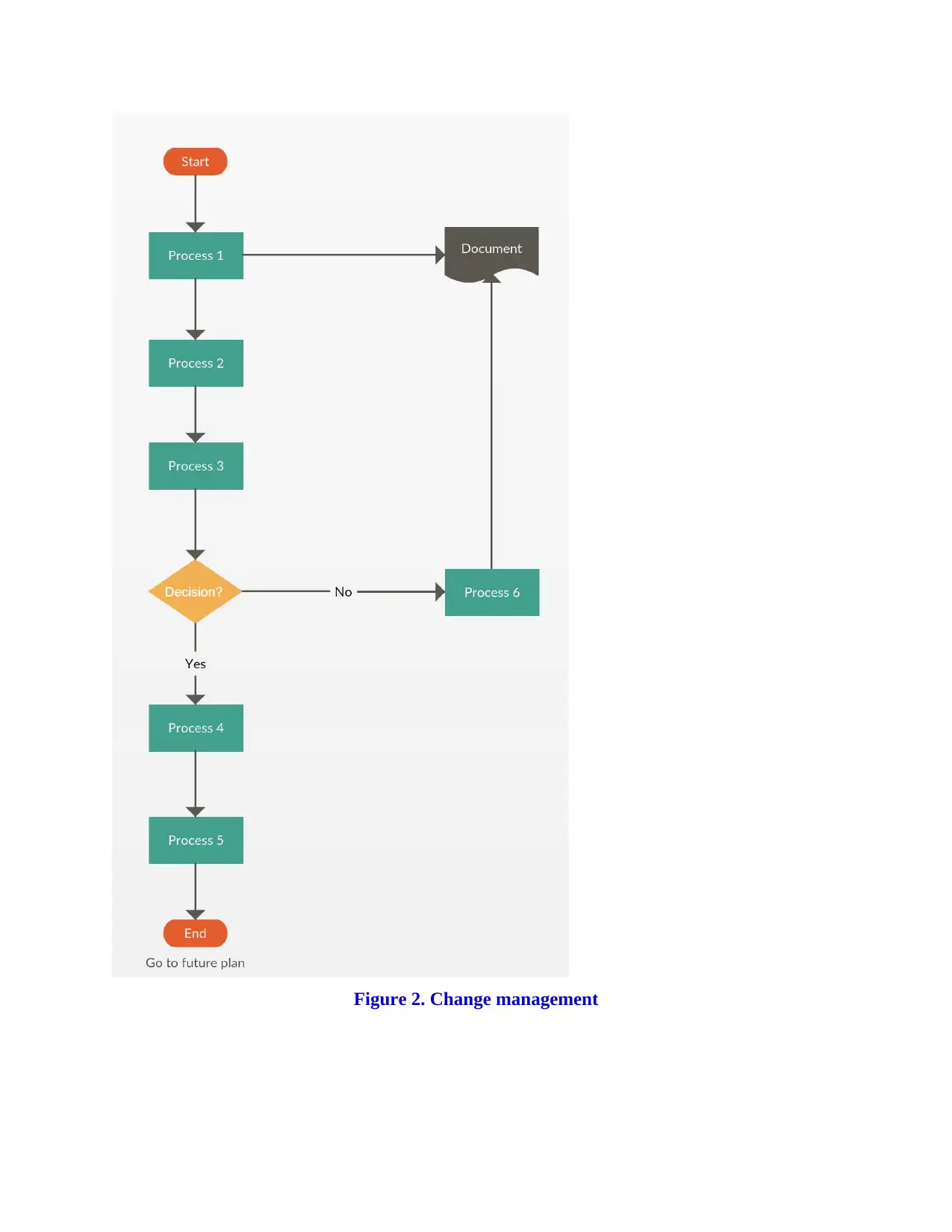
Figure 2. Change management
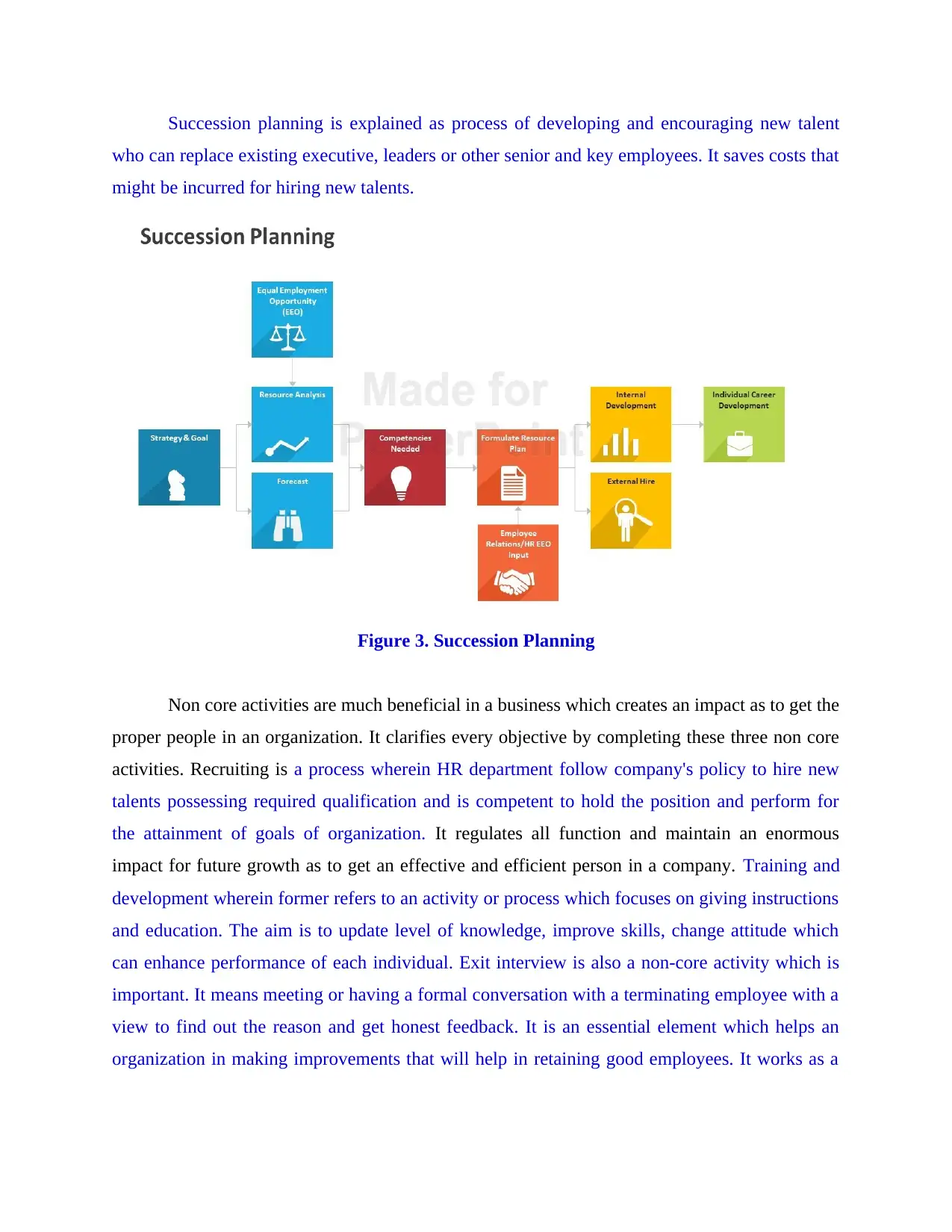
Succession planning is explained as process of developing and encouraging new talent
who can replace existing executive, leaders or other senior and key employees. It saves costs that
might be incurred for hiring new talents.
Figure 3. Succession Planning
Non core activities are much beneficial in a business which creates an impact as to get the
proper people in an organization. It clarifies every objective by completing these three non core
activities. Recruiting is a process wherein HR department follow company's policy to hire new
talents possessing required qualification and is competent to hold the position and perform for
the attainment of goals of organization. It regulates all function and maintain an enormous
impact for future growth as to get an effective and efficient person in a company. Training and
development wherein former refers to an activity or process which focuses on giving instructions
and education. The aim is to update level of knowledge, improve skills, change attitude which
can enhance performance of each individual. Exit interview is also a non-core activity which is
important. It means meeting or having a formal conversation with a terminating employee with a
view to find out the reason and get honest feedback. It is an essential element which helps an
organization in making improvements that will help in retaining good employees. It works as a
who can replace existing executive, leaders or other senior and key employees. It saves costs that
might be incurred for hiring new talents.
Figure 3. Succession Planning
Non core activities are much beneficial in a business which creates an impact as to get the
proper people in an organization. It clarifies every objective by completing these three non core
activities. Recruiting is a process wherein HR department follow company's policy to hire new
talents possessing required qualification and is competent to hold the position and perform for
the attainment of goals of organization. It regulates all function and maintain an enormous
impact for future growth as to get an effective and efficient person in a company. Training and
development wherein former refers to an activity or process which focuses on giving instructions
and education. The aim is to update level of knowledge, improve skills, change attitude which
can enhance performance of each individual. Exit interview is also a non-core activity which is
important. It means meeting or having a formal conversation with a terminating employee with a
view to find out the reason and get honest feedback. It is an essential element which helps an
organization in making improvements that will help in retaining good employees. It works as a
⊘ This is a preview!⊘
Do you want full access?
Subscribe today to unlock all pages.
Trusted by 1+ million students worldwide
checklist which should be included in future policy of companies. Further, it is like a last
opportunity in which employee can be convinced to not to move out of the entity.
Organization maintain every function in a way as to get proper functional relation with
every department. There is a specific structure that HR department in every organization has to
follow irrespective of its nature and size. This provides a framework within which it has to work,
this promotes orderly and smooth functioning. The department tries to maintain pace and co-
ordination with rest of the units. Manpower is the requirement of all areas and HR department is
responsible for recruiting the adequate number of talented people who will help in achieving the
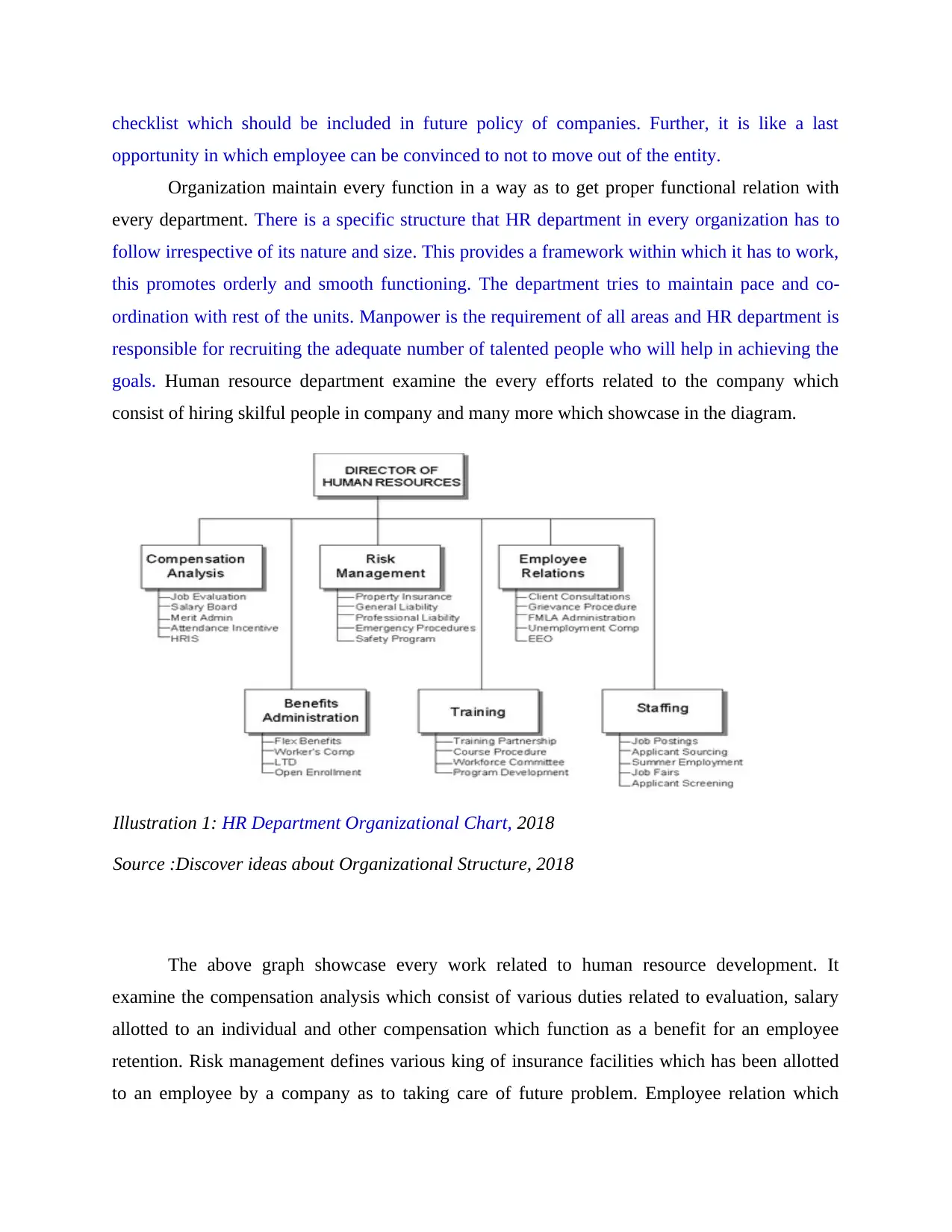
goals. Human resource department examine the every efforts related to the company which
consist of hiring skilful people in company and many more which showcase in the diagram.
The above graph showcase every work related to human resource development. It
examine the compensation analysis which consist of various duties related to evaluation, salary
allotted to an individual and other compensation which function as a benefit for an employee
retention. Risk management defines various king of insurance facilities which has been allotted
to an employee by a company as to taking care of future problem. Employee relation which
Illustration 1: HR Department Organizational Chart, 2018
Source :Discover ideas about Organizational Structure, 2018
opportunity in which employee can be convinced to not to move out of the entity.
Organization maintain every function in a way as to get proper functional relation with
every department. There is a specific structure that HR department in every organization has to
follow irrespective of its nature and size. This provides a framework within which it has to work,
this promotes orderly and smooth functioning. The department tries to maintain pace and co-
ordination with rest of the units. Manpower is the requirement of all areas and HR department is
responsible for recruiting the adequate number of talented people who will help in achieving the
goals. Human resource department examine the every efforts related to the company which
consist of hiring skilful people in company and many more which showcase in the diagram.
The above graph showcase every work related to human resource development. It
examine the compensation analysis which consist of various duties related to evaluation, salary
allotted to an individual and other compensation which function as a benefit for an employee
retention. Risk management defines various king of insurance facilities which has been allotted
to an employee by a company as to taking care of future problem. Employee relation which
Illustration 1: HR Department Organizational Chart, 2018
Source :Discover ideas about Organizational Structure, 2018
Paraphrase This Document
Need a fresh take? Get an instant paraphrase of this document with our AI Paraphraser
works as a growth of an organization and treated as a way of proper horizontal and vertical
communication within the company (Budhwar, 2012). Benefit administration consist of different
positive income which comes from various work done by individual employee as to get an
objective fulfil. Training helps in filling gap between the skills which an employee has and the
skill which a job required. Staffing denotes the job position where and what are the work give
efficient and effectiveness in a company as to achieve an organizational objective in an
appropriate manner.
There are different roles and responsibility assigned to each personnel for core activities.
Strategic HR planning is a crucial process which should be done with utmost care and diligence.
This is involves number of sessions and meetings before finalising on a decision. Planning is a
continuous activity carried frequently to assess the number of employees required for the
position. There may be different vacancies at different levels, thus, planning should be carried
accordingly. Appointing personnel at higher level requires more time and consideration, hence,
high precision is required. Thus, it should be done by HR manager who has previous records of
appointing the same. However, consultation with top management must be taken.
In case of change management, many modifications and alterations occur in business life
which can not be avoided. Moreover, growth opportunities can be explored with these changes.
However, employees at first instance, resist to adapt changes as they become very comfortable in
there working style. There comes the importance of a leader by applying leadership skills to
motivate employees for understanding changes and make necessary adjustments. Succession
planning is about changing the position of an employee and promote them to replace existing
team leaders. The role of encouraging employees to work hard for getting to a higher position is
done by leader, whereas, to replace top executives and key employees, presence of top
management is essential.
Risk can be defined as a probability of uncertainty that can occur in future. There could
be different kind of risks which may posses in different aspects. Core activities also have chances
of success or failure. The potential risks in strategic HR planning are non-availability of required
talent, incurring extra cost, etc. Change management has following risks, works for growth and
function as a protective hand to face all challenges, so building strategies without proper
planning may turn the business activities on loss.
communication within the company (Budhwar, 2012). Benefit administration consist of different
positive income which comes from various work done by individual employee as to get an
objective fulfil. Training helps in filling gap between the skills which an employee has and the
skill which a job required. Staffing denotes the job position where and what are the work give
efficient and effectiveness in a company as to achieve an organizational objective in an
appropriate manner.
There are different roles and responsibility assigned to each personnel for core activities.
Strategic HR planning is a crucial process which should be done with utmost care and diligence.
This is involves number of sessions and meetings before finalising on a decision. Planning is a
continuous activity carried frequently to assess the number of employees required for the
position. There may be different vacancies at different levels, thus, planning should be carried
accordingly. Appointing personnel at higher level requires more time and consideration, hence,
high precision is required. Thus, it should be done by HR manager who has previous records of
appointing the same. However, consultation with top management must be taken.
In case of change management, many modifications and alterations occur in business life
which can not be avoided. Moreover, growth opportunities can be explored with these changes.
However, employees at first instance, resist to adapt changes as they become very comfortable in
there working style. There comes the importance of a leader by applying leadership skills to
motivate employees for understanding changes and make necessary adjustments. Succession
planning is about changing the position of an employee and promote them to replace existing
team leaders. The role of encouraging employees to work hard for getting to a higher position is
done by leader, whereas, to replace top executives and key employees, presence of top
management is essential.
Risk can be defined as a probability of uncertainty that can occur in future. There could
be different kind of risks which may posses in different aspects. Core activities also have chances
of success or failure. The potential risks in strategic HR planning are non-availability of required
talent, incurring extra cost, etc. Change management has following risks, works for growth and
function as a protective hand to face all challenges, so building strategies without proper
planning may turn the business activities on loss.
Estimation Risk factors are many while estimating the cost of a work done in a company.
Outsourcing is one of the vital part of risk as it comprises various factors which involves risk
management as to identify proper skill. Implementation Risk defines as duration to implement a
project and its completion time management, complexity while working towards the objective
and components to enable the successful Implementation of the Project. Ongoing risk defines as
xternal and internal work consist of various risk in an organization and ongoing risk consist of
both which affect a business internally and externally in getting an objective for an organization.
Annual Budget of an organization defines as a plan to keep future in mind for an
organization. Keeping every expenses in mind and designing annual budget involves every
revenue and expenses of a company. A budget is called a a balancing budget when income and
expenditure shows equal amount.
CONCLUSION
From the above mentioned report, it can be analysed that human resource and people
management are the vast term which focus in managing the overall activities of people in a
company. Facing challenges is a part of it which showcase every functionality in a way as to get
the proper planning and resolve at a particular period of time.
Outsourcing is one of the vital part of risk as it comprises various factors which involves risk
management as to identify proper skill. Implementation Risk defines as duration to implement a
project and its completion time management, complexity while working towards the objective
and components to enable the successful Implementation of the Project. Ongoing risk defines as
xternal and internal work consist of various risk in an organization and ongoing risk consist of
both which affect a business internally and externally in getting an objective for an organization.
Annual Budget of an organization defines as a plan to keep future in mind for an
organization. Keeping every expenses in mind and designing annual budget involves every
revenue and expenses of a company. A budget is called a a balancing budget when income and
expenditure shows equal amount.
CONCLUSION
From the above mentioned report, it can be analysed that human resource and people
management are the vast term which focus in managing the overall activities of people in a
company. Facing challenges is a part of it which showcase every functionality in a way as to get
the proper planning and resolve at a particular period of time.
⊘ This is a preview!⊘
Do you want full access?
Subscribe today to unlock all pages.
Trusted by 1+ million students worldwide
REFERENCES
Books and Journal
Michie, J., et.al., 2016. Do we need HR?: Repositioning people management for success.
Springer.
Knies, E. and Leisink, P., 2014. Linking people management and extra‐role behaviour: results of
a longitudinal study. Human Resource Management Journal, 24(1) .pp.57-76.
Books and Journal
Michie, J., et.al., 2016. Do we need HR?: Repositioning people management for success.
Springer.
Knies, E. and Leisink, P., 2014. Linking people management and extra‐role behaviour: results of
a longitudinal study. Human Resource Management Journal, 24(1) .pp.57-76.
Paraphrase This Document
Need a fresh take? Get an instant paraphrase of this document with our AI Paraphraser
Taylor, T., Doherty, A. and McGraw, P., 2015. Managing people in sport organizations: A
strategic human resource management perspective. Routledge.
Kearns, P., 2013. Professional HR: Evidence-based people management and development.
Routledge.
Budhwar, P., 2012. Management of human resources in foreign firms operating in India: the role
of HR in country-specific headquarters. The International Journal of Human Resource
Management. 23(12). pp.2514-2531.
James Sunday Kehinde PhD, A.C.A., 2012. Talent management: Effect on organizational
performance. Journal of Management Research. 4(2). p.178.
Reilly, P. and Williams, T., 2016. Strategic HR: Building the capability to deliver. Routledge.
Kearns, P., 2012. HR strategy: business focused individually centred. Routledge.
Online
About HR department organisational chart. 2018. [online]. Available through:
<https://www.google.co.uk/search?q=hr+department+organisational+chart
%3b&source=lnms&tbm=isch&sa=x&ved=0ahukewiz15x57olhahuuioykhskvdqoq_aui
digb&biw=1319&bih=641#imgrc=8mdqo0tjecyftm:>.
strategic human resource management perspective. Routledge.
Kearns, P., 2013. Professional HR: Evidence-based people management and development.
Routledge.
Budhwar, P., 2012. Management of human resources in foreign firms operating in India: the role
of HR in country-specific headquarters. The International Journal of Human Resource
Management. 23(12). pp.2514-2531.
James Sunday Kehinde PhD, A.C.A., 2012. Talent management: Effect on organizational
performance. Journal of Management Research. 4(2). p.178.
Reilly, P. and Williams, T., 2016. Strategic HR: Building the capability to deliver. Routledge.
Kearns, P., 2012. HR strategy: business focused individually centred. Routledge.
Online
About HR department organisational chart. 2018. [online]. Available through:
<https://www.google.co.uk/search?q=hr+department+organisational+chart
%3b&source=lnms&tbm=isch&sa=x&ved=0ahukewiz15x57olhahuuioykhskvdqoq_aui
digb&biw=1319&bih=641#imgrc=8mdqo0tjecyftm:>.

1 out of 11


Related Documents


Your All-in-One AI-Powered Toolkit for Academic Success.
+13062052269
info@desklib.com
Available 24*7 on WhatsApp / Email
![[object Object]](/_next/static/media/star-bottom.7253800d.svg)
Unlock your academic potential
Copyright © 2020–2025 A2Z Services. All Rights Reserved. Developed and managed by ZUCOL.