Analysis of HRM Practices and Flexibility at Toyota Report
VerifiedAdded on 2020/10/22
|17
|5323
|343
Report
AI Summary
This report provides a comprehensive analysis of Human Resource Management (HRM) practices, using Toyota as a case study. It begins with an overview of HRM models, particularly Guest's model, and contrasts different definitions of HRM, personnel, and industrial relations. The report explores the implications of strategic HRM for line managers and employees. It then delves into organizational flexibility, examining different types of flexibility and the use of flexible working practices from both employee and employer perspectives, considering the impact of labor market changes. The report also addresses workplace discrimination, equal opportunities legislation, and approaches to managing diversity. Furthermore, it compares performance management methods, assesses employee welfare approaches, and discusses the implications of health and safety legislation on HRM practices. The conclusion summarizes the key findings and insights into effective HRM strategies within the context of Toyota's operations.

Managing Human Resources

Paraphrase This Document
Need a fresh take? Get an instant paraphrase of this document with our AI Paraphraser
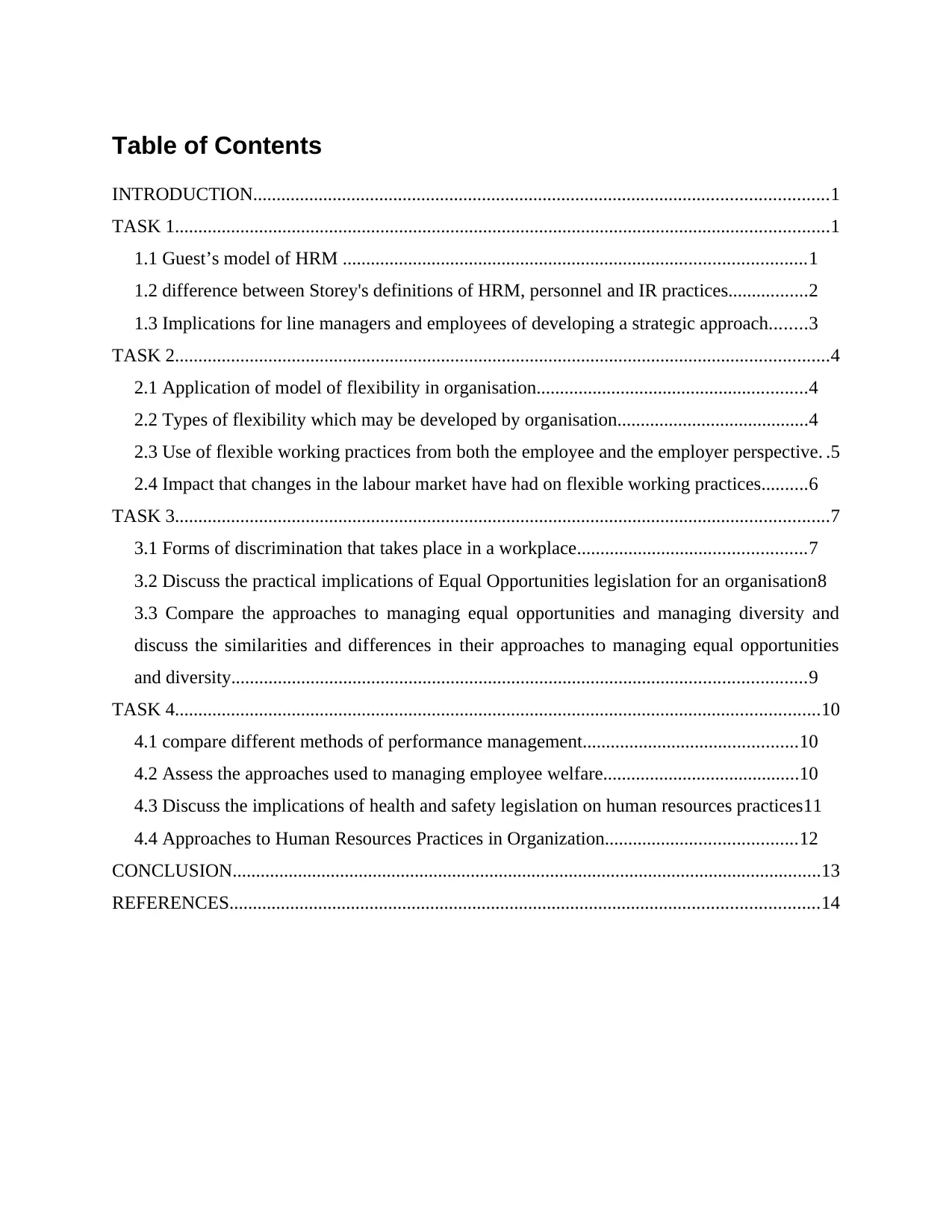
Table of Contents
INTRODUCTION...........................................................................................................................1
TASK 1............................................................................................................................................1
1.1 Guest’s model of HRM ...................................................................................................1
1.2 difference between Storey's definitions of HRM, personnel and IR practices.................2
1.3 Implications for line managers and employees of developing a strategic approach........3
TASK 2............................................................................................................................................4
2.1 Application of model of flexibility in organisation..........................................................4
2.2 Types of flexibility which may be developed by organisation.........................................4
2.3 Use of flexible working practices from both the employee and the employer perspective. .5
2.4 Impact that changes in the labour market have had on flexible working practices..........6
TASK 3............................................................................................................................................7
3.1 Forms of discrimination that takes place in a workplace.................................................7
3.2 Discuss the practical implications of Equal Opportunities legislation for an organisation8
3.3 Compare the approaches to managing equal opportunities and managing diversity and
discuss the similarities and differences in their approaches to managing equal opportunities
and diversity...........................................................................................................................9
TASK 4..........................................................................................................................................10
4.1 compare different methods of performance management..............................................10
4.2 Assess the approaches used to managing employee welfare..........................................10
4.3 Discuss the implications of health and safety legislation on human resources practices11
4.4 Approaches to Human Resources Practices in Organization.........................................12
CONCLUSION..............................................................................................................................13
REFERENCES..............................................................................................................................14
INTRODUCTION...........................................................................................................................1
TASK 1............................................................................................................................................1
1.1 Guest’s model of HRM ...................................................................................................1
1.2 difference between Storey's definitions of HRM, personnel and IR practices.................2
1.3 Implications for line managers and employees of developing a strategic approach........3
TASK 2............................................................................................................................................4
2.1 Application of model of flexibility in organisation..........................................................4
2.2 Types of flexibility which may be developed by organisation.........................................4
2.3 Use of flexible working practices from both the employee and the employer perspective. .5
2.4 Impact that changes in the labour market have had on flexible working practices..........6
TASK 3............................................................................................................................................7
3.1 Forms of discrimination that takes place in a workplace.................................................7
3.2 Discuss the practical implications of Equal Opportunities legislation for an organisation8
3.3 Compare the approaches to managing equal opportunities and managing diversity and
discuss the similarities and differences in their approaches to managing equal opportunities
and diversity...........................................................................................................................9
TASK 4..........................................................................................................................................10
4.1 compare different methods of performance management..............................................10
4.2 Assess the approaches used to managing employee welfare..........................................10
4.3 Discuss the implications of health and safety legislation on human resources practices11
4.4 Approaches to Human Resources Practices in Organization.........................................12
CONCLUSION..............................................................................................................................13
REFERENCES..............................................................................................................................14
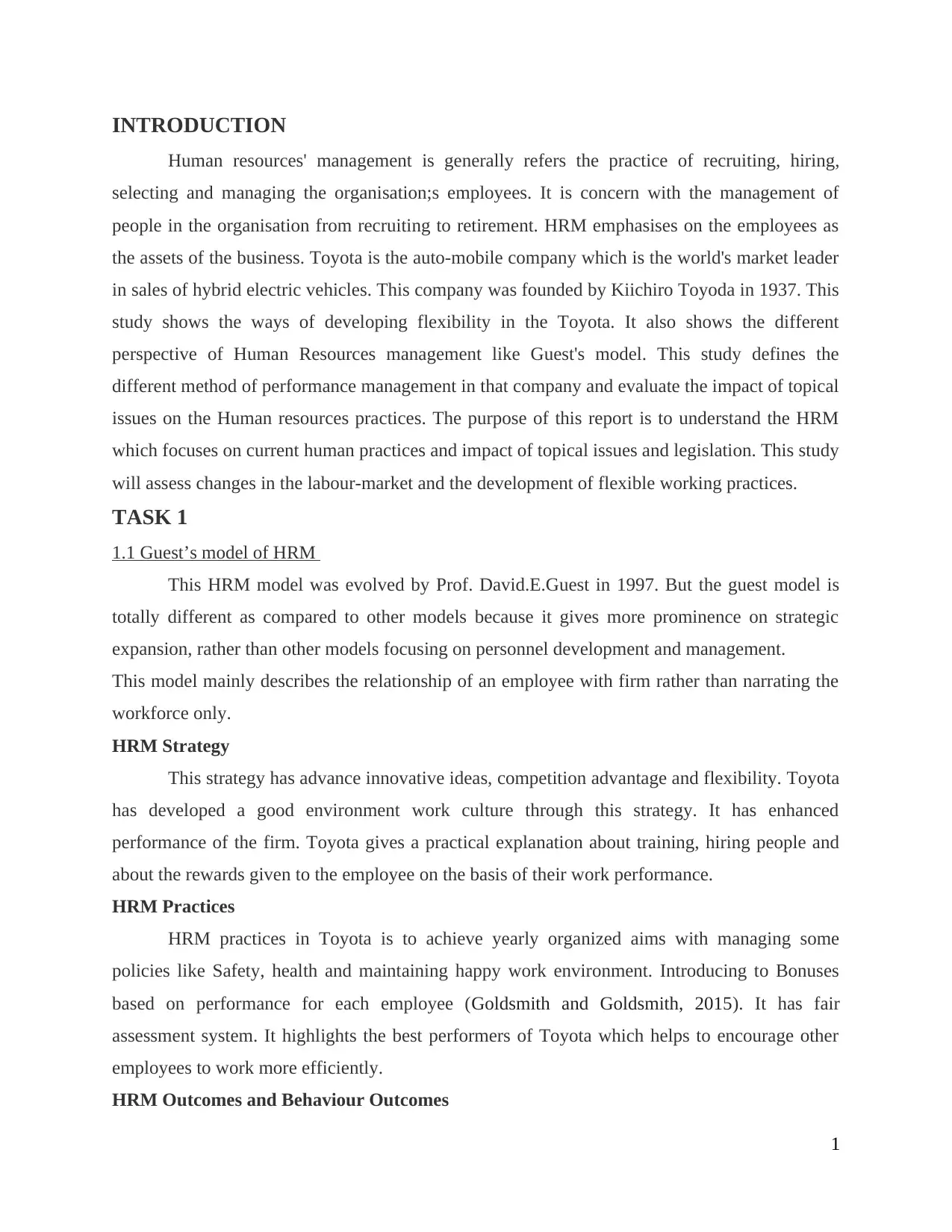
INTRODUCTION
Human resources' management is generally refers the practice of recruiting, hiring,
selecting and managing the organisation;s employees. It is concern with the management of
people in the organisation from recruiting to retirement. HRM emphasises on the employees as
the assets of the business. Toyota is the auto-mobile company which is the world's market leader
in sales of hybrid electric vehicles. This company was founded by Kiichiro Toyoda in 1937. This
study shows the ways of developing flexibility in the Toyota. It also shows the different
perspective of Human Resources management like Guest's model. This study defines the
different method of performance management in that company and evaluate the impact of topical
issues on the Human resources practices. The purpose of this report is to understand the HRM
which focuses on current human practices and impact of topical issues and legislation. This study
will assess changes in the labour-market and the development of flexible working practices.
TASK 1
1.1 Guest’s model of HRM
This HRM model was evolved by Prof. David.E.Guest in 1997. But the guest model is
totally different as compared to other models because it gives more prominence on strategic
expansion, rather than other models focusing on personnel development and management.
This model mainly describes the relationship of an employee with firm rather than narrating the
workforce only.
HRM Strategy
This strategy has advance innovative ideas, competition advantage and flexibility. Toyota
has developed a good environment work culture through this strategy. It has enhanced
performance of the firm. Toyota gives a practical explanation about training, hiring people and
about the rewards given to the employee on the basis of their work performance.
HRM Practices
HRM practices in Toyota is to achieve yearly organized aims with managing some
policies like Safety, health and maintaining happy work environment. Introducing to Bonuses
based on performance for each employee (Goldsmith and Goldsmith, 2015). It has fair
assessment system. It highlights the best performers of Toyota which helps to encourage other
employees to work more efficiently.
HRM Outcomes and Behaviour Outcomes
1
Human resources' management is generally refers the practice of recruiting, hiring,
selecting and managing the organisation;s employees. It is concern with the management of
people in the organisation from recruiting to retirement. HRM emphasises on the employees as
the assets of the business. Toyota is the auto-mobile company which is the world's market leader
in sales of hybrid electric vehicles. This company was founded by Kiichiro Toyoda in 1937. This
study shows the ways of developing flexibility in the Toyota. It also shows the different
perspective of Human Resources management like Guest's model. This study defines the
different method of performance management in that company and evaluate the impact of topical
issues on the Human resources practices. The purpose of this report is to understand the HRM
which focuses on current human practices and impact of topical issues and legislation. This study
will assess changes in the labour-market and the development of flexible working practices.
TASK 1
1.1 Guest’s model of HRM
This HRM model was evolved by Prof. David.E.Guest in 1997. But the guest model is
totally different as compared to other models because it gives more prominence on strategic
expansion, rather than other models focusing on personnel development and management.
This model mainly describes the relationship of an employee with firm rather than narrating the
workforce only.
HRM Strategy
This strategy has advance innovative ideas, competition advantage and flexibility. Toyota
has developed a good environment work culture through this strategy. It has enhanced
performance of the firm. Toyota gives a practical explanation about training, hiring people and
about the rewards given to the employee on the basis of their work performance.
HRM Practices
HRM practices in Toyota is to achieve yearly organized aims with managing some
policies like Safety, health and maintaining happy work environment. Introducing to Bonuses
based on performance for each employee (Goldsmith and Goldsmith, 2015). It has fair
assessment system. It highlights the best performers of Toyota which helps to encourage other
employees to work more efficiently.
HRM Outcomes and Behaviour Outcomes
1
⊘ This is a preview!⊘
Do you want full access?
Subscribe today to unlock all pages.

Trusted by 1+ million students worldwide
HRM Outcomes main motive is to expand the outcome of this firm which is performs
very well and along with it, it even boosts the employee, financial and company's outcome by
planning, controlling, staffing, leading, organizing and managing employees in Toyota.
Employee's behavioural outcome is managed by giving specific training in result is expected to
attain the job performance.
Performance Outcome and Financial Outcome
Performance of the employee indirectly effects the financial outcome (Rothwell, Hohne
and King, 2018). So the performance of the employee always sets an academic success for
Toyota which in turn leads to maximum Financial outcome of the firm. Like in 2018 it has lead
to selling 29,463 units more than previous year. Each year its financial graph is increasing.
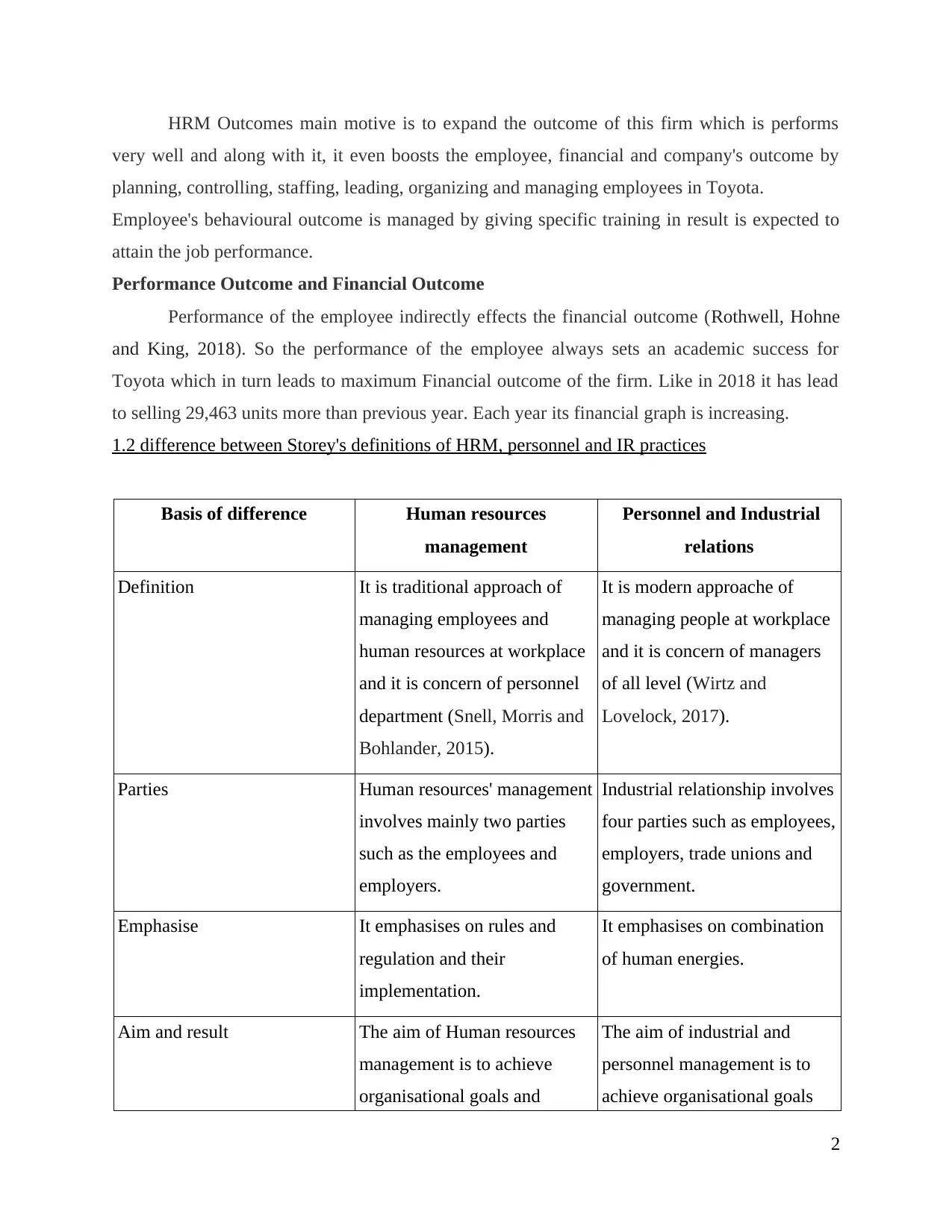
1.2 difference between Storey's definitions of HRM, personnel and IR practices
Basis of difference Human resources
management
Personnel and Industrial
relations
Definition It is traditional approach of
managing employees and
human resources at workplace
and it is concern of personnel
department (Snell, Morris and
Bohlander, 2015).
It is modern approache of
managing people at workplace
and it is concern of managers
of all level (Wirtz and
Lovelock, 2017).
Parties Human resources' management
involves mainly two parties
such as the employees and
employers.
Industrial relationship involves
four parties such as employees,
employers, trade unions and
government.
Emphasise It emphasises on rules and
regulation and their
implementation.
It emphasises on combination
of human energies.
Aim and result The aim of Human resources
management is to achieve
organisational goals and
The aim of industrial and
personnel management is to
achieve organisational goals
2
very well and along with it, it even boosts the employee, financial and company's outcome by
planning, controlling, staffing, leading, organizing and managing employees in Toyota.
Employee's behavioural outcome is managed by giving specific training in result is expected to
attain the job performance.
Performance Outcome and Financial Outcome
Performance of the employee indirectly effects the financial outcome (Rothwell, Hohne
and King, 2018). So the performance of the employee always sets an academic success for
Toyota which in turn leads to maximum Financial outcome of the firm. Like in 2018 it has lead
to selling 29,463 units more than previous year. Each year its financial graph is increasing.
1.2 difference between Storey's definitions of HRM, personnel and IR practices
Basis of difference Human resources
management
Personnel and Industrial
relations
Definition It is traditional approach of
managing employees and
human resources at workplace
and it is concern of personnel
department (Snell, Morris and
Bohlander, 2015).
It is modern approache of
managing people at workplace
and it is concern of managers
of all level (Wirtz and
Lovelock, 2017).
Parties Human resources' management
involves mainly two parties
such as the employees and
employers.
Industrial relationship involves
four parties such as employees,
employers, trade unions and
government.
Emphasise It emphasises on rules and
regulation and their
implementation.
It emphasises on combination
of human energies.
Aim and result The aim of Human resources
management is to achieve
organisational goals and
The aim of industrial and
personnel management is to
achieve organisational goals
2
Paraphrase This Document
Need a fresh take? Get an instant paraphrase of this document with our AI Paraphraser
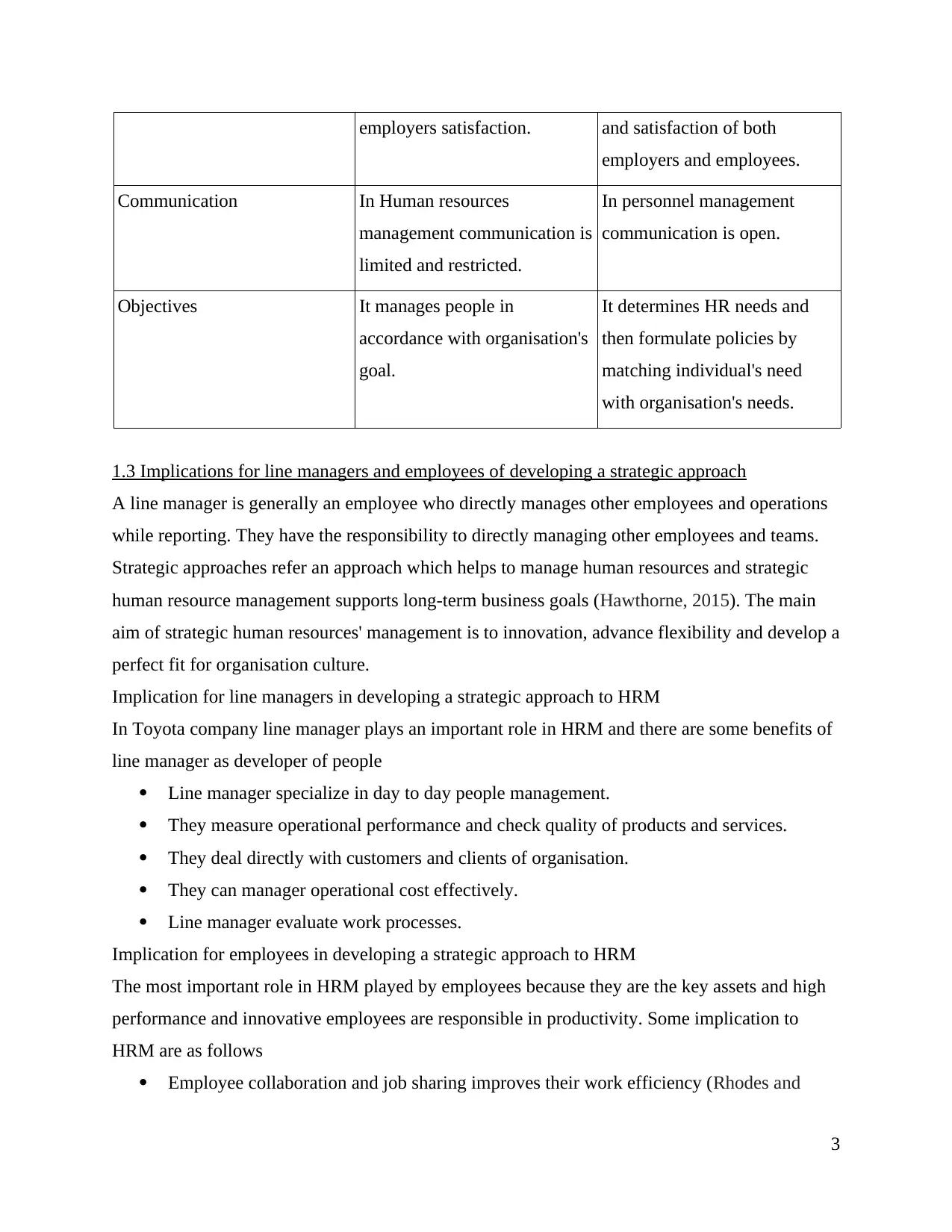
employers satisfaction. and satisfaction of both
employers and employees.
Communication In Human resources
management communication is
limited and restricted.
In personnel management
communication is open.
Objectives It manages people in
accordance with organisation's
goal.
It determines HR needs and
then formulate policies by
matching individual's need
with organisation's needs.
1.3 Implications for line managers and employees of developing a strategic approach
A line manager is generally an employee who directly manages other employees and operations
while reporting. They have the responsibility to directly managing other employees and teams.
Strategic approaches refer an approach which helps to manage human resources and strategic
human resource management supports long-term business goals (Hawthorne, 2015). The main
aim of strategic human resources' management is to innovation, advance flexibility and develop a
perfect fit for organisation culture.
Implication for line managers in developing a strategic approach to HRM
In Toyota company line manager plays an important role in HRM and there are some benefits of
line manager as developer of people
Line manager specialize in day to day people management.
They measure operational performance and check quality of products and services.
They deal directly with customers and clients of organisation.
They can manager operational cost effectively.
Line manager evaluate work processes.
Implication for employees in developing a strategic approach to HRM
The most important role in HRM played by employees because they are the key assets and high
performance and innovative employees are responsible in productivity. Some implication to
HRM are as follows
Employee collaboration and job sharing improves their work efficiency (Rhodes and
3
employers and employees.
Communication In Human resources
management communication is
limited and restricted.
In personnel management
communication is open.
Objectives It manages people in
accordance with organisation's
goal.
It determines HR needs and
then formulate policies by
matching individual's need
with organisation's needs.
1.3 Implications for line managers and employees of developing a strategic approach
A line manager is generally an employee who directly manages other employees and operations
while reporting. They have the responsibility to directly managing other employees and teams.
Strategic approaches refer an approach which helps to manage human resources and strategic
human resource management supports long-term business goals (Hawthorne, 2015). The main
aim of strategic human resources' management is to innovation, advance flexibility and develop a
perfect fit for organisation culture.
Implication for line managers in developing a strategic approach to HRM
In Toyota company line manager plays an important role in HRM and there are some benefits of
line manager as developer of people
Line manager specialize in day to day people management.
They measure operational performance and check quality of products and services.
They deal directly with customers and clients of organisation.
They can manager operational cost effectively.
Line manager evaluate work processes.
Implication for employees in developing a strategic approach to HRM
The most important role in HRM played by employees because they are the key assets and high
performance and innovative employees are responsible in productivity. Some implication to
HRM are as follows
Employee collaboration and job sharing improves their work efficiency (Rhodes and
3
Rhodes, 2017).
Feedback and effective communication from employees helps in reducing errors and
frustration at work.s
Employees helps in developing performance which lead continuous improvement.
TASK 2
2.1 Application of model of flexibility in organisation
Flexibility of HRM refers the ability of an organisation to make their worker flexible and able to
adapt other duties and responsibilities within the company (Wilton, 2016). Firm uses different
forms of flexibility to improve the use of the human resources. The main aim of model of
flexibility is to manage the work-life with the home-life of employees and make them satisfied.
Toyota company uses model of flexibility of Atkinson by adopting the different ways like
Job security- For making organisation flexible and maintaining work-life with home-
life, company can implement different policies which give security to employees. By providing
job security employees become flexible. Company can provide benefits like appropriate pay for
their position which can help employees in achieving long-term career goals. By respecting and
caring employees, company build trust between their staff which results in better output, stronger
company reputation and reduce turnover.
Flexible work hour- Time- agnostic work means flexible time which allows employees
to choose time accordingly. By applying this strategy firm enables in reducing cost and
increasing productivity by satisfying their employees (Rambe and Setyawati, 2015). It results in
lower level of stress, psychological distress and higher job satisfaction.
Job sharing- Job sharing is the best method of applying flexibility in work place. Job
sharing means the arrangement of work in which two employees voluntarily share their work by
choosing work time accordingly. For example company can hire two employees on part-time
instead of choosing one employee on full-time.
2.2 Types of flexibility which may be developed by organisation
There are generally five types of flexibility which company may develop
Functional flexibility- Functional flexibility refers the ability of organisation to be multi-
functional and the ability to make their employee multi functional for other duties and
responsibilities within the company. The main aim of Toyota is to make employees multi-skilled
so that they can perform various types of tasks whenever required. For example an employee
4
Feedback and effective communication from employees helps in reducing errors and
frustration at work.s
Employees helps in developing performance which lead continuous improvement.
TASK 2
2.1 Application of model of flexibility in organisation
Flexibility of HRM refers the ability of an organisation to make their worker flexible and able to
adapt other duties and responsibilities within the company (Wilton, 2016). Firm uses different
forms of flexibility to improve the use of the human resources. The main aim of model of
flexibility is to manage the work-life with the home-life of employees and make them satisfied.
Toyota company uses model of flexibility of Atkinson by adopting the different ways like
Job security- For making organisation flexible and maintaining work-life with home-
life, company can implement different policies which give security to employees. By providing
job security employees become flexible. Company can provide benefits like appropriate pay for
their position which can help employees in achieving long-term career goals. By respecting and
caring employees, company build trust between their staff which results in better output, stronger
company reputation and reduce turnover.
Flexible work hour- Time- agnostic work means flexible time which allows employees
to choose time accordingly. By applying this strategy firm enables in reducing cost and
increasing productivity by satisfying their employees (Rambe and Setyawati, 2015). It results in
lower level of stress, psychological distress and higher job satisfaction.
Job sharing- Job sharing is the best method of applying flexibility in work place. Job
sharing means the arrangement of work in which two employees voluntarily share their work by
choosing work time accordingly. For example company can hire two employees on part-time
instead of choosing one employee on full-time.
2.2 Types of flexibility which may be developed by organisation
There are generally five types of flexibility which company may develop
Functional flexibility- Functional flexibility refers the ability of organisation to be multi-
functional and the ability to make their employee multi functional for other duties and
responsibilities within the company. The main aim of Toyota is to make employees multi-skilled
so that they can perform various types of tasks whenever required. For example an employee
4
⊘ This is a preview!⊘
Do you want full access?
Subscribe today to unlock all pages.
Trusted by 1+ million students worldwide
who knows the work A and work B also and a project has come up for function B but the man
power is less over there then instead of hiring new employee, company can deploy the existing
employee to work in function B.
Numeric flexibility-A numeric flexibility is also known as outsourcing. The numerical
flexibility refers the capacity of company to adjust their human resources to variation in demand.
There is an increased use of part-timers, temporary and short-term staffs in Toyota. The main
aim of numerical flexibility is to reduce firm's costs.
Financial flexibility- Financial flexibility refers to achievement of flexibility through the
pay and reward method. By financial flexibility Toyota make themselves able to survive tough
economic times and take advantage of unexpected investment opportunities.
Temporal flexibility- Temporal flexibility defines the difference and variation between
the timing of the work or working hours of company and the number of hours worked by the
employees. There are typical forms are overtime, seasonal- hours and annual hours contracts.
The aim of company of temporal flexible is to reduce conflicts between work and family life.
Locational flexibility- Workplace flexibility is the ability for workers to work and
collaborate from different location and even different countries. Toyota allows their employees
to work from different office locations, home and any other location. The aim of locational
flexibility is to save money and time.
2.3 Use of flexible working practices from both the employee and the employer perspective
There are some flexible working practices which Toyota provides their employees like
part-time, job sharing, shift working, home working, teleworking etc (Fawcett and Mullan,
2018). Flexible working boost employees morale and improve their physical and mental well
being.
Use for employees-
Toyota provide their employees home-working facility which make employees happier
and productive.
By getting the opportunity to work more flexible hours and fewer hours they pay off big
time in the long run in company.
By providing the job sharing flexibility Toyota encourages employees to help each
others. This create a happy workplace and more supportive and connected team within
the company.
5
power is less over there then instead of hiring new employee, company can deploy the existing
employee to work in function B.
Numeric flexibility-A numeric flexibility is also known as outsourcing. The numerical
flexibility refers the capacity of company to adjust their human resources to variation in demand.
There is an increased use of part-timers, temporary and short-term staffs in Toyota. The main
aim of numerical flexibility is to reduce firm's costs.
Financial flexibility- Financial flexibility refers to achievement of flexibility through the
pay and reward method. By financial flexibility Toyota make themselves able to survive tough
economic times and take advantage of unexpected investment opportunities.
Temporal flexibility- Temporal flexibility defines the difference and variation between
the timing of the work or working hours of company and the number of hours worked by the
employees. There are typical forms are overtime, seasonal- hours and annual hours contracts.
The aim of company of temporal flexible is to reduce conflicts between work and family life.
Locational flexibility- Workplace flexibility is the ability for workers to work and
collaborate from different location and even different countries. Toyota allows their employees
to work from different office locations, home and any other location. The aim of locational
flexibility is to save money and time.
2.3 Use of flexible working practices from both the employee and the employer perspective
There are some flexible working practices which Toyota provides their employees like
part-time, job sharing, shift working, home working, teleworking etc (Fawcett and Mullan,
2018). Flexible working boost employees morale and improve their physical and mental well
being.
Use for employees-
Toyota provide their employees home-working facility which make employees happier
and productive.
By getting the opportunity to work more flexible hours and fewer hours they pay off big
time in the long run in company.
By providing the job sharing flexibility Toyota encourages employees to help each
others. This create a happy workplace and more supportive and connected team within
the company.
5
Paraphrase This Document
Need a fresh take? Get an instant paraphrase of this document with our AI Paraphraser
By providing flexible work practice like part-time and job sharing company allows
employees to take break whenever they need. It allows them to work in an environment
that is accordingly, enhance their productivity.
By getting flexible working hours employees can live their personal life with the job life
which make them stress free and happy.
Uses for employers
Company provides their employees home-working facility which reduces turnover rates.
Working from home reduces unnecessary expenses like travelling expenses.
By offering flexible working practices company attracts employees and then hiring the
good and appropriate employees it increases its talent pool.
It increases employees morale, engagement and commitment to the organisation.
By providing the flexible working practices company reduce turnover of valued staff.
It reduces absenteeism and tardiness in organisation.
2.4 Impact that changes in the labour market have had on flexible working practices
The labour market is the place where employer and the people come together foe bargain for
wages. The quantity or number of people which want to work, depends upon the level of pay that
employers offer (Bidwell, 2017). Labour market flexibility refers the ability of labour to respond
to changes in market condition like changes in the demand for labour rate. Changing in labour
market and labour rate affects-
Productivity- Changes in labour rate affect the productivity of the organisation. If a
manager increases the labour rate then it will increase the organisation cost which will decrease
the profit and productivity of firm. Changes in demand for specific goods and services affect the
income of the workers who make those goods and services.
Labour market demographic- Changing in the labour market and labour rates will lead
the unemployment. Employers are the demander in labour market and workers are the suppliers
in labour market. Both plays an important role in labour market.
Work life balance or recognition is important because it helps in reducing stress. A good work
life balance of employees leads to increase productivity, lower absenteeism and less stressed
workforce.
6
employees to take break whenever they need. It allows them to work in an environment
that is accordingly, enhance their productivity.
By getting flexible working hours employees can live their personal life with the job life
which make them stress free and happy.
Uses for employers
Company provides their employees home-working facility which reduces turnover rates.
Working from home reduces unnecessary expenses like travelling expenses.
By offering flexible working practices company attracts employees and then hiring the
good and appropriate employees it increases its talent pool.
It increases employees morale, engagement and commitment to the organisation.
By providing the flexible working practices company reduce turnover of valued staff.
It reduces absenteeism and tardiness in organisation.
2.4 Impact that changes in the labour market have had on flexible working practices
The labour market is the place where employer and the people come together foe bargain for
wages. The quantity or number of people which want to work, depends upon the level of pay that
employers offer (Bidwell, 2017). Labour market flexibility refers the ability of labour to respond
to changes in market condition like changes in the demand for labour rate. Changing in labour
market and labour rate affects-
Productivity- Changes in labour rate affect the productivity of the organisation. If a
manager increases the labour rate then it will increase the organisation cost which will decrease
the profit and productivity of firm. Changes in demand for specific goods and services affect the
income of the workers who make those goods and services.
Labour market demographic- Changing in the labour market and labour rates will lead
the unemployment. Employers are the demander in labour market and workers are the suppliers
in labour market. Both plays an important role in labour market.
Work life balance or recognition is important because it helps in reducing stress. A good work
life balance of employees leads to increase productivity, lower absenteeism and less stressed
workforce.
6
TASK 3
3.1 Forms of discrimination that takes place in a workplace
There are various forms of discrimination that take place in any workplace. Some among them
are based on gender, race, religion, education, social belief, age and disability. Genetic
information, pregnancy and their relationship with another person. This is like doing injustice
with some people belonging to this. Equal pay compensation describes that though having same
experience they do not provide same pay scale to both the candidates who got selected. And
some even offends the candidates while interview.
Gender- Like to only select females or only males as preferable to them comes under
gender discrimination.
Education- Many employers accepting you only if you are having specific degree or
level of education to crack the interview rounds.
Toyota motor credit has done with paying $21.9 million as a recompensate to
several of Asian, American-African and pacific Islander customers to charge them excessive
rates on auto-loans as compared to white borrowers said by government of U.S. With equivalent
reliable. Hence, with a new mission known as “ Start your impossible” Toyota has come out with
a different aspect to commit to 'facing challenges of the society' to fight against Discrimination in
2018 while supporting the company's succeeding growth phase. This had a negative impact of it
people.
Where-as until two years to go for 2020 Olympics, it is supporting Para-Sports for Para-
Athletes which means a person with physical, visionary and intellectual disabilities is eligible for
Para-sports. Toyota is supporting Paralympic sports by contributing Paralympic-Auto mobiles to
create a comprehensive society which will further encourage interest in para-sports everywhere
in world by providing “flexibility for all”. This led to gain back trust of people towards Toyota
after the case of discrimination filed against Toyota Motor Corporation.
Akio Toyoda the president of Toyota Motor Corporation further added his point at
focusing on the Paralympics that they have become even more devoted to providing flexibility
for all people. The AODA was introduced which means “Accessibility for Ontarians with
disability Act 2005”.
This form clarifies the policy of the company related with activities of meeting the
opportunity to fulfil needs of disabled persons. This policy has been introduced to recognize,
7
3.1 Forms of discrimination that takes place in a workplace
There are various forms of discrimination that take place in any workplace. Some among them
are based on gender, race, religion, education, social belief, age and disability. Genetic
information, pregnancy and their relationship with another person. This is like doing injustice
with some people belonging to this. Equal pay compensation describes that though having same
experience they do not provide same pay scale to both the candidates who got selected. And
some even offends the candidates while interview.
Gender- Like to only select females or only males as preferable to them comes under
gender discrimination.
Education- Many employers accepting you only if you are having specific degree or
level of education to crack the interview rounds.
Toyota motor credit has done with paying $21.9 million as a recompensate to
several of Asian, American-African and pacific Islander customers to charge them excessive
rates on auto-loans as compared to white borrowers said by government of U.S. With equivalent
reliable. Hence, with a new mission known as “ Start your impossible” Toyota has come out with
a different aspect to commit to 'facing challenges of the society' to fight against Discrimination in
2018 while supporting the company's succeeding growth phase. This had a negative impact of it
people.
Where-as until two years to go for 2020 Olympics, it is supporting Para-Sports for Para-
Athletes which means a person with physical, visionary and intellectual disabilities is eligible for
Para-sports. Toyota is supporting Paralympic sports by contributing Paralympic-Auto mobiles to
create a comprehensive society which will further encourage interest in para-sports everywhere
in world by providing “flexibility for all”. This led to gain back trust of people towards Toyota
after the case of discrimination filed against Toyota Motor Corporation.
Akio Toyoda the president of Toyota Motor Corporation further added his point at
focusing on the Paralympics that they have become even more devoted to providing flexibility
for all people. The AODA was introduced which means “Accessibility for Ontarians with
disability Act 2005”.
This form clarifies the policy of the company related with activities of meeting the
opportunity to fulfil needs of disabled persons. This policy has been introduced to recognize,
7
⊘ This is a preview!⊘
Do you want full access?
Subscribe today to unlock all pages.
Trusted by 1+ million students worldwide
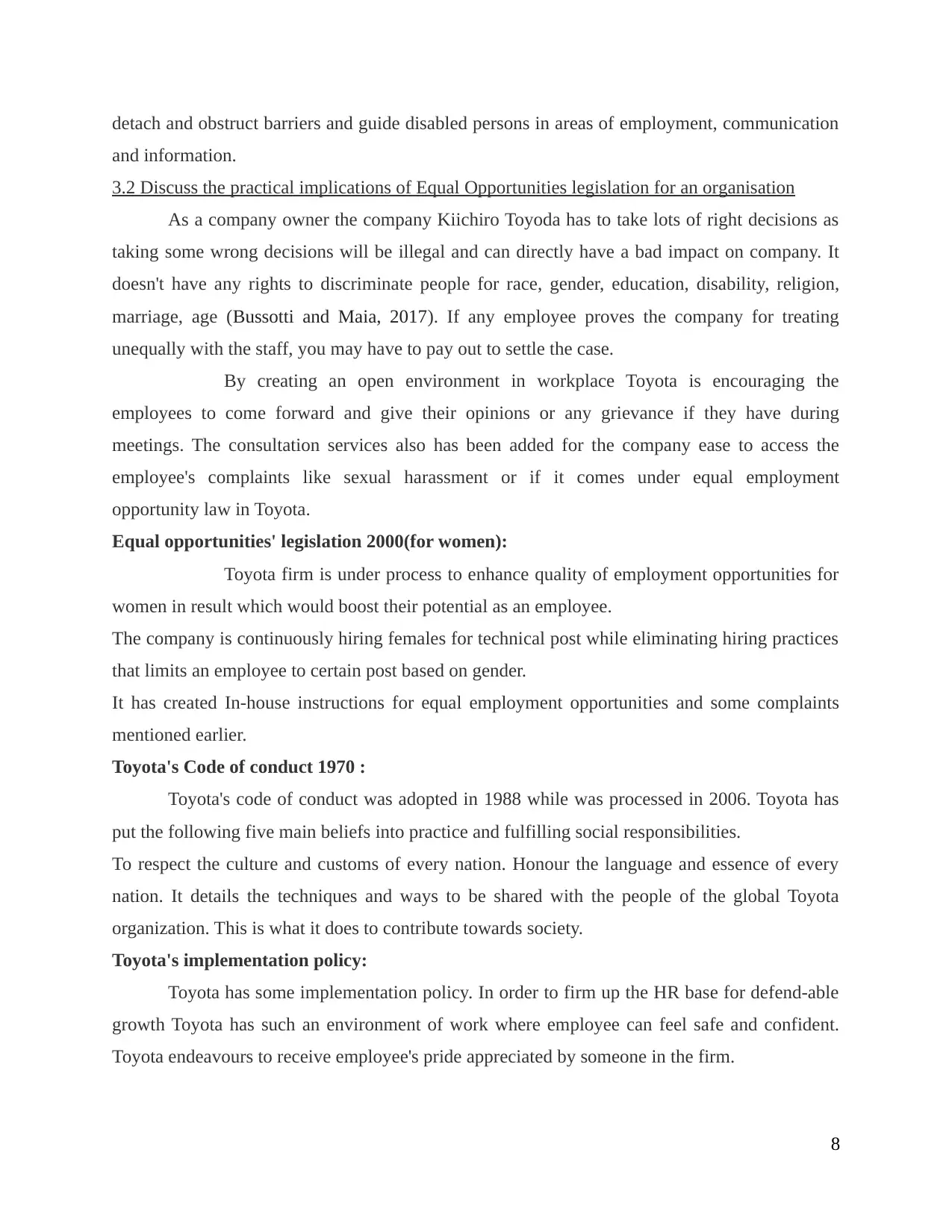
detach and obstruct barriers and guide disabled persons in areas of employment, communication
and information.
3.2 Discuss the practical implications of Equal Opportunities legislation for an organisation
As a company owner the company Kiichiro Toyoda has to take lots of right decisions as
taking some wrong decisions will be illegal and can directly have a bad impact on company. It
doesn't have any rights to discriminate people for race, gender, education, disability, religion,
marriage, age (Bussotti and Maia, 2017). If any employee proves the company for treating
unequally with the staff, you may have to pay out to settle the case.
By creating an open environment in workplace Toyota is encouraging the
employees to come forward and give their opinions or any grievance if they have during
meetings. The consultation services also has been added for the company ease to access the
employee's complaints like sexual harassment or if it comes under equal employment
opportunity law in Toyota.
Equal opportunities' legislation 2000(for women):
Toyota firm is under process to enhance quality of employment opportunities for
women in result which would boost their potential as an employee.
The company is continuously hiring females for technical post while eliminating hiring practices
that limits an employee to certain post based on gender.
It has created In-house instructions for equal employment opportunities and some complaints
mentioned earlier.
Toyota's Code of conduct 1970 :
Toyota's code of conduct was adopted in 1988 while was processed in 2006. Toyota has
put the following five main beliefs into practice and fulfilling social responsibilities.
To respect the culture and customs of every nation. Honour the language and essence of every
nation. It details the techniques and ways to be shared with the people of the global Toyota
organization. This is what it does to contribute towards society.
Toyota's implementation policy:
Toyota has some implementation policy. In order to firm up the HR base for defend-able
growth Toyota has such an environment of work where employee can feel safe and confident.
Toyota endeavours to receive employee's pride appreciated by someone in the firm.
8
and information.
3.2 Discuss the practical implications of Equal Opportunities legislation for an organisation
As a company owner the company Kiichiro Toyoda has to take lots of right decisions as
taking some wrong decisions will be illegal and can directly have a bad impact on company. It
doesn't have any rights to discriminate people for race, gender, education, disability, religion,
marriage, age (Bussotti and Maia, 2017). If any employee proves the company for treating
unequally with the staff, you may have to pay out to settle the case.
By creating an open environment in workplace Toyota is encouraging the
employees to come forward and give their opinions or any grievance if they have during
meetings. The consultation services also has been added for the company ease to access the
employee's complaints like sexual harassment or if it comes under equal employment
opportunity law in Toyota.
Equal opportunities' legislation 2000(for women):
Toyota firm is under process to enhance quality of employment opportunities for
women in result which would boost their potential as an employee.
The company is continuously hiring females for technical post while eliminating hiring practices
that limits an employee to certain post based on gender.
It has created In-house instructions for equal employment opportunities and some complaints
mentioned earlier.
Toyota's Code of conduct 1970 :
Toyota's code of conduct was adopted in 1988 while was processed in 2006. Toyota has
put the following five main beliefs into practice and fulfilling social responsibilities.
To respect the culture and customs of every nation. Honour the language and essence of every
nation. It details the techniques and ways to be shared with the people of the global Toyota
organization. This is what it does to contribute towards society.
Toyota's implementation policy:
Toyota has some implementation policy. In order to firm up the HR base for defend-able
growth Toyota has such an environment of work where employee can feel safe and confident.
Toyota endeavours to receive employee's pride appreciated by someone in the firm.
8
Paraphrase This Document
Need a fresh take? Get an instant paraphrase of this document with our AI Paraphraser
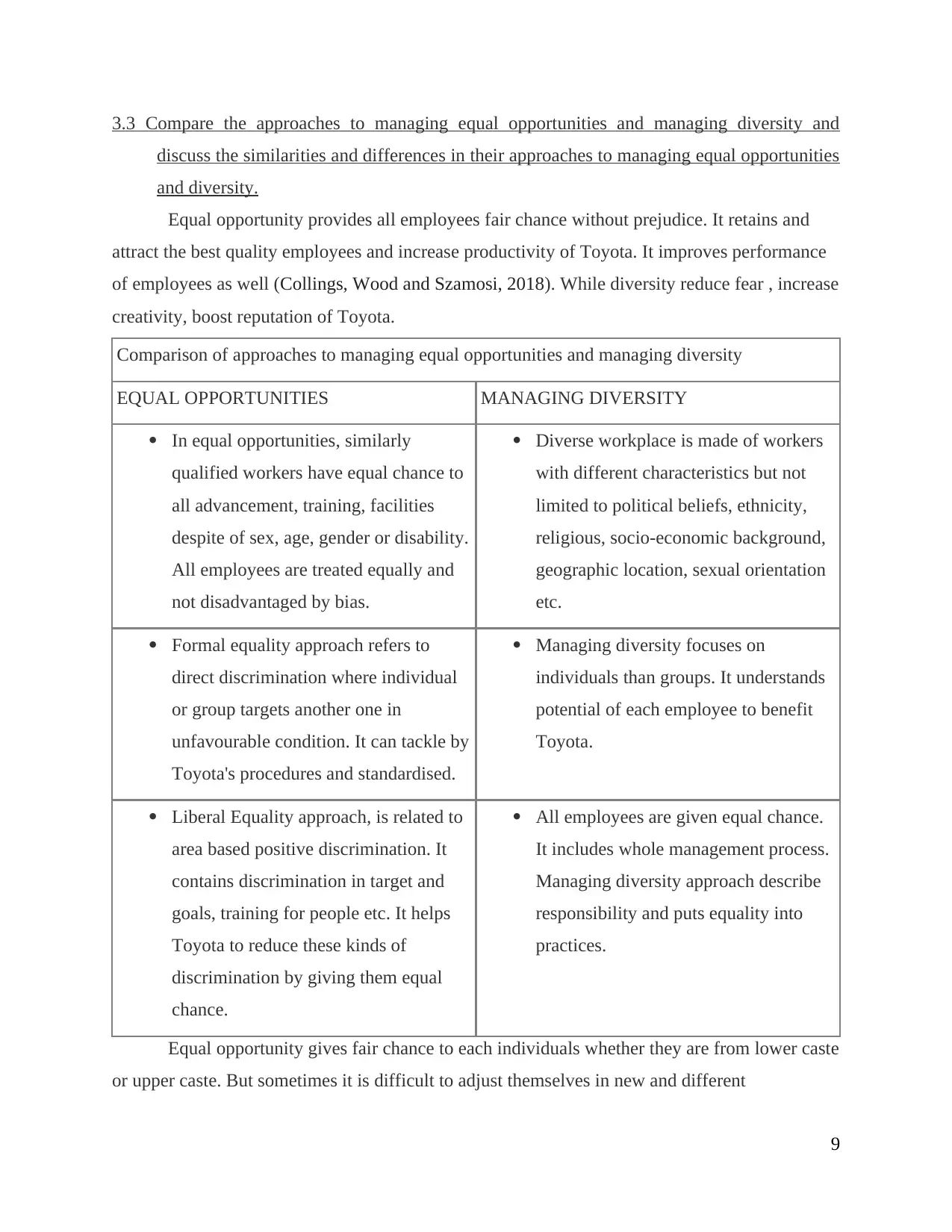
3.3 Compare the approaches to managing equal opportunities and managing diversity and
discuss the similarities and differences in their approaches to managing equal opportunities
and diversity.
Equal opportunity provides all employees fair chance without prejudice. It retains and
attract the best quality employees and increase productivity of Toyota. It improves performance
of employees as well (Collings, Wood and Szamosi, 2018). While diversity reduce fear , increase
creativity, boost reputation of Toyota.
Comparison of approaches to managing equal opportunities and managing diversity
EQUAL OPPORTUNITIES MANAGING DIVERSITY
In equal opportunities, similarly
qualified workers have equal chance to
all advancement, training, facilities
despite of sex, age, gender or disability.
All employees are treated equally and
not disadvantaged by bias.
Diverse workplace is made of workers
with different characteristics but not
limited to political beliefs, ethnicity,
religious, socio-economic background,
geographic location, sexual orientation
etc.
Formal equality approach refers to
direct discrimination where individual
or group targets another one in
unfavourable condition. It can tackle by
Toyota's procedures and standardised.
Managing diversity focuses on
individuals than groups. It understands
potential of each employee to benefit
Toyota.
Liberal Equality approach, is related to
area based positive discrimination. It
contains discrimination in target and
goals, training for people etc. It helps
Toyota to reduce these kinds of
discrimination by giving them equal
chance.
All employees are given equal chance.
It includes whole management process.
Managing diversity approach describe
responsibility and puts equality into
practices.
Equal opportunity gives fair chance to each individuals whether they are from lower caste
or upper caste. But sometimes it is difficult to adjust themselves in new and different
9
discuss the similarities and differences in their approaches to managing equal opportunities
and diversity.
Equal opportunity provides all employees fair chance without prejudice. It retains and
attract the best quality employees and increase productivity of Toyota. It improves performance
of employees as well (Collings, Wood and Szamosi, 2018). While diversity reduce fear , increase
creativity, boost reputation of Toyota.
Comparison of approaches to managing equal opportunities and managing diversity
EQUAL OPPORTUNITIES MANAGING DIVERSITY
In equal opportunities, similarly
qualified workers have equal chance to
all advancement, training, facilities
despite of sex, age, gender or disability.
All employees are treated equally and
not disadvantaged by bias.
Diverse workplace is made of workers
with different characteristics but not
limited to political beliefs, ethnicity,
religious, socio-economic background,
geographic location, sexual orientation
etc.
Formal equality approach refers to
direct discrimination where individual
or group targets another one in
unfavourable condition. It can tackle by
Toyota's procedures and standardised.
Managing diversity focuses on
individuals than groups. It understands
potential of each employee to benefit
Toyota.
Liberal Equality approach, is related to
area based positive discrimination. It
contains discrimination in target and
goals, training for people etc. It helps
Toyota to reduce these kinds of
discrimination by giving them equal
chance.
All employees are given equal chance.
It includes whole management process.
Managing diversity approach describe
responsibility and puts equality into
practices.
Equal opportunity gives fair chance to each individuals whether they are from lower caste
or upper caste. But sometimes it is difficult to adjust themselves in new and different
9
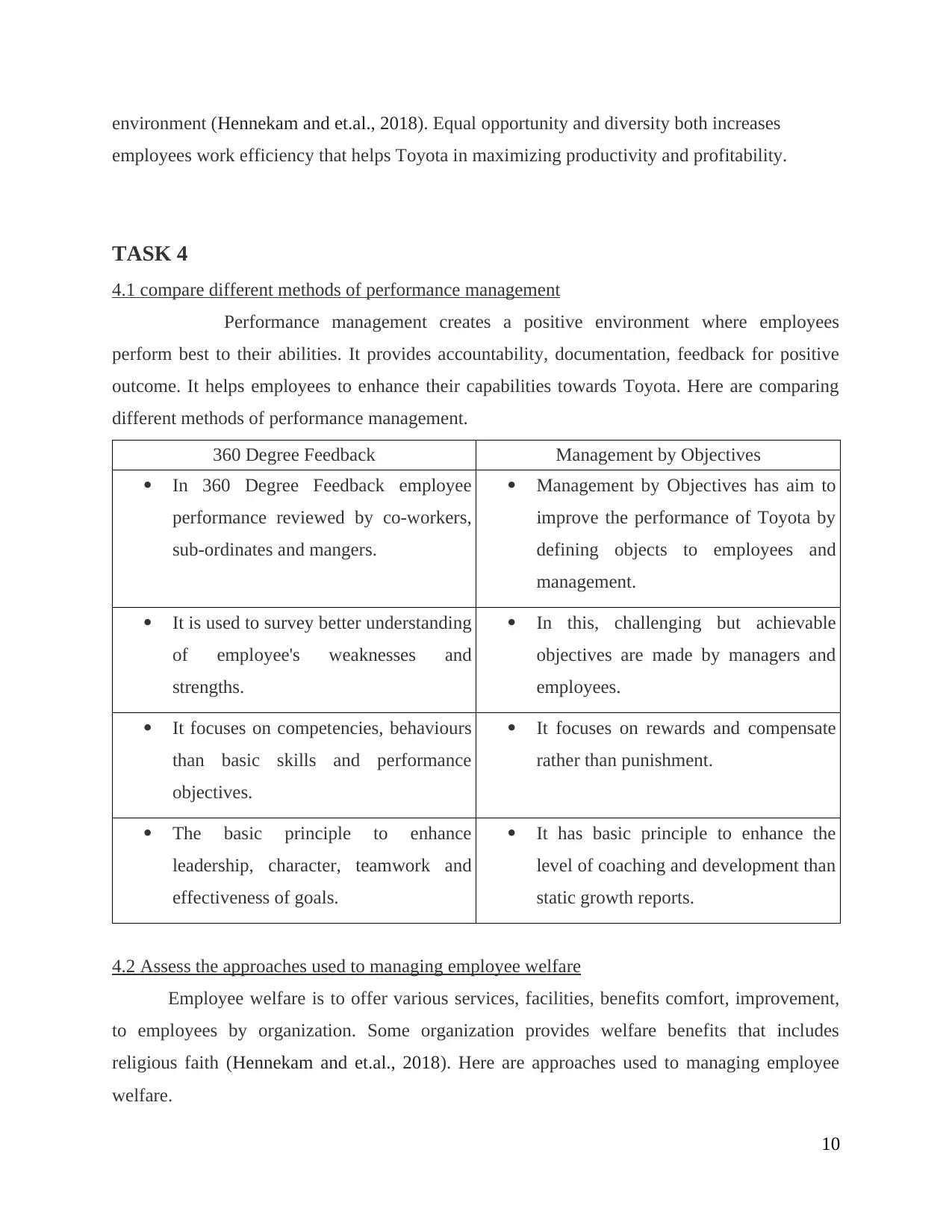
environment (Hennekam and et.al., 2018). Equal opportunity and diversity both increases
employees work efficiency that helps Toyota in maximizing productivity and profitability.
TASK 4
4.1 compare different methods of performance management
Performance management creates a positive environment where employees
perform best to their abilities. It provides accountability, documentation, feedback for positive
outcome. It helps employees to enhance their capabilities towards Toyota. Here are comparing
different methods of performance management.
360 Degree Feedback Management by Objectives
In 360 Degree Feedback employee
performance reviewed by co-workers,
sub-ordinates and mangers.
Management by Objectives has aim to
improve the performance of Toyota by
defining objects to employees and
management.
It is used to survey better understanding
of employee's weaknesses and
strengths.
In this, challenging but achievable
objectives are made by managers and
employees.
It focuses on competencies, behaviours
than basic skills and performance
objectives.
It focuses on rewards and compensate
rather than punishment.
The basic principle to enhance
leadership, character, teamwork and
effectiveness of goals.
It has basic principle to enhance the
level of coaching and development than
static growth reports.
4.2 Assess the approaches used to managing employee welfare
Employee welfare is to offer various services, facilities, benefits comfort, improvement,
to employees by organization. Some organization provides welfare benefits that includes
religious faith (Hennekam and et.al., 2018). Here are approaches used to managing employee
welfare.
10
employees work efficiency that helps Toyota in maximizing productivity and profitability.
TASK 4
4.1 compare different methods of performance management
Performance management creates a positive environment where employees
perform best to their abilities. It provides accountability, documentation, feedback for positive
outcome. It helps employees to enhance their capabilities towards Toyota. Here are comparing
different methods of performance management.
360 Degree Feedback Management by Objectives
In 360 Degree Feedback employee
performance reviewed by co-workers,
sub-ordinates and mangers.
Management by Objectives has aim to
improve the performance of Toyota by
defining objects to employees and
management.
It is used to survey better understanding
of employee's weaknesses and
strengths.
In this, challenging but achievable
objectives are made by managers and
employees.
It focuses on competencies, behaviours
than basic skills and performance
objectives.
It focuses on rewards and compensate
rather than punishment.
The basic principle to enhance
leadership, character, teamwork and
effectiveness of goals.
It has basic principle to enhance the
level of coaching and development than
static growth reports.
4.2 Assess the approaches used to managing employee welfare
Employee welfare is to offer various services, facilities, benefits comfort, improvement,
to employees by organization. Some organization provides welfare benefits that includes
religious faith (Hennekam and et.al., 2018). Here are approaches used to managing employee
welfare.
10
⊘ This is a preview!⊘
Do you want full access?
Subscribe today to unlock all pages.
Trusted by 1+ million students worldwide

1 out of 17


Related Documents


Your All-in-One AI-Powered Toolkit for Academic Success.
+13062052269
info@desklib.com
Available 24*7 on WhatsApp / Email
![[object Object]](/_next/static/media/star-bottom.7253800d.svg)
Unlock your academic potential
Copyright © 2020–2026 A2Z Services. All Rights Reserved. Developed and managed by ZUCOL.