Case Study: Analyzing Strategic Human Resource Management at Walmart
VerifiedAdded on 2023/05/31
|55
|9916
|109
Case Study
AI Summary
This case study provides an in-depth analysis of Walmart's strategic human resource management (HRM) practices, focusing on the alignment between its corporate strategy of cost leadership and its HR policies. It examines various aspects of Walmart's HR, including recruitment, training, performance management, career management, compensation, employee benefits, safety, and labor relations. The analysis highlights how Walmart aggressively implements low-cost HR activities to maintain its competitive advantage. The study also explores the integration of HR practices with Walmart's overall strategy, emphasizing the contingency perspective of 'best fit.' The case study concludes by offering insights into potential improvements for Walmart's employment practices, considering the balance between cost efficiency and employee well-being. Desklib provides a platform for students to access this and other solved assignments.
ABN 94 134 836 454 - RTO Provider 91707 - CRICOS Code 03208D
Level 4, 56-58 York Street, Sydney NSW 2000 Australia
Tel: +61 2 92794949 Email: info@georgebrown.nsw.edu.au
Web: www.georgebrown.nsw.edu.au
Assessment
Manage human resources strategic planning
BSBHRM602
Level 4, 56-58 York Street, Sydney NSW 2000 Australia
Tel: +61 2 92794949 Email: info@georgebrown.nsw.edu.au
Web: www.georgebrown.nsw.edu.au
Assessment
Manage human resources strategic planning
BSBHRM602

Paraphrase This Document
Need a fresh take? Get an instant paraphrase of this document with our AI Paraphraser
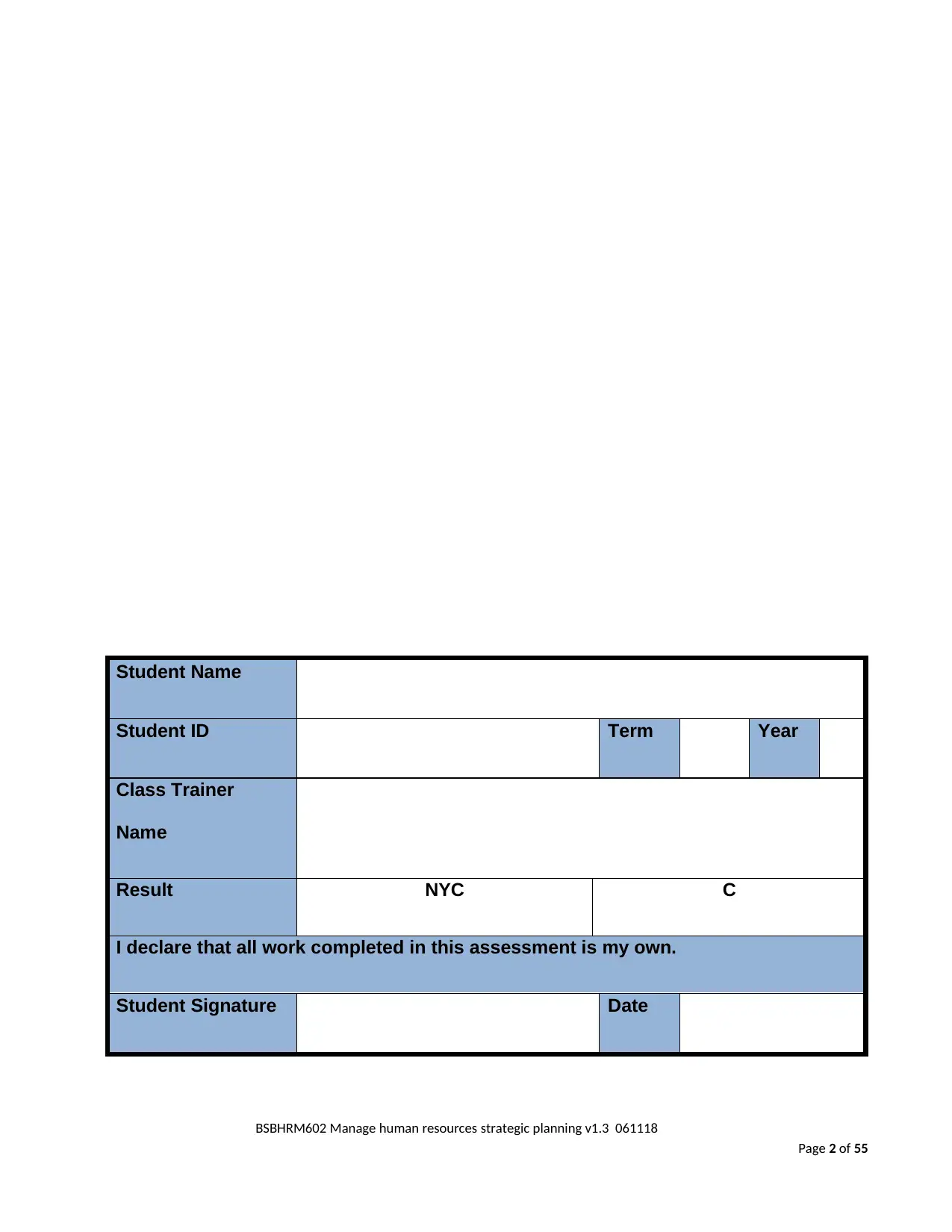
Student Name
Student ID Term Year
Class Trainer
Name
Result NYC C
I declare that all work completed in this assessment is my own.
Student Signature Date
BSBHRM602 Manage human resources strategic planning v1.3 061118
Page 2 of 55
Student ID Term Year
Class Trainer
Name
Result NYC C
I declare that all work completed in this assessment is my own.
Student Signature Date
BSBHRM602 Manage human resources strategic planning v1.3 061118
Page 2 of 55
Contents
Assessment Guidelines 3
Assessment Schedule 4
Task 1: Research planning requirements 5
Task 2: Develop human resources strategic plan 12
Task 3: Implement human resource strategic plan 21
Task 4: Skills and knowledge Activity 26
Assessment mapping 29
Record of Assessment Outcome 31
References / recommended resources 32
BSBHRM602 Manage human resources strategic planning v1.3 061118
Page 3 of 55
Assessment Guidelines 3
Assessment Schedule 4
Task 1: Research planning requirements 5
Task 2: Develop human resources strategic plan 12
Task 3: Implement human resource strategic plan 21
Task 4: Skills and knowledge Activity 26
Assessment mapping 29
Record of Assessment Outcome 31
References / recommended resources 32
BSBHRM602 Manage human resources strategic planning v1.3 061118
Page 3 of 55
⊘ This is a preview!⊘
Do you want full access?
Subscribe today to unlock all pages.

Trusted by 1+ million students worldwide
Assessment Guidelines
Assessment
You are advised to commence work on your assessment from week 1 and must be submitted by the due date.
1. All assessment tasks must be completed and uploaded online in RTO Manager
(gbc.rtomanager.com.au) for being marked by your assessor.
2. Please read all instructions before starting each assessment.
3. Where you are required to submit documentation for an assessment, it must be attached to your
assessment booklet.
4. Your trainer will not be able to assist you in answering questions. However, your trainer will address any
issues concerning questions requiring further explanation.
5. You may refer to your student learner guide/student resources or any other relevant resource when
completing your assessment. Do not quote directly from the notes. You should answer questions in your own
words, except where it asks you to quote.
6. You have access to computers which are equipped with Microsoft suite of products and printing facility is
available at nominal cost
BSBHRM602 Manage human resources strategic planning v1.3 061118
Page 4 of 55
Assessment
You are advised to commence work on your assessment from week 1 and must be submitted by the due date.
1. All assessment tasks must be completed and uploaded online in RTO Manager
(gbc.rtomanager.com.au) for being marked by your assessor.
2. Please read all instructions before starting each assessment.
3. Where you are required to submit documentation for an assessment, it must be attached to your
assessment booklet.
4. Your trainer will not be able to assist you in answering questions. However, your trainer will address any
issues concerning questions requiring further explanation.
5. You may refer to your student learner guide/student resources or any other relevant resource when
completing your assessment. Do not quote directly from the notes. You should answer questions in your own
words, except where it asks you to quote.
6. You have access to computers which are equipped with Microsoft suite of products and printing facility is
available at nominal cost
BSBHRM602 Manage human resources strategic planning v1.3 061118
Page 4 of 55
Paraphrase This Document
Need a fresh take? Get an instant paraphrase of this document with our AI Paraphraser

Assessment Schedule
Week Tasks to complete
Week 1
Task 1:
Week 2
Task 1:
Week 3
Task 2:
Week 4 Task 3:
Week 5
Task 4:
Week 6
BSBHRM602 Manage human resources strategic planning v1.3 061118
Page 5 of 55
Week Tasks to complete
Week 1
Task 1:
Week 2
Task 1:
Week 3
Task 2:
Week 4 Task 3:
Week 5
Task 4:
Week 6
BSBHRM602 Manage human resources strategic planning v1.3 061118
Page 5 of 55
Case study of strategic human resource management in Walmart stores
Introduction
Part 1: the analysis of corporate strategy and HR strategy at Wal-Mart.
Part 2: The analysis of HR policies at Walmart and its integration with Corporate Strategy.
Part 3: the role of the HR manager in this company?
Part 4: some advices to improve the employment practices at Walmart.
Conclusion
Introduction:
Michael E. Porter (1980) in his famous book said there are three basic competitive strategies for a
company, which are overall cost leadership; differentiation and focus strategy. Companies use these
Competitive strategies to achieve competitive advantage. In this case, Walmart Company is
Obviously taking the cost leadership strategy, that is to say, it aims to become the low-cost leader in
the retail industry. Walmart maintains its competitive advantage through its satellite-based
distribution system, and by keeping store location costs to a minimum by placing stores on low-cost
land outside small to medium-sized towns, no matter in the US or in its abroad affiliations.
Part 1: the analysis of corporate strategy and HR strategy at Wal-Mart.
From this case material we could also see that Walmart purchased massive quantities of items
from its suppliers to form scale economy, and with the efficient stock control system helping make
its operating costs lower than those of its competitors. It also imported many goods from China, “the
world factory” for its low cost. So in a word the company-level strategy of Walmart is low cost and
low cost, with little differentiation strategy.
Managers engage in three levels of strategic planning (Gary Dessler, 2005): the corporate-level
strategy; the business-level strategy and the function-level strategy. The functional strategy should
serve the overall company strategy so the corporate strategy could be implemented more effectively
BSBHRM602 Manage human resources strategic planning v1.3 061118
Page 6 of 55
Introduction
Part 1: the analysis of corporate strategy and HR strategy at Wal-Mart.
Part 2: The analysis of HR policies at Walmart and its integration with Corporate Strategy.
Part 3: the role of the HR manager in this company?
Part 4: some advices to improve the employment practices at Walmart.
Conclusion
Introduction:
Michael E. Porter (1980) in his famous book said there are three basic competitive strategies for a
company, which are overall cost leadership; differentiation and focus strategy. Companies use these
Competitive strategies to achieve competitive advantage. In this case, Walmart Company is
Obviously taking the cost leadership strategy, that is to say, it aims to become the low-cost leader in
the retail industry. Walmart maintains its competitive advantage through its satellite-based
distribution system, and by keeping store location costs to a minimum by placing stores on low-cost
land outside small to medium-sized towns, no matter in the US or in its abroad affiliations.
Part 1: the analysis of corporate strategy and HR strategy at Wal-Mart.
From this case material we could also see that Walmart purchased massive quantities of items
from its suppliers to form scale economy, and with the efficient stock control system helping make
its operating costs lower than those of its competitors. It also imported many goods from China, “the
world factory” for its low cost. So in a word the company-level strategy of Walmart is low cost and
low cost, with little differentiation strategy.
Managers engage in three levels of strategic planning (Gary Dessler, 2005): the corporate-level
strategy; the business-level strategy and the function-level strategy. The functional strategy should
serve the overall company strategy so the corporate strategy could be implemented more effectively
BSBHRM602 Manage human resources strategic planning v1.3 061118
Page 6 of 55
⊘ This is a preview!⊘
Do you want full access?
Subscribe today to unlock all pages.
Trusted by 1+ million students worldwide
and efficiently. As for Walmart, its corporate-level strategy and business-level strategy, as we
analyzed above, is the low cost leadership. Then we’ll focus on its functional strategy, especially its
HR strategy. Besides the above factors, Walmart builds its low cost leader on employment policies
that help it to achieve extraordinarily low employment costs. Through low-cost HR activities,
Walmart tried to maintain its predominate competitive advantage.
Part 2: The analysis of HR policies at Walmart and its integration with Corporate Strategy.
The basic premise that underlying SHRM is that organizations adopting a particular strategy
require HR practices that are different from those required by organizations adopting alternative
strategies (Jackson&Schuler, 1995). Generally, there are three SHRM theoretical models in the
study of this discipline: the universalistic best practices, the contingency perspective of “best fit”
and the resource-based configuration perspective. Here I would not deliberate on all these three
models to examine the HR practices at Walmart, but just choose the contingency perspective of
“best fit”. With this view, the individual HR practices will be selected based on the contingency of
the specific context of a company. Like the Walmart has different corporate strategy with those
retailers with differentiation strategy, which actually cultivates the primary contingency factor in the
SHRM literature. What’s more, we should be reminded that the individual HR practices will interact
with firm strategy to result in organizational performance, and just for this interaction effects make
the “universal best practices” may not apply so well in a specific company. In the above part we
have put great emphasis in identifying and analyzing the primary contingency factor of Walmart’s
corporate strategy, so in the following part we’ll examine the “fitness” of HR practices in Walmart
with this theoretical model, which is obviously also the integration process of HR practices with the
contingency variables to some extent. As there are the HR policies and activities (such as how the
company recruits, selects, and trains and rewards employees) that comprise the HR system itself,
here we could illustrate the integration just by the sequence of the HR activities.
BSBHRM602 Manage human resources strategic planning v1.3 061118
Page 7 of 55
analyzed above, is the low cost leadership. Then we’ll focus on its functional strategy, especially its
HR strategy. Besides the above factors, Walmart builds its low cost leader on employment policies
that help it to achieve extraordinarily low employment costs. Through low-cost HR activities,
Walmart tried to maintain its predominate competitive advantage.
Part 2: The analysis of HR policies at Walmart and its integration with Corporate Strategy.
The basic premise that underlying SHRM is that organizations adopting a particular strategy
require HR practices that are different from those required by organizations adopting alternative
strategies (Jackson&Schuler, 1995). Generally, there are three SHRM theoretical models in the
study of this discipline: the universalistic best practices, the contingency perspective of “best fit”
and the resource-based configuration perspective. Here I would not deliberate on all these three
models to examine the HR practices at Walmart, but just choose the contingency perspective of
“best fit”. With this view, the individual HR practices will be selected based on the contingency of
the specific context of a company. Like the Walmart has different corporate strategy with those
retailers with differentiation strategy, which actually cultivates the primary contingency factor in the
SHRM literature. What’s more, we should be reminded that the individual HR practices will interact
with firm strategy to result in organizational performance, and just for this interaction effects make
the “universal best practices” may not apply so well in a specific company. In the above part we
have put great emphasis in identifying and analyzing the primary contingency factor of Walmart’s
corporate strategy, so in the following part we’ll examine the “fitness” of HR practices in Walmart
with this theoretical model, which is obviously also the integration process of HR practices with the
contingency variables to some extent. As there are the HR policies and activities (such as how the
company recruits, selects, and trains and rewards employees) that comprise the HR system itself,
here we could illustrate the integration just by the sequence of the HR activities.
BSBHRM602 Manage human resources strategic planning v1.3 061118
Page 7 of 55
Paraphrase This Document
Need a fresh take? Get an instant paraphrase of this document with our AI Paraphraser
From the recruitment Walmart has tried its best to reduce the cost considering so big number of
its employees. For example, the New York Times (January 2004) reported on an internal Walmart
audit which found “extensive violations of child-labor laws and state regulations requiring time for
breaks and meals.” The cheap price of children labors and minors make it earn more cost
competitive advantage over other companies. Walmart also faced a barrage of lawsuits alleging that
the company discriminates against workers with disabilities, for the recruitment of these guys means
providing more facilities for them and the lost of efficiency to some extent.
From training perspective, Walmart refers to its employees as “associates”, and encourages
managers to think of themselves as “servant leaders”, that is, to encourage them to serve others
while staying focused on achieving results in line with the organization’s values and integrity. An
organization’s strategy necessitates behavioral requirement for success, and the use of HR practices
in the organization can reward and control employee behavior, therefore the organization should
implement HR practices that encourage the employee behaviors that are consistent with the
organization’s strategy (Delery, John E; Doty, D Harold, 1996). Through this training and
encouragement, Walmart tried to adjust the employee behaviors and competencies to what the
company’s strategy requires, that is to low down cost more. This logic also is embodied in its
“lock-in” of its night time shift in various stores. Through this enforced policy, Walmart tried to
prevent “shrinkage” behavior of its employees, to eliminate unauthorized cigarette breaks or quick
trips home.
From the performance management perspective, Walmart made very high demanding standards
and job designs. The New York Times reported Walmart had extensive violations of state regulations
requiring time for breaks and meals. And there are so many instances of minors working too late,
during school hours, or for too many hours in a day, for the performance appraising just force them
to do so. In the Career management, Walmart also goes great lengths to reduce cost, there are many
BSBHRM602 Manage human resources strategic planning v1.3 061118
Page 8 of 55
its employees. For example, the New York Times (January 2004) reported on an internal Walmart
audit which found “extensive violations of child-labor laws and state regulations requiring time for
breaks and meals.” The cheap price of children labors and minors make it earn more cost
competitive advantage over other companies. Walmart also faced a barrage of lawsuits alleging that
the company discriminates against workers with disabilities, for the recruitment of these guys means
providing more facilities for them and the lost of efficiency to some extent.
From training perspective, Walmart refers to its employees as “associates”, and encourages
managers to think of themselves as “servant leaders”, that is, to encourage them to serve others
while staying focused on achieving results in line with the organization’s values and integrity. An
organization’s strategy necessitates behavioral requirement for success, and the use of HR practices
in the organization can reward and control employee behavior, therefore the organization should
implement HR practices that encourage the employee behaviors that are consistent with the
organization’s strategy (Delery, John E; Doty, D Harold, 1996). Through this training and
encouragement, Walmart tried to adjust the employee behaviors and competencies to what the
company’s strategy requires, that is to low down cost more. This logic also is embodied in its
“lock-in” of its night time shift in various stores. Through this enforced policy, Walmart tried to
prevent “shrinkage” behavior of its employees, to eliminate unauthorized cigarette breaks or quick
trips home.
From the performance management perspective, Walmart made very high demanding standards
and job designs. The New York Times reported Walmart had extensive violations of state regulations
requiring time for breaks and meals. And there are so many instances of minors working too late,
during school hours, or for too many hours in a day, for the performance appraising just force them
to do so. In the Career management, Walmart also goes great lengths to reduce cost, there are many
BSBHRM602 Manage human resources strategic planning v1.3 061118
Page 8 of 55
cases that women sued Walmart for its discriminated policy against women by systematically
denying them promotions and paying them less than men. Women are pushed into “female”
departments and are demoted if they complain about unequal treatment just for more cost reduction
against its competitors.
From the compensation management perspective, Walmart has also showed very aggressive
HR policies and activities to fit the “low-cost” strategy. Walmart imported $15 billion worth of
goods from china, not only for the strategic consideration of supplier chain economy, but also
Walmart has some factories in china, whose products are branded with Walmart name. With this
method, Walmart pays much less to Chinese labors in this “world-factory” and earn some
advantages, so we could just see how the Walmart corporate strategy is just intensely integrated with
its HR policy. In 2002, operating costs for Walmart were just 16.6 percent of total sales, compared
to a 20.7 average for the retail industry as a whole, which supported greatly the overall strategy.
Walmart workers in California earn on average 31 percent less than workers employed in large retail
as a whole. Actually, with other operating and inventory costs set by higher level management, store
managers must turn to wages to increase profits, and Walmart expects the labor costs to be cut by
two-tenths of a percentage point each year. So these aggressive HR polices, are just the most
“fittest”.
From the employee benefit and safety perspective, Walmart’s HR policies are also well aligned
with the corporate-level strategy. At Walmart, workers eligible for benefits such as health insurance
must pay over the odds for them. In 1999, employees paid 36 percent of the costs. In 2001, the
employee burden rose to 42 percent. While in the US, large-firm employees pay on average 16
percent of the premium for health insurance. Unionized supermarket workers typically pay nothing.
Walmart was frequently accused of not providing employees with affordable access to health care,
but the top managers and HR managers know their focus was just to try their most to implement the
BSBHRM602 Manage human resources strategic planning v1.3 061118
Page 9 of 55
denying them promotions and paying them less than men. Women are pushed into “female”
departments and are demoted if they complain about unequal treatment just for more cost reduction
against its competitors.
From the compensation management perspective, Walmart has also showed very aggressive
HR policies and activities to fit the “low-cost” strategy. Walmart imported $15 billion worth of
goods from china, not only for the strategic consideration of supplier chain economy, but also
Walmart has some factories in china, whose products are branded with Walmart name. With this
method, Walmart pays much less to Chinese labors in this “world-factory” and earn some
advantages, so we could just see how the Walmart corporate strategy is just intensely integrated with
its HR policy. In 2002, operating costs for Walmart were just 16.6 percent of total sales, compared
to a 20.7 average for the retail industry as a whole, which supported greatly the overall strategy.
Walmart workers in California earn on average 31 percent less than workers employed in large retail
as a whole. Actually, with other operating and inventory costs set by higher level management, store
managers must turn to wages to increase profits, and Walmart expects the labor costs to be cut by
two-tenths of a percentage point each year. So these aggressive HR polices, are just the most
“fittest”.
From the employee benefit and safety perspective, Walmart’s HR policies are also well aligned
with the corporate-level strategy. At Walmart, workers eligible for benefits such as health insurance
must pay over the odds for them. In 1999, employees paid 36 percent of the costs. In 2001, the
employee burden rose to 42 percent. While in the US, large-firm employees pay on average 16
percent of the premium for health insurance. Unionized supermarket workers typically pay nothing.
Walmart was frequently accused of not providing employees with affordable access to health care,
but the top managers and HR managers know their focus was just to try their most to implement the
BSBHRM602 Manage human resources strategic planning v1.3 061118
Page 9 of 55
⊘ This is a preview!⊘
Do you want full access?
Subscribe today to unlock all pages.
Trusted by 1+ million students worldwide
“low-cost” strategy.
Finally, from the labor relations perspective, Walmart couldn’t have done better to show us
how the contingency model of “best fitness” works. Sam Walton sought to bring great value through
aggressive discounting to customers, to implement its low-cost strategy. Because unionized
supermarket workers typically pay nothing, Walmart has strong anti-union policy. Allegations of
firing workers sympathetic to labor organizations have been made, all new employees are shown a
propaganda video tape which said joining a union would have bad implication for them, and the
employees should never sign a union card. In the UK it was reported in the Guardian that Walmart is
facing the prospect of a bruising legal battle with the GMB trade union in a row over collective
bargaining rights, for the union would not accepting Walmart withdrew a 10% pay offer to more
than 700 workers after they rejected a new package of terms and conditions, which included giving
up rights to collective pay bargaining. Here there may be some doubt why Walmart has recently
allowed unionization in their stores in China, where unionization is mandatory. But actually this
mandatory rule is made a long time before Walmart walk into china, so why Walmart give up its
persistence in not having a some unions, and its former reason to China government is that it did not
have any unions in its global working. So how do we see Walmart’s compromise if that constitutes a
“compromise”? It has been argued that doing business in China is particularly difficult because of
the higher relative importance of personal relationships (guanxi), as opposed to the specification and
enforcement of contracts in the West (Davies et al, 1995). Walmart China has tried every effort to
develop good relationships with China government and other influence groups. So Walmart made
this exception of have unionizations is just in accordance with its corporate strategy and HR strategy.
If it ignores the Chinese government’s firm rule, its cost would just outweigh what it would save by
organizing no unions in its labor relations management. And also it forgets not its basic corporate
and HR strategy, for in china Walmart provides little power for workers and the unions are
BSBHRM602 Manage human resources strategic planning v1.3 061118
Page 10 of 55
Finally, from the labor relations perspective, Walmart couldn’t have done better to show us
how the contingency model of “best fitness” works. Sam Walton sought to bring great value through
aggressive discounting to customers, to implement its low-cost strategy. Because unionized
supermarket workers typically pay nothing, Walmart has strong anti-union policy. Allegations of
firing workers sympathetic to labor organizations have been made, all new employees are shown a
propaganda video tape which said joining a union would have bad implication for them, and the
employees should never sign a union card. In the UK it was reported in the Guardian that Walmart is
facing the prospect of a bruising legal battle with the GMB trade union in a row over collective
bargaining rights, for the union would not accepting Walmart withdrew a 10% pay offer to more
than 700 workers after they rejected a new package of terms and conditions, which included giving
up rights to collective pay bargaining. Here there may be some doubt why Walmart has recently
allowed unionization in their stores in China, where unionization is mandatory. But actually this
mandatory rule is made a long time before Walmart walk into china, so why Walmart give up its
persistence in not having a some unions, and its former reason to China government is that it did not
have any unions in its global working. So how do we see Walmart’s compromise if that constitutes a
“compromise”? It has been argued that doing business in China is particularly difficult because of
the higher relative importance of personal relationships (guanxi), as opposed to the specification and
enforcement of contracts in the West (Davies et al, 1995). Walmart China has tried every effort to
develop good relationships with China government and other influence groups. So Walmart made
this exception of have unionizations is just in accordance with its corporate strategy and HR strategy.
If it ignores the Chinese government’s firm rule, its cost would just outweigh what it would save by
organizing no unions in its labor relations management. And also it forgets not its basic corporate
and HR strategy, for in china Walmart provides little power for workers and the unions are
BSBHRM602 Manage human resources strategic planning v1.3 061118
Page 10 of 55
Paraphrase This Document
Need a fresh take? Get an instant paraphrase of this document with our AI Paraphraser
controlled by the state. So from this we could further understand how Walmart would adjust its HR
policies and activities to fit its corporate strategy contingency.
Part 3: the role of the HR manager in this company?
So in the above part we have assessed how various human resource practices and systems of
Walmart “fit” the organization’s competitive corporate strategy. Then what the role of HR managers
in this company, who are HR professionals with strategic and other skills required to build a
strategy-oriented HR system. As managers in one of the functional departments of Walmart, they
have tried their best to “fit” the corporate strategy to low down cost. They made some rules and
policies, for example, they implement anti-union policy in its stores to reduce extra-costs from
union workers; they help implement “lock-in” policies; they tried to resist disability people for the
efficiency loss; they discriminate women by giving them much fewer money and opportunities to be
promoted, and actually the male workers in Walmart also got much lower salary compared with
industry average level. Walmart HR managers also tried to adjust the employee behaviors and
competencies to what the company’s strategy requires through the actions and policies of the firm’s
strategy-supporting HR system, and some of which we have listed.
So in the above paragraph, we have analyzed the role of HR mangers in Walmart using the
“best fit” model, in the next we would attempt to analyze their role from two other models.
Huselid’s (1995) work reflects what has come to be known as the “universalistic” or “best practice”
approach to SHRM, which assumes that there are certain “best” HRM practices that will contribute
to increased financial performance, regardless of the strategic goals of the firm. In this case, for
example, Walmart HR managers refers to its employees as “associates”, and encourages managers
to think of themselves as “servant leaders”, that is, to encourage them to serve others while staying
focused on achieving results in line with the organization’s values and integrity. All such kinds of
HR policies just are universal best practices adopted by HR department in all good companies. No
BSBHRM602 Manage human resources strategic planning v1.3 061118
Page 11 of 55
policies and activities to fit its corporate strategy contingency.
Part 3: the role of the HR manager in this company?
So in the above part we have assessed how various human resource practices and systems of
Walmart “fit” the organization’s competitive corporate strategy. Then what the role of HR managers
in this company, who are HR professionals with strategic and other skills required to build a
strategy-oriented HR system. As managers in one of the functional departments of Walmart, they
have tried their best to “fit” the corporate strategy to low down cost. They made some rules and
policies, for example, they implement anti-union policy in its stores to reduce extra-costs from
union workers; they help implement “lock-in” policies; they tried to resist disability people for the
efficiency loss; they discriminate women by giving them much fewer money and opportunities to be
promoted, and actually the male workers in Walmart also got much lower salary compared with
industry average level. Walmart HR managers also tried to adjust the employee behaviors and
competencies to what the company’s strategy requires through the actions and policies of the firm’s
strategy-supporting HR system, and some of which we have listed.
So in the above paragraph, we have analyzed the role of HR mangers in Walmart using the
“best fit” model, in the next we would attempt to analyze their role from two other models.
Huselid’s (1995) work reflects what has come to be known as the “universalistic” or “best practice”
approach to SHRM, which assumes that there are certain “best” HRM practices that will contribute
to increased financial performance, regardless of the strategic goals of the firm. In this case, for
example, Walmart HR managers refers to its employees as “associates”, and encourages managers
to think of themselves as “servant leaders”, that is, to encourage them to serve others while staying
focused on achieving results in line with the organization’s values and integrity. All such kinds of
HR policies just are universal best practices adopted by HR department in all good companies. No
BSBHRM602 Manage human resources strategic planning v1.3 061118
Page 11 of 55
matter Walmart adopted low-cost strategy or differentiation strategy, these policies and practices
would bring no extra cost, but would motivate employees to contribute more to the corporate, and
even help to form even good corporate culture, to reduce much more lawsuits and form good
relationships with the community and government. And then there is also a call for a configurational
approach to SHRM, and this theoretical model argues that there are specific “ideal types” of HRM
systems that provide both horizontal and vertical fit of HRM practices to organizational structure
and strategic goals. More specifically, there are certain, specific systems of HRM practices that
result in the highest internal consistency and complementarity (horizontal fit), as well as congruence
with organizational goals (vertical fit). In the part 2, we have seen how Walmart HR managers have
coordinated a systematic type of HRM policies to complement each other, to be congruent with
organizational goals (Gerald R.Ferris, 1999).
Part 4: some advices to improve the employment practices at Walmart.
Actually from the above analysis of the role of HR managers, we knew from different
theoretical SHRM models, there are still many things for HR managers to improve. The
resource-based view focuses on firm resources that can be sources of competitive advantage within
the industry. Three basic types of resources can provide this competitive advantage (Barney, 1991).
Human capital resources include such things as the skills, judgment, and intelligence of the firm’s
employees. So from the case material we just most information concerning how Walmart exploited
its workers by various HR policies to low down the cost to the minimum level, which would
certainly reduce the loyalty and dedication of those human resource in the company. And besides
referring to its employees as “associates”, and encourages managers to think of themselves as
“servant leaders”, there seems little training and other activities taken to develop its valuable human
resources, while human capital and learning could be a core source of sustainable competitive
advantage (Nile & Jeffrey, 2004). As for the specific training and develop methods and forms, it
BSBHRM602 Manage human resources strategic planning v1.3 061118
Page 12 of 55
would bring no extra cost, but would motivate employees to contribute more to the corporate, and
even help to form even good corporate culture, to reduce much more lawsuits and form good
relationships with the community and government. And then there is also a call for a configurational
approach to SHRM, and this theoretical model argues that there are specific “ideal types” of HRM
systems that provide both horizontal and vertical fit of HRM practices to organizational structure
and strategic goals. More specifically, there are certain, specific systems of HRM practices that
result in the highest internal consistency and complementarity (horizontal fit), as well as congruence
with organizational goals (vertical fit). In the part 2, we have seen how Walmart HR managers have
coordinated a systematic type of HRM policies to complement each other, to be congruent with
organizational goals (Gerald R.Ferris, 1999).
Part 4: some advices to improve the employment practices at Walmart.
Actually from the above analysis of the role of HR managers, we knew from different
theoretical SHRM models, there are still many things for HR managers to improve. The
resource-based view focuses on firm resources that can be sources of competitive advantage within
the industry. Three basic types of resources can provide this competitive advantage (Barney, 1991).
Human capital resources include such things as the skills, judgment, and intelligence of the firm’s
employees. So from the case material we just most information concerning how Walmart exploited
its workers by various HR policies to low down the cost to the minimum level, which would
certainly reduce the loyalty and dedication of those human resource in the company. And besides
referring to its employees as “associates”, and encourages managers to think of themselves as
“servant leaders”, there seems little training and other activities taken to develop its valuable human
resources, while human capital and learning could be a core source of sustainable competitive
advantage (Nile & Jeffrey, 2004). As for the specific training and develop methods and forms, it
BSBHRM602 Manage human resources strategic planning v1.3 061118
Page 12 of 55
⊘ This is a preview!⊘
Do you want full access?
Subscribe today to unlock all pages.
Trusted by 1+ million students worldwide

1 out of 55


Related Documents


Your All-in-One AI-Powered Toolkit for Academic Success.
+13062052269
info@desklib.com
Available 24*7 on WhatsApp / Email
![[object Object]](/_next/static/media/star-bottom.7253800d.svg)
Unlock your academic potential
Copyright © 2020–2026 A2Z Services. All Rights Reserved. Developed and managed by ZUCOL.