Strategic Information Systems for Logistics Industry Analysis
VerifiedAdded on 2024/07/24
|14
|3490
|353
Report
AI Summary
This report provides a comprehensive strategic analysis of a logistics industry in Australia, focusing on XYZ, a major private rail operator. The analysis begins with an external assessment using PESTLE and Porter's Five Forces to evaluate the general and industry environments, identifying opportunities and threats. It then transitions to an internal analysis, examining the organization's resources, capabilities, and core competencies. The report proposes a suitable information system to meet the identified needs, followed by an evaluation of the proposed system and recommendations for implementation. Key areas covered include political, economic, social, technological, legal, and environmental factors affecting the industry, as well as competitive rivalry and the bargaining power of suppliers and buyers. The report concludes with insights into leveraging digitalization and expanding into developing markets.
Assignment 1-Strategic Information Systems
1
1

Paraphrase This Document
Need a fresh take? Get an instant paraphrase of this document with our AI Paraphraser
Contents
Introduction................................................................................................................................ 3
Part 1: External Analysis............................................................................................................4
1. Business Background...................................................................................................... 4
2. What industry is it?......................................................................................................... 4
3. General environment analysis......................................................................................... 5
4. Industry Environment Analysis.......................................................................................6
5. Competitive environment................................................................................................7
6. Opportunities and threats................................................................................................ 7
Part 2- Internal Analysis and Proposal.......................................................................................8
1. The Resources of the Organisation................................................................................. 8
2. Capabilities Identification...............................................................................................9
3. Core competency analysis...............................................................................................9
4. Suitable information system..........................................................................................10
5. Evaluate the proposed system and provide your recommendations.............................11
Conclusion................................................................................................................................12
References................................................................................................................................ 13
2
Introduction................................................................................................................................ 3
Part 1: External Analysis............................................................................................................4
1. Business Background...................................................................................................... 4
2. What industry is it?......................................................................................................... 4
3. General environment analysis......................................................................................... 5
4. Industry Environment Analysis.......................................................................................6
5. Competitive environment................................................................................................7
6. Opportunities and threats................................................................................................ 7
Part 2- Internal Analysis and Proposal.......................................................................................8
1. The Resources of the Organisation................................................................................. 8
2. Capabilities Identification...............................................................................................9
3. Core competency analysis...............................................................................................9
4. Suitable information system..........................................................................................10
5. Evaluate the proposed system and provide your recommendations.............................11
Conclusion................................................................................................................................12
References................................................................................................................................ 13
2
Introduction
Strategic analysis plays a significant role in strategic decision-making. It brings out crucial
information through internal and external analysis of organisation’s environment. In this
report, the strategic analysis of a logistic industry of Australia has been done. For that
purpose, a general external environment analysis is done, wherein different physical,
economic, sociocultural, global, technological, demographic aspects are considered.
Moreover, the environment is analysed using Porter’s five force model. Furthermore, the
competitive environment, opportunities, and threats have been worked on. The second part
focuses on internal analysis. The analysis also covers the firm’s capabilities and core
competency. Later on, a proposal is given regarding a suitable information system that
satisfies the needs of the selected organisation. At last, the proposed system and the
recommendations are evaluated thoroughly.
3
Strategic analysis plays a significant role in strategic decision-making. It brings out crucial
information through internal and external analysis of organisation’s environment. In this
report, the strategic analysis of a logistic industry of Australia has been done. For that
purpose, a general external environment analysis is done, wherein different physical,
economic, sociocultural, global, technological, demographic aspects are considered.
Moreover, the environment is analysed using Porter’s five force model. Furthermore, the
competitive environment, opportunities, and threats have been worked on. The second part
focuses on internal analysis. The analysis also covers the firm’s capabilities and core
competency. Later on, a proposal is given regarding a suitable information system that
satisfies the needs of the selected organisation. At last, the proposed system and the
recommendations are evaluated thoroughly.
3
⊘ This is a preview!⊘
Do you want full access?
Subscribe today to unlock all pages.

Trusted by 1+ million students worldwide
Part 1: External Analysis
1. Business Background
XYZ is one of the biggest private rail operators of Australia. The company is a result of a
joint venture. The company functions across the Australia. The company currently operates
12875 wagons and 596 locomotives. The services include bulk freight, such as steel ore,
grain, coal, etc. In addition to this, the company all deals with intermodal container for import
and export and domestic purposes.
2. What industry is it?
XYZ is the logistic and transport industry that emphasises more on bulk haulage of steel and
coal. The organisation makes use of the processes, such as planning, implementing, and
controlling for effective and efficient transportation of material. The company uses a wide
range of equipment and instruments in order to reduce the transportation cost, such as
specialised wagons and balloon loops. The company takes important measure in maintaining
the quality services.
3. General environment analysis
Environmental analysis is considered to be one of the important strategic analysis tools that
identify all the external and internal factors affecting the organisation’ performance. The
analysis can determine the potential opportunities and threats along with their impact on the
business. Once this is done, the outcomes and results are considered in decision-making. The
widely used tool for a detailed environmental analysis is “PESTLE analysis” (Ho, 2014).
Using this tool for the analysis of XYZ, one can easily determine the diversification of
logistic industry.
Political Factors: The political factors such as government stability and policies play a
significant role. These factors affect every aspect of a business, namely planning, developing,
using, regulating, educating, and promoting XYZ to other service providers and customers.
Other factors include taxation system, financial backing, and government intervention can
also affect the business functions at different stage (Lee, 2012).
Economic Factors: The Company’s economic positions are directly linked to national
economy. In Australia, nearly 10 billion tons of freight needs more than 3 million heavy-duty
trucks. This show that the importance of logistics and transportation industry in the GDP of
4
1. Business Background
XYZ is one of the biggest private rail operators of Australia. The company is a result of a
joint venture. The company functions across the Australia. The company currently operates
12875 wagons and 596 locomotives. The services include bulk freight, such as steel ore,
grain, coal, etc. In addition to this, the company all deals with intermodal container for import
and export and domestic purposes.
2. What industry is it?
XYZ is the logistic and transport industry that emphasises more on bulk haulage of steel and
coal. The organisation makes use of the processes, such as planning, implementing, and
controlling for effective and efficient transportation of material. The company uses a wide
range of equipment and instruments in order to reduce the transportation cost, such as
specialised wagons and balloon loops. The company takes important measure in maintaining
the quality services.
3. General environment analysis
Environmental analysis is considered to be one of the important strategic analysis tools that
identify all the external and internal factors affecting the organisation’ performance. The
analysis can determine the potential opportunities and threats along with their impact on the
business. Once this is done, the outcomes and results are considered in decision-making. The
widely used tool for a detailed environmental analysis is “PESTLE analysis” (Ho, 2014).
Using this tool for the analysis of XYZ, one can easily determine the diversification of
logistic industry.
Political Factors: The political factors such as government stability and policies play a
significant role. These factors affect every aspect of a business, namely planning, developing,
using, regulating, educating, and promoting XYZ to other service providers and customers.
Other factors include taxation system, financial backing, and government intervention can
also affect the business functions at different stage (Lee, 2012).
Economic Factors: The Company’s economic positions are directly linked to national
economy. In Australia, nearly 10 billion tons of freight needs more than 3 million heavy-duty
trucks. This show that the importance of logistics and transportation industry in the GDP of
4
Paraphrase This Document
Need a fresh take? Get an instant paraphrase of this document with our AI Paraphraser
Australia. Economic factor have two sub-components: macro and micro factors. The former
include the national economy growth, inflation rate, taxation policies. The latter include
income, unemployment, education level, etc.
Social Factors: It is quite difficult to pin point the social aspects of XYZ due to a wide range
of social traits the logistic industry beholds. The company can make use of social media
platforms in order to promote and advertise its services. The link between the logistic
industry and social media is quite natural i.e., both depend on digital platform to operate.
XYZ’s strategies are greatly influenced by social media (Ho, 2014).
Technological Factors: The logistic industry is getting transformed day by day due to ever-
changing technology. The technology is altering the way how transportation and logistics
industry operates. The use of IT in various business aspects can be a vital opportunity for the
business. The IT can enhance XYZ’s service and products integrity. Now customers can track
their parcels (Lee, 2012).
Legal Factors: Transporting goods and products is not always hassle-free. Within domestic
boundaries, there are numerous administrations that govern the trucking sector. Each
authority has led down their rules and standards. These rules and regulations are regarding
the road safety, health and safety of drivers, transit corridor regulations, etc.
Environmental Factors: The logistic industry is always been criticised for its high carbon
footprint, pollution, and environmental degradation. The major challenge for XYZ is to lower
down the carbon footprint without affecting efficiency of the supply chain. The company can
make use of greener trucking equipment so as to increase the fuel economy. This can help in
reducing the global warming and making a world a more sustainable place.
4. Industry Environment Analysis
Industry Environment can be best analysed by implementing Porter’s five force model.
Porter’s model in the logistic industry can help in determining the attractiveness of the market
and competitive intensity (Verma and Verter, 2012). This model will ultimately analyse the
profitability of XYZ. This model can be used by the firm in order to gain an edge over the
competitors.
Threats of new entry: Since the company deals in every state of Australia, it requires
a large number of delivering vehicles in order to match with the annual target. This
requires a large amount of capital investment. As the initial capital requirement of a
5
include the national economy growth, inflation rate, taxation policies. The latter include
income, unemployment, education level, etc.
Social Factors: It is quite difficult to pin point the social aspects of XYZ due to a wide range
of social traits the logistic industry beholds. The company can make use of social media
platforms in order to promote and advertise its services. The link between the logistic
industry and social media is quite natural i.e., both depend on digital platform to operate.
XYZ’s strategies are greatly influenced by social media (Ho, 2014).
Technological Factors: The logistic industry is getting transformed day by day due to ever-
changing technology. The technology is altering the way how transportation and logistics
industry operates. The use of IT in various business aspects can be a vital opportunity for the
business. The IT can enhance XYZ’s service and products integrity. Now customers can track
their parcels (Lee, 2012).
Legal Factors: Transporting goods and products is not always hassle-free. Within domestic
boundaries, there are numerous administrations that govern the trucking sector. Each
authority has led down their rules and standards. These rules and regulations are regarding
the road safety, health and safety of drivers, transit corridor regulations, etc.
Environmental Factors: The logistic industry is always been criticised for its high carbon
footprint, pollution, and environmental degradation. The major challenge for XYZ is to lower
down the carbon footprint without affecting efficiency of the supply chain. The company can
make use of greener trucking equipment so as to increase the fuel economy. This can help in
reducing the global warming and making a world a more sustainable place.
4. Industry Environment Analysis
Industry Environment can be best analysed by implementing Porter’s five force model.
Porter’s model in the logistic industry can help in determining the attractiveness of the market
and competitive intensity (Verma and Verter, 2012). This model will ultimately analyse the
profitability of XYZ. This model can be used by the firm in order to gain an edge over the
competitors.
Threats of new entry: Since the company deals in every state of Australia, it requires
a large number of delivering vehicles in order to match with the annual target. This
requires a large amount of capital investment. As the initial capital requirement of a
5
logistic industry is quite high, the threat from the new entrants is very meagre. To
generalise this point, it can be said that overall threat from new entrants is moderate.
Threat from substitution: Substitution threat arises when the consumer inclines
toward the rival service provider. This may be due to poor quality of service, high
prices, and increase in time of shipment. It may severely hit the company’s bottom
line as it has to figure out other ways to combat the substitution. If the availability of
substitute products is large and their prices are low, then it may increase the threat for
XYZ. Overall impact of this force is moderate to high (Dulčić, et.al, 2012).
Bargaining Power of Supplier: Suppliers in the logistic industry are characterised
as: high profit makers, high price factors, high switching cost, and large in numbers.
As they are very large in number, there bargaining power is low. Hence, overall
impact of this force is low.
Bargaining power of buyer: The logistic sector is depending on two core factors,
such as price and quality of service. Due to high competition in this industry, the
buyers enjoy a high bargaining power. In addition to this, consumers’ are capable of
making such demands because the businesses are always in threat of losing them.
Overall impact of this force is high.
Competitive Rivalry: Transportation industry has high competition due to large
number of service providers and high returns and profit margins. This leads to sharing
of hard earned revenues with the rivals. Since the growth of logistic industry is high,
there is very less chance of rival switching the field. Overall impact of this force is
high.
5. Competitive environment
Australia has a privatised, liberalised, and globalised business market. This is characterised
by international trade and Foreign Direct Investment (FDI) in the logistics sectors. This has
increased the overall competition for the localised industry like XYZ. Rivals eats up the
customer base which further leads to sharing of profits with the rivals (Verma and Verter,
2012). The five force model has determined certain factors that can affect the logistics and
transportation sector rivalry. These include large and balanced competitors, high storage and
fixed costs, slow industry growth, high exit barriers, large strategic stakes, etc. In order to
evaluate the competitive powers of a logistic industry like XYZ, the LPI indicators are
usually taken into consideration (Paul, et.al, 2014). These components include:
6
generalise this point, it can be said that overall threat from new entrants is moderate.
Threat from substitution: Substitution threat arises when the consumer inclines
toward the rival service provider. This may be due to poor quality of service, high
prices, and increase in time of shipment. It may severely hit the company’s bottom
line as it has to figure out other ways to combat the substitution. If the availability of
substitute products is large and their prices are low, then it may increase the threat for
XYZ. Overall impact of this force is moderate to high (Dulčić, et.al, 2012).
Bargaining Power of Supplier: Suppliers in the logistic industry are characterised
as: high profit makers, high price factors, high switching cost, and large in numbers.
As they are very large in number, there bargaining power is low. Hence, overall
impact of this force is low.
Bargaining power of buyer: The logistic sector is depending on two core factors,
such as price and quality of service. Due to high competition in this industry, the
buyers enjoy a high bargaining power. In addition to this, consumers’ are capable of
making such demands because the businesses are always in threat of losing them.
Overall impact of this force is high.
Competitive Rivalry: Transportation industry has high competition due to large
number of service providers and high returns and profit margins. This leads to sharing
of hard earned revenues with the rivals. Since the growth of logistic industry is high,
there is very less chance of rival switching the field. Overall impact of this force is
high.
5. Competitive environment
Australia has a privatised, liberalised, and globalised business market. This is characterised
by international trade and Foreign Direct Investment (FDI) in the logistics sectors. This has
increased the overall competition for the localised industry like XYZ. Rivals eats up the
customer base which further leads to sharing of profits with the rivals (Verma and Verter,
2012). The five force model has determined certain factors that can affect the logistics and
transportation sector rivalry. These include large and balanced competitors, high storage and
fixed costs, slow industry growth, high exit barriers, large strategic stakes, etc. In order to
evaluate the competitive powers of a logistic industry like XYZ, the LPI indicators are
usually taken into consideration (Paul, et.al, 2014). These components include:
6
⊘ This is a preview!⊘
Do you want full access?
Subscribe today to unlock all pages.
Trusted by 1+ million students worldwide
Customs
Infrastructure
Logistic Competence
Timeliness
International Shipments
Tracking and Tracing
Rivals can increase their customer base by decreasing the logistic cost and improvising their
service standards. Along with this, they may make use of modern information technology in
order to gain a competing edge over XYZ.
6. Opportunities and threats
Threats for Logistic Industry:
Threat is from overseas big players like UPS that may enter this sector.
The small transporters can also be a threat as they provide services at a very
cheaper rate.
Rise of the substitutes in Australia (Aithal, 2017).
Opportunities for Logistic Industry:
Rising influence of digitalisation can be a huge opportunity for XYZ. This could
help in promotion and cost reduction.
Investing in developing countries like India, South Africa, and Kuwait as these
have the maximum potential due to high rate of growth.
Target market is rapidly growing. Therefore, XYZ can invest more capital.
7
Infrastructure
Logistic Competence
Timeliness
International Shipments
Tracking and Tracing
Rivals can increase their customer base by decreasing the logistic cost and improvising their
service standards. Along with this, they may make use of modern information technology in
order to gain a competing edge over XYZ.
6. Opportunities and threats
Threats for Logistic Industry:
Threat is from overseas big players like UPS that may enter this sector.
The small transporters can also be a threat as they provide services at a very
cheaper rate.
Rise of the substitutes in Australia (Aithal, 2017).
Opportunities for Logistic Industry:
Rising influence of digitalisation can be a huge opportunity for XYZ. This could
help in promotion and cost reduction.
Investing in developing countries like India, South Africa, and Kuwait as these
have the maximum potential due to high rate of growth.
Target market is rapidly growing. Therefore, XYZ can invest more capital.
7
Paraphrase This Document
Need a fresh take? Get an instant paraphrase of this document with our AI Paraphraser
Part 2- Internal Analysis and Proposal
1. The Resources of the Organisation
As the organisation operates its business or has the place of business in Australia and is
considered to be one of the largest rail freight organisations. This organisation functions in
the whole of Australia and have resources of good quality. The resources of XYZ Ltd include
the locomotive engines which are used for transportation or freight services, its innovative
and efficient workforce and the publicly funded financial resources. This organisation runs on
the total of 1000 locomotive and with 10200 wagons at 85 sites all around Australia
(Queensland Resources Council, 2018).
These locomotives are used in providing the services of carriage for different bulk freight for
coal, steel, ores, steel, etc. It also includes in domestic and export in intermodal containers
and other specialised services. Another resource of the organisation is its workforce or the
Human Resources. The organisation is responsible for employing approximately 4,000
employees specialised in their own area (Pacific National, 2018). In this organisation,
innovation isn’t based on the traditional theory that innovation means something instead it
means working for the objectives created by the management of the organisation and makes
plans to improve those plans so that the objectives of the organisation can be accomplished. It
is made sure by the expert and specialises employees of the organisation that allocated work
are performed effectively and efficiently. Another resource of the organisation is its financial
resources. The organisation is funded by the public and the equity of the shares considered as
a $1,274 Million.
2. Capabilities Identification
The organisation is making its way up in the market of Australia on basis of its capabilities
and provision of good and better quality services. The capability of the organisation identified
in this regards is as follows:
Logistics Management: This organisation is responsible for managing the elements of the
supply chain which is utilised to meet the requirements of the customer through controlling,
implementing and planning of the effective storage and the movement in relation with the
8
1. The Resources of the Organisation
As the organisation operates its business or has the place of business in Australia and is
considered to be one of the largest rail freight organisations. This organisation functions in
the whole of Australia and have resources of good quality. The resources of XYZ Ltd include
the locomotive engines which are used for transportation or freight services, its innovative
and efficient workforce and the publicly funded financial resources. This organisation runs on
the total of 1000 locomotive and with 10200 wagons at 85 sites all around Australia
(Queensland Resources Council, 2018).
These locomotives are used in providing the services of carriage for different bulk freight for
coal, steel, ores, steel, etc. It also includes in domestic and export in intermodal containers
and other specialised services. Another resource of the organisation is its workforce or the
Human Resources. The organisation is responsible for employing approximately 4,000
employees specialised in their own area (Pacific National, 2018). In this organisation,
innovation isn’t based on the traditional theory that innovation means something instead it
means working for the objectives created by the management of the organisation and makes
plans to improve those plans so that the objectives of the organisation can be accomplished. It
is made sure by the expert and specialises employees of the organisation that allocated work
are performed effectively and efficiently. Another resource of the organisation is its financial
resources. The organisation is funded by the public and the equity of the shares considered as
a $1,274 Million.
2. Capabilities Identification
The organisation is making its way up in the market of Australia on basis of its capabilities
and provision of good and better quality services. The capability of the organisation identified
in this regards is as follows:
Logistics Management: This organisation is responsible for managing the elements of the
supply chain which is utilised to meet the requirements of the customer through controlling,
implementing and planning of the effective storage and the movement in relation with the
8
products and services from the place of origin till the place of destination. It reduces the
expenses of the organisations and improves the services provided to the customers. There are
several factors which are to be considered while managing logistics. These factors are
meeting requirement of the customers, industrial standards and other strategies, planning, and
implementations of such plans for logistics management.
Resources Management: It is essential that the resources of the organisation must preserve
and must be utilised in accordance the requirements of the customers and the operations and
functions of the organisation providing the services of logistics and its management. As there
is a scarcity of resources, it is necessary that resources available with the organisation must
be utilised properly. This helps in the reduction of wastage of resources which eventually
saves the funds of the organisation. It is necessary that the locomotives and the wagons
available with the organisation must be properly so that quality services can be provided to
the customers, reduces the expenses of the organisation and increases generation of revenues
with the passing times (Paul, et.al, 2014).
3. Core competency analysis
It is an analysis which is done by the organisations for identifying its strengths and
weaknesses so that it can ensure its growth and development in the market in which it is
operating its business and in order to make sure the organisation is capable enough to
compete with other organisations functioning in the market (Mindtools, 2018). The analysis
of the core competency of the organisation provides an overview of the uniqueness of the
organisation i.e. what the organisation can do or perform uniquely. Analysis of core
competency is done with the help of three tests which are Relevance, Breadth of Application
and Difficulty of Imitation.
Relevance means the providing the customers something which influences him or her
strongly in order to select from the services provided by the organisation. It is also stated that
if the organisation is providing the services in accordance with the requirements of the
customers, then also the customers will be influenced by the services provided by the
organisation. The logistics management of the organisation is based on this concept only as
by this organisation is able to attract more customers. Logistic management also attracts
breadth of the application as due to logistics management, more and new opportunities for the
organisation will be opened.
9
expenses of the organisations and improves the services provided to the customers. There are
several factors which are to be considered while managing logistics. These factors are
meeting requirement of the customers, industrial standards and other strategies, planning, and
implementations of such plans for logistics management.
Resources Management: It is essential that the resources of the organisation must preserve
and must be utilised in accordance the requirements of the customers and the operations and
functions of the organisation providing the services of logistics and its management. As there
is a scarcity of resources, it is necessary that resources available with the organisation must
be utilised properly. This helps in the reduction of wastage of resources which eventually
saves the funds of the organisation. It is necessary that the locomotives and the wagons
available with the organisation must be properly so that quality services can be provided to
the customers, reduces the expenses of the organisation and increases generation of revenues
with the passing times (Paul, et.al, 2014).
3. Core competency analysis
It is an analysis which is done by the organisations for identifying its strengths and
weaknesses so that it can ensure its growth and development in the market in which it is
operating its business and in order to make sure the organisation is capable enough to
compete with other organisations functioning in the market (Mindtools, 2018). The analysis
of the core competency of the organisation provides an overview of the uniqueness of the
organisation i.e. what the organisation can do or perform uniquely. Analysis of core
competency is done with the help of three tests which are Relevance, Breadth of Application
and Difficulty of Imitation.
Relevance means the providing the customers something which influences him or her
strongly in order to select from the services provided by the organisation. It is also stated that
if the organisation is providing the services in accordance with the requirements of the
customers, then also the customers will be influenced by the services provided by the
organisation. The logistics management of the organisation is based on this concept only as
by this organisation is able to attract more customers. Logistic management also attracts
breadth of the application as due to logistics management, more and new opportunities for the
organisation will be opened.
9
⊘ This is a preview!⊘
Do you want full access?
Subscribe today to unlock all pages.
Trusted by 1+ million students worldwide
4. Suitable information system
There different types of an information system which can be used for the organisation
provides the services of logistics. It is significant that such an information system must be
adopted in accordance with the nature of the business and the size of the organisation. Such
an information system helps in exchanging the information and the data at different levels of
the organisation by which the issues at various levels of the organisation can be resolved.
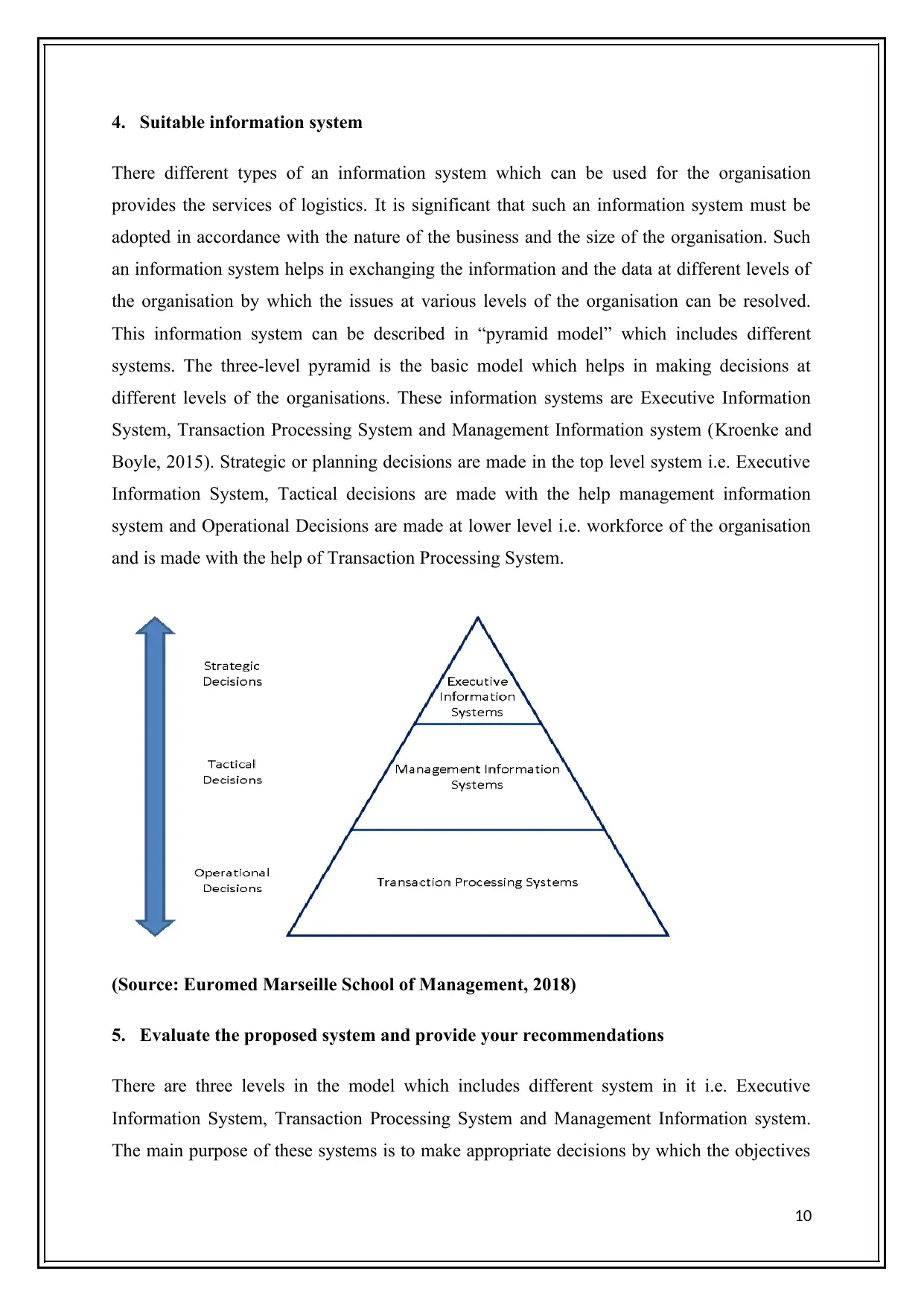
This information system can be described in “pyramid model” which includes different
systems. The three-level pyramid is the basic model which helps in making decisions at
different levels of the organisations. These information systems are Executive Information
System, Transaction Processing System and Management Information system (Kroenke and
Boyle, 2015). Strategic or planning decisions are made in the top level system i.e. Executive
Information System, Tactical decisions are made with the help management information
system and Operational Decisions are made at lower level i.e. workforce of the organisation
and is made with the help of Transaction Processing System.
(Source: Euromed Marseille School of Management, 2018)
5. Evaluate the proposed system and provide your recommendations
There are three levels in the model which includes different system in it i.e. Executive
Information System, Transaction Processing System and Management Information system.
The main purpose of these systems is to make appropriate decisions by which the objectives
10
There different types of an information system which can be used for the organisation
provides the services of logistics. It is significant that such an information system must be
adopted in accordance with the nature of the business and the size of the organisation. Such
an information system helps in exchanging the information and the data at different levels of
the organisation by which the issues at various levels of the organisation can be resolved.
This information system can be described in “pyramid model” which includes different
systems. The three-level pyramid is the basic model which helps in making decisions at
different levels of the organisations. These information systems are Executive Information
System, Transaction Processing System and Management Information system (Kroenke and
Boyle, 2015). Strategic or planning decisions are made in the top level system i.e. Executive
Information System, Tactical decisions are made with the help management information
system and Operational Decisions are made at lower level i.e. workforce of the organisation
and is made with the help of Transaction Processing System.
(Source: Euromed Marseille School of Management, 2018)
5. Evaluate the proposed system and provide your recommendations
There are three levels in the model which includes different system in it i.e. Executive
Information System, Transaction Processing System and Management Information system.
The main purpose of these systems is to make appropriate decisions by which the objectives
10
Paraphrase This Document
Need a fresh take? Get an instant paraphrase of this document with our AI Paraphraser
of the organisation can be accomplished within the specified time period. Moreover, these
systems will also help in meeting with the requirements of the customers.
It is recommended for the organisation providing the services of logistics and transportation
of the products and its storage that proper communication channels must be established by
the organisation so that information at different levels can be easily exchanged and planning
and performance for the allocated task could be done accordingly (Laudon and Laudon,
2015). Moreover, as the organisation has a large number of fleets of locomotives and wagons,
it must manage all the resources properly as it would result in the generation of more
revenues.
11
systems will also help in meeting with the requirements of the customers.
It is recommended for the organisation providing the services of logistics and transportation
of the products and its storage that proper communication channels must be established by
the organisation so that information at different levels can be easily exchanged and planning
and performance for the allocated task could be done accordingly (Laudon and Laudon,
2015). Moreover, as the organisation has a large number of fleets of locomotives and wagons,
it must manage all the resources properly as it would result in the generation of more
revenues.
11
Conclusion
This report aimed at understanding the importance of strategic analysis in decision-making
process of an organisation. This report analysed the logistic industry of Australia. For that
purpose, a general external environment analysis was done, wherein different physical,
economic, sociocultural, global, technological, demographic aspects were considered.
Moreover, the environment was analysed using Porter’s five force model. Furthermore, the
competitive environment, opportunities, and threats were worked on. The second part focused
on internal analysis. The analysis also covered the firm’s capabilities and core competency.
Later part of the report discussed the proposal regarding a suitable information system that
satisfies the needs of the selected organisation. At last, the proposed system and the
recommendations were evaluated thoroughly.
12
This report aimed at understanding the importance of strategic analysis in decision-making
process of an organisation. This report analysed the logistic industry of Australia. For that
purpose, a general external environment analysis was done, wherein different physical,
economic, sociocultural, global, technological, demographic aspects were considered.
Moreover, the environment was analysed using Porter’s five force model. Furthermore, the
competitive environment, opportunities, and threats were worked on. The second part focused
on internal analysis. The analysis also covered the firm’s capabilities and core competency.
Later part of the report discussed the proposal regarding a suitable information system that
satisfies the needs of the selected organisation. At last, the proposed system and the
recommendations were evaluated thoroughly.
12
⊘ This is a preview!⊘
Do you want full access?
Subscribe today to unlock all pages.
Trusted by 1+ million students worldwide

1 out of 14


Related Documents


Your All-in-One AI-Powered Toolkit for Academic Success.
+13062052269
info@desklib.com
Available 24*7 on WhatsApp / Email
![[object Object]](/_next/static/media/star-bottom.7253800d.svg)
Unlock your academic potential
Copyright © 2020–2026 A2Z Services. All Rights Reserved. Developed and managed by ZUCOL.