Strategic Information System in Energy Industry: A Detailed Report
VerifiedAdded on 2020/05/16
|21
|5548
|40
Report
AI Summary
This report delves into the strategic implementation of Information Systems (IS), specifically focusing on the energy industry. It proposes the adoption of Enterprise Resource Planning (ERP) as a Strategic Information System (SIS) to provide a competitive edge. The report addresses challenges faced during SIS planning, including management commitment, stakeholder involvement, technical difficulties, database management, environmental factors, and time constraints. It assesses the value of IS to businesses, emphasizing how ERP can enhance resource productivity, improve customer relationship management (CRM), and facilitate remote operations, using Australian Gas Light (AGL) Energy Ltd. as a case study. The report also examines the features of a 'good' internal control system, and offers recommendations for designing such a system, concluding with a rationale for organizational adoption of SIS.
Running head: STRATEGIC INFORMATION SYSTEM IN ENERGY INDUSTRY
Strategic Information System in Energy Industry
Name of the Student
Name of the University
Author note
Strategic Information System in Energy Industry
Name of the Student
Name of the University
Author note

Paraphrase This Document
Need a fresh take? Get an instant paraphrase of this document with our AI Paraphraser
1STRATEGIC INFORMATION SYSTEM IN ENERGY INDUSTRY
Executive Summary:
The report here is devised to propose the implementation of the strategic information system
in the industries. The energy industry is taken into consideration to put forth the points and
challenges that are associated while planning the system. The deemed report also suggests
methods by which the system can offer a competitive advantage to the considered industry. A
discussion over the value that is offered by the IS to business has also been evaluated along
with the features of a ‘good’ internal control. The report has been concluded by offering the
points that should be kept in mind while designing the internal control system along with the
author’s opinion of why the organisation should equip the deemed system.
Executive Summary:
The report here is devised to propose the implementation of the strategic information system
in the industries. The energy industry is taken into consideration to put forth the points and
challenges that are associated while planning the system. The deemed report also suggests
methods by which the system can offer a competitive advantage to the considered industry. A
discussion over the value that is offered by the IS to business has also been evaluated along
with the features of a ‘good’ internal control. The report has been concluded by offering the
points that should be kept in mind while designing the internal control system along with the
author’s opinion of why the organisation should equip the deemed system.
2STRATEGIC INFORMATION SYSTEM IN ENERGY INDUSTRY
Table of Contents
Introduction:................................................................................................................................3
Comparison and contrast on the challenge and issues faced by SIS planners:...........................3
Management:...........................................................................................................................4
Stakeholders:...........................................................................................................................4
Technical:................................................................................................................................4
Database:.................................................................................................................................5
Environmental:........................................................................................................................5
Time:.......................................................................................................................................5
Assessing IS in Energy Industry for Competitive advantage:....................................................6
Developing SIS for innovative implications:..............................................................................8
End User computing:................................................................................................................11
Approach AGL can adopt when developing the strategy for ERP use:....................................11
Strategic Information Systems can add business value to an organisation through IT/IS:.......12
‘Good’ internal control:............................................................................................................13
Conclusion:...............................................................................................................................15
References:................................................................................................................................16
Table of Contents
Introduction:................................................................................................................................3
Comparison and contrast on the challenge and issues faced by SIS planners:...........................3
Management:...........................................................................................................................4
Stakeholders:...........................................................................................................................4
Technical:................................................................................................................................4
Database:.................................................................................................................................5
Environmental:........................................................................................................................5
Time:.......................................................................................................................................5
Assessing IS in Energy Industry for Competitive advantage:....................................................6
Developing SIS for innovative implications:..............................................................................8
End User computing:................................................................................................................11
Approach AGL can adopt when developing the strategy for ERP use:....................................11
Strategic Information Systems can add business value to an organisation through IT/IS:.......12
‘Good’ internal control:............................................................................................................13
Conclusion:...............................................................................................................................15
References:................................................................................................................................16
⊘ This is a preview!⊘
Do you want full access?
Subscribe today to unlock all pages.

Trusted by 1+ million students worldwide
3STRATEGIC INFORMATION SYSTEM IN ENERGY INDUSTRY
Introduction:
Information systems refer the processing systems that process the information through
smart equipment (Like computers, network hardware, servers and others) to support and
manage organisational decisions (Laudon and Laudon 2016). IT should not be confused with
the IS, as the former is just a subcategory of the latter. IT deals only with the technology that
is operational in the system while IS itself is the system that includes the users and the
processes as well. Hence, to cover a broader perspective, the report has taken consideration of
the IS system, and the technology will be assessed based on the same.
Strategic Information System (SIS) is a sub-category of the IS which takes the
responsibility of developing and offering a competitive advantage to the considered
organisation (Arvidsson, Holmström and Lyytinen 2014). The report is developed to discuss
the details about SIS from the benefits to the challenges in the energy industry. In the report,
Enterprises Resource Planning (ERP) is suggested as the SIS system to be implemented in the
organisation. Competitive advantage and the additional value that the organisation will gain
after implementing the SIS’s are also discussed in the report. A potential solution for the
implementation of the SIS in the organisation with appropriate methodology is discussed in
the report as well. The report is concluded to offer an analysis of the internal control system
and its development method.
Comparison and contrast on the challenge and issues faced by SIS planners:
SISP (Strategic Information Strategy Planning) is a significant change in an
organisation. It is an essential activity done to assess strategic applications and to align the
firm’s strategy with efficient IS for achieving the firm’s goals and objectives. These changes
draft some challenges for the SIS planner which need to be tackled with before implementing
Introduction:
Information systems refer the processing systems that process the information through
smart equipment (Like computers, network hardware, servers and others) to support and
manage organisational decisions (Laudon and Laudon 2016). IT should not be confused with
the IS, as the former is just a subcategory of the latter. IT deals only with the technology that
is operational in the system while IS itself is the system that includes the users and the
processes as well. Hence, to cover a broader perspective, the report has taken consideration of
the IS system, and the technology will be assessed based on the same.
Strategic Information System (SIS) is a sub-category of the IS which takes the
responsibility of developing and offering a competitive advantage to the considered
organisation (Arvidsson, Holmström and Lyytinen 2014). The report is developed to discuss
the details about SIS from the benefits to the challenges in the energy industry. In the report,
Enterprises Resource Planning (ERP) is suggested as the SIS system to be implemented in the
organisation. Competitive advantage and the additional value that the organisation will gain
after implementing the SIS’s are also discussed in the report. A potential solution for the
implementation of the SIS in the organisation with appropriate methodology is discussed in
the report as well. The report is concluded to offer an analysis of the internal control system
and its development method.
Comparison and contrast on the challenge and issues faced by SIS planners:
SISP (Strategic Information Strategy Planning) is a significant change in an
organisation. It is an essential activity done to assess strategic applications and to align the
firm’s strategy with efficient IS for achieving the firm’s goals and objectives. These changes
draft some challenges for the SIS planner which need to be tackled with before implementing
Paraphrase This Document
Need a fresh take? Get an instant paraphrase of this document with our AI Paraphraser
4STRATEGIC INFORMATION SYSTEM IN ENERGY INDUSTRY
the system. As those challenges can lead to the failure of the project which is undesirable for
any firm. The challenges associated with the SISP are discussed in the following section.
Management:
The most significant challenge in the SISP is the lack of commitment from the
management. Their role is vital, and hence the planners have to convince them to for a
committed approach towards the implementation (Lederer 2013). However, the issues
associated in the develop in convincing the senior officials as they may not believe in the
system's capabilities and hence a waste of money and time. In the public sector industries lack
of communication, poor coordination, responsibility sharing and the decision making are the
most prominent issues associated with the management. Retirement/transfer of the officials
can also put a halt to the implementation.
Stakeholders:
Public sector firms are slow at decision-making which offers challenge to the planners
because deploying training modules may be time consuming and improper. This may result in
a delayed deployment of the IS. The private industries are unable to employ the proper skill
for the implementation and operation of the system because of their limited funding.
Additionally, the stakeholders who are not interested in automatic working (through the
computer) are an even bigger threat to the process (Motro and Smets 2012). While the issues
are with the stakeholders and their lack of interest in computing operations that leads to
failure of the training module and hence resulting in a negative review of the system.
Technical:
Technical difficulties associated with the implementation of the system are the issues
regarding the hardware and software. Energy industry offers telecommunication barriers in
the installation of the SIS (Luthra et al. 2014). Energy industry equips heavy equipment
the system. As those challenges can lead to the failure of the project which is undesirable for
any firm. The challenges associated with the SISP are discussed in the following section.
Management:
The most significant challenge in the SISP is the lack of commitment from the
management. Their role is vital, and hence the planners have to convince them to for a
committed approach towards the implementation (Lederer 2013). However, the issues
associated in the develop in convincing the senior officials as they may not believe in the
system's capabilities and hence a waste of money and time. In the public sector industries lack
of communication, poor coordination, responsibility sharing and the decision making are the
most prominent issues associated with the management. Retirement/transfer of the officials
can also put a halt to the implementation.
Stakeholders:
Public sector firms are slow at decision-making which offers challenge to the planners
because deploying training modules may be time consuming and improper. This may result in
a delayed deployment of the IS. The private industries are unable to employ the proper skill
for the implementation and operation of the system because of their limited funding.
Additionally, the stakeholders who are not interested in automatic working (through the
computer) are an even bigger threat to the process (Motro and Smets 2012). While the issues
are with the stakeholders and their lack of interest in computing operations that leads to
failure of the training module and hence resulting in a negative review of the system.
Technical:
Technical difficulties associated with the implementation of the system are the issues
regarding the hardware and software. Energy industry offers telecommunication barriers in
the installation of the SIS (Luthra et al. 2014). Energy industry equips heavy equipment
5STRATEGIC INFORMATION SYSTEM IN ENERGY INDUSTRY
which derives the challenge of moving from the old systems to the new. On the other hand,
cost of deploying the new equipment for the SIS implementation is the challenge offered for
the planners. The public sector industry can manage the cost issue however it is difficult for
the private energy industry. The maintaining the quality of the equipped technology is a
challenge for the public sector industry (Samad and Kiliccote 2012).
Database:
An appropriate database is needed in every organisation is needed for data
safekeeping. However, those data can be processed to determine the need of the deemed
organisation. The above mentioned target can be achieved by statistically analysis the failed
project or the reports that are based on the conflicts within the organisation. The importance
of adopting the considered step is because not all the need of the organisation is known to the
management. Some needs are hidden and hence these should be analysed manually. However,
if an organisation don’t have an appropriate database it becomes challenging for the planners.
It becomes difficult for the planners to collect data from different sources and plan the subject
accordingly. While issues derived due to lack of database management is the time it consumes
in the planning (Galliers and Leidner 2014).
Environmental:
The most crucial challenge that the planners face in implementing the considered
system is the remote location of the plant’s establishment (Leyh and Muschick 2013).
Depending on the type of energy to be produced, the location of the industry varies, and all
the locations are away from the civilian areas. Additionally, environmental challenges include
the environment within the organisation. Organisational changes, culture, inadequate
capabilities behaviour and others are to be taken consideration of before planning. While the
organisational environmental matters if not appropriately handled may lead to conflicts and
political issues (Bryson 2018).
which derives the challenge of moving from the old systems to the new. On the other hand,
cost of deploying the new equipment for the SIS implementation is the challenge offered for
the planners. The public sector industry can manage the cost issue however it is difficult for
the private energy industry. The maintaining the quality of the equipped technology is a
challenge for the public sector industry (Samad and Kiliccote 2012).
Database:
An appropriate database is needed in every organisation is needed for data
safekeeping. However, those data can be processed to determine the need of the deemed
organisation. The above mentioned target can be achieved by statistically analysis the failed
project or the reports that are based on the conflicts within the organisation. The importance
of adopting the considered step is because not all the need of the organisation is known to the
management. Some needs are hidden and hence these should be analysed manually. However,
if an organisation don’t have an appropriate database it becomes challenging for the planners.
It becomes difficult for the planners to collect data from different sources and plan the subject
accordingly. While issues derived due to lack of database management is the time it consumes
in the planning (Galliers and Leidner 2014).
Environmental:
The most crucial challenge that the planners face in implementing the considered
system is the remote location of the plant’s establishment (Leyh and Muschick 2013).
Depending on the type of energy to be produced, the location of the industry varies, and all
the locations are away from the civilian areas. Additionally, environmental challenges include
the environment within the organisation. Organisational changes, culture, inadequate
capabilities behaviour and others are to be taken consideration of before planning. While the
organisational environmental matters if not appropriately handled may lead to conflicts and
political issues (Bryson 2018).
⊘ This is a preview!⊘
Do you want full access?
Subscribe today to unlock all pages.
Trusted by 1+ million students worldwide
6STRATEGIC INFORMATION SYSTEM IN ENERGY INDUSTRY
Time:
Tackling with the challenges mentioned above develops yet another challenge for the
planner namely time challenge. Hence, it is necessary for the planners to take full
consideration of the time that will be required in tackling the challenges and the
implementation. The issue that may derive is cancellation of the project because of exceeding
the time framework (Galliers and Leidner 2014). The reason for the cancellation can be
because of the change in strategy for the organisation, and they may think the project to be
unnecessary or any other reason may be quoted for the same.
The planners also have to tackle other minor challenges like aligning the system with
the business strategy, measurement of the benefits, expenses associated with the new system,
lack of budget for the hardware and software upgrading and others. However, the most
complicated issues related to the deemed planning are limited to the factors discussed above.
Assessing IS in Energy Industry for Competitive advantage:
The report has used ERP as the IS system that is used for assessing whether or not the
system offers competitive advantage after implementation. ERP represents the software that is
equipped for the smooth operation of the business. Business processes like order and
inventory management, stakeholder resources, CRM (Customer Relationship Management),
accounting and others are concentrated to a single system to streamline operations and the
information (Bernroider, Wong and Lai, 2014). The subject supports multi-dimensional
functions of various units and stores and processes them in unit database. It also offers a
limited amount of in-sync reporting along with automation. The deemed system does not
interfere with the operations or control of any department, instead it just offers a suitable
method for doing the departmental work while monitoring the operations.
Time:
Tackling with the challenges mentioned above develops yet another challenge for the
planner namely time challenge. Hence, it is necessary for the planners to take full
consideration of the time that will be required in tackling the challenges and the
implementation. The issue that may derive is cancellation of the project because of exceeding
the time framework (Galliers and Leidner 2014). The reason for the cancellation can be
because of the change in strategy for the organisation, and they may think the project to be
unnecessary or any other reason may be quoted for the same.
The planners also have to tackle other minor challenges like aligning the system with
the business strategy, measurement of the benefits, expenses associated with the new system,
lack of budget for the hardware and software upgrading and others. However, the most
complicated issues related to the deemed planning are limited to the factors discussed above.
Assessing IS in Energy Industry for Competitive advantage:
The report has used ERP as the IS system that is used for assessing whether or not the
system offers competitive advantage after implementation. ERP represents the software that is
equipped for the smooth operation of the business. Business processes like order and
inventory management, stakeholder resources, CRM (Customer Relationship Management),
accounting and others are concentrated to a single system to streamline operations and the
information (Bernroider, Wong and Lai, 2014). The subject supports multi-dimensional
functions of various units and stores and processes them in unit database. It also offers a
limited amount of in-sync reporting along with automation. The deemed system does not
interfere with the operations or control of any department, instead it just offers a suitable
method for doing the departmental work while monitoring the operations.
Paraphrase This Document
Need a fresh take? Get an instant paraphrase of this document with our AI Paraphraser
7STRATEGIC INFORMATION SYSTEM IN ENERGY INDUSTRY
The subject of the report offers a managed operation within the organisation as well as
outside it. Adopting the deemed system enables the firm to increase their resource
productivity and hence quality of the produced products. CRM is a part of the deemed system
which helps in maintaining customer related issues when needed direly which in turn
improves the image of the firm in the market. It is also known that competitive advantage can
be gained by building trust of the customer through quality product offering along with decent
customer support (West, Ford and Ibrahim 2015). Hence the considered system does offers
competitive advantage. However, if the implemented system is faulty it can show just the
opposite results. ERP does offer a competitive advantage only if implemented appropriately.
To justify the claims made above the report has considered Australian Gas Light (AGL)
Energy Ltd. AGL is an energy industry of Australia that have multiple plants (including
thermal, hydro, solar, gas and other plants)n for generating energy (Agl.com.au, 2018).
Before implementing the ERP, the firm should consider the following points:
ERP that suits the organisation:
The firm should be able to analyse the type of ERP that they need for themselves and
not follow the competitive firms or sister organisation (Dass 2012). The reason for quoting
the same is that the competitive organisations have implemented the system depending on
their need and environment while the sister organisations hold expertise in different fields.
Hence, no business and its internal operations are equivalent. So, depending upon the needs,
the firm should implement the system.
Listening to the stakeholders:
The firm must prepare their human resources before implementing the ERP as they are
the ones who will operate them (Amid, Moalagh and Ravasan 2012). The latter if not
The subject of the report offers a managed operation within the organisation as well as
outside it. Adopting the deemed system enables the firm to increase their resource
productivity and hence quality of the produced products. CRM is a part of the deemed system
which helps in maintaining customer related issues when needed direly which in turn
improves the image of the firm in the market. It is also known that competitive advantage can
be gained by building trust of the customer through quality product offering along with decent
customer support (West, Ford and Ibrahim 2015). Hence the considered system does offers
competitive advantage. However, if the implemented system is faulty it can show just the
opposite results. ERP does offer a competitive advantage only if implemented appropriately.
To justify the claims made above the report has considered Australian Gas Light (AGL)
Energy Ltd. AGL is an energy industry of Australia that have multiple plants (including
thermal, hydro, solar, gas and other plants)n for generating energy (Agl.com.au, 2018).
Before implementing the ERP, the firm should consider the following points:
ERP that suits the organisation:
The firm should be able to analyse the type of ERP that they need for themselves and
not follow the competitive firms or sister organisation (Dass 2012). The reason for quoting
the same is that the competitive organisations have implemented the system depending on
their need and environment while the sister organisations hold expertise in different fields.
Hence, no business and its internal operations are equivalent. So, depending upon the needs,
the firm should implement the system.
Listening to the stakeholders:
The firm must prepare their human resources before implementing the ERP as they are
the ones who will operate them (Amid, Moalagh and Ravasan 2012). The latter if not
8STRATEGIC INFORMATION SYSTEM IN ENERGY INDUSTRY
comfortable with the system will not make accurate use of the system and gain a competitive
advantage for the firm.
However, if the ERP is implemented with proper planning and accuracy, then it may
offer a competitive advantage to the firm. The section following gives an insight of how ERP
can help AGL to gain competitive advantage.
The AGL is a vast industry where the operations are done at a larger scale and are
always in operation. The industry also has geographically dispersed processing units,
sophisticated chain supply demands that develop extreme pressure on the organisational
resources. However, ERP implementation offers flexibility by enabling rapid movement and
regulating the workload among the units that are distributed geographically (Bradford 2015).
The subjected system also offers an appropriate flow of information among all the units that
help them to stay updated with the problems and their potential solutions related to the
operations and the customers. This step offers the considered organisation a c competitive
advantage over its competitors.
The ERP also upgrades the fault detection system that helps the organisation in
maintaining equipment, preventing shutdowns and others which enables the firm to deliver
optimum performance level (Pätäri et al. 2012). Energy industry can also demand human
effort at any time of the day and however, it is difficult for the engineers to stay present at the
workplace at every instance. Here, ERP helps in minimising the problem as the former
enables remote operation of the systems at any time. So, the problems can be sorted out
immediately without any delay (Pätäri et al. 2012). Taking all the discussion above, it can be
concluded to state that implementing ERP does offer competitive advantage for the firm.
comfortable with the system will not make accurate use of the system and gain a competitive
advantage for the firm.
However, if the ERP is implemented with proper planning and accuracy, then it may
offer a competitive advantage to the firm. The section following gives an insight of how ERP
can help AGL to gain competitive advantage.
The AGL is a vast industry where the operations are done at a larger scale and are
always in operation. The industry also has geographically dispersed processing units,
sophisticated chain supply demands that develop extreme pressure on the organisational
resources. However, ERP implementation offers flexibility by enabling rapid movement and
regulating the workload among the units that are distributed geographically (Bradford 2015).
The subjected system also offers an appropriate flow of information among all the units that
help them to stay updated with the problems and their potential solutions related to the
operations and the customers. This step offers the considered organisation a c competitive
advantage over its competitors.
The ERP also upgrades the fault detection system that helps the organisation in
maintaining equipment, preventing shutdowns and others which enables the firm to deliver
optimum performance level (Pätäri et al. 2012). Energy industry can also demand human
effort at any time of the day and however, it is difficult for the engineers to stay present at the
workplace at every instance. Here, ERP helps in minimising the problem as the former
enables remote operation of the systems at any time. So, the problems can be sorted out
immediately without any delay (Pätäri et al. 2012). Taking all the discussion above, it can be
concluded to state that implementing ERP does offer competitive advantage for the firm.
⊘ This is a preview!⊘
Do you want full access?
Subscribe today to unlock all pages.
Trusted by 1+ million students worldwide
9STRATEGIC INFORMATION SYSTEM IN ENERGY INDUSTRY
Developing SIS for innovative implications:
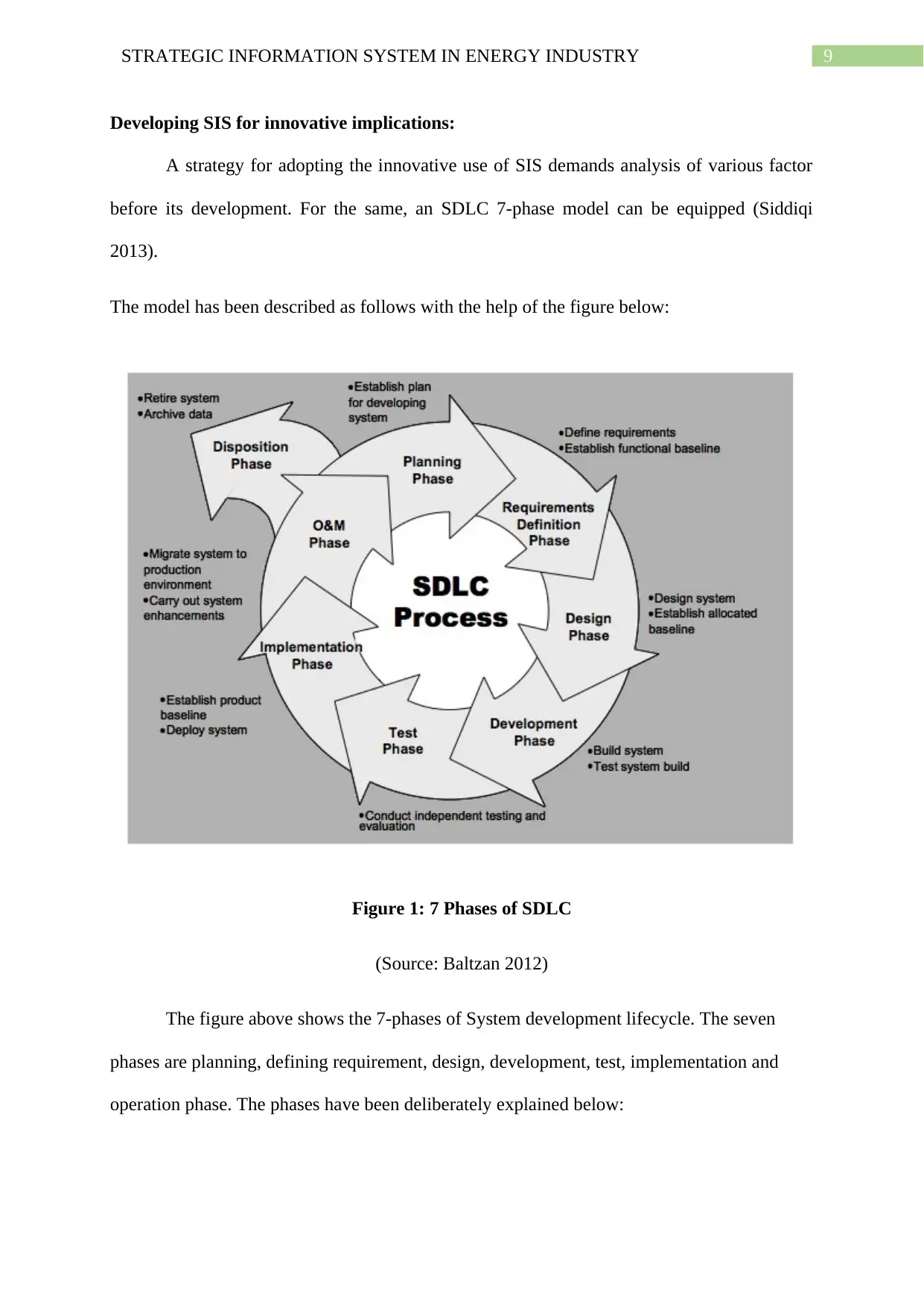
A strategy for adopting the innovative use of SIS demands analysis of various factor
before its development. For the same, an SDLC 7-phase model can be equipped (Siddiqi
2013).
The model has been described as follows with the help of the figure below:
Figure 1: 7 Phases of SDLC
(Source: Baltzan 2012)
The figure above shows the 7-phases of System development lifecycle. The seven
phases are planning, defining requirement, design, development, test, implementation and
operation phase. The phases have been deliberately explained below:
Developing SIS for innovative implications:
A strategy for adopting the innovative use of SIS demands analysis of various factor
before its development. For the same, an SDLC 7-phase model can be equipped (Siddiqi
2013).
The model has been described as follows with the help of the figure below:
Figure 1: 7 Phases of SDLC
(Source: Baltzan 2012)
The figure above shows the 7-phases of System development lifecycle. The seven
phases are planning, defining requirement, design, development, test, implementation and
operation phase. The phases have been deliberately explained below:
Paraphrase This Document
Need a fresh take? Get an instant paraphrase of this document with our AI Paraphraser
10STRATEGIC INFORMATION SYSTEM IN ENERGY INDUSTRY
Planning: Planning stage defines the plan to devise a system for strategic development. The
planning is done by defining the needs of the organisation and the problems associated with
the same. It also considers the resources, time framework, associated costs, benefits after
equipping and others. The considered phase is of great significance in the energy industry
because the latter is a vast and highly volatile industry. Consideration of the challenges
(mentioned above) is also an important reason for giving high importance to the discussed
phase.
Defining Requirements: This phase defines the functional requirement that the planners need
to consider to implement the system. In the energy industry, the requirements needs are fault
detection and prevention (Relays, Circuit Breakers and PLC module operations),
measurement of the energy developed, resources consumed, operations of the generating units
and others (Cellura et al. 2014). The subjected phase also analyses the system to confirm that
the latter is suitable to meet the challenges offered by the organisational operations.
Designing: The phase in consideration defines the control over the adopted technology by the
considered organisation. The former offers an elaborate description of the desired
specification, operations and the features that saturate the functional needs of the IS that will
be equipped. More often, this phase leads to cancellation of the project because of the cost
efficiency criterion (Yoo et al. 2014). AGL energy equips bulk equipment, and
implementation of the system will derive the need for new equipment that is supposed to be
rectified in the discussed phase.
Development: The deemed phase converts the above mentioned phases to a working solution
that offers reliability (Kaur, Singh and Pandey 2017). This phase marks the end of
initialisation and initiates the production of the system, and hence it is featured as installation
Planning: Planning stage defines the plan to devise a system for strategic development. The
planning is done by defining the needs of the organisation and the problems associated with
the same. It also considers the resources, time framework, associated costs, benefits after
equipping and others. The considered phase is of great significance in the energy industry
because the latter is a vast and highly volatile industry. Consideration of the challenges
(mentioned above) is also an important reason for giving high importance to the discussed
phase.
Defining Requirements: This phase defines the functional requirement that the planners need
to consider to implement the system. In the energy industry, the requirements needs are fault
detection and prevention (Relays, Circuit Breakers and PLC module operations),
measurement of the energy developed, resources consumed, operations of the generating units
and others (Cellura et al. 2014). The subjected phase also analyses the system to confirm that
the latter is suitable to meet the challenges offered by the organisational operations.
Designing: The phase in consideration defines the control over the adopted technology by the
considered organisation. The former offers an elaborate description of the desired
specification, operations and the features that saturate the functional needs of the IS that will
be equipped. More often, this phase leads to cancellation of the project because of the cost
efficiency criterion (Yoo et al. 2014). AGL energy equips bulk equipment, and
implementation of the system will derive the need for new equipment that is supposed to be
rectified in the discussed phase.
Development: The deemed phase converts the above mentioned phases to a working solution
that offers reliability (Kaur, Singh and Pandey 2017). This phase marks the end of
initialisation and initiates the production of the system, and hence it is featured as installation
11STRATEGIC INFORMATION SYSTEM IN ENERGY INDUSTRY
and the change. The benefits that can be deduced from the system are at the peak, and the
attained control is limited to offer freedom for the operations by the former.
Testing: Test phase includes the process of integrating. In the referred phase the strategic
system is integrated with the business strategy along with the integration of all the systems
from old to new. While, as the name suggests the testing of the integrated systems and
strategies are also test for the error or benefits after the implementation (Sohn, Lee and Cho
2015). The process is done by employing the Quality Assurance professionals.
Implementation: When the system is associated with the former system and starts functioning
at a constant and smooth rate (Ray and Malhotra 2013). In the deemed phase the coding and
designing the system is completed including the improvises made if any error is detected in
the synching and testing of the system with the functions of the energy plant. The
transmission of the information along with authorising the controls to the new system from
the older system is done in the discussed phase.
Operation: This is the last phase of the considered model where the employees of the system
can modify the operational controls of the system as per their comfort (Mohankumar and
Anand 2015). Fine-tuning, performance boosting, adding new capabilities to meet the end-
users requirements are all part of the considered phase. The operations of the IS system
initiates during this phase. In this very phase, any innovative method to boost the performance
of the operations on the implementation of the IS can be done.
End User computing:
End-User computing strategy comprises of all the approaches and processes adopted
by the industry for the assessment, assimilation and identification of the end-user technology
in the organisation (Childs et al. 2012). An appropriate end-user strategy will enable AGL to
avoid wastage of capital and time on the solutions which later proves to be inaccurate,
and the change. The benefits that can be deduced from the system are at the peak, and the
attained control is limited to offer freedom for the operations by the former.
Testing: Test phase includes the process of integrating. In the referred phase the strategic
system is integrated with the business strategy along with the integration of all the systems
from old to new. While, as the name suggests the testing of the integrated systems and
strategies are also test for the error or benefits after the implementation (Sohn, Lee and Cho
2015). The process is done by employing the Quality Assurance professionals.
Implementation: When the system is associated with the former system and starts functioning
at a constant and smooth rate (Ray and Malhotra 2013). In the deemed phase the coding and
designing the system is completed including the improvises made if any error is detected in
the synching and testing of the system with the functions of the energy plant. The
transmission of the information along with authorising the controls to the new system from
the older system is done in the discussed phase.
Operation: This is the last phase of the considered model where the employees of the system
can modify the operational controls of the system as per their comfort (Mohankumar and
Anand 2015). Fine-tuning, performance boosting, adding new capabilities to meet the end-
users requirements are all part of the considered phase. The operations of the IS system
initiates during this phase. In this very phase, any innovative method to boost the performance
of the operations on the implementation of the IS can be done.
End User computing:
End-User computing strategy comprises of all the approaches and processes adopted
by the industry for the assessment, assimilation and identification of the end-user technology
in the organisation (Childs et al. 2012). An appropriate end-user strategy will enable AGL to
avoid wastage of capital and time on the solutions which later proves to be inaccurate,
⊘ This is a preview!⊘
Do you want full access?
Subscribe today to unlock all pages.
Trusted by 1+ million students worldwide

1 out of 21


Related Documents


Your All-in-One AI-Powered Toolkit for Academic Success.
+13062052269
info@desklib.com
Available 24*7 on WhatsApp / Email
![[object Object]](/_next/static/media/star-bottom.7253800d.svg)
Unlock your academic potential
Copyright © 2020–2026 A2Z Services. All Rights Reserved. Developed and managed by ZUCOL.