Strategic Management: Exploring Porter, Blue Ocean and Stakeholders
VerifiedAdded on 2020/04/21
|13
|2418
|64
Report
AI Summary
This report delves into several key concepts in strategic management. It begins by exploring Porter's Generic Strategies and operational effectiveness versus strategic positioning, using Starbucks as an example of a unique value chain. The report then examines the Resource-Based View (RBV), highlighting the importance of internal resources, both tangible and intangible, in achieving a competitive advantage and introduces the VRIO framework. The Blue Ocean Strategy is then analyzed, including its principles, the Four Actions Framework, and the Strategy Canvas, with examples from companies like Apple and Ford. The report also provides a detailed discussion of stakeholder mapping, including identification, analysis, prioritization, and engagement of primary and secondary stakeholders. Finally, the report compares and contrasts the Blue Ocean Strategy with Porter's Generic Strategies and critically discusses the schools of strategy, both prescriptive and descriptive, while also examining why a planned strategy may not be fully realized.
Strategic Management Questions 1
STRATEGIC MANAGEMENT QUESTIONS
By Name
Course
Instructor
Institution
Location
Date
STRATEGIC MANAGEMENT QUESTIONS
By Name
Course
Instructor
Institution
Location
Date

Paraphrase This Document
Need a fresh take? Get an instant paraphrase of this document with our AI Paraphraser
Strategic Management Questions 2
Strategic Management Questions
1.Porters Generic Operational Effectiveness is important but the Strategy is more
critical. Operations and Strategy (Good Strategy + Good Execution), (Cost/Diff), Value
Chains and Examples
There is confusion sometimes between strategy and operational effectiveness as explained by
porter. Operational effectiveness is when a company does similar activities like others but in
a more efficient manner. Strategy on the other hand is doing different activities as compared
to other organizations so that a unique mix of value is attained. Organizations can gain
competitive advantage through operational effectiveness and strategy. Competitive
advanatage that is gained from strategy is however more sustainable. This is because
benchmarking leads to similarity in company operations. An organisation can have a strategy
that will lead to it being operationally effective (Porter & Heppelmann 2014). Operational
effectiveness is usually part of the main organizational strategy to remain competitive while
at the same time differentiating oneself through the products produced or kind of service that
is given.
An organisation, which wants to maintain high earnings over a lengthy period, must have
sustainable competitive advantage. This can only be achieved by having a sound strategy,
which is based on how a company differentiates itself. The company must be focussed and
also make some trade-offs if it wants to be successful. When looking at strategy, the
organization must ask itself whether the activities chosen are the ones that should be done
differently and if they can be simply copied by other companies. The activities chosen should
be very unique such that not any one can copy them. Identifying and focusing on core
competencies and unique advantages lead to success and these are the characteristics of a
good strategy.
Strategic Management Questions
1.Porters Generic Operational Effectiveness is important but the Strategy is more
critical. Operations and Strategy (Good Strategy + Good Execution), (Cost/Diff), Value
Chains and Examples
There is confusion sometimes between strategy and operational effectiveness as explained by
porter. Operational effectiveness is when a company does similar activities like others but in
a more efficient manner. Strategy on the other hand is doing different activities as compared
to other organizations so that a unique mix of value is attained. Organizations can gain
competitive advantage through operational effectiveness and strategy. Competitive
advanatage that is gained from strategy is however more sustainable. This is because
benchmarking leads to similarity in company operations. An organisation can have a strategy
that will lead to it being operationally effective (Porter & Heppelmann 2014). Operational
effectiveness is usually part of the main organizational strategy to remain competitive while
at the same time differentiating oneself through the products produced or kind of service that
is given.
An organisation, which wants to maintain high earnings over a lengthy period, must have
sustainable competitive advantage. This can only be achieved by having a sound strategy,
which is based on how a company differentiates itself. The company must be focussed and
also make some trade-offs if it wants to be successful. When looking at strategy, the
organization must ask itself whether the activities chosen are the ones that should be done
differently and if they can be simply copied by other companies. The activities chosen should
be very unique such that not any one can copy them. Identifying and focusing on core
competencies and unique advantages lead to success and these are the characteristics of a
good strategy.
Strategic Management Questions 3
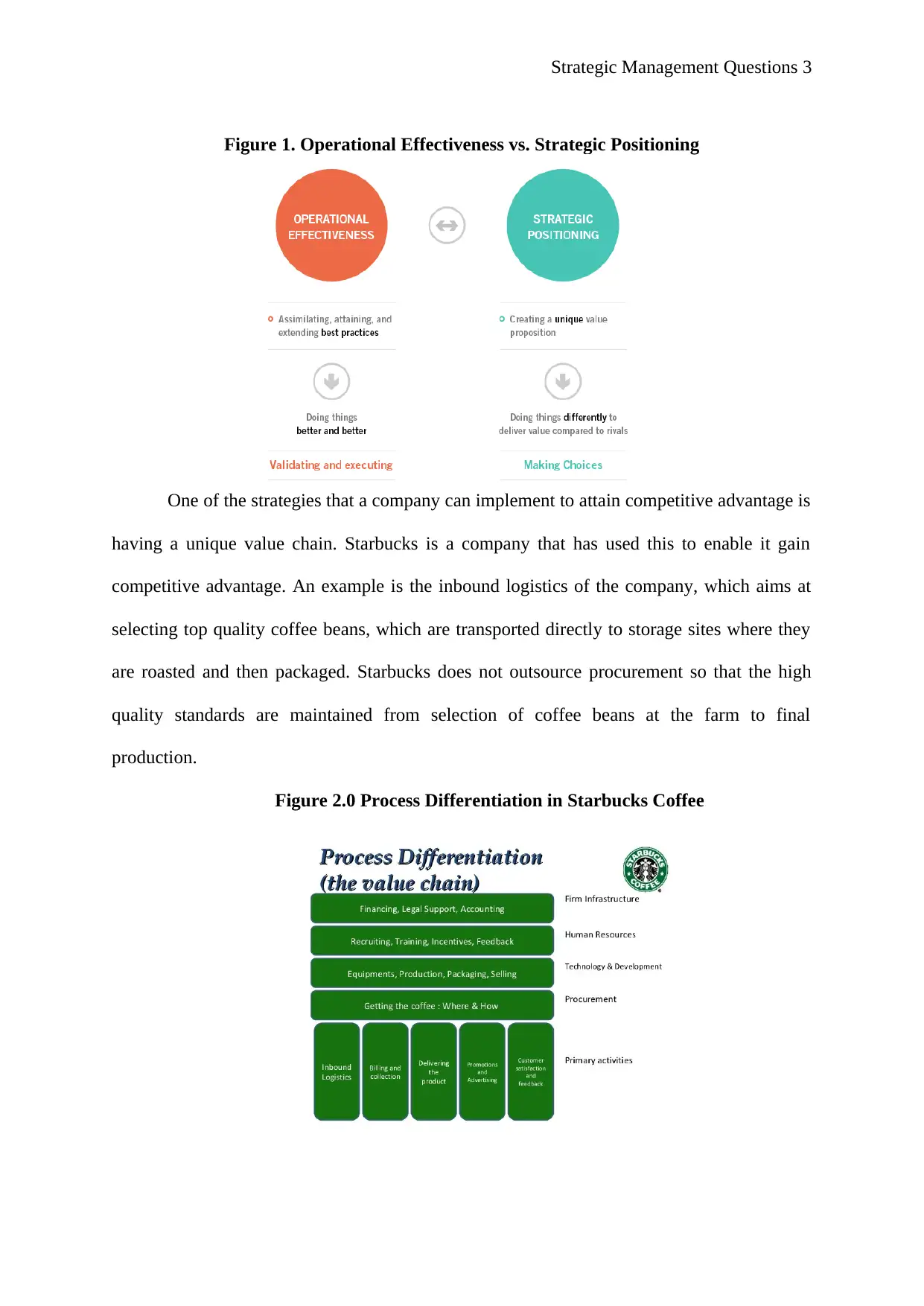
Figure 1. Operational Effectiveness vs. Strategic Positioning
One of the strategies that a company can implement to attain competitive advantage is
having a unique value chain. Starbucks is a company that has used this to enable it gain
competitive advantage. An example is the inbound logistics of the company, which aims at
selecting top quality coffee beans, which are transported directly to storage sites where they
are roasted and then packaged. Starbucks does not outsource procurement so that the high
quality standards are maintained from selection of coffee beans at the farm to final
production.
Figure 2.0 Process Differentiation in Starbucks Coffee
Figure 1. Operational Effectiveness vs. Strategic Positioning
One of the strategies that a company can implement to attain competitive advantage is
having a unique value chain. Starbucks is a company that has used this to enable it gain
competitive advantage. An example is the inbound logistics of the company, which aims at
selecting top quality coffee beans, which are transported directly to storage sites where they
are roasted and then packaged. Starbucks does not outsource procurement so that the high
quality standards are maintained from selection of coffee beans at the farm to final
production.
Figure 2.0 Process Differentiation in Starbucks Coffee
⊘ This is a preview!⊘
Do you want full access?
Subscribe today to unlock all pages.

Trusted by 1+ million students worldwide
Strategic Management Questions 4
2. Recourse Based View. Why are some organizations more successful than others?
Porter, Business strategy / Barriers to Entry. But RBV says uniqueness of their internal
resources which include (Tangible &Intangible). Explain and Give examples.
The resource-based view is a way in a company is able to achieve competitive advantage. It
argues that companies should be able to look within themselves to find sources of
competitive advantage instead of looking at the competitive environment for the same (UNC
2013).
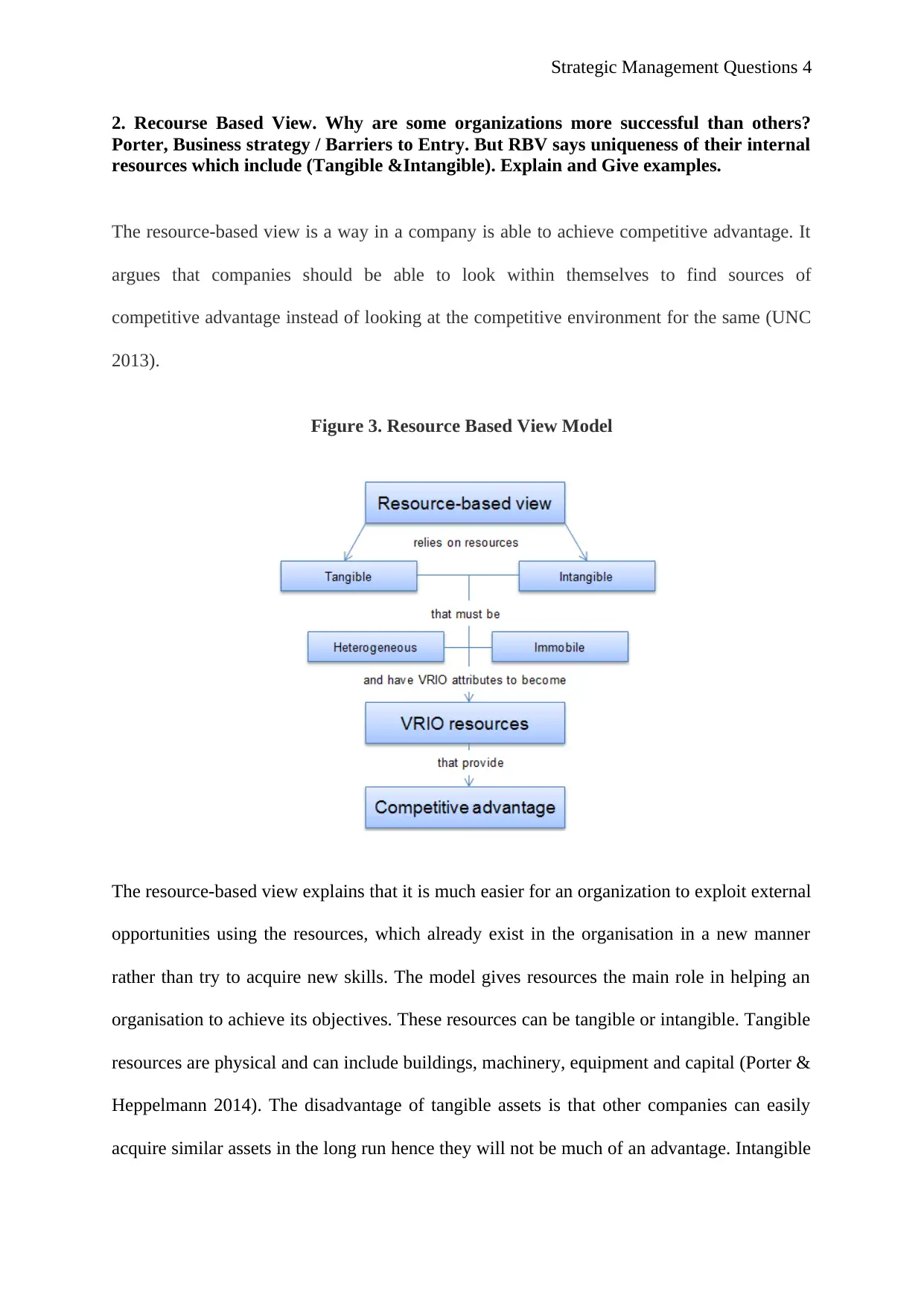
Figure 3. Resource Based View Model
The resource-based view explains that it is much easier for an organization to exploit external
opportunities using the resources, which already exist in the organisation in a new manner
rather than try to acquire new skills. The model gives resources the main role in helping an
organisation to achieve its objectives. These resources can be tangible or intangible. Tangible
resources are physical and can include buildings, machinery, equipment and capital (Porter &
Heppelmann 2014). The disadvantage of tangible assets is that other companies can easily
acquire similar assets in the long run hence they will not be much of an advantage. Intangible
2. Recourse Based View. Why are some organizations more successful than others?
Porter, Business strategy / Barriers to Entry. But RBV says uniqueness of their internal
resources which include (Tangible &Intangible). Explain and Give examples.
The resource-based view is a way in a company is able to achieve competitive advantage. It
argues that companies should be able to look within themselves to find sources of
competitive advantage instead of looking at the competitive environment for the same (UNC
2013).
Figure 3. Resource Based View Model
The resource-based view explains that it is much easier for an organization to exploit external
opportunities using the resources, which already exist in the organisation in a new manner
rather than try to acquire new skills. The model gives resources the main role in helping an
organisation to achieve its objectives. These resources can be tangible or intangible. Tangible
resources are physical and can include buildings, machinery, equipment and capital (Porter &
Heppelmann 2014). The disadvantage of tangible assets is that other companies can easily
acquire similar assets in the long run hence they will not be much of an advantage. Intangible
Paraphrase This Document
Need a fresh take? Get an instant paraphrase of this document with our AI Paraphraser
Strategic Management Questions 5
assets have no physical presence but can be owned by the organization. These include things
like brand strength, patents, trademarks and intellectual property. These are not easily
duplicated by competitors hence lead to sustainable competitive advantage for the company.
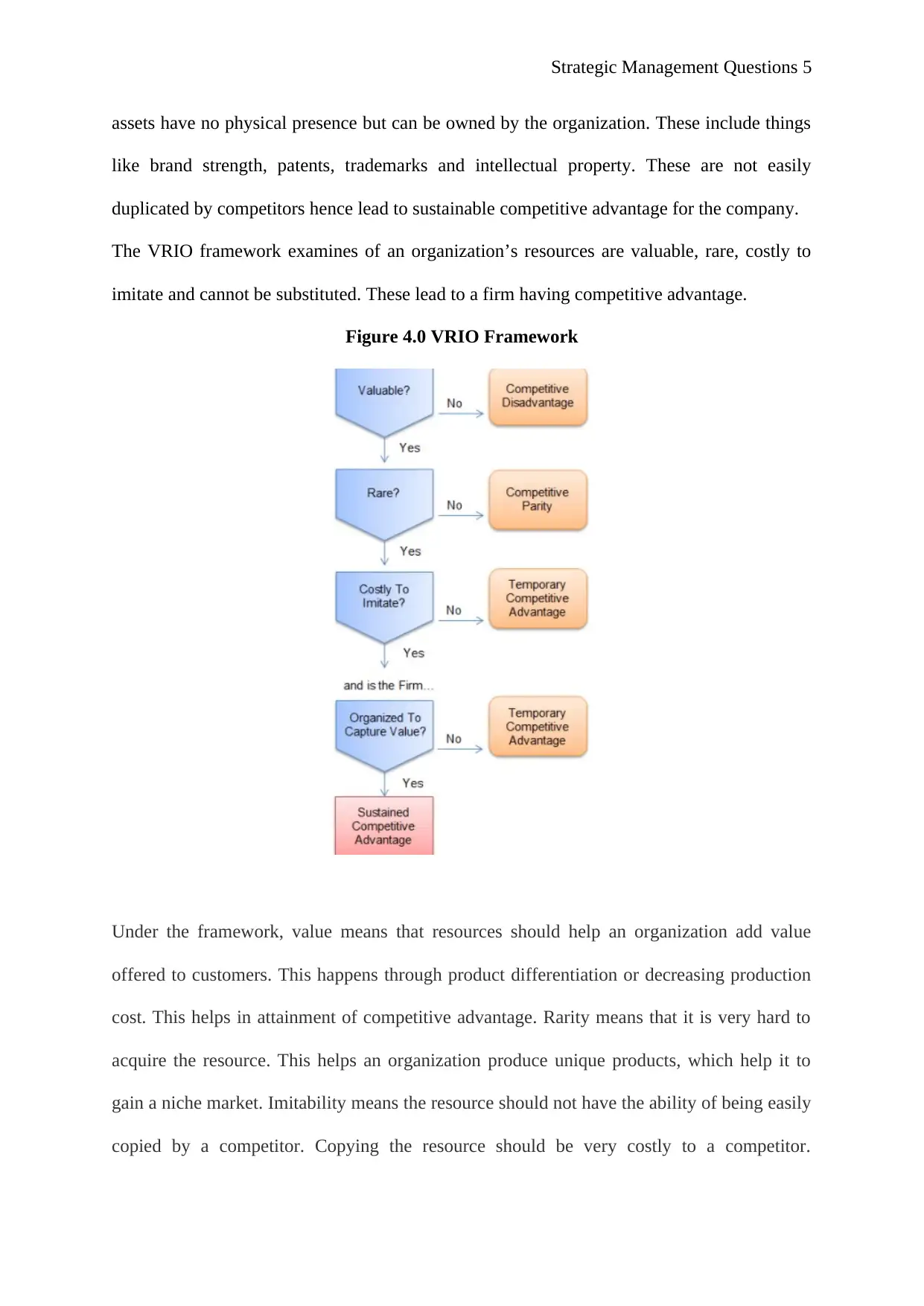
The VRIO framework examines of an organization’s resources are valuable, rare, costly to
imitate and cannot be substituted. These lead to a firm having competitive advantage.
Figure 4.0 VRIO Framework
Under the framework, value means that resources should help an organization add value
offered to customers. This happens through product differentiation or decreasing production
cost. This helps in attainment of competitive advantage. Rarity means that it is very hard to
acquire the resource. This helps an organization produce unique products, which help it to
gain a niche market. Imitability means the resource should not have the ability of being easily
copied by a competitor. Copying the resource should be very costly to a competitor.
assets have no physical presence but can be owned by the organization. These include things
like brand strength, patents, trademarks and intellectual property. These are not easily
duplicated by competitors hence lead to sustainable competitive advantage for the company.
The VRIO framework examines of an organization’s resources are valuable, rare, costly to
imitate and cannot be substituted. These lead to a firm having competitive advantage.
Figure 4.0 VRIO Framework
Under the framework, value means that resources should help an organization add value
offered to customers. This happens through product differentiation or decreasing production
cost. This helps in attainment of competitive advantage. Rarity means that it is very hard to
acquire the resource. This helps an organization produce unique products, which help it to
gain a niche market. Imitability means the resource should not have the ability of being easily
copied by a competitor. Copying the resource should be very costly to a competitor.
Strategic Management Questions 6
Organization means the resource should be organized in such a way that it can capture value
for the organisation.
The resource based view can compared to the Michael Porter Five force analysis business
strategy concept. This concept states that a company will have unique resources that will
enable a company achieve competitive advantage in the market where it operates. Both
models are similar because they agree that the ultimate objective of a business is to achieve
sustainable competitive advantage (UNC 2013). In Porter’s model, the organisation achieves
competitive advantage by having high returns in the end while the resource based view model
mainly speaks about the company achieving competitive advanatage when competitors can
no longer beat its position.
3.0 Blue Ocean Strategy. Some firms have rejected respective industry recipe for
success (not to follow what other does). Give Examples, Strategy Canvas, 4 Actions
framework on Blue Ocean Strategy)
The blue ocean strategy is a theory, which gives a suggestion that companies are better off
looking for ways to gain market space that is uncontested rather than participate in traditional
competition. The industry and innovation may be unknown and the aim is to make
competition irrelevant.
In the traditional industries, organizations compete with one another for the market share. It is
very intense and leads to some companies exiting the industry, as they are unable to sustain
themselves (Porter & Heppelmann 2014). This type of industry is commonly referred to as a
red ocean and it is a representation of a saturated market, which is shared by different
bloodied competitors. In order to avoid this competition, which can be quite costly an
organization can innovate or expands it hopes to get a blue ocean. The blue ocean will allow
the organization to expand with no competition.
Organization means the resource should be organized in such a way that it can capture value
for the organisation.
The resource based view can compared to the Michael Porter Five force analysis business
strategy concept. This concept states that a company will have unique resources that will
enable a company achieve competitive advantage in the market where it operates. Both
models are similar because they agree that the ultimate objective of a business is to achieve
sustainable competitive advantage (UNC 2013). In Porter’s model, the organisation achieves
competitive advantage by having high returns in the end while the resource based view model
mainly speaks about the company achieving competitive advanatage when competitors can
no longer beat its position.
3.0 Blue Ocean Strategy. Some firms have rejected respective industry recipe for
success (not to follow what other does). Give Examples, Strategy Canvas, 4 Actions
framework on Blue Ocean Strategy)
The blue ocean strategy is a theory, which gives a suggestion that companies are better off
looking for ways to gain market space that is uncontested rather than participate in traditional
competition. The industry and innovation may be unknown and the aim is to make
competition irrelevant.
In the traditional industries, organizations compete with one another for the market share. It is
very intense and leads to some companies exiting the industry, as they are unable to sustain
themselves (Porter & Heppelmann 2014). This type of industry is commonly referred to as a
red ocean and it is a representation of a saturated market, which is shared by different
bloodied competitors. In order to avoid this competition, which can be quite costly an
organization can innovate or expands it hopes to get a blue ocean. The blue ocean will allow
the organization to expand with no competition.
⊘ This is a preview!⊘
Do you want full access?
Subscribe today to unlock all pages.
Trusted by 1+ million students worldwide
Strategic Management Questions 7
Some of the companies that have implemented the blue ocean strategy are Apple and Ford.
The Ford Motor Company came up with model T as a car for the masses. It was reliable,
durable and affordable and this was possible because Ford used a new manufucturing process
that enabled them produce cost-effectively. The car officially replaces horse drawn carriages
as the transportation mode. Apple Limited also found a blue ocean through the iTunes music
download platform (UNC 2013). They came up with the first legal way for downloading
music in 2003 and gave users a very reasonable price. It also provided a new revenue stream
for music producers. They account for 60% of the global digital music market.
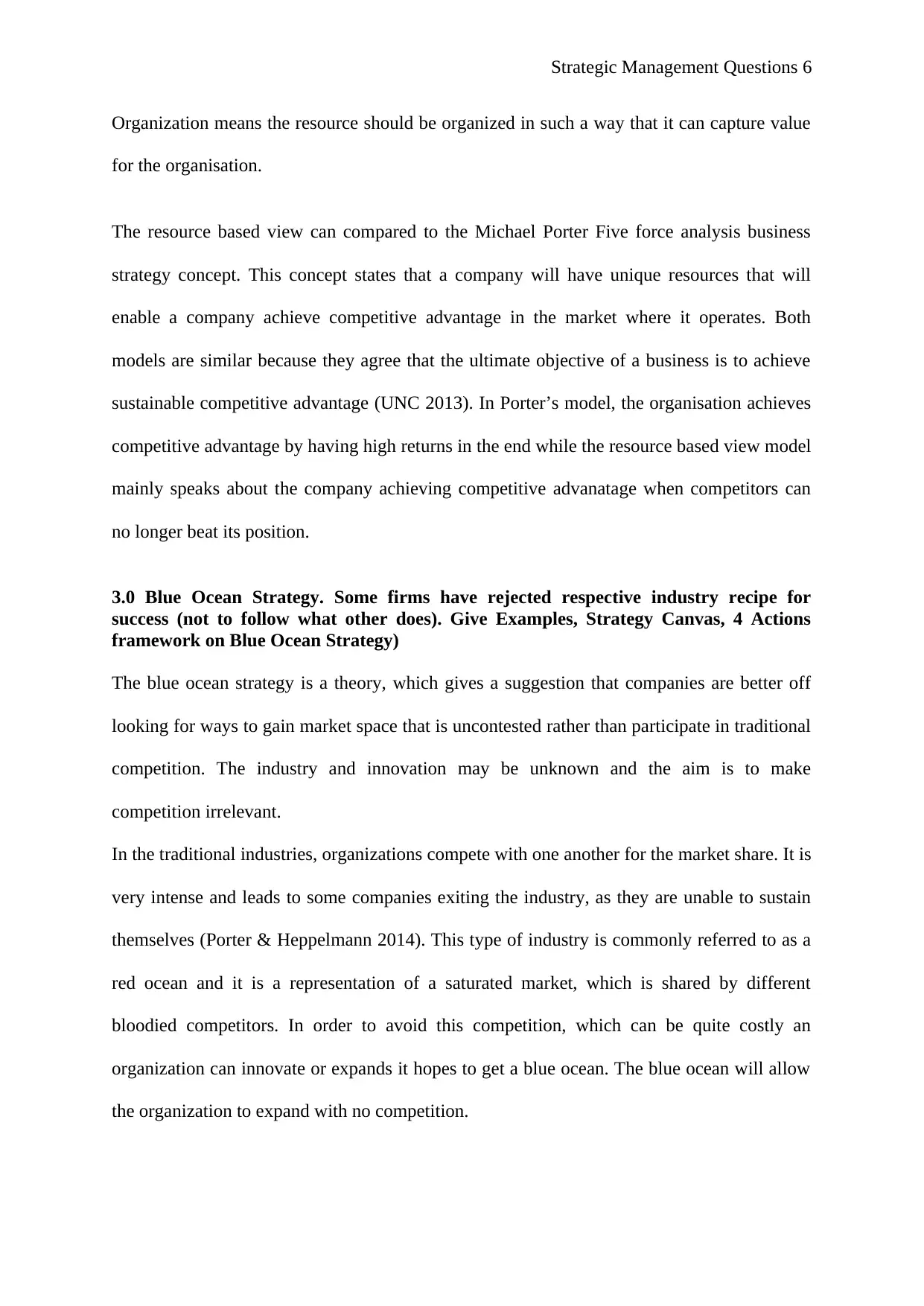
Figure 5.0 Four actions Framework for Blue Ocean Strategy
One of the strategy tools for the blue ocean is the four-action framework. It is used for value
addition to the strategic canvas curve of the blue ocean. It consists of the following areas:
Create – The organization creates new factors in the industry, which lead to
value generation, and new markets that were previously not offered.
Reduce – The organisation reduces factors that were put in place due to
competition between market players to differentiate themselves.
Some of the companies that have implemented the blue ocean strategy are Apple and Ford.
The Ford Motor Company came up with model T as a car for the masses. It was reliable,
durable and affordable and this was possible because Ford used a new manufucturing process
that enabled them produce cost-effectively. The car officially replaces horse drawn carriages
as the transportation mode. Apple Limited also found a blue ocean through the iTunes music
download platform (UNC 2013). They came up with the first legal way for downloading
music in 2003 and gave users a very reasonable price. It also provided a new revenue stream
for music producers. They account for 60% of the global digital music market.
Figure 5.0 Four actions Framework for Blue Ocean Strategy
One of the strategy tools for the blue ocean is the four-action framework. It is used for value
addition to the strategic canvas curve of the blue ocean. It consists of the following areas:
Create – The organization creates new factors in the industry, which lead to
value generation, and new markets that were previously not offered.
Reduce – The organisation reduces factors that were put in place due to
competition between market players to differentiate themselves.
Paraphrase This Document
Need a fresh take? Get an instant paraphrase of this document with our AI Paraphraser
Strategic Management Questions 8
Eliminate – Here the organization identifies factors that have been leading to
competition in the industry.
Raise – The organization identify those factors, which need to be raised above
their current position in the industry.
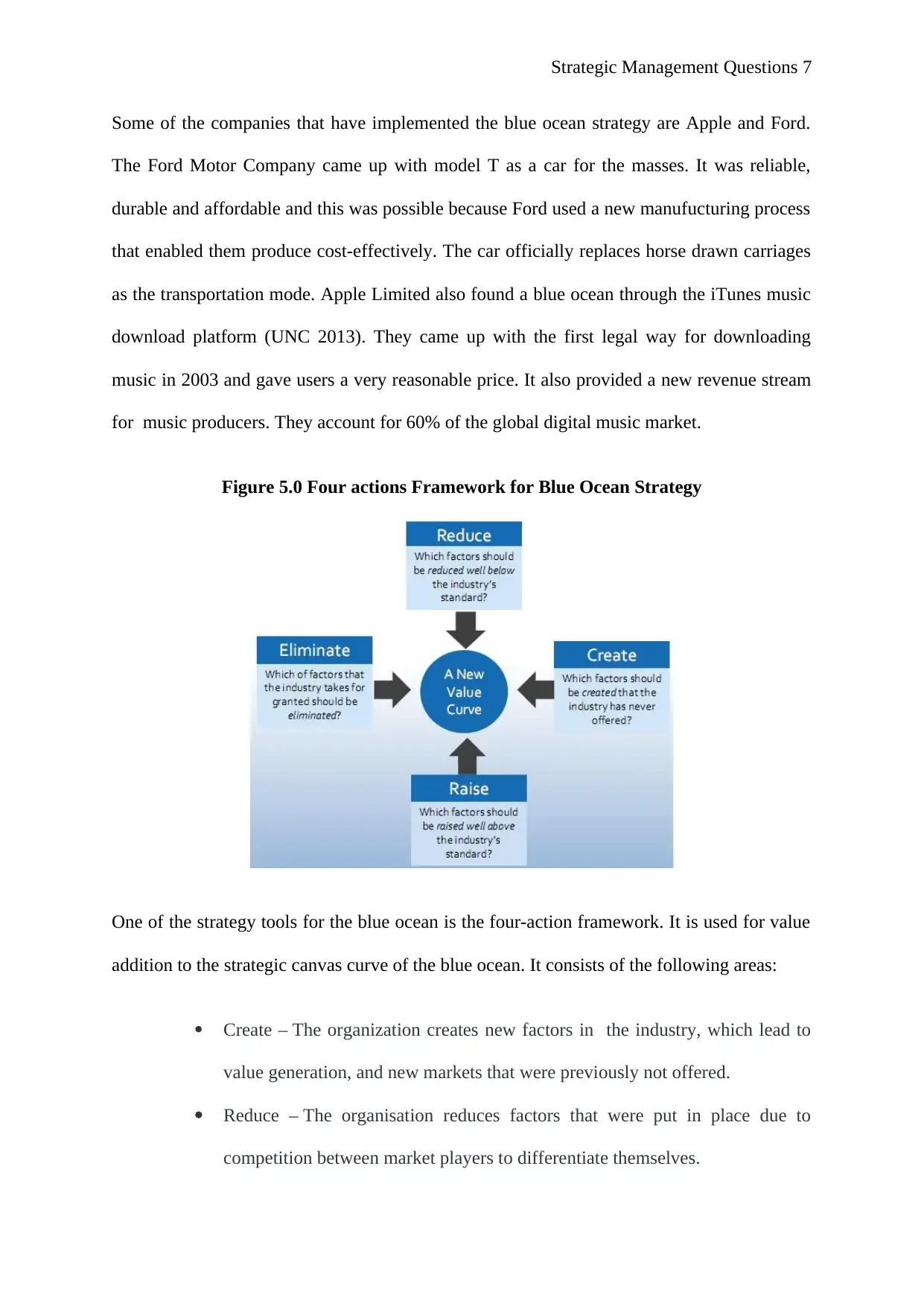
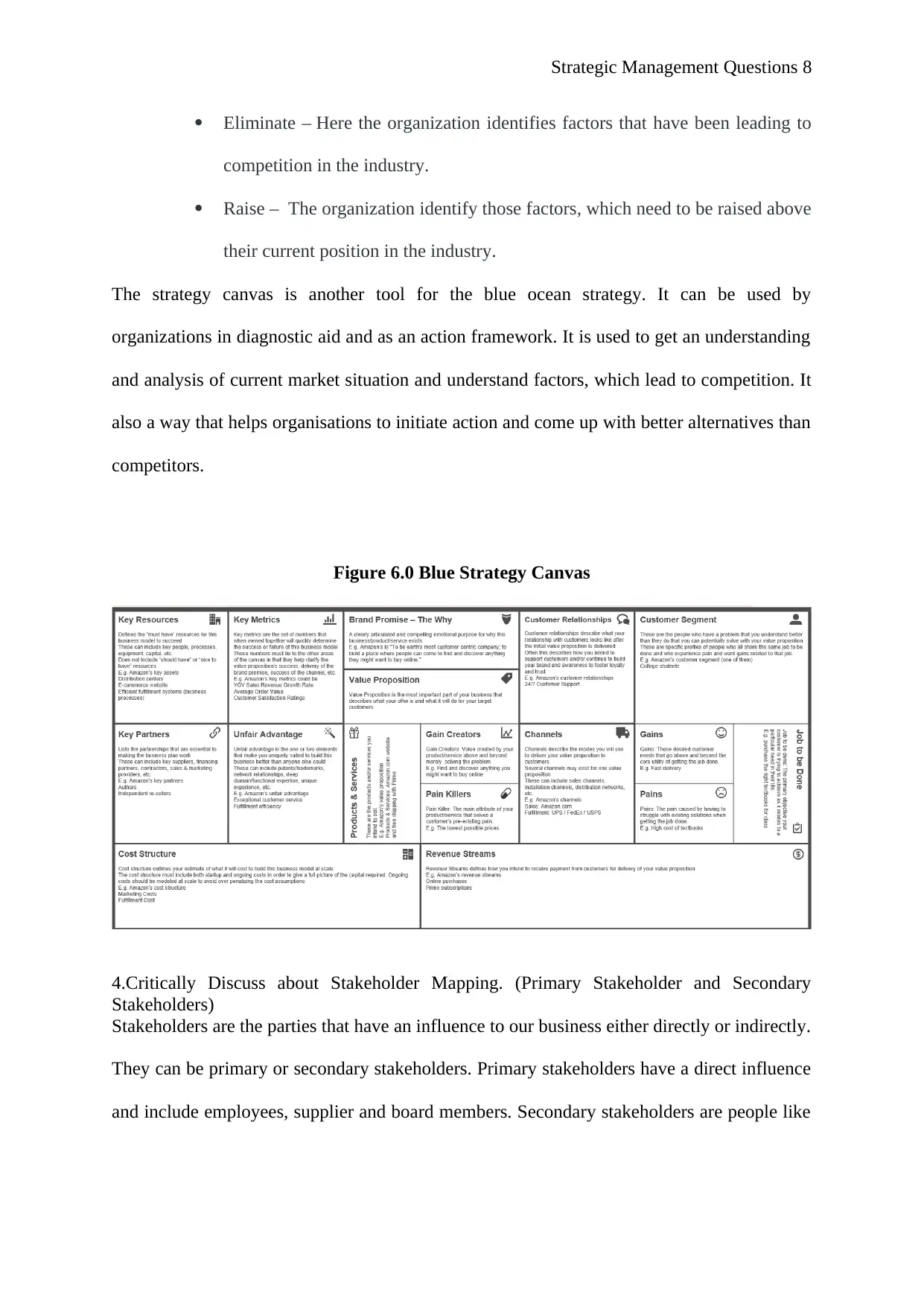
The strategy canvas is another tool for the blue ocean strategy. It can be used by
organizations in diagnostic aid and as an action framework. It is used to get an understanding
and analysis of current market situation and understand factors, which lead to competition. It
also a way that helps organisations to initiate action and come up with better alternatives than
competitors.
Figure 6.0 Blue Strategy Canvas
4.Critically Discuss about Stakeholder Mapping. (Primary Stakeholder and Secondary
Stakeholders)
Stakeholders are the parties that have an influence to our business either directly or indirectly.
They can be primary or secondary stakeholders. Primary stakeholders have a direct influence
and include employees, supplier and board members. Secondary stakeholders are people like
Eliminate – Here the organization identifies factors that have been leading to
competition in the industry.
Raise – The organization identify those factors, which need to be raised above
their current position in the industry.
The strategy canvas is another tool for the blue ocean strategy. It can be used by
organizations in diagnostic aid and as an action framework. It is used to get an understanding
and analysis of current market situation and understand factors, which lead to competition. It
also a way that helps organisations to initiate action and come up with better alternatives than
competitors.
Figure 6.0 Blue Strategy Canvas
4.Critically Discuss about Stakeholder Mapping. (Primary Stakeholder and Secondary
Stakeholders)
Stakeholders are the parties that have an influence to our business either directly or indirectly.
They can be primary or secondary stakeholders. Primary stakeholders have a direct influence
and include employees, supplier and board members. Secondary stakeholders are people like
Strategic Management Questions 9
the government and communities around who can be affected by the business in one way or
another.
Mapping of stakeholders involves identification, analysis, prioritising and evaluating people
and companies who have a stake in the organization or in a certain project. It assists
organizations in coming up with project requirements and managing and communicating
effectively with stakeholders.
Figure 7.0 Steps of Stakeholder Mapping
Identification –This step involves identification of anyone who has an interest or stake in the
organization. Some projects usually generate large community interest and their impact is
high. Stakeholders either can contribute to a project or be affected by the project. Some
stakeholders can fall into both categories as they can contribute to a projected but are also
affected by it in other ways. Projects or strategies can be delayed if the organisation does not
identify stakeholders.
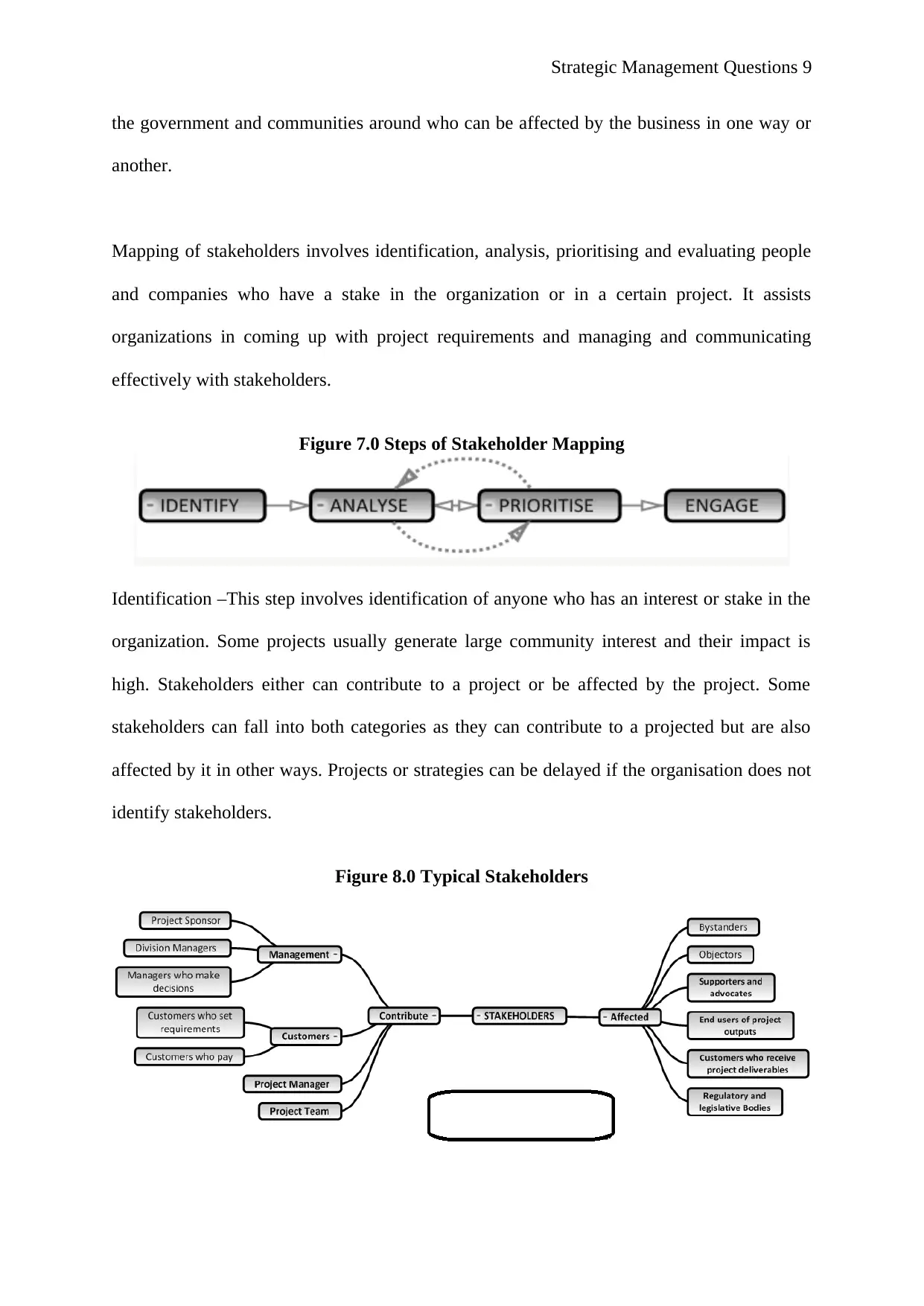
Figure 8.0 Typical Stakeholders
the government and communities around who can be affected by the business in one way or
another.
Mapping of stakeholders involves identification, analysis, prioritising and evaluating people
and companies who have a stake in the organization or in a certain project. It assists
organizations in coming up with project requirements and managing and communicating
effectively with stakeholders.
Figure 7.0 Steps of Stakeholder Mapping
Identification –This step involves identification of anyone who has an interest or stake in the
organization. Some projects usually generate large community interest and their impact is
high. Stakeholders either can contribute to a project or be affected by the project. Some
stakeholders can fall into both categories as they can contribute to a projected but are also
affected by it in other ways. Projects or strategies can be delayed if the organisation does not
identify stakeholders.
Figure 8.0 Typical Stakeholders
⊘ This is a preview!⊘
Do you want full access?
Subscribe today to unlock all pages.
Trusted by 1+ million students worldwide
Strategic Management Questions 10
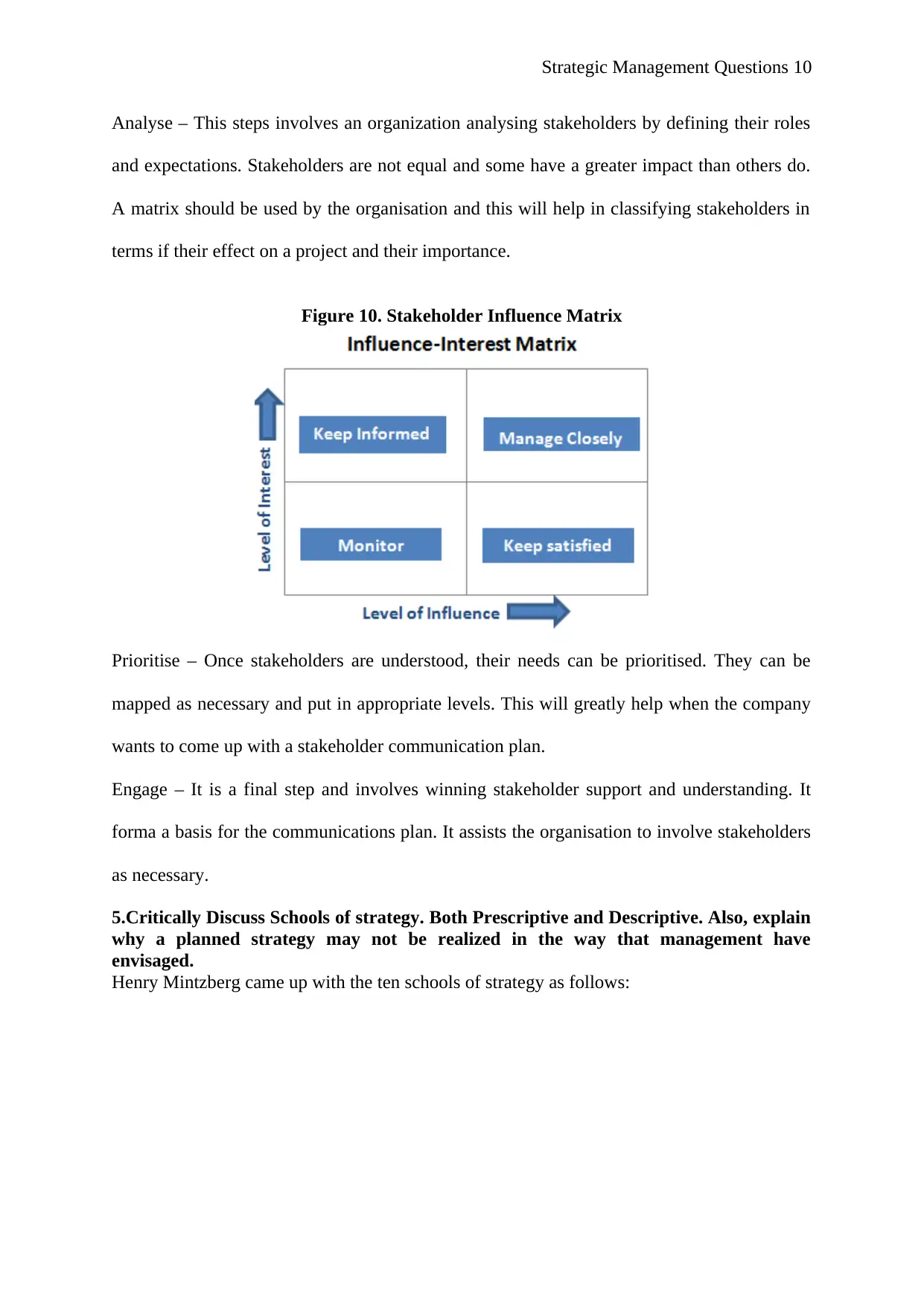
Analyse – This steps involves an organization analysing stakeholders by defining their roles
and expectations. Stakeholders are not equal and some have a greater impact than others do.
A matrix should be used by the organisation and this will help in classifying stakeholders in
terms if their effect on a project and their importance.
Figure 10. Stakeholder Influence Matrix
Prioritise – Once stakeholders are understood, their needs can be prioritised. They can be
mapped as necessary and put in appropriate levels. This will greatly help when the company
wants to come up with a stakeholder communication plan.
Engage – It is a final step and involves winning stakeholder support and understanding. It
forma a basis for the communications plan. It assists the organisation to involve stakeholders
as necessary.
5.Critically Discuss Schools of strategy. Both Prescriptive and Descriptive. Also, explain
why a planned strategy may not be realized in the way that management have
envisaged.
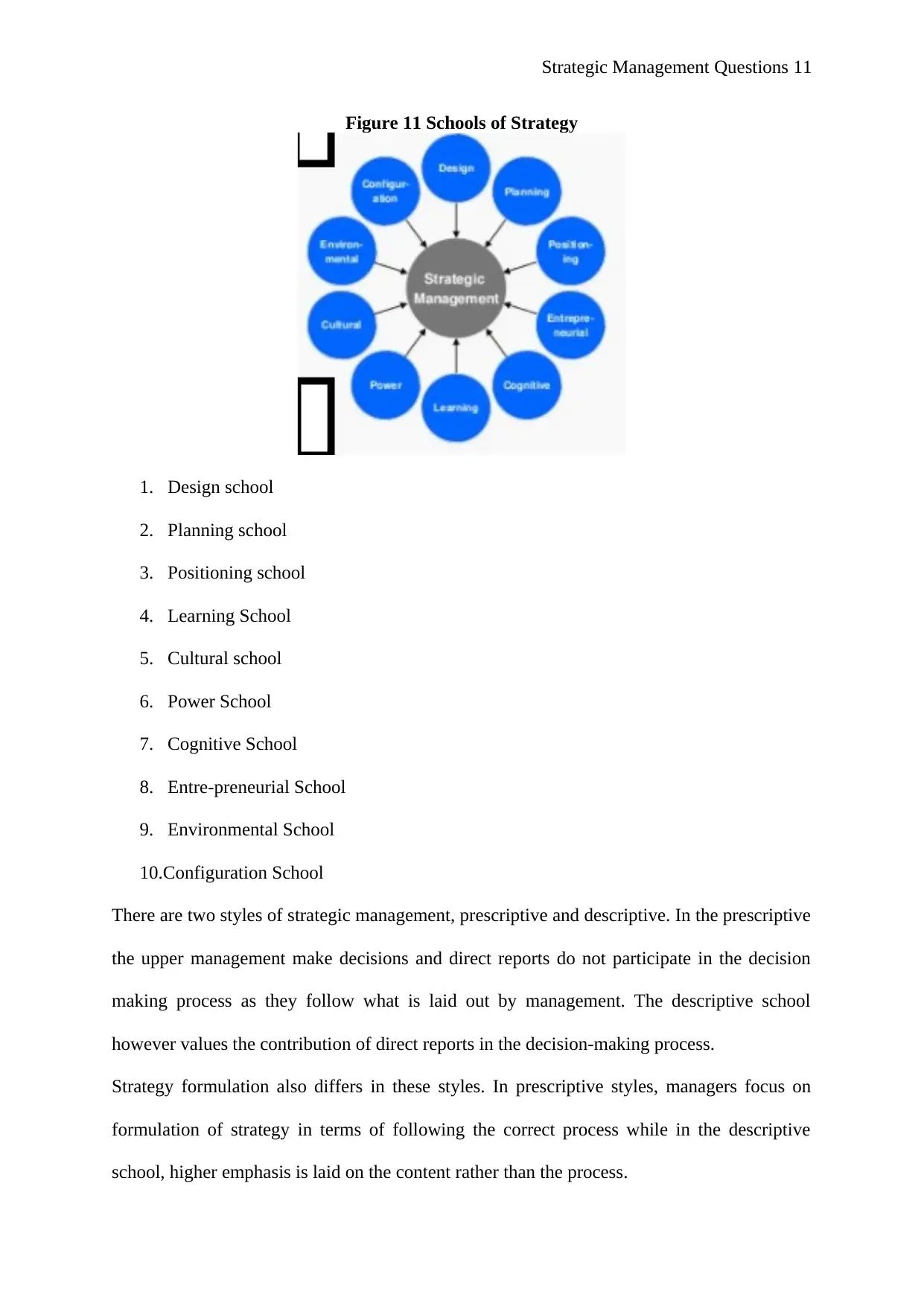
Henry Mintzberg came up with the ten schools of strategy as follows:
Analyse – This steps involves an organization analysing stakeholders by defining their roles
and expectations. Stakeholders are not equal and some have a greater impact than others do.
A matrix should be used by the organisation and this will help in classifying stakeholders in
terms if their effect on a project and their importance.
Figure 10. Stakeholder Influence Matrix
Prioritise – Once stakeholders are understood, their needs can be prioritised. They can be
mapped as necessary and put in appropriate levels. This will greatly help when the company
wants to come up with a stakeholder communication plan.
Engage – It is a final step and involves winning stakeholder support and understanding. It
forma a basis for the communications plan. It assists the organisation to involve stakeholders
as necessary.
5.Critically Discuss Schools of strategy. Both Prescriptive and Descriptive. Also, explain
why a planned strategy may not be realized in the way that management have
envisaged.
Henry Mintzberg came up with the ten schools of strategy as follows:
Paraphrase This Document
Need a fresh take? Get an instant paraphrase of this document with our AI Paraphraser
Strategic Management Questions 11
Figure 11 Schools of Strategy
1. Design school
2. Planning school
3. Positioning school
4. Learning School
5. Cultural school
6. Power School
7. Cognitive School
8. Entre-preneurial School
9. Environmental School
10.Configuration School
There are two styles of strategic management, prescriptive and descriptive. In the prescriptive
the upper management make decisions and direct reports do not participate in the decision
making process as they follow what is laid out by management. The descriptive school
however values the contribution of direct reports in the decision-making process.
Strategy formulation also differs in these styles. In prescriptive styles, managers focus on
formulation of strategy in terms of following the correct process while in the descriptive
school, higher emphasis is laid on the content rather than the process.
Figure 11 Schools of Strategy
1. Design school
2. Planning school
3. Positioning school
4. Learning School
5. Cultural school
6. Power School
7. Cognitive School
8. Entre-preneurial School
9. Environmental School
10.Configuration School
There are two styles of strategic management, prescriptive and descriptive. In the prescriptive
the upper management make decisions and direct reports do not participate in the decision
making process as they follow what is laid out by management. The descriptive school
however values the contribution of direct reports in the decision-making process.
Strategy formulation also differs in these styles. In prescriptive styles, managers focus on
formulation of strategy in terms of following the correct process while in the descriptive
school, higher emphasis is laid on the content rather than the process.
Strategic Management Questions 12
Prescriptive managers have a belief that strategy must be planned and do not take conditions
that change into account. Descriptive managers look at the fact that decision-making can be
very unpredictable hence are flexible and do not stick to one particular plan. Prescriptive
managers look at coming up with strategies which enhance perfomance. Descriptive
managers are more concerned with looking at the survival of the company and they believe in
learning from experience, as it will help the organisation succeed.
A planned strategy may not be realised due to different reasons. The reasons may be either
internal or external. Sometimes a strategy can be hampered by the external environment.
These can be political, economic, social, technological, legal or environmental factors.
Internal factors can be things like unsuccessful change management processes, lack of
enough resources or lack of adequate human resources.
6. Compare and Contrast the blue ocean strategy and porter’s generic strategies
The porter’s five forces model focuses more on what makes an organization become
competitive in the red ocean and is mostly connected with micro-environmental factors,
which affect business in the same industry. Blue ocean strategy on the other hand is a strategy
that organizations take in a very new dimension that competitors have not ventured into.
Porters model explains that competitive strategy should be based on industry understanding
and the way they change due to different factors. Porters have five forces, which shape each
industry and market. The forces are a determinant of the intensity of competition and hence
the attractiveness of the industry. Organizations should come up with strategies that modify
these forces to improve their position (Porter & Heppelmann 2014). The blue ocean strategy
looks at the fact that innovation should enable an organization to create a new market space
and tap into consumer demands that have not been satisfied. The organizations aim to get
Prescriptive managers have a belief that strategy must be planned and do not take conditions
that change into account. Descriptive managers look at the fact that decision-making can be
very unpredictable hence are flexible and do not stick to one particular plan. Prescriptive
managers look at coming up with strategies which enhance perfomance. Descriptive
managers are more concerned with looking at the survival of the company and they believe in
learning from experience, as it will help the organisation succeed.
A planned strategy may not be realised due to different reasons. The reasons may be either
internal or external. Sometimes a strategy can be hampered by the external environment.
These can be political, economic, social, technological, legal or environmental factors.
Internal factors can be things like unsuccessful change management processes, lack of
enough resources or lack of adequate human resources.
6. Compare and Contrast the blue ocean strategy and porter’s generic strategies
The porter’s five forces model focuses more on what makes an organization become
competitive in the red ocean and is mostly connected with micro-environmental factors,
which affect business in the same industry. Blue ocean strategy on the other hand is a strategy
that organizations take in a very new dimension that competitors have not ventured into.
Porters model explains that competitive strategy should be based on industry understanding
and the way they change due to different factors. Porters have five forces, which shape each
industry and market. The forces are a determinant of the intensity of competition and hence
the attractiveness of the industry. Organizations should come up with strategies that modify
these forces to improve their position (Porter & Heppelmann 2014). The blue ocean strategy
looks at the fact that innovation should enable an organization to create a new market space
and tap into consumer demands that have not been satisfied. The organizations aim to get
⊘ This is a preview!⊘
Do you want full access?
Subscribe today to unlock all pages.
Trusted by 1+ million students worldwide

1 out of 13


Related Documents


Your All-in-One AI-Powered Toolkit for Academic Success.
+13062052269
info@desklib.com
Available 24*7 on WhatsApp / Email
![[object Object]](/_next/static/media/star-bottom.7253800d.svg)
Unlock your academic potential
Copyright © 2020–2026 A2Z Services. All Rights Reserved. Developed and managed by ZUCOL.