Strategic Management Accounting: Changes in China & Australia

Verified

Added on  2022/08/25

|7
|1634
|12
Report
AI Summary
This report delves into the realm of strategic management accounting (SMA), providing a comprehensive analysis of its principles and applications. It begins by defining SMA and its role in strategic decision-making, highlighting its function in providing financial information for evaluating business strategies. The report then explores various SMA techniques, including ABC management, target costing, and competitor analysis. A significant portion of the report focuses on the evolution of SMA in China, examining the impact of economic reforms on accounting practices and the adoption of Western management accounting tools. Additionally, it investigates the changes in SMA in Australia, discussing the adoption of new techniques like JIT and the shift towards strategic and non-financial information. The report also discusses the key drivers of change in management accounting, including environmental and organizational factors, while also noting the varying rates of adoption of new techniques across different regions. Finally, the report concludes by referencing the key literature in this area to provide a well-rounded understanding of SMA.
Document Page
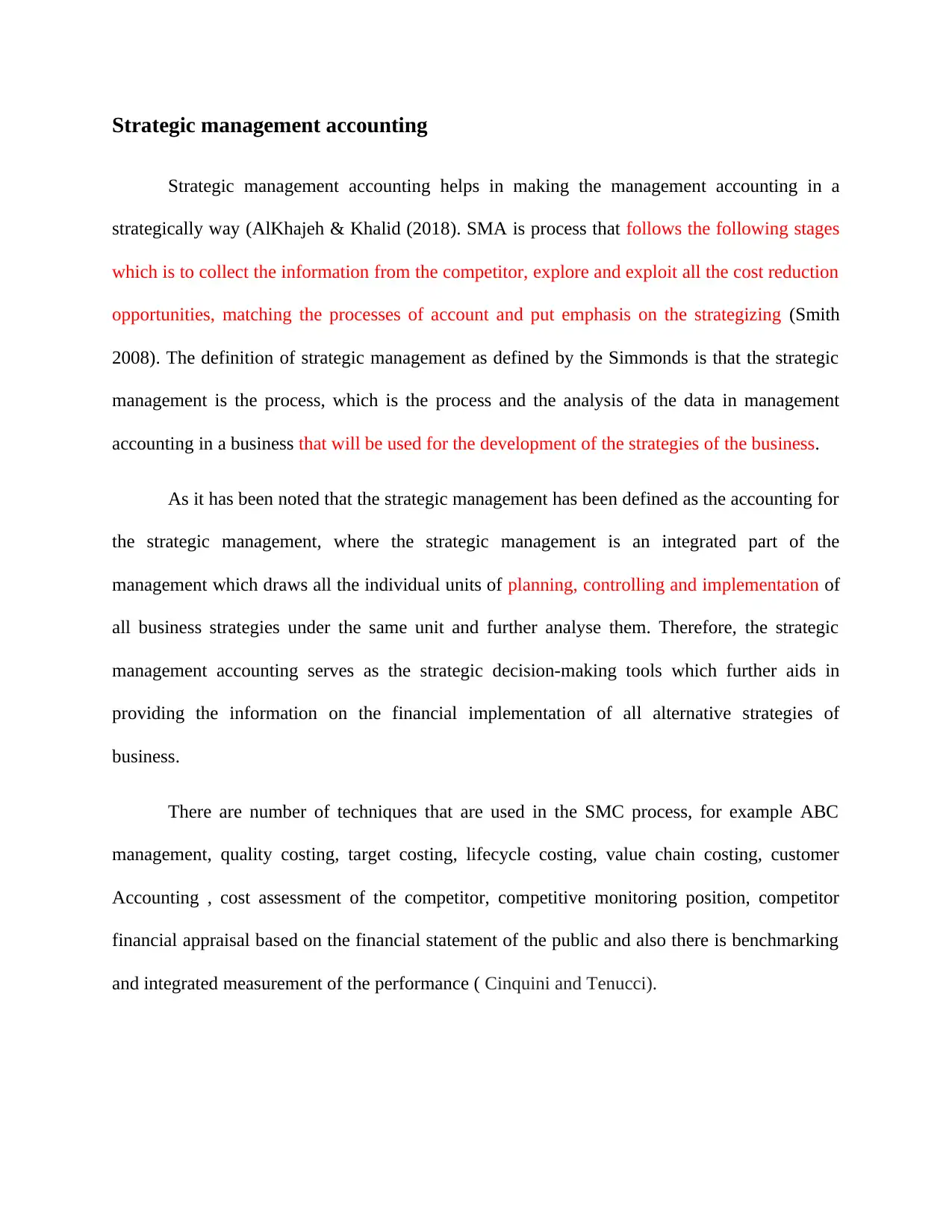
Strategic management accounting
Strategic management accounting helps in making the management accounting in a
strategically way (AlKhajeh & Khalid (2018). SMA is process that follows the following stages
which is to collect the information from the competitor, explore and exploit all the cost reduction
opportunities, matching the processes of account and put emphasis on the strategizing (Smith
2008). The definition of strategic management as defined by the Simmonds is that the strategic
management is the process, which is the process and the analysis of the data in management
accounting in a business that will be used for the development of the strategies of the business.
As it has been noted that the strategic management has been defined as the accounting for
the strategic management, where the strategic management is an integrated part of the
management which draws all the individual units of planning, controlling and implementation of
all business strategies under the same unit and further analyse them. Therefore, the strategic
management accounting serves as the strategic decision-making tools which further aids in
providing the information on the financial implementation of all alternative strategies of
business.
There are number of techniques that are used in the SMC process, for example ABC
management, quality costing, target costing, lifecycle costing, value chain costing, customer
Accounting , cost assessment of the competitor, competitive monitoring position, competitor
financial appraisal based on the financial statement of the public and also there is benchmarking
and integrated measurement of the performance ( Cinquini and Tenucci).
tabler-icon-diamond-filled.svg

Paraphrase This Document

Need a fresh take? Get an instant paraphrase of this document with our AI Paraphraser
Document Page
Change in the Strategic Management Accounting in China
It was the period when the government of China has decided to come up with reform in
its economic programs in the late 1970s then there came the changes in the accounting practices
in China. The most important factor that lead to the increase demand for the management
accounting in China has been the expansion of the decision-making authority (Tashakor,
Appuhami & Munir,2019). It has been noted that there has been a way given to the
benchmarking when the Chinese enterprises have started referring to the element of cost to make
the performance of the market. It has been revealed that the Zhoulu fertilizers in the china has
already invented the responsibility cost management system, where the cost used to get fixed as
per the market competition and the duties of the various responsibility is then defined as per the
centers individually(Jones and Xiao, 1999). It has been noted that all the accounting techniques
that were famous in the western management, for example the cost-volume profit or the
contribution margin, all of these are equally famous among the Chinese enterprises. Both of this
techniques has provided the Chinese mangers a powerful tool in order to analyse the effect of the
decision that the operational managers take on the revenue and the costs. Therefore, it has been
noted that the use of these tools such as the CVP analysis and the contribution margin has
increased manifolds. (Erokhin et al,2019)
Change in the Strategic Management Accounting In Australia
It has been noted that the traditional management technique like the standard costing,
traditional budgeting or the variance analysis and the cost-volume profit analysis has been seen
that these techniques are of lesser use in the manufacturing industries. However, in order succeed
in the present dynamic situation, it is important to adopt to the new methods of JIT, TOM , life
Document Page
cycle assessment or the target costing, all these techniques will further help the enterprises to
compete on global platform and established itself. With the help of the literature review it has
been identified as to what extent the traditional management tools are being used in four Asian
countries like Malaysia, China, India and Singapore. However it is been reviewed that the usage
of conventional tools of management accounting are seen lesser among these four countries
lately (Hutaibat & Alhatabat 2019)
From the past results it has been identified that the rate of adoption of the traditional
management technique has been immense as compared to the recently developed techniques.
However it also need to be noted that the newer technique for example, the activity based costing
has been adopted more widespread that has been displayed by the recent researches as compared
to the prior survey. It has also been seen that the benefits that has been drawn from the traditional
technique has been more pronounced than the newer introduced techniques. It has been
suggested by the evidences that most of the Australian firms have taken up management
techniques that focusses more on the strategic approach and provide the non-financial
information.
Uyar, 2019 throw a light on the cost and developed techniques in the management
accounting if the literature is referred then the following can be termed as the developed
technique of the accounting in management, which are as follows like the (1) Activity-based
costing (ABC); (2) Activity management (AM) and activity-based management (ABM); (3)
Local information systems (LS); (4) Balanced scorecard (BSC); (5) Life cycle costing (LCC); (6)
Target costing (TC); (7) Strategic management accounting (SMA)
Document Page
Thus, the key drivers/triggers of change in management accounting practice, as reported
by empirical studies conducted in Australia, the UK and the US, can be classified into two
groups: environmental and organizational factors (Alamri, 2019). ENVIRONMENTAL
FACTORS encompasses
• Globalization of Markets
• Advances in Information and Production Technologies
• Increased Competition
ORGANISATIONAL FACTORS
• Core Competencies • Customer and Supplier Relationships
• Downsizing
• Outsourcing
• Flatter Organizational Structures
• Team-Work
However it has been noted that though there has been development in many techniques
with respect to the changing requirement of the accounting in the management field have not
been seen by the respondents of the study which is being particularly useful . (Ntshonga &
Kamala, 2019) has been seen given the summary related to those trends and it has been seen
classifying these trends as compared to the importance in the given study. The results indicates
that there will be more focus on Budgeting for Planning and Control, Analysis of variances ,
Capital Budgeting and Return on Investment Techniques with a moderate focus on Balanced
tabler-icon-diamond-filled.svg

Paraphrase This Document

Need a fresh take? Get an instant paraphrase of this document with our AI Paraphraser
Document Page
Scorecard Activity-based costing and management, Customer Satisfaction Measurement,
Shareholder Value analysis, absorption accosting and variable costing.
It has been noted that most of the accounting techniques for management purposes have
been introduced with the help of the journals, conferences and the workshops. It has been
witnessed that despite having numerous seminars and workshops over the development of the
cost and management techniques in Australia; however it has been noted that there have been
fewer and lesser development over the usage and the techniques of the management and cost
accounting techniques, there have been fewer innovations and people are still opting for the
traditional technique for the said purpose, leading to the lag in the adoption of much developed
and standardized technique. For example, the ranking in terms of adoption of some of these new
techniques in Australian firms are: activity based costing ranked (24), activity based
management (21), product life cycle analysis (20), target costing (27) (Ahmad & Al-
Shbiel.,2019).
Document Page
References
AlKhajeh, M. H. A., & Khalid, A. A. (2018). Management Accounting Practices (MAPs) Impact
on Small and Medium Enterprise Business Performance within the Gauteng Province of
South Africa. Journal of Accounting and Auditing: Research & Practice.
Tashakor, S., Appuhami, R., & Munir, R. (2019). Environmental management accounting
practices in Australian cotton farming: The use of the theory of planned
behaviour. Accounting, Auditing & Accountability Journal.
Hutaibat, K., & Alhatabat, Z. (2019). Management accounting practices’ adoption in UK
universities. Journal of Further and Higher Education, 1-15.
Ntshonga, O., & Kamala, P. N. (2019). Adoption of conventional management accounting
practices by small and medium enterprises operating in the hotel sector of the Cape
Metropole
Alamri, A. M. (2019). Association between strategic management accounting facets and
organizational performance. Baltic Journal of Management, 14(2), 212-234.
Uyar, M. (2019). The management accounting and the business strategy development at
SMEs. Problems and Perspectives in Management, 17(1), 1.
Erokhin, V., Endovitsky, D., Bobryshev, A., Kulagina, N., & Ivolga, A. (2019). Management
Accounting Change as a Sustainable Economic Development Strategy during Pre-
Recession and Recession Periods: Evidence from Russia. Sustainability, 11(11), 3139.
Document Page
Ahmad, M. A., & Al-Shbiel, S. O. (2019). The Effect of Accounting Information System on
Organizational Performance in Jordanian Industrial SMEs: The Mediating Role of
Knowledge Management. International Journal of Business and Social Science, 10(3).
chevron_up_icon
1 out of 7
circle_padding
hide_on_mobile
zoom_out_icon
[object Object]