Strategic Management: Corporate Level Strategies of Three Companies
VerifiedAdded on 2020/03/16
|14
|3871
|294
Report
AI Summary
This report provides an in-depth analysis of corporate level strategies, a critical component of strategic management. It defines corporate level strategies, categorizing them into integration, intensive, diversification, and defensive strategies. The report then examines these strategies in the context of three major corporations: PepsiCo, Ford Motors, and Google. For each company, the report details the corporate strategies employed, including their mission and vision statements, generic strategies, and how they have adapted to market pressures and maintained a competitive advantage. PepsiCo's diversification and intensive strategies are highlighted, along with its forward integration and market development approaches. Ford Motors' focus on intensive growth, product development, and backward vertical integration is explored. Google's use of intensive growth strategies, market penetration, and product development through innovation is also analyzed. The report offers insights into how these companies have utilized corporate level strategies to achieve their objectives, adapt to market changes, and maintain their positions in the global market. The report emphasizes the strategic choices these companies have made, and how they have influenced their success in the market.
BBPS4103 STRATEGIC MANAGEMENT
ASSIGNMENT 1
INSTITUTIONAL AFFILIATION(S)
STUDENT NAME
[Pick the date]
ASSIGNMENT 1
INSTITUTIONAL AFFILIATION(S)
STUDENT NAME
[Pick the date]

Paraphrase This Document
Need a fresh take? Get an instant paraphrase of this document with our AI Paraphraser
STRATEGIC MANAGEMENT
Assignment 1(a)
CORPORATE LEVEL STRATEGIES
In changing environment of businesses, the scope and direction through which organisation
configures its competence and resources to meet stakeholder’s expectation is called strategies
(Toluwalope, 2016). Basic characteristics of strategy are that they are long term in
temperament i.e. planning can be short timed but its affect has long term impression on
organisations. Elements of uncertainty along with dynamic constituent are contained in
strategies while directing organisations towards meeting goals of company. There are two
basic levels of strategic formulations, corporate level strategy and business level strategy. In
this assessment corporate level strategies will be described while identifying the same in
three renowned organisations.
Corporate level strategy is considered as delicate part in strategic planning procedures
and is highly responsible for affecting organisations. It involves critical analysis of company
while considering probable questions arising about business to participate in. Corporate
strategies can also be defined as set of plan and actions made in order to assist organisations
achieving desired goals and objectives. Corporate level strategies can be further divided into
four parts; Integration strategies, Intensive strategies, Diversification strategies and Defensive
strategies. Integration strategies, also known and vertical integration strategy deals in
involving horizontal, forward or backward controlling of operations in organisations.
Intensive strategies are used to gain competitive advantage in business by making intense
decisions and efforts on corporate level. Diversification strategies refers to such activities in
which organisations involves its businesses in diversified areas and to those places which
may or may not relate to centre commotion of organisation. Defensive strategies refer to
those activities that are utilised by organisations to defend it from declining its position.
While corporate strategies are determined, the managers need to take strategic decisions to
increase and maintain overall activity of business and thus it becomes significant for
corporate managers to select the decision according to the requirements in obtaining core
objectives of organisation.
2 | P a g e
Assignment 1(a)
CORPORATE LEVEL STRATEGIES
In changing environment of businesses, the scope and direction through which organisation
configures its competence and resources to meet stakeholder’s expectation is called strategies
(Toluwalope, 2016). Basic characteristics of strategy are that they are long term in
temperament i.e. planning can be short timed but its affect has long term impression on
organisations. Elements of uncertainty along with dynamic constituent are contained in
strategies while directing organisations towards meeting goals of company. There are two
basic levels of strategic formulations, corporate level strategy and business level strategy. In
this assessment corporate level strategies will be described while identifying the same in
three renowned organisations.
Corporate level strategy is considered as delicate part in strategic planning procedures
and is highly responsible for affecting organisations. It involves critical analysis of company
while considering probable questions arising about business to participate in. Corporate
strategies can also be defined as set of plan and actions made in order to assist organisations
achieving desired goals and objectives. Corporate level strategies can be further divided into
four parts; Integration strategies, Intensive strategies, Diversification strategies and Defensive
strategies. Integration strategies, also known and vertical integration strategy deals in
involving horizontal, forward or backward controlling of operations in organisations.
Intensive strategies are used to gain competitive advantage in business by making intense
decisions and efforts on corporate level. Diversification strategies refers to such activities in
which organisations involves its businesses in diversified areas and to those places which
may or may not relate to centre commotion of organisation. Defensive strategies refer to
those activities that are utilised by organisations to defend it from declining its position.
While corporate strategies are determined, the managers need to take strategic decisions to
increase and maintain overall activity of business and thus it becomes significant for
corporate managers to select the decision according to the requirements in obtaining core
objectives of organisation.
2 | P a g e
STRATEGIC MANAGEMENT
PEPSICO
PepsiCo is the second largest company in the world dealing in food and beverage. The
headquarters of the company is situated in New York in USA. The company was established
in the year 1965 with merger of Frito Lay and Pepsi-Cola Company. The mission and vision
statement are aligned with the current operations of the business. The diversification strategy
company follows, is highlighted in terms of market and product mix while leading the
company to develop products and fulfil the demand of customers. PepsiCo’s corporate
mission declaration establishes actions that help in achieving vision of the company. It also
indicates organisation the direction for attaining long term sustainability and pushing the
company towards the top in global food market. The firm’s generic strategy is made
according to market pressure coming from its competitors and in order to maintain
competitive advantage, PepsiCo uses corporate strategies to evolve in food and beverage
market worldwide (PepsiCo, 2014).
Intensive strategies used by PepsiCo makes the company penetrate in markets with
primary growth intensive strategy. The intensive strategy allows increase in sales through
sharing big portion of market globally. With forceful marketing strategy it follows, PepsiCo
has been successful in attracting large amount of customers. The main reason behind
company’s intensive growth strategy is to reduce expenditure in order to attract more people
in spite of saturation in market. The cost leadership quality also supports generic competition
while supporting integrative strategies. The second corporate level strategy implemented by
PepsiCo is product development. This intensive strategy helps company promote newer
products and develops existing products to capture more consumers. Board differentiation
and generic competitive strategies followed by PepsiCo offers uniqueness and novelty in
products and growth in business. Market development is also supported by intensive growth
strategy of PepsiCo as it supports entering new market segments and continues in expanding
business through distribution network in developing regions. Although PepsiCo has got
significant market presence, still the strategic objectives of business supports intensive
growth strategies by expanding in more diversified areas (Ferguson, 2017).
Over the years PepsiCo has been utilising its integrative strategies in corporate levels
to formulate systematic strategies required for growth of the company. Forward integration
system is majorly utilised by PepsiCo under which functions relating supply chain takes
shape. Distributors, manufacturers and retailers are controlled by the company before making
3 | P a g e
PEPSICO
PepsiCo is the second largest company in the world dealing in food and beverage. The
headquarters of the company is situated in New York in USA. The company was established
in the year 1965 with merger of Frito Lay and Pepsi-Cola Company. The mission and vision
statement are aligned with the current operations of the business. The diversification strategy
company follows, is highlighted in terms of market and product mix while leading the
company to develop products and fulfil the demand of customers. PepsiCo’s corporate
mission declaration establishes actions that help in achieving vision of the company. It also
indicates organisation the direction for attaining long term sustainability and pushing the
company towards the top in global food market. The firm’s generic strategy is made
according to market pressure coming from its competitors and in order to maintain
competitive advantage, PepsiCo uses corporate strategies to evolve in food and beverage
market worldwide (PepsiCo, 2014).
Intensive strategies used by PepsiCo makes the company penetrate in markets with
primary growth intensive strategy. The intensive strategy allows increase in sales through
sharing big portion of market globally. With forceful marketing strategy it follows, PepsiCo
has been successful in attracting large amount of customers. The main reason behind
company’s intensive growth strategy is to reduce expenditure in order to attract more people
in spite of saturation in market. The cost leadership quality also supports generic competition
while supporting integrative strategies. The second corporate level strategy implemented by
PepsiCo is product development. This intensive strategy helps company promote newer
products and develops existing products to capture more consumers. Board differentiation
and generic competitive strategies followed by PepsiCo offers uniqueness and novelty in
products and growth in business. Market development is also supported by intensive growth
strategy of PepsiCo as it supports entering new market segments and continues in expanding
business through distribution network in developing regions. Although PepsiCo has got
significant market presence, still the strategic objectives of business supports intensive
growth strategies by expanding in more diversified areas (Ferguson, 2017).
Over the years PepsiCo has been utilising its integrative strategies in corporate levels
to formulate systematic strategies required for growth of the company. Forward integration
system is majorly utilised by PepsiCo under which functions relating supply chain takes
shape. Distributors, manufacturers and retailers are controlled by the company before making
3 | P a g e
⊘ This is a preview!⊘
Do you want full access?
Subscribe today to unlock all pages.

Trusted by 1+ million students worldwide
STRATEGIC MANAGEMENT
final transact of finished products (Dodovisky, 2016). The distribution and bottling rights
have been undertaken by Pepsi America and Pepsi bottling group. In terms of profiteering,
these strategies have been a huge success and according to annual report presented by
company most of its beverages like Gatorade, Pepsi, Tropicana, etc. have increased its profit
for more than 1% annually. Horizontal growth strategies of PepsiCo has enabled company
expand its existing products in more diversified regions or market segments. The company
has made many strategic alliances which has made easier for the company to increase its
economic scale by increasing its operations. Earlier PepsiCo has started its business from
American regions but now it operates in more than 200 countries including Asia and MENA
regions.
PepsiCo follows concentric diversification strategy that means the company expands
its business in related industry only and adopts synergies that align existing business
(PepsiCo, 2012). Situation that are chosen for new business gains advantages from common
similarities of existing business in forms of technology, distribution, product, manufacturing
or customer aspects. Therefore this strategy helps in avoiding controversial reasons for
carbonated drinks as PepsiCo poses for healthier variety in food products. PepsiCo has also
made many acquisitions and mergers in order to create more efficient and agile brand while
enabling innovative and competent brand in beverage and food system. Presently the CEO of
the company, Indra Krishnamurthy Nooyi has been increasing PepsiCo’s associations with
other recognised brands and increasing company value by promoting the initiative of ‘One
PepsiCo’ to facilitate sharing infrastructure and supply chain management.
PepsiCo has undoubtedly risen strikingly from defensive to offensive stage by making
decisions strategically in corporate level (Accenture, 2015). Company’s has been successful
in understanding its consumers and monitored trends by regular accessing day to day
business operations. The company had been able to protect the core objective by evaluating
consumer’s categories and measuring the market and its competitors. Cost cutting strategies
followed by PepsiCo has made the company save its synergies for product development
while enabling technology and innovations in its industrial sites. The corporate strategy of the
company also enables CSR in its functions thereby satisfying governmental requirements and
business ethics.
4 | P a g e
final transact of finished products (Dodovisky, 2016). The distribution and bottling rights
have been undertaken by Pepsi America and Pepsi bottling group. In terms of profiteering,
these strategies have been a huge success and according to annual report presented by
company most of its beverages like Gatorade, Pepsi, Tropicana, etc. have increased its profit
for more than 1% annually. Horizontal growth strategies of PepsiCo has enabled company
expand its existing products in more diversified regions or market segments. The company
has made many strategic alliances which has made easier for the company to increase its
economic scale by increasing its operations. Earlier PepsiCo has started its business from
American regions but now it operates in more than 200 countries including Asia and MENA
regions.
PepsiCo follows concentric diversification strategy that means the company expands
its business in related industry only and adopts synergies that align existing business
(PepsiCo, 2012). Situation that are chosen for new business gains advantages from common
similarities of existing business in forms of technology, distribution, product, manufacturing
or customer aspects. Therefore this strategy helps in avoiding controversial reasons for
carbonated drinks as PepsiCo poses for healthier variety in food products. PepsiCo has also
made many acquisitions and mergers in order to create more efficient and agile brand while
enabling innovative and competent brand in beverage and food system. Presently the CEO of
the company, Indra Krishnamurthy Nooyi has been increasing PepsiCo’s associations with
other recognised brands and increasing company value by promoting the initiative of ‘One
PepsiCo’ to facilitate sharing infrastructure and supply chain management.
PepsiCo has undoubtedly risen strikingly from defensive to offensive stage by making
decisions strategically in corporate level (Accenture, 2015). Company’s has been successful
in understanding its consumers and monitored trends by regular accessing day to day
business operations. The company had been able to protect the core objective by evaluating
consumer’s categories and measuring the market and its competitors. Cost cutting strategies
followed by PepsiCo has made the company save its synergies for product development
while enabling technology and innovations in its industrial sites. The corporate strategy of the
company also enables CSR in its functions thereby satisfying governmental requirements and
business ethics.
4 | P a g e
Paraphrase This Document
Need a fresh take? Get an instant paraphrase of this document with our AI Paraphraser
STRATEGIC MANAGEMENT
FORD MOTORS
Ford motor is currently fifth largest company dealing in automobile manufacturing whose
headquarters is situated in USA. The company operates in more than six continents operating
in 70 plants globally and has nearly 159000 employees. The company has been able to
perform well in UK also by making mergers with Jaguar, Volvo and Aston Martin (Ford,
2017). The vision of company states one plan one goal which shows their integrated thinking
toward distributors, suppliers and global work force to make the company lead consumer
vehicle marketplace. The corporate strategy relating purchasing, maintaining and financing
shows their progressive thinking in making their brand as one stop shop in vehicle related
field. The mission statement of Ford motors defines the action plan to achieve organisational
goal of exceeding its market position and performance level.
Ford motors is been highly supported with intensive growth strategy it follows which
aligns its generic strategies with competitive market. Ford is depended on market penetration
and development of product. The company entails in making increased sales of products to its
existing customers in order to grow its business and for this reason Ford has been increasing
the dealerships and sale volumes. The company’s strategic objectives are linked with its
intensive growth formula which is achieved by the company through increased retention
among customers and selling more to existing customers. The generic competitive strategy
followed by the company enables company to reduce its costs and gain bigger market split.
The company keeps developing its products and keep offering new products to get increased
ratio in sales. The intensive strategy for product development is improvised in the company
through implementing technology and innovation in its productions and supply areas. Market
development strategy allows the company to work in more diversified locations. This strategy
involves company to provide new products in new market segments. Since Ford operations
are spread in global market, the company does not needs to work more on market developing
areas as compared to initial years (Meyer, 2017).
Ford motors follows backward vertical integration strategy which makes the company
moving reverse along chain value and emerging supplier’s trade. These strategies are
normally followed by those companies who believe that their suppliers have got more power
over them (Mahlburg, 2000). During early stages of automobile industries, Ford had created
many subsidiaries that provide the company with major inputs like glass, rubber and metal.
Thus chances of getting neglected by suppliers are reduced. Also providing inferior materials
5 | P a g e
FORD MOTORS
Ford motor is currently fifth largest company dealing in automobile manufacturing whose
headquarters is situated in USA. The company operates in more than six continents operating
in 70 plants globally and has nearly 159000 employees. The company has been able to
perform well in UK also by making mergers with Jaguar, Volvo and Aston Martin (Ford,
2017). The vision of company states one plan one goal which shows their integrated thinking
toward distributors, suppliers and global work force to make the company lead consumer
vehicle marketplace. The corporate strategy relating purchasing, maintaining and financing
shows their progressive thinking in making their brand as one stop shop in vehicle related
field. The mission statement of Ford motors defines the action plan to achieve organisational
goal of exceeding its market position and performance level.
Ford motors is been highly supported with intensive growth strategy it follows which
aligns its generic strategies with competitive market. Ford is depended on market penetration
and development of product. The company entails in making increased sales of products to its
existing customers in order to grow its business and for this reason Ford has been increasing
the dealerships and sale volumes. The company’s strategic objectives are linked with its
intensive growth formula which is achieved by the company through increased retention
among customers and selling more to existing customers. The generic competitive strategy
followed by the company enables company to reduce its costs and gain bigger market split.
The company keeps developing its products and keep offering new products to get increased
ratio in sales. The intensive strategy for product development is improvised in the company
through implementing technology and innovation in its productions and supply areas. Market
development strategy allows the company to work in more diversified locations. This strategy
involves company to provide new products in new market segments. Since Ford operations
are spread in global market, the company does not needs to work more on market developing
areas as compared to initial years (Meyer, 2017).
Ford motors follows backward vertical integration strategy which makes the company
moving reverse along chain value and emerging supplier’s trade. These strategies are
normally followed by those companies who believe that their suppliers have got more power
over them (Mahlburg, 2000). During early stages of automobile industries, Ford had created
many subsidiaries that provide the company with major inputs like glass, rubber and metal.
Thus chances of getting neglected by suppliers are reduced. Also providing inferior materials
5 | P a g e
STRATEGIC MANAGEMENT
or highly priced material is avoided by the company through their enhanced relationship.
Backward vertical integrated strategies are usually followed by manufacturing and
automobile industries although few entertainment industries also follow same strategy in their
corporate planning (Creative Common Attribution).
Ford motors approach towards corporate level strategy shows that the company
follows concentric diversification as the company is geared towards providing its customers
with special requirement in automobile vehicles. The companies operation are spread in
global market which is the reason company gains much attention by its dealers and
customers. The designing team in the company is focussed in making products of Ford
according to consumer’s preferences and while considering issues related to any of its
products, Ford is always ready to make changes to it. Since the customer’s of the company
are situated in diversified regions, the company has to make adjustments in marketing
strategies and communication while exploring offers and features that target active lifestyle
of customers(E-Coach, 2017).
The global standard of production had made Ford sustain the automobile industry
with prominence and has made the company come out through defensive stage to offensive
stage. However the company had to face many challenges from government and country
laws, still by modifying production standards and strategic moves, the company had
surpassed all major challenges. Global businesses have to follow global corporate strategies;
therefore, the strategic choices for companies like Ford have become limited and shall be
taken with much care. Ford, with its strategic corporate principles has been able to survive
the auto industry and fulfil its objectives.
GOOGLE
Another America based MNC is Google who has been one of the most influential technology
companies ruling the world. Internet based services and creations had been vastly introduced
by the company which had changed the people’s way of using web. Promotion of information
and knowledge through its content has been influencing people since the formation of the
company in the year 1998. The vision and mission statement of the company reflects its
powerful ideas and what the company desires to achieve. Goggle’s mission defines its
strategies like development of its products and services along with achieving new heights
6 | P a g e
or highly priced material is avoided by the company through their enhanced relationship.
Backward vertical integrated strategies are usually followed by manufacturing and
automobile industries although few entertainment industries also follow same strategy in their
corporate planning (Creative Common Attribution).
Ford motors approach towards corporate level strategy shows that the company
follows concentric diversification as the company is geared towards providing its customers
with special requirement in automobile vehicles. The companies operation are spread in
global market which is the reason company gains much attention by its dealers and
customers. The designing team in the company is focussed in making products of Ford
according to consumer’s preferences and while considering issues related to any of its
products, Ford is always ready to make changes to it. Since the customer’s of the company
are situated in diversified regions, the company has to make adjustments in marketing
strategies and communication while exploring offers and features that target active lifestyle
of customers(E-Coach, 2017).
The global standard of production had made Ford sustain the automobile industry
with prominence and has made the company come out through defensive stage to offensive
stage. However the company had to face many challenges from government and country
laws, still by modifying production standards and strategic moves, the company had
surpassed all major challenges. Global businesses have to follow global corporate strategies;
therefore, the strategic choices for companies like Ford have become limited and shall be
taken with much care. Ford, with its strategic corporate principles has been able to survive
the auto industry and fulfil its objectives.
Another America based MNC is Google who has been one of the most influential technology
companies ruling the world. Internet based services and creations had been vastly introduced
by the company which had changed the people’s way of using web. Promotion of information
and knowledge through its content has been influencing people since the formation of the
company in the year 1998. The vision and mission statement of the company reflects its
powerful ideas and what the company desires to achieve. Goggle’s mission defines its
strategies like development of its products and services along with achieving new heights
6 | P a g e
⊘ This is a preview!⊘
Do you want full access?
Subscribe today to unlock all pages.
Trusted by 1+ million students worldwide
STRATEGIC MANAGEMENT
through innovation and technology (Google, 2017). The effort of the company and its
employees is the reason behind success of Google.
Google is also recognised as most valuable brand worldwide through its intensive
growth strategies which had been satisfying the needs of the firm through continuous growth
and leadership. Market penetration for Google in and outside home country through internet
and cable connections had been easier as not much competition is seen in market. Google
also shares a large share in global marketing advertisement, made online. Development in
market is also one of the corporate level strategies followed by Google and the company
already has become leader in many countries. However in few countries like China who has
their own online web company does not allow penetrating easily for other brands. Google
strategy for product development is accomplished through developing its product with
innovation and techniques. Google has also developed many mobile apps and phones which
shows its diversified nature for market penetration. Business development is necessary for
companies to survive which has been realised by the company as it makes continuous efforts
in developing its products and websites (Thompson, 2017).
Google sets a good example for forward integration strategy used by company. The
company uses this strategy for managing demand and eliminate risks (Ward, 2011). The
company got frustrated with incumbent telecom industries and was successful in launching its
own product with its own mobile network. The company tries to establish better services in
internet and networking which automatically increase demand of more operators by
customers. Increase in internet traffic increases search engines and hence scope for increment
in business is viable. Apple is one another important company which follows the same
principle and has been successful in opening its own retail stores worldwide. Big companies
like Apple and Google can easily afford forward integration but at the same time can prove
risky if their current operations seem dwindling (Favaro, 2015).
After analysing Google’s corporate level strategy it is seen that Google has made its
online searching as main service or. But, with changing times the company has begun
developing horizontal diversification strategy by developing inter related products and
services. Products like Gmail, Google search appliance, Google drive and online publishing
services were developed by the company along with many other products in the last decade.
All the products introduced by the company add complimentary services to existing ones and
thus users are becoming more depended on Google. Google has also created mobile phones
7 | P a g e
through innovation and technology (Google, 2017). The effort of the company and its
employees is the reason behind success of Google.
Google is also recognised as most valuable brand worldwide through its intensive
growth strategies which had been satisfying the needs of the firm through continuous growth
and leadership. Market penetration for Google in and outside home country through internet
and cable connections had been easier as not much competition is seen in market. Google
also shares a large share in global marketing advertisement, made online. Development in
market is also one of the corporate level strategies followed by Google and the company
already has become leader in many countries. However in few countries like China who has
their own online web company does not allow penetrating easily for other brands. Google
strategy for product development is accomplished through developing its product with
innovation and techniques. Google has also developed many mobile apps and phones which
shows its diversified nature for market penetration. Business development is necessary for
companies to survive which has been realised by the company as it makes continuous efforts
in developing its products and websites (Thompson, 2017).
Google sets a good example for forward integration strategy used by company. The
company uses this strategy for managing demand and eliminate risks (Ward, 2011). The
company got frustrated with incumbent telecom industries and was successful in launching its
own product with its own mobile network. The company tries to establish better services in
internet and networking which automatically increase demand of more operators by
customers. Increase in internet traffic increases search engines and hence scope for increment
in business is viable. Apple is one another important company which follows the same
principle and has been successful in opening its own retail stores worldwide. Big companies
like Apple and Google can easily afford forward integration but at the same time can prove
risky if their current operations seem dwindling (Favaro, 2015).
After analysing Google’s corporate level strategy it is seen that Google has made its
online searching as main service or. But, with changing times the company has begun
developing horizontal diversification strategy by developing inter related products and
services. Products like Gmail, Google search appliance, Google drive and online publishing
services were developed by the company along with many other products in the last decade.
All the products introduced by the company add complimentary services to existing ones and
thus users are becoming more depended on Google. Google has also created mobile phones
7 | P a g e
Paraphrase This Document
Need a fresh take? Get an instant paraphrase of this document with our AI Paraphraser
STRATEGIC MANAGEMENT
and apps which had provided company to retain existing users in diversified manner and thus
Google is positioned as one stop placed for internet users (Pineda, 2016).
8 | P a g e
and apps which had provided company to retain existing users in diversified manner and thus
Google is positioned as one stop placed for internet users (Pineda, 2016).
8 | P a g e
STRATEGIC MANAGEMENT
Assignment 1 (b)
PORTER’S FIVE FORCE MODEL
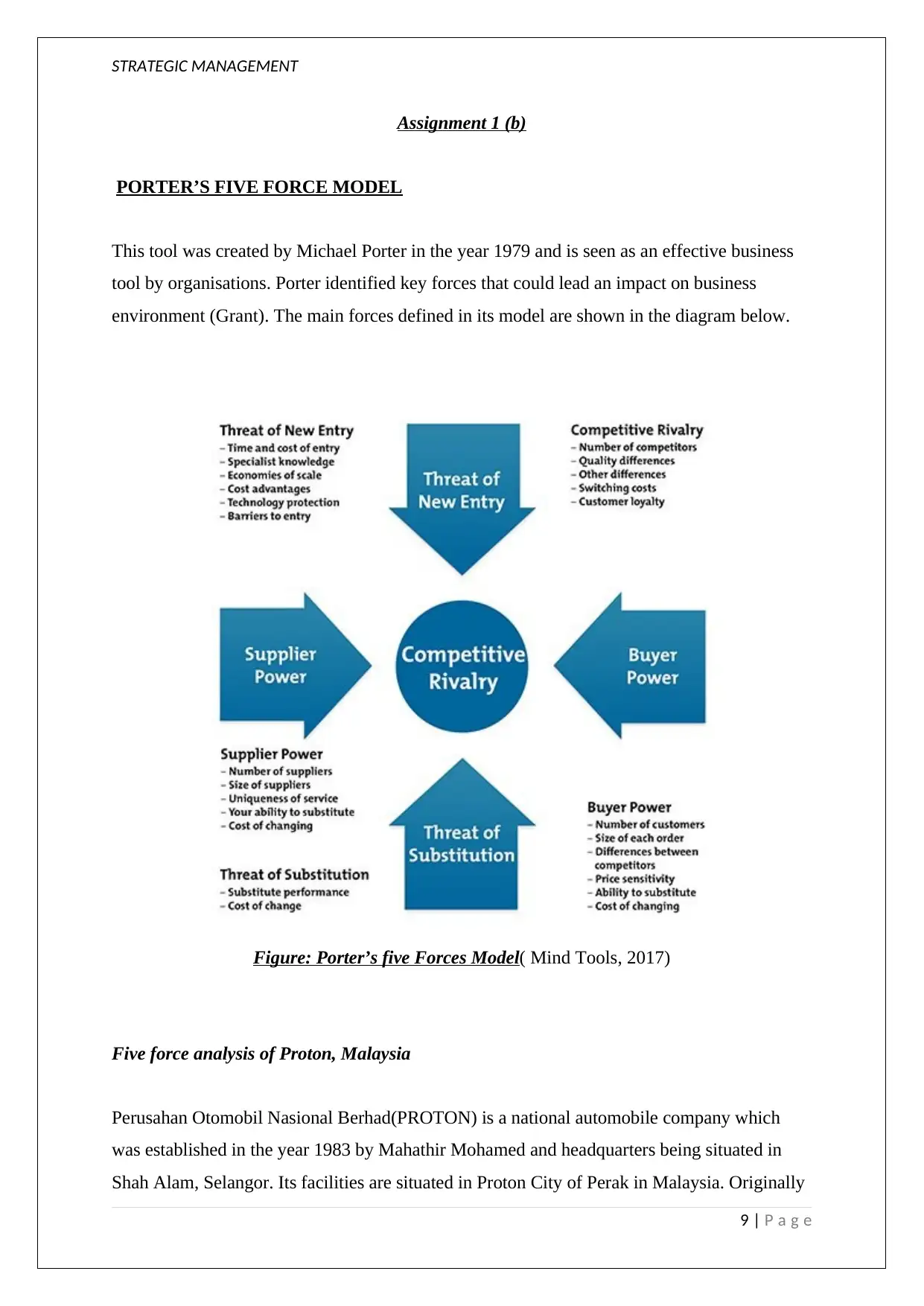
This tool was created by Michael Porter in the year 1979 and is seen as an effective business
tool by organisations. Porter identified key forces that could lead an impact on business
environment (Grant). The main forces defined in its model are shown in the diagram below.
Figure: Porter’s five Forces Model( Mind Tools, 2017)
Five force analysis of Proton, Malaysia
Perusahan Otomobil Nasional Berhad(PROTON) is a national automobile company which
was established in the year 1983 by Mahathir Mohamed and headquarters being situated in
Shah Alam, Selangor. Its facilities are situated in Proton City of Perak in Malaysia. Originally
9 | P a g e
Assignment 1 (b)
PORTER’S FIVE FORCE MODEL
This tool was created by Michael Porter in the year 1979 and is seen as an effective business
tool by organisations. Porter identified key forces that could lead an impact on business
environment (Grant). The main forces defined in its model are shown in the diagram below.
Figure: Porter’s five Forces Model( Mind Tools, 2017)
Five force analysis of Proton, Malaysia
Perusahan Otomobil Nasional Berhad(PROTON) is a national automobile company which
was established in the year 1983 by Mahathir Mohamed and headquarters being situated in
Shah Alam, Selangor. Its facilities are situated in Proton City of Perak in Malaysia. Originally
9 | P a g e
⊘ This is a preview!⊘
Do you want full access?
Subscribe today to unlock all pages.
Trusted by 1+ million students worldwide
STRATEGIC MANAGEMENT
the company was a manufacturer of parts of Mitsubishi but from the year 1985; the company
started producing its own cars under the name Proton Saga. Proton cars are sold in more than
15 countries in which Asia covers the largest part(PROTON Holdings Berhad, 2017). Porters
five force analysis made of Proton shows the structure of the industry and its forces as shown
in above figure.
Threats of new entry: This force describes the force required by new entrants to enter
in the competing market. The major barriers for new entrants are higher investment
and capital required to enter the industry. The long players of manufacturing industry
generally possess high quality maintenance and latest technologies which makes
difficult for any new entrant to enter the market. Availability of distribution channel is
also difficult to seek for connecting customers. Since Protons has a good reputation in
Malaysian market, this force seems to be week. Although government always support
entrance of new companies with its friendly policies but for Proton there are other
favourable factors also (Pang, 2017).
Threat of substitution: This factor shows the ability of customers to switch to other
products that may be cheaper or accessible like motorcycles and bikes. Consumers
seems to favour substitutes of two wheelers mainly because of increasing in prices of
gasoline and due to concern regarding environment as two wheelers produces less
harmful gasses. There are other brands also which provides high quality product in
lesser rates. Thus the quality and rate of other substitute product and willingness of
buyers make threat of substitution force to be strong for car companies. On the other
hand if comfort level is considered, customers always prefer for cars only and thus
threat of substitution seems moderate for Proton ( The DataGroup).
Buyer power: Many similar car companies are present in Malaysian market that
competes with each other. Bargaining power of customers also seems to be strong due
to other products presence. The amount of sales is divided among all car manufacturers
and distributors. Since Malaysian car markets are fragmented where demand for cars is
high, Protons can maintain its market due to the economic development seen in the
country and its buyers. Protons maintain quality in its product which is the reason
behind its firm presence in global car market (Pang, 2017).
10 | P a g e
the company was a manufacturer of parts of Mitsubishi but from the year 1985; the company
started producing its own cars under the name Proton Saga. Proton cars are sold in more than
15 countries in which Asia covers the largest part(PROTON Holdings Berhad, 2017). Porters
five force analysis made of Proton shows the structure of the industry and its forces as shown
in above figure.
Threats of new entry: This force describes the force required by new entrants to enter
in the competing market. The major barriers for new entrants are higher investment
and capital required to enter the industry. The long players of manufacturing industry
generally possess high quality maintenance and latest technologies which makes
difficult for any new entrant to enter the market. Availability of distribution channel is
also difficult to seek for connecting customers. Since Protons has a good reputation in
Malaysian market, this force seems to be week. Although government always support
entrance of new companies with its friendly policies but for Proton there are other
favourable factors also (Pang, 2017).
Threat of substitution: This factor shows the ability of customers to switch to other
products that may be cheaper or accessible like motorcycles and bikes. Consumers
seems to favour substitutes of two wheelers mainly because of increasing in prices of
gasoline and due to concern regarding environment as two wheelers produces less
harmful gasses. There are other brands also which provides high quality product in
lesser rates. Thus the quality and rate of other substitute product and willingness of
buyers make threat of substitution force to be strong for car companies. On the other
hand if comfort level is considered, customers always prefer for cars only and thus
threat of substitution seems moderate for Proton ( The DataGroup).
Buyer power: Many similar car companies are present in Malaysian market that
competes with each other. Bargaining power of customers also seems to be strong due
to other products presence. The amount of sales is divided among all car manufacturers
and distributors. Since Malaysian car markets are fragmented where demand for cars is
high, Protons can maintain its market due to the economic development seen in the
country and its buyers. Protons maintain quality in its product which is the reason
behind its firm presence in global car market (Pang, 2017).
10 | P a g e
Paraphrase This Document
Need a fresh take? Get an instant paraphrase of this document with our AI Paraphraser
STRATEGIC MANAGEMENT
Supplier’s power: This force seems to be neutral for the industry as few dominant
industries rule the supply sector of car manufacturing parts. They have got reputation
for good quality which makes strong reason for them to bargain. The role of quality
and service in car manufacturing industry is directly related to customer’s safety and
requirements to travel in faster way. Once any supplier is fixed, it becomes difficult to
replace as customer may demand for same quality, unless up gradation is seen. On the
other hand, switching cost is also high which makes the car companies fixed to few
suppliers only. Since government is highly pushing for industrialisation in Malaysia,
more than 350 companies supplying vehicle components were seen that indicates that
supplier power is satisfactory regarding availability of substitute products. Proton is
self manufacturing plant and is country owned and thus it has fewer chances of
forward integrated threats from suppliers that show that supplier bargaining power is
medium for Protons (Stategic Management of Proton, Malaysia, 2015).
Competitive rivalry: This force describes the amount of competition present and its
intensity for rivalry in the industry. Almost every competitor of car manufactures
present in the world tries to improve their product by giving in extensive effort to
become unique and posse’s strong position in global market. This is one of the
strongest reasons why the companies have to struggle in its home country even as
emerging of foreign companies makes the competition more difficult(Pang, 2017). Car
manufacturers from Korea, China and Japan had made Malaysian car market more
competitive and Proton has been trying greatly to adjust the diverse culture and
organisational behaviours of its rival companies. Lesser to no switching costs also
creates a threat for the company for getting its customers switch to other brands.
Therefore competitive rivalry force can be said to be strong for Proton and to sustain
the car market the company has to improve its products along with minimising car
rates (Stategic Management of Proton, Malaysia, 2015).
REFERENCES
11 | P a g e
Supplier’s power: This force seems to be neutral for the industry as few dominant
industries rule the supply sector of car manufacturing parts. They have got reputation
for good quality which makes strong reason for them to bargain. The role of quality
and service in car manufacturing industry is directly related to customer’s safety and
requirements to travel in faster way. Once any supplier is fixed, it becomes difficult to
replace as customer may demand for same quality, unless up gradation is seen. On the
other hand, switching cost is also high which makes the car companies fixed to few
suppliers only. Since government is highly pushing for industrialisation in Malaysia,
more than 350 companies supplying vehicle components were seen that indicates that
supplier power is satisfactory regarding availability of substitute products. Proton is
self manufacturing plant and is country owned and thus it has fewer chances of
forward integrated threats from suppliers that show that supplier bargaining power is
medium for Protons (Stategic Management of Proton, Malaysia, 2015).
Competitive rivalry: This force describes the amount of competition present and its
intensity for rivalry in the industry. Almost every competitor of car manufactures
present in the world tries to improve their product by giving in extensive effort to
become unique and posse’s strong position in global market. This is one of the
strongest reasons why the companies have to struggle in its home country even as
emerging of foreign companies makes the competition more difficult(Pang, 2017). Car
manufacturers from Korea, China and Japan had made Malaysian car market more
competitive and Proton has been trying greatly to adjust the diverse culture and
organisational behaviours of its rival companies. Lesser to no switching costs also
creates a threat for the company for getting its customers switch to other brands.
Therefore competitive rivalry force can be said to be strong for Proton and to sustain
the car market the company has to improve its products along with minimising car
rates (Stategic Management of Proton, Malaysia, 2015).
REFERENCES
11 | P a g e
STRATEGIC MANAGEMENT
Mind Tools. (2017). Porter's Five Forces. Retrieved from
https://www.mindtools.com/pages/article/newTMC_08.htm
The DataGroup. (n.d.). The Tactical & Strategic Report on Proton Holdings. Retrieved from
http://www.data-institute.org/PureData/Malaysia/proton-holdings.html
Accenture. (2015). Moving from Defense to Offense . Retrieved from
https://www.accenture.com/t20150818T085104Z__w__/us-en/_acnmedia/Accenture/
Conversion-Assets/DotCom/Documents/Global/PDF/Industries_18/Accenture-
Moving-From-Defense-to-Offense-Consumer-Goods.pdfla=en
Creative Common Attribution. (n.d.). Vertical Integration Strategies. Retrieved from
http://open.lib.umn.edu/strategicmanagement/chapter/8-3-vertical-integration-
strategies/
Dodovisky, J. (2016). PepsiCo Business Strategy and Competitive Advantage. Retrieved from
https://research-methodology.net/pepsico-analysis-of-corporate-strategy/
E-Coach. (2017). Ford Motor Company: Sustainable Growth Strategies. Retrieved from
http://www.1000ventures.com/business_guide/cs_sg_ford.html
Favaro, K. (2015). Vertical Integration 2.0: An Old Strategy Makes a Comeback. Retrieved
from https://www.strategy-business.com/blog/Vertical-Integration-2-0-An-Old-
Strategy-Makes-a-Comeback?gko=41fe1
Ferguson, E. (2017). PepsiCo’s Generic and Intensive Growth Strategies. Retrieved from
http://panmore.com/pepsico-generic-strategy-intensive-growth-strategies
Ford. (2017). Ford Motor Company. Retrieved from
https://corporate.ford.com/microsites/sustainability-report-2016-17/operations/
index.html
Google. (2017). Google: Our Company. Retrieved from https://www.google.com/about/
Grant, R. M. (n.d.). ORIGINS AND SIGNIFICANCE OF THE FIVE FORCES
FRAMEWORK. Retrieved from
http://onlinelibrary.wiley.com/store/10.1002/9781118785317/asset/homepages/
weom120173.pdf;jsessionid=C52E5B8C7E43A0FE6FD584A81F3F46BD.f01t04?
v=1&s=f38efd0c2a9f3d5ab513e2b4cf59412e1f8a23d8
12 | P a g e
Mind Tools. (2017). Porter's Five Forces. Retrieved from
https://www.mindtools.com/pages/article/newTMC_08.htm
The DataGroup. (n.d.). The Tactical & Strategic Report on Proton Holdings. Retrieved from
http://www.data-institute.org/PureData/Malaysia/proton-holdings.html
Accenture. (2015). Moving from Defense to Offense . Retrieved from
https://www.accenture.com/t20150818T085104Z__w__/us-en/_acnmedia/Accenture/
Conversion-Assets/DotCom/Documents/Global/PDF/Industries_18/Accenture-
Moving-From-Defense-to-Offense-Consumer-Goods.pdfla=en
Creative Common Attribution. (n.d.). Vertical Integration Strategies. Retrieved from
http://open.lib.umn.edu/strategicmanagement/chapter/8-3-vertical-integration-
strategies/
Dodovisky, J. (2016). PepsiCo Business Strategy and Competitive Advantage. Retrieved from
https://research-methodology.net/pepsico-analysis-of-corporate-strategy/
E-Coach. (2017). Ford Motor Company: Sustainable Growth Strategies. Retrieved from
http://www.1000ventures.com/business_guide/cs_sg_ford.html
Favaro, K. (2015). Vertical Integration 2.0: An Old Strategy Makes a Comeback. Retrieved
from https://www.strategy-business.com/blog/Vertical-Integration-2-0-An-Old-
Strategy-Makes-a-Comeback?gko=41fe1
Ferguson, E. (2017). PepsiCo’s Generic and Intensive Growth Strategies. Retrieved from
http://panmore.com/pepsico-generic-strategy-intensive-growth-strategies
Ford. (2017). Ford Motor Company. Retrieved from
https://corporate.ford.com/microsites/sustainability-report-2016-17/operations/
index.html
Google. (2017). Google: Our Company. Retrieved from https://www.google.com/about/
Grant, R. M. (n.d.). ORIGINS AND SIGNIFICANCE OF THE FIVE FORCES
FRAMEWORK. Retrieved from
http://onlinelibrary.wiley.com/store/10.1002/9781118785317/asset/homepages/
weom120173.pdf;jsessionid=C52E5B8C7E43A0FE6FD584A81F3F46BD.f01t04?
v=1&s=f38efd0c2a9f3d5ab513e2b4cf59412e1f8a23d8
12 | P a g e
⊘ This is a preview!⊘
Do you want full access?
Subscribe today to unlock all pages.
Trusted by 1+ million students worldwide

1 out of 14


Related Documents


Your All-in-One AI-Powered Toolkit for Academic Success.
+13062052269
info@desklib.com
Available 24*7 on WhatsApp / Email
![[object Object]](/_next/static/media/star-bottom.7253800d.svg)
Unlock your academic potential
Copyright © 2020–2025 A2Z Services. All Rights Reserved. Developed and managed by ZUCOL.