Strategic Management: Google's International Business Strategies
VerifiedAdded on 2022/07/20
|17
|3925
|30
Report
AI Summary
This report analyzes Google's strategic management within an international context. It begins with an overview of multinational corporations, using Google as a case study, and explores strategies like differentiation and cost leadership. The report examines the paradox of localization and globalization, Porter's generic strategies, and the impact of COVID-19 on these strategies. It then delves into managing industry compliance and choice, including industry context, Porter's 5 Forces, PESTLE analysis, Ansoff Matrix, and BCG Matrix. The report also discusses the paradox of profitability and corporate social responsibility (CSR), exploring advantages, disadvantages, and consequences of implementing CSR. The analysis highlights Google's strategic responses to market challenges, emphasizing competitive advantages and the importance of adapting to industry dynamics. The report provides insights into how Google navigates the complexities of international business and maintains its competitive edge.
UNIVERSITY OF SUNDERLAND
Faculty Business, Law and Tourism
MASTER IN BUSINESS ADMINISTRATIVE
ASSESSMENT SUBMITTED IN FULFILLMENT REQUIREMENT FOR SUBJECT
STRATEGIC MANAGEMENT IN INTERNATIONAL CONTEXT
PGBM 156
MA JIN
SCKL2200243
DR.PRADEEP
2022
1
Faculty Business, Law and Tourism
MASTER IN BUSINESS ADMINISTRATIVE
ASSESSMENT SUBMITTED IN FULFILLMENT REQUIREMENT FOR SUBJECT
STRATEGIC MANAGEMENT IN INTERNATIONAL CONTEXT
PGBM 156
MA JIN
SCKL2200243
DR.PRADEEP
2022
1

Paraphrase This Document
Need a fresh take? Get an instant paraphrase of this document with our AI Paraphraser
Abstract
This study focuses on the strategies that global organisations might employ to combat the covid
epidemic. The paper begins with an overview of multinational corporations, particularly Google,
which serves as an example of a global corporation that ensures its survival using strategies such
as differentiation and cost leadership. The paper then goes on to discuss how multinational
corporations in a case of Google inc.
2
This study focuses on the strategies that global organisations might employ to combat the covid
epidemic. The paper begins with an overview of multinational corporations, particularly Google,
which serves as an example of a global corporation that ensures its survival using strategies such
as differentiation and cost leadership. The paper then goes on to discuss how multinational
corporations in a case of Google inc.
2
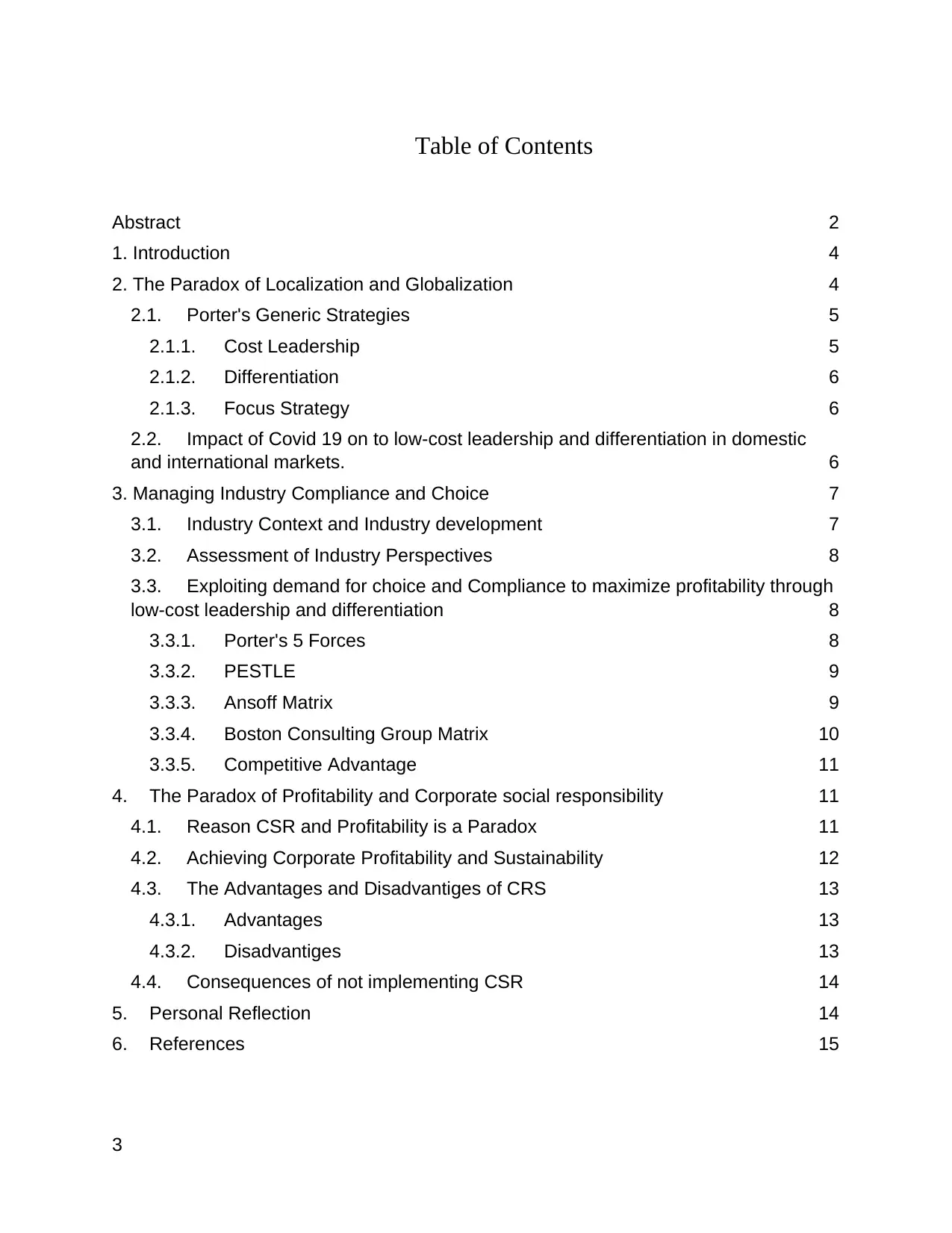
Table of Contents
Abstract 2
1. Introduction 4
2. The Paradox of Localization and Globalization 4
2.1. Porter's Generic Strategies 5
2.1.1. Cost Leadership 5
2.1.2. Differentiation 6
2.1.3. Focus Strategy 6
2.2. Impact of Covid 19 on to low-cost leadership and differentiation in domestic
and international markets. 6
3. Managing Industry Compliance and Choice 7
3.1. Industry Context and Industry development 7
3.2. Assessment of Industry Perspectives 8
3.3. Exploiting demand for choice and Compliance to maximize profitability through
low-cost leadership and differentiation 8
3.3.1. Porter's 5 Forces 8
3.3.2. PESTLE 9
3.3.3. Ansoff Matrix 9
3.3.4. Boston Consulting Group Matrix 10
3.3.5. Competitive Advantage 11
4. The Paradox of Profitability and Corporate social responsibility 11
4.1. Reason CSR and Profitability is a Paradox 11
4.2. Achieving Corporate Profitability and Sustainability 12
4.3. The Advantages and Disadvantiges of CRS 13
4.3.1. Advantages 13
4.3.2. Disadvantiges 13
4.4. Consequences of not implementing CSR 14
5. Personal Reflection 14
6. References 15
3
Abstract 2
1. Introduction 4
2. The Paradox of Localization and Globalization 4
2.1. Porter's Generic Strategies 5
2.1.1. Cost Leadership 5
2.1.2. Differentiation 6
2.1.3. Focus Strategy 6
2.2. Impact of Covid 19 on to low-cost leadership and differentiation in domestic
and international markets. 6
3. Managing Industry Compliance and Choice 7
3.1. Industry Context and Industry development 7
3.2. Assessment of Industry Perspectives 8
3.3. Exploiting demand for choice and Compliance to maximize profitability through
low-cost leadership and differentiation 8
3.3.1. Porter's 5 Forces 8
3.3.2. PESTLE 9
3.3.3. Ansoff Matrix 9
3.3.4. Boston Consulting Group Matrix 10
3.3.5. Competitive Advantage 11
4. The Paradox of Profitability and Corporate social responsibility 11
4.1. Reason CSR and Profitability is a Paradox 11
4.2. Achieving Corporate Profitability and Sustainability 12
4.3. The Advantages and Disadvantiges of CRS 13
4.3.1. Advantages 13
4.3.2. Disadvantiges 13
4.4. Consequences of not implementing CSR 14
5. Personal Reflection 14
6. References 15
3
⊘ This is a preview!⊘
Do you want full access?
Subscribe today to unlock all pages.

Trusted by 1+ million students worldwide
1. Introduction
If a company has operations in both its home nation and other countries across the world,
it is considered a global corporation. In their day-to-day operations, multinational corporations
commonly use two approaches. International and national strategies are used in these cases.
When deciding on an international strategy, MNCs must take into account a wide range of
issues. MNCs face a number of challenges in their long-term operations in addition to choosing
the right international strategy. The dilemma of demand and choice, paradox of localization and
globalisation, and the conflict between corporate profit and social responsibility are just a few of
them. (Brian, 2014). The above paradoxes as they relate to multinational organisations are
examined in this paper in case of Google. MNCs must establish core competences and dynamic
skills in order to reduce overhead costs, use capital effectively, and upgrade their structural
foundations for long-term recovery.
2. The Paradox of Localization and Globalization
One can never escape the needs of localization and globalisation, says Stopford, for
international corporations (1998). They must address the needs of both groups in order to
improve their industrial competitiveness. Companies like Google have to adapt their products
and services to suit localization requirements. Localization, according to Plaatsman (2014), is the
process of tailoring an organization's resources to meet the needs of a certain geographic area. As
Google is utilised by people from all over the world, the company must ensure that its services
are tailored to their specific needs. This is an excellent illustration of Google's translation efforts:
Google Assistant, Google's search engine. Depending on the user's location or preference,
4
If a company has operations in both its home nation and other countries across the world,
it is considered a global corporation. In their day-to-day operations, multinational corporations
commonly use two approaches. International and national strategies are used in these cases.
When deciding on an international strategy, MNCs must take into account a wide range of
issues. MNCs face a number of challenges in their long-term operations in addition to choosing
the right international strategy. The dilemma of demand and choice, paradox of localization and
globalisation, and the conflict between corporate profit and social responsibility are just a few of
them. (Brian, 2014). The above paradoxes as they relate to multinational organisations are
examined in this paper in case of Google. MNCs must establish core competences and dynamic
skills in order to reduce overhead costs, use capital effectively, and upgrade their structural
foundations for long-term recovery.
2. The Paradox of Localization and Globalization
One can never escape the needs of localization and globalisation, says Stopford, for
international corporations (1998). They must address the needs of both groups in order to
improve their industrial competitiveness. Companies like Google have to adapt their products
and services to suit localization requirements. Localization, according to Plaatsman (2014), is the
process of tailoring an organization's resources to meet the needs of a certain geographic area. As
Google is utilised by people from all over the world, the company must ensure that its services
are tailored to their specific needs. This is an excellent illustration of Google's translation efforts:
Google Assistant, Google's search engine. Depending on the user's location or preference,
4
Paraphrase This Document
Need a fresh take? Get an instant paraphrase of this document with our AI Paraphraser
Google displays results in a variety of languages (Google Products, 2021). While globalisation
focuses on adapting resources to meet the needs of diverse cultures, it is not the same as
globalisation itself (Plaatsman, 2014). An example of globalisation can be found in Google
Maps. With the help of Google Maps, you can get from one area to another no matter where you
are right now. Distances are calculated using Google Maps. Localization and globalisation have
a role in Google's decision to offer several languages. Google uses localization to tailor its
content to a certain audience's linguistic preferences (Google Products, 2021). However, as a
result of globalisation, the company's material is now available in a variety of languages,
allowing it to reach a wider audience (Girard, 2009).
2.1. Porter's Generic Strategies
Google and other multinational corporations might utilise Michale Porter's Porter's Fiver Forces
framework to find a possible niche market (Akan et al., 2006). A company's profitability can
either be above or below the industry average based on where it stands in relation to the
competition. Low cost, differentiation, and differentiation are the three main forms of
competitive advantages a firm can have.
2.1.1. Cost Leadership
A company's goal is to be the lowest-cost producer in the industry. Cost advantages come from a
variety of places, depending on the company. In order to offer its services at the lowest possible
cost, the Google Corporation is constantly working to minimise production costs. Google LLC
(2021) asserts that its internet search engine, Google Search, provides services at a lower price
than the competition. Competitors of Google's include the likes of Yahoo and Facebook, as well
as Microsoft and IBM. Google uses economies of scale and unique technology to cut production
costs below the industry standard.
5
focuses on adapting resources to meet the needs of diverse cultures, it is not the same as
globalisation itself (Plaatsman, 2014). An example of globalisation can be found in Google
Maps. With the help of Google Maps, you can get from one area to another no matter where you
are right now. Distances are calculated using Google Maps. Localization and globalisation have
a role in Google's decision to offer several languages. Google uses localization to tailor its
content to a certain audience's linguistic preferences (Google Products, 2021). However, as a
result of globalisation, the company's material is now available in a variety of languages,
allowing it to reach a wider audience (Girard, 2009).
2.1. Porter's Generic Strategies
Google and other multinational corporations might utilise Michale Porter's Porter's Fiver Forces
framework to find a possible niche market (Akan et al., 2006). A company's profitability can
either be above or below the industry average based on where it stands in relation to the
competition. Low cost, differentiation, and differentiation are the three main forms of
competitive advantages a firm can have.
2.1.1. Cost Leadership
A company's goal is to be the lowest-cost producer in the industry. Cost advantages come from a
variety of places, depending on the company. In order to offer its services at the lowest possible
cost, the Google Corporation is constantly working to minimise production costs. Google LLC
(2021) asserts that its internet search engine, Google Search, provides services at a lower price
than the competition. Competitors of Google's include the likes of Yahoo and Facebook, as well
as Microsoft and IBM. Google uses economies of scale and unique technology to cut production
costs below the industry standard.
5
2.1.2. Differentiation
Differentiation is a strategy organisations employ to stand apart from the competition (De Wit,
2020). It's common for a product's distinctiveness to fall into one of the following categories:
Differentiation occurs when a company brings together many traits that the buyer considers
significant, and then positions itself to answer those needs in a unique way (Kharun, Mor &
Sharma, 2019).
2.1.3. Focus Strategy
The Focus method entails identifying specific industry segments and adjusting organisational
tactics to meet the needs of those segments only (Akan et al. 2006). A company's focus strategy
allows it to focus on a specific market. The specific market dynamics and the individual client
needs must therefore be understood by organisations. When pursuing a cost advantage, an
organisation may choose to focus on cost, or it may choose to focus on distinction.
2.2. Impact of Covid 19 on to low-cost leadership and differentiation in
domestic and international markets.
Aiming to protect itself from the potentially devastating repercussions of the avian flu pandemic,
Google has increased its focus on differentiation and cost-effectiveness. This was done in
response to Facebook's expanding popularity. When it comes to internet services, Google has
made a point of being the most affordable option (Alphabet Annual Report, 2021). In order to
better serve its customers, Google adapted products like Gmail in order to differentiate itself
6
Differentiation is a strategy organisations employ to stand apart from the competition (De Wit,
2020). It's common for a product's distinctiveness to fall into one of the following categories:
Differentiation occurs when a company brings together many traits that the buyer considers
significant, and then positions itself to answer those needs in a unique way (Kharun, Mor &
Sharma, 2019).
2.1.3. Focus Strategy
The Focus method entails identifying specific industry segments and adjusting organisational
tactics to meet the needs of those segments only (Akan et al. 2006). A company's focus strategy
allows it to focus on a specific market. The specific market dynamics and the individual client
needs must therefore be understood by organisations. When pursuing a cost advantage, an
organisation may choose to focus on cost, or it may choose to focus on distinction.
2.2. Impact of Covid 19 on to low-cost leadership and differentiation in
domestic and international markets.
Aiming to protect itself from the potentially devastating repercussions of the avian flu pandemic,
Google has increased its focus on differentiation and cost-effectiveness. This was done in
response to Facebook's expanding popularity. When it comes to internet services, Google has
made a point of being the most affordable option (Alphabet Annual Report, 2021). In order to
better serve its customers, Google adapted products like Gmail in order to differentiate itself
6
⊘ This is a preview!⊘
Do you want full access?
Subscribe today to unlock all pages.
Trusted by 1+ million students worldwide
from its competitors. You may now hold a meeting or conference using the Gmail application.
Internet users have embraced the differentiation technique (Sharma et al., 2020).
3. Managing Industry Compliance and Choice
Compliance in any corporate setting is not a choice; it is a necessity according to
Heilman and Garner (1975). The demands of corporate compliance are ever-changing, and
organisations must stay up with them.
3.1. Industry Context and Industry development
Google competes with Mozilla, Amazon, Yahoo, and others in the search market (Trans,
2017). Competition in the search market is based on the usage of similar technology to produce
content search and intranet solutions. Mid-to-late-1990s is when a large number of organisations
in the business were formed (Bauer, 2014). Pay-per-click advertising is the principal source of
revenue for these businesses.
The rules that govern Google and its competitors are based on the overall industry setting. This
restricts the firms' ability to take strategic action. Regulations governing search are also open to
alteration as technology advances (Mckinsey & Company, 2021).
Firm compliance and individual freedom are viewed as mutually exclusive by Heilman (1975).
Companies, he says, must adapt to their settings in order to meet their compliance requirements.
As a result, they must have a thorough grasp of the conditions in which they work. Companies
must design tactics that go above and beyond the norm in order to achieve a considerable
competitive advantage over their rivals in the strategic choice market.
7
Internet users have embraced the differentiation technique (Sharma et al., 2020).
3. Managing Industry Compliance and Choice
Compliance in any corporate setting is not a choice; it is a necessity according to
Heilman and Garner (1975). The demands of corporate compliance are ever-changing, and
organisations must stay up with them.
3.1. Industry Context and Industry development
Google competes with Mozilla, Amazon, Yahoo, and others in the search market (Trans,
2017). Competition in the search market is based on the usage of similar technology to produce
content search and intranet solutions. Mid-to-late-1990s is when a large number of organisations
in the business were formed (Bauer, 2014). Pay-per-click advertising is the principal source of
revenue for these businesses.
The rules that govern Google and its competitors are based on the overall industry setting. This
restricts the firms' ability to take strategic action. Regulations governing search are also open to
alteration as technology advances (Mckinsey & Company, 2021).
Firm compliance and individual freedom are viewed as mutually exclusive by Heilman (1975).
Companies, he says, must adapt to their settings in order to meet their compliance requirements.
As a result, they must have a thorough grasp of the conditions in which they work. Companies
must design tactics that go above and beyond the norm in order to achieve a considerable
competitive advantage over their rivals in the strategic choice market.
7
Paraphrase This Document
Need a fresh take? Get an instant paraphrase of this document with our AI Paraphraser
3.2. Assessment of Industry Perspectives
Industry dynamics perspective
The term "industry dynamics" refers to the ways and procedures through which a
particular industry evolves. Additionally, this approach holds the belief that individual
enterprises can alter the sector, according to Whittington et al. (2020). His view is that the ability
of a company to blend in with its surroundings is critical to its long-term survival and expansion.
The industry leadership perspective
Perceived differently, certain rules cannot be altered, while others can (Mintzberg et al., 2008)
3.3. Exploiting demand for choice and Compliance to maximize profitability
through low-cost leadership and differentiation
3.3.1. Porter's 5 Forces
Due to the enormous number of IT service providers, Google is subjected to a lot of
competition. In Porter's model, a company's growth is stifled by its competitors (Rice, 2010). To
keep up with the competition, Google will have to adopt cost-cutting and differentiating
initiatives. Because there are so many suppliers to pick from, Google enjoys a significant
advantage over its competitors. Google's annual report shows that the issue of alternatives is
being taken more seriously than in previous years (Alphabet Annual Report 2019). In order to
prevent customers from switching to cheaper alternatives, Google mostly employs a low-cost
strategy. For Google, the possibility of competition from newcomers is a moderate force. There
8
Industry dynamics perspective
The term "industry dynamics" refers to the ways and procedures through which a
particular industry evolves. Additionally, this approach holds the belief that individual
enterprises can alter the sector, according to Whittington et al. (2020). His view is that the ability
of a company to blend in with its surroundings is critical to its long-term survival and expansion.
The industry leadership perspective
Perceived differently, certain rules cannot be altered, while others can (Mintzberg et al., 2008)
3.3. Exploiting demand for choice and Compliance to maximize profitability
through low-cost leadership and differentiation
3.3.1. Porter's 5 Forces
Due to the enormous number of IT service providers, Google is subjected to a lot of
competition. In Porter's model, a company's growth is stifled by its competitors (Rice, 2010). To
keep up with the competition, Google will have to adopt cost-cutting and differentiating
initiatives. Because there are so many suppliers to pick from, Google enjoys a significant
advantage over its competitors. Google's annual report shows that the issue of alternatives is
being taken more seriously than in previous years (Alphabet Annual Report 2019). In order to
prevent customers from switching to cheaper alternatives, Google mostly employs a low-cost
strategy. For Google, the possibility of competition from newcomers is a moderate force. There
8
is a steep price to pay for a new company to get into the search sector. For this reason, Google
must ensure that its pricing remain competitive in order to prevent losing clients.
3.3.2. PESTLE
Political: Google Firm abides by government regulations. Google, for example, may have
to censor certain material based on political ideology (Kasi, 2021).
Economical: Inflation is an important factor to consider when estimating product costs.
Social: Customer value development involves specific differentiation tactics based on the
target markets' demographics and distribution.
Technological: Google's low-cost strategy is made possible by the availability of low-cost
technologies (Thompson, 2021).
Legal: Internet and search industry regulations must be adhered to by the company legal
obligations.
Environmental: As a public corporation, Google has an obligation to follow all applicable
environmental regulations and laws.
3.3.3. Ansoff Matrix
The Ansoff Matrix can be used to determine product and market growth plans (Loredana,
2017). The matrix depicts the market segment's potential for enterprises to grow. According to
Johnson et al. (2007), the matrix analyses current and future products in order to build and
establish new markets.
9
must ensure that its pricing remain competitive in order to prevent losing clients.
3.3.2. PESTLE
Political: Google Firm abides by government regulations. Google, for example, may have
to censor certain material based on political ideology (Kasi, 2021).
Economical: Inflation is an important factor to consider when estimating product costs.
Social: Customer value development involves specific differentiation tactics based on the
target markets' demographics and distribution.
Technological: Google's low-cost strategy is made possible by the availability of low-cost
technologies (Thompson, 2021).
Legal: Internet and search industry regulations must be adhered to by the company legal
obligations.
Environmental: As a public corporation, Google has an obligation to follow all applicable
environmental regulations and laws.
3.3.3. Ansoff Matrix
The Ansoff Matrix can be used to determine product and market growth plans (Loredana,
2017). The matrix depicts the market segment's potential for enterprises to grow. According to
Johnson et al. (2007), the matrix analyses current and future products in order to build and
establish new markets.
9
⊘ This is a preview!⊘
Do you want full access?
Subscribe today to unlock all pages.
Trusted by 1+ million students worldwide
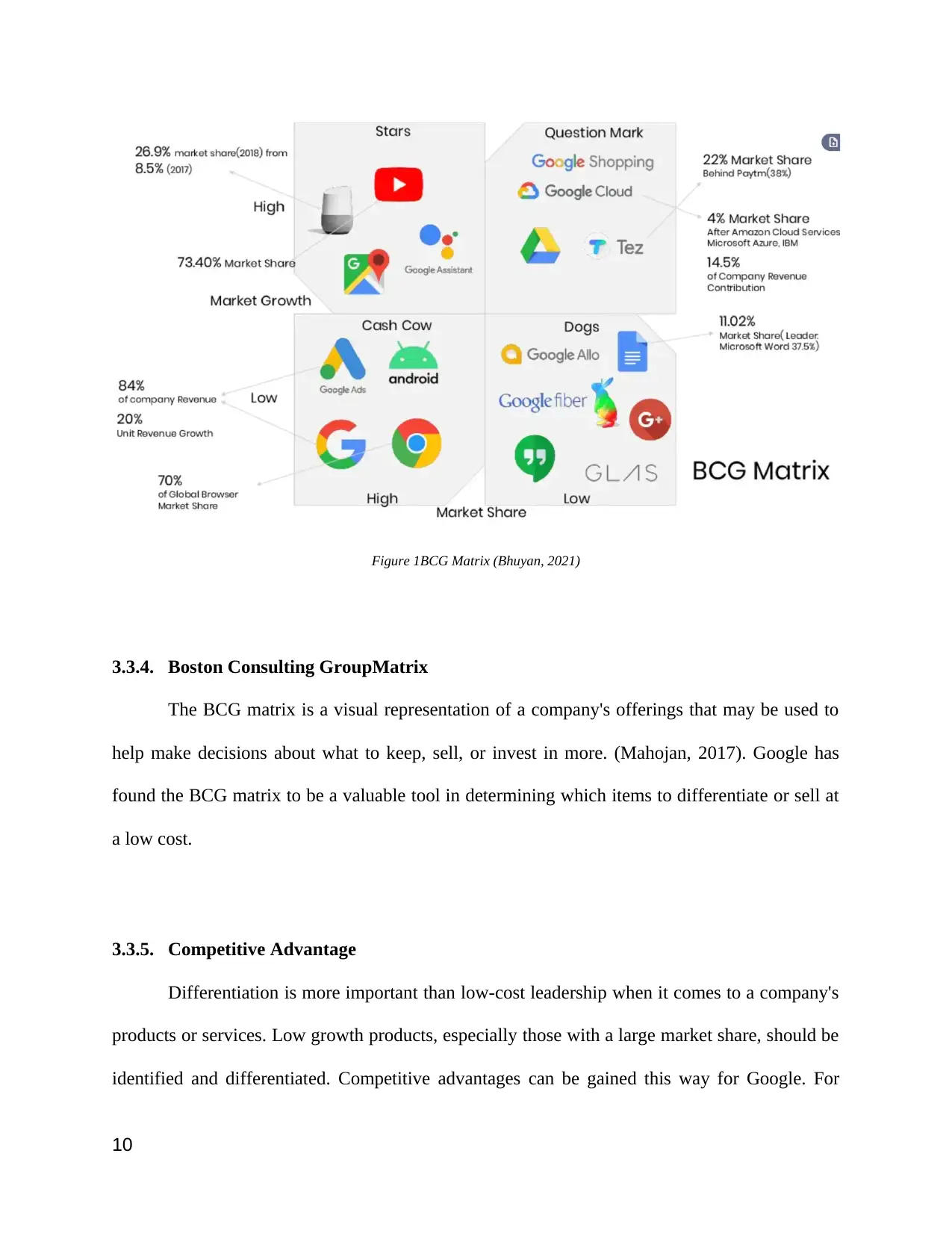
Figure 1BCG Matrix (Bhuyan, 2021)
3.3.4. Boston Consulting GroupMatrix
The BCG matrix is a visual representation of a company's offerings that may be used to
help make decisions about what to keep, sell, or invest in more. (Mahojan, 2017). Google has
found the BCG matrix to be a valuable tool in determining which items to differentiate or sell at
a low cost.
3.3.5. Competitive Advantage
Differentiation is more important than low-cost leadership when it comes to a company's
products or services. Low growth products, especially those with a large market share, should be
identified and differentiated. Competitive advantages can be gained this way for Google. For
10
3.3.4. Boston Consulting GroupMatrix
The BCG matrix is a visual representation of a company's offerings that may be used to
help make decisions about what to keep, sell, or invest in more. (Mahojan, 2017). Google has
found the BCG matrix to be a valuable tool in determining which items to differentiate or sell at
a low cost.
3.3.5. Competitive Advantage
Differentiation is more important than low-cost leadership when it comes to a company's
products or services. Low growth products, especially those with a large market share, should be
identified and differentiated. Competitive advantages can be gained this way for Google. For
10
Paraphrase This Document
Need a fresh take? Get an instant paraphrase of this document with our AI Paraphraser
example, Chromecast, a new product differentiation feature, has given Google a competitive
advantage over its competitors. Because Google's Cast function allows one to wirelessly project
the display to an external screen, many consumers will simply utilise Google services instead of
Yahoo (Valipour, Biriandi & Honabarksh, 2018).
4. The Paradox of Profitability and Corporate social responsibility
4.1. Reason CSR and Profitability is a Paradox
CSR and profitability in a company is an example of a paradox, which is anything that
appears to be in conflict. Corporate social responsibility (CSR) leverages a company's income to
benefit others, whereas profitability focuses on increasing a company's bottom line through
various means. A company's profits are channelled into social and environmental initiatives
through corporate social responsibility (CSR). Therefore, corporate social responsibility (CSR) is
at odds with the company's financial objectives (Emilsson, Classon & Bredmar, 2012).
Many firms, on the other hand, still see the value in participating in CSR activities. CSR
engagement is often believed to have a positive impact on a company's bottom line. Despite its
difficulty, corporate social responsibility, according to Kirk (2020), can boost earnings. Many
business leaders are aware that corporate social responsibility (CSR) can boost their brand's
reputation in the marketplace, which in turn leads to improved sales and better employee
retention. Focusing on sustainability also reduces expenses and increases the efficiency of a
business (Falkenberg & Brunseal, 2011). While the former is correct, other organisations hold to
the dichotomy of the two, reducing or eliminating their involvement in CSR altogether.
11
advantage over its competitors. Because Google's Cast function allows one to wirelessly project
the display to an external screen, many consumers will simply utilise Google services instead of
Yahoo (Valipour, Biriandi & Honabarksh, 2018).
4. The Paradox of Profitability and Corporate social responsibility
4.1. Reason CSR and Profitability is a Paradox
CSR and profitability in a company is an example of a paradox, which is anything that
appears to be in conflict. Corporate social responsibility (CSR) leverages a company's income to
benefit others, whereas profitability focuses on increasing a company's bottom line through
various means. A company's profits are channelled into social and environmental initiatives
through corporate social responsibility (CSR). Therefore, corporate social responsibility (CSR) is
at odds with the company's financial objectives (Emilsson, Classon & Bredmar, 2012).
Many firms, on the other hand, still see the value in participating in CSR activities. CSR
engagement is often believed to have a positive impact on a company's bottom line. Despite its
difficulty, corporate social responsibility, according to Kirk (2020), can boost earnings. Many
business leaders are aware that corporate social responsibility (CSR) can boost their brand's
reputation in the marketplace, which in turn leads to improved sales and better employee
retention. Focusing on sustainability also reduces expenses and increases the efficiency of a
business (Falkenberg & Brunseal, 2011). While the former is correct, other organisations hold to
the dichotomy of the two, reducing or eliminating their involvement in CSR altogether.
11
4.2. Achieving Corporate Profitability and Sustainability
CEO Sundar Pichai's impact on the firm's environmental initiatives has helped propel the
company toward profitability over the past several years (Alphabets Annual Report 2020). When
Pichai announced in 2016 that Google would become a carbon-neutral firm, he meant it. Google
was ranked as the first corporation in 2017 to use 100% renewable energy to power its
operations. Google's current sustainability programme aims to create a world free of carbon
emissions for all (Alphabet Annual Report 2019). At all its campuses and data centres, Google
has vowed to utilise only carbon-free electricity. Google's focus on sustainability has a direct
impact on the design of its products, buildings, and infrastructures.
In addition to supporting humanitarian organisations like the Red Cross, the Google grant also
assists other non-profits. Up the wake of natural disasters, Google has stepped in to assist
families in need (an earthquake that hit China). Mercy Corps and the corporation have teamed up
to help save children and medical professionals. In addition, Google has provided financial
support for scientific and technological endeavours at other colleges across the world. A strong
brand and more profitability have resulted from Google's efforts to be environmentally friendly
(Google Sustainability Report 2020).
4.3. The Advantages and Disadvantiges of CRS
4.3.1. Advantages
● CSR helps businesses gain a competitive edge by establishing a reputation for socially
and environmentally responsible operations. Customers are more likely to buy from a
retailer with ethical business practises. The accountability of firms is not just a choice
consideration for some customers, but something they demand.
12
CEO Sundar Pichai's impact on the firm's environmental initiatives has helped propel the
company toward profitability over the past several years (Alphabets Annual Report 2020). When
Pichai announced in 2016 that Google would become a carbon-neutral firm, he meant it. Google
was ranked as the first corporation in 2017 to use 100% renewable energy to power its
operations. Google's current sustainability programme aims to create a world free of carbon
emissions for all (Alphabet Annual Report 2019). At all its campuses and data centres, Google
has vowed to utilise only carbon-free electricity. Google's focus on sustainability has a direct
impact on the design of its products, buildings, and infrastructures.
In addition to supporting humanitarian organisations like the Red Cross, the Google grant also
assists other non-profits. Up the wake of natural disasters, Google has stepped in to assist
families in need (an earthquake that hit China). Mercy Corps and the corporation have teamed up
to help save children and medical professionals. In addition, Google has provided financial
support for scientific and technological endeavours at other colleges across the world. A strong
brand and more profitability have resulted from Google's efforts to be environmentally friendly
(Google Sustainability Report 2020).
4.3. The Advantages and Disadvantiges of CRS
4.3.1. Advantages
● CSR helps businesses gain a competitive edge by establishing a reputation for socially
and environmentally responsible operations. Customers are more likely to buy from a
retailer with ethical business practises. The accountability of firms is not just a choice
consideration for some customers, but something they demand.
12
⊘ This is a preview!⊘
Do you want full access?
Subscribe today to unlock all pages.
Trusted by 1+ million students worldwide

1 out of 17


Related Documents


Your All-in-One AI-Powered Toolkit for Academic Success.
+13062052269
info@desklib.com
Available 24*7 on WhatsApp / Email
![[object Object]](/_next/static/media/star-bottom.7253800d.svg)
Unlock your academic potential
Copyright © 2020–2026 A2Z Services. All Rights Reserved. Developed and managed by ZUCOL.