Strategic Management in Organizations (STRA60093) Portfolio Assessment
VerifiedAdded on 2022/11/15
|14
|3039
|380
Portfolio
AI Summary
This portfolio assignment analyzes two key areas: the brewing industry and the Tune Group's diversification strategies. The first part delves into the brewing industry's macro environment using PESTEL analysis and its micro-environment using Porter's Five Forces. It explores the potential decline of the 'pub' in the 21st century, providing reasoned arguments. The second part examines the Tune Group's diversification, identifying factors driving this expansion and assessing its portfolio, including the contribution of each Strategic Business Unit (SBU). It considers the dominant logic of the group, potential problems arising from its SBU strategies, how the group adds value to its SBUs, and the future potential of the Tune Group, suggesting which SBUs to protect, grow, or divest. A reflective piece is also included. The analysis provides a comprehensive overview of strategic management principles and their application in real-world business scenarios.

Running head: PORTFOLIO
PORTFOLIO
Name of the Student
Name of the University
Author Note
PORTFOLIO
Name of the Student
Name of the University
Author Note

Paraphrase This Document
Need a fresh take? Get an instant paraphrase of this document with our AI Paraphraser
1PORTFOLIO
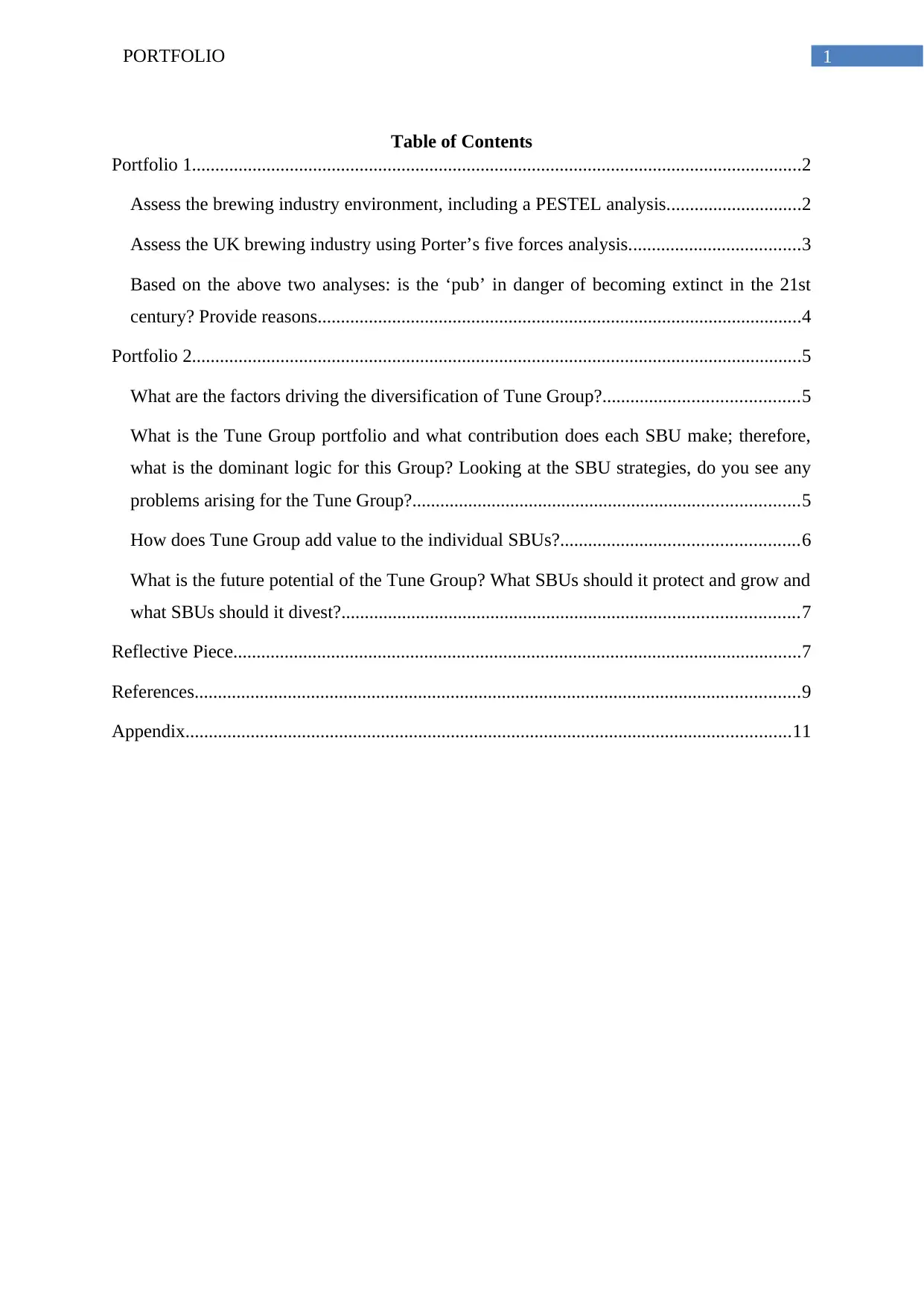
Table of Contents
Portfolio 1...................................................................................................................................2
Assess the brewing industry environment, including a PESTEL analysis.............................2
Assess the UK brewing industry using Porter’s five forces analysis.....................................3
Based on the above two analyses: is the ‘pub’ in danger of becoming extinct in the 21st
century? Provide reasons........................................................................................................4
Portfolio 2...................................................................................................................................5
What are the factors driving the diversification of Tune Group?..........................................5
What is the Tune Group portfolio and what contribution does each SBU make; therefore,
what is the dominant logic for this Group? Looking at the SBU strategies, do you see any
problems arising for the Tune Group?...................................................................................5
How does Tune Group add value to the individual SBUs?...................................................6
What is the future potential of the Tune Group? What SBUs should it protect and grow and
what SBUs should it divest?..................................................................................................7
Reflective Piece..........................................................................................................................7
References..................................................................................................................................9
Appendix..................................................................................................................................11
Table of Contents
Portfolio 1...................................................................................................................................2
Assess the brewing industry environment, including a PESTEL analysis.............................2
Assess the UK brewing industry using Porter’s five forces analysis.....................................3
Based on the above two analyses: is the ‘pub’ in danger of becoming extinct in the 21st
century? Provide reasons........................................................................................................4
Portfolio 2...................................................................................................................................5
What are the factors driving the diversification of Tune Group?..........................................5
What is the Tune Group portfolio and what contribution does each SBU make; therefore,
what is the dominant logic for this Group? Looking at the SBU strategies, do you see any
problems arising for the Tune Group?...................................................................................5
How does Tune Group add value to the individual SBUs?...................................................6
What is the future potential of the Tune Group? What SBUs should it protect and grow and
what SBUs should it divest?..................................................................................................7
Reflective Piece..........................................................................................................................7
References..................................................................................................................................9
Appendix..................................................................................................................................11
2PORTFOLIO
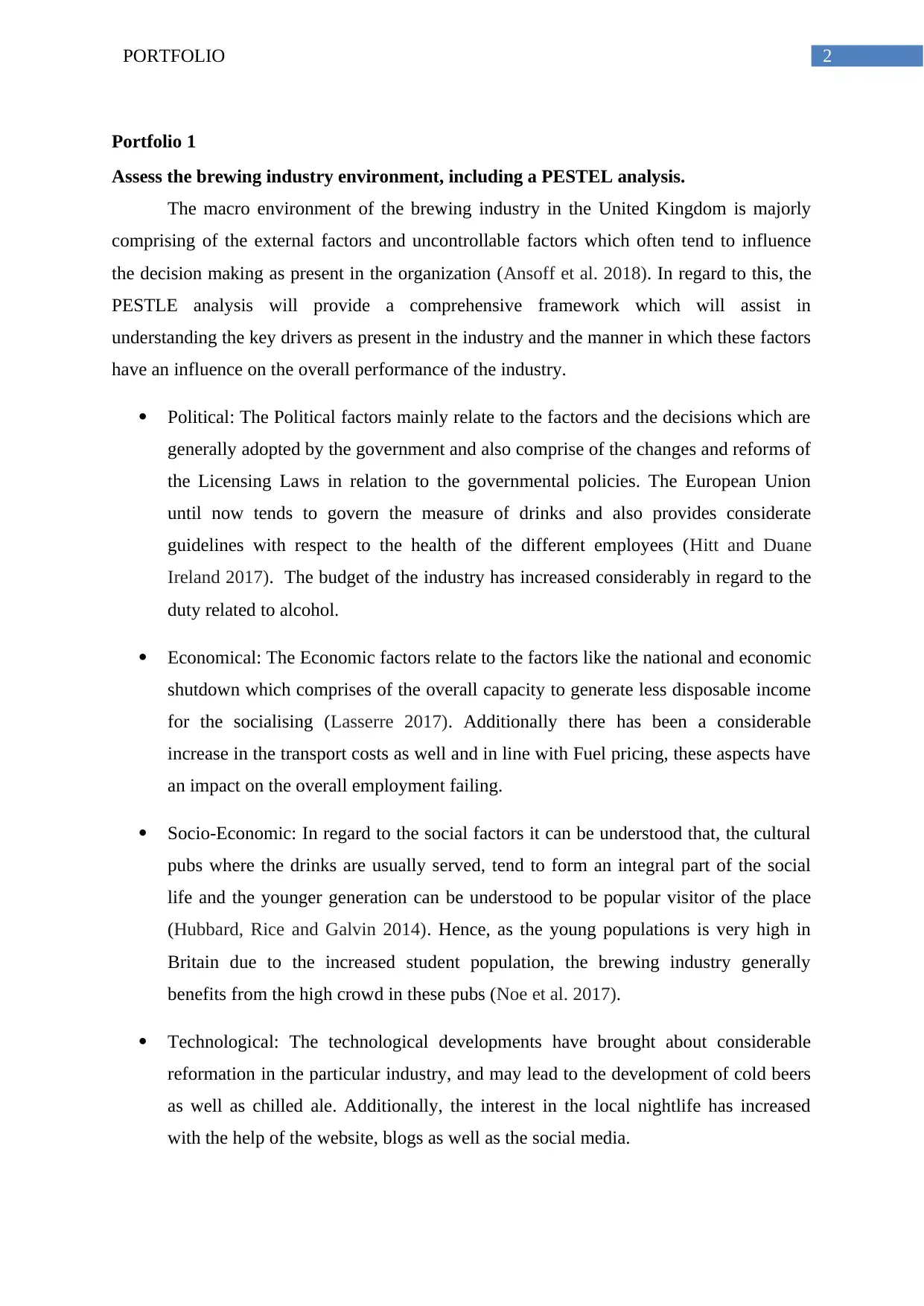
Portfolio 1
Assess the brewing industry environment, including a PESTEL analysis.
The macro environment of the brewing industry in the United Kingdom is majorly
comprising of the external factors and uncontrollable factors which often tend to influence
the decision making as present in the organization (Ansoff et al. 2018). In regard to this, the
PESTLE analysis will provide a comprehensive framework which will assist in
understanding the key drivers as present in the industry and the manner in which these factors
have an influence on the overall performance of the industry.
Political: The Political factors mainly relate to the factors and the decisions which are
generally adopted by the government and also comprise of the changes and reforms of
the Licensing Laws in relation to the governmental policies. The European Union
until now tends to govern the measure of drinks and also provides considerate
guidelines with respect to the health of the different employees (Hitt and Duane
Ireland 2017). The budget of the industry has increased considerably in regard to the
duty related to alcohol.
Economical: The Economic factors relate to the factors like the national and economic
shutdown which comprises of the overall capacity to generate less disposable income
for the socialising (Lasserre 2017). Additionally there has been a considerable
increase in the transport costs as well and in line with Fuel pricing, these aspects have
an impact on the overall employment failing.
Socio-Economic: In regard to the social factors it can be understood that, the cultural
pubs where the drinks are usually served, tend to form an integral part of the social
life and the younger generation can be understood to be popular visitor of the place
(Hubbard, Rice and Galvin 2014). Hence, as the young populations is very high in
Britain due to the increased student population, the brewing industry generally
benefits from the high crowd in these pubs (Noe et al. 2017).
Technological: The technological developments have brought about considerable
reformation in the particular industry, and may lead to the development of cold beers
as well as chilled ale. Additionally, the interest in the local nightlife has increased
with the help of the website, blogs as well as the social media.
Portfolio 1
Assess the brewing industry environment, including a PESTEL analysis.
The macro environment of the brewing industry in the United Kingdom is majorly
comprising of the external factors and uncontrollable factors which often tend to influence
the decision making as present in the organization (Ansoff et al. 2018). In regard to this, the
PESTLE analysis will provide a comprehensive framework which will assist in
understanding the key drivers as present in the industry and the manner in which these factors
have an influence on the overall performance of the industry.
Political: The Political factors mainly relate to the factors and the decisions which are
generally adopted by the government and also comprise of the changes and reforms of
the Licensing Laws in relation to the governmental policies. The European Union
until now tends to govern the measure of drinks and also provides considerate
guidelines with respect to the health of the different employees (Hitt and Duane
Ireland 2017). The budget of the industry has increased considerably in regard to the
duty related to alcohol.
Economical: The Economic factors relate to the factors like the national and economic
shutdown which comprises of the overall capacity to generate less disposable income
for the socialising (Lasserre 2017). Additionally there has been a considerable
increase in the transport costs as well and in line with Fuel pricing, these aspects have
an impact on the overall employment failing.
Socio-Economic: In regard to the social factors it can be understood that, the cultural
pubs where the drinks are usually served, tend to form an integral part of the social
life and the younger generation can be understood to be popular visitor of the place
(Hubbard, Rice and Galvin 2014). Hence, as the young populations is very high in
Britain due to the increased student population, the brewing industry generally
benefits from the high crowd in these pubs (Noe et al. 2017).
Technological: The technological developments have brought about considerable
reformation in the particular industry, and may lead to the development of cold beers
as well as chilled ale. Additionally, the interest in the local nightlife has increased
with the help of the website, blogs as well as the social media.
⊘ This is a preview!⊘
Do you want full access?
Subscribe today to unlock all pages.

Trusted by 1+ million students worldwide
3PORTFOLIO
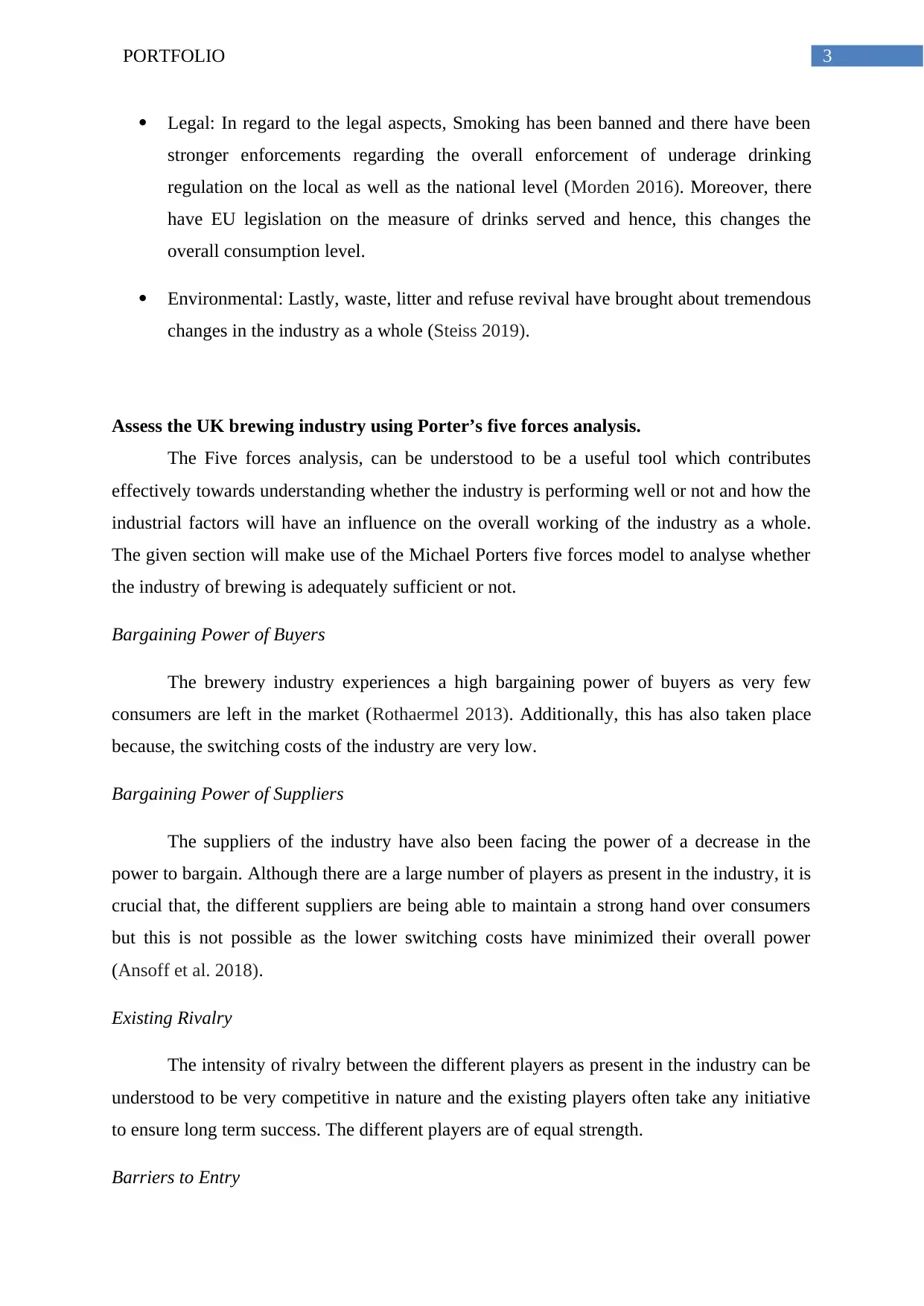
Legal: In regard to the legal aspects, Smoking has been banned and there have been
stronger enforcements regarding the overall enforcement of underage drinking
regulation on the local as well as the national level (Morden 2016). Moreover, there
have EU legislation on the measure of drinks served and hence, this changes the
overall consumption level.
Environmental: Lastly, waste, litter and refuse revival have brought about tremendous
changes in the industry as a whole (Steiss 2019).
Assess the UK brewing industry using Porter’s five forces analysis.
The Five forces analysis, can be understood to be a useful tool which contributes
effectively towards understanding whether the industry is performing well or not and how the
industrial factors will have an influence on the overall working of the industry as a whole.
The given section will make use of the Michael Porters five forces model to analyse whether
the industry of brewing is adequately sufficient or not.
Bargaining Power of Buyers
The brewery industry experiences a high bargaining power of buyers as very few
consumers are left in the market (Rothaermel 2013). Additionally, this has also taken place
because, the switching costs of the industry are very low.
Bargaining Power of Suppliers
The suppliers of the industry have also been facing the power of a decrease in the
power to bargain. Although there are a large number of players as present in the industry, it is
crucial that, the different suppliers are being able to maintain a strong hand over consumers
but this is not possible as the lower switching costs have minimized their overall power
(Ansoff et al. 2018).
Existing Rivalry
The intensity of rivalry between the different players as present in the industry can be
understood to be very competitive in nature and the existing players often take any initiative
to ensure long term success. The different players are of equal strength.
Barriers to Entry
Legal: In regard to the legal aspects, Smoking has been banned and there have been
stronger enforcements regarding the overall enforcement of underage drinking
regulation on the local as well as the national level (Morden 2016). Moreover, there
have EU legislation on the measure of drinks served and hence, this changes the
overall consumption level.
Environmental: Lastly, waste, litter and refuse revival have brought about tremendous
changes in the industry as a whole (Steiss 2019).
Assess the UK brewing industry using Porter’s five forces analysis.
The Five forces analysis, can be understood to be a useful tool which contributes
effectively towards understanding whether the industry is performing well or not and how the
industrial factors will have an influence on the overall working of the industry as a whole.
The given section will make use of the Michael Porters five forces model to analyse whether
the industry of brewing is adequately sufficient or not.
Bargaining Power of Buyers
The brewery industry experiences a high bargaining power of buyers as very few
consumers are left in the market (Rothaermel 2013). Additionally, this has also taken place
because, the switching costs of the industry are very low.
Bargaining Power of Suppliers
The suppliers of the industry have also been facing the power of a decrease in the
power to bargain. Although there are a large number of players as present in the industry, it is
crucial that, the different suppliers are being able to maintain a strong hand over consumers
but this is not possible as the lower switching costs have minimized their overall power
(Ansoff et al. 2018).
Existing Rivalry
The intensity of rivalry between the different players as present in the industry can be
understood to be very competitive in nature and the existing players often take any initiative
to ensure long term success. The different players are of equal strength.
Barriers to Entry
Paraphrase This Document
Need a fresh take? Get an instant paraphrase of this document with our AI Paraphraser
4PORTFOLIO
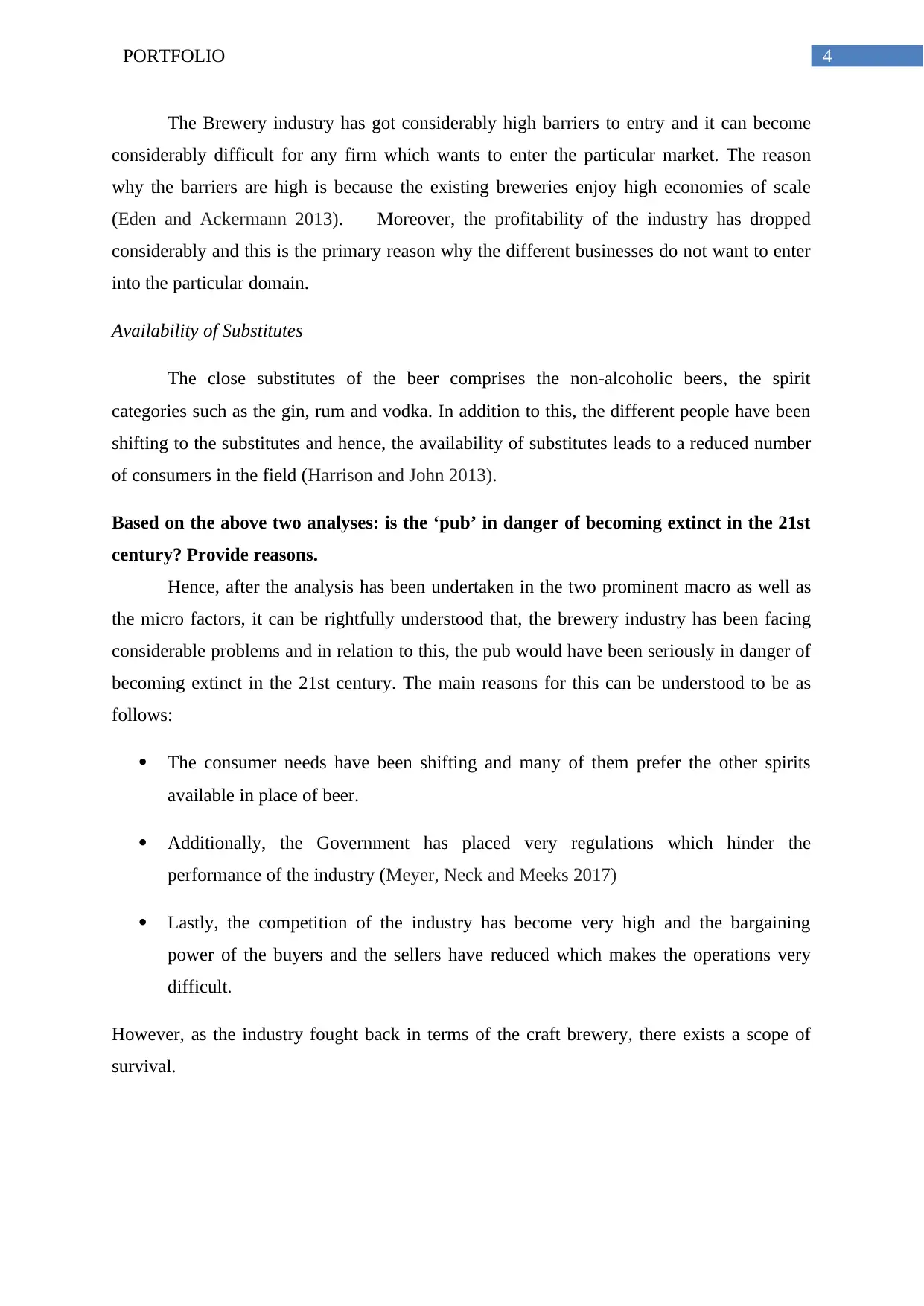
The Brewery industry has got considerably high barriers to entry and it can become
considerably difficult for any firm which wants to enter the particular market. The reason
why the barriers are high is because the existing breweries enjoy high economies of scale
(Eden and Ackermann 2013). Moreover, the profitability of the industry has dropped
considerably and this is the primary reason why the different businesses do not want to enter
into the particular domain.
Availability of Substitutes
The close substitutes of the beer comprises the non-alcoholic beers, the spirit
categories such as the gin, rum and vodka. In addition to this, the different people have been
shifting to the substitutes and hence, the availability of substitutes leads to a reduced number
of consumers in the field (Harrison and John 2013).
Based on the above two analyses: is the ‘pub’ in danger of becoming extinct in the 21st
century? Provide reasons.
Hence, after the analysis has been undertaken in the two prominent macro as well as
the micro factors, it can be rightfully understood that, the brewery industry has been facing
considerable problems and in relation to this, the pub would have been seriously in danger of
becoming extinct in the 21st century. The main reasons for this can be understood to be as
follows:
The consumer needs have been shifting and many of them prefer the other spirits
available in place of beer.
Additionally, the Government has placed very regulations which hinder the
performance of the industry (Meyer, Neck and Meeks 2017)
Lastly, the competition of the industry has become very high and the bargaining
power of the buyers and the sellers have reduced which makes the operations very
difficult.
However, as the industry fought back in terms of the craft brewery, there exists a scope of
survival.
The Brewery industry has got considerably high barriers to entry and it can become
considerably difficult for any firm which wants to enter the particular market. The reason
why the barriers are high is because the existing breweries enjoy high economies of scale
(Eden and Ackermann 2013). Moreover, the profitability of the industry has dropped
considerably and this is the primary reason why the different businesses do not want to enter
into the particular domain.
Availability of Substitutes
The close substitutes of the beer comprises the non-alcoholic beers, the spirit
categories such as the gin, rum and vodka. In addition to this, the different people have been
shifting to the substitutes and hence, the availability of substitutes leads to a reduced number
of consumers in the field (Harrison and John 2013).
Based on the above two analyses: is the ‘pub’ in danger of becoming extinct in the 21st
century? Provide reasons.
Hence, after the analysis has been undertaken in the two prominent macro as well as
the micro factors, it can be rightfully understood that, the brewery industry has been facing
considerable problems and in relation to this, the pub would have been seriously in danger of
becoming extinct in the 21st century. The main reasons for this can be understood to be as
follows:
The consumer needs have been shifting and many of them prefer the other spirits
available in place of beer.
Additionally, the Government has placed very regulations which hinder the
performance of the industry (Meyer, Neck and Meeks 2017)
Lastly, the competition of the industry has become very high and the bargaining
power of the buyers and the sellers have reduced which makes the operations very
difficult.
However, as the industry fought back in terms of the craft brewery, there exists a scope of
survival.
5PORTFOLIO
Portfolio 2
What are the factors driving the diversification of Tune Group?
The different factors which drive the diversification of the Tune Group can be
understood to be as follows:
1. Expanding markets: The Tune group came to the realisation that the business was
flourishing considerably and this is the reason why it planned to diversify and extend
its operations. The needs of the customers were improving and the investment
opportunities were quite suitable for the company and it is with respect to this that the
company decided to expand and diversify its portfolios (Eden and Ackermann 2013).
2. Additional funds: Although some of the years were quite turbulent for the operations
of the firm, however, the firm decided to expand the operations and invest its funds
into the overall welfare of the organization at large (Morden 2016). This would assists
them in gaining high returns in the long run and ensuring a sustainable future in the
long run.
3. Strategic vision: The owners and the CEO of the firm could be understood to have a
strategic vision and it is with respect to this that, the firm decided to diversify its
operations and take advantage of the new trends as involved in the industry.
What is the Tune Group portfolio and what contribution does each SBU make;
therefore, what is the dominant logic for this Group? Looking at the SBU strategies, do
you see any problems arising for the Tune Group?
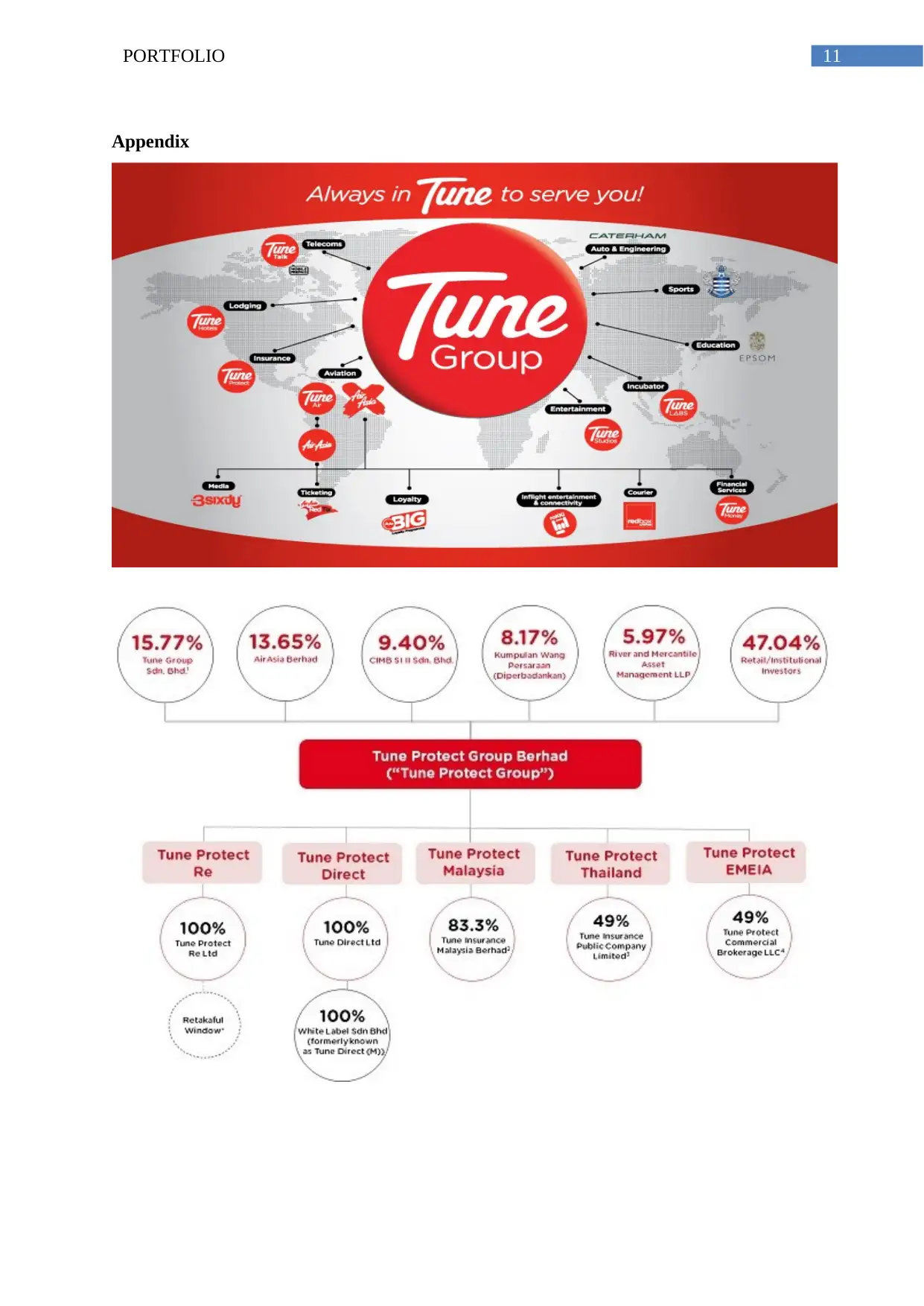
The different divisions of the Tune Group can be understood to be as follows:
1. Tune Hotel: The Tune Hotel launched its operations in the year 2007 and the hotel
was funded by the holding company Tune Ventures. The hotel provided safe and
clean service to the different employees as present and in addition to this, they also
looked out to fulfil the other needs of the different customers related to the basic
sanitation (Harrison and John 2013). The room reservations could be easily made
online and with respect to this, the room borrowed from the AirAsia formula an early
reservations provided a discount on the same.
Portfolio 2
What are the factors driving the diversification of Tune Group?
The different factors which drive the diversification of the Tune Group can be
understood to be as follows:
1. Expanding markets: The Tune group came to the realisation that the business was
flourishing considerably and this is the reason why it planned to diversify and extend
its operations. The needs of the customers were improving and the investment
opportunities were quite suitable for the company and it is with respect to this that the
company decided to expand and diversify its portfolios (Eden and Ackermann 2013).
2. Additional funds: Although some of the years were quite turbulent for the operations
of the firm, however, the firm decided to expand the operations and invest its funds
into the overall welfare of the organization at large (Morden 2016). This would assists
them in gaining high returns in the long run and ensuring a sustainable future in the
long run.
3. Strategic vision: The owners and the CEO of the firm could be understood to have a
strategic vision and it is with respect to this that, the firm decided to diversify its
operations and take advantage of the new trends as involved in the industry.
What is the Tune Group portfolio and what contribution does each SBU make;
therefore, what is the dominant logic for this Group? Looking at the SBU strategies, do
you see any problems arising for the Tune Group?
The different divisions of the Tune Group can be understood to be as follows:
1. Tune Hotel: The Tune Hotel launched its operations in the year 2007 and the hotel
was funded by the holding company Tune Ventures. The hotel provided safe and
clean service to the different employees as present and in addition to this, they also
looked out to fulfil the other needs of the different customers related to the basic
sanitation (Harrison and John 2013). The room reservations could be easily made
online and with respect to this, the room borrowed from the AirAsia formula an early
reservations provided a discount on the same.
⊘ This is a preview!⊘
Do you want full access?
Subscribe today to unlock all pages.
Trusted by 1+ million students worldwide
6PORTFOLIO
2. Tune Money: The Tune Money was also launched in the year 2007 and the
foundations of the firm were laid upon at the same time as that of the Tuna Hotel. The
business was aimed at catering the value seeking customers who wanted the payment,
loyalty as well as the insurance products at considerably affordable prices (David and
David 2013). As many customers do not have their own credit card, the firm aimed at
providing the particular convenience to the different customers which would then
enable them to perform considerably well. True money in addition to the prepaid
cards also sold home insurance, motor as well as personal accident insurance along
with travel insurance (Moutinho and Vargas-Sanchez 2018).
3. Tune Project Malaysia Berhad: The True Protect was under the True Insurance which
was launched back in 2012 and their entrance into the portfolio was based on the
strong financial as well as technological banking and they had an aim to leverage their
overall operations.
4. Tune Sport: The Tune Sport was launched because of the love of Fernandes in this
domain. They got into various sponsorships which allowed them to become
considerably popular.
5. Tune Talk: The Tune Talk was launched back in 2008 and introduced itself as the
youngest virtual network operator. It provided various services like the lowest call
rates, free personal accident insurance and big loyalty points to the different
customers.
The primary logic for the group can be understood to be the fact that, they wanted to
use their brand name and market dominance in order to expand their overall operations into
the various domains and take advantage of this dominance. Through these activities, the
organization was actually successful in ensuring that it is being able to spread its operations
in various fields and gain success (Engert, Rauter and Baumgartner 2016).
In the future there might be issues for these units as the competition can be
understood to be very dynamic in nature and it is with respect to this dynamic competition
that, the units may succumb and may not be able to perform that well.
2. Tune Money: The Tune Money was also launched in the year 2007 and the
foundations of the firm were laid upon at the same time as that of the Tuna Hotel. The
business was aimed at catering the value seeking customers who wanted the payment,
loyalty as well as the insurance products at considerably affordable prices (David and
David 2013). As many customers do not have their own credit card, the firm aimed at
providing the particular convenience to the different customers which would then
enable them to perform considerably well. True money in addition to the prepaid
cards also sold home insurance, motor as well as personal accident insurance along
with travel insurance (Moutinho and Vargas-Sanchez 2018).
3. Tune Project Malaysia Berhad: The True Protect was under the True Insurance which
was launched back in 2012 and their entrance into the portfolio was based on the
strong financial as well as technological banking and they had an aim to leverage their
overall operations.
4. Tune Sport: The Tune Sport was launched because of the love of Fernandes in this
domain. They got into various sponsorships which allowed them to become
considerably popular.
5. Tune Talk: The Tune Talk was launched back in 2008 and introduced itself as the
youngest virtual network operator. It provided various services like the lowest call
rates, free personal accident insurance and big loyalty points to the different
customers.
The primary logic for the group can be understood to be the fact that, they wanted to
use their brand name and market dominance in order to expand their overall operations into
the various domains and take advantage of this dominance. Through these activities, the
organization was actually successful in ensuring that it is being able to spread its operations
in various fields and gain success (Engert, Rauter and Baumgartner 2016).
In the future there might be issues for these units as the competition can be
understood to be very dynamic in nature and it is with respect to this dynamic competition
that, the units may succumb and may not be able to perform that well.
Paraphrase This Document
Need a fresh take? Get an instant paraphrase of this document with our AI Paraphraser
7PORTFOLIO
How does Tune Group add value to the individual SBUs?
The Tune Group tends to contribute to the given set of Sub units by providing them
with adequate support and expansion funds throughout. The different sub units would not
have been essentially successful if they had not been provided with the big brand name and
the essentially support which they required. The competition in the field can be understood to
be essential fierce and hence, it is the brand name of the Tune Group which has assisted the
firm in achieving and attaining overall success (David and David 2013).
What is the future potential of the Tune Group? What SBUs should it protect and grow
and what SBUs should it divest?
The future potential of the Tune Group can be understood to be essentially bright. The
Sub Units which the Tune Group is required to protect and grow can be understood to be the
Tune Money and the Tune Hotel (Frynas and Mellahi 2015). The reason why these
companies have been recommended to grow its operations is because, their business model is
essentially well suited in the overall dynamic business environment present today and in
relation to this, the group can make use of its association with the Air Asia in order to induce
the different customers to book the flight tickets along with booking the different hotels and
restaurants as well (Eden and Ackermann 2013). In addition to this, the Tune money is also a
progressive concept which can be kept up with the different operations of the firm and
additionally, the company can undertake initiatives to ensure long term success as the
digitalisation of money has become considerably popular as well.
As pet the GE matrix, the subunits which are in the high market attractiveness unit
and performing considerably well should be invested in and the rest should be hold or
harvested. Hence, the recommendation is to hold and invest in Tune Money and Tune Hotels
(Morschett, Schramm-Klein and Zentes 2015).
Reflective Piece
The learning experience while undertaking this module has been considerably
enriching. In this module, we got the experience of undertaking various case studies and
undergoing various theories and frameworks which essentially contributed towards ensuring
that I was able to gain a comprehensive knowledge in the fields of the Strategic management
and the related initiatives which should be undertaken by the different organizations in order
to ensure long term success. It could be stated that not only was the module successful in
uplifting my knowledge about the domain but was also successful in ensuring that I was able
How does Tune Group add value to the individual SBUs?
The Tune Group tends to contribute to the given set of Sub units by providing them
with adequate support and expansion funds throughout. The different sub units would not
have been essentially successful if they had not been provided with the big brand name and
the essentially support which they required. The competition in the field can be understood to
be essential fierce and hence, it is the brand name of the Tune Group which has assisted the
firm in achieving and attaining overall success (David and David 2013).
What is the future potential of the Tune Group? What SBUs should it protect and grow
and what SBUs should it divest?
The future potential of the Tune Group can be understood to be essentially bright. The
Sub Units which the Tune Group is required to protect and grow can be understood to be the
Tune Money and the Tune Hotel (Frynas and Mellahi 2015). The reason why these
companies have been recommended to grow its operations is because, their business model is
essentially well suited in the overall dynamic business environment present today and in
relation to this, the group can make use of its association with the Air Asia in order to induce
the different customers to book the flight tickets along with booking the different hotels and
restaurants as well (Eden and Ackermann 2013). In addition to this, the Tune money is also a
progressive concept which can be kept up with the different operations of the firm and
additionally, the company can undertake initiatives to ensure long term success as the
digitalisation of money has become considerably popular as well.
As pet the GE matrix, the subunits which are in the high market attractiveness unit
and performing considerably well should be invested in and the rest should be hold or
harvested. Hence, the recommendation is to hold and invest in Tune Money and Tune Hotels
(Morschett, Schramm-Klein and Zentes 2015).
Reflective Piece
The learning experience while undertaking this module has been considerably
enriching. In this module, we got the experience of undertaking various case studies and
undergoing various theories and frameworks which essentially contributed towards ensuring
that I was able to gain a comprehensive knowledge in the fields of the Strategic management
and the related initiatives which should be undertaken by the different organizations in order
to ensure long term success. It could be stated that not only was the module successful in
uplifting my knowledge about the domain but was also successful in ensuring that I was able
8PORTFOLIO
to develop my overall soft skills as well. While working in groups and submitting the tasks
within the deadline, I was able to develop the soft skills ranging from critical thinking,
agility, emotional intelligence, self-awareness as well as team work.
Moreover, I have understood that in order to survive in the competitive business
environment I would be required to work on my skills which relate to the skills related to
emotional intelligence and improve my overall comfort in the team work aspect. Hence, my
aim after the module will be to undertake initiatives which would help me in gaining a sound
experience. Moreover, from the knowledge gained in the domain, I plan to take part in
various debates as well as discussions which would further contribute towards building my
overall skills and thereby making me proactive for the dynamic corporate world.
to develop my overall soft skills as well. While working in groups and submitting the tasks
within the deadline, I was able to develop the soft skills ranging from critical thinking,
agility, emotional intelligence, self-awareness as well as team work.
Moreover, I have understood that in order to survive in the competitive business
environment I would be required to work on my skills which relate to the skills related to
emotional intelligence and improve my overall comfort in the team work aspect. Hence, my
aim after the module will be to undertake initiatives which would help me in gaining a sound
experience. Moreover, from the knowledge gained in the domain, I plan to take part in
various debates as well as discussions which would further contribute towards building my
overall skills and thereby making me proactive for the dynamic corporate world.
⊘ This is a preview!⊘
Do you want full access?
Subscribe today to unlock all pages.
Trusted by 1+ million students worldwide
9PORTFOLIO
References
Ansoff, H.I., Kipley, D., Lewis, A.O., Helm-Stevens, R. and Ansoff, R., 2018. Implanting
strategic management. Springer.
David, F.R. and David, F.R., 2013. Strategic management: Concepts and cases: A
competitive advantage approach. Pearson.
Eden, C. and Ackermann, F., 2013. Making strategy: The journey of strategic management.
Sage.
Engert, S., Rauter, R. and Baumgartner, R.J., 2016. Exploring the integration of corporate
sustainability into strategic management: a literature review. Journal of cleaner
production, 112, pp.2833-2850.
Frynas, J.G. and Mellahi, K., 2015. Global strategic management. Oxford University Press,
USA.
Harrison, J.S. and John, C.H.S., 2013. Foundations in strategic management. Cengage
Learning.
Hitt, M. and Duane Ireland, R., 2017. The intersection of entrepreneurship and strategic
management research. The Blackwell handbook of entrepreneurship, pp.45-63.
Hubbard, G., Rice, J. and Galvin, P., 2014. Strategic management. Pearson Australia.
Lasserre, P., 2017. Global strategic management. Macmillan International Higher Education.
Meyer, G.D., Neck, H.M. and Meeks, M.D., 2017. The entrepreneurship‐strategic
management interface. Strategic entrepreneurship: Creating a new mindset, pp.17-44.
Morden, T., 2016. Principles of strategic management. Routledge.
Morschett, D., Schramm-Klein, H. and Zentes, J., 2015. Strategic international
management (pp. 978-3658078836). Springer.
Moutinho, L. and Vargas-Sanchez, A. eds., 2018. Strategic Management in Tourism, CABI
Tourism Texts. Cabi.
Noe, R.A., Hollenbeck, J.R., Gerhart, B. and Wright, P.M., 2017. Human resource
management: Gaining a competitive advantage. New York, NY: McGraw-Hill Education.
References
Ansoff, H.I., Kipley, D., Lewis, A.O., Helm-Stevens, R. and Ansoff, R., 2018. Implanting
strategic management. Springer.
David, F.R. and David, F.R., 2013. Strategic management: Concepts and cases: A
competitive advantage approach. Pearson.
Eden, C. and Ackermann, F., 2013. Making strategy: The journey of strategic management.
Sage.
Engert, S., Rauter, R. and Baumgartner, R.J., 2016. Exploring the integration of corporate
sustainability into strategic management: a literature review. Journal of cleaner
production, 112, pp.2833-2850.
Frynas, J.G. and Mellahi, K., 2015. Global strategic management. Oxford University Press,
USA.
Harrison, J.S. and John, C.H.S., 2013. Foundations in strategic management. Cengage
Learning.
Hitt, M. and Duane Ireland, R., 2017. The intersection of entrepreneurship and strategic
management research. The Blackwell handbook of entrepreneurship, pp.45-63.
Hubbard, G., Rice, J. and Galvin, P., 2014. Strategic management. Pearson Australia.
Lasserre, P., 2017. Global strategic management. Macmillan International Higher Education.
Meyer, G.D., Neck, H.M. and Meeks, M.D., 2017. The entrepreneurship‐strategic
management interface. Strategic entrepreneurship: Creating a new mindset, pp.17-44.
Morden, T., 2016. Principles of strategic management. Routledge.
Morschett, D., Schramm-Klein, H. and Zentes, J., 2015. Strategic international
management (pp. 978-3658078836). Springer.
Moutinho, L. and Vargas-Sanchez, A. eds., 2018. Strategic Management in Tourism, CABI
Tourism Texts. Cabi.
Noe, R.A., Hollenbeck, J.R., Gerhart, B. and Wright, P.M., 2017. Human resource
management: Gaining a competitive advantage. New York, NY: McGraw-Hill Education.
Paraphrase This Document
Need a fresh take? Get an instant paraphrase of this document with our AI Paraphraser
10PORTFOLIO
Rothaermel, F.T., 2013. Strategic management: concepts. New York, NY: McGraw-Hill
Irwin.
Steiss, A.W., 2019. Strategic management for public and nonprofit organizations. Routledge.
Case studies
The `pub`: decline of a British institution-how brewers fought back.
Air Asia and the Tune Group : diversifying across industries.
Rothaermel, F.T., 2013. Strategic management: concepts. New York, NY: McGraw-Hill
Irwin.
Steiss, A.W., 2019. Strategic management for public and nonprofit organizations. Routledge.
Case studies
The `pub`: decline of a British institution-how brewers fought back.
Air Asia and the Tune Group : diversifying across industries.
11PORTFOLIO
Appendix
Appendix
⊘ This is a preview!⊘
Do you want full access?
Subscribe today to unlock all pages.
Trusted by 1+ million students worldwide

1 out of 14


Related Documents


Your All-in-One AI-Powered Toolkit for Academic Success.
+13062052269
info@desklib.com
Available 24*7 on WhatsApp / Email
![[object Object]](/_next/static/media/star-bottom.7253800d.svg)
Unlock your academic potential
Copyright © 2020–2026 A2Z Services. All Rights Reserved. Developed and managed by ZUCOL.