Strategic Management Report: Global Pharmaceutical Industry Analysis
VerifiedAdded on 2023/04/11
|13
|2650
|183
Report
AI Summary
This report provides a comprehensive analysis of the global pharmaceutical industry, examining current trends and key challenges. It delves into the industry's structure, drivers, and competitive landscape, highlighting issues such as unethical practices, patient-centric approaches, and technological disruptions. The report includes a VRIO analysis of Pfizer, assessing its resources and competitive advantages, and a PESTLE analysis to evaluate external factors. Furthermore, it discusses the strategic perspectives of the industry's leading companies and concludes with recommendations for navigating the competitive environment. The report also touches on the macro-environmental factors like political, economic, social, technological, environmental, and legal aspects impacting the pharmaceutical sector. Finally, the report utilizes Porter's Five Forces to assess the level of competitiveness within the industry.
Running head: STRATEGIC MANAGEMENT
Strategic management
Name of the student
Name of the university
Author note
Strategic management
Name of the student
Name of the university
Author note

Paraphrase This Document
Need a fresh take? Get an instant paraphrase of this document with our AI Paraphraser
1STRATEGIC MANAGEMENT
Executive summary
The aim of this report is to discuss about the current trends in the global pharmaceutical industry
along with the key issues being faced by them. It is identified that there are number of challenges
being faced by the pharmaceutical industry from different perspectives. In addition, VRIO
analysis is also being done for Pfizer and it is identified that rarity and inimitability is the major
competing factor for the pharmaceutical firms. PESTLE analysis concluded that there are
numbers of external threats and opportunities being faced by the pharmaceutical industry. It is
also concluded that the level of competitiveness in the pharmaceutical industry is limited.
Executive summary
The aim of this report is to discuss about the current trends in the global pharmaceutical industry
along with the key issues being faced by them. It is identified that there are number of challenges
being faced by the pharmaceutical industry from different perspectives. In addition, VRIO
analysis is also being done for Pfizer and it is identified that rarity and inimitability is the major
competing factor for the pharmaceutical firms. PESTLE analysis concluded that there are
numbers of external threats and opportunities being faced by the pharmaceutical industry. It is
also concluded that the level of competitiveness in the pharmaceutical industry is limited.
2STRATEGIC MANAGEMENT
Table of Contents
Introduction......................................................................................................................................3
Industry analysis..............................................................................................................................3
Key issues with the pharmaceutical industry...................................................................................4
Strategic perspective of global pharmaceutical industry.................................................................5
VRIO analysis of Pfizer...............................................................................................................5
Macro environmental analysis.........................................................................................................7
Political factors............................................................................................................................7
Economical factors......................................................................................................................7
Social factors...............................................................................................................................7
Technological factors...................................................................................................................8
Environmental factors..................................................................................................................8
Legal factors................................................................................................................................8
Porter 5 five forces analysis.............................................................................................................9
Conclusion.......................................................................................................................................9
Reference.......................................................................................................................................11
Table of Contents
Introduction......................................................................................................................................3
Industry analysis..............................................................................................................................3
Key issues with the pharmaceutical industry...................................................................................4
Strategic perspective of global pharmaceutical industry.................................................................5
VRIO analysis of Pfizer...............................................................................................................5
Macro environmental analysis.........................................................................................................7
Political factors............................................................................................................................7
Economical factors......................................................................................................................7
Social factors...............................................................................................................................7
Technological factors...................................................................................................................8
Environmental factors..................................................................................................................8
Legal factors................................................................................................................................8
Porter 5 five forces analysis.............................................................................................................9
Conclusion.......................................................................................................................................9
Reference.......................................................................................................................................11
⊘ This is a preview!⊘
Do you want full access?
Subscribe today to unlock all pages.

Trusted by 1+ million students worldwide
3STRATEGIC MANAGEMENT
Introduction
Global pharmaceutical industry is one of the largest and potential business sectors in the
world and with the increase in the health concerns across the world; this industry is gaining more
importance in the market. However, it should also be noted that increase in the opportunities in
this sector is also attracting more competitors, which is further increasing the intensity of the
competition. Global pharmaceutical industry is not defined by the including only the medicine
manufacturing sector but also the surgery and other equipments (DiMasi, Grabowski & Hansen,
2016). Thus, this sector is huge and according to the reports, it is currently standing at USD 1.2
billion as of 2017, excluding the animal health sector worth of USD 32 billion. However, still
there are few determining the factors in this industry that should be noted.
This report will discuss about these determining factors for the global pharmaceutical
industry along with the discussion about the strategic position of a particular pharmaceutical
brand. The external factors will also be discussed on the basis of PESTLE analysis and
competitive analysis on the basis of Porter 5 forces. Based on the issues identified, a few
recommendations will also be discussed.
Industry analysis
As discussed in the above scenario, global pharmaceutical industry is one of the largest
industries in terms of revenue and also one of the biggest employers in the world. However, it
should be noted that this industry is organized across the world. This is mainly due to the reason
that only the large scale entities can survive the high research and development cost in this
industry (Ruijter & Orru, 2013). Hence, there is no evidence of fragmentation in this industry.
One of the major drivers of this industry is the emerging health concerns due to the fact that the
Introduction
Global pharmaceutical industry is one of the largest and potential business sectors in the
world and with the increase in the health concerns across the world; this industry is gaining more
importance in the market. However, it should also be noted that increase in the opportunities in
this sector is also attracting more competitors, which is further increasing the intensity of the
competition. Global pharmaceutical industry is not defined by the including only the medicine
manufacturing sector but also the surgery and other equipments (DiMasi, Grabowski & Hansen,
2016). Thus, this sector is huge and according to the reports, it is currently standing at USD 1.2
billion as of 2017, excluding the animal health sector worth of USD 32 billion. However, still
there are few determining the factors in this industry that should be noted.
This report will discuss about these determining factors for the global pharmaceutical
industry along with the discussion about the strategic position of a particular pharmaceutical
brand. The external factors will also be discussed on the basis of PESTLE analysis and
competitive analysis on the basis of Porter 5 forces. Based on the issues identified, a few
recommendations will also be discussed.
Industry analysis
As discussed in the above scenario, global pharmaceutical industry is one of the largest
industries in terms of revenue and also one of the biggest employers in the world. However, it
should be noted that this industry is organized across the world. This is mainly due to the reason
that only the large scale entities can survive the high research and development cost in this
industry (Ruijter & Orru, 2013). Hence, there is no evidence of fragmentation in this industry.
One of the major drivers of this industry is the emerging health concerns due to the fact that the
Paraphrase This Document
Need a fresh take? Get an instant paraphrase of this document with our AI Paraphraser
4STRATEGIC MANAGEMENT
trend of the pharmaceutical industry will be determined by the recent global health issues. For
instance, AIDS and cancer are the major health concerns in the recent time and pharmaceutical
firms are investing big in developing the antidotes for these issues. Another key driver for
change in this industry is the cost (Jones et al., 2015). This is due to the reason that competition
is high in this sector and cost effectiveness will help the entities to stay ahead in the competition.
Thus, the majority of the pharmaceutical brands are developing cost effective solutions for the
health concerns. As per the industry lifecycle curve, the global pharmaceutical industry is
currently standing at maturity stage due to the reason that this industry is developed enough in
the investing huge in the research and development and can also cater to different health
concerns. However, it should be noted that the maturity stage of this industry will be extended
due to the fact that with the change in the health concerns will enable the pharmaceutical
industry to further initiate the new development process (David, Wolfender & Dias, 2015). It is
also reported that the global pharmaceutical industry will cross USD 1170 billion by 2021 along
with growing at the rate of more than 5 percent. This denotes that the global pharmaceutical
industry is having favorable potentialities in the long term.
Key issues with the pharmaceutical industry
One of the major issues with the global pharmaceutical industry is unethical business
practices. This is due to the reason that number pharmaceutical brands are accused in the
past for following unethical practices in their business operation including charging
higher price for the emergency medicines. This is actually affecting the trustworthiness of
this industry (Schuhmacher et al., 2013).
Another major issue for this industry is the emergence of the patient centric approaches.
This is due to the reason that the current trend of customer centricity in the business
trend of the pharmaceutical industry will be determined by the recent global health issues. For
instance, AIDS and cancer are the major health concerns in the recent time and pharmaceutical
firms are investing big in developing the antidotes for these issues. Another key driver for
change in this industry is the cost (Jones et al., 2015). This is due to the reason that competition
is high in this sector and cost effectiveness will help the entities to stay ahead in the competition.
Thus, the majority of the pharmaceutical brands are developing cost effective solutions for the
health concerns. As per the industry lifecycle curve, the global pharmaceutical industry is
currently standing at maturity stage due to the reason that this industry is developed enough in
the investing huge in the research and development and can also cater to different health
concerns. However, it should be noted that the maturity stage of this industry will be extended
due to the fact that with the change in the health concerns will enable the pharmaceutical
industry to further initiate the new development process (David, Wolfender & Dias, 2015). It is
also reported that the global pharmaceutical industry will cross USD 1170 billion by 2021 along
with growing at the rate of more than 5 percent. This denotes that the global pharmaceutical
industry is having favorable potentialities in the long term.
Key issues with the pharmaceutical industry
One of the major issues with the global pharmaceutical industry is unethical business
practices. This is due to the reason that number pharmaceutical brands are accused in the
past for following unethical practices in their business operation including charging
higher price for the emergency medicines. This is actually affecting the trustworthiness of
this industry (Schuhmacher et al., 2013).
Another major issue for this industry is the emergence of the patient centric approaches.
This is due to the reason that the current trend of customer centricity in the business
5STRATEGIC MANAGEMENT
strategies is also influencing the pharmaceutical industry and needs and value of the
patients are being given the maximum focus. Thus, the end pricing of the pharmaceutical
products is also getting determined by the market trend, which will be reducing the
profitability of the pharmaceutical brands (McElroy et al., 2015).
Evolution in the technology is another major challenge for the global pharmaceutical
industry due to the reason that newer technologies such as 3D printing and artificial
intelligence (Haleem et al., 2015). This is due to the reason that these technologies are
disrupting the existing trends and is involving the higher cost of development. Thus, with
the tighter control over the end price, increase in the development cost is affecting the
business viability of the pharmaceutical firms.
Strategic perspective of global pharmaceutical industry
The top companies in the pharmaceutical industry in the world are Pfizer, Novartis and
Roche. The major reason behind the competitiveness of these brands is their diverse portfolio.
Brands such as Pfizer are having solutions for different of health issues and this is helping them
in catering to larger segments across the world (Malerba & Oresenigo, 2015). The following
section will involve VRIO analysis for the particular brand in this industry. This will help to
identify the major competing factors in this industry along with the strengths and weaknesses.
VRIO analysis of Pfizer
The major resources for Pfizer are the human resources, financial resources, brand value
and technology. Among all these available resources, human resources are valuable for them due
to the reason that skills and expertise of the human resources are helping Pfizer in having more
value proposition along with effective development process (Mehralian et al., 2014). However,
strategies is also influencing the pharmaceutical industry and needs and value of the
patients are being given the maximum focus. Thus, the end pricing of the pharmaceutical
products is also getting determined by the market trend, which will be reducing the
profitability of the pharmaceutical brands (McElroy et al., 2015).
Evolution in the technology is another major challenge for the global pharmaceutical
industry due to the reason that newer technologies such as 3D printing and artificial
intelligence (Haleem et al., 2015). This is due to the reason that these technologies are
disrupting the existing trends and is involving the higher cost of development. Thus, with
the tighter control over the end price, increase in the development cost is affecting the
business viability of the pharmaceutical firms.
Strategic perspective of global pharmaceutical industry
The top companies in the pharmaceutical industry in the world are Pfizer, Novartis and
Roche. The major reason behind the competitiveness of these brands is their diverse portfolio.
Brands such as Pfizer are having solutions for different of health issues and this is helping them
in catering to larger segments across the world (Malerba & Oresenigo, 2015). The following
section will involve VRIO analysis for the particular brand in this industry. This will help to
identify the major competing factors in this industry along with the strengths and weaknesses.
VRIO analysis of Pfizer
The major resources for Pfizer are the human resources, financial resources, brand value
and technology. Among all these available resources, human resources are valuable for them due
to the reason that skills and expertise of the human resources are helping Pfizer in having more
value proposition along with effective development process (Mehralian et al., 2014). However,
⊘ This is a preview!⊘
Do you want full access?
Subscribe today to unlock all pages.
Trusted by 1+ million students worldwide
6STRATEGIC MANAGEMENT
in this case, the major weakness for them is the diverse workforce with different level of skills
and expertise. This is due to the reason that Pfizer is having their operations across the world and
the employees from different regions are not having the same level of expertise, which is causing
challenges in maintaining the uniformity in the internal process. In addition, brand value of
Pfizer is also adding value to their business. This is due to the reason that brand value Pfizer is
creating a sense of trustworthiness among the patients and this is helping them in pushing the
sales in the newer regions (Bauchnet & Fontanarosa, 2013). Technology can also be considered
as valuable for Pfizer due to the reason that improved technology is helping Pfizer is helping in
regulating the cost of operation and introducing more cost effective and developed products in
the market. However, in this case, their major weakness is the cost involved in developing newer
technologies, which is further adding in their cost of production. Moreover, with the rapid
evolution of the technologies, it is more difficult for Pfizer to cope up with the change.
In terms of the rarity, the access to strategic resources by Pfizer is rare due to the reason
that not all of their competitors are having the access to same level of strategic resources.
However, the added cost of maintaining the strategic resources is more for Pfizer compared to
their competitors. All other resources including the human and financial resources are not rare in
nature. In terms of inimitability, the skills and expertise of the human resources of Pfizer will be
inimitable due to the reason that human resources of the competing firms will not have the same
level of the skills (Khanna, Guler & Nerkar, 2016). Moreover, the brand value of Pfizer also
cannot be imitated as it should be earned. Lastly, in terms of the organizational capability, Pfizer
is the leading pharmaceutical brand in the world and thus they are having enough capability in
competing with their competitors in the global market.
in this case, the major weakness for them is the diverse workforce with different level of skills
and expertise. This is due to the reason that Pfizer is having their operations across the world and
the employees from different regions are not having the same level of expertise, which is causing
challenges in maintaining the uniformity in the internal process. In addition, brand value of
Pfizer is also adding value to their business. This is due to the reason that brand value Pfizer is
creating a sense of trustworthiness among the patients and this is helping them in pushing the
sales in the newer regions (Bauchnet & Fontanarosa, 2013). Technology can also be considered
as valuable for Pfizer due to the reason that improved technology is helping Pfizer is helping in
regulating the cost of operation and introducing more cost effective and developed products in
the market. However, in this case, their major weakness is the cost involved in developing newer
technologies, which is further adding in their cost of production. Moreover, with the rapid
evolution of the technologies, it is more difficult for Pfizer to cope up with the change.
In terms of the rarity, the access to strategic resources by Pfizer is rare due to the reason
that not all of their competitors are having the access to same level of strategic resources.
However, the added cost of maintaining the strategic resources is more for Pfizer compared to
their competitors. All other resources including the human and financial resources are not rare in
nature. In terms of inimitability, the skills and expertise of the human resources of Pfizer will be
inimitable due to the reason that human resources of the competing firms will not have the same
level of the skills (Khanna, Guler & Nerkar, 2016). Moreover, the brand value of Pfizer also
cannot be imitated as it should be earned. Lastly, in terms of the organizational capability, Pfizer
is the leading pharmaceutical brand in the world and thus they are having enough capability in
competing with their competitors in the global market.
Paraphrase This Document
Need a fresh take? Get an instant paraphrase of this document with our AI Paraphraser
7STRATEGIC MANAGEMENT
Macro environmental analysis
Political factors
Pharmaceutical industry is having their operations across the world and thus the diverse
political factors are being faced by them. This is posing challenges for the industry due to the
reason that organizations such as Pfizer are having their operations across the world and different
political factors are creating difficulties in maintaining their uniformity. Moreover, political
issues such as government interference are also creating issues for the global pharmaceutical
industry. Public health is associated with this industry and thus interference from the side of the
government is high (Schott et al., 2013). Diplomatic relationships between the countries also
determine the effectiveness of the pharmaceutical industry due to the reason that there are
countries with different restricted drug items to be imprinted. This is also causing difficulties for
the global pharmaceutical industry in operate in uniform manner.
Economical factors
It is reported that growth in the developing economies is getting stagnant along with
constant business from the developed economies for the global pharmaceutical industry. It
should be noted that changes in the average economic growth is having influence on the growth
rate of this pharmaceutical but health concerns will be there in spite of economic issues. Thus,
the certain amount of potentialities for the pharmaceutical industry will always be there
(Roemer-Mahler, 2013). Still, the issues such as emergence of global economic downturn will
have adverse impact on the pharmaceutical industry as it will affect the purchasing power of the
patients. Their affordability in availing the critical medicines will be affected.
Social factors
Macro environmental analysis
Political factors
Pharmaceutical industry is having their operations across the world and thus the diverse
political factors are being faced by them. This is posing challenges for the industry due to the
reason that organizations such as Pfizer are having their operations across the world and different
political factors are creating difficulties in maintaining their uniformity. Moreover, political
issues such as government interference are also creating issues for the global pharmaceutical
industry. Public health is associated with this industry and thus interference from the side of the
government is high (Schott et al., 2013). Diplomatic relationships between the countries also
determine the effectiveness of the pharmaceutical industry due to the reason that there are
countries with different restricted drug items to be imprinted. This is also causing difficulties for
the global pharmaceutical industry in operate in uniform manner.
Economical factors
It is reported that growth in the developing economies is getting stagnant along with
constant business from the developed economies for the global pharmaceutical industry. It
should be noted that changes in the average economic growth is having influence on the growth
rate of this pharmaceutical but health concerns will be there in spite of economic issues. Thus,
the certain amount of potentialities for the pharmaceutical industry will always be there
(Roemer-Mahler, 2013). Still, the issues such as emergence of global economic downturn will
have adverse impact on the pharmaceutical industry as it will affect the purchasing power of the
patients. Their affordability in availing the critical medicines will be affected.
Social factors
8STRATEGIC MANAGEMENT
Social factors are also important as the health of the larger population is associated with
the pharmaceutical industry. The level of acceptances of the pharmaceutical products is not same
across all the countries such as some conservative Asian and African countries where medicines
and vaccinations are not accepted (Sah & Fugh-Berman, 2013). This is restricting the business
for the pharmaceutical industry. In addition, business practices of pharmaceutical industry are
also determined by the social factors such as the impact on the community. There are numbers of
unethical practices of the pharmaceutical entities emerged in the recent past, which created
negative social images.
Technological factors
Technology plays an important game in determining the efficiency of the pharmaceutical
industry. Majority of the pharmaceutical firms are heavily depended on latest technologies in
their production process. This is having multiple advantages for the firms with one of them being
the regulated cost of operation and more improved products. However, on the other hand, the
pharmaceutical technologies are getting evolved rapidly and it is also getting important to initiate
these changes, which is causing more cost investment.
Environmental factors
There are no different impacts of the pharmaceutical industry on the environment but
they have indirect impacts as using of rare natural resources in the production process. This
should be regulated and should also be adhered with the environmental regulations. Moreover,
the risks of hazardous emission from the production process are also evident, which will also
determine the presence of business operation in any particular country.
Legal factors
Social factors are also important as the health of the larger population is associated with
the pharmaceutical industry. The level of acceptances of the pharmaceutical products is not same
across all the countries such as some conservative Asian and African countries where medicines
and vaccinations are not accepted (Sah & Fugh-Berman, 2013). This is restricting the business
for the pharmaceutical industry. In addition, business practices of pharmaceutical industry are
also determined by the social factors such as the impact on the community. There are numbers of
unethical practices of the pharmaceutical entities emerged in the recent past, which created
negative social images.
Technological factors
Technology plays an important game in determining the efficiency of the pharmaceutical
industry. Majority of the pharmaceutical firms are heavily depended on latest technologies in
their production process. This is having multiple advantages for the firms with one of them being
the regulated cost of operation and more improved products. However, on the other hand, the
pharmaceutical technologies are getting evolved rapidly and it is also getting important to initiate
these changes, which is causing more cost investment.
Environmental factors
There are no different impacts of the pharmaceutical industry on the environment but
they have indirect impacts as using of rare natural resources in the production process. This
should be regulated and should also be adhered with the environmental regulations. Moreover,
the risks of hazardous emission from the production process are also evident, which will also
determine the presence of business operation in any particular country.
Legal factors
⊘ This is a preview!⊘
Do you want full access?
Subscribe today to unlock all pages.
Trusted by 1+ million students worldwide
9STRATEGIC MANAGEMENT
Legal aspects are stringent for the pharmaceutical industry as there are number of
legislations regarding the safety and standards of the items are evident (Bax & Green, 2015).
Apart from these, the entire production process of pharmaceutical items is highly regulated.
Thus, minimal changes in these standards will affect the entire process.
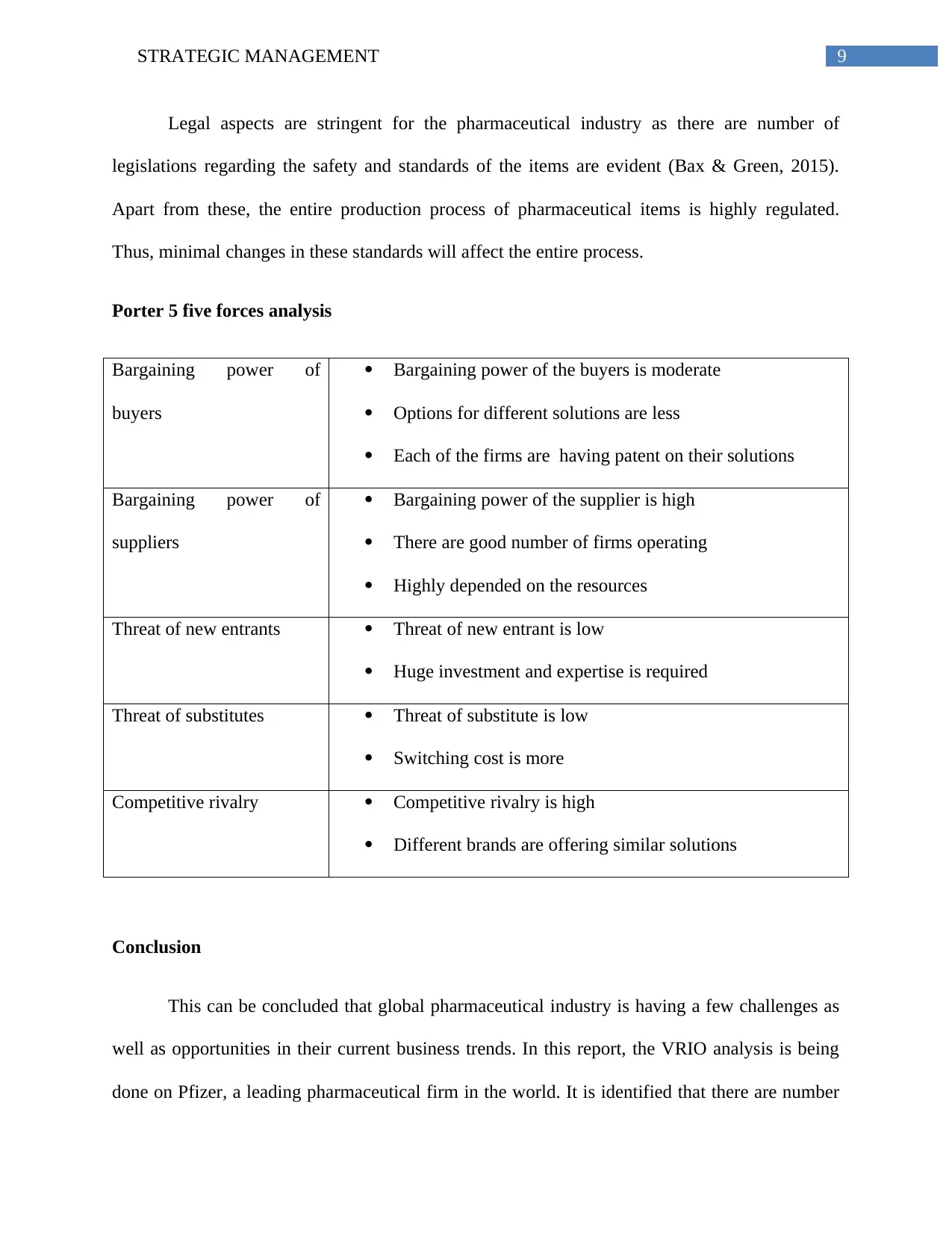
Porter 5 five forces analysis
Bargaining power of
buyers
Bargaining power of the buyers is moderate
Options for different solutions are less
Each of the firms are having patent on their solutions
Bargaining power of
suppliers
Bargaining power of the supplier is high
There are good number of firms operating
Highly depended on the resources
Threat of new entrants Threat of new entrant is low
Huge investment and expertise is required
Threat of substitutes Threat of substitute is low
Switching cost is more
Competitive rivalry Competitive rivalry is high
Different brands are offering similar solutions
Conclusion
This can be concluded that global pharmaceutical industry is having a few challenges as
well as opportunities in their current business trends. In this report, the VRIO analysis is being
done on Pfizer, a leading pharmaceutical firm in the world. It is identified that there are number
Legal aspects are stringent for the pharmaceutical industry as there are number of
legislations regarding the safety and standards of the items are evident (Bax & Green, 2015).
Apart from these, the entire production process of pharmaceutical items is highly regulated.
Thus, minimal changes in these standards will affect the entire process.
Porter 5 five forces analysis
Bargaining power of
buyers
Bargaining power of the buyers is moderate
Options for different solutions are less
Each of the firms are having patent on their solutions
Bargaining power of
suppliers
Bargaining power of the supplier is high
There are good number of firms operating
Highly depended on the resources
Threat of new entrants Threat of new entrant is low
Huge investment and expertise is required
Threat of substitutes Threat of substitute is low
Switching cost is more
Competitive rivalry Competitive rivalry is high
Different brands are offering similar solutions
Conclusion
This can be concluded that global pharmaceutical industry is having a few challenges as
well as opportunities in their current business trends. In this report, the VRIO analysis is being
done on Pfizer, a leading pharmaceutical firm in the world. It is identified that there are number
Paraphrase This Document
Need a fresh take? Get an instant paraphrase of this document with our AI Paraphraser
10STRATEGIC MANAGEMENT
of resources, which are valuable for them but the rare and inimitable resources are the major
competing factors for them. In addition, the PESTLE analysis is also being done to identify the
key external trends for the pharmaceutical industry. It is identified that there are number of
positive and negative impacts being evident in the operation of pharmaceutical industry. With the
help of the Porter five forces analysis, it is identified that competitiveness is low for the
pharmaceutical industry. However, the presence of large number of firms in this industry is
creating the sense of substitutes among them.
of resources, which are valuable for them but the rare and inimitable resources are the major
competing factors for them. In addition, the PESTLE analysis is also being done to identify the
key external trends for the pharmaceutical industry. It is identified that there are number of
positive and negative impacts being evident in the operation of pharmaceutical industry. With the
help of the Porter five forces analysis, it is identified that competitiveness is low for the
pharmaceutical industry. However, the presence of large number of firms in this industry is
creating the sense of substitutes among them.
11STRATEGIC MANAGEMENT
Reference
Bauchner, H., & Fontanarosa, P. B. (2013). Restoring confidence in the pharmaceutical
industry. JAMA, 309(6), 607-609.
Bax, R., & Green, S. (2015). Antibiotics: the changing regulatory and pharmaceutical industry
paradigm. Journal of Antimicrobial Chemotherapy, 70(5), 1281-1284.
David, B., Wolfender, J.L. and Dias, D.A., 2015. The pharmaceutical industry and natural
products: historical status and new trends. Phytochemistry Reviews, 14(2), pp.299-315.
DiMasi, J. A., Grabowski, H. G., & Hansen, R. W. (2016). Innovation in the pharmaceutical
industry: new estimates of R&D costs. Journal of health economics, 47, 20-33.
Haleem, R. M., Salem, M. Y., Fatahallah, F. A., & Abdelfattah, L. E. (2015). Quality in the
pharmaceutical industry–A literature review. Saudi Pharmaceutical Journal, 23(5), 463-
469.
Jones, H. M., Chen, Y., Gibson, C., Heimbach, T., Parrott, N., Peters, S. A., ... & Hall, S. D.
(2015). Physiologically based pharmacokinetic modeling in drug discovery and
development: a pharmaceutical industry perspective. Clinical Pharmacology &
Therapeutics, 97(3), 247-262.
Khanna, R., Guler, I., & Nerkar, A. (2016). Fail often, fail big, and fail fast? Learning from small
failures and R&D performance in the pharmaceutical industry. Academy of Management
Journal, 59(2), 436-459.
Malerba, F., & Orsenigo, L. (2015). The evolution of the pharmaceutical industry. Business
History, 57(5), 664-687.
Reference
Bauchner, H., & Fontanarosa, P. B. (2013). Restoring confidence in the pharmaceutical
industry. JAMA, 309(6), 607-609.
Bax, R., & Green, S. (2015). Antibiotics: the changing regulatory and pharmaceutical industry
paradigm. Journal of Antimicrobial Chemotherapy, 70(5), 1281-1284.
David, B., Wolfender, J.L. and Dias, D.A., 2015. The pharmaceutical industry and natural
products: historical status and new trends. Phytochemistry Reviews, 14(2), pp.299-315.
DiMasi, J. A., Grabowski, H. G., & Hansen, R. W. (2016). Innovation in the pharmaceutical
industry: new estimates of R&D costs. Journal of health economics, 47, 20-33.
Haleem, R. M., Salem, M. Y., Fatahallah, F. A., & Abdelfattah, L. E. (2015). Quality in the
pharmaceutical industry–A literature review. Saudi Pharmaceutical Journal, 23(5), 463-
469.
Jones, H. M., Chen, Y., Gibson, C., Heimbach, T., Parrott, N., Peters, S. A., ... & Hall, S. D.
(2015). Physiologically based pharmacokinetic modeling in drug discovery and
development: a pharmaceutical industry perspective. Clinical Pharmacology &
Therapeutics, 97(3), 247-262.
Khanna, R., Guler, I., & Nerkar, A. (2016). Fail often, fail big, and fail fast? Learning from small
failures and R&D performance in the pharmaceutical industry. Academy of Management
Journal, 59(2), 436-459.
Malerba, F., & Orsenigo, L. (2015). The evolution of the pharmaceutical industry. Business
History, 57(5), 664-687.
⊘ This is a preview!⊘
Do you want full access?
Subscribe today to unlock all pages.
Trusted by 1+ million students worldwide

1 out of 13


Related Documents


Your All-in-One AI-Powered Toolkit for Academic Success.
+13062052269
info@desklib.com
Available 24*7 on WhatsApp / Email
![[object Object]](/_next/static/media/star-bottom.7253800d.svg)
Unlock your academic potential
Copyright © 2020–2025 A2Z Services. All Rights Reserved. Developed and managed by ZUCOL.