Strategic Management Report: Strategic Objectives and Analysis

Verified

Added on  2020/04/13

|5
|675
|190
Report
AI Summary
This report focuses on strategic management, examining the core components such as vision, mission, and strategic objectives. It explores the importance of strategy in a dynamic business environment, highlighting the role of business analysts in strategic planning and implementation. The report delves into the significance of environmental scans using tools like PESTLE, SWOT analysis, and the challenges associated with implementing strategies. It emphasizes the crucial role of business analysts in providing project investment information, managing business requirements, and participating in tactical activities. The report also stresses the importance of strategic management in addressing issues faced by business analysts, such as cost tracking and error prevention. The report concludes that strategy provides a roadmap for organizations to meet long-term goals, and strategic management aids business analysts in implementing strategies effectively.

Document Page
Strategic Management
tabler-icon-diamond-filled.svg

Paraphrase This Document

Need a fresh take? Get an instant paraphrase of this document with our AI Paraphraser
Document Page
Strategic Management
Rich Picture
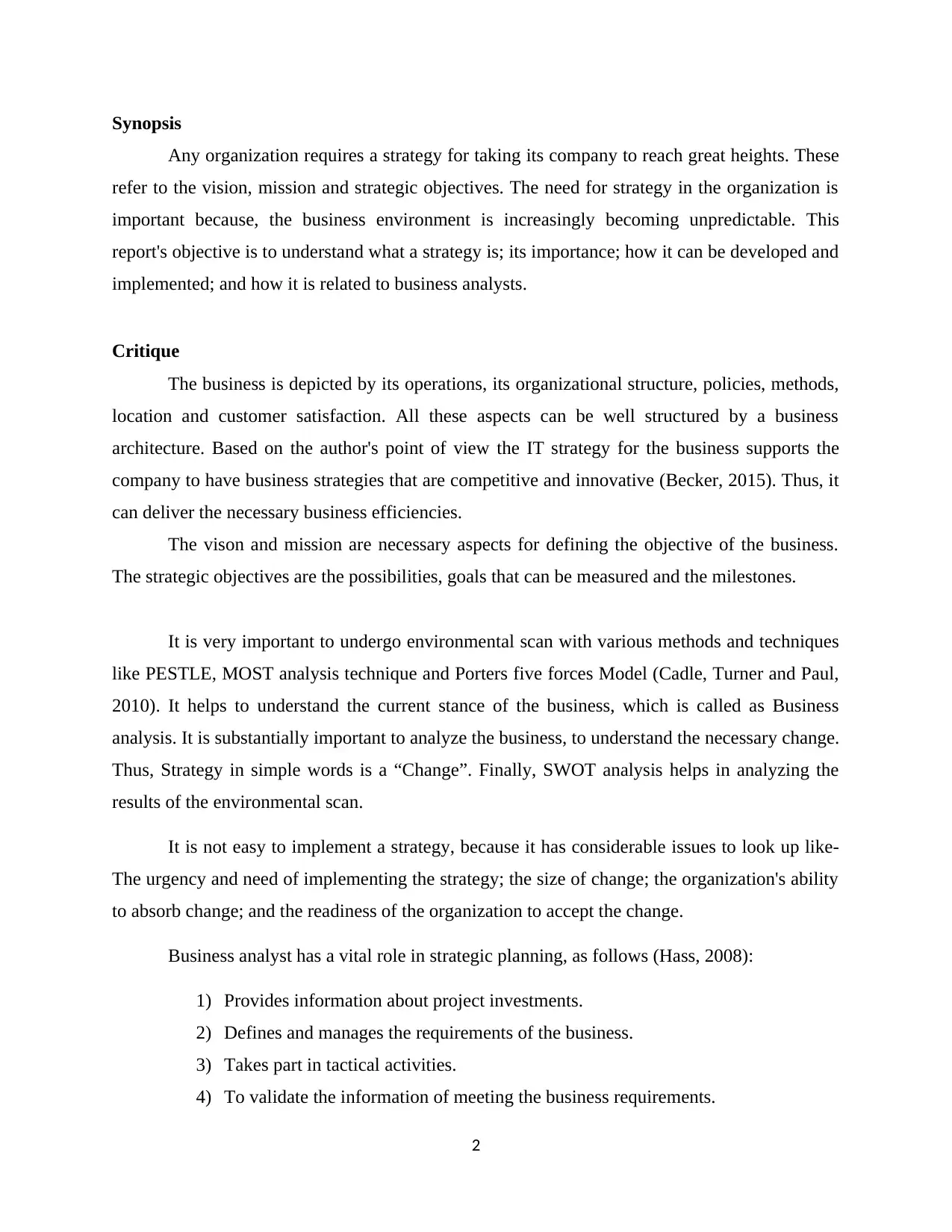
The critiquing topics include vision, mission, strategic objective, strategic management
process and SWOT analysis. All these aspects comprises as a strategic management. The
Strategic Management Concept’s map is illustrated below.
MS Visio file is attached here.
1
Document Page
Synopsis
Any organization requires a strategy for taking its company to reach great heights. These
refer to the vision, mission and strategic objectives. The need for strategy in the organization is
important because, the business environment is increasingly becoming unpredictable. This
report's objective is to understand what a strategy is; its importance; how it can be developed and
implemented; and how it is related to business analysts.
Critique
The business is depicted by its operations, its organizational structure, policies, methods,
location and customer satisfaction. All these aspects can be well structured by a business
architecture. Based on the author's point of view the IT strategy for the business supports the
company to have business strategies that are competitive and innovative (Becker, 2015). Thus, it
can deliver the necessary business efficiencies.
The vison and mission are necessary aspects for defining the objective of the business.
The strategic objectives are the possibilities, goals that can be measured and the milestones.
It is very important to undergo environmental scan with various methods and techniques
like PESTLE, MOST analysis technique and Porters five forces Model (Cadle, Turner and Paul,
2010). It helps to understand the current stance of the business, which is called as Business
analysis. It is substantially important to analyze the business, to understand the necessary change.
Thus, Strategy in simple words is a “Change”. Finally, SWOT analysis helps in analyzing the
results of the environmental scan.
It is not easy to implement a strategy, because it has considerable issues to look up like-
The urgency and need of implementing the strategy; the size of change; the organization's ability
to absorb change; and the readiness of the organization to accept the change.
Business analyst has a vital role in strategic planning, as follows (Hass, 2008):
1) Provides information about project investments.
2) Defines and manages the requirements of the business.
3) Takes part in tactical activities.
4) To validate the information of meeting the business requirements.
2
Document Page
Strategic management helps to resolve the issues of the business analysts like, tracking the cost
of the business and its benefit; prevention from errors and much more (Pullan and Archer, 2013).
Reflection
It is concluded that the strategy is a scope and direction for the company's long term plan,
for satisfying the expectations of the stakeholders. Strategy is categorized into three levels
namely, corporate, business unit and operational level. Strategy for an organization can be
developed based on the detailed analysis of the enterprise. Therefore, the strategic plan works as
a road map for the organization, to meet its long term goals. Henceforth, the strategic
management comes to the rescue of the business analysts, because of the issues in implementing
the strategy.
3
tabler-icon-diamond-filled.svg

Paraphrase This Document

Need a fresh take? Get an instant paraphrase of this document with our AI Paraphraser
Document Page
References
Becker, L. (2015). Roadmap to the Strategic Business Analyst and how it crosses other
disciplines. BBC Conference. [online] Available at:
http://www.buildingbusinesscapability.com/presentations/2015/2196.pdf.
Cadle, J., Turner, P. and Paul, D. (2010). Business analysis techniques. London [England]:
British Computer Society.
Hass, K. (2008). The business analyst as strategist. Vienna, VA: Management Concepts.
Pullan, P. and Archer, J. (2013). Business analysis and leadership. London: Kogan Page
Limited.
4
chevron_up_icon
1 out of 5
circle_padding
hide_on_mobile
zoom_out_icon
[object Object]