Strategic Management: Examining Management Roles and Structure
VerifiedAdded on 2023/06/13
|7
|1401
|316
Essay
AI Summary
This essay delves into the multifaceted roles of a manager, examining Mintzberg's role classifications (interpersonal, informational, and decisional) and their practical application within an organization. It analyzes the McKinsey 7-S framework as a tool for evaluating organizational structure and its impact on performance. Furthermore, the essay explores Weber's bureaucracy theory, highlighting its principles of formal rules, specialization, equality, and merit-based recruitment, while also considering the shift towards employee-centric management practices. The integration of these theories and frameworks is crucial for effective leadership and achieving organizational goals in a competitive market, emphasizing the importance of adapting to evolving business trends.
MANAGEMENT ROLES AND STRUCTURE 1
MANAGEMENT ROLES AND STRUCTURE
Name
Professor
Course
Institution
Date
MANAGEMENT ROLES AND STRUCTURE
Name
Professor
Course
Institution
Date
Paraphrase This Document
Need a fresh take? Get an instant paraphrase of this document with our AI Paraphraser

MANAGEMENT ROLES AND STRUCTURE 2
Part 1
The Role of the Manager.
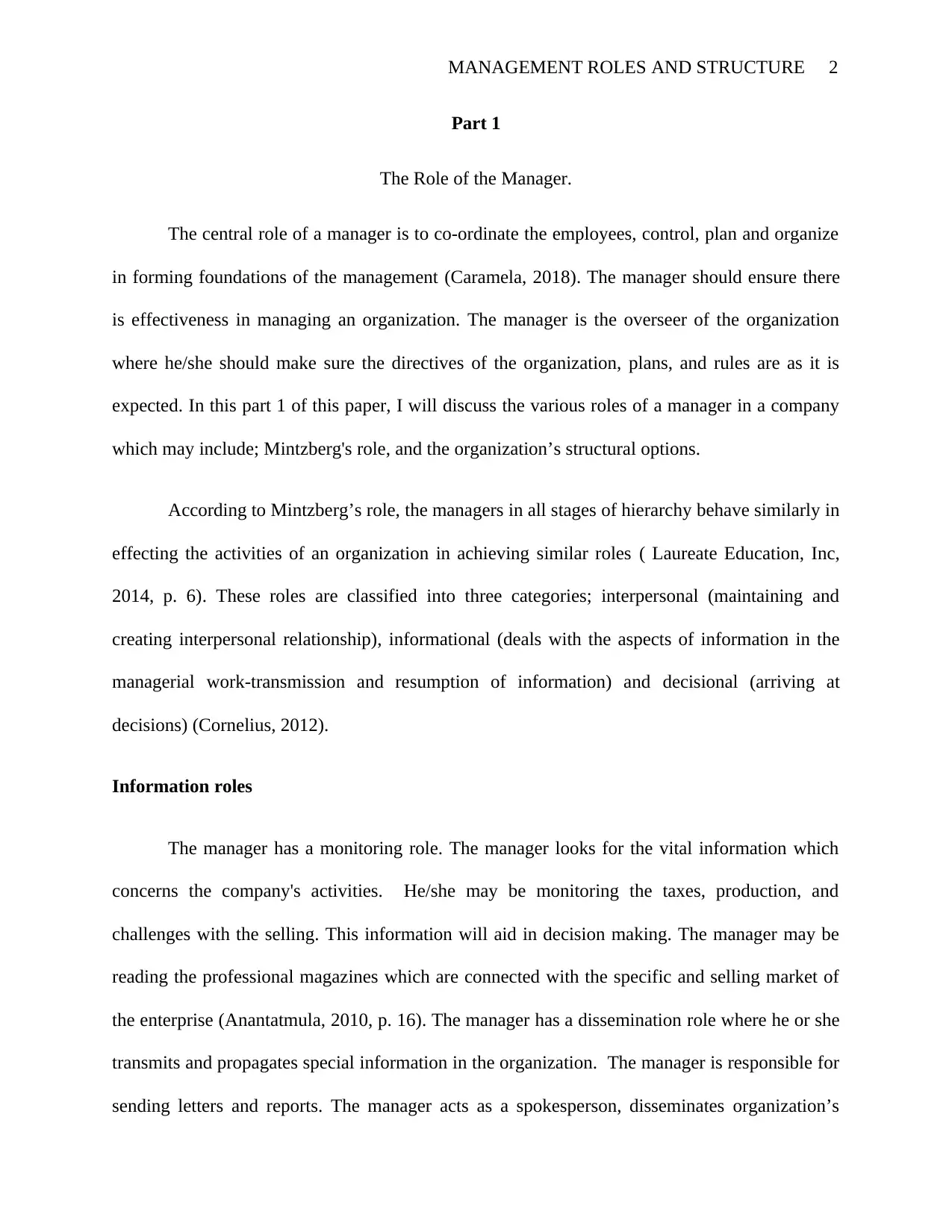
The central role of a manager is to co-ordinate the employees, control, plan and organize
in forming foundations of the management (Caramela, 2018). The manager should ensure there
is effectiveness in managing an organization. The manager is the overseer of the organization
where he/she should make sure the directives of the organization, plans, and rules are as it is
expected. In this part 1 of this paper, I will discuss the various roles of a manager in a company
which may include; Mintzberg's role, and the organization’s structural options.
According to Mintzberg’s role, the managers in all stages of hierarchy behave similarly in
effecting the activities of an organization in achieving similar roles ( Laureate Education, Inc,
2014, p. 6). These roles are classified into three categories; interpersonal (maintaining and
creating interpersonal relationship), informational (deals with the aspects of information in the
managerial work-transmission and resumption of information) and decisional (arriving at
decisions) (Cornelius, 2012).
Information roles
The manager has a monitoring role. The manager looks for the vital information which
concerns the company's activities. He/she may be monitoring the taxes, production, and
challenges with the selling. This information will aid in decision making. The manager may be
reading the professional magazines which are connected with the specific and selling market of
the enterprise (Anantatmula, 2010, p. 16). The manager has a dissemination role where he or she
transmits and propagates special information in the organization. The manager is responsible for
sending letters and reports. The manager acts as a spokesperson, disseminates organization’s
Part 1
The Role of the Manager.
The central role of a manager is to co-ordinate the employees, control, plan and organize
in forming foundations of the management (Caramela, 2018). The manager should ensure there
is effectiveness in managing an organization. The manager is the overseer of the organization
where he/she should make sure the directives of the organization, plans, and rules are as it is
expected. In this part 1 of this paper, I will discuss the various roles of a manager in a company
which may include; Mintzberg's role, and the organization’s structural options.
According to Mintzberg’s role, the managers in all stages of hierarchy behave similarly in
effecting the activities of an organization in achieving similar roles ( Laureate Education, Inc,
2014, p. 6). These roles are classified into three categories; interpersonal (maintaining and
creating interpersonal relationship), informational (deals with the aspects of information in the
managerial work-transmission and resumption of information) and decisional (arriving at
decisions) (Cornelius, 2012).
Information roles
The manager has a monitoring role. The manager looks for the vital information which
concerns the company's activities. He/she may be monitoring the taxes, production, and
challenges with the selling. This information will aid in decision making. The manager may be
reading the professional magazines which are connected with the specific and selling market of
the enterprise (Anantatmula, 2010, p. 16). The manager has a dissemination role where he or she
transmits and propagates special information in the organization. The manager is responsible for
sending letters and reports. The manager acts as a spokesperson, disseminates organization’s

MANAGEMENT ROLES AND STRUCTURE 3
information unto its environment, that is, local government, media, different offices and central
government, and in the organization of labour.
Decision roles
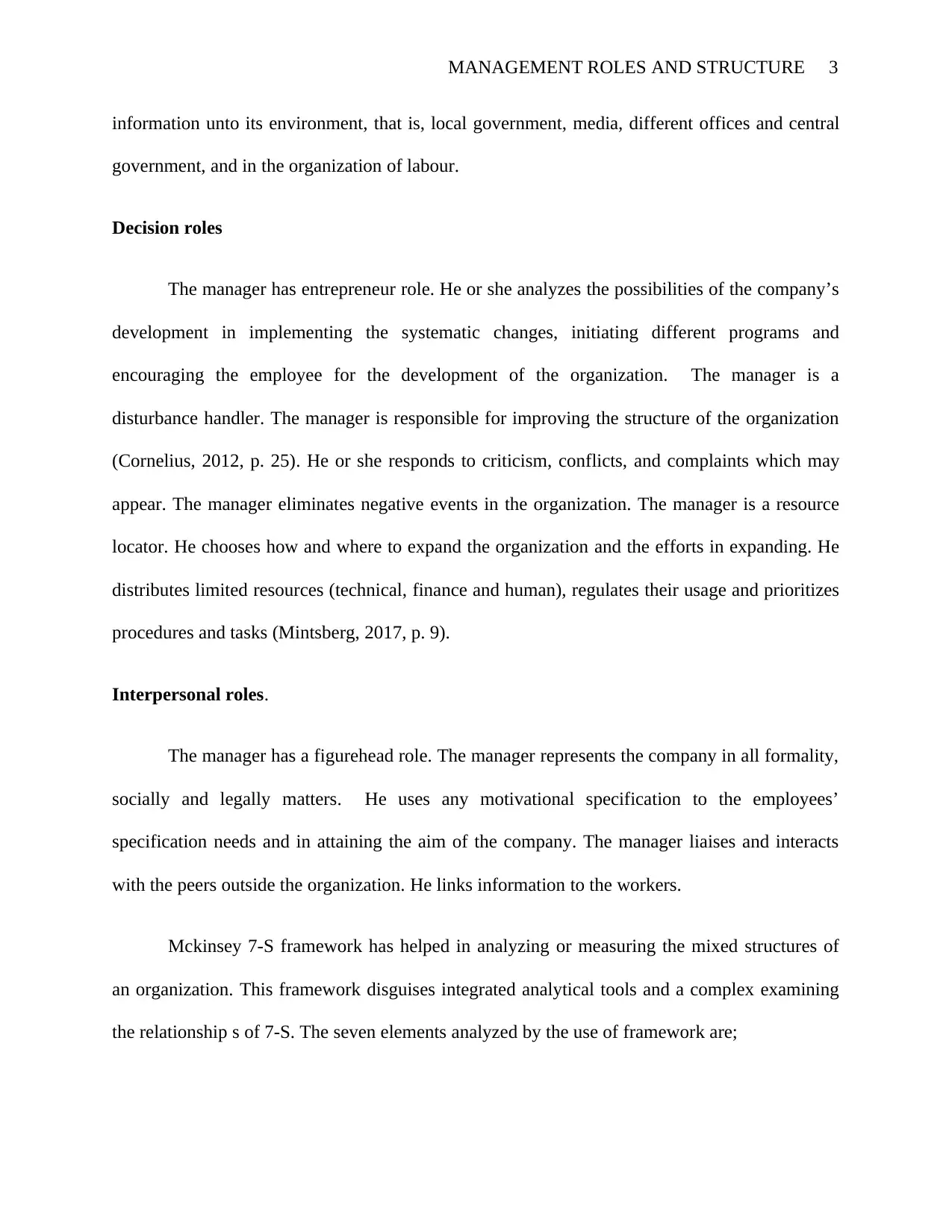
The manager has entrepreneur role. He or she analyzes the possibilities of the company’s
development in implementing the systematic changes, initiating different programs and
encouraging the employee for the development of the organization. The manager is a
disturbance handler. The manager is responsible for improving the structure of the organization
(Cornelius, 2012, p. 25). He or she responds to criticism, conflicts, and complaints which may
appear. The manager eliminates negative events in the organization. The manager is a resource
locator. He chooses how and where to expand the organization and the efforts in expanding. He
distributes limited resources (technical, finance and human), regulates their usage and prioritizes
procedures and tasks (Mintsberg, 2017, p. 9).
Interpersonal roles.
The manager has a figurehead role. The manager represents the company in all formality,
socially and legally matters. He uses any motivational specification to the employees’
specification needs and in attaining the aim of the company. The manager liaises and interacts
with the peers outside the organization. He links information to the workers.
Mckinsey 7-S framework has helped in analyzing or measuring the mixed structures of
an organization. This framework disguises integrated analytical tools and a complex examining
the relationship s of 7-S. The seven elements analyzed by the use of framework are;
information unto its environment, that is, local government, media, different offices and central
government, and in the organization of labour.
Decision roles
The manager has entrepreneur role. He or she analyzes the possibilities of the company’s
development in implementing the systematic changes, initiating different programs and
encouraging the employee for the development of the organization. The manager is a
disturbance handler. The manager is responsible for improving the structure of the organization
(Cornelius, 2012, p. 25). He or she responds to criticism, conflicts, and complaints which may
appear. The manager eliminates negative events in the organization. The manager is a resource
locator. He chooses how and where to expand the organization and the efforts in expanding. He
distributes limited resources (technical, finance and human), regulates their usage and prioritizes
procedures and tasks (Mintsberg, 2017, p. 9).
Interpersonal roles.
The manager has a figurehead role. The manager represents the company in all formality,
socially and legally matters. He uses any motivational specification to the employees’
specification needs and in attaining the aim of the company. The manager liaises and interacts
with the peers outside the organization. He links information to the workers.
Mckinsey 7-S framework has helped in analyzing or measuring the mixed structures of
an organization. This framework disguises integrated analytical tools and a complex examining
the relationship s of 7-S. The seven elements analyzed by the use of framework are;
⊘ This is a preview!⊘
Do you want full access?
Subscribe today to unlock all pages.

Trusted by 1+ million students worldwide

MANAGEMENT ROLES AND STRUCTURE 4
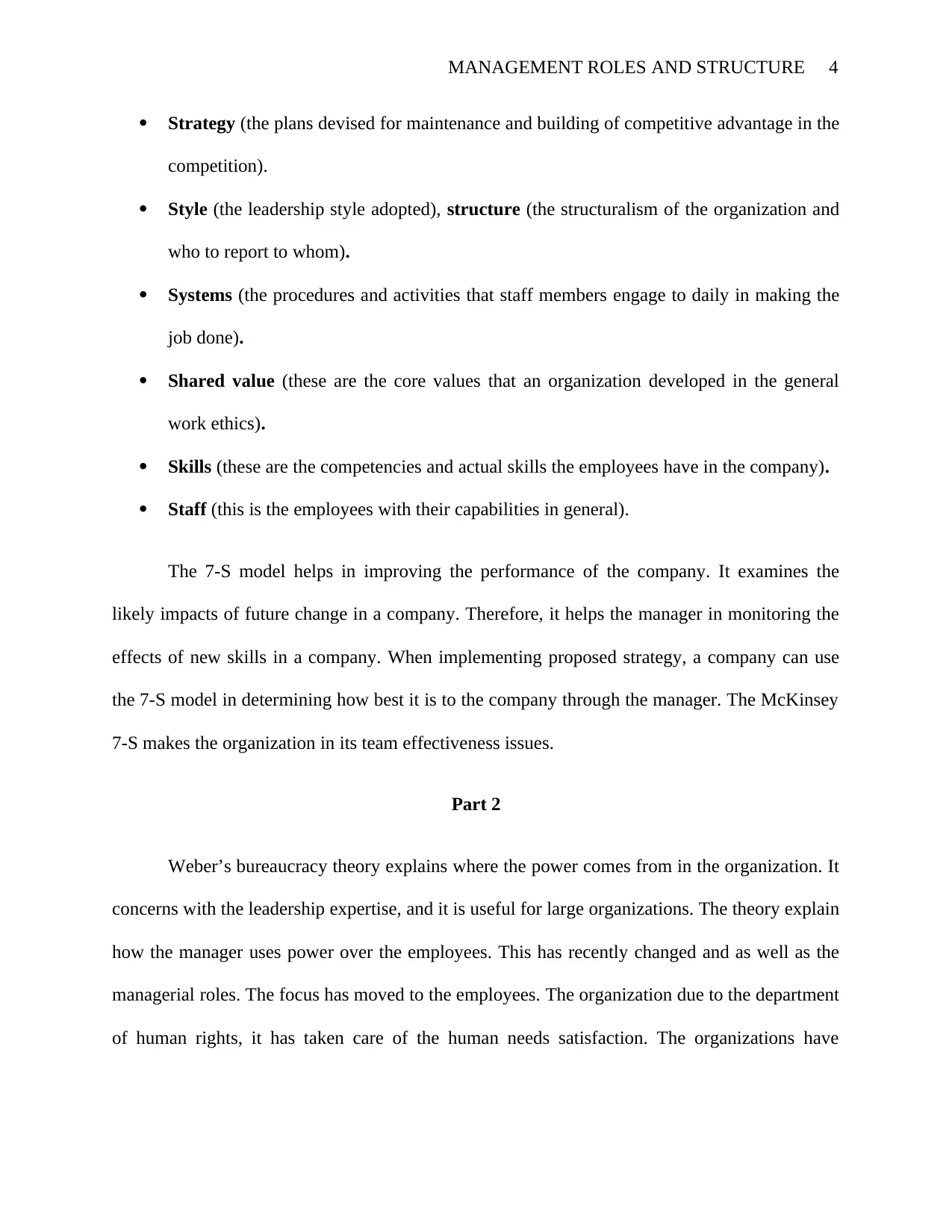
Strategy (the plans devised for maintenance and building of competitive advantage in the
competition).
Style (the leadership style adopted), structure (the structuralism of the organization and
who to report to whom).
Systems (the procedures and activities that staff members engage to daily in making the
job done).
Shared value (these are the core values that an organization developed in the general
work ethics).
Skills (these are the competencies and actual skills the employees have in the company).
Staff (this is the employees with their capabilities in general).
The 7-S model helps in improving the performance of the company. It examines the
likely impacts of future change in a company. Therefore, it helps the manager in monitoring the
effects of new skills in a company. When implementing proposed strategy, a company can use
the 7-S model in determining how best it is to the company through the manager. The McKinsey
7-S makes the organization in its team effectiveness issues.
Part 2
Weber’s bureaucracy theory explains where the power comes from in the organization. It
concerns with the leadership expertise, and it is useful for large organizations. The theory explain
how the manager uses power over the employees. This has recently changed and as well as the
managerial roles. The focus has moved to the employees. The organization due to the department
of human rights, it has taken care of the human needs satisfaction. The organizations have
Strategy (the plans devised for maintenance and building of competitive advantage in the
competition).
Style (the leadership style adopted), structure (the structuralism of the organization and
who to report to whom).
Systems (the procedures and activities that staff members engage to daily in making the
job done).
Shared value (these are the core values that an organization developed in the general
work ethics).
Skills (these are the competencies and actual skills the employees have in the company).
Staff (this is the employees with their capabilities in general).
The 7-S model helps in improving the performance of the company. It examines the
likely impacts of future change in a company. Therefore, it helps the manager in monitoring the
effects of new skills in a company. When implementing proposed strategy, a company can use
the 7-S model in determining how best it is to the company through the manager. The McKinsey
7-S makes the organization in its team effectiveness issues.
Part 2
Weber’s bureaucracy theory explains where the power comes from in the organization. It
concerns with the leadership expertise, and it is useful for large organizations. The theory explain
how the manager uses power over the employees. This has recently changed and as well as the
managerial roles. The focus has moved to the employees. The organization due to the department
of human rights, it has taken care of the human needs satisfaction. The organizations have
Paraphrase This Document
Need a fresh take? Get an instant paraphrase of this document with our AI Paraphraser

MANAGEMENT ROLES AND STRUCTURE 5
realized that the production in the enterprise depends on the employees’ commitment. It monitors
the employees’ services rather than the manager.
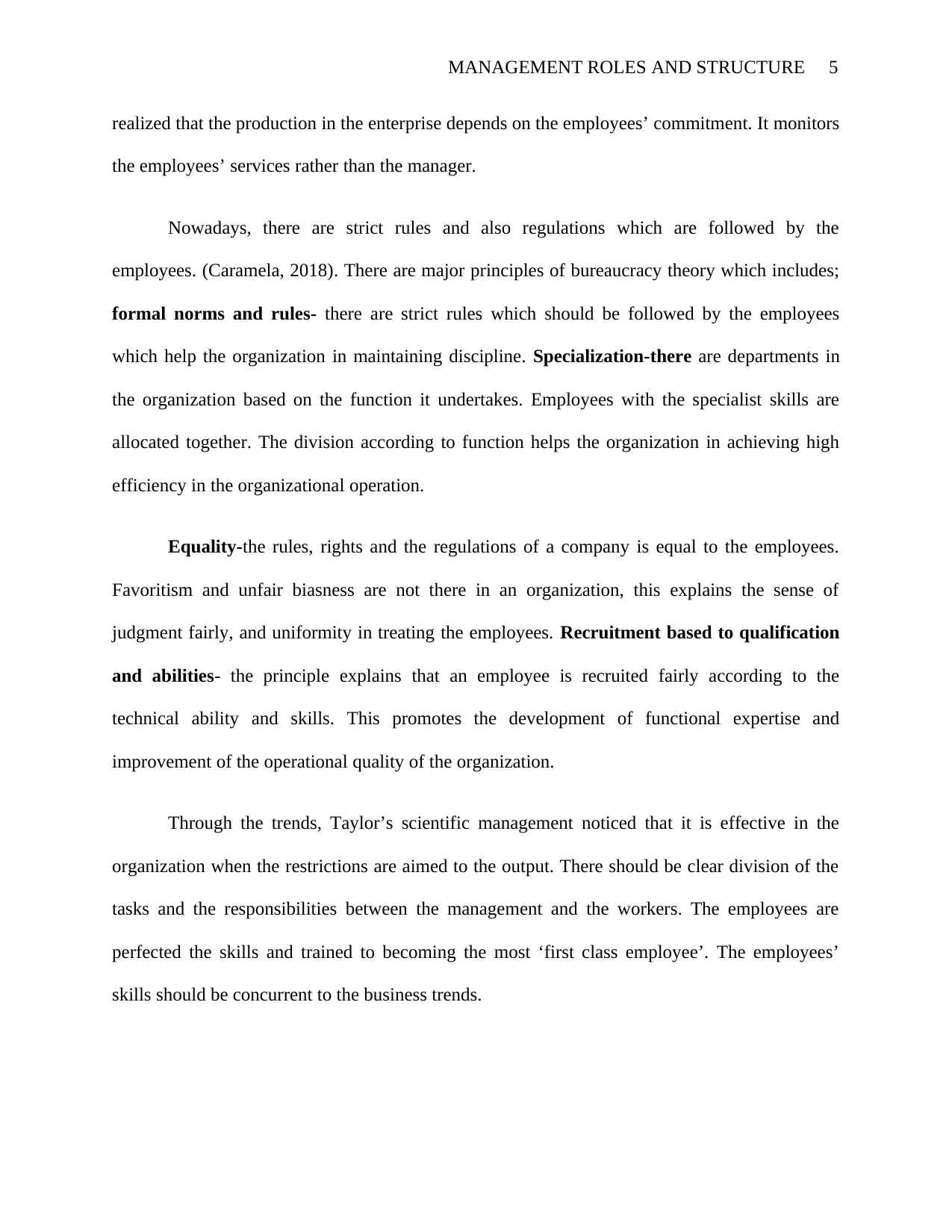
Nowadays, there are strict rules and also regulations which are followed by the
employees. (Caramela, 2018). There are major principles of bureaucracy theory which includes;
formal norms and rules- there are strict rules which should be followed by the employees
which help the organization in maintaining discipline. Specialization-there are departments in
the organization based on the function it undertakes. Employees with the specialist skills are
allocated together. The division according to function helps the organization in achieving high
efficiency in the organizational operation.
Equality-the rules, rights and the regulations of a company is equal to the employees.
Favoritism and unfair biasness are not there in an organization, this explains the sense of
judgment fairly, and uniformity in treating the employees. Recruitment based to qualification
and abilities- the principle explains that an employee is recruited fairly according to the
technical ability and skills. This promotes the development of functional expertise and
improvement of the operational quality of the organization.
Through the trends, Taylor’s scientific management noticed that it is effective in the
organization when the restrictions are aimed to the output. There should be clear division of the
tasks and the responsibilities between the management and the workers. The employees are
perfected the skills and trained to becoming the most ‘first class employee’. The employees’
skills should be concurrent to the business trends.
realized that the production in the enterprise depends on the employees’ commitment. It monitors
the employees’ services rather than the manager.
Nowadays, there are strict rules and also regulations which are followed by the
employees. (Caramela, 2018). There are major principles of bureaucracy theory which includes;
formal norms and rules- there are strict rules which should be followed by the employees
which help the organization in maintaining discipline. Specialization-there are departments in
the organization based on the function it undertakes. Employees with the specialist skills are
allocated together. The division according to function helps the organization in achieving high
efficiency in the organizational operation.
Equality-the rules, rights and the regulations of a company is equal to the employees.
Favoritism and unfair biasness are not there in an organization, this explains the sense of
judgment fairly, and uniformity in treating the employees. Recruitment based to qualification
and abilities- the principle explains that an employee is recruited fairly according to the
technical ability and skills. This promotes the development of functional expertise and
improvement of the operational quality of the organization.
Through the trends, Taylor’s scientific management noticed that it is effective in the
organization when the restrictions are aimed to the output. There should be clear division of the
tasks and the responsibilities between the management and the workers. The employees are
perfected the skills and trained to becoming the most ‘first class employee’. The employees’
skills should be concurrent to the business trends.

MANAGEMENT ROLES AND STRUCTURE 6
In conclusion, the manager in the organization should integrate the bureaucracy theory to
achieve the objective of the organization. The strategies will be of great use in leading the
employees effectively. The manager should ensure the core goal is achieved it the organization.
The McKinsey S-7, when implemented in any organization by the leader, the ultimate objective,
and effectiveness in the enterprise will be attained. The leader should always be updated to the
business trends which will make the organization fit into the competitive market.
In conclusion, the manager in the organization should integrate the bureaucracy theory to
achieve the objective of the organization. The strategies will be of great use in leading the
employees effectively. The manager should ensure the core goal is achieved it the organization.
The McKinsey S-7, when implemented in any organization by the leader, the ultimate objective,
and effectiveness in the enterprise will be attained. The leader should always be updated to the
business trends which will make the organization fit into the competitive market.
⊘ This is a preview!⊘
Do you want full access?
Subscribe today to unlock all pages.

Trusted by 1+ million students worldwide

MANAGEMENT ROLES AND STRUCTURE 7
References
Laureate Education, Inc, 2014. The evolution of management, Parts I & II. liverpool: Laureate
Education, Inc.
Anantatmula, V. S., 2010. Project Manager Leadership Role in Improving Project Performance.
management tool , Volume 22, pp. 13-23.
Caramela, S., 2018. The management Theaory of Max Weber.. [Online]
Available at: https://www.business.com/articles/management-theory-of-max-weber/
[Accessed 12 February 2018].
Cornelius, M., 2012. Supervisor Roles and responsibilities. Oakland: CompassPoint Nonprofit
Services.
Mintsberg, H., 2017. The manager's job. Havard Business Review, 3(2), pp. 1-14.
References
Laureate Education, Inc, 2014. The evolution of management, Parts I & II. liverpool: Laureate
Education, Inc.
Anantatmula, V. S., 2010. Project Manager Leadership Role in Improving Project Performance.
management tool , Volume 22, pp. 13-23.
Caramela, S., 2018. The management Theaory of Max Weber.. [Online]
Available at: https://www.business.com/articles/management-theory-of-max-weber/
[Accessed 12 February 2018].
Cornelius, M., 2012. Supervisor Roles and responsibilities. Oakland: CompassPoint Nonprofit
Services.
Mintsberg, H., 2017. The manager's job. Havard Business Review, 3(2), pp. 1-14.
1 out of 7
Related Documents
Your All-in-One AI-Powered Toolkit for Academic Success.
+13062052269
info@desklib.com
Available 24*7 on WhatsApp / Email
Unlock your academic potential
Copyright © 2020–2025 A2Z Services. All Rights Reserved. Developed and managed by ZUCOL.