Personal Development Report: Strategic Managers Skills Audit
VerifiedAdded on 2021/06/17
|15
|3736
|4
Report
AI Summary
This report, titled 'Personal Development for Strategic Managers,' delves into the essential skills and competencies required of modern-day managers. It begins by identifying key skills such as coaching, mentoring, leadership, communication, and multi-tasking, emphasizing their importance in fulfilling dynamic job roles and contributing to organizational objectives. The report then explores techniques for assessing professional skills in line with strategic direction. Furthermore, it includes a self-assessment skills audit, evaluating the author's communication, research & planning, human relation, and organizational skills, along with plans for improvement in each area. The report references various academic sources to support its claims and analyses, providing a comprehensive overview of personal development within a strategic management context.
Personal Development for Strategic
Managers
Managers

Paraphrase This Document
Need a fresh take? Get an instant paraphrase of this document with our AI Paraphraser
Table of Contents
Task 1.........................................................................................................................................3
1.1 Identifying the skills and competencies that are required by modern day managers to
satisfy their dynamic job roles and responsibilities and understanding how they are critical
to the job performance and strategic business objectives of an organisation........................3
1.2 Applying techniques to assess professional skills required to support the strategic
direction of the organization..................................................................................................6
Task 2.........................................................................................................................................7
2.1 Conducting a skills audit to evaluate my existing level of strategic managerial skills....7
2.2 Researching the different theories of learning styles and identifying my preferred
learning style........................................................................................................................11
References................................................................................................................................14
Task 1.........................................................................................................................................3
1.1 Identifying the skills and competencies that are required by modern day managers to
satisfy their dynamic job roles and responsibilities and understanding how they are critical
to the job performance and strategic business objectives of an organisation........................3
1.2 Applying techniques to assess professional skills required to support the strategic
direction of the organization..................................................................................................6
Task 2.........................................................................................................................................7
2.1 Conducting a skills audit to evaluate my existing level of strategic managerial skills....7
2.2 Researching the different theories of learning styles and identifying my preferred
learning style........................................................................................................................11
References................................................................................................................................14
Task 1
1.1 Identifying the skills and competencies that are required by modern day
managers to satisfy their dynamic job roles and responsibilities and
understanding how they are critical to the job performance and strategic
business objectives of an organisation
Modern day managers have diverse job roles and responsibilities to fulfil within an
organisation and this is what makes them an important asset of any organisation. The
managers are responsible for maintaining the normal smooth business functioning and
productivity within an organisation and this is what makes their job extremely dynamic and
challenging in nature (Whetten, 2011). There are different skills and competencies that are
expected from a manger in order to satisfy and fulfil their crucial job roles and
responsibilities within an organisation and these include coaching and mentoring skills,
ability to counsel employees and helping them with their learning and development needs,
leadership skills, multi-tasking skills, presentation skills, ability to lead and chair meetings,
understanding and making use of occupational standards in order to identify the capabilities
of the employees (Ellinger and Ellinger, 2014).
Ability to counsel staffs and help them with their learning and development
requirements – This is one of the most crucial and important skill that a modern day
manager needs to possess. Today the work environment has become extremely hectic and
stressful for the staffs and this is invariably creating greater instances of burnout among the
employees. Employees are unable to handle and cope up with the work related stress and this
is making them more disengaged and discontent with their job and eventually making them
prone to depression (Kor and Mesko, 2013). With the help of counselling, the managers are
able to instil the necessary motivation and confidence among their employees which makes
them more committed and dedicated at their jobs. The aspect of counselling involves
understanding and exploring the personal problems and issues that are being faced by the
employees in their respective workplace. Counselling usually involves face-to-face
discussion with the employees in order to develop a greater understanding and self awareness
about the problems faced by an individual in the workplace (Katz, 2009). With the help of
counselling the mangers area able to resolve and mitigate the problems and issued faced by
1.1 Identifying the skills and competencies that are required by modern day
managers to satisfy their dynamic job roles and responsibilities and
understanding how they are critical to the job performance and strategic
business objectives of an organisation
Modern day managers have diverse job roles and responsibilities to fulfil within an
organisation and this is what makes them an important asset of any organisation. The
managers are responsible for maintaining the normal smooth business functioning and
productivity within an organisation and this is what makes their job extremely dynamic and
challenging in nature (Whetten, 2011). There are different skills and competencies that are
expected from a manger in order to satisfy and fulfil their crucial job roles and
responsibilities within an organisation and these include coaching and mentoring skills,
ability to counsel employees and helping them with their learning and development needs,
leadership skills, multi-tasking skills, presentation skills, ability to lead and chair meetings,
understanding and making use of occupational standards in order to identify the capabilities
of the employees (Ellinger and Ellinger, 2014).
Ability to counsel staffs and help them with their learning and development
requirements – This is one of the most crucial and important skill that a modern day
manager needs to possess. Today the work environment has become extremely hectic and
stressful for the staffs and this is invariably creating greater instances of burnout among the
employees. Employees are unable to handle and cope up with the work related stress and this
is making them more disengaged and discontent with their job and eventually making them
prone to depression (Kor and Mesko, 2013). With the help of counselling, the managers are
able to instil the necessary motivation and confidence among their employees which makes
them more committed and dedicated at their jobs. The aspect of counselling involves
understanding and exploring the personal problems and issues that are being faced by the
employees in their respective workplace. Counselling usually involves face-to-face
discussion with the employees in order to develop a greater understanding and self awareness
about the problems faced by an individual in the workplace (Katz, 2009). With the help of
counselling the mangers area able to resolve and mitigate the problems and issued faced by
⊘ This is a preview!⊘
Do you want full access?
Subscribe today to unlock all pages.

Trusted by 1+ million students worldwide
the employees and this helps in increasing the performance and productivity of the
employees.
Coaching and mentoring skills – This is another vital skill which must be possessed by the
modern day managers. The aspect of coaching and mentoring helps in fine tuning the existing
skills and abilities of the employees and it helps the employees to un-tap their true potential at
the workplace. An effective mentoring and coaching skills helps the mangers to undertake
development activities that are tailor made to suit the individual needs and learning styles of
the different employees (Clutterbuck, 2008). This helps the managers to enhance the
performance of their employees by eliminate the mistakes made by their employees. The
aspect of coaching and mentorship helps the managers to focus on the existing interpersonal
skills and abilities of their employees and this helps the business establishments to design
their employees training programs that would eventually help the employees to realise their
true potential at the workplace. The employees are able to apply and transfer their skills in the
live environment and they are able to contribute towards their organisational growth and
success (Littlejohn and Margarayn, 2011).
Leadership Skills – This is the most important characteristic trait of a manager which makes
him the most vital asset of an organisation. Successful managers must possess excellent
leadership skills and they have a clear understanding about the different leadership styles and
leadership theories and their applicability in the modern day workplace. The managers must
possess a precise understanding about the different theories of leadership such as traits
theory, behaviour theory, contingency theory, situation al leadership theory and action
centred leadership model (Phelan and Sharpley, 2012). This would enable the managers to
provide the necessary motivation and inspiration to their staffs. Communication is an
imperative aspect of the leadership process and the managers need to be good communicators
for realising the need and expectations of their staffs in a better manner. The job roles of the
managers involve interacting and communicating with their staffs on a daily basis in order to
understand how the employees are performing in their individual work roles and
responsibilities and whether they need to change their working styles in order to satisfy the
changing organisational requirements (Rubin and Dierdorff, 2009). The leadership skills
would enable the managers to improve the motivation and commitment levels of the workers
and this would eventually help in improving the individual performance and productivity of
the employees.
employees.
Coaching and mentoring skills – This is another vital skill which must be possessed by the
modern day managers. The aspect of coaching and mentoring helps in fine tuning the existing
skills and abilities of the employees and it helps the employees to un-tap their true potential at
the workplace. An effective mentoring and coaching skills helps the mangers to undertake
development activities that are tailor made to suit the individual needs and learning styles of
the different employees (Clutterbuck, 2008). This helps the managers to enhance the
performance of their employees by eliminate the mistakes made by their employees. The
aspect of coaching and mentorship helps the managers to focus on the existing interpersonal
skills and abilities of their employees and this helps the business establishments to design
their employees training programs that would eventually help the employees to realise their
true potential at the workplace. The employees are able to apply and transfer their skills in the
live environment and they are able to contribute towards their organisational growth and
success (Littlejohn and Margarayn, 2011).
Leadership Skills – This is the most important characteristic trait of a manager which makes
him the most vital asset of an organisation. Successful managers must possess excellent
leadership skills and they have a clear understanding about the different leadership styles and
leadership theories and their applicability in the modern day workplace. The managers must
possess a precise understanding about the different theories of leadership such as traits
theory, behaviour theory, contingency theory, situation al leadership theory and action
centred leadership model (Phelan and Sharpley, 2012). This would enable the managers to
provide the necessary motivation and inspiration to their staffs. Communication is an
imperative aspect of the leadership process and the managers need to be good communicators
for realising the need and expectations of their staffs in a better manner. The job roles of the
managers involve interacting and communicating with their staffs on a daily basis in order to
understand how the employees are performing in their individual work roles and
responsibilities and whether they need to change their working styles in order to satisfy the
changing organisational requirements (Rubin and Dierdorff, 2009). The leadership skills
would enable the managers to improve the motivation and commitment levels of the workers
and this would eventually help in improving the individual performance and productivity of
the employees.
Paraphrase This Document
Need a fresh take? Get an instant paraphrase of this document with our AI Paraphraser
Multi-tasking skills – The multi-tasking skills are a modern day business requirement
because the modern day managers are expected to perform a wide variety of job roles and
responsibilities in the modern day workplace. The multitasking skills have become a highly
sought after quality which helps the managers to tackle and address the diverse problems and
issues that are arising in their day-to-day business functionalities. This is eventually helping
the business establishments to ensure the normal smooth continuity of their business
operations in the market (Kor and Mesko, 2013).
Leading and chairing meetings – This is another important skill which the managers must
possess. The managers must have the capacity to chair business meetings and make their
employees aware about the long term organisational goals and objectives. This helps them to
provide the much needed strategic direction to their staffs and as a result the managers are
able to guide their staffs in their daily work functionalities. The ability to lead and chair
meetings is important because it helps the managers to make their employees aware of the
mistakes that they are committing and which is having a detrimental impact on the
organisational productivity. This would help the managers in making their employees more
proficient and competent in their jobs (Mitchelmore & Rowley, 2013).
Presentation skills - This is another important skill and competency which the modern day
managers need to possess. The presentation skills help the managers to create and design
effective strategic plans and communicate those plans with their employees. The employees
on their part will be able to obtain a better clarity and understanding about what the
organisation is expecting from them and how they are supposed to carry out their individual
work roles and responsibilities within the organisation (Ellinger and Ellinger, 2014).
Understanding and making use of occupational standards in order to identify the
capabilities of the employees – This is another important talent or skill which is associated
with a good manager. The manager must have the capacity to understand the individual
potential of the employees who are working under their guidance. They must utilise existing
modern employee appraisal tools (like 360 degree feedback and management by objective) in
order to monitor and evaluate the performance and commitment of their existing employees
(Whetten, 2011). This would help them to understand the individual strengths and abilities of
their employees and they would be able to separate their dedicated and productive employees
from those that are not so productive. This would eventually help them to promote their truly
dedicated and deserving employees to higher ranks within the organisation. Thus, the
because the modern day managers are expected to perform a wide variety of job roles and
responsibilities in the modern day workplace. The multitasking skills have become a highly
sought after quality which helps the managers to tackle and address the diverse problems and
issues that are arising in their day-to-day business functionalities. This is eventually helping
the business establishments to ensure the normal smooth continuity of their business
operations in the market (Kor and Mesko, 2013).
Leading and chairing meetings – This is another important skill which the managers must
possess. The managers must have the capacity to chair business meetings and make their
employees aware about the long term organisational goals and objectives. This helps them to
provide the much needed strategic direction to their staffs and as a result the managers are
able to guide their staffs in their daily work functionalities. The ability to lead and chair
meetings is important because it helps the managers to make their employees aware of the
mistakes that they are committing and which is having a detrimental impact on the
organisational productivity. This would help the managers in making their employees more
proficient and competent in their jobs (Mitchelmore & Rowley, 2013).
Presentation skills - This is another important skill and competency which the modern day
managers need to possess. The presentation skills help the managers to create and design
effective strategic plans and communicate those plans with their employees. The employees
on their part will be able to obtain a better clarity and understanding about what the
organisation is expecting from them and how they are supposed to carry out their individual
work roles and responsibilities within the organisation (Ellinger and Ellinger, 2014).
Understanding and making use of occupational standards in order to identify the
capabilities of the employees – This is another important talent or skill which is associated
with a good manager. The manager must have the capacity to understand the individual
potential of the employees who are working under their guidance. They must utilise existing
modern employee appraisal tools (like 360 degree feedback and management by objective) in
order to monitor and evaluate the performance and commitment of their existing employees
(Whetten, 2011). This would help them to understand the individual strengths and abilities of
their employees and they would be able to separate their dedicated and productive employees
from those that are not so productive. This would eventually help them to promote their truly
dedicated and deserving employees to higher ranks within the organisation. Thus, the
managers are able to ensure the future career growth and development of the employees at
the workplace (Rubin and Dierdorff, 2009).
1.2 Applying techniques to assess professional skills required to support the
strategic direction of the organization
The professional skills required to support the strategic direction of the organisation could be
effectively assessed by evaluating how much successfully an organisation has been able to
achieve their strategic goals and objectives in the market. The strategic goals and objectives
of the organisation would be successfully realised if the employees are able to perform their
jobs roles and responsibilities in an effective manner without requiring help from their
supervisors. The managers need to provide their staffs with adequate opportunities to satisfy
and meet their individual leading requirements. The employees need to be provided with
greater amount of liberty and flexibility at the workplace which would help them to adapt to
the changes taking place within the organisation (Mitchelmore and Rowley, 2010). The
managers would be able to minimise the opposition and resistance to the change management
process and this would enable them to ensure a smooth change management process which
would eventually go a long way in ensuring the future organisational growth and success.
The managers must create a learning culture within the organisation by making use of
conceptual tools that would enable the employees to identify their own strengths and
weaknesses and enable them to take adequate measures to ensure their future professional
growth and development within the organisation (Dragoni et al., 2009).
The managers need to provide the highest levels of importance and emphasis to the aspect of
employee training and development. This would help the mangers to develop those
competencies that would eventually help the organisation to realise strategic goals and
objectives in the market (Littlejohn and Margarayn, 2011). The managers would be able to
improve the individual commitment of the employees and create better understanding and
cohesiveness among their team members resulting in improved team performance and
productivity. This would help the managers to create a healthy working environment at the
workplace that would help to foster better mutual trust and respect among the employees. The
managers would be able to retain their staffs for the long haul by fostering job satisfaction
and job loyalty among their staffs. This would help the organisation to perform in an optimal
manner by improving the engagement and commitment levels among the employees (Katz,
2009).
the workplace (Rubin and Dierdorff, 2009).
1.2 Applying techniques to assess professional skills required to support the
strategic direction of the organization
The professional skills required to support the strategic direction of the organisation could be
effectively assessed by evaluating how much successfully an organisation has been able to
achieve their strategic goals and objectives in the market. The strategic goals and objectives
of the organisation would be successfully realised if the employees are able to perform their
jobs roles and responsibilities in an effective manner without requiring help from their
supervisors. The managers need to provide their staffs with adequate opportunities to satisfy
and meet their individual leading requirements. The employees need to be provided with
greater amount of liberty and flexibility at the workplace which would help them to adapt to
the changes taking place within the organisation (Mitchelmore and Rowley, 2010). The
managers would be able to minimise the opposition and resistance to the change management
process and this would enable them to ensure a smooth change management process which
would eventually go a long way in ensuring the future organisational growth and success.
The managers must create a learning culture within the organisation by making use of
conceptual tools that would enable the employees to identify their own strengths and
weaknesses and enable them to take adequate measures to ensure their future professional
growth and development within the organisation (Dragoni et al., 2009).
The managers need to provide the highest levels of importance and emphasis to the aspect of
employee training and development. This would help the mangers to develop those
competencies that would eventually help the organisation to realise strategic goals and
objectives in the market (Littlejohn and Margarayn, 2011). The managers would be able to
improve the individual commitment of the employees and create better understanding and
cohesiveness among their team members resulting in improved team performance and
productivity. This would help the managers to create a healthy working environment at the
workplace that would help to foster better mutual trust and respect among the employees. The
managers would be able to retain their staffs for the long haul by fostering job satisfaction
and job loyalty among their staffs. This would help the organisation to perform in an optimal
manner by improving the engagement and commitment levels among the employees (Katz,
2009).
⊘ This is a preview!⊘
Do you want full access?
Subscribe today to unlock all pages.
Trusted by 1+ million students worldwide
Task 2
2.1 Conducting a skills audit to evaluate my existing level of strategic managerial
skills
Self Assessment:
1. Skill and ability: Communication
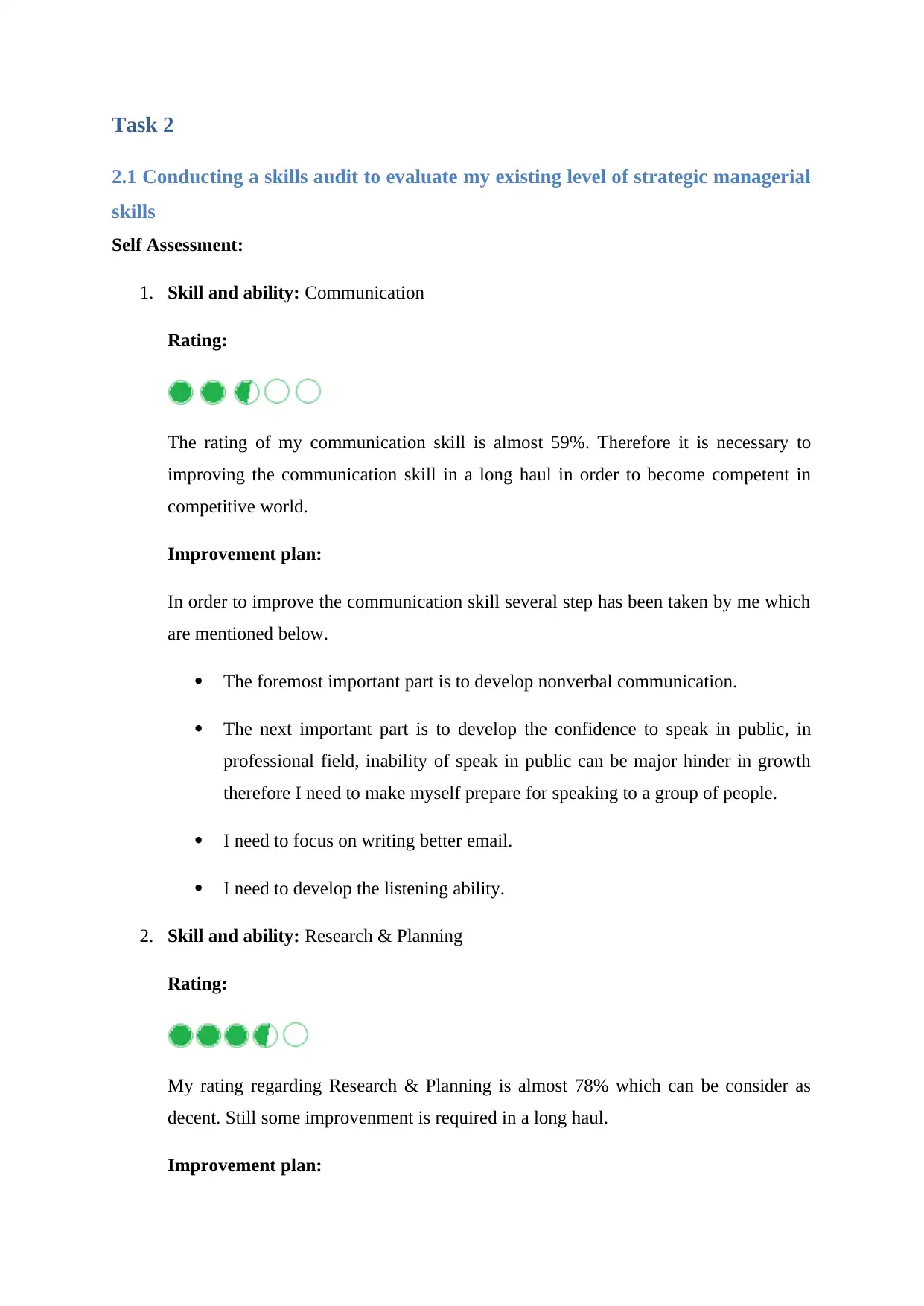
Rating:
The rating of my communication skill is almost 59%. Therefore it is necessary to
improving the communication skill in a long haul in order to become competent in
competitive world.
Improvement plan:
In order to improve the communication skill several step has been taken by me which
are mentioned below.
The foremost important part is to develop nonverbal communication.
The next important part is to develop the confidence to speak in public, in
professional field, inability of speak in public can be major hinder in growth
therefore I need to make myself prepare for speaking to a group of people.
I need to focus on writing better email.
I need to develop the listening ability.
2. Skill and ability: Research & Planning
Rating:
My rating regarding Research & Planning is almost 78% which can be consider as
decent. Still some improvenment is required in a long haul.
Improvement plan:
2.1 Conducting a skills audit to evaluate my existing level of strategic managerial
skills
Self Assessment:
1. Skill and ability: Communication
Rating:
The rating of my communication skill is almost 59%. Therefore it is necessary to
improving the communication skill in a long haul in order to become competent in
competitive world.
Improvement plan:
In order to improve the communication skill several step has been taken by me which
are mentioned below.
The foremost important part is to develop nonverbal communication.
The next important part is to develop the confidence to speak in public, in
professional field, inability of speak in public can be major hinder in growth
therefore I need to make myself prepare for speaking to a group of people.
I need to focus on writing better email.
I need to develop the listening ability.
2. Skill and ability: Research & Planning
Rating:
My rating regarding Research & Planning is almost 78% which can be consider as
decent. Still some improvenment is required in a long haul.
Improvement plan:
Paraphrase This Document
Need a fresh take? Get an instant paraphrase of this document with our AI Paraphraser
In order to improve the Research & Planning skill several step has been taken by me
which are mentioned below.
Creating self SMART goal.
Develop evidence-based practices.
Establish fidelity of Implementation.
Developing both short term & long term measures and evaluation process.
3. Skill and ability: Human Relation
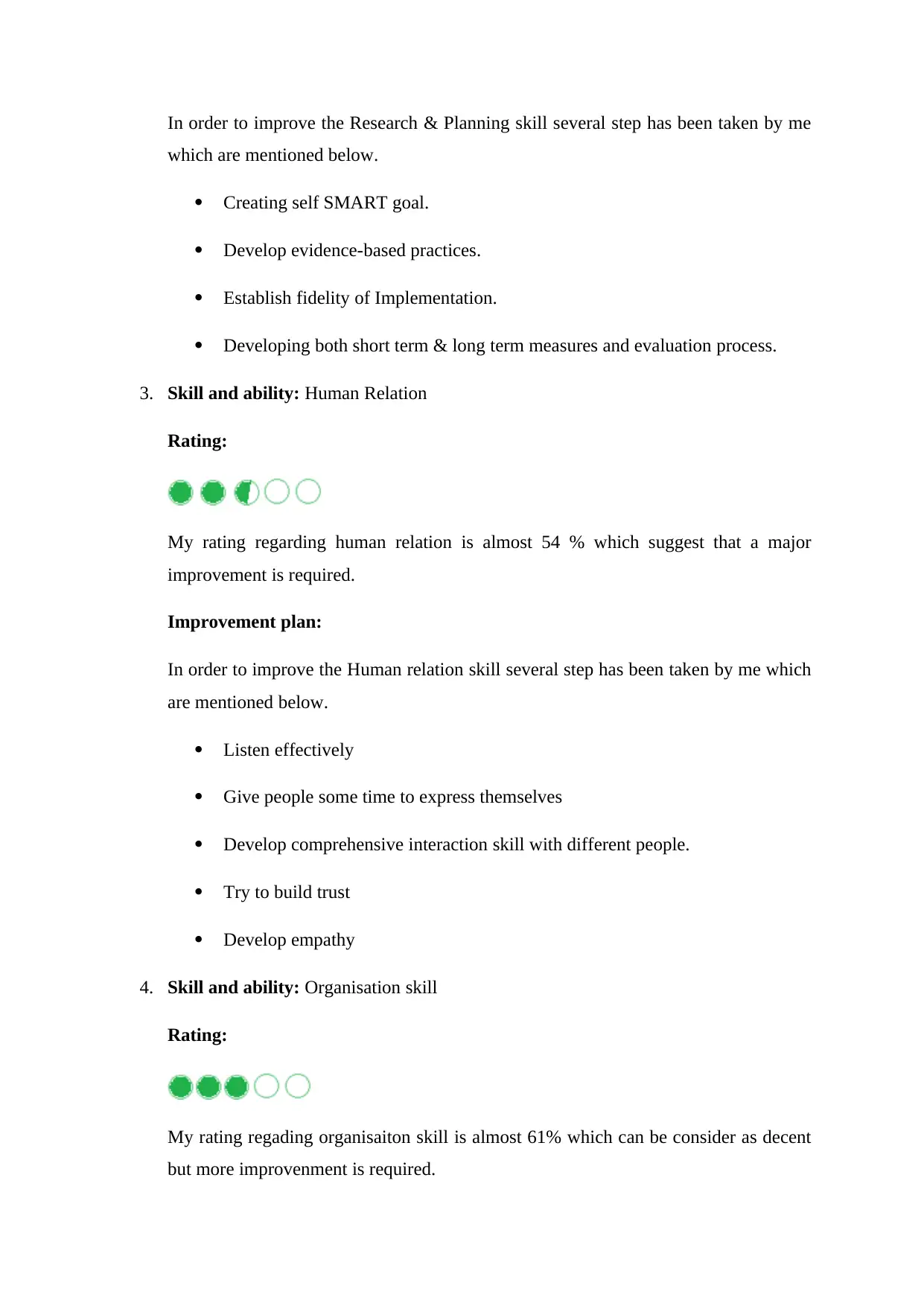
Rating:
My rating regarding human relation is almost 54 % which suggest that a major
improvement is required.
Improvement plan:
In order to improve the Human relation skill several step has been taken by me which
are mentioned below.
Listen effectively
Give people some time to express themselves
Develop comprehensive interaction skill with different people.
Try to build trust
Develop empathy
4. Skill and ability: Organisation skill
Rating:
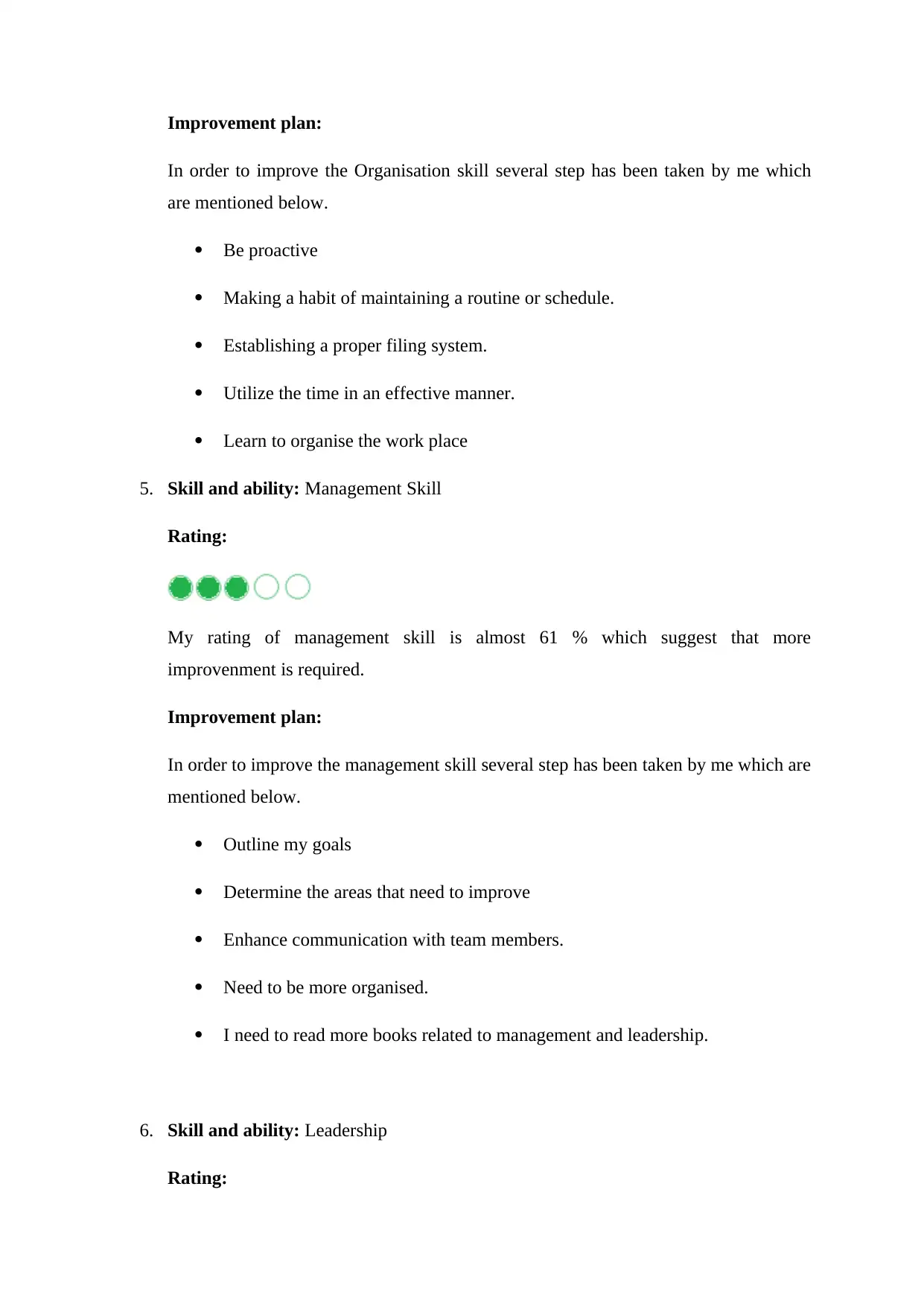
My rating regading organisaiton skill is almost 61% which can be consider as decent
but more improvenment is required.
which are mentioned below.
Creating self SMART goal.
Develop evidence-based practices.
Establish fidelity of Implementation.
Developing both short term & long term measures and evaluation process.
3. Skill and ability: Human Relation
Rating:
My rating regarding human relation is almost 54 % which suggest that a major
improvement is required.
Improvement plan:
In order to improve the Human relation skill several step has been taken by me which
are mentioned below.
Listen effectively
Give people some time to express themselves
Develop comprehensive interaction skill with different people.
Try to build trust
Develop empathy
4. Skill and ability: Organisation skill
Rating:
My rating regading organisaiton skill is almost 61% which can be consider as decent
but more improvenment is required.
Improvement plan:
In order to improve the Organisation skill several step has been taken by me which
are mentioned below.
Be proactive
Making a habit of maintaining a routine or schedule.
Establishing a proper filing system.
Utilize the time in an effective manner.
Learn to organise the work place
5. Skill and ability: Management Skill
Rating:
My rating of management skill is almost 61 % which suggest that more
improvenment is required.
Improvement plan:
In order to improve the management skill several step has been taken by me which are
mentioned below.
Outline my goals
Determine the areas that need to improve
Enhance communication with team members.
Need to be more organised.
I need to read more books related to management and leadership.
6. Skill and ability: Leadership
Rating:
In order to improve the Organisation skill several step has been taken by me which
are mentioned below.
Be proactive
Making a habit of maintaining a routine or schedule.
Establishing a proper filing system.
Utilize the time in an effective manner.
Learn to organise the work place
5. Skill and ability: Management Skill
Rating:
My rating of management skill is almost 61 % which suggest that more
improvenment is required.
Improvement plan:
In order to improve the management skill several step has been taken by me which are
mentioned below.
Outline my goals
Determine the areas that need to improve
Enhance communication with team members.
Need to be more organised.
I need to read more books related to management and leadership.
6. Skill and ability: Leadership
Rating:
⊘ This is a preview!⊘
Do you want full access?
Subscribe today to unlock all pages.
Trusted by 1+ million students worldwide
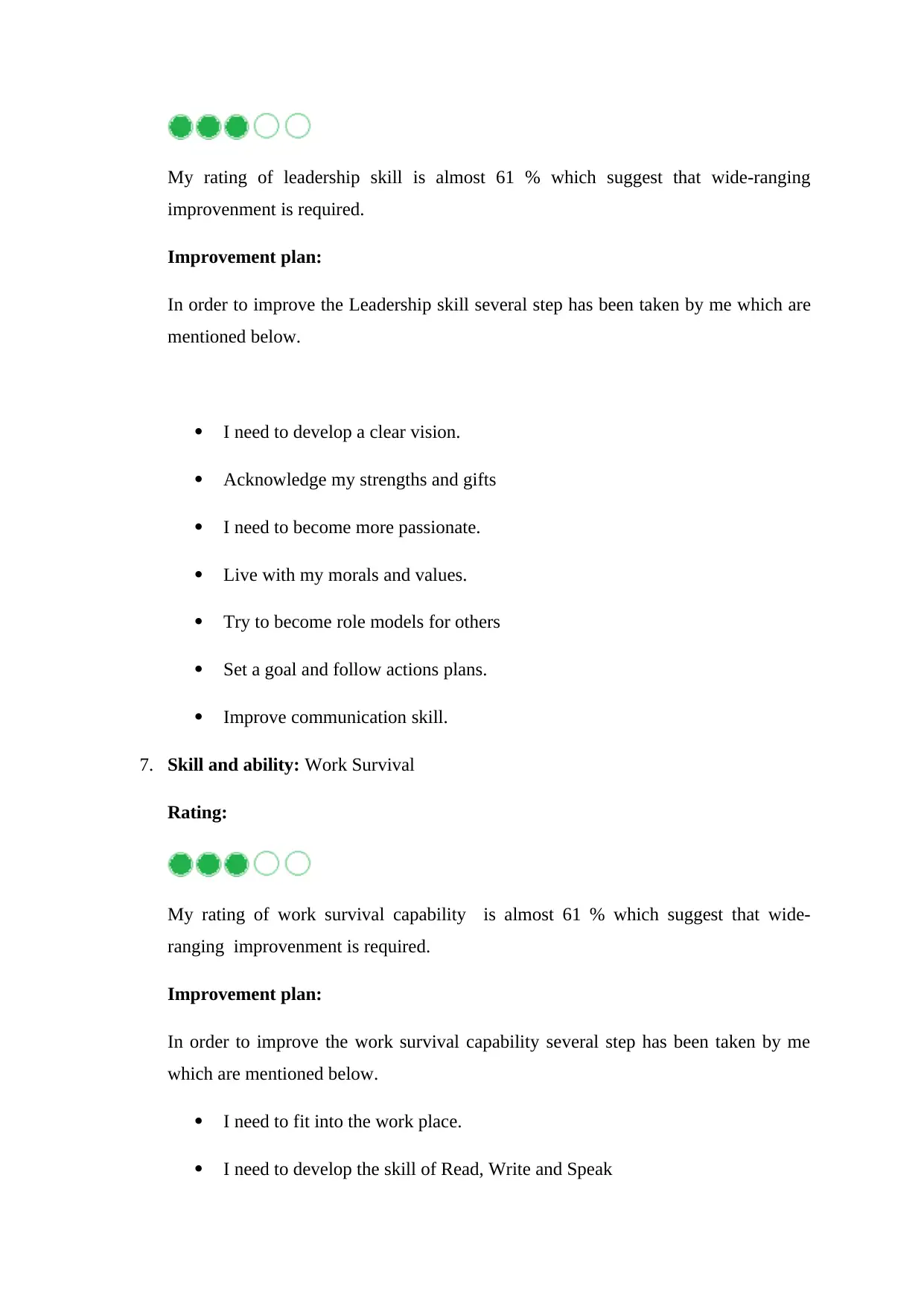
My rating of leadership skill is almost 61 % which suggest that wide-ranging
improvenment is required.
Improvement plan:
In order to improve the Leadership skill several step has been taken by me which are
mentioned below.
I need to develop a clear vision.
Acknowledge my strengths and gifts
I need to become more passionate.
Live with my morals and values.
Try to become role models for others
Set a goal and follow actions plans.
Improve communication skill.
7. Skill and ability: Work Survival
Rating:
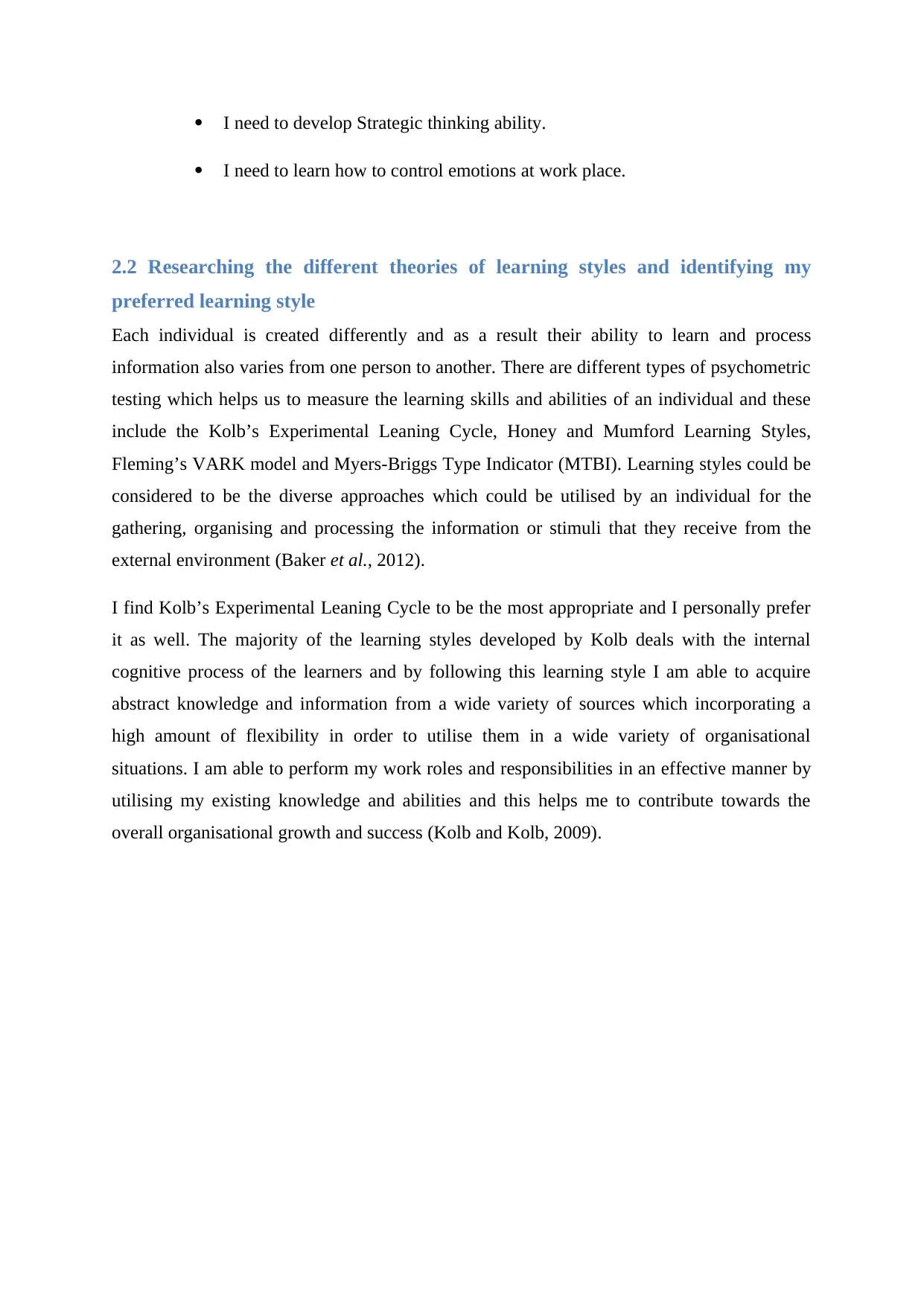
My rating of work survival capability is almost 61 % which suggest that wide-
ranging improvenment is required.
Improvement plan:
In order to improve the work survival capability several step has been taken by me
which are mentioned below.
I need to fit into the work place.
I need to develop the skill of Read, Write and Speak
improvenment is required.
Improvement plan:
In order to improve the Leadership skill several step has been taken by me which are
mentioned below.
I need to develop a clear vision.
Acknowledge my strengths and gifts
I need to become more passionate.
Live with my morals and values.
Try to become role models for others
Set a goal and follow actions plans.
Improve communication skill.
7. Skill and ability: Work Survival
Rating:
My rating of work survival capability is almost 61 % which suggest that wide-
ranging improvenment is required.
Improvement plan:
In order to improve the work survival capability several step has been taken by me
which are mentioned below.
I need to fit into the work place.
I need to develop the skill of Read, Write and Speak
Paraphrase This Document
Need a fresh take? Get an instant paraphrase of this document with our AI Paraphraser
I need to develop Strategic thinking ability.
I need to learn how to control emotions at work place.
2.2 Researching the different theories of learning styles and identifying my
preferred learning style
Each individual is created differently and as a result their ability to learn and process
information also varies from one person to another. There are different types of psychometric
testing which helps us to measure the learning skills and abilities of an individual and these
include the Kolb’s Experimental Leaning Cycle, Honey and Mumford Learning Styles,
Fleming’s VARK model and Myers-Briggs Type Indicator (MTBI). Learning styles could be
considered to be the diverse approaches which could be utilised by an individual for the
gathering, organising and processing the information or stimuli that they receive from the
external environment (Baker et al., 2012).
I find Kolb’s Experimental Leaning Cycle to be the most appropriate and I personally prefer
it as well. The majority of the learning styles developed by Kolb deals with the internal
cognitive process of the learners and by following this learning style I am able to acquire
abstract knowledge and information from a wide variety of sources which incorporating a
high amount of flexibility in order to utilise them in a wide variety of organisational
situations. I am able to perform my work roles and responsibilities in an effective manner by
utilising my existing knowledge and abilities and this helps me to contribute towards the
overall organisational growth and success (Kolb and Kolb, 2009).
I need to learn how to control emotions at work place.
2.2 Researching the different theories of learning styles and identifying my
preferred learning style
Each individual is created differently and as a result their ability to learn and process
information also varies from one person to another. There are different types of psychometric
testing which helps us to measure the learning skills and abilities of an individual and these
include the Kolb’s Experimental Leaning Cycle, Honey and Mumford Learning Styles,
Fleming’s VARK model and Myers-Briggs Type Indicator (MTBI). Learning styles could be
considered to be the diverse approaches which could be utilised by an individual for the
gathering, organising and processing the information or stimuli that they receive from the
external environment (Baker et al., 2012).
I find Kolb’s Experimental Leaning Cycle to be the most appropriate and I personally prefer
it as well. The majority of the learning styles developed by Kolb deals with the internal
cognitive process of the learners and by following this learning style I am able to acquire
abstract knowledge and information from a wide variety of sources which incorporating a
high amount of flexibility in order to utilise them in a wide variety of organisational
situations. I am able to perform my work roles and responsibilities in an effective manner by
utilising my existing knowledge and abilities and this helps me to contribute towards the
overall organisational growth and success (Kolb and Kolb, 2009).
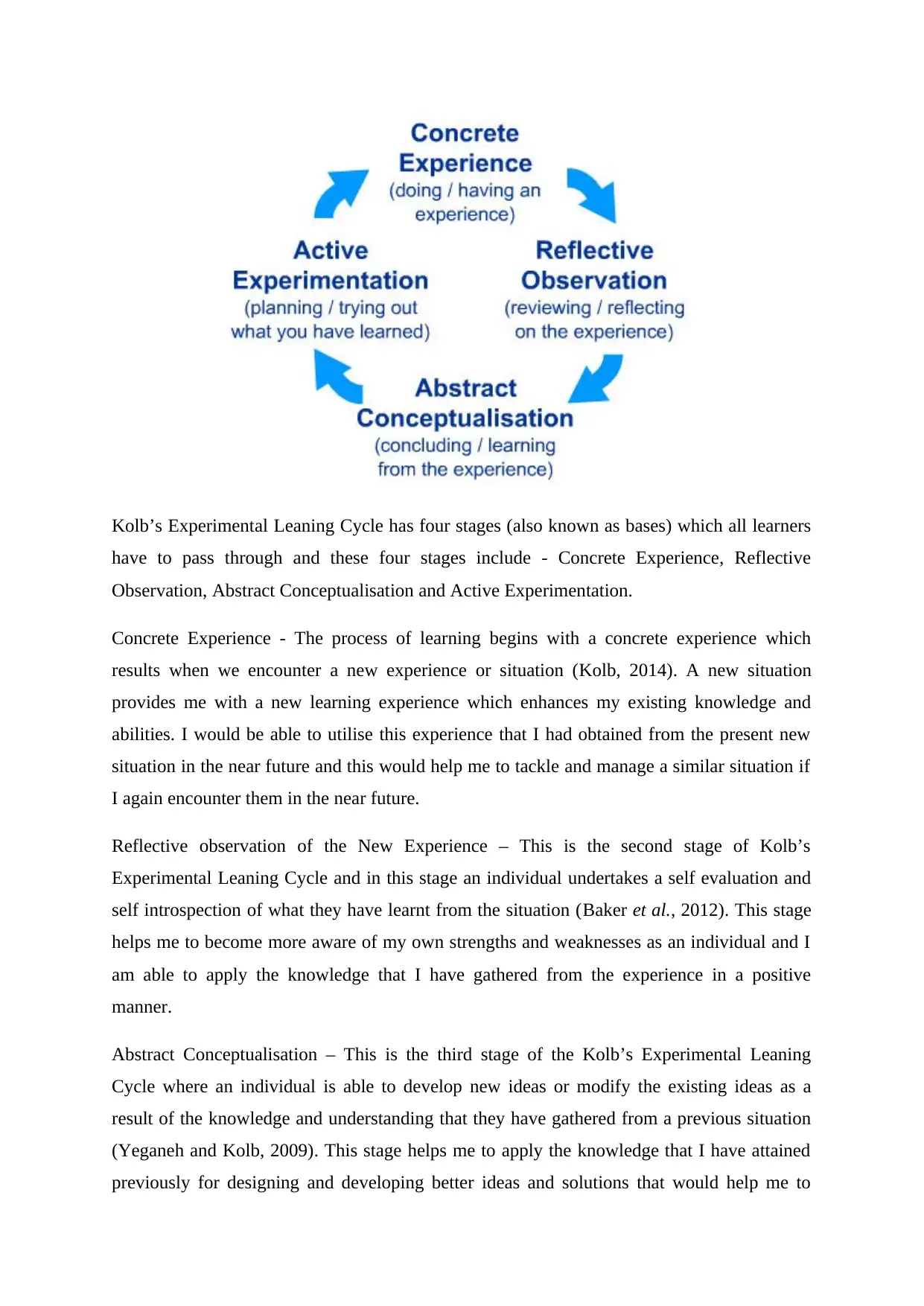
Kolb’s Experimental Leaning Cycle has four stages (also known as bases) which all learners
have to pass through and these four stages include - Concrete Experience, Reflective
Observation, Abstract Conceptualisation and Active Experimentation.
Concrete Experience - The process of learning begins with a concrete experience which
results when we encounter a new experience or situation (Kolb, 2014). A new situation
provides me with a new learning experience which enhances my existing knowledge and
abilities. I would be able to utilise this experience that I had obtained from the present new
situation in the near future and this would help me to tackle and manage a similar situation if
I again encounter them in the near future.
Reflective observation of the New Experience – This is the second stage of Kolb’s
Experimental Leaning Cycle and in this stage an individual undertakes a self evaluation and
self introspection of what they have learnt from the situation (Baker et al., 2012). This stage
helps me to become more aware of my own strengths and weaknesses as an individual and I
am able to apply the knowledge that I have gathered from the experience in a positive
manner.
Abstract Conceptualisation – This is the third stage of the Kolb’s Experimental Leaning
Cycle where an individual is able to develop new ideas or modify the existing ideas as a
result of the knowledge and understanding that they have gathered from a previous situation
(Yeganeh and Kolb, 2009). This stage helps me to apply the knowledge that I have attained
previously for designing and developing better ideas and solutions that would help me to
have to pass through and these four stages include - Concrete Experience, Reflective
Observation, Abstract Conceptualisation and Active Experimentation.
Concrete Experience - The process of learning begins with a concrete experience which
results when we encounter a new experience or situation (Kolb, 2014). A new situation
provides me with a new learning experience which enhances my existing knowledge and
abilities. I would be able to utilise this experience that I had obtained from the present new
situation in the near future and this would help me to tackle and manage a similar situation if
I again encounter them in the near future.
Reflective observation of the New Experience – This is the second stage of Kolb’s
Experimental Leaning Cycle and in this stage an individual undertakes a self evaluation and
self introspection of what they have learnt from the situation (Baker et al., 2012). This stage
helps me to become more aware of my own strengths and weaknesses as an individual and I
am able to apply the knowledge that I have gathered from the experience in a positive
manner.
Abstract Conceptualisation – This is the third stage of the Kolb’s Experimental Leaning
Cycle where an individual is able to develop new ideas or modify the existing ideas as a
result of the knowledge and understanding that they have gathered from a previous situation
(Yeganeh and Kolb, 2009). This stage helps me to apply the knowledge that I have attained
previously for designing and developing better ideas and solutions that would help me to
⊘ This is a preview!⊘
Do you want full access?
Subscribe today to unlock all pages.
Trusted by 1+ million students worldwide

1 out of 15


Related Documents


Your All-in-One AI-Powered Toolkit for Academic Success.
+13062052269
info@desklib.com
Available 24*7 on WhatsApp / Email
![[object Object]](/_next/static/media/star-bottom.7253800d.svg)
Unlock your academic potential
Copyright © 2020–2026 A2Z Services. All Rights Reserved. Developed and managed by ZUCOL.