Strategic Management Report: Analysis of Telstra's Strategies
VerifiedAdded on 2021/12/14
|12
|2979
|26
Report
AI Summary
This report provides a comprehensive strategic management analysis of Telstra, a leading telecommunications company. It begins with an introduction to strategic management and an overview of Telstra, followed by a PESTLE analysis examining the political, economic, social, technological, legal, and environmental factors affecting the company. The report then conducts an industry analysis using Porter's Five Forces framework to assess the competitive landscape. An internal analysis explores Telstra's key resources, core competencies, and capabilities, along with its strengths and weaknesses. Finally, it delves into Telstra's business-level strategies, including an evaluation of its key strategies and a value chain analysis, offering insights into how Telstra creates and sustains a competitive advantage. The analysis covers various aspects like market position, internal capabilities, and competitive advantages within the telecommunications industry.
Running head: STRATEGIC MANAGEMENT
STRATEGIC MANAGEMENT
Name of the Student
Name of the University
Author Note
STRATEGIC MANAGEMENT
Name of the Student
Name of the University
Author Note

Paraphrase This Document
Need a fresh take? Get an instant paraphrase of this document with our AI Paraphraser
1STRATEGIC MANAGEMENT
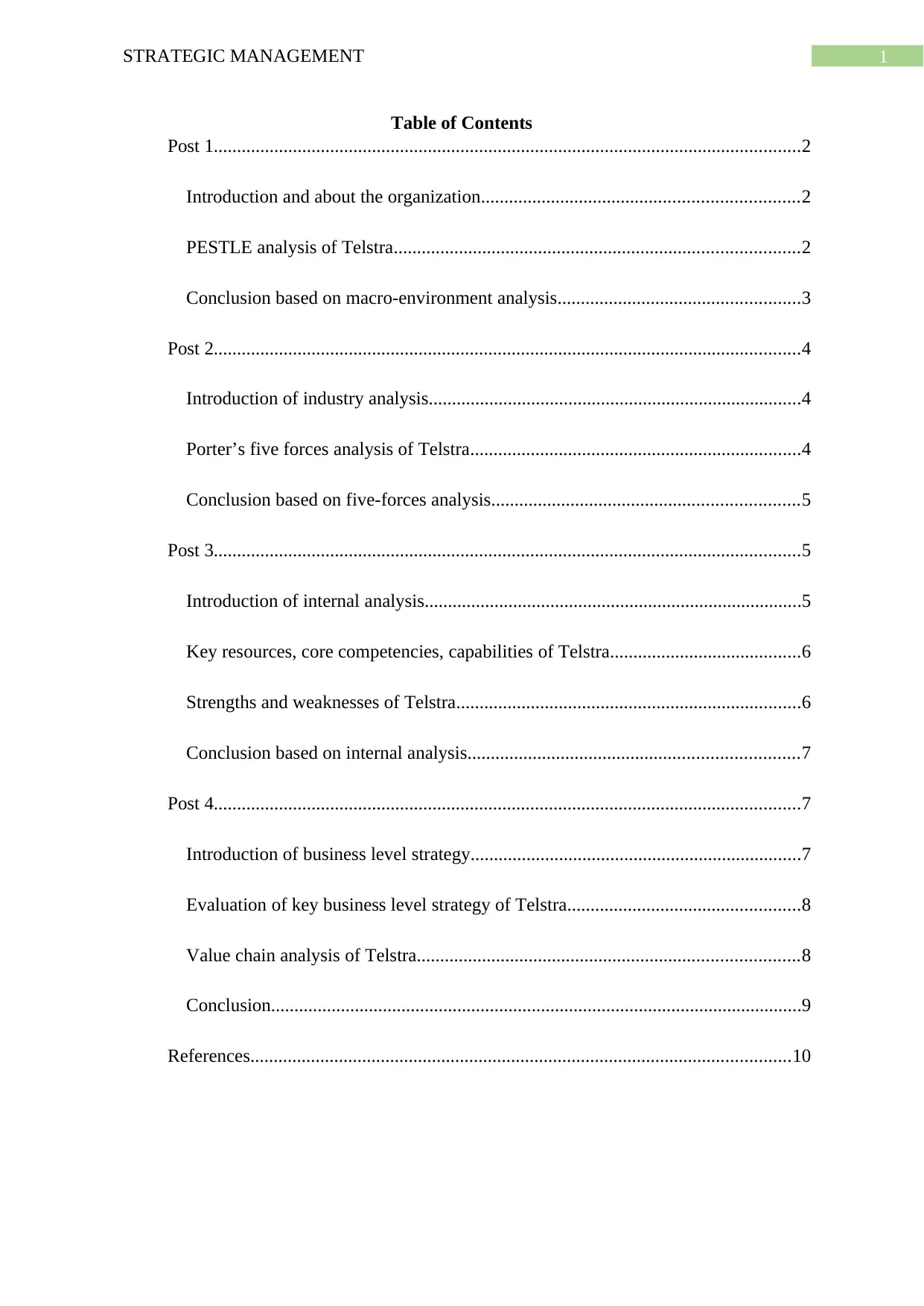
Table of Contents
Post 1..............................................................................................................................2
Introduction and about the organization....................................................................2
PESTLE analysis of Telstra.......................................................................................2
Conclusion based on macro-environment analysis....................................................3
Post 2..............................................................................................................................4
Introduction of industry analysis................................................................................4
Porter’s five forces analysis of Telstra.......................................................................4
Conclusion based on five-forces analysis..................................................................5
Post 3..............................................................................................................................5
Introduction of internal analysis.................................................................................5
Key resources, core competencies, capabilities of Telstra.........................................6
Strengths and weaknesses of Telstra..........................................................................6
Conclusion based on internal analysis.......................................................................7
Post 4..............................................................................................................................7
Introduction of business level strategy.......................................................................7
Evaluation of key business level strategy of Telstra..................................................8
Value chain analysis of Telstra..................................................................................8
Conclusion..................................................................................................................9
References....................................................................................................................10
Table of Contents
Post 1..............................................................................................................................2
Introduction and about the organization....................................................................2
PESTLE analysis of Telstra.......................................................................................2
Conclusion based on macro-environment analysis....................................................3
Post 2..............................................................................................................................4
Introduction of industry analysis................................................................................4
Porter’s five forces analysis of Telstra.......................................................................4
Conclusion based on five-forces analysis..................................................................5
Post 3..............................................................................................................................5
Introduction of internal analysis.................................................................................5
Key resources, core competencies, capabilities of Telstra.........................................6
Strengths and weaknesses of Telstra..........................................................................6
Conclusion based on internal analysis.......................................................................7
Post 4..............................................................................................................................7
Introduction of business level strategy.......................................................................7
Evaluation of key business level strategy of Telstra..................................................8
Value chain analysis of Telstra..................................................................................8
Conclusion..................................................................................................................9
References....................................................................................................................10
2STRATEGIC MANAGEMENT
Post 1
Introduction and about the organization
Strategic management is considered to be a process which is based on continuous
monitoring, planning, assessment and analysis of the ways by which an organization is able
to meets the objectives and goals. The development of major goals is also considered to be an
important part of the operations of modern organizations. Strategic management is thereby
based on the detailed analysis of the external and internal environment (Barros, Hernangómez
& Martin-Cruz, 2016).
Telstra has acquired the position of the largest technology and telecommunication
based organization. The organization mainly offers a vast range of services to the consumers
in Australian telecommunication based sector. Telstra is known for providing more than 17
million retail based mobile services, around 4.9 million retail based fixed line services and
greater than 3 million retail based fixed broadband services. The main aim which is set by the
company is related to the levels of communication which are develop between people and
further increasing the number of opportunities as well (Telstra.com.au., 2018).
PESTLE analysis of Telstra
Political factors – The political situation of a country is able to play a major role in
proper determination of profitability levels of Telstra in the telecommunications based
industry. The implementation of new tax based policies is an important aspect which affects
the operations of Telstra in the industry. The changes which are made in the fiscal policies
and trade policies can affect the business based procedures.
Economic factors – The economic performance which is shown by the country is an
important factor which affects the operations of Telstra and trade policies which are
developed in the country as well. Understanding the demands of consumers is an important
Post 1
Introduction and about the organization
Strategic management is considered to be a process which is based on continuous
monitoring, planning, assessment and analysis of the ways by which an organization is able
to meets the objectives and goals. The development of major goals is also considered to be an
important part of the operations of modern organizations. Strategic management is thereby
based on the detailed analysis of the external and internal environment (Barros, Hernangómez
& Martin-Cruz, 2016).
Telstra has acquired the position of the largest technology and telecommunication
based organization. The organization mainly offers a vast range of services to the consumers
in Australian telecommunication based sector. Telstra is known for providing more than 17
million retail based mobile services, around 4.9 million retail based fixed line services and
greater than 3 million retail based fixed broadband services. The main aim which is set by the
company is related to the levels of communication which are develop between people and
further increasing the number of opportunities as well (Telstra.com.au., 2018).
PESTLE analysis of Telstra
Political factors – The political situation of a country is able to play a major role in
proper determination of profitability levels of Telstra in the telecommunications based
industry. The implementation of new tax based policies is an important aspect which affects
the operations of Telstra in the industry. The changes which are made in the fiscal policies
and trade policies can affect the business based procedures.
Economic factors – The economic performance which is shown by the country is an
important factor which affects the operations of Telstra and trade policies which are
developed in the country as well. Understanding the demands of consumers is an important
⊘ This is a preview!⊘
Do you want full access?
Subscribe today to unlock all pages.

Trusted by 1+ million students worldwide
3STRATEGIC MANAGEMENT
way to mitigate the risks which are provided by the economic environment of the country
(Daspit et al., 2017).
Social factors – The social condition of a country is based on different determinants
which include, cultural trends, demographics and analysis of the population. The unwanted
changes which are a part of the business operations of Telstra are a part of the social factors.
Technological factors – Technology is able to provide an important level of
advantage to the operations of Telstra in the competitive telecommunications industry. The
organization is thereby able to develop an effective competitive advantage in the country as
compared to the competitors.
Legal factors – The legal factors are based on the internal and the external operational
environment of Telstra. The laws which are developed by the government have a major
impact on the regulations and policies which are formed within the organization itself
(Demir, Wennberg & McKelvie, 2017).
Environmental factors – The geographical location and weather also has a major
impact on the effective operations of modern organizations. The activities based on
networking which are performed by Telstra are able to affect the revenues and levels of
profitability in a huge manner.
Conclusion based on macro-environment analysis
The macro-environment analysis of Telstra has been able to depict that the political
environment, economic condition and technological environment affects the operations in a
huge manner. The formation of strategies is thereby based on the factors related to the
external environment of the organization.
way to mitigate the risks which are provided by the economic environment of the country
(Daspit et al., 2017).
Social factors – The social condition of a country is based on different determinants
which include, cultural trends, demographics and analysis of the population. The unwanted
changes which are a part of the business operations of Telstra are a part of the social factors.
Technological factors – Technology is able to provide an important level of
advantage to the operations of Telstra in the competitive telecommunications industry. The
organization is thereby able to develop an effective competitive advantage in the country as
compared to the competitors.
Legal factors – The legal factors are based on the internal and the external operational
environment of Telstra. The laws which are developed by the government have a major
impact on the regulations and policies which are formed within the organization itself
(Demir, Wennberg & McKelvie, 2017).
Environmental factors – The geographical location and weather also has a major
impact on the effective operations of modern organizations. The activities based on
networking which are performed by Telstra are able to affect the revenues and levels of
profitability in a huge manner.
Conclusion based on macro-environment analysis
The macro-environment analysis of Telstra has been able to depict that the political
environment, economic condition and technological environment affects the operations in a
huge manner. The formation of strategies is thereby based on the factors related to the
external environment of the organization.
Paraphrase This Document
Need a fresh take? Get an instant paraphrase of this document with our AI Paraphraser
4STRATEGIC MANAGEMENT
Post 2
Introduction of industry analysis
Industry analysis can be considered as a tool which helps in providing an
understanding based on the position which is developed by an organization as compared to its
competitors. The analysis of industry of a particular organization is based on different forces
which are able to affect the profitability based levels. This is considered to be an important
part of strategic planning based process which is considered by the organization. Porter’s five
forces framework is considered to be an effective tool which is used for proper analysis of the
industry in which an organization (Durand, Grant & Madsen, 2017). The analysis is mainly
based five different forces which affect the organizational operations.
Porter’s five forces analysis of Telstra
Power of the buyers – The first major force is based on the power which is held by
the buyers in the industry. The options which is provided to the consumers by different
organizations are able to increase their power. Telstra faces major threat from this force as the
competitors of the organization provide similar products and services.
Power of the suppliers – The superior levels of services can be provided by the
organization with proper support and raw materials provided by the suppliers. The power of
suppliers in case of Telstra is quite low as the organization aims at providing the best level of
services to the consumers (Dobbs, 2014).
Rivalry levels between the competitors – The levels of competitive rivalry which exist
in the telecommunication based industry are quite high. The execution of proper business
operations by the Telstra is affected by the levels of competition. The competitors in
telecommunications industry are considered to be highly important for the proper operations
Post 2
Introduction of industry analysis
Industry analysis can be considered as a tool which helps in providing an
understanding based on the position which is developed by an organization as compared to its
competitors. The analysis of industry of a particular organization is based on different forces
which are able to affect the profitability based levels. This is considered to be an important
part of strategic planning based process which is considered by the organization. Porter’s five
forces framework is considered to be an effective tool which is used for proper analysis of the
industry in which an organization (Durand, Grant & Madsen, 2017). The analysis is mainly
based five different forces which affect the organizational operations.
Porter’s five forces analysis of Telstra
Power of the buyers – The first major force is based on the power which is held by
the buyers in the industry. The options which is provided to the consumers by different
organizations are able to increase their power. Telstra faces major threat from this force as the
competitors of the organization provide similar products and services.
Power of the suppliers – The superior levels of services can be provided by the
organization with proper support and raw materials provided by the suppliers. The power of
suppliers in case of Telstra is quite low as the organization aims at providing the best level of
services to the consumers (Dobbs, 2014).
Rivalry levels between the competitors – The levels of competitive rivalry which exist
in the telecommunication based industry are quite high. The execution of proper business
operations by the Telstra is affected by the levels of competition. The competitors in
telecommunications industry are considered to be highly important for the proper operations
5STRATEGIC MANAGEMENT
and profitability levels of Telstra. The rivalry based force is thereby considered to have high
power in case of the operations of Telstra (Dyer et al., 2015).
Threats provided by the new entrants – Potential levels of threats are provided to
Telstra by the new organizations which enter the industry. The profits of Telstra are also
reduced by the entry of different new organizations within the telecommunications industry.
The organization can aim at increasing the effectiveness of the business prices in order to
operate profitably within the industry.
Threats provided by the substitutes – The threats are also provided by the
organizations which are able to provide direct substitutes of the products which are offered by
Telstra. The major competitors of Telstra which operate in the telecommunications based
industry mainly include, Vodafone, Optus, Virgin mobile (Engert, Rauter & Baumgartner,
2016).
Conclusion based on five-forces analysis
The analysis of telecommunications industry has been able to depict that Telstra is
able to provide a vast variety of products to the customers in a highly competitive
environment. However, the services which are offered by the organization are mainly
affected by different forces which are a part of the industry. Telstra thereby needs to
considered the different industry forces in order to operate profitably in the industry. The
levels of competition can also affect the effective operations of Telstra.
Post 3
Introduction of internal analysis
Internal analysis is considered to be a process which is used for exploring the
competency levels of the organizations. Different factors which are analysed with the internal
and profitability levels of Telstra. The rivalry based force is thereby considered to have high
power in case of the operations of Telstra (Dyer et al., 2015).
Threats provided by the new entrants – Potential levels of threats are provided to
Telstra by the new organizations which enter the industry. The profits of Telstra are also
reduced by the entry of different new organizations within the telecommunications industry.
The organization can aim at increasing the effectiveness of the business prices in order to
operate profitably within the industry.
Threats provided by the substitutes – The threats are also provided by the
organizations which are able to provide direct substitutes of the products which are offered by
Telstra. The major competitors of Telstra which operate in the telecommunications based
industry mainly include, Vodafone, Optus, Virgin mobile (Engert, Rauter & Baumgartner,
2016).
Conclusion based on five-forces analysis
The analysis of telecommunications industry has been able to depict that Telstra is
able to provide a vast variety of products to the customers in a highly competitive
environment. However, the services which are offered by the organization are mainly
affected by different forces which are a part of the industry. Telstra thereby needs to
considered the different industry forces in order to operate profitably in the industry. The
levels of competition can also affect the effective operations of Telstra.
Post 3
Introduction of internal analysis
Internal analysis is considered to be a process which is used for exploring the
competency levels of the organizations. Different factors which are analysed with the internal
⊘ This is a preview!⊘
Do you want full access?
Subscribe today to unlock all pages.
Trusted by 1+ million students worldwide
6STRATEGIC MANAGEMENT
analysis based process mainly include, cost position of the organization, competitive viability
and core competencies. The viability of the organizational operations is also considered to be
an important factor which can be analysed with the help of internal analysis based process.
The ways by which an organization can sustain its operations and further grow the business
based operations can be detected by analysing the internal environment (Ethiraj, Gambardella
& Helfat, 2018).
Key resources, core competencies, capabilities of Telstra
Telstra provides importance to the changes which need to be implemented within the
organization in order to transform the operations. The operating environment of the
organization is based on fresh set of skills and directions based on career. The employees of
Telstra and their capability levels are related to the core value which are followed by the
organization. The levels of simplicity which are implemented within the operations are
important for the profitability levels of Telstra (Frynas & Mellahi, 2015). The worldwide
evolution of the industry is thereby able to affect the workplace environment developed in
Telstra. Equality and diversity can be considered to be major competencies of Telstra. The
individual leaders of the organization are also able to increase the levels of flexibility and
fairness within the organizational operations.
Strengths and weaknesses of Telstra
Strengths – The major strengths which have been developed by the operations of
Telstra are based on the ways by which the organization is able to thrive in the
telecommunications based industry. The share of Telstra in the market is also protected
effectively with the help of its strengths. The organization has depicted superb levels of
performance in the new market based areas. The cash flow levels of Telstra and the company
has been successful in developing its revenue stream as well. The levels of customer
satisfaction which have been achieved by Telstra are high as compared to the competitors.
analysis based process mainly include, cost position of the organization, competitive viability
and core competencies. The viability of the organizational operations is also considered to be
an important factor which can be analysed with the help of internal analysis based process.
The ways by which an organization can sustain its operations and further grow the business
based operations can be detected by analysing the internal environment (Ethiraj, Gambardella
& Helfat, 2018).
Key resources, core competencies, capabilities of Telstra
Telstra provides importance to the changes which need to be implemented within the
organization in order to transform the operations. The operating environment of the
organization is based on fresh set of skills and directions based on career. The employees of
Telstra and their capability levels are related to the core value which are followed by the
organization. The levels of simplicity which are implemented within the operations are
important for the profitability levels of Telstra (Frynas & Mellahi, 2015). The worldwide
evolution of the industry is thereby able to affect the workplace environment developed in
Telstra. Equality and diversity can be considered to be major competencies of Telstra. The
individual leaders of the organization are also able to increase the levels of flexibility and
fairness within the organizational operations.
Strengths and weaknesses of Telstra
Strengths – The major strengths which have been developed by the operations of
Telstra are based on the ways by which the organization is able to thrive in the
telecommunications based industry. The share of Telstra in the market is also protected
effectively with the help of its strengths. The organization has depicted superb levels of
performance in the new market based areas. The cash flow levels of Telstra and the company
has been successful in developing its revenue stream as well. The levels of customer
satisfaction which have been achieved by Telstra are high as compared to the competitors.
Paraphrase This Document
Need a fresh take? Get an instant paraphrase of this document with our AI Paraphraser
7STRATEGIC MANAGEMENT
Telstra has also been able to develop a vast distribution network in order to operate in the
industry (Hill, Jones & Schilling, 2014).
Weaknesses – The marketing activities which are performed by Telstra Corporation
need to be improved in order to increase the profitability levels of the organization. The
challenges which are being provided by the new entrants also need to be managed effectively
by Telstra. The organization can also aim at making more investment in the research and
development based activities in order to improve the product offerings. The product of
Telstra also needs to be diversified in order to improve its position in the industry (Hubbard,
Rice & Galvin, 2014).
Conclusion based on internal analysis
The internal analysis of Telstra depicts that the core competencies and capabilities of
the organization are able to play a key role in the operations. The resources which have been
gained by the organization while operating in the telecommunications based industry are
highly important for high levels of profitability and revenues. The analysis has also been able
to show the internal strengths as well as weaknesses in operations.
Post 4
Introduction of business level strategy
The business level strategies play a major role in development of effective
competitive advantage in the industry. Owners of the modern business organizations are
thereby able to create an effective competitive in the market with the help of business level
strategies. The business level strategies are mainly related to the ways by which the
organization is able to compete in the market. The strategic decisions which are taken by the
organizations are based on these effective business level strategies. These strategies can also
Telstra has also been able to develop a vast distribution network in order to operate in the
industry (Hill, Jones & Schilling, 2014).
Weaknesses – The marketing activities which are performed by Telstra Corporation
need to be improved in order to increase the profitability levels of the organization. The
challenges which are being provided by the new entrants also need to be managed effectively
by Telstra. The organization can also aim at making more investment in the research and
development based activities in order to improve the product offerings. The product of
Telstra also needs to be diversified in order to improve its position in the industry (Hubbard,
Rice & Galvin, 2014).
Conclusion based on internal analysis
The internal analysis of Telstra depicts that the core competencies and capabilities of
the organization are able to play a key role in the operations. The resources which have been
gained by the organization while operating in the telecommunications based industry are
highly important for high levels of profitability and revenues. The analysis has also been able
to show the internal strengths as well as weaknesses in operations.
Post 4
Introduction of business level strategy
The business level strategies play a major role in development of effective
competitive advantage in the industry. Owners of the modern business organizations are
thereby able to create an effective competitive in the market with the help of business level
strategies. The business level strategies are mainly related to the ways by which the
organization is able to compete in the market. The strategic decisions which are taken by the
organizations are based on these effective business level strategies. These strategies can also
8STRATEGIC MANAGEMENT
be termed as effective positioning strategies which are helpful in securing the position and
identity of the organizations in the industry (Karadag, 2015).
Evaluation of key business level strategy of Telstra
The corporate strategy which has been implemented by Telstra is based on the ways
by which the Australian market can be led with the help of simplification of the services and
products. The improvement of customer experience is also considered to be a major part of
the business level strategies which have been implemented by Telstra. The new strategy
which has been developed Telstra is based on the following four pillars,
Simplifying the product based offerings, eliminating the pain points of
customers and further creating digital experiences as well.
Establishing an infrastructure business which is standalone and will be helpful
in driving the performance in order to provide the future opportunities.
Simplifying the business structure and providing empowerment to the
employees in order to serve the customers.
Portfolio management and cost reduction program which leads the industry
(Kasemsap, 2014).
Value chain analysis of Telstra
Primary activities –
Inbound logistics – This is based on the network based and electronic components
which are required for business operations.
Operations – The new areas which are based on connectivity can be developed and
network facilities can be maintained.
be termed as effective positioning strategies which are helpful in securing the position and
identity of the organizations in the industry (Karadag, 2015).
Evaluation of key business level strategy of Telstra
The corporate strategy which has been implemented by Telstra is based on the ways
by which the Australian market can be led with the help of simplification of the services and
products. The improvement of customer experience is also considered to be a major part of
the business level strategies which have been implemented by Telstra. The new strategy
which has been developed Telstra is based on the following four pillars,
Simplifying the product based offerings, eliminating the pain points of
customers and further creating digital experiences as well.
Establishing an infrastructure business which is standalone and will be helpful
in driving the performance in order to provide the future opportunities.
Simplifying the business structure and providing empowerment to the
employees in order to serve the customers.
Portfolio management and cost reduction program which leads the industry
(Kasemsap, 2014).
Value chain analysis of Telstra
Primary activities –
Inbound logistics – This is based on the network based and electronic components
which are required for business operations.
Operations – The new areas which are based on connectivity can be developed and
network facilities can be maintained.
⊘ This is a preview!⊘
Do you want full access?
Subscribe today to unlock all pages.
Trusted by 1+ million students worldwide

9STRATEGIC MANAGEMENT
Outbound logistics – The transport based activities of the organization which are
able to provide communication with the warehouses is a major part of this aspect.
Sales and marketing – The products designed by Telstra are offered in different
retail stores of and further the installations are also made in an effective manner.
Service and support – The experience provided to the customers can be enhanced
with the help of different online stores and customer based business centres (Meyer, Neck &
Meeks, 2017).
Support activities –
Firm infrastructure – The infrastructure is based on different departments which
include, finance, management, legal.
Human resource management – The human resource management of Telstra is
based on more than 36,000 employees who are a part of the positive work culture.
Technology development – Development of technology is considered to be the most
important part of the successful operations of Telstra in the industry.
Procurement – The network based equipment and IT equipments are procured from
the suppliers in order to maintain an effective network (Michael, Storey & Thomas, 2017).
Conclusion
The value chain based analysis of Telstra has been able to show that the organization
has developed different departments for its operations in the telecommunications industry.
The business level strategy which has been developed by Telstra is also considered to be a
major factor which is able to affect the operations of the organization.
Outbound logistics – The transport based activities of the organization which are
able to provide communication with the warehouses is a major part of this aspect.
Sales and marketing – The products designed by Telstra are offered in different
retail stores of and further the installations are also made in an effective manner.
Service and support – The experience provided to the customers can be enhanced
with the help of different online stores and customer based business centres (Meyer, Neck &
Meeks, 2017).
Support activities –
Firm infrastructure – The infrastructure is based on different departments which
include, finance, management, legal.
Human resource management – The human resource management of Telstra is
based on more than 36,000 employees who are a part of the positive work culture.
Technology development – Development of technology is considered to be the most
important part of the successful operations of Telstra in the industry.
Procurement – The network based equipment and IT equipments are procured from
the suppliers in order to maintain an effective network (Michael, Storey & Thomas, 2017).
Conclusion
The value chain based analysis of Telstra has been able to show that the organization
has developed different departments for its operations in the telecommunications industry.
The business level strategy which has been developed by Telstra is also considered to be a
major factor which is able to affect the operations of the organization.
Paraphrase This Document
Need a fresh take? Get an instant paraphrase of this document with our AI Paraphraser

10STRATEGIC MANAGEMENT
References
Barros, I., Hernangómez, J. & Martin-Cruz, N. (2016). A theoretical model of strategic
management of family firms. A dynamic capabilities approach. Journal of Family
Business Strategy, 7(3), pp.149-159.
Daspit, J.J., Chrisman, J.J., Sharma, P., Pearson, A.W. & Long, R.G. (2017). A strategic
management perspective of the family firm: Past trends, new insights, and future
directions. Journal of Managerial Issues, 29(1), p.6.
Demir, R., Wennberg, K. & McKelvie, A. (2017). The strategic management of high-growth
firms: a review and theoretical conceptualization. Long Range Planning, 50(4),
pp.431-456.
Dobbs, ME (2014). 'Guidelines for applying Porter's five forces framework: a set of industry
analysis templates', Competitiveness Review, vol. 24, no. 1, pp. 32–45.
Durand, R., Grant, R.M. & Madsen, T.L. (2017). The expanding domain of strategic
management research and the quest for integration. Strategic Management
Journal, 38(1), pp.4-16.
Dyer, J.H., Godfrey, P., Jensen, R. & Bryce, D. (2015). Strategic Management: Concepts
and Cases. Wiley Global Education.
Engert, S., Rauter, R. & Baumgartner, R.J. (2016). Exploring the integration of corporate
sustainability into strategic management: a literature review. Journal of cleaner
production, 112, pp.2833-2850.
Ethiraj, S.K., Gambardella, A. & Helfat, C.E. (2018). Theory in strategic
management. Strategic Management Journal, 39(6), pp.1529-1529.
References
Barros, I., Hernangómez, J. & Martin-Cruz, N. (2016). A theoretical model of strategic
management of family firms. A dynamic capabilities approach. Journal of Family
Business Strategy, 7(3), pp.149-159.
Daspit, J.J., Chrisman, J.J., Sharma, P., Pearson, A.W. & Long, R.G. (2017). A strategic
management perspective of the family firm: Past trends, new insights, and future
directions. Journal of Managerial Issues, 29(1), p.6.
Demir, R., Wennberg, K. & McKelvie, A. (2017). The strategic management of high-growth
firms: a review and theoretical conceptualization. Long Range Planning, 50(4),
pp.431-456.
Dobbs, ME (2014). 'Guidelines for applying Porter's five forces framework: a set of industry
analysis templates', Competitiveness Review, vol. 24, no. 1, pp. 32–45.
Durand, R., Grant, R.M. & Madsen, T.L. (2017). The expanding domain of strategic
management research and the quest for integration. Strategic Management
Journal, 38(1), pp.4-16.
Dyer, J.H., Godfrey, P., Jensen, R. & Bryce, D. (2015). Strategic Management: Concepts
and Cases. Wiley Global Education.
Engert, S., Rauter, R. & Baumgartner, R.J. (2016). Exploring the integration of corporate
sustainability into strategic management: a literature review. Journal of cleaner
production, 112, pp.2833-2850.
Ethiraj, S.K., Gambardella, A. & Helfat, C.E. (2018). Theory in strategic
management. Strategic Management Journal, 39(6), pp.1529-1529.
11STRATEGIC MANAGEMENT
Frynas, J.G. & Mellahi, K. (2015). Global strategic management. Oxford University Press,
USA.
Hill, C.W., Jones, G.R. & Schilling, M.A. (2014). Strategic management: theory: an
integrated approach. Cengage Learning.
Hubbard, G., Rice, J. & Galvin, P. (2014). Strategic management. Pearson Australia.
Karadag, H. (2015). Financial management challenges in small and medium-sized
enterprises: A strategic management approach. Emerging Markets Journal, 5(1), p.26.
Kasemsap, K. (2014). Strategic innovation management: An integrative framework and
causal model of knowledge management, strategic orientation, organizational
innovation, and organizational performance. In Strategic approaches for human
capital management and development in a turbulent economy (pp. 102-116). IGI
Global.
Meyer, G.D., Neck, H.M. & Meeks, M.D. (2017). The entrepreneurship‐strategic
management interface. Strategic entrepreneurship: Creating a new mindset, pp.17-44.
Michael, S., Storey, D. & Thomas, H. (2017). Discovery and coordination in strategic
management and entrepreneurship. Strategic entrepreneurship: Creating a new
mindset, pp.45-65.
Telstra.com.au. (2018). Telstra - About us, investors, media, community & environment and
our company. Retrieved from https://www.telstra.com.au/aboutus
Frynas, J.G. & Mellahi, K. (2015). Global strategic management. Oxford University Press,
USA.
Hill, C.W., Jones, G.R. & Schilling, M.A. (2014). Strategic management: theory: an
integrated approach. Cengage Learning.
Hubbard, G., Rice, J. & Galvin, P. (2014). Strategic management. Pearson Australia.
Karadag, H. (2015). Financial management challenges in small and medium-sized
enterprises: A strategic management approach. Emerging Markets Journal, 5(1), p.26.
Kasemsap, K. (2014). Strategic innovation management: An integrative framework and
causal model of knowledge management, strategic orientation, organizational
innovation, and organizational performance. In Strategic approaches for human
capital management and development in a turbulent economy (pp. 102-116). IGI
Global.
Meyer, G.D., Neck, H.M. & Meeks, M.D. (2017). The entrepreneurship‐strategic
management interface. Strategic entrepreneurship: Creating a new mindset, pp.17-44.
Michael, S., Storey, D. & Thomas, H. (2017). Discovery and coordination in strategic
management and entrepreneurship. Strategic entrepreneurship: Creating a new
mindset, pp.45-65.
Telstra.com.au. (2018). Telstra - About us, investors, media, community & environment and
our company. Retrieved from https://www.telstra.com.au/aboutus
⊘ This is a preview!⊘
Do you want full access?
Subscribe today to unlock all pages.
Trusted by 1+ million students worldwide

1 out of 12


Related Documents


Your All-in-One AI-Powered Toolkit for Academic Success.
+13062052269
info@desklib.com
Available 24*7 on WhatsApp / Email
![[object Object]](/_next/static/media/star-bottom.7253800d.svg)
Unlock your academic potential
Copyright © 2020–2026 A2Z Services. All Rights Reserved. Developed and managed by ZUCOL.