Triple Constraints: Strategic Management & Project Balanced Scorecard

Verified

Added on  2023/01/23

|4
|776
|25
Essay
AI Summary
This essay delves into the crucial relationship between the triple constraints of project management—cost, schedule, and scope—and the strategic management principles necessary for successful project execution. It highlights how strategic management provides a framework for defining project objectives, aligning them with the organization's mission and vision, and managing scope creep. The essay also emphasizes the importance of a balanced scorecard in continuously evaluating project performance, identifying potential issues related to cost and schedule variations, and implementing corrective measures. By integrating strategic management and utilizing tools like the balanced scorecard, project managers can effectively address challenges, maintain project alignment, and ensure projects are completed within defined constraints.
Document Page
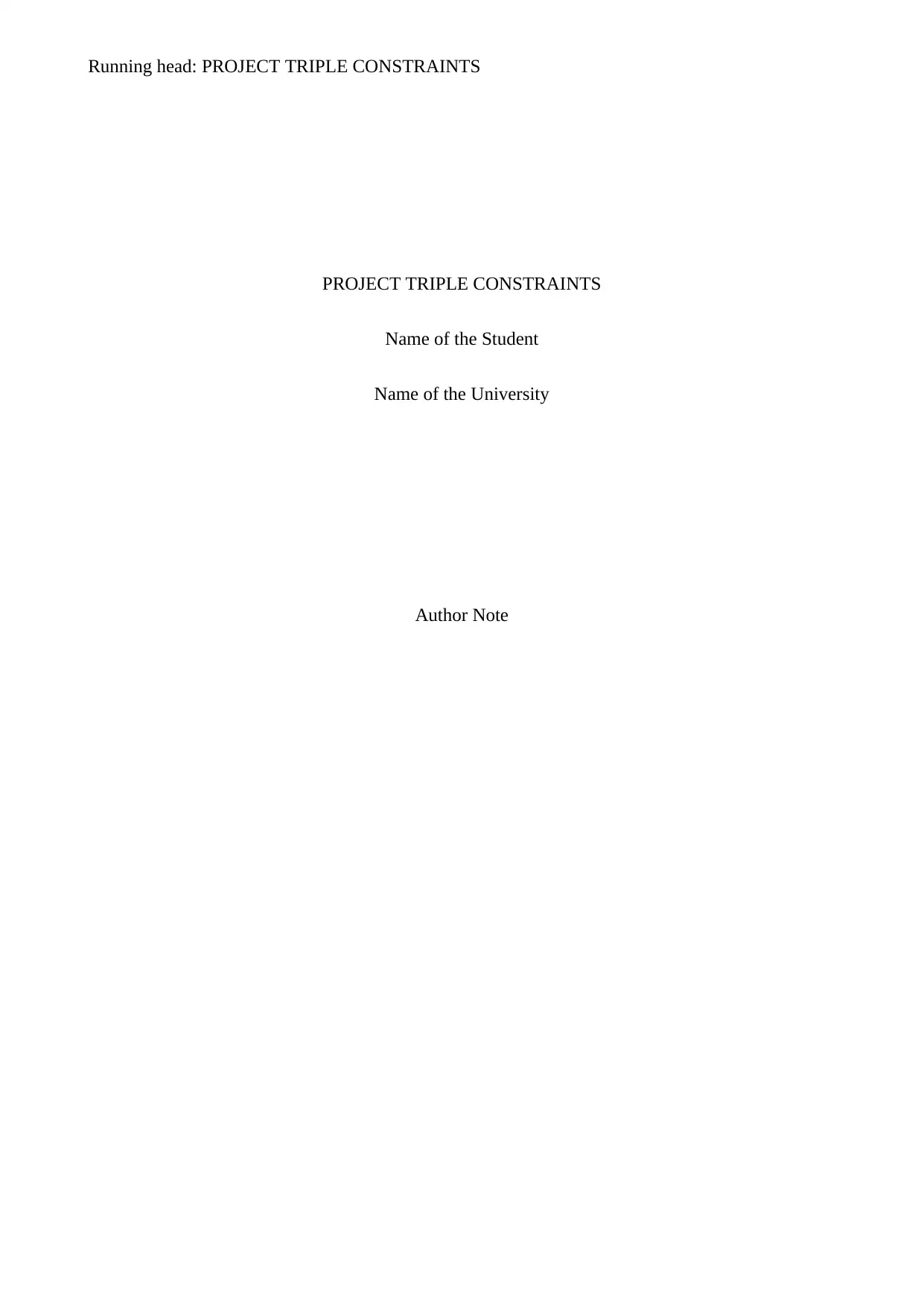
Running head: PROJECT TRIPLE CONSTRAINTS
PROJECT TRIPLE CONSTRAINTS
Name of the Student
Name of the University
Author Note
tabler-icon-diamond-filled.svg

Paraphrase This Document

Need a fresh take? Get an instant paraphrase of this document with our AI Paraphraser
Document Page
1
PROJECT TRIPLE CONSTRAINTS
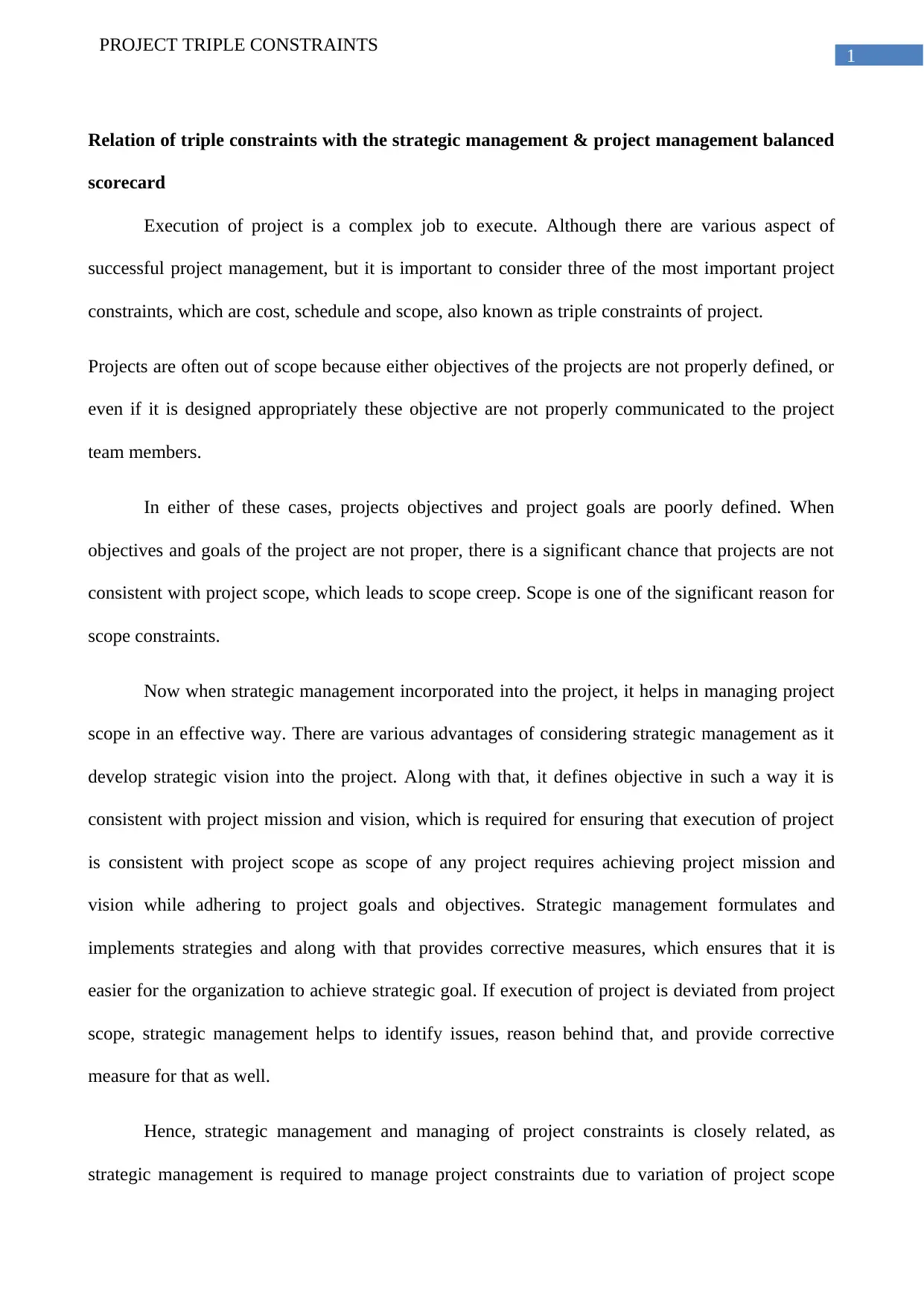
Relation of triple constraints with the strategic management & project management balanced
scorecard
Execution of project is a complex job to execute. Although there are various aspect of
successful project management, but it is important to consider three of the most important project
constraints, which are cost, schedule and scope, also known as triple constraints of project.
Projects are often out of scope because either objectives of the projects are not properly defined, or
even if it is designed appropriately these objective are not properly communicated to the project
team members.
In either of these cases, projects objectives and project goals are poorly defined. When
objectives and goals of the project are not proper, there is a significant chance that projects are not
consistent with project scope, which leads to scope creep. Scope is one of the significant reason for
scope constraints.
Now when strategic management incorporated into the project, it helps in managing project
scope in an effective way. There are various advantages of considering strategic management as it
develop strategic vision into the project. Along with that, it defines objective in such a way it is
consistent with project mission and vision, which is required for ensuring that execution of project
is consistent with project scope as scope of any project requires achieving project mission and
vision while adhering to project goals and objectives. Strategic management formulates and
implements strategies and along with that provides corrective measures, which ensures that it is
easier for the organization to achieve strategic goal. If execution of project is deviated from project
scope, strategic management helps to identify issues, reason behind that, and provide corrective
measure for that as well.
Hence, strategic management and managing of project constraints is closely related, as
strategic management is required to manage project constraints due to variation of project scope
Document Page
2
PROJECT TRIPLE CONSTRAINTS
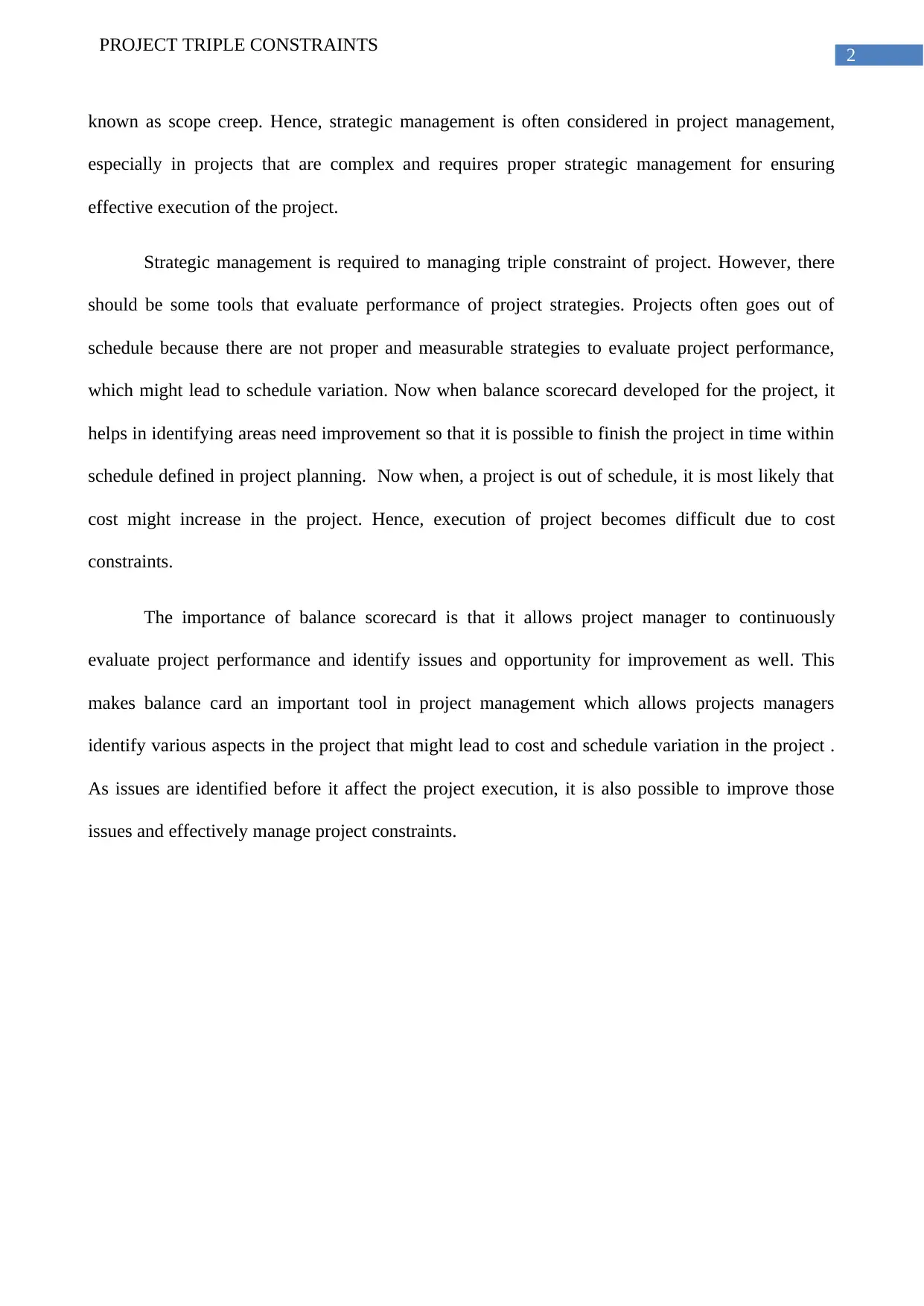
known as scope creep. Hence, strategic management is often considered in project management,
especially in projects that are complex and requires proper strategic management for ensuring
effective execution of the project.
Strategic management is required to managing triple constraint of project. However, there
should be some tools that evaluate performance of project strategies. Projects often goes out of
schedule because there are not proper and measurable strategies to evaluate project performance,
which might lead to schedule variation. Now when balance scorecard developed for the project, it
helps in identifying areas need improvement so that it is possible to finish the project in time within
schedule defined in project planning. Now when, a project is out of schedule, it is most likely that
cost might increase in the project. Hence, execution of project becomes difficult due to cost
constraints.
The importance of balance scorecard is that it allows project manager to continuously
evaluate project performance and identify issues and opportunity for improvement as well. This
makes balance card an important tool in project management which allows projects managers
identify various aspects in the project that might lead to cost and schedule variation in the project .
As issues are identified before it affect the project execution, it is also possible to improve those
issues and effectively manage project constraints.
Document Page
3
PROJECT TRIPLE CONSTRAINTS
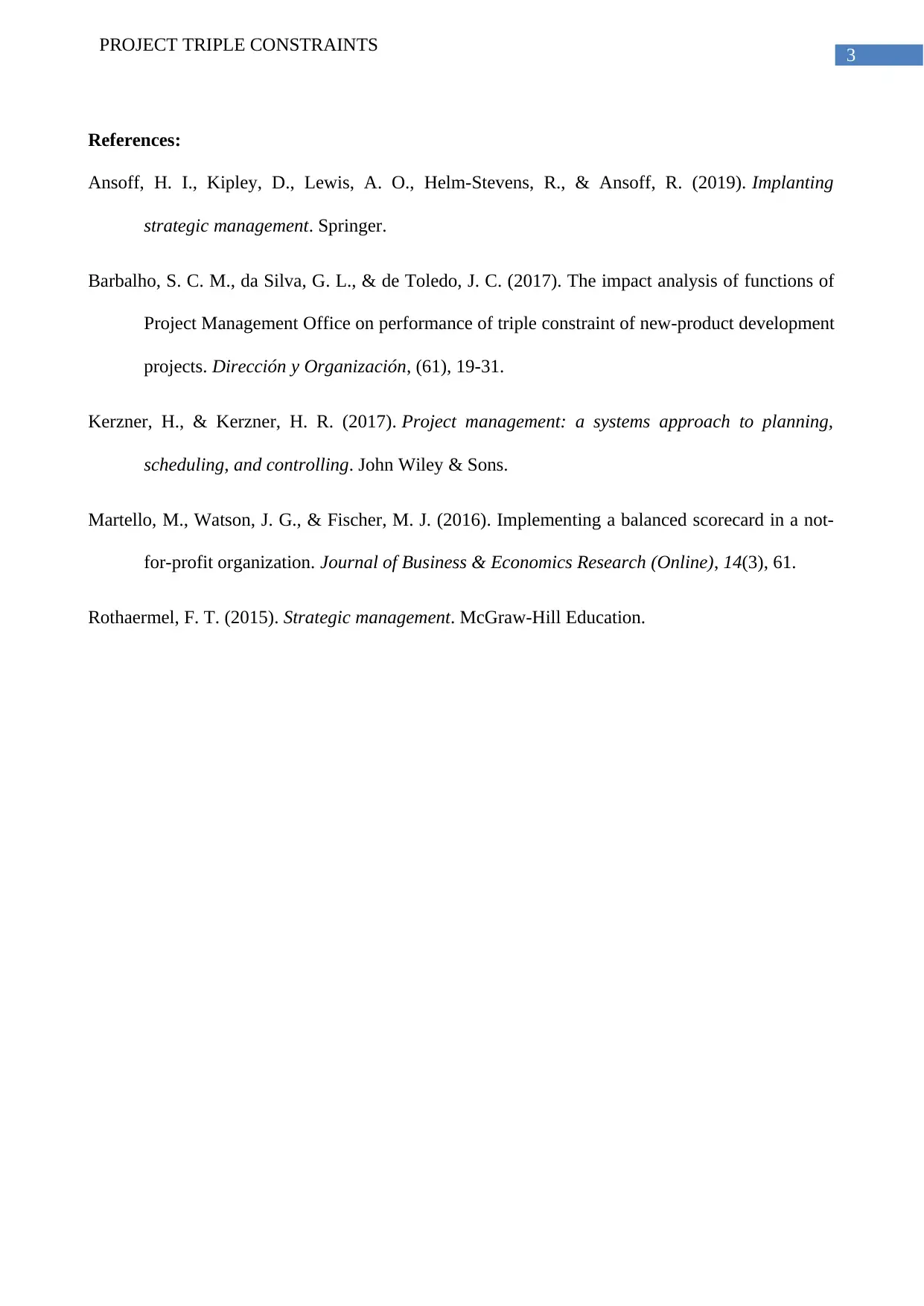
References:
Ansoff, H. I., Kipley, D., Lewis, A. O., Helm-Stevens, R., & Ansoff, R. (2019). Implanting
strategic management. Springer.
Barbalho, S. C. M., da Silva, G. L., & de Toledo, J. C. (2017). The impact analysis of functions of
Project Management Office on performance of triple constraint of new-product development
projects. Dirección y Organización, (61), 19-31.
Kerzner, H., & Kerzner, H. R. (2017). Project management: a systems approach to planning,
scheduling, and controlling. John Wiley & Sons.
Martello, M., Watson, J. G., & Fischer, M. J. (2016). Implementing a balanced scorecard in a not-
for-profit organization. Journal of Business & Economics Research (Online), 14(3), 61.
Rothaermel, F. T. (2015). Strategic management. McGraw-Hill Education.
chevron_up_icon
1 out of 4
circle_padding
hide_on_mobile
zoom_out_icon
[object Object]