Strategic Management: Process, Analysis, and Change at Unilever
VerifiedAdded on 2022/11/29
|14
|3655
|146
Report
AI Summary
This report provides a comprehensive analysis of Unilever's strategic management practices. It begins with an introduction to strategic management, defining its core principles and approaches. The main body of the report delves into the processes Unilever employs to determine its strategies, emphasizing the importance of aligning objectives and developing strategic action plans. A significant portion of the report is dedicated to a PESTEL analysis, examining the political, economic, social, technological, environmental, and legal factors that influence Unilever's operations, particularly given its global presence. The report also highlights the significance of change management within the organization, underscoring the need for effective communication and adaptation. The conclusion summarizes the key findings, emphasizing the importance of strategic foresight and adaptability for a multinational corporation like Unilever.
Strategic Management.

Paraphrase This Document
Need a fresh take? Get an instant paraphrase of this document with our AI Paraphraser
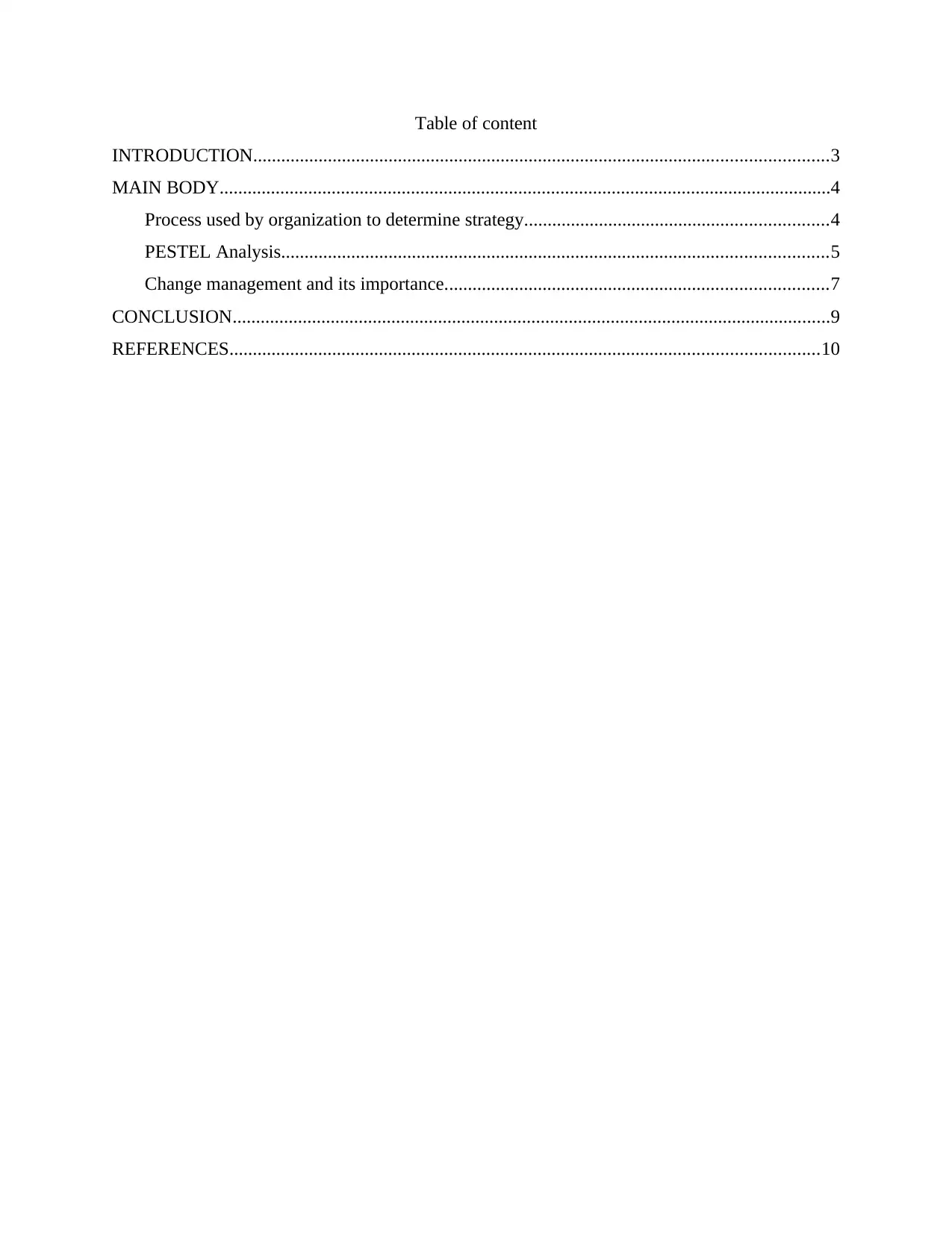
Table of content
INTRODUCTION...........................................................................................................................3
MAIN BODY...................................................................................................................................4
Process used by organization to determine strategy.................................................................4
PESTEL Analysis.....................................................................................................................5
Change management and its importance..................................................................................7
CONCLUSION................................................................................................................................9
REFERENCES..............................................................................................................................10
INTRODUCTION...........................................................................................................................3
MAIN BODY...................................................................................................................................4
Process used by organization to determine strategy.................................................................4
PESTEL Analysis.....................................................................................................................5
Change management and its importance..................................................................................7
CONCLUSION................................................................................................................................9
REFERENCES..............................................................................................................................10
INTRODUCTION
Strategic management is a management process that is done on the resources of the organization
in order to achieves the goals and objectives of the organization. Strategic management involves
analyzing internal environment, setting objectives, analyzing the competitive environment,
proper implementation of the strategies, evaluation of strategies, analyzing the results of the
strategic implementation across the organization (Almutairi, T.M. and Sriramesh, K., 2020.).
Their are majorly two approaches to strategic management and both focuses on different stages
of strategic management. The first approach to strategic management is prescriptive approach.
This approach focuses on how strategies are made. The first step in strategic management is to
make a strategy according to the requirements of the company and this approach focuses on that
stage. On the other hand descriptive approach focuses more on the implementation stages of
strategic management. It focuses on how the strategies are coming into practise. These
approaches differ on the basis of whether the strategy is made by analytic & systematic process
or it is made by general guiding principles. In context to Unilever, the company truly believes in
transparency and they say that “Transparency is important to our consumers and so it’s important
to us. People trust us to provide them with products that are safe for them, their families and the
environment”. unilever is a multi national company headquartered in London, England. The
company owns approximately 400 brands and the brand is available in nearly 190 countries
including developing countries such as India, China, etc. The company was founded in the year
1929 by Lever Brothers and Margarine Unie. The company is the largest producer of soap in the
world and thirteen of the brands of company have sales over one billion Euros. In 2020, the net
income of the company was about $6.073 billion with 155000 employees (Anyakoha, C., 2019.).
Unilever products includes food, energy drinks, baby food, soap, soft drinks, cheese, tea, ice
cream, pet food, bottled water, toothpaste, candy, chewing gums, personal care, cosmetics,
pharmaceuticals, etc. Some of the famous brands of Unilever includes Omo, Knorr, Dove,
Magnum, Sunsilk, Surf, Heartbrand ice creams, etc. The company has a primary listing in
London Stock Exchange and has secondary listing on Euronext Amsterdam. The company is also
a part of Euro Stoxx 50 stock market index and an announcement on 30 November 2020, was
made for unification of Unilever’s Dutch and UK arms under a single London based entity.
Strategic management is a management process that is done on the resources of the organization
in order to achieves the goals and objectives of the organization. Strategic management involves
analyzing internal environment, setting objectives, analyzing the competitive environment,
proper implementation of the strategies, evaluation of strategies, analyzing the results of the
strategic implementation across the organization (Almutairi, T.M. and Sriramesh, K., 2020.).
Their are majorly two approaches to strategic management and both focuses on different stages
of strategic management. The first approach to strategic management is prescriptive approach.
This approach focuses on how strategies are made. The first step in strategic management is to
make a strategy according to the requirements of the company and this approach focuses on that
stage. On the other hand descriptive approach focuses more on the implementation stages of
strategic management. It focuses on how the strategies are coming into practise. These
approaches differ on the basis of whether the strategy is made by analytic & systematic process
or it is made by general guiding principles. In context to Unilever, the company truly believes in
transparency and they say that “Transparency is important to our consumers and so it’s important
to us. People trust us to provide them with products that are safe for them, their families and the
environment”. unilever is a multi national company headquartered in London, England. The
company owns approximately 400 brands and the brand is available in nearly 190 countries
including developing countries such as India, China, etc. The company was founded in the year
1929 by Lever Brothers and Margarine Unie. The company is the largest producer of soap in the
world and thirteen of the brands of company have sales over one billion Euros. In 2020, the net
income of the company was about $6.073 billion with 155000 employees (Anyakoha, C., 2019.).
Unilever products includes food, energy drinks, baby food, soap, soft drinks, cheese, tea, ice
cream, pet food, bottled water, toothpaste, candy, chewing gums, personal care, cosmetics,
pharmaceuticals, etc. Some of the famous brands of Unilever includes Omo, Knorr, Dove,
Magnum, Sunsilk, Surf, Heartbrand ice creams, etc. The company has a primary listing in
London Stock Exchange and has secondary listing on Euronext Amsterdam. The company is also
a part of Euro Stoxx 50 stock market index and an announcement on 30 November 2020, was
made for unification of Unilever’s Dutch and UK arms under a single London based entity.
⊘ This is a preview!⊘
Do you want full access?
Subscribe today to unlock all pages.

Trusted by 1+ million students worldwide
MAIN BODY
Process used by organization to determine strategy.
There is a process of implementing the strategy into an organizations management. The process
does not include only these steps but effective communication and organizations culture also
plays a major role in the process of strategic management especially for big cooperates who are
going through strategy management.
Determine the strategic position: It is important for the company to determine where
they stand when it comes to strategy. It is about analyzing the strategic direction in which the
company is going.this stage is a preparation stage in which he company needs to get themselves
prepared for new strategies and its implementation (Carter, W.R. and Stickney, L.T., 2019.). The
company needs to involve right stakeholders in the starting stage of the process considering the
external and internal factors. In order to get a clear image of the strategy the company needs to
analyse the mission and vision objectives of the company so that they can work in that direction
and make sure that the right strategy is opted by them.
Prioritize your objective: Once the company determines its position in the market, the
second step is to set the objective. Its the objective that the company wants to achieve with the
help of the strategy so that the strategy is chosen keeping in mind the objectives. The objective
must be clear, distinct and measurable so that the long term strategic initiatives and goals can be
reached by the company with the help of strategy(Dhir, S., 2019.Haynes, P., 2018.). Before
developing a plan for the company it is important to determine the timeline and identify the
resources that are needed to achieve by the strategic management.
Develop a strategic action plan: Now is the time for the company to develop a strategic
plan which is according to the objectives of the company and which will help the company to
move towards its goals. This action plan is required to have designated timeline and the plan
must be clear so that the communication of responsibilities become efficient (Hodgkinson, G.P.
and Healey, M.P., 2018.). The planning stage is very important for every organization as this
strategy is for the long term future of the company and even a small mistake can be very
dangerous for the company. Strategy mapping can be an effective method to visualize the plan. It
will help the company to view business processes and to identify scope for improvement.
Execute the action plan: Once the planning is completed it is tie to execute that plan.
The execution will always starts with communication. The members needs to communicate plan
Process used by organization to determine strategy.
There is a process of implementing the strategy into an organizations management. The process
does not include only these steps but effective communication and organizations culture also
plays a major role in the process of strategic management especially for big cooperates who are
going through strategy management.
Determine the strategic position: It is important for the company to determine where
they stand when it comes to strategy. It is about analyzing the strategic direction in which the
company is going.this stage is a preparation stage in which he company needs to get themselves
prepared for new strategies and its implementation (Carter, W.R. and Stickney, L.T., 2019.). The
company needs to involve right stakeholders in the starting stage of the process considering the
external and internal factors. In order to get a clear image of the strategy the company needs to
analyse the mission and vision objectives of the company so that they can work in that direction
and make sure that the right strategy is opted by them.
Prioritize your objective: Once the company determines its position in the market, the
second step is to set the objective. Its the objective that the company wants to achieve with the
help of the strategy so that the strategy is chosen keeping in mind the objectives. The objective
must be clear, distinct and measurable so that the long term strategic initiatives and goals can be
reached by the company with the help of strategy(Dhir, S., 2019.Haynes, P., 2018.). Before
developing a plan for the company it is important to determine the timeline and identify the
resources that are needed to achieve by the strategic management.
Develop a strategic action plan: Now is the time for the company to develop a strategic
plan which is according to the objectives of the company and which will help the company to
move towards its goals. This action plan is required to have designated timeline and the plan
must be clear so that the communication of responsibilities become efficient (Hodgkinson, G.P.
and Healey, M.P., 2018.). The planning stage is very important for every organization as this
strategy is for the long term future of the company and even a small mistake can be very
dangerous for the company. Strategy mapping can be an effective method to visualize the plan. It
will help the company to view business processes and to identify scope for improvement.
Execute the action plan: Once the planning is completed it is tie to execute that plan.
The execution will always starts with communication. The members needs to communicate plan
Paraphrase This Document
Need a fresh take? Get an instant paraphrase of this document with our AI Paraphraser
to the employees in a clear manner so that miscommunication can be avoided. The company
needs to make sure that every employee clearly understands the plan and are ready for their
contribution ( Janošková and et. al., 2018.). The next step is to allocate the authority and
responsibility of every stage of the plan. It is necessary to to identify the completion process and
divide ownership for each step of the plan. This stage is extremely important for strategic
management as if the implementation is not correct then the result will undoubtedly be below
expectations.
Evaluate the results: This is the final stage of the process. It gives an opportunity to the
company to make changes and reevaluate the priorities of the company. The company can make
corrections in this stage based on the past experience of success and failure. The company needs
to keep a check on the progress of the strategy on quarterly basis (Joyce, P., 2019.). It is
important for the company to stay on track in order to ensure long term success. This stage is to
make sure that the strategy is going in the right direction and is moving towards the objectives of
the company.on annual basis the company needs to reevaluate the strategy so that necessary
changes can be made to make the strategy beneficial for the company.
PESTEL Analysis
PESTEL analysis is is a framework or tool used by marketers in order to analyse the external
environment of the company. External environment refers to the macro environment of the
company. Before implementing any new strategy the company needs to make sure that these
factors will not affect the company in a negative manner (Kalyuzhna and et. al., 2018.). In
context to Unilever, these external factors vary importantly, because of international scope of the
business. Nonetheless, the company must focus on increasing business performance. The factors
involved in PESTEL analysis are given below:
Political factor: These factors tell the company about the degree up to which the
government can intervene in the economy and also in free market. It includes tax policy, foreign
trade policy, government policies, environmental law, trade policies and political instability in
the overseas market. All these factors can affect the workings of the company. All these factors
of the market must be taken into account by the company before entering any new potential
market (Kodama, M., 2019.). In case of Unilever as the company is present in more than 190
needs to make sure that every employee clearly understands the plan and are ready for their
contribution ( Janošková and et. al., 2018.). The next step is to allocate the authority and
responsibility of every stage of the plan. It is necessary to to identify the completion process and
divide ownership for each step of the plan. This stage is extremely important for strategic
management as if the implementation is not correct then the result will undoubtedly be below
expectations.
Evaluate the results: This is the final stage of the process. It gives an opportunity to the
company to make changes and reevaluate the priorities of the company. The company can make
corrections in this stage based on the past experience of success and failure. The company needs
to keep a check on the progress of the strategy on quarterly basis (Joyce, P., 2019.). It is
important for the company to stay on track in order to ensure long term success. This stage is to
make sure that the strategy is going in the right direction and is moving towards the objectives of
the company.on annual basis the company needs to reevaluate the strategy so that necessary
changes can be made to make the strategy beneficial for the company.
PESTEL Analysis
PESTEL analysis is is a framework or tool used by marketers in order to analyse the external
environment of the company. External environment refers to the macro environment of the
company. Before implementing any new strategy the company needs to make sure that these
factors will not affect the company in a negative manner (Kalyuzhna and et. al., 2018.). In
context to Unilever, these external factors vary importantly, because of international scope of the
business. Nonetheless, the company must focus on increasing business performance. The factors
involved in PESTEL analysis are given below:
Political factor: These factors tell the company about the degree up to which the
government can intervene in the economy and also in free market. It includes tax policy, foreign
trade policy, government policies, environmental law, trade policies and political instability in
the overseas market. All these factors can affect the workings of the company. All these factors
of the market must be taken into account by the company before entering any new potential
market (Kodama, M., 2019.). In case of Unilever as the company is present in more than 190
countries it is necessary for them to analyse the political stability of all the countries. Also
growing free trade relations is an opportunity for the company.
Economical factors: these are the factors that tell the company about the performance of
a certain economy. These factors have long term as well as short term impact on the workings of
the company. The company may have to price their products and services again as it will impact
the purchasing power of the customer and will also manage the demand and supply chain of the
market (Köseoglu and et. al., 2021.). It includes exchange rates, inflation rates, economic
growth, disposable income, interest rates, unemployment rates, etc. In context to Unilever, one of
the major factor that affect economic factor of the company is increasing wages of Labour in
developing countries. It is important for the company to make sue that their cost does not be
affected by this factor.
Social factors: these factors refers to the demographic characteristics, culture, norms,
customs and values of the society in which the business is operating. It is important for the
company to analyse all these factors in order to make sure that they are working according to the
society. It includes trends of population such as career attitude, health consciousness, safety
emphasis, cultural barriers, lifestyle attitude, age distribution and population growth rate
(Laužikas, M. and Miliūtė, A., 2019.). In order to target the specific customers of the market the
company needs to focus on these factors. In reference to Unilever, the social factor that needed to
be analyzed by the company are rising health consciousness of consumers and dismantling of the
gender divide. Some of the products of the company are gender specific and the changes in
society can impact those products of the company.
Technological factors: It refers to the factors related to the innovative technology that is
prevailing in the market. It can affect the operations and management of the company favorably
or unfavorably. The company must look at the technology that is prevailing in the market.
Implementing new technology can be a hard task as well as expensive also. This factor can
influence the decision of enter or not to enter in a certain industry (Marinov, R., 2018, June.). It
includes level of innovation, technology incentives, automation, research and development
activities, the amount of technology awareness that the market and competitors possess. In
respect to Unilever, rising automation and rising Research and development activities is essential
for the company.
growing free trade relations is an opportunity for the company.
Economical factors: these are the factors that tell the company about the performance of
a certain economy. These factors have long term as well as short term impact on the workings of
the company. The company may have to price their products and services again as it will impact
the purchasing power of the customer and will also manage the demand and supply chain of the
market (Köseoglu and et. al., 2021.). It includes exchange rates, inflation rates, economic
growth, disposable income, interest rates, unemployment rates, etc. In context to Unilever, one of
the major factor that affect economic factor of the company is increasing wages of Labour in
developing countries. It is important for the company to make sue that their cost does not be
affected by this factor.
Social factors: these factors refers to the demographic characteristics, culture, norms,
customs and values of the society in which the business is operating. It is important for the
company to analyse all these factors in order to make sure that they are working according to the
society. It includes trends of population such as career attitude, health consciousness, safety
emphasis, cultural barriers, lifestyle attitude, age distribution and population growth rate
(Laužikas, M. and Miliūtė, A., 2019.). In order to target the specific customers of the market the
company needs to focus on these factors. In reference to Unilever, the social factor that needed to
be analyzed by the company are rising health consciousness of consumers and dismantling of the
gender divide. Some of the products of the company are gender specific and the changes in
society can impact those products of the company.
Technological factors: It refers to the factors related to the innovative technology that is
prevailing in the market. It can affect the operations and management of the company favorably
or unfavorably. The company must look at the technology that is prevailing in the market.
Implementing new technology can be a hard task as well as expensive also. This factor can
influence the decision of enter or not to enter in a certain industry (Marinov, R., 2018, June.). It
includes level of innovation, technology incentives, automation, research and development
activities, the amount of technology awareness that the market and competitors possess. In
respect to Unilever, rising automation and rising Research and development activities is essential
for the company.
⊘ This is a preview!⊘
Do you want full access?
Subscribe today to unlock all pages.
Trusted by 1+ million students worldwide
Environmental factors: These factors are important to analyse because of the increasing
scarcity of the raw material, pollution target, carbon footprint targets that are set by government.
Growing concerns about the impact on environment because of the company’s workings are
making more companies to involve in corporate social responsibility activities (Mwakisaghu,
J.K., 2019.). It includes whether, climate, environmental offsets, etc. In context to Unilever, the
factors that ca severly affect the business are, increasing interest in environmentalism, rising in
business efforts in sustainability. The company must look forward for these factors.
Legal factors: They include specific laws, rules and regulations for the company in order
to make sure that competitors are doing trade ethically and fairly. The line between legal and
illegal trade is drawn by these laws. It includes laws such as employment law, anti trust law,
consumer protection law, discrimination law, health and safety law, patent and copyright law. If
the company is working globally then it is very important to analyse this factor as every country
has their own set of laws and the company’s are expected to follow them in order to do business
(Nataliia and et. al., 2019.). In case of Unilever, they must look for factors such as rising
complexity of environmental regulations and strengthening of consumer protection law.
Change management and its importance.
Change management plays an important role in the modern companies as change management
focuses on the change which is from people’s side. It refers to as a process through which
company implement changes in the internal as well as external management of the company.
Effective communication is one of the main factor that is essential in order to make the change
successful (Ogbechie, C., 2018.). Changes in management might not be accepted by the
employees and human resource of the organization so it is important for the company to make
sure that employees clearly understand the purpose of the change so that their will be no conflicts
in the organization.
Importance of change management.
Reduce cost: It will help the company to reduce the cost by reducing the wastage. New
change management will help the company to reduce wastage that is occurring in the process of
the product. By reducing the wastage the cost of the product will also reduce which will help the
company to earn more profits as the profit margin will increase (Putz, M.V., 2019.). In terms of
scares resources or expensive resources the company will be able to earn maximum benefit.
scarcity of the raw material, pollution target, carbon footprint targets that are set by government.
Growing concerns about the impact on environment because of the company’s workings are
making more companies to involve in corporate social responsibility activities (Mwakisaghu,
J.K., 2019.). It includes whether, climate, environmental offsets, etc. In context to Unilever, the
factors that ca severly affect the business are, increasing interest in environmentalism, rising in
business efforts in sustainability. The company must look forward for these factors.
Legal factors: They include specific laws, rules and regulations for the company in order
to make sure that competitors are doing trade ethically and fairly. The line between legal and
illegal trade is drawn by these laws. It includes laws such as employment law, anti trust law,
consumer protection law, discrimination law, health and safety law, patent and copyright law. If
the company is working globally then it is very important to analyse this factor as every country
has their own set of laws and the company’s are expected to follow them in order to do business
(Nataliia and et. al., 2019.). In case of Unilever, they must look for factors such as rising
complexity of environmental regulations and strengthening of consumer protection law.
Change management and its importance.
Change management plays an important role in the modern companies as change management
focuses on the change which is from people’s side. It refers to as a process through which
company implement changes in the internal as well as external management of the company.
Effective communication is one of the main factor that is essential in order to make the change
successful (Ogbechie, C., 2018.). Changes in management might not be accepted by the
employees and human resource of the organization so it is important for the company to make
sure that employees clearly understand the purpose of the change so that their will be no conflicts
in the organization.
Importance of change management.
Reduce cost: It will help the company to reduce the cost by reducing the wastage. New
change management will help the company to reduce wastage that is occurring in the process of
the product. By reducing the wastage the cost of the product will also reduce which will help the
company to earn more profits as the profit margin will increase (Putz, M.V., 2019.). In terms of
scares resources or expensive resources the company will be able to earn maximum benefit.
Paraphrase This Document
Need a fresh take? Get an instant paraphrase of this document with our AI Paraphraser
Effective change management will help the company to chose smarter options and increase the
productivity and decrease risk in the workings of the company.
External factors: Changing in the external environment of the company makes change
necessary for the company itself. Technological changes such as globalization and rapid
development of digital solutions makes it necessary for the company to upgrade their technology
in order to gain competitive advantage and to survive in the market (Stoyanova, V., 2018.). No
company can survive in the market with obsolete technology and it becomes a necessary to
remain with the trends of the market in order to attract customers and to deliver best possible
products to the customers. Ignoring such changes can be very harmful for the company as they
will eventually loose their market share and will not be able to survive in the market.
Enable cross functional changes: In the present scenario it becomes a necessity for the
organization to change itself and innovate on a regular basis in order to remain competitive in the
market which will help them in gaining customers as well. The important thing in change
management is to align overall strategy of business with the change plan so that the change plan
do not interrupt or impact the current business strategy of the company. Improvement of internal
as well as external services and requests is also possible due to the change management and the
company will be able to track and resolve the issues that are related to the company.
Improving performance and productivity: Change will help the company to improve
the performance of their staff as routine work sometimes get too boring for the employees that
they loose their productivity but change will help them to retain their energy back and make sure
that they are working on their optimum productivity (Sukhobokov and et. al., 2018, August.).
Change is important whether its and organization or any other entity. Change is the first step
towards the productivity of employees and the company needs to make sure that they are
providing necessary changes to the company in order to remain productive and to make sure that
their employees are not feeling like robots.
Making new ideas succeed: Change will help the company to engage their new ad
creative ideas in the operations of the company so that the employees can manage their work
according to the change. The employees needs to adjust themselves with the change. No
company can survive without changes as changes leads the company towards its goals and
objectives (Wills, J., 2020.). Without change no company can survive in the market as they will
not be able to compete with their competitors without moving in the directions of trends. In order
productivity and decrease risk in the workings of the company.
External factors: Changing in the external environment of the company makes change
necessary for the company itself. Technological changes such as globalization and rapid
development of digital solutions makes it necessary for the company to upgrade their technology
in order to gain competitive advantage and to survive in the market (Stoyanova, V., 2018.). No
company can survive in the market with obsolete technology and it becomes a necessary to
remain with the trends of the market in order to attract customers and to deliver best possible
products to the customers. Ignoring such changes can be very harmful for the company as they
will eventually loose their market share and will not be able to survive in the market.
Enable cross functional changes: In the present scenario it becomes a necessity for the
organization to change itself and innovate on a regular basis in order to remain competitive in the
market which will help them in gaining customers as well. The important thing in change
management is to align overall strategy of business with the change plan so that the change plan
do not interrupt or impact the current business strategy of the company. Improvement of internal
as well as external services and requests is also possible due to the change management and the
company will be able to track and resolve the issues that are related to the company.
Improving performance and productivity: Change will help the company to improve
the performance of their staff as routine work sometimes get too boring for the employees that
they loose their productivity but change will help them to retain their energy back and make sure
that they are working on their optimum productivity (Sukhobokov and et. al., 2018, August.).
Change is important whether its and organization or any other entity. Change is the first step
towards the productivity of employees and the company needs to make sure that they are
providing necessary changes to the company in order to remain productive and to make sure that
their employees are not feeling like robots.
Making new ideas succeed: Change will help the company to engage their new ad
creative ideas in the operations of the company so that the employees can manage their work
according to the change. The employees needs to adjust themselves with the change. No
company can survive without changes as changes leads the company towards its goals and
objectives (Wills, J., 2020.). Without change no company can survive in the market as they will
not be able to compete with their competitors without moving in the directions of trends. In order

to remain according to the needs of the customers and to understand what customer actually want
is the first and foremost duty of any company and in order to meet those needs and demands the
company need to make some changes in the workings of the organization.
is the first and foremost duty of any company and in order to meet those needs and demands the
company need to make some changes in the workings of the organization.
⊘ This is a preview!⊘
Do you want full access?
Subscribe today to unlock all pages.
Trusted by 1+ million students worldwide
CONCLUSION
From the above given report it is concluded that strategic management is needed to be done by
the company with the help of the process given. Also it is important for the company to analyse
all the external factors that can affect the operations of the company with the help of the
framework given. Change management can play an important role in the success of the company.
From the above given report it is concluded that strategic management is needed to be done by
the company with the help of the process given. Also it is important for the company to analyse
all the external factors that can affect the operations of the company with the help of the
framework given. Change management can play an important role in the success of the company.
Paraphrase This Document
Need a fresh take? Get an instant paraphrase of this document with our AI Paraphraser
REFERENCES
Books and journals
Alfonso-Robaina and et. al., 2020. Modeling enterprise architecture and strategic management
from fuzzy decision rules. In Computational Intelligence and Mathematics for Tackling
Complex Problems (pp. 139-147). Springer, Cham.
Almutairi, T.M. and Sriramesh, K., 2020. Strategic management of public relations in
Kuwait. Corporate Communications: An International Journal.
Anyakoha, C., 2019. Strategic management practice and micro-small enterprises financial
performance in Imo, south east Nigeria. Acta Oeconomica Universitatis Selye, 8(1),
pp.41-52.
Carter, W.R. and Stickney, L.T., 2019. A capstone for the capstone: An experiential exercise in
strategic management. Journal of Management Education, 43(3), pp.233-261.
Dhir, S., 2019. Cases in Strategic Management: A Flexibility Perspective. Springer.
Haynes, P., 2018. Complex policy planning: The government strategic management of the social
care market. Routledge.
Hodgkinson, G.P. and Healey, M.P., 2018. The psychological foundations of strategic
management: Beyond cold cognition. In The Sage Handbook of Industrial, Work, and
Organizational Psychology: Managerial Psychology and Organizational
Approaches (pp. 275-310). Sage Publications Ltd.
Janošková and et. al., 2018. Measurement of company performance as part of its strategic
management. In Managerial strategies for business sustainability during turbulent
times (pp. 309-335). IGI Global.
Joyce, P., 2019. Strategic management in the public sector.
Kalyuzhna and et. al., 2018. Strategic management of labor resources of agricultural enterprises
on the basis of marketing. Agricultural and Resource Economics: International
Scientific E-Journal, 4(2), pp.55-68.
Kodama, M., 2019. Developing Holistic Strategic Management in the Advanced ICT Era (Vol.
35). World Scientific.
Köseoglu and et. al., 2021. Identifying influential studies and maturity level in intellectual
structure of fields: evidence from strategic management. Scientometrics, 126(2),
pp.1271-1309.
Laužikas, M. and Miliūtė, A., 2019. COMMUNICATION EFFICIENCY AND
EFFECTIVENESS WITHIN STRATEGIC MANAGEMENT OF CHANGE:
INSIGHTS INTO CIVIL SERVICE ORGANIZATIONS. Journal of Security &
Sustainability Issues, 8(4).
Marinov, R., 2018, June. Dynamics in the theory and practice of the strategic management.
In 2018 International Conference on High Technology for Sustainable Development
(HiTech) (pp. 1-2). IEEE.
Books and journals
Alfonso-Robaina and et. al., 2020. Modeling enterprise architecture and strategic management
from fuzzy decision rules. In Computational Intelligence and Mathematics for Tackling
Complex Problems (pp. 139-147). Springer, Cham.
Almutairi, T.M. and Sriramesh, K., 2020. Strategic management of public relations in
Kuwait. Corporate Communications: An International Journal.
Anyakoha, C., 2019. Strategic management practice and micro-small enterprises financial
performance in Imo, south east Nigeria. Acta Oeconomica Universitatis Selye, 8(1),
pp.41-52.
Carter, W.R. and Stickney, L.T., 2019. A capstone for the capstone: An experiential exercise in
strategic management. Journal of Management Education, 43(3), pp.233-261.
Dhir, S., 2019. Cases in Strategic Management: A Flexibility Perspective. Springer.
Haynes, P., 2018. Complex policy planning: The government strategic management of the social
care market. Routledge.
Hodgkinson, G.P. and Healey, M.P., 2018. The psychological foundations of strategic
management: Beyond cold cognition. In The Sage Handbook of Industrial, Work, and
Organizational Psychology: Managerial Psychology and Organizational
Approaches (pp. 275-310). Sage Publications Ltd.
Janošková and et. al., 2018. Measurement of company performance as part of its strategic
management. In Managerial strategies for business sustainability during turbulent
times (pp. 309-335). IGI Global.
Joyce, P., 2019. Strategic management in the public sector.
Kalyuzhna and et. al., 2018. Strategic management of labor resources of agricultural enterprises
on the basis of marketing. Agricultural and Resource Economics: International
Scientific E-Journal, 4(2), pp.55-68.
Kodama, M., 2019. Developing Holistic Strategic Management in the Advanced ICT Era (Vol.
35). World Scientific.
Köseoglu and et. al., 2021. Identifying influential studies and maturity level in intellectual
structure of fields: evidence from strategic management. Scientometrics, 126(2),
pp.1271-1309.
Laužikas, M. and Miliūtė, A., 2019. COMMUNICATION EFFICIENCY AND
EFFECTIVENESS WITHIN STRATEGIC MANAGEMENT OF CHANGE:
INSIGHTS INTO CIVIL SERVICE ORGANIZATIONS. Journal of Security &
Sustainability Issues, 8(4).
Marinov, R., 2018, June. Dynamics in the theory and practice of the strategic management.
In 2018 International Conference on High Technology for Sustainable Development
(HiTech) (pp. 1-2). IEEE.
Mwakisaghu, J.K., 2019. Strategic management change. International Journal of Advanced
Research in Management and Social Sciences, 8(5), pp.8-22.
Nataliia and et. al., 2019. The quality of financial education as the basis of proper human
resources for economic security strategic management. Academy of Strategic
Management Journal, 18(6), pp.1-5
Ogbechie, C., 2018. Strategic Management Practices in Africa. In Indigenous Management
Practices in Africa. Emerald Publishing Limited.
Putz, M.V., 2019. The Cube of Strategic Management: The Distinctive Advantage of
Organizations. CRC Press.
Stoyanova, V., 2018. An Analysis of David J. Teece's Dynamic Capabilites and Strategic
Management: Organizing for Innovation and Growth. Taylor & Francis.
Sukhobokov and et. al., 2018, August. A Strategic Management System Based on Systemic
Learning Algorithm. In Biologically Inspired Cognitive Architectures Meeting (pp. 290-
295). Springer, Cham.
Wills, J., 2020. Strategic management and corporate planning. In Australian handbook of public
sector management (pp. 47-59). Routledge.
Research in Management and Social Sciences, 8(5), pp.8-22.
Nataliia and et. al., 2019. The quality of financial education as the basis of proper human
resources for economic security strategic management. Academy of Strategic
Management Journal, 18(6), pp.1-5
Ogbechie, C., 2018. Strategic Management Practices in Africa. In Indigenous Management
Practices in Africa. Emerald Publishing Limited.
Putz, M.V., 2019. The Cube of Strategic Management: The Distinctive Advantage of
Organizations. CRC Press.
Stoyanova, V., 2018. An Analysis of David J. Teece's Dynamic Capabilites and Strategic
Management: Organizing for Innovation and Growth. Taylor & Francis.
Sukhobokov and et. al., 2018, August. A Strategic Management System Based on Systemic
Learning Algorithm. In Biologically Inspired Cognitive Architectures Meeting (pp. 290-
295). Springer, Cham.
Wills, J., 2020. Strategic management and corporate planning. In Australian handbook of public
sector management (pp. 47-59). Routledge.
⊘ This is a preview!⊘
Do you want full access?
Subscribe today to unlock all pages.
Trusted by 1+ million students worldwide

1 out of 14


Related Documents


Your All-in-One AI-Powered Toolkit for Academic Success.
+13062052269
info@desklib.com
Available 24*7 on WhatsApp / Email
![[object Object]](/_next/static/media/star-bottom.7253800d.svg)
Unlock your academic potential
Copyright © 2020–2026 A2Z Services. All Rights Reserved. Developed and managed by ZUCOL.