Strategic Marketing: A Comprehensive Analysis of Key Strategies
VerifiedAdded on 2022/08/25
|121
|43839
|47
Report
AI Summary
This report provides a comprehensive overview of strategic marketing, encompassing its core concepts, principles, and processes. It begins by defining marketing and its various levels, emphasizing customer orientation and satisfaction. The report then delves into the theoretical basis of competition, including generic strategies, competitive advantage, and resource-based views. It explores what can be marketed, including core benefits, products, and branding. Furthermore, it examines marketing's role in the business, cross-functional and strategic issues, research of the environment, and situation analysis, including the PESLEDI, BCG Matrix, Porter’s Five Forces, Ansoff’s Matrix, 5Ms internal audit, SWOT-Analysis, and Forecasting. The report also covers segmentation, targeting, and positioning, along with branding and the marketing mix (product, price, place, promotion). Finally, it discusses product management, marketing communications, and the expansion of marketing's traditional boundaries.
Andrew Whalley
Strategic Marketing
Download free books at
Strategic Marketing
Download free books at

Paraphrase This Document
Need a fresh take? Get an instant paraphrase of this document with our AI Paraphraser
Download free ebooks at bookboon.com
2
Andrew Whalley
Strategic Marketing
2
Andrew Whalley
Strategic Marketing
Download free ebooks at bookboon.com
3
Strategic Marketing
© 2010 Andrew Whalley & Ventus Publishing ApS
ISBN 978-87-7681-643-8
3
Strategic Marketing
© 2010 Andrew Whalley & Ventus Publishing ApS
ISBN 978-87-7681-643-8
⊘ This is a preview!⊘
Do you want full access?
Subscribe today to unlock all pages.

Trusted by 1+ million students worldwide
Download free ebooks at bookboon.com
Strategic Marketing
4
Contents
Contents
Preface 9
1. So what is marketing? 11
1.1 The Three levels of Marketing 11
1.2 The value of Marketing; Needs, Utility, Exchange Relationships & Demand 13
1.3 The Theoretical basis of competition 20
1.3.1 Generic Strategy: Types of Competitive Advantage 21
1.3.2 What is the basis for competitive advantage? 23
1.3.3 How is competitive advantage created? 24
1.3.4 How is competitive advantage implemented? 27
1.3.5 How is competitive advantage sustained? 30
1.3.6 What are core competencies and capabilities? 31
1.3.7 Resource-Based View of the Firm (RBV) 33
1.4. Alternative Frameworks: Evolutionary Change and Hypercompetition 36
1.4.1 Evolutionary Change 36
1.4.2 Hypercompetition 37
1.5 The Marketing Concept 38
2. What can be marketed? 43
2.1 Core Benefit Product 47
2.2 Basic product 47
2.3 Augmented product 48
Stand out from the crowd
Designed for graduates with less than one year of full-time postgraduate work
experience, London Business School’s Masters in Management will expand your
thinking and provide you with the foundations for a successful career in business.
The programme is developed in consultation with recruiters to provide you with
the key skills that top employers demand. Through 11 months of full-time study,
you will gain the business knowledge and capabilities to increase your career
choices and stand out from the crowd.
Applications are now open for entry in September 2011.
For more information visit www.london.edu/mim/
email mim@london.edu or call +44 (0)20 7000 7573
Masters in Management
London Business School
Regent’s Park
London NW1 4SA
United Kingdom
Tel +44 (0)20 7000 7573
Email mim@london.edu
www.london.edu/mim/
Fast-track
your career
Please click the advert
Strategic Marketing
4
Contents
Contents
Preface 9
1. So what is marketing? 11
1.1 The Three levels of Marketing 11
1.2 The value of Marketing; Needs, Utility, Exchange Relationships & Demand 13
1.3 The Theoretical basis of competition 20
1.3.1 Generic Strategy: Types of Competitive Advantage 21
1.3.2 What is the basis for competitive advantage? 23
1.3.3 How is competitive advantage created? 24
1.3.4 How is competitive advantage implemented? 27
1.3.5 How is competitive advantage sustained? 30
1.3.6 What are core competencies and capabilities? 31
1.3.7 Resource-Based View of the Firm (RBV) 33
1.4. Alternative Frameworks: Evolutionary Change and Hypercompetition 36
1.4.1 Evolutionary Change 36
1.4.2 Hypercompetition 37
1.5 The Marketing Concept 38
2. What can be marketed? 43
2.1 Core Benefit Product 47
2.2 Basic product 47
2.3 Augmented product 48
Stand out from the crowd
Designed for graduates with less than one year of full-time postgraduate work
experience, London Business School’s Masters in Management will expand your
thinking and provide you with the foundations for a successful career in business.
The programme is developed in consultation with recruiters to provide you with
the key skills that top employers demand. Through 11 months of full-time study,
you will gain the business knowledge and capabilities to increase your career
choices and stand out from the crowd.
Applications are now open for entry in September 2011.
For more information visit www.london.edu/mim/
email mim@london.edu or call +44 (0)20 7000 7573
Masters in Management
London Business School
Regent’s Park
London NW1 4SA
United Kingdom
Tel +44 (0)20 7000 7573
Email mim@london.edu
www.london.edu/mim/
Fast-track
your career
Please click the advert
Paraphrase This Document
Need a fresh take? Get an instant paraphrase of this document with our AI Paraphraser
Download free ebooks at bookboon.com
Strategic Marketing
5
Contents
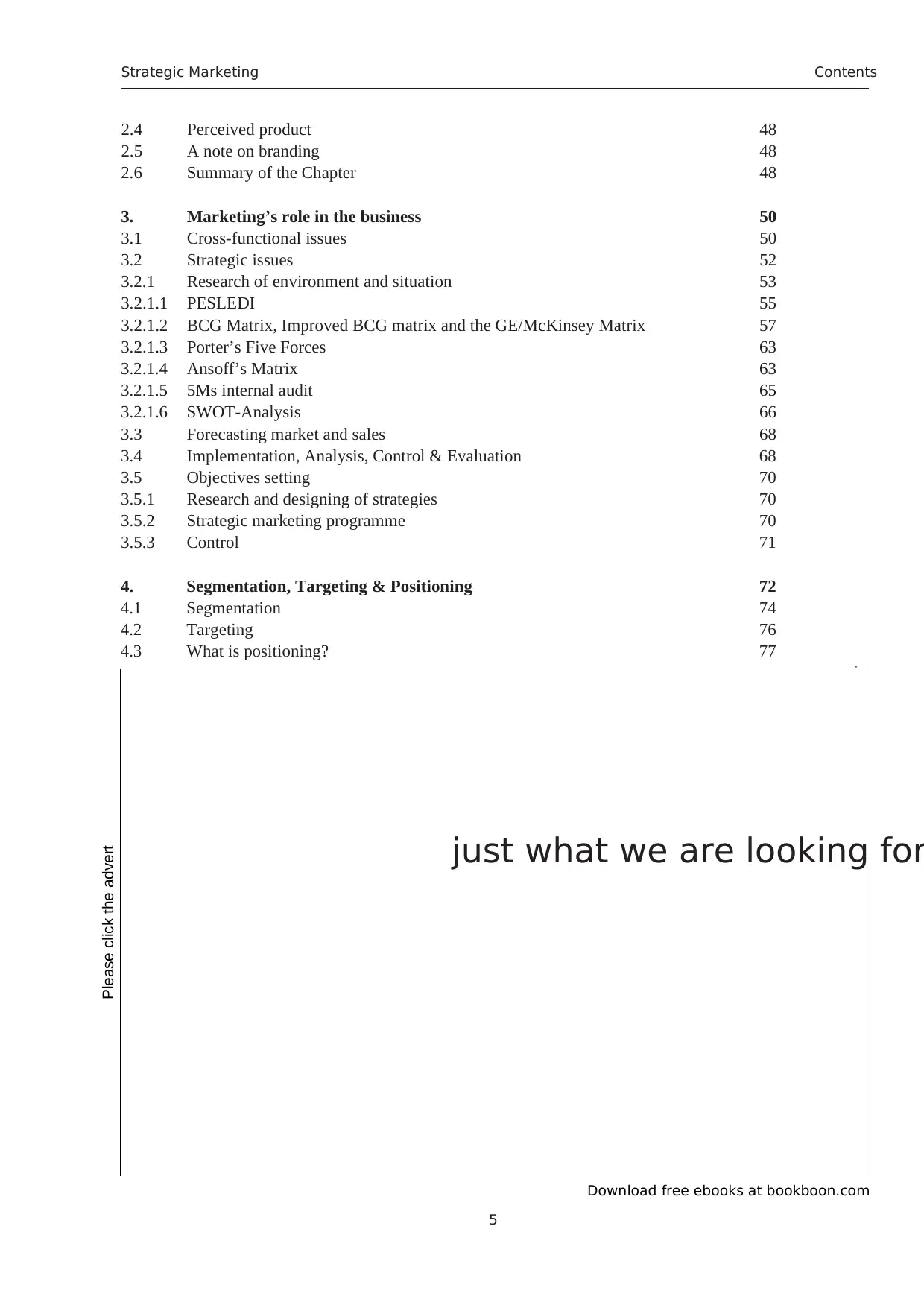
2.4 Perceived product 48
2.5 A note on branding 48
2.6 Summary of the Chapter 48
3. Marketing’s role in the business 50
3.1 Cross-functional issues 50
3.2 Strategic issues 52
3.2.1 Research of environment and situation 53
3.2.1.1 PESLEDI 55
3.2.1.2 BCG Matrix, Improved BCG matrix and the GE/McKinsey Matrix 57
3.2.1.3 Porter’s Five Forces 63
3.2.1.4 Ansoff’s Matrix 63
3.2.1.5 5Ms internal audit 65
3.2.1.6 SWOT-Analysis 66
3.3 Forecasting market and sales 68
3.4 Implementation, Analysis, Control & Evaluation 68
3.5 Objectives setting 70
3.5.1 Research and designing of strategies 70
3.5.2 Strategic marketing programme 70
3.5.3 Control 71
4. Segmentation, Targeting & Positioning 72
4.1 Segmentation 74
4.2 Targeting 76
4.3 What is positioning? 77
© UBS 2010. All rights reserved.
www.ubs.com/graduates
Looking for a career where your ideas could really make a difference? UBS’s
Graduate Programme and internships are a chance for you to experience
for yourself what it’s like to be part of a global team that rewards your input
and believes in succeeding together.
Wherever you are in your academic career, make your future a part of ours
by visiting www.ubs.com/graduates.
You’re full ofenergy
and ideas. And that’s
just what we are looking for
Please click the advert
Strategic Marketing
5
Contents
2.4 Perceived product 48
2.5 A note on branding 48
2.6 Summary of the Chapter 48
3. Marketing’s role in the business 50
3.1 Cross-functional issues 50
3.2 Strategic issues 52
3.2.1 Research of environment and situation 53
3.2.1.1 PESLEDI 55
3.2.1.2 BCG Matrix, Improved BCG matrix and the GE/McKinsey Matrix 57
3.2.1.3 Porter’s Five Forces 63
3.2.1.4 Ansoff’s Matrix 63
3.2.1.5 5Ms internal audit 65
3.2.1.6 SWOT-Analysis 66
3.3 Forecasting market and sales 68
3.4 Implementation, Analysis, Control & Evaluation 68
3.5 Objectives setting 70
3.5.1 Research and designing of strategies 70
3.5.2 Strategic marketing programme 70
3.5.3 Control 71
4. Segmentation, Targeting & Positioning 72
4.1 Segmentation 74
4.2 Targeting 76
4.3 What is positioning? 77
© UBS 2010. All rights reserved.
www.ubs.com/graduates
Looking for a career where your ideas could really make a difference? UBS’s
Graduate Programme and internships are a chance for you to experience
for yourself what it’s like to be part of a global team that rewards your input
and believes in succeeding together.
Wherever you are in your academic career, make your future a part of ours
by visiting www.ubs.com/graduates.
You’re full ofenergy
and ideas. And that’s
just what we are looking for
Please click the advert
Download free ebooks at bookboon.com
Strategic Marketing
6
Contents
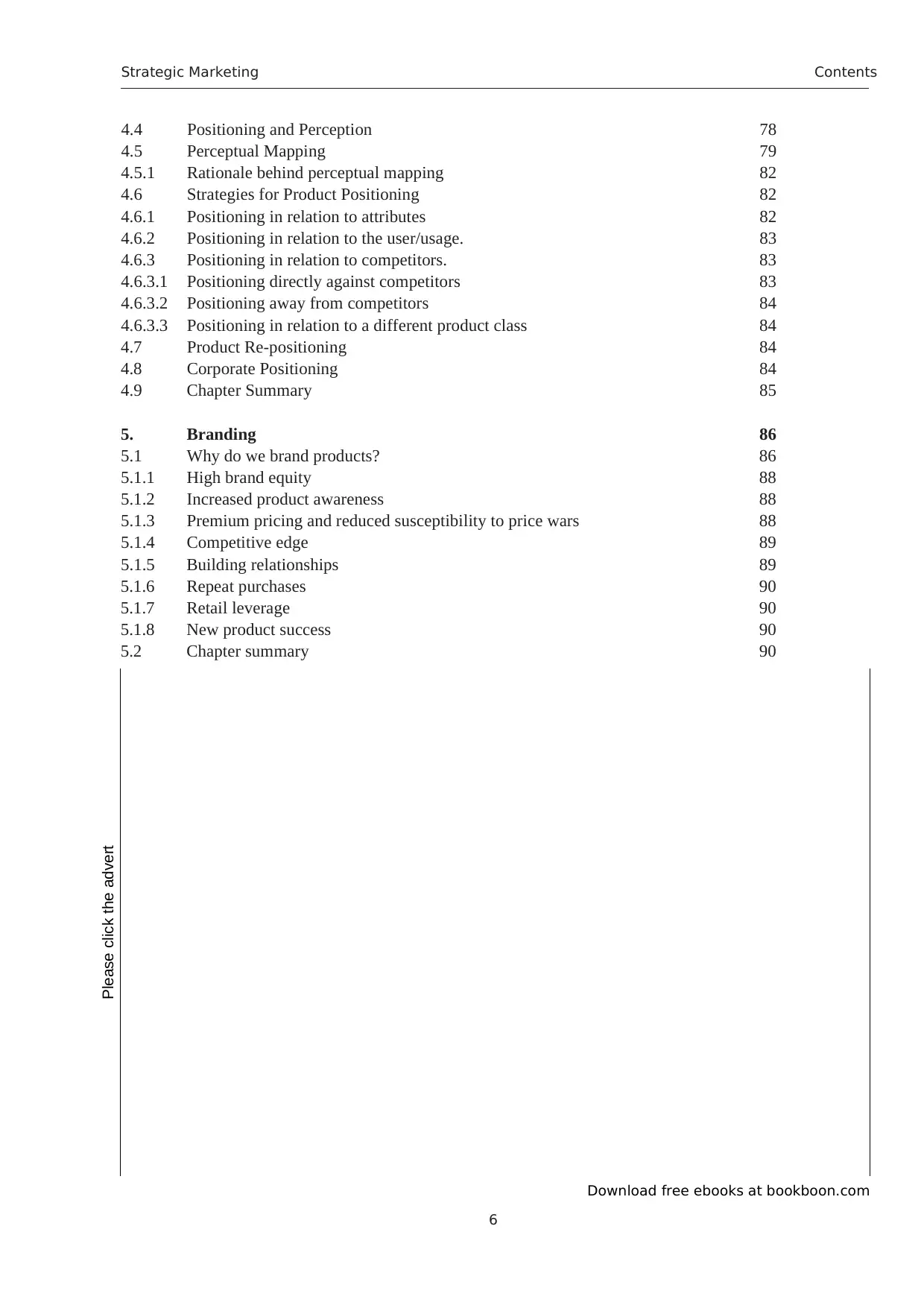
4.4 Positioning and Perception 78
4.5 Perceptual Mapping 79
4.5.1 Rationale behind perceptual mapping 82
4.6 Strategies for Product Positioning 82
4.6.1 Positioning in relation to attributes 82
4.6.2 Positioning in relation to the user/usage. 83
4.6.3 Positioning in relation to competitors. 83
4.6.3.1 Positioning directly against competitors 83
4.6.3.2 Positioning away from competitors 84
4.6.3.3 Positioning in relation to a different product class 84
4.7 Product Re-positioning 84
4.8 Corporate Positioning 84
4.9 Chapter Summary 85
5. Branding 86
5.1 Why do we brand products? 86
5.1.1 High brand equity 88
5.1.2 Increased product awareness 88
5.1.3 Premium pricing and reduced susceptibility to price wars 88
5.1.4 Competitive edge 89
5.1.5 Building relationships 89
5.1.6 Repeat purchases 90
5.1.7 Retail leverage 90
5.1.8 New product success 90
5.2 Chapter summary 90
Please click the advert
Strategic Marketing
6
Contents
4.4 Positioning and Perception 78
4.5 Perceptual Mapping 79
4.5.1 Rationale behind perceptual mapping 82
4.6 Strategies for Product Positioning 82
4.6.1 Positioning in relation to attributes 82
4.6.2 Positioning in relation to the user/usage. 83
4.6.3 Positioning in relation to competitors. 83
4.6.3.1 Positioning directly against competitors 83
4.6.3.2 Positioning away from competitors 84
4.6.3.3 Positioning in relation to a different product class 84
4.7 Product Re-positioning 84
4.8 Corporate Positioning 84
4.9 Chapter Summary 85
5. Branding 86
5.1 Why do we brand products? 86
5.1.1 High brand equity 88
5.1.2 Increased product awareness 88
5.1.3 Premium pricing and reduced susceptibility to price wars 88
5.1.4 Competitive edge 89
5.1.5 Building relationships 89
5.1.6 Repeat purchases 90
5.1.7 Retail leverage 90
5.1.8 New product success 90
5.2 Chapter summary 90
Please click the advert
⊘ This is a preview!⊘
Do you want full access?
Subscribe today to unlock all pages.
Trusted by 1+ million students worldwide

Download free ebooks at bookboon.com
Strategic Marketing
7
Contents
6. The Marketing Mix 91
6.1 Price 93
6.2 Place 96
6.3 Product 98
6.3.1 The Product Life-cycle 101
6.4 Promotion 102
6.4.1 Personal Selling. 103
6.4.2 Sales Promotion 104
6.4.3 Public Relations (PR) 104
6.4.4 Direct Marketing 104
6.4.5 Trade Fairs and Exhibitions 104
6.4.6 Advertising 105
6.4.7 Sponsorship 105
6.5 Physical Evidence 105
6.6 People 106
6.6.1 Training 107
6.6.2 Personal Selling 107
6.6.3 Customer Service 107
6.7 Process 107
7. Product Management 109
8. Marketing Communications or MarCom or Integrated Marketing
Communications (IMC) 110
8.1 The Marketing Communications Mix 110
your chance
to change
the world
Here at Ericsson we have a deep rooted belief that
the innovations we make on a daily basis can have a
profound effect on making the world a better place
for people, business and society. Join us.
In Germany we are especially looking for graduates
as Integration Engineers for
• Radio Access and IP Networks
• IMS and IPTV
We are looking forward to getting your application!
To apply and for all current job openings please visit
our web page: www.ericsson.com/careers
Please click the advert
Strategic Marketing
7
Contents
6. The Marketing Mix 91
6.1 Price 93
6.2 Place 96
6.3 Product 98
6.3.1 The Product Life-cycle 101
6.4 Promotion 102
6.4.1 Personal Selling. 103
6.4.2 Sales Promotion 104
6.4.3 Public Relations (PR) 104
6.4.4 Direct Marketing 104
6.4.5 Trade Fairs and Exhibitions 104
6.4.6 Advertising 105
6.4.7 Sponsorship 105
6.5 Physical Evidence 105
6.6 People 106
6.6.1 Training 107
6.6.2 Personal Selling 107
6.6.3 Customer Service 107
6.7 Process 107
7. Product Management 109
8. Marketing Communications or MarCom or Integrated Marketing
Communications (IMC) 110
8.1 The Marketing Communications Mix 110
your chance
to change
the world
Here at Ericsson we have a deep rooted belief that
the innovations we make on a daily basis can have a
profound effect on making the world a better place
for people, business and society. Join us.
In Germany we are especially looking for graduates
as Integration Engineers for
• Radio Access and IP Networks
• IMS and IPTV
We are looking forward to getting your application!
To apply and for all current job openings please visit
our web page: www.ericsson.com/careers
Please click the advert
Paraphrase This Document
Need a fresh take? Get an instant paraphrase of this document with our AI Paraphraser
Download free ebooks at bookboon.com
Strategic Marketing
8
Contents
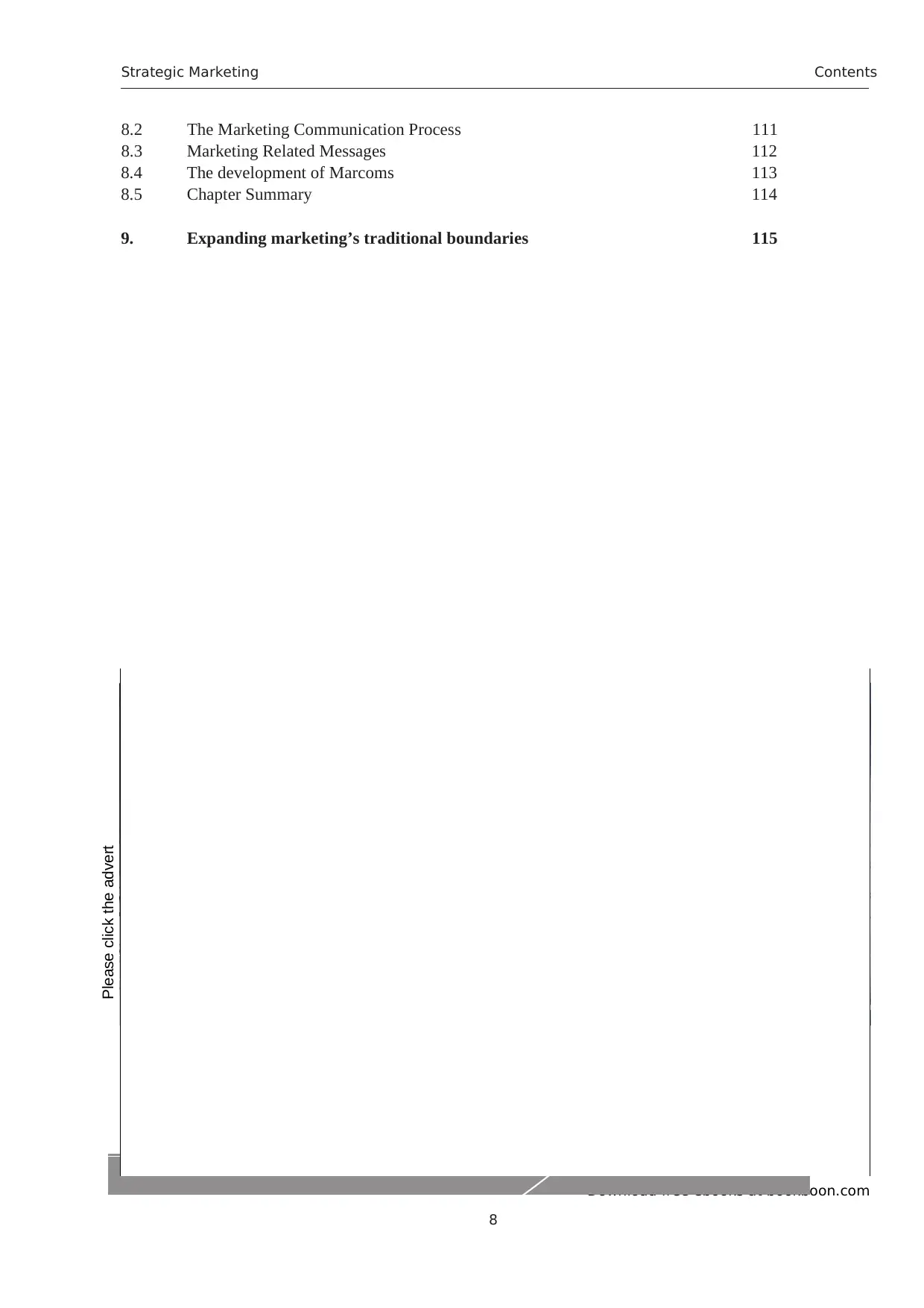
8.2 The Marketing Communication Process 111
8.3 Marketing Related Messages 112
8.4 The development of Marcoms 113
8.5 Chapter Summary 114
9. Expanding marketing’s traditional boundaries 115
what‘s missing in this equation?
maeRsK inteRnationaL teChnoLogY & sCienCe PRogRamme
You could be one of our future talents
Are you about to graduate as an engineer or geoscientist? Or have you already graduated?
If so, there may be an exciting future for you with A.P. Moller - Maersk.
www.maersk.com/mitas
Please click the advert
Strategic Marketing
8
Contents
8.2 The Marketing Communication Process 111
8.3 Marketing Related Messages 112
8.4 The development of Marcoms 113
8.5 Chapter Summary 114
9. Expanding marketing’s traditional boundaries 115
what‘s missing in this equation?
maeRsK inteRnationaL teChnoLogY & sCienCe PRogRamme
You could be one of our future talents
Are you about to graduate as an engineer or geoscientist? Or have you already graduated?
If so, there may be an exciting future for you with A.P. Moller - Maersk.
www.maersk.com/mitas
Please click the advert
Download free ebooks at bookboon.com
Strategic Marketing
9
Preface
Preface
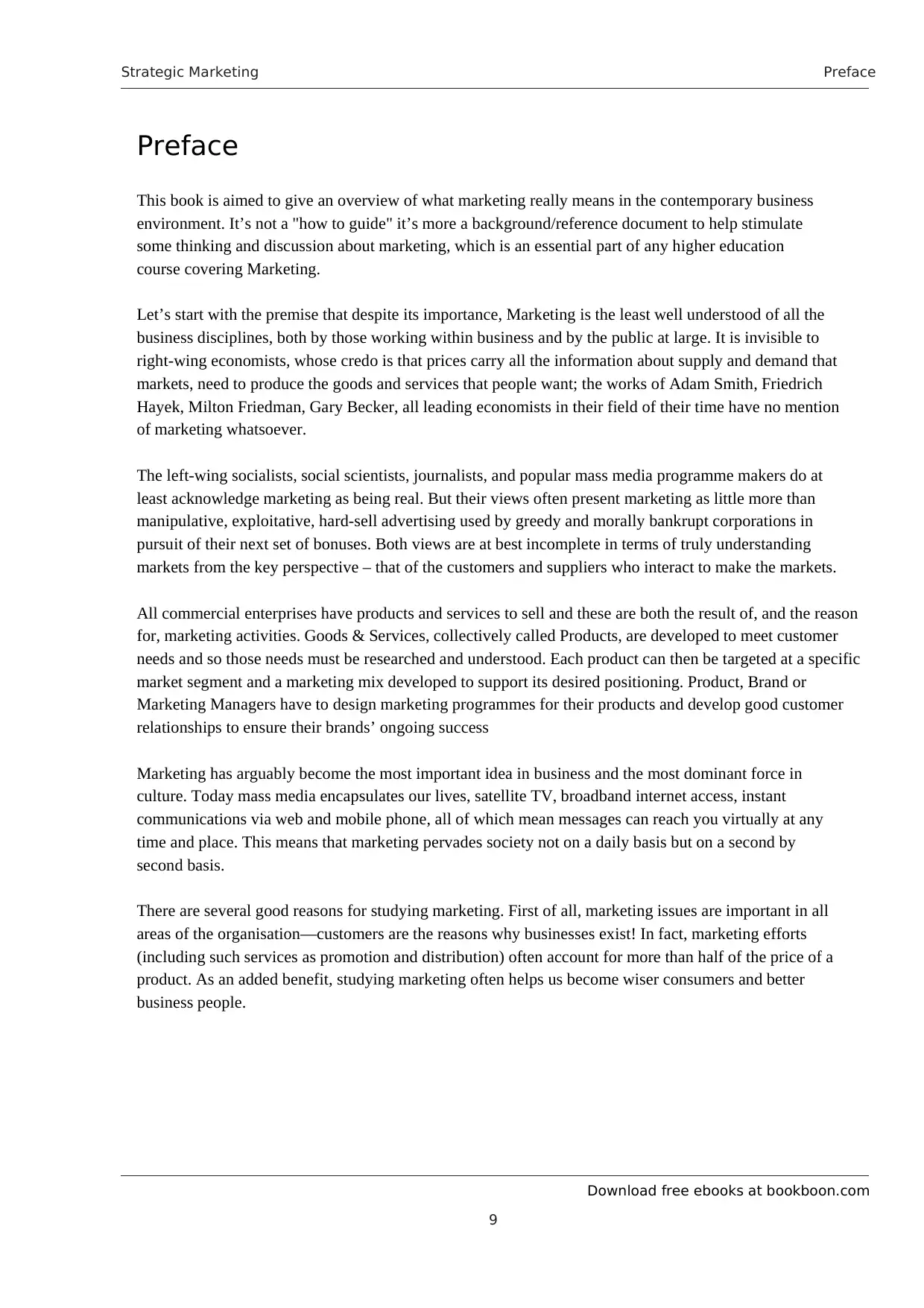
This book is aimed to give an overview of what marketing really means in the contemporary business
environment. It’s not a "how to guide" it’s more a background/reference document to help stimulate
some thinking and discussion about marketing, which is an essential part of any higher education
course covering Marketing.
Let’s start with the premise that despite its importance, Marketing is the least well understood of all the
business disciplines, both by those working within business and by the public at large. It is invisible to
right-wing economists, whose credo is that prices carry all the information about supply and demand that
markets, need to produce the goods and services that people want; the works of Adam Smith, Friedrich
Hayek, Milton Friedman, Gary Becker, all leading economists in their field of their time have no mention
of marketing whatsoever.
The left-wing socialists, social scientists, journalists, and popular mass media programme makers do at
least acknowledge marketing as being real. But their views often present marketing as little more than
manipulative, exploitative, hard-sell advertising used by greedy and morally bankrupt corporations in
pursuit of their next set of bonuses. Both views are at best incomplete in terms of truly understanding
markets from the key perspective – that of the customers and suppliers who interact to make the markets.
All commercial enterprises have products and services to sell and these are both the result of, and the reason
for, marketing activities. Goods & Services, collectively called Products, are developed to meet customer
needs and so those needs must be researched and understood. Each product can then be targeted at a specific
market segment and a marketing mix developed to support its desired positioning. Product, Brand or
Marketing Managers have to design marketing programmes for their products and develop good customer
relationships to ensure their brands’ ongoing success
Marketing has arguably become the most important idea in business and the most dominant force in
culture. Today mass media encapsulates our lives, satellite TV, broadband internet access, instant
communications via web and mobile phone, all of which mean messages can reach you virtually at any
time and place. This means that marketing pervades society not on a daily basis but on a second by
second basis.
There are several good reasons for studying marketing. First of all, marketing issues are important in all
areas of the organisation—customers are the reasons why businesses exist! In fact, marketing efforts
(including such services as promotion and distribution) often account for more than half of the price of a
product. As an added benefit, studying marketing often helps us become wiser consumers and better
business people.
Strategic Marketing
9
Preface
Preface
This book is aimed to give an overview of what marketing really means in the contemporary business
environment. It’s not a "how to guide" it’s more a background/reference document to help stimulate
some thinking and discussion about marketing, which is an essential part of any higher education
course covering Marketing.
Let’s start with the premise that despite its importance, Marketing is the least well understood of all the
business disciplines, both by those working within business and by the public at large. It is invisible to
right-wing economists, whose credo is that prices carry all the information about supply and demand that
markets, need to produce the goods and services that people want; the works of Adam Smith, Friedrich
Hayek, Milton Friedman, Gary Becker, all leading economists in their field of their time have no mention
of marketing whatsoever.
The left-wing socialists, social scientists, journalists, and popular mass media programme makers do at
least acknowledge marketing as being real. But their views often present marketing as little more than
manipulative, exploitative, hard-sell advertising used by greedy and morally bankrupt corporations in
pursuit of their next set of bonuses. Both views are at best incomplete in terms of truly understanding
markets from the key perspective – that of the customers and suppliers who interact to make the markets.
All commercial enterprises have products and services to sell and these are both the result of, and the reason
for, marketing activities. Goods & Services, collectively called Products, are developed to meet customer
needs and so those needs must be researched and understood. Each product can then be targeted at a specific
market segment and a marketing mix developed to support its desired positioning. Product, Brand or
Marketing Managers have to design marketing programmes for their products and develop good customer
relationships to ensure their brands’ ongoing success
Marketing has arguably become the most important idea in business and the most dominant force in
culture. Today mass media encapsulates our lives, satellite TV, broadband internet access, instant
communications via web and mobile phone, all of which mean messages can reach you virtually at any
time and place. This means that marketing pervades society not on a daily basis but on a second by
second basis.
There are several good reasons for studying marketing. First of all, marketing issues are important in all
areas of the organisation—customers are the reasons why businesses exist! In fact, marketing efforts
(including such services as promotion and distribution) often account for more than half of the price of a
product. As an added benefit, studying marketing often helps us become wiser consumers and better
business people.
⊘ This is a preview!⊘
Do you want full access?
Subscribe today to unlock all pages.
Trusted by 1+ million students worldwide
Download free ebooks at bookboon.com
Strategic Marketing
10
Preface
Marketing is also vital to understanding businesses of any sort, thus any study of business that excludes an
appreciation of marketing is incomplete. In particular at the highest levels marketing becomes an
integrating holistic culture that drives integrated, co-ordinated and focussed business practices with the
interests of the customer as its heart – a combination that makes such businesses difficult to beat in the
market.
Some of the main issues involved include:
Marketers help design products, finding out what customers want and what can practically be
made available given technology and price constraints.
Marketers distribute products—there must be some efficient way to get the products from the
factory to the end-consumer.
Marketers also promote products, and this is perhaps what we tend to think of first when we think
of marketing. Promotion involves advertising—and much more. Other tools to promote products
include trade promotion (store sales and coupons), obtaining favourable and visible shelf-space,
and obtaining favourable press coverage.
Marketers also price products to “move” them. We know from economics that, in most cases,
sales correlate negatively with price—the higher the price, the lower the quantity demanded. In
some cases, however, price may provide the customer with a “signal” of quality. Thus, the
marketer needs to price the product to (1) maximise profit and (2) communicate a desired image
of the product.
Marketing is applicable to services and ideas as well as to tangible goods. For example,
accountants may need to market their tax preparation services to consumers.
Strategic Marketing
10
Preface
Marketing is also vital to understanding businesses of any sort, thus any study of business that excludes an
appreciation of marketing is incomplete. In particular at the highest levels marketing becomes an
integrating holistic culture that drives integrated, co-ordinated and focussed business practices with the
interests of the customer as its heart – a combination that makes such businesses difficult to beat in the
market.
Some of the main issues involved include:
Marketers help design products, finding out what customers want and what can practically be
made available given technology and price constraints.
Marketers distribute products—there must be some efficient way to get the products from the
factory to the end-consumer.
Marketers also promote products, and this is perhaps what we tend to think of first when we think
of marketing. Promotion involves advertising—and much more. Other tools to promote products
include trade promotion (store sales and coupons), obtaining favourable and visible shelf-space,
and obtaining favourable press coverage.
Marketers also price products to “move” them. We know from economics that, in most cases,
sales correlate negatively with price—the higher the price, the lower the quantity demanded. In
some cases, however, price may provide the customer with a “signal” of quality. Thus, the
marketer needs to price the product to (1) maximise profit and (2) communicate a desired image
of the product.
Marketing is applicable to services and ideas as well as to tangible goods. For example,
accountants may need to market their tax preparation services to consumers.
Paraphrase This Document
Need a fresh take? Get an instant paraphrase of this document with our AI Paraphraser
Download free ebooks at bookboon.com
Strategic Marketing
11
So what is marketing?
1. So what is marketing?
Marketing is commonly misunderstood as an ostentatious term for advertising and promotion; in reality it
is far more than that. This perception isn’t in many ways unreasonable, advertising and promotion are the
major way in which most people are exposed to marketing. However, the term ‘marketing’ actually covers
everything from company culture and positioning, through market research, new business/product
development, advertising and promotion, PR (public/press relations), and arguably all of the sales and
customer service functions as well;
It is systematic attempt to fulfil human desires by producing goods and services that people will
buy.
It is where the cutting edge of human nature meets the versatility of technology.
Marketing-oriented companies help us discover desires we never knew we had, and ways of
fulfilling them we never imagined could be invented.
1.1 The Three levels of Marketing
Almost every marketing textbook has a different definition of the term “marketing.” The better definitions
are focused upon customer orientation and satisfaction of customer needs;
The American Marketing Association (AMA) uses the following: “The process of planning and
executing the conception, pricing, promotion, and distribution of ideas, goods, and services to
create exchanges that satisfy individual and organizational objectives.”
Philip Kotler uses, “Marketing is the social process by which individuals and groups obtain
what they need and want through creating and exchanging products and value with others.”
The Chartered Institute of Marketing (CIM), “Marketing is the management process that
identifies, anticipates and satisfies customer requirements profitably.”
In a January 1991, Regis McKenna published an article in the Harvard Business Review (HBR) entitled
“Marketing Is Everything.” In the article the McKenna states, "Marketing today is not a function; it is a
way of doing business." Indeed we now call this the top level of Marketing – Marketing as a business
philosophy. So yes, marketing is everything. In essence it’s the process by which a company decides
what it will sell, to whom, when & how and then does it!
Strategic Marketing
11
So what is marketing?
1. So what is marketing?
Marketing is commonly misunderstood as an ostentatious term for advertising and promotion; in reality it
is far more than that. This perception isn’t in many ways unreasonable, advertising and promotion are the
major way in which most people are exposed to marketing. However, the term ‘marketing’ actually covers
everything from company culture and positioning, through market research, new business/product
development, advertising and promotion, PR (public/press relations), and arguably all of the sales and
customer service functions as well;
It is systematic attempt to fulfil human desires by producing goods and services that people will
buy.
It is where the cutting edge of human nature meets the versatility of technology.
Marketing-oriented companies help us discover desires we never knew we had, and ways of
fulfilling them we never imagined could be invented.
1.1 The Three levels of Marketing
Almost every marketing textbook has a different definition of the term “marketing.” The better definitions
are focused upon customer orientation and satisfaction of customer needs;
The American Marketing Association (AMA) uses the following: “The process of planning and
executing the conception, pricing, promotion, and distribution of ideas, goods, and services to
create exchanges that satisfy individual and organizational objectives.”
Philip Kotler uses, “Marketing is the social process by which individuals and groups obtain
what they need and want through creating and exchanging products and value with others.”
The Chartered Institute of Marketing (CIM), “Marketing is the management process that
identifies, anticipates and satisfies customer requirements profitably.”
In a January 1991, Regis McKenna published an article in the Harvard Business Review (HBR) entitled
“Marketing Is Everything.” In the article the McKenna states, "Marketing today is not a function; it is a
way of doing business." Indeed we now call this the top level of Marketing – Marketing as a business
philosophy. So yes, marketing is everything. In essence it’s the process by which a company decides
what it will sell, to whom, when & how and then does it!
Download free ebooks at bookboon.com
Strategic Marketing
12
So what is marketing?
This brings us to the second level of Marketing; Marketing as Strategy. This entails understanding the
environment the business is operating in; customers, competitors, laws, regulations, etc and planning
marketing strategy to make the business a success. This second layer is about segmenting (S) the market,
deciding which customers to target (T) and deciding what messages you want the targets to associate with
you; what is called Positioning (P). The overall process is usually referred to as; segmentation-targeting-
positioning (STP) which is covered in Chapter Three.
STP however is not alone at this level; it is closely allied with the concept of Branding, which is not just
about logos and names. Brands are now about image – or more correctly its perception, branding is a link
between the attributes customers associate with a brand and how the brand owner wants the consumer to
perceive the brand: the brand identity. Over time, or through poorly executed marketing or through
societal changes in markets, a brand’s identity evolves gaining new attributes from the consumer’s
perspective.
Not all of these will be beneficial from the brand owner’s perspective and they will seek to bridge the gap
between the brand image and the brand identity, by trying to change the customers perceptions – brand
image – to be closer to what’s wanted brand identity; sometimes this necessitates a brand re-launch. A
central aspect to brand is the choice of name. Effective brand names build a connection between the
brand’s personality as it is perceived by the target audience and the actual product/service, by implication
the brand name should be on target with the brand demographic, i.e. based in correct segmentation and
targeting. Level two of Marketing can thus be summarised as STP + Branding; Branding is covered in
Chapter Four.
The third level of marketing is about the day to day operational running of marketing, it encompasses the
control of the Marketing Mix and the processes within a business that help create and deliver that
company’s products and services to the customer. This level spans all aspects of a business and across
all customer contact points including:
A company's web site;
How they answer the phones;
Their marketing and PR campaigns;
Their sales process;
How customer contact staff present themselves (in person and on the phone);
How a business delivers its services;
How a business “manages" its clients
How a business solicits feedback from its clients.
These operational issues are covered in Chapters Five, Six and Seven.
Strategic Marketing
12
So what is marketing?
This brings us to the second level of Marketing; Marketing as Strategy. This entails understanding the
environment the business is operating in; customers, competitors, laws, regulations, etc and planning
marketing strategy to make the business a success. This second layer is about segmenting (S) the market,
deciding which customers to target (T) and deciding what messages you want the targets to associate with
you; what is called Positioning (P). The overall process is usually referred to as; segmentation-targeting-
positioning (STP) which is covered in Chapter Three.
STP however is not alone at this level; it is closely allied with the concept of Branding, which is not just
about logos and names. Brands are now about image – or more correctly its perception, branding is a link
between the attributes customers associate with a brand and how the brand owner wants the consumer to
perceive the brand: the brand identity. Over time, or through poorly executed marketing or through
societal changes in markets, a brand’s identity evolves gaining new attributes from the consumer’s
perspective.
Not all of these will be beneficial from the brand owner’s perspective and they will seek to bridge the gap
between the brand image and the brand identity, by trying to change the customers perceptions – brand
image – to be closer to what’s wanted brand identity; sometimes this necessitates a brand re-launch. A
central aspect to brand is the choice of name. Effective brand names build a connection between the
brand’s personality as it is perceived by the target audience and the actual product/service, by implication
the brand name should be on target with the brand demographic, i.e. based in correct segmentation and
targeting. Level two of Marketing can thus be summarised as STP + Branding; Branding is covered in
Chapter Four.
The third level of marketing is about the day to day operational running of marketing, it encompasses the
control of the Marketing Mix and the processes within a business that help create and deliver that
company’s products and services to the customer. This level spans all aspects of a business and across
all customer contact points including:
A company's web site;
How they answer the phones;
Their marketing and PR campaigns;
Their sales process;
How customer contact staff present themselves (in person and on the phone);
How a business delivers its services;
How a business “manages" its clients
How a business solicits feedback from its clients.
These operational issues are covered in Chapters Five, Six and Seven.
⊘ This is a preview!⊘
Do you want full access?
Subscribe today to unlock all pages.
Trusted by 1+ million students worldwide

1 out of 121


Your All-in-One AI-Powered Toolkit for Academic Success.
+13062052269
info@desklib.com
Available 24*7 on WhatsApp / Email
![[object Object]](/_next/static/media/star-bottom.7253800d.svg)
Unlock your academic potential
Copyright © 2020–2026 A2Z Services. All Rights Reserved. Developed and managed by ZUCOL.