Strategic Marketing Analysis of IKEA in International Markets
VerifiedAdded on 2019/12/03
|13
|4010
|79
Report
AI Summary
This report provides a comprehensive analysis of IKEA's marketing strategies, both domestically and internationally. It examines the company's approach to market segmentation, targeting, and positioning, highlighting how IKEA adapts its strategies to different cultural and economic environments. The report delves into IKEA's customer acquisition and retention activities, showcasing how the company attracts and maintains customer loyalty through competitive pricing, innovative product design, and a strong brand identity. It explores the implications of innovation, future trends, and environmental factors on IKEA's marketing objectives and strategies. Furthermore, the report provides a detailed overview of the social, political, economic, legal, and ecological environments in which IKEA operates, providing insights into the challenges and opportunities the company faces in the global market. The report also includes an executive summary, table of contents, and references. The report demonstrates the strategies IKEA has used to navigate different markets successfully and maintain its position as a global leader in the furniture industry.
Strategic
Marketing
Marketing

Paraphrase This Document
Need a fresh take? Get an instant paraphrase of this document with our AI Paraphraser
EXECUTIVE SUMMARY
IKEA is a globally renowned for its competitive prices and innovation in designing
patterns relating to furniture. In course of this study it is shown how the company faced various
problems in Chinese and US market. It depicts what strategies it used in order to stand out from
other retailers. As a matter of fact, the low prices of furniture sold by IKEA created a doubt in
local customers about credibility and other competitors copied their designs easily. As a startup it
was not easy for IKEA to cope up with existing competitors and convince them. The project
depicts how IKEA followed its objective and became profitable. It also indicates that despite of
thousand troubles IKEA did not leave its basic ideas and strategies. It shows how IKEA
represented itself at local and international level. Various modernized marketing ideas have also
been depicted.
2
IKEA is a globally renowned for its competitive prices and innovation in designing
patterns relating to furniture. In course of this study it is shown how the company faced various
problems in Chinese and US market. It depicts what strategies it used in order to stand out from
other retailers. As a matter of fact, the low prices of furniture sold by IKEA created a doubt in
local customers about credibility and other competitors copied their designs easily. As a startup it
was not easy for IKEA to cope up with existing competitors and convince them. The project
depicts how IKEA followed its objective and became profitable. It also indicates that despite of
thousand troubles IKEA did not leave its basic ideas and strategies. It shows how IKEA
represented itself at local and international level. Various modernized marketing ideas have also
been depicted.
2
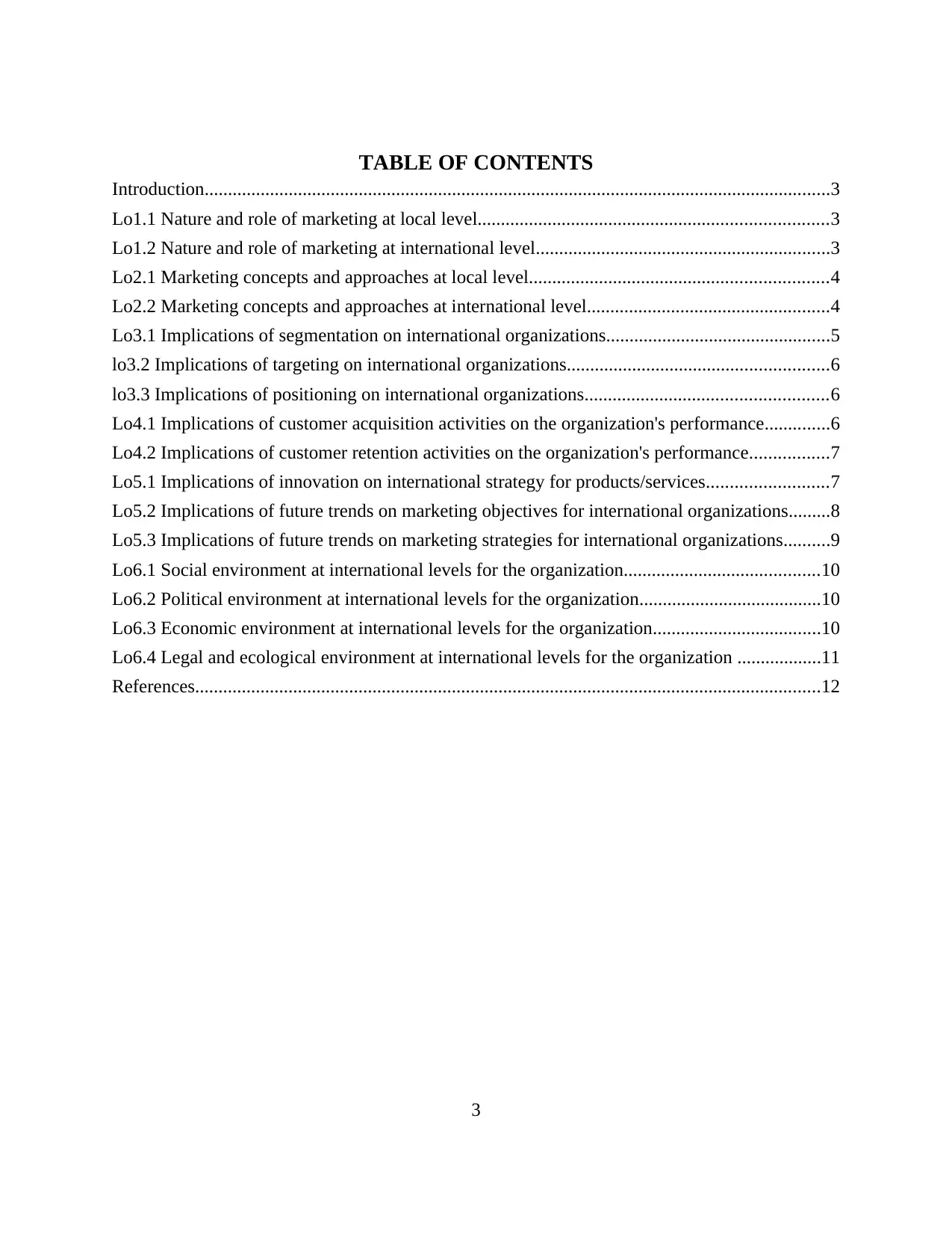
TABLE OF CONTENTS
Introduction......................................................................................................................................3
Lo1.1 Nature and role of marketing at local level...........................................................................3
Lo1.2 Nature and role of marketing at international level...............................................................3
Lo2.1 Marketing concepts and approaches at local level................................................................4
Lo2.2 Marketing concepts and approaches at international level....................................................4
Lo3.1 Implications of segmentation on international organizations................................................5
lo3.2 Implications of targeting on international organizations........................................................6
lo3.3 Implications of positioning on international organizations....................................................6
Lo4.1 Implications of customer acquisition activities on the organization's performance..............6
Lo4.2 Implications of customer retention activities on the organization's performance.................7
Lo5.1 Implications of innovation on international strategy for products/services..........................7
Lo5.2 Implications of future trends on marketing objectives for international organizations.........8
Lo5.3 Implications of future trends on marketing strategies for international organizations..........9
Lo6.1 Social environment at international levels for the organization..........................................10
Lo6.2 Political environment at international levels for the organization.......................................10
Lo6.3 Economic environment at international levels for the organization....................................10
Lo6.4 Legal and ecological environment at international levels for the organization ..................11
References......................................................................................................................................12
3
Introduction......................................................................................................................................3
Lo1.1 Nature and role of marketing at local level...........................................................................3
Lo1.2 Nature and role of marketing at international level...............................................................3
Lo2.1 Marketing concepts and approaches at local level................................................................4
Lo2.2 Marketing concepts and approaches at international level....................................................4
Lo3.1 Implications of segmentation on international organizations................................................5
lo3.2 Implications of targeting on international organizations........................................................6
lo3.3 Implications of positioning on international organizations....................................................6
Lo4.1 Implications of customer acquisition activities on the organization's performance..............6
Lo4.2 Implications of customer retention activities on the organization's performance.................7
Lo5.1 Implications of innovation on international strategy for products/services..........................7
Lo5.2 Implications of future trends on marketing objectives for international organizations.........8
Lo5.3 Implications of future trends on marketing strategies for international organizations..........9
Lo6.1 Social environment at international levels for the organization..........................................10
Lo6.2 Political environment at international levels for the organization.......................................10
Lo6.3 Economic environment at international levels for the organization....................................10
Lo6.4 Legal and ecological environment at international levels for the organization ..................11
References......................................................................................................................................12
3
⊘ This is a preview!⊘
Do you want full access?
Subscribe today to unlock all pages.

Trusted by 1+ million students worldwide
INTRODUCTION
All modern organizations are involved in marketing in order to win more and more
customers. It helps in finding needs and requirements of the customers. IKEA is a Swedish
furniture company which believes in customer satisfaction by creating a strong relationship with
customers. In this project IKEA's international and domestic marketing strategies have been
discussed. Also the latest trends and developments have been focused in this particular sector of
home furnishing.
LO1.1 NATURE AND ROLE OF MARKETING AT LOCAL LEVEL
Local level marketing is also termed as Domestic marketing. The best concept that IKEA
has followed in domestic market is to go global with the help of e-marketing (Helgesen, Nesset
and Voldsund, 2009). The number of customers rose by 21.8% as soon as e-marketing and an
app of IKEA was launched. With the help of this app, one can design their own rooms with
IKEA products. Younger generations found it more impressive and appealing. IKEA believes
that the main role of domestic marketing is:
Identifying: It tells how to find customers and know about their requirements. This is an
important element of strategic marketing.
Anticipating: Market is full of dynamic customers so it is important to analyse what will
be the future needs of customers.
Satisfying: It refers to availability of right product at right time and right place at an
affordable price.
Profitability: No business can run without earning profits. Thus profit is the key element
in doing any business.
LO1.2 NATURE AND ROLE OF MARKETING AT INTERNATIONAL
LEVEL
International marketing is a strategy where firm balances its product by making one or
more marketing mix decisions depending upon the tastes and preferences of people of that
particular place. The most complex decision for any firm is to establish various manufacturing or
distribution units all round the world and coordinating their marketing strategies across the globe
(Meiners, Ringleb and Edwards, 2014). IKEA sells its products all around the world. It also
4
All modern organizations are involved in marketing in order to win more and more
customers. It helps in finding needs and requirements of the customers. IKEA is a Swedish
furniture company which believes in customer satisfaction by creating a strong relationship with
customers. In this project IKEA's international and domestic marketing strategies have been
discussed. Also the latest trends and developments have been focused in this particular sector of
home furnishing.
LO1.1 NATURE AND ROLE OF MARKETING AT LOCAL LEVEL
Local level marketing is also termed as Domestic marketing. The best concept that IKEA
has followed in domestic market is to go global with the help of e-marketing (Helgesen, Nesset
and Voldsund, 2009). The number of customers rose by 21.8% as soon as e-marketing and an
app of IKEA was launched. With the help of this app, one can design their own rooms with
IKEA products. Younger generations found it more impressive and appealing. IKEA believes
that the main role of domestic marketing is:
Identifying: It tells how to find customers and know about their requirements. This is an
important element of strategic marketing.
Anticipating: Market is full of dynamic customers so it is important to analyse what will
be the future needs of customers.
Satisfying: It refers to availability of right product at right time and right place at an
affordable price.
Profitability: No business can run without earning profits. Thus profit is the key element
in doing any business.
LO1.2 NATURE AND ROLE OF MARKETING AT INTERNATIONAL
LEVEL
International marketing is a strategy where firm balances its product by making one or
more marketing mix decisions depending upon the tastes and preferences of people of that
particular place. The most complex decision for any firm is to establish various manufacturing or
distribution units all round the world and coordinating their marketing strategies across the globe
(Meiners, Ringleb and Edwards, 2014). IKEA sells its products all around the world. It also
4
Paraphrase This Document
Need a fresh take? Get an instant paraphrase of this document with our AI Paraphraser
sources its products from all parts of the world. It has gained huge popularity because of its
priority given to each country at the time of making catalogues which is based on the language
and culture of that place in which the firm is presently operating its business. Branding is an
important part of marketing which is same in all the countries that is, blue and yellow logo which
represents Sweden. Pricing of IKEA product depends upon exchange rate of each country.
However, products are still low priced and are of good quality.
LO2.1 MARKETING CONCEPTS AND APPROACHES AT LOCAL
LEVEL
The main concept of IKEA was that it always focused on middle class people and has
provided low cost stylish furniture (Fillis, 2003). Various approaches which it uses at domestic
level to gain its customers are advertising through televisions, internet, hoardings, providing
customer's full satisfaction, promotion through apps and its brochure. It has replicated the
concept of proudly promoting their country's designs and philosophy. It has also used the
concept of green environment as its strategy tool. The president of IKEA came out with a new
announcement stating in their annual reports that they would be launching various energy by
saving products and convenient light bulbs, eco friendly solutions such as water saving taps and
special process of recycling house hold wastes. IKEA also promoted that their kitchen range
would include smart and eco friendly solutions.
LO2.2 MARKETING CONCEPTS AND APPROACHES AT
INTERNATIONAL LEVEL
International marketing of IKEA includes activities, interests and operations that relate to
more than on country. It ensures that the customer’s needs are met so that their main orientation
would be on selling the product (Gosh, 2009). The marketing concept that it uses is retaining
itself to Swedish parameters and the symbol representing Swedish colours. It also came up with
the new concept of providing and customising furniture through an app with the help of which
people across globe could tell their needs and preferences. Other approaches used by IKEA to go
international are, promotion through low cost furniture which is stylish and trendy. As a result of
its competitive price, people buy furniture from IKEA when there is low economy. It has also
opened various stores in suburbs near highways so that people can easily go there by cars. It
5
priority given to each country at the time of making catalogues which is based on the language
and culture of that place in which the firm is presently operating its business. Branding is an
important part of marketing which is same in all the countries that is, blue and yellow logo which
represents Sweden. Pricing of IKEA product depends upon exchange rate of each country.
However, products are still low priced and are of good quality.
LO2.1 MARKETING CONCEPTS AND APPROACHES AT LOCAL
LEVEL
The main concept of IKEA was that it always focused on middle class people and has
provided low cost stylish furniture (Fillis, 2003). Various approaches which it uses at domestic
level to gain its customers are advertising through televisions, internet, hoardings, providing
customer's full satisfaction, promotion through apps and its brochure. It has replicated the
concept of proudly promoting their country's designs and philosophy. It has also used the
concept of green environment as its strategy tool. The president of IKEA came out with a new
announcement stating in their annual reports that they would be launching various energy by
saving products and convenient light bulbs, eco friendly solutions such as water saving taps and
special process of recycling house hold wastes. IKEA also promoted that their kitchen range
would include smart and eco friendly solutions.
LO2.2 MARKETING CONCEPTS AND APPROACHES AT
INTERNATIONAL LEVEL
International marketing of IKEA includes activities, interests and operations that relate to
more than on country. It ensures that the customer’s needs are met so that their main orientation
would be on selling the product (Gosh, 2009). The marketing concept that it uses is retaining
itself to Swedish parameters and the symbol representing Swedish colours. It also came up with
the new concept of providing and customising furniture through an app with the help of which
people across globe could tell their needs and preferences. Other approaches used by IKEA to go
international are, promotion through low cost furniture which is stylish and trendy. As a result of
its competitive price, people buy furniture from IKEA when there is low economy. It has also
opened various stores in suburbs near highways so that people can easily go there by cars. It
5
opened various stores in China, USA, Europe, etc. and all the furniture provided in those
countries was standardized on the basis of location and needs of customers. These differences are
a result of diverse cultures and exposures (Rosenbloom, 2011). It has also affiliated with various
NGOs such as UNICEF and WWF which helps in building good public relations and corporate
image. The main marketing tool is its catalogue which promotes maximum variety of local tastes
in the most presentable and stylish manner ever.
LO3.1 IMPLICATIONS OF SEGMENTATION ON INTERNATIONAL
ORGANISATIONS
Market segmentation is a strategy where consumers are divided into target markets
depending upon their interests and priorities. . It helps IKEA to determine which kind of
customers it wants to cater to. Segmenting in the international organisation has helped IKEA in
understanding the social and cultural effects of consumers on business. It has also helped IKEA
in knowing the local traditions and preferences of different countries. IKEA has made
segmentations on the basis of following segments. Geographic segments: This segment helps in ascertaining IKEA that which parts of
nation, state, region, city and country it wants to cater to. This classification is based on
the availability of raw material and cheap labour in order to keep its prices competitive.
This segmentation is considered as the first step in placing feet in an international market. Demographic segments: This segment is based on various variables that affect sales of
IKEA. It is defined by dividing whole market depending upon the age, gender and paying
capacity of the person. This segmentation also depends up on the size of the company and
the industry in which it is working (Dettwiler, Lindelöf and Löfsten,
2006).Psychographic segments: Through this segment, IKEA looks into lifestyles of
people by taking into account the leisure needs of people and how external forces
influence their needs and wants. The lifestyle style products are however a bit expensive
and attract elite customers only.
Behavioural segments: Here, IKEA has divided customers depending upon their
knowledge towards furniture, their usage and attitude towards the product. They also look
into the loyalty status of a person and gives special discounts to their loyal customers. It
6
countries was standardized on the basis of location and needs of customers. These differences are
a result of diverse cultures and exposures (Rosenbloom, 2011). It has also affiliated with various
NGOs such as UNICEF and WWF which helps in building good public relations and corporate
image. The main marketing tool is its catalogue which promotes maximum variety of local tastes
in the most presentable and stylish manner ever.
LO3.1 IMPLICATIONS OF SEGMENTATION ON INTERNATIONAL
ORGANISATIONS
Market segmentation is a strategy where consumers are divided into target markets
depending upon their interests and priorities. . It helps IKEA to determine which kind of
customers it wants to cater to. Segmenting in the international organisation has helped IKEA in
understanding the social and cultural effects of consumers on business. It has also helped IKEA
in knowing the local traditions and preferences of different countries. IKEA has made
segmentations on the basis of following segments. Geographic segments: This segment helps in ascertaining IKEA that which parts of
nation, state, region, city and country it wants to cater to. This classification is based on
the availability of raw material and cheap labour in order to keep its prices competitive.
This segmentation is considered as the first step in placing feet in an international market. Demographic segments: This segment is based on various variables that affect sales of
IKEA. It is defined by dividing whole market depending upon the age, gender and paying
capacity of the person. This segmentation also depends up on the size of the company and
the industry in which it is working (Dettwiler, Lindelöf and Löfsten,
2006).Psychographic segments: Through this segment, IKEA looks into lifestyles of
people by taking into account the leisure needs of people and how external forces
influence their needs and wants. The lifestyle style products are however a bit expensive
and attract elite customers only.
Behavioural segments: Here, IKEA has divided customers depending upon their
knowledge towards furniture, their usage and attitude towards the product. They also look
into the loyalty status of a person and gives special discounts to their loyal customers. It
6
⊘ This is a preview!⊘
Do you want full access?
Subscribe today to unlock all pages.
Trusted by 1+ million students worldwide
is believed by IKEA that behavioural segment is the best suited for building a good
market.
LO3.2 IMPLICATIONS OF TARGETING ON INTERNATIONAL
ORGANISATIONS
IKEA targeted on international organisations by maintaining a long term mutually
beneficial relationship with suppliers in order to meet demands of the target segment (Sodhi,
2011). As a result of targeting on international market, if became famous and renowned in a
short span of time which increased its sales by more than 30%. Targeting on international market
has resolved major problem of middle class consumers because those people who did not have
access to low priced furniture can now buy the same from IKEA.
LO3.3 IMPLICATIONS OF POSITIONING ON INTERNATIONAL
ORGANISATIONS
IKEA has also faced various pitfalls and depending upon which it has commendably
adapted to new international market. IKEA is wholly driven by concepts as in this process of
positioning itself; it has not changed its business concept regardless of the location of its retail
outlets. IKEA has a strong purchasing power as a result of which it has positioned itself on a
competitive graph (Swoboda, Elsner and Morschett, 2012). Also it has attracted various strong
and international consumer groups by ensuring exceptional products at low prices. Benefit of
international positioning was that a perception about IKEA was framed in minds of people with
comparison to that of its relative competitors. Positioning plays an important part in branding out
IKEA among international and domestic competitors. It fulfils the aim of IKEA by creating a
unique place for furniture. Positioning resulted in two benefits: the way people looked at IKEA's
furniture and the way it impacted its competitors.
LO4.1 IMPLICATIONS OF CUSTOMER ACQUISITION ACTIVITIES ON
THE ORGANISATION'S PERFORMANCE
Customer acquisition refers to a tool of marketing through which more and more
customers are targeted and attracted (International marketing strategy, 2008). The main aim of
IKEA is acquiring more and more customers through development of a strategy which focuses
on offering low priced furniture with contemporary designs. It results in setting relationship with
7
market.
LO3.2 IMPLICATIONS OF TARGETING ON INTERNATIONAL
ORGANISATIONS
IKEA targeted on international organisations by maintaining a long term mutually
beneficial relationship with suppliers in order to meet demands of the target segment (Sodhi,
2011). As a result of targeting on international market, if became famous and renowned in a
short span of time which increased its sales by more than 30%. Targeting on international market
has resolved major problem of middle class consumers because those people who did not have
access to low priced furniture can now buy the same from IKEA.
LO3.3 IMPLICATIONS OF POSITIONING ON INTERNATIONAL
ORGANISATIONS
IKEA has also faced various pitfalls and depending upon which it has commendably
adapted to new international market. IKEA is wholly driven by concepts as in this process of
positioning itself; it has not changed its business concept regardless of the location of its retail
outlets. IKEA has a strong purchasing power as a result of which it has positioned itself on a
competitive graph (Swoboda, Elsner and Morschett, 2012). Also it has attracted various strong
and international consumer groups by ensuring exceptional products at low prices. Benefit of
international positioning was that a perception about IKEA was framed in minds of people with
comparison to that of its relative competitors. Positioning plays an important part in branding out
IKEA among international and domestic competitors. It fulfils the aim of IKEA by creating a
unique place for furniture. Positioning resulted in two benefits: the way people looked at IKEA's
furniture and the way it impacted its competitors.
LO4.1 IMPLICATIONS OF CUSTOMER ACQUISITION ACTIVITIES ON
THE ORGANISATION'S PERFORMANCE
Customer acquisition refers to a tool of marketing through which more and more
customers are targeted and attracted (International marketing strategy, 2008). The main aim of
IKEA is acquiring more and more customers through development of a strategy which focuses
on offering low priced furniture with contemporary designs. It results in setting relationship with
7
Paraphrase This Document
Need a fresh take? Get an instant paraphrase of this document with our AI Paraphraser
suppliers and leads to international expansion. It spends more and more time in product
development by finding new and improvised ways to develop cheaper products. As a result of
which there is a decrease in prices of IKEA by an average of 2% to 3% every year. It also
provides discounts at festive time and provides alteration of payment period and credit terms
which has increased profits and popularity of the company (Essentials of Marketing, 2005). It
has also adopted a strategy where it reduces prices of products every now and then just because
those products are popular among people. This helps in making customers happy and getting
good amount of orders which results in bigger profits.
LO4.2 IMPLICATIONS OF CUSTOMER RETENTION ACTIVITIES ON
THE ORGANISATION'S PERFORMANCE
It is the activity in which the organisation selling its product decides to reduce its
customer defections. To become successful it is necessary that the organisation makes its first
contact with its customers strong and satisfactory. The retention activity does not only deal with
the quality of goods but also depends upon how it deals with its existing customers and the
manner of providing services. IKEA has successfully retained its customers by giving them more
than their expectation which has resulted in customer’s loyalty. This strategy is also known as
customer's delight strategy (Sodhi, 2011). Increased customer loyalty finally leads to increase in
the shareholder value which is the main aim of any company. Customer retention directly affects
profitability of the business. Another implication of customer retention on IKEA is that it has
helped IKEA in knowing needs of people leading to international expansion. Due to customer
retention, the organisation works in a better way. It knows how and from where the customers’
needs can be satisfied. It also ensures considerable profits that an organisation can earn over
years by following customer retention techniques. High customer value indirectly helps an
organisation in gaining reputation which anyhow results in better profits.
LO5.1 IMPLICATIONS OF INNOVATION ON INTERNATIONAL
STRATEGY FOR PRODUCTS/SERVICES
IKEA has used various innovative strategies for gaining a brand name by using its
products and services in a challenging way. Every customer has a reason to go to IKEA in the
first instance. Its unique designs attract customers tremendously. It has satisfied various hungry
8
development by finding new and improvised ways to develop cheaper products. As a result of
which there is a decrease in prices of IKEA by an average of 2% to 3% every year. It also
provides discounts at festive time and provides alteration of payment period and credit terms
which has increased profits and popularity of the company (Essentials of Marketing, 2005). It
has also adopted a strategy where it reduces prices of products every now and then just because
those products are popular among people. This helps in making customers happy and getting
good amount of orders which results in bigger profits.
LO4.2 IMPLICATIONS OF CUSTOMER RETENTION ACTIVITIES ON
THE ORGANISATION'S PERFORMANCE
It is the activity in which the organisation selling its product decides to reduce its
customer defections. To become successful it is necessary that the organisation makes its first
contact with its customers strong and satisfactory. The retention activity does not only deal with
the quality of goods but also depends upon how it deals with its existing customers and the
manner of providing services. IKEA has successfully retained its customers by giving them more
than their expectation which has resulted in customer’s loyalty. This strategy is also known as
customer's delight strategy (Sodhi, 2011). Increased customer loyalty finally leads to increase in
the shareholder value which is the main aim of any company. Customer retention directly affects
profitability of the business. Another implication of customer retention on IKEA is that it has
helped IKEA in knowing needs of people leading to international expansion. Due to customer
retention, the organisation works in a better way. It knows how and from where the customers’
needs can be satisfied. It also ensures considerable profits that an organisation can earn over
years by following customer retention techniques. High customer value indirectly helps an
organisation in gaining reputation which anyhow results in better profits.
LO5.1 IMPLICATIONS OF INNOVATION ON INTERNATIONAL
STRATEGY FOR PRODUCTS/SERVICES
IKEA has used various innovative strategies for gaining a brand name by using its
products and services in a challenging way. Every customer has a reason to go to IKEA in the
first instance. Its unique designs attract customers tremendously. It has satisfied various hungry
8
customers by providing them with comfortable product that meets their requirement. The food
court started by IKEA compels customers to stay there for a long time and indulge in some
Swedish taste. It has a 30 days return policy as well (Rosenbloom, 2011). If customer is not
satisfied with the product, he can bring it back and get full claim against the product regardless
of the reason of return. Thus, this has ensured high level of trust among customers. Another
procedure followed by it is the safety alarm procedures that are rigorously followed by IKEA for
its workers and co workers. This has resulted in good working climate and trust. IKEA has also
followed strategies like using renewable material, recycling its products, using environmental
friendly products, maintaining product quality and keeping the waste of recyclable and non
recyclable products separately. All these practises adopted by the company helps in developing a
better brand image. It ensures people that the company works on the concept of go green. It
economises resources which protected environment (Sodhi, 2011). Through this, the concept of
sustainability gets fulfilled and the resources can be used efficiently by saving it for future as
well. Providing UTZ certified coffee also makes sure that the company works on the concept of
eco friendly products in a more prudent way. Hence customer started linking the logo of IKEA
as a standard for products that are safe, healthy and protect the environment. This developed a
brand image that even the company had not thought of.
LO5.2 IMPLICATIONS OF FUTURE TRENDS ON MARKETING
OBJECTIVES FOR INTERNATIONAL ORGANISATIONS
Setting marketing objectives has always helped IKEA in raising awareness about itself,
its products and services offered. Its marketing objective helps in building awareness about the
organisation and growing customer's loyalty. Talking in general terms, these objectives refer to
the goals which are set by IKEA while promoting its products to potential customers. It has set
standards that need to be achieved in a particular time frame (Gosh, 2009). These strategies help
IKEA in achieving overall organisational objectives. Strategy that IKEA uses for its better future
is of increasing awareness about the products and services that it offers among its targeted set of
customers and providing information on the features that they provide. They have also tried to
make customers happy by following various practices of customer retention. IKEA follows
9
court started by IKEA compels customers to stay there for a long time and indulge in some
Swedish taste. It has a 30 days return policy as well (Rosenbloom, 2011). If customer is not
satisfied with the product, he can bring it back and get full claim against the product regardless
of the reason of return. Thus, this has ensured high level of trust among customers. Another
procedure followed by it is the safety alarm procedures that are rigorously followed by IKEA for
its workers and co workers. This has resulted in good working climate and trust. IKEA has also
followed strategies like using renewable material, recycling its products, using environmental
friendly products, maintaining product quality and keeping the waste of recyclable and non
recyclable products separately. All these practises adopted by the company helps in developing a
better brand image. It ensures people that the company works on the concept of go green. It
economises resources which protected environment (Sodhi, 2011). Through this, the concept of
sustainability gets fulfilled and the resources can be used efficiently by saving it for future as
well. Providing UTZ certified coffee also makes sure that the company works on the concept of
eco friendly products in a more prudent way. Hence customer started linking the logo of IKEA
as a standard for products that are safe, healthy and protect the environment. This developed a
brand image that even the company had not thought of.
LO5.2 IMPLICATIONS OF FUTURE TRENDS ON MARKETING
OBJECTIVES FOR INTERNATIONAL ORGANISATIONS
Setting marketing objectives has always helped IKEA in raising awareness about itself,
its products and services offered. Its marketing objective helps in building awareness about the
organisation and growing customer's loyalty. Talking in general terms, these objectives refer to
the goals which are set by IKEA while promoting its products to potential customers. It has set
standards that need to be achieved in a particular time frame (Gosh, 2009). These strategies help
IKEA in achieving overall organisational objectives. Strategy that IKEA uses for its better future
is of increasing awareness about the products and services that it offers among its targeted set of
customers and providing information on the features that they provide. They have also tried to
make customers happy by following various practices of customer retention. IKEA follows
9
⊘ This is a preview!⊘
Do you want full access?
Subscribe today to unlock all pages.
Trusted by 1+ million students worldwide
SMART approach in order to mix up with the future trends which fulfil the main marketing
objectives which it wants to achieve. This approach is discussed below: Specific: These state the clear objectives that IKEA hopes to achieve overall. They are
the key reasons stating why IKEA has been formed. Measurable: It measures the success level of IKEA by stating the growth that it has
achieved yearly. It sates success of IKEA as compared to its competitors. Achievable: These state the reasonableness of an idea. Whether that idea which it wants
to adopt can be implemented and achieved in reality or not. It motivates IKEA to think
beyond. Realistic: It states whether the idea that is thought to be implemented can really be
achieved with the help of existing manpower and resources or any further investment is
required.
Time specific: This approach tells as how much time the company will need to
implement an idea and sets standards that need to be achieved in a particular time frame.
LO5.3 IMPLICATIONS OF FUTURE TRENDS ON MARKETING
STRATEGIES FOR INTERNATIONAL ORGANISATIONS
As a futurist, it is important to always keep in mind that future is not where we tend to go
but it is something that we create by our ideas and innovations. Thus taking help of trends that
will affect the future of people is always a good idea in case of any international organisation
(Gosh, 2009). In modern world, where people do not have time, IKEA started selling ready-to-
assemble furniture at a very low price. The ever rising costs of other competitors differentiated
IKEA as its prices fell every year by 2% to 3%. The company works on the ideology of
sustainable development which is again a futuristic approach as it believes that wasting resources
is a moral sin. It has set future trends by using strategies like opening restaurants and facilities
for child-care.
LO6.1 SOCIAL ENVIRONMENT AT INTERNATIONAL LEVELS FOR
THE ORGANISATION
Social environment refers to an environment which talks about culture where an
individual has lived. It refers to the demographic changes that have happened in the time. It deals
10
objectives which it wants to achieve. This approach is discussed below: Specific: These state the clear objectives that IKEA hopes to achieve overall. They are
the key reasons stating why IKEA has been formed. Measurable: It measures the success level of IKEA by stating the growth that it has
achieved yearly. It sates success of IKEA as compared to its competitors. Achievable: These state the reasonableness of an idea. Whether that idea which it wants
to adopt can be implemented and achieved in reality or not. It motivates IKEA to think
beyond. Realistic: It states whether the idea that is thought to be implemented can really be
achieved with the help of existing manpower and resources or any further investment is
required.
Time specific: This approach tells as how much time the company will need to
implement an idea and sets standards that need to be achieved in a particular time frame.
LO5.3 IMPLICATIONS OF FUTURE TRENDS ON MARKETING
STRATEGIES FOR INTERNATIONAL ORGANISATIONS
As a futurist, it is important to always keep in mind that future is not where we tend to go
but it is something that we create by our ideas and innovations. Thus taking help of trends that
will affect the future of people is always a good idea in case of any international organisation
(Gosh, 2009). In modern world, where people do not have time, IKEA started selling ready-to-
assemble furniture at a very low price. The ever rising costs of other competitors differentiated
IKEA as its prices fell every year by 2% to 3%. The company works on the ideology of
sustainable development which is again a futuristic approach as it believes that wasting resources
is a moral sin. It has set future trends by using strategies like opening restaurants and facilities
for child-care.
LO6.1 SOCIAL ENVIRONMENT AT INTERNATIONAL LEVELS FOR
THE ORGANISATION
Social environment refers to an environment which talks about culture where an
individual has lived. It refers to the demographic changes that have happened in the time. It deals
10
Paraphrase This Document
Need a fresh take? Get an instant paraphrase of this document with our AI Paraphraser
with changes in trend, lifestyle and working pattern of people. IKEA has gained prosperity with
the change in education levels of people, social mobility, public opinion, social taboos, better
lifestyle choices and employment patterns.
LO6.2 POLITICAL ENVIRONMENT AT INTERNATIONAL LEVELS
FOR THE ORGANISATION
In any international business, political environment deals with set of political factors that
affect the existence and working of the business in this dynamic environment. These government
factors can either uplift or hamper the business (Rosenbloom, 2011). Some political factors
which have affected IKEA are the import export costs, trade agreements with various supplier
countries, informal trade barriers, tariffs, increase or decrease in tax rates, health and safety laws,
Environmental laws, etc.
LO6.3 ECONOMIC ENVIRONMENT AT INTERNATIONAL LEVELS
FOR THE ORGANISATION
Economic factors play an important role in determining success or downfall of any
organisation. It refers to the external environment of the business and its capacity to influence
business. There are various factors in economic environment that externally affect business.
These external factors are out of the reach of business and cannot be controlled. Economic
environment is of two types: Macro environment: These deals with cases that affect the entire working economy and
its participants. These are broad factors that affect the whole of economy either directly
or indirectly (Fillis, 2003). Example: Interest rates, taxes, Inflation, Recession,
Depression, Exchange rate, etc.
Micro Environment: It deals with the actions of an individual or firm that affect the
business. These also affect the decision making powers of the business. Unlike Macro
environment these factors do not affect the entire economy. Example: Demand, Supply,
Competitors, Size of the market, Retailers, etc.
11
the change in education levels of people, social mobility, public opinion, social taboos, better
lifestyle choices and employment patterns.
LO6.2 POLITICAL ENVIRONMENT AT INTERNATIONAL LEVELS
FOR THE ORGANISATION
In any international business, political environment deals with set of political factors that
affect the existence and working of the business in this dynamic environment. These government
factors can either uplift or hamper the business (Rosenbloom, 2011). Some political factors
which have affected IKEA are the import export costs, trade agreements with various supplier
countries, informal trade barriers, tariffs, increase or decrease in tax rates, health and safety laws,
Environmental laws, etc.
LO6.3 ECONOMIC ENVIRONMENT AT INTERNATIONAL LEVELS
FOR THE ORGANISATION
Economic factors play an important role in determining success or downfall of any
organisation. It refers to the external environment of the business and its capacity to influence
business. There are various factors in economic environment that externally affect business.
These external factors are out of the reach of business and cannot be controlled. Economic
environment is of two types: Macro environment: These deals with cases that affect the entire working economy and
its participants. These are broad factors that affect the whole of economy either directly
or indirectly (Fillis, 2003). Example: Interest rates, taxes, Inflation, Recession,
Depression, Exchange rate, etc.
Micro Environment: It deals with the actions of an individual or firm that affect the
business. These also affect the decision making powers of the business. Unlike Macro
environment these factors do not affect the entire economy. Example: Demand, Supply,
Competitors, Size of the market, Retailers, etc.
11
LO6.4 LEGAL AND ECOLOGICAL ENVIRONMENT AT
INTERNATIONAL LEVELS FOR THE ORGANISATION
Ecological environment deals the surrounding environment.Various factors are there
which can result in a bad image of the company if it causes environmental pollution. Example:
Air Quality, Discharge of pollution, Managing the waste, maintaining water quality, proper use
of land and resources, parking facilities, etc. IKEA has gained most of the popularity because of
its efforts to maintain ecological balance by promoting eco friendly schemes, using eco friendly
products, recycling wastes, sustainable use of resources (International marketing strategy, 2008).
Legal factors refer to those factors which affect the business if it does not follow proper laws,
carries out illegal practices, and does not follow rules and regulations that it is supposed to
follow and carries out an unlawful or ethical behaviour. Business is also required to fulfil the
primary and secondary legislation requirements with respect to Employment laws, contract laws,
Health Bills, etc.
CONCLUSION
The whole project tells us about the changes that businesses and people must adopt in
order to cope up with setting trends and environment. It also states as how business can grow and
prosper by adopting the futuristic approach. It is depicted how an organization can improve its
relationship with customers. Learning is provided on how international marketing can affect the
customer base of any company. An organization should always adopt a futuristic approach while
planning and setting objectives. This will increase its customer base and growth of the company.
12
INTERNATIONAL LEVELS FOR THE ORGANISATION
Ecological environment deals the surrounding environment.Various factors are there
which can result in a bad image of the company if it causes environmental pollution. Example:
Air Quality, Discharge of pollution, Managing the waste, maintaining water quality, proper use
of land and resources, parking facilities, etc. IKEA has gained most of the popularity because of
its efforts to maintain ecological balance by promoting eco friendly schemes, using eco friendly
products, recycling wastes, sustainable use of resources (International marketing strategy, 2008).
Legal factors refer to those factors which affect the business if it does not follow proper laws,
carries out illegal practices, and does not follow rules and regulations that it is supposed to
follow and carries out an unlawful or ethical behaviour. Business is also required to fulfil the
primary and secondary legislation requirements with respect to Employment laws, contract laws,
Health Bills, etc.
CONCLUSION
The whole project tells us about the changes that businesses and people must adopt in
order to cope up with setting trends and environment. It also states as how business can grow and
prosper by adopting the futuristic approach. It is depicted how an organization can improve its
relationship with customers. Learning is provided on how international marketing can affect the
customer base of any company. An organization should always adopt a futuristic approach while
planning and setting objectives. This will increase its customer base and growth of the company.
12
⊘ This is a preview!⊘
Do you want full access?
Subscribe today to unlock all pages.
Trusted by 1+ million students worldwide

1 out of 13


Related Documents


Your All-in-One AI-Powered Toolkit for Academic Success.
+13062052269
info@desklib.com
Available 24*7 on WhatsApp / Email
![[object Object]](/_next/static/media/star-bottom.7253800d.svg)
Unlock your academic potential
Copyright © 2020–2026 A2Z Services. All Rights Reserved. Developed and managed by ZUCOL.