University Marketing Plan Report: Strategies and Evaluation
VerifiedAdded on 2022/11/18
|8
|1488
|380
Report
AI Summary
This report provides a comprehensive analysis of a marketing plan, encompassing various critical components and strategic approaches. It begins by outlining the significance of marketing tools and techniques in supporting organizational strategies, emphasizing their role in data gathering, analysis, and decision-making. The report delves into marketing methodologies, including competitive analysis and strategic reviews, alongside a detailed examination of risk associations within marketing plans, such as product failure and competitor actions. Key components of a marketing plan are explored, including market analysis, financial objectives, marketing mix, budget, and evaluation methods, along with mitigation strategies for potential risks. The report further outlines the steps involved in developing a marketing plan, emphasizing the alignment of business goals, target audience identification, and execution strategies. It also highlights the importance of proactive planning and a clear sense of direction. The report concludes with an overview of evaluation and review processes, offering a valuable resource for understanding and adapting marketing plans to meet organizational objectives.
STRATEGIC MANAGEMENT
Running Head: MANAGEMENT 0
Paraphrase This Document
Need a fresh take? Get an instant paraphrase of this document with our AI Paraphraser

MANAGEMENT 1
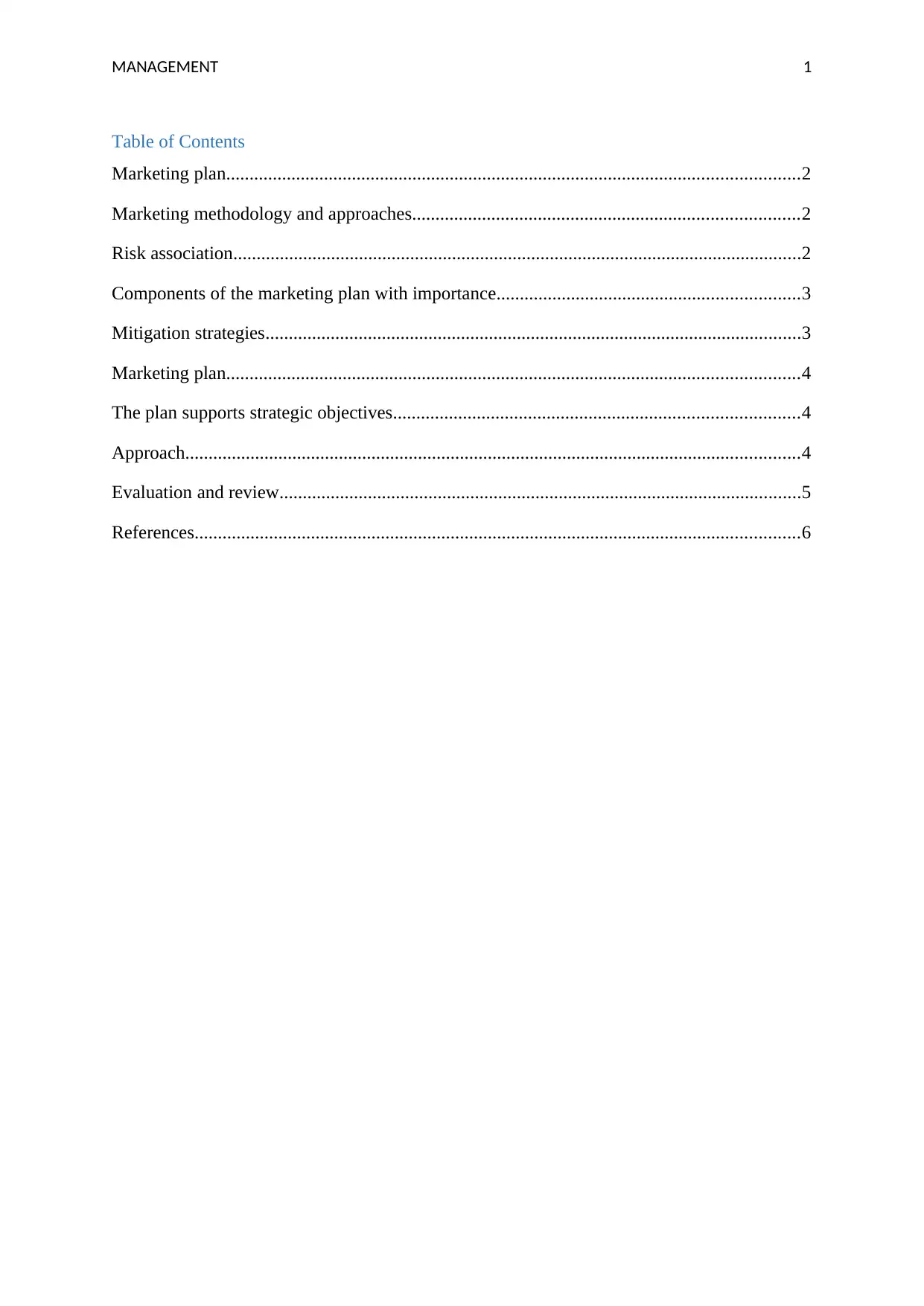
Table of Contents
Marketing plan...........................................................................................................................2
Marketing methodology and approaches...................................................................................2
Risk association..........................................................................................................................2
Components of the marketing plan with importance.................................................................3
Mitigation strategies...................................................................................................................3
Marketing plan...........................................................................................................................4
The plan supports strategic objectives.......................................................................................4
Approach....................................................................................................................................4
Evaluation and review................................................................................................................5
References..................................................................................................................................6
Table of Contents
Marketing plan...........................................................................................................................2
Marketing methodology and approaches...................................................................................2
Risk association..........................................................................................................................2
Components of the marketing plan with importance.................................................................3
Mitigation strategies...................................................................................................................3
Marketing plan...........................................................................................................................4
The plan supports strategic objectives.......................................................................................4
Approach....................................................................................................................................4
Evaluation and review................................................................................................................5
References..................................................................................................................................6

MANAGEMENT 2
Marketing plan
Marketing tools and techniques support the strategy of an organization by gathering required
data and information that is used for structuring conversations and include data deliberating
and generate options to address issues that affect the performance of the organization
(Croning-Gilmore, 2012). Strategic planning tools and techniques apply procedures to
develop effective marketing plans. These identify the big picture of many factors to identify
the information that applied to these factors and draw a conclusion for the information. These
help to understand strength and weakness by identifying opportunities and threats towards
marketing plans of the business. These affect the product life cycle theory to determine
priorities with the product portfolio. All tool and technique overall increase performance.
Marketing methodology and approaches
Marketing methodology and approaches are activities of the organization's management team
takes to pull new customers by retaining existing customers by building revenues and
increasing market share (Buchell, et al., 2013).
Observe the competition
Competition within the market is observed by competitive intelligence to identify the
competitors. This is very useful to identify the competitor’s weakness by spark the creation of
strategies to exploit the weakness.
Strategic review
Preferable annual and quarterly base support the owner of the business and team to review
marketing strategies by evaluation of present effectiveness. It supports the organization to
continuously update the strategic plan.
Risk association
A marketing plan is associated with the many risks and it is important to take actions to
remove or reduce the risk in marketing execution (Zheng, 2011).
Marketing planning
This kind of risk enter into the plans by the beginning of them and initiatives with different
strategic choices carry many levels and types of marketing risk.
Product failure
Marketing plan
Marketing tools and techniques support the strategy of an organization by gathering required
data and information that is used for structuring conversations and include data deliberating
and generate options to address issues that affect the performance of the organization
(Croning-Gilmore, 2012). Strategic planning tools and techniques apply procedures to
develop effective marketing plans. These identify the big picture of many factors to identify
the information that applied to these factors and draw a conclusion for the information. These
help to understand strength and weakness by identifying opportunities and threats towards
marketing plans of the business. These affect the product life cycle theory to determine
priorities with the product portfolio. All tool and technique overall increase performance.
Marketing methodology and approaches
Marketing methodology and approaches are activities of the organization's management team
takes to pull new customers by retaining existing customers by building revenues and
increasing market share (Buchell, et al., 2013).
Observe the competition
Competition within the market is observed by competitive intelligence to identify the
competitors. This is very useful to identify the competitor’s weakness by spark the creation of
strategies to exploit the weakness.
Strategic review
Preferable annual and quarterly base support the owner of the business and team to review
marketing strategies by evaluation of present effectiveness. It supports the organization to
continuously update the strategic plan.
Risk association
A marketing plan is associated with the many risks and it is important to take actions to
remove or reduce the risk in marketing execution (Zheng, 2011).
Marketing planning
This kind of risk enter into the plans by the beginning of them and initiatives with different
strategic choices carry many levels and types of marketing risk.
Product failure
⊘ This is a preview!⊘
Do you want full access?
Subscribe today to unlock all pages.

Trusted by 1+ million students worldwide

MANAGEMENT 3
Issues of relations with public or product can damage the reputation. A competitor can limit
the attractiveness of the product and it is hard to predict and can have more consequences at a
severe level.
Opportunity assessment
Marketing plans of an organization focuses on optimizing the preference, share, and so on.
Sales pursuit and growth of profit can lead the organization to underestimate the risk in
projects to pursue.
Components of the marketing plan with the importance
Components of marketing plans support organization to deals with the opportunities
(Winston, 2012). Following are the components with importance.
Market analysis and research
This allows to gather pertinent information around the potential market of services and
products to evaluate strength and weakness by identifying the target audience.
Marketing and financial objectives and goals
It outlines marketing and financial aims and objectives. This helps to focus and assess
marketing efforts.
Marketing mix
This evaluates specific strategies to implement and reach the target audience by spending
money and generate an aspiration in them towards organization return.
Marketing budget
This is important to develop a promoting budget that allows planning for marketing
expenditures.
Evaluating and monitoring market response
This helps to evaluate the usefulness of a marketing plan to adjust to meet goals.
Contingency plan
It describes possible adjustment to make strategies with marketing tactics that are operative
than originally planned.
Issues of relations with public or product can damage the reputation. A competitor can limit
the attractiveness of the product and it is hard to predict and can have more consequences at a
severe level.
Opportunity assessment
Marketing plans of an organization focuses on optimizing the preference, share, and so on.
Sales pursuit and growth of profit can lead the organization to underestimate the risk in
projects to pursue.
Components of the marketing plan with the importance
Components of marketing plans support organization to deals with the opportunities
(Winston, 2012). Following are the components with importance.
Market analysis and research
This allows to gather pertinent information around the potential market of services and
products to evaluate strength and weakness by identifying the target audience.
Marketing and financial objectives and goals
It outlines marketing and financial aims and objectives. This helps to focus and assess
marketing efforts.
Marketing mix
This evaluates specific strategies to implement and reach the target audience by spending
money and generate an aspiration in them towards organization return.
Marketing budget
This is important to develop a promoting budget that allows planning for marketing
expenditures.
Evaluating and monitoring market response
This helps to evaluate the usefulness of a marketing plan to adjust to meet goals.
Contingency plan
It describes possible adjustment to make strategies with marketing tactics that are operative
than originally planned.
Paraphrase This Document
Need a fresh take? Get an instant paraphrase of this document with our AI Paraphraser

MANAGEMENT 4
Checklist of marketing plan
This allows summarizing the task that desires to be accomplished by the action plan.
Mitigation strategies
Risk mitigation policies is a term that describes many ways to deal with a task. These consists
of transfer, risk avoidance, sharing, reducing, and elimination at an acceptable level (Wymer,
2011). This is important to have the strategies regarding the elimination of risk in a way to
reduce the level of minimum impact.
Risk-retention and acceptance
This is necessary to identify and take actions to reduce the risk with possible consequences.
Risk reduction
It is essential to take some measures to reduce the risk at an acceptable level.
Risk transfer
For this organization can take the benefits of insurance or can transfer the risk to other
organization by the outsourcing.
Risk avoidance
This is important to realize the intentions from the risk arise and it is helpful to identify that
organization will not launce product or not conclude a contract.
Marketing plan
Organization marketing plan presents the structure of organization success (Johnson, 2012).
To develop a advertising plan it is necessary to develop the following steps.
Business goals
This is necessary to align with the highest levels of business goal line and objectives to
generate awareness of organization amenities, products and produce new opportunities to
sales that meet organization target audience profile.
Goals and budget
Checklist of marketing plan
This allows summarizing the task that desires to be accomplished by the action plan.
Mitigation strategies
Risk mitigation policies is a term that describes many ways to deal with a task. These consists
of transfer, risk avoidance, sharing, reducing, and elimination at an acceptable level (Wymer,
2011). This is important to have the strategies regarding the elimination of risk in a way to
reduce the level of minimum impact.
Risk-retention and acceptance
This is necessary to identify and take actions to reduce the risk with possible consequences.
Risk reduction
It is essential to take some measures to reduce the risk at an acceptable level.
Risk transfer
For this organization can take the benefits of insurance or can transfer the risk to other
organization by the outsourcing.
Risk avoidance
This is important to realize the intentions from the risk arise and it is helpful to identify that
organization will not launce product or not conclude a contract.
Marketing plan
Organization marketing plan presents the structure of organization success (Johnson, 2012).
To develop a advertising plan it is necessary to develop the following steps.
Business goals
This is necessary to align with the highest levels of business goal line and objectives to
generate awareness of organization amenities, products and produce new opportunities to
sales that meet organization target audience profile.
Goals and budget

MANAGEMENT 5
This is necessary to provide a consistent flow of high quality leads to help and fuel sales
opportunities that drive growth. This is necessary to use a smart marketing approach that
builds an execution to plan and aligned with business goals
Target persons
This is an essential part to identify the summary of the most valued prospects with the sales
procedure to convert them that leads to prospects towards customers.
Execution plan
Generated marketing goals develop an activity plan as a marketing communication plan as an
effective way to focus on the common goal. It provides a picture to establish the objectives.
Organize and measure
Define marketing team roles determine the achieve results with the evaluation of plan
annually and quarterly.
The plan cares strategic objectives
This is important to understand the importance of strategic objectives and review as a
strategic planning process (Robinson, 2012).
Proactive in place of reactive
This allows the organization to foresee the future and prepare according to the strategic
planning that organization can anticipate particular unfavorable scenarios with the
precautions to avoid them. A proactive approach allows to keep up with the change trends in
the market to step ahead of the competition.
Sense of direction
This support to define the trend with the business must travel and establish realistic goals and
objectives that in line by the mission and vision followed out for it. This offers an important
foundation in which the organization can develop, evaluate success and compensate
employees to establish boundaries for effective decision making.
Approach
An approach like tactics and actions refers to gain the agreement with the agreement for the
marketing plan that changes actions and methods to accomplish strategic objectives (Phelan,
2011).
This is necessary to provide a consistent flow of high quality leads to help and fuel sales
opportunities that drive growth. This is necessary to use a smart marketing approach that
builds an execution to plan and aligned with business goals
Target persons
This is an essential part to identify the summary of the most valued prospects with the sales
procedure to convert them that leads to prospects towards customers.
Execution plan
Generated marketing goals develop an activity plan as a marketing communication plan as an
effective way to focus on the common goal. It provides a picture to establish the objectives.
Organize and measure
Define marketing team roles determine the achieve results with the evaluation of plan
annually and quarterly.
The plan cares strategic objectives
This is important to understand the importance of strategic objectives and review as a
strategic planning process (Robinson, 2012).
Proactive in place of reactive
This allows the organization to foresee the future and prepare according to the strategic
planning that organization can anticipate particular unfavorable scenarios with the
precautions to avoid them. A proactive approach allows to keep up with the change trends in
the market to step ahead of the competition.
Sense of direction
This support to define the trend with the business must travel and establish realistic goals and
objectives that in line by the mission and vision followed out for it. This offers an important
foundation in which the organization can develop, evaluate success and compensate
employees to establish boundaries for effective decision making.
Approach
An approach like tactics and actions refers to gain the agreement with the agreement for the
marketing plan that changes actions and methods to accomplish strategic objectives (Phelan,
2011).
⊘ This is a preview!⊘
Do you want full access?
Subscribe today to unlock all pages.

Trusted by 1+ million students worldwide

MANAGEMENT 6
Tactics and actions
A detailed marketing action plan helps to generate and establish a step that explores options
and contract by the specific tasks to an external agency or consultant. An action plan with
detail nominate to work and sets date to complete more work with the set of instructions with
an action plan that becomes work instruction for different people and enables to enlist support
towards opportunities by carrying new tasks with the detailed brief.
Evaluation and review
Information from the evaluation and review provide resources to determine and adapt
successfully sources with the planned and implemented actions. By consistently use of
standard evaluation will allow focussing on the performance objectives that are essential to
match the requirements. This serves as a measurement tool during the assessment of
described organizational roles.
Tactics and actions
A detailed marketing action plan helps to generate and establish a step that explores options
and contract by the specific tasks to an external agency or consultant. An action plan with
detail nominate to work and sets date to complete more work with the set of instructions with
an action plan that becomes work instruction for different people and enables to enlist support
towards opportunities by carrying new tasks with the detailed brief.
Evaluation and review
Information from the evaluation and review provide resources to determine and adapt
successfully sources with the planned and implemented actions. By consistently use of
standard evaluation will allow focussing on the performance objectives that are essential to
match the requirements. This serves as a measurement tool during the assessment of
described organizational roles.
Paraphrase This Document
Need a fresh take? Get an instant paraphrase of this document with our AI Paraphraser

MANAGEMENT 7
References
Buchell, K., Ruth, R. & Patel, K., 2013. Marketing Social Norms. Journal of Consumer
Behavior, 12(01), pp. 01-09.
Croning-Gilmore, J., 2012. Marketing Plan. Journal of Marketing Development and
Competitiveness, 06(01), pp. 96-107.
Johnson, M., 2012. Marketing Plan in Business. Journal of Marketing Development and
Competitiveness, 06(01), pp. 96-107.
Phelan, W., 2011. Marketing Optimization. Journal of Strategic Management, 07(01), pp.
327-904.
Robinson, C., 2012. Application and Implication. Journal of Business Management, 25(01),
pp. 04-12.
Winston, W., 2012. Components of Marketing Plans with Importance. I ed. UK: Routledge.
Wymer, W., 2011. Effective Social Marketing Strategies. Journal of Social Marketing,
01(01), pp. 17-31.
Zheng, W., 2011. Association. Journal of Business Ethics, 364(08), pp. 719-729.
References
Buchell, K., Ruth, R. & Patel, K., 2013. Marketing Social Norms. Journal of Consumer
Behavior, 12(01), pp. 01-09.
Croning-Gilmore, J., 2012. Marketing Plan. Journal of Marketing Development and
Competitiveness, 06(01), pp. 96-107.
Johnson, M., 2012. Marketing Plan in Business. Journal of Marketing Development and
Competitiveness, 06(01), pp. 96-107.
Phelan, W., 2011. Marketing Optimization. Journal of Strategic Management, 07(01), pp.
327-904.
Robinson, C., 2012. Application and Implication. Journal of Business Management, 25(01),
pp. 04-12.
Winston, W., 2012. Components of Marketing Plans with Importance. I ed. UK: Routledge.
Wymer, W., 2011. Effective Social Marketing Strategies. Journal of Social Marketing,
01(01), pp. 17-31.
Zheng, W., 2011. Association. Journal of Business Ethics, 364(08), pp. 719-729.
1 out of 8
Related Documents
Your All-in-One AI-Powered Toolkit for Academic Success.
+13062052269
info@desklib.com
Available 24*7 on WhatsApp / Email
Unlock your academic potential
Copyright © 2020–2025 A2Z Services. All Rights Reserved. Developed and managed by ZUCOL.