Strategic Networks Unit: PSPGEN067 Activities Assessment Guide
VerifiedAdded on 2022/12/09
|17
|5765
|179
Homework Assignment
AI Summary
This assignment assesses the student's understanding of strategic networks, as outlined in the PSPGEN067 unit. The assessment comprises multiple activities, including identifying different types of networks, benefits of networking, key stakeholders, and the differences between internal and external stakeholders. The student explores the advantages of maintaining and expanding existing networks, building new relationships, and the importance of good people skills. The assignment also delves into strategic communication, the advantages and disadvantages of technology in communication, and the developments that need to be discussed with stakeholders. The student provides detailed answers, demonstrating their knowledge of the unit's core concepts and their ability to apply them to real-world scenarios. The assignment covers a range of topics, including communication channels, technology's impact, and stakeholder management, providing a comprehensive overview of strategic networks and their practical applications.
Assessment Guide
PSPGEN067 Establish and maintain
strategic networks
PSPGEN067 Assessment Guide V1
1 | P a g e
PSPGEN067 Establish and maintain
strategic networks
PSPGEN067 Assessment Guide V1
1 | P a g e

Paraphrase This Document
Need a fresh take? Get an instant paraphrase of this document with our AI Paraphraser
Introduction
This Assessment Booklet provides you with information and your assessment tasks for this
unit. A requirement of your qualification, from which the unit of competence is taken, is the
application of the concepts you have been learning.
The assessment activities are an important part of your course as they provide an opportunity
to apply what you have been learning and they give both you and your trainer feedback on
your progress.
Please read this section carefully before commencing the assessment tasks.
RECOGNITION OF PRIOR LEARNING
If you can demonstrate that you have the skills and knowledge within this unit, you should
speak to a trainer/assessor about this and apply for recognition of prior learning.
COMPLETING YOUR ASSESSMENTS
Prior to Assessment
You must be advised of your rights before and after the assessments including the right to
appeal.
Assessors must provide you with all relevant information relating to the assessments prior to
commencement and of the appeals procedure that can be utilised if you wish to appeal against
the assessment outcome or make a complaint.
Submitting Assessments
Each part of this assessment booklet needs to be carefully completed and you are required to
attain a ‘satisfactory’ mark for each of the assessment activities. Full details of what is required
have been detailed in instructions before each assessment task.
You must submit assessment tasks with the cover sheet provided at the end of this Booklet.
You must attach one cover sheet per assessment upon submission, ticking the relevant
assessment box. Ensure you sign the form after completion.
Assessments should be submitted on or before their due date. Extensions for individual
assessment tasks may be negotiated in specific circumstances. Consultation on this must
occur prior to the due date and extensions due to illness will require a medical certificate.
Extensions will be confirmed to you in writing.
Plagiarism and Referencing
You are reminded that plagiarism will not be tolerated. Information, ideas etc. quoted or
paraphrased from another source, must be acknowledged with “quotation marks” around the
relevant words/sentences or ideas and cited at the end of the document. Sources of
information, ideas etc. must be provided in alphabetical order by author’s surname (including
author’s full name, name of document/ book/internet etc. and year and place of publishing) or
may be included in brackets in the text.
PSPGEN067Assessment Guide V1
2 | P a g e
This Assessment Booklet provides you with information and your assessment tasks for this
unit. A requirement of your qualification, from which the unit of competence is taken, is the
application of the concepts you have been learning.
The assessment activities are an important part of your course as they provide an opportunity
to apply what you have been learning and they give both you and your trainer feedback on
your progress.
Please read this section carefully before commencing the assessment tasks.
RECOGNITION OF PRIOR LEARNING
If you can demonstrate that you have the skills and knowledge within this unit, you should
speak to a trainer/assessor about this and apply for recognition of prior learning.
COMPLETING YOUR ASSESSMENTS
Prior to Assessment
You must be advised of your rights before and after the assessments including the right to
appeal.
Assessors must provide you with all relevant information relating to the assessments prior to
commencement and of the appeals procedure that can be utilised if you wish to appeal against
the assessment outcome or make a complaint.
Submitting Assessments
Each part of this assessment booklet needs to be carefully completed and you are required to
attain a ‘satisfactory’ mark for each of the assessment activities. Full details of what is required
have been detailed in instructions before each assessment task.
You must submit assessment tasks with the cover sheet provided at the end of this Booklet.
You must attach one cover sheet per assessment upon submission, ticking the relevant
assessment box. Ensure you sign the form after completion.
Assessments should be submitted on or before their due date. Extensions for individual
assessment tasks may be negotiated in specific circumstances. Consultation on this must
occur prior to the due date and extensions due to illness will require a medical certificate.
Extensions will be confirmed to you in writing.
Plagiarism and Referencing
You are reminded that plagiarism will not be tolerated. Information, ideas etc. quoted or
paraphrased from another source, must be acknowledged with “quotation marks” around the
relevant words/sentences or ideas and cited at the end of the document. Sources of
information, ideas etc. must be provided in alphabetical order by author’s surname (including
author’s full name, name of document/ book/internet etc. and year and place of publishing) or
may be included in brackets in the text.
PSPGEN067Assessment Guide V1
2 | P a g e
ASSESSMENT OUTCOMES
The evidence you submit will be assessed and you will be given written feedback. Each
assessment task will be marked as either Satisfactory or Unsatisfactory and once all
assessments have been marked you will be given an outcome of Competent or Not Competent
for the unit of competence. Upon demonstrating competence, you will be awarded this unit. If
you are assessed as Not Competent, you will be given some suggestions for improvement and
asked to redo your assessment.
Re-assessment
In the event you are deemed Unsatisfactory, you will be allowed two (2) further attempts at an
assessment within the timeframe of this course.
As part of the assessment process, you must abide by any relevant assessment policies as
provided to you. If you feel you are not yet ready to be assessed or this assessment is unfair,
you should be offered the opportunity to discuss all options that are available to you to
complete the assessment.
Reasonable Adjustment
RTOs and Trainers/Assessors are obliged by law to make reasonable adjustment to ensure
maximum participation of students with disability in teaching, learning and assessment
activities. This includes:
• ensuring that course activities are sufficiently flexible;
• providing additional support where necessary; and
• offering a reasonable substitute within the context of the course where a student cannot
participate.
Reasonable adjustment is defined in section 4(1) of the Employment and the Disability
Discrimination Act as ‘an adjustment to be made by a person is a reasonable adjustment
unless making the adjustment would impose an unjustifiable hardship on the person’.
Reasonable adjustment as it applies to participation in learning and assessment activities may
include:
• customising resources or activities within a training package or accredited course;
• modifying a presentation medium;
• providing additional support;
• providing assistive or adaptive technologies;
• making additional information accessible both before enrolment and during the course;
and
• monitoring these adjustments to ensure that the student’s needs continue to be met.
An individual’s access to the assessment process should not be adversely affected by
restrictions placed on the location or context of assessment beyond the requirements specified
in the training package. Reasonable adjustments can be made to ensure equity in assessment
for people with disabilities. Adjustments include any changes to the assessment process or
context that meet the individual needs of the person with a disability, but do not change
competency outcomes.
The assessment process must:
Provide for valid, reliable, flexible and fair assessment
Provide for judgement to be made on the basis of sufficient evidence
Offer valid, authentic and current evidence.
PSPGEN067Assessment Guide V1
3 | P a g e
The evidence you submit will be assessed and you will be given written feedback. Each
assessment task will be marked as either Satisfactory or Unsatisfactory and once all
assessments have been marked you will be given an outcome of Competent or Not Competent
for the unit of competence. Upon demonstrating competence, you will be awarded this unit. If
you are assessed as Not Competent, you will be given some suggestions for improvement and
asked to redo your assessment.
Re-assessment
In the event you are deemed Unsatisfactory, you will be allowed two (2) further attempts at an
assessment within the timeframe of this course.
As part of the assessment process, you must abide by any relevant assessment policies as
provided to you. If you feel you are not yet ready to be assessed or this assessment is unfair,
you should be offered the opportunity to discuss all options that are available to you to
complete the assessment.
Reasonable Adjustment
RTOs and Trainers/Assessors are obliged by law to make reasonable adjustment to ensure
maximum participation of students with disability in teaching, learning and assessment
activities. This includes:
• ensuring that course activities are sufficiently flexible;
• providing additional support where necessary; and
• offering a reasonable substitute within the context of the course where a student cannot
participate.
Reasonable adjustment is defined in section 4(1) of the Employment and the Disability
Discrimination Act as ‘an adjustment to be made by a person is a reasonable adjustment
unless making the adjustment would impose an unjustifiable hardship on the person’.
Reasonable adjustment as it applies to participation in learning and assessment activities may
include:
• customising resources or activities within a training package or accredited course;
• modifying a presentation medium;
• providing additional support;
• providing assistive or adaptive technologies;
• making additional information accessible both before enrolment and during the course;
and
• monitoring these adjustments to ensure that the student’s needs continue to be met.
An individual’s access to the assessment process should not be adversely affected by
restrictions placed on the location or context of assessment beyond the requirements specified
in the training package. Reasonable adjustments can be made to ensure equity in assessment
for people with disabilities. Adjustments include any changes to the assessment process or
context that meet the individual needs of the person with a disability, but do not change
competency outcomes.
The assessment process must:
Provide for valid, reliable, flexible and fair assessment
Provide for judgement to be made on the basis of sufficient evidence
Offer valid, authentic and current evidence.
PSPGEN067Assessment Guide V1
3 | P a g e
⊘ This is a preview!⊘
Do you want full access?
Subscribe today to unlock all pages.

Trusted by 1+ million students worldwide
COMPETENCY ASSESSMENT
Within this qualification are units of competency that form the basis of your assessments.
These can be located in your Unit Outline Booklet.
ASSESSMENTS FOR THIS UNIT
There are three (3) forms of assessment or evidence gathering methods for this unit of
competency. You are required to complete and submit all the assessments.
Assessment 1. Activities
This assessment consists of eight (8)activities to assess your knowledge of this unit. You must
answer all questions. Most questions require short answers although some questions require a
more detailed response. You should provide typed responses. You may use various sources of
information including: text books, learning workbooks, other documents and the internet and
must list your sources.
Assessment 2. Skills & Knowledge Activity
This assessment provides the student with an opportunity to demonstrate their knowledge of
the foundation skills, knowledge evidence and performance evidence of this unit. The student
will be required to respond to six (6) questions relating to a range of communication methods
and channels with diverse strategic networks, applying legislation, regulations and policies
relating to public sector environment, resolving conflict in a strategic networking context and
applying procedures relating to occupational health and safety and environment in the context
of strategic networking.
Students must record their answers in a separate A4 document and submit by attaching to
their cover page.
Assessment 3. Major Activity
This assessment is a major activity which consists of four (4) questions to assess the student’s
knowledge of the entire unit.
PSPGEN067Assessment Guide V1
4 | P a g e
Within this qualification are units of competency that form the basis of your assessments.
These can be located in your Unit Outline Booklet.
ASSESSMENTS FOR THIS UNIT
There are three (3) forms of assessment or evidence gathering methods for this unit of
competency. You are required to complete and submit all the assessments.
Assessment 1. Activities
This assessment consists of eight (8)activities to assess your knowledge of this unit. You must
answer all questions. Most questions require short answers although some questions require a
more detailed response. You should provide typed responses. You may use various sources of
information including: text books, learning workbooks, other documents and the internet and
must list your sources.
Assessment 2. Skills & Knowledge Activity
This assessment provides the student with an opportunity to demonstrate their knowledge of
the foundation skills, knowledge evidence and performance evidence of this unit. The student
will be required to respond to six (6) questions relating to a range of communication methods
and channels with diverse strategic networks, applying legislation, regulations and policies
relating to public sector environment, resolving conflict in a strategic networking context and
applying procedures relating to occupational health and safety and environment in the context
of strategic networking.
Students must record their answers in a separate A4 document and submit by attaching to
their cover page.
Assessment 3. Major Activity
This assessment is a major activity which consists of four (4) questions to assess the student’s
knowledge of the entire unit.
PSPGEN067Assessment Guide V1
4 | P a g e
Paraphrase This Document
Need a fresh take? Get an instant paraphrase of this document with our AI Paraphraser
Assessment 1: Activities
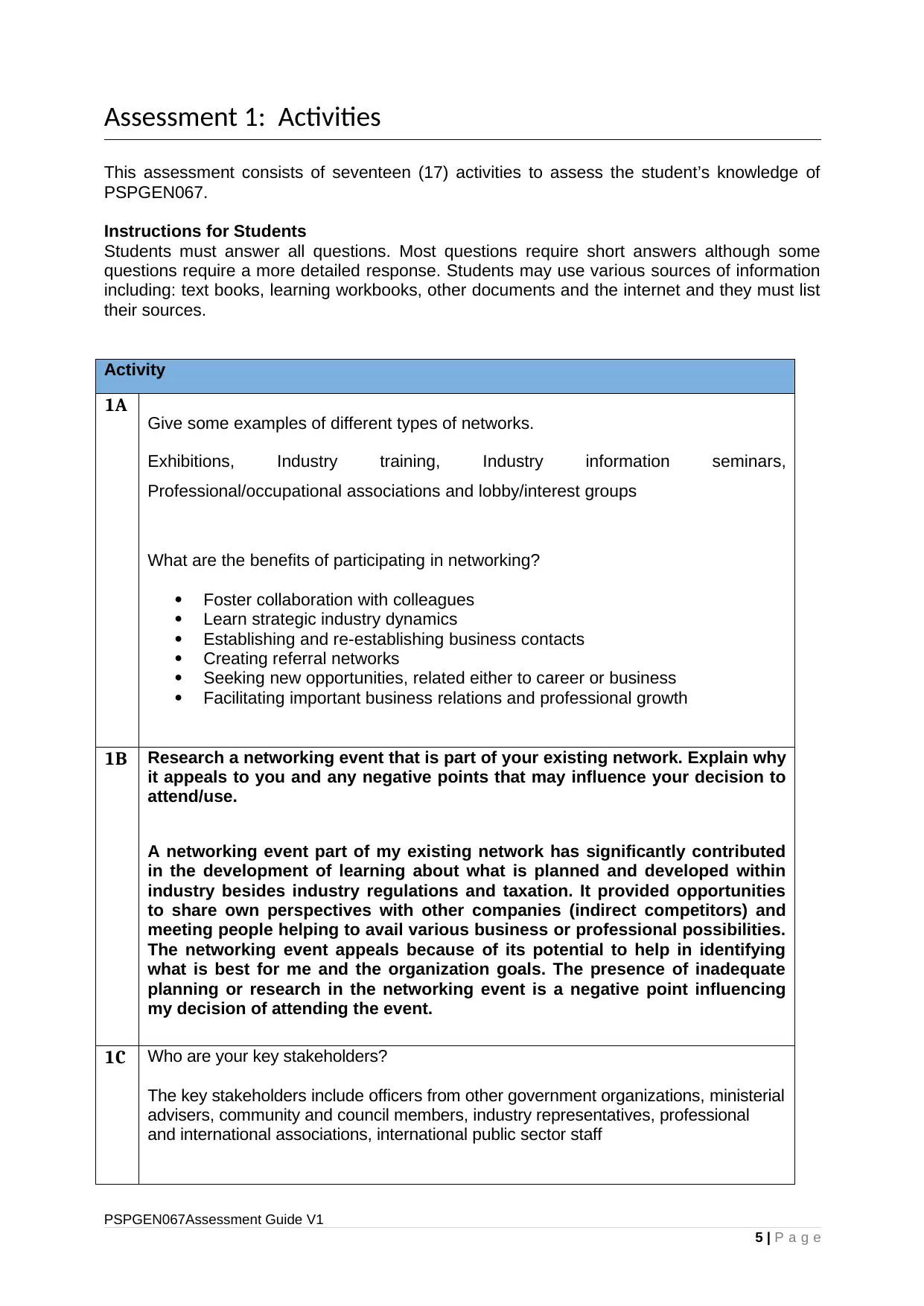
This assessment consists of seventeen (17) activities to assess the student’s knowledge of
PSPGEN067.
Instructions for Students
Students must answer all questions. Most questions require short answers although some
questions require a more detailed response. Students may use various sources of information
including: text books, learning workbooks, other documents and the internet and they must list
their sources.
Activity
1A Give some examples of different types of networks.
Exhibitions, Industry training, Industry information seminars,
Professional/occupational associations and lobby/interest groups
What are the benefits of participating in networking?
Foster collaboration with colleagues
Learn strategic industry dynamics
Establishing and re-establishing business contacts
Creating referral networks
Seeking new opportunities, related either to career or business
Facilitating important business relations and professional growth
1B Research a networking event that is part of your existing network. Explain why
it appeals to you and any negative points that may influence your decision to
attend/use.
A networking event part of my existing network has significantly contributed
in the development of learning about what is planned and developed within
industry besides industry regulations and taxation. It provided opportunities
to share own perspectives with other companies (indirect competitors) and
meeting people helping to avail various business or professional possibilities.
The networking event appeals because of its potential to help in identifying
what is best for me and the organization goals. The presence of inadequate
planning or research in the networking event is a negative point influencing
my decision of attending the event.
1C Who are your key stakeholders?
The key stakeholders include officers from other government organizations, ministerial
advisers, community and council members, industry representatives, professional
and international associations, international public sector staff
PSPGEN067Assessment Guide V1
5 | P a g e
This assessment consists of seventeen (17) activities to assess the student’s knowledge of
PSPGEN067.
Instructions for Students
Students must answer all questions. Most questions require short answers although some
questions require a more detailed response. Students may use various sources of information
including: text books, learning workbooks, other documents and the internet and they must list
their sources.
Activity
1A Give some examples of different types of networks.
Exhibitions, Industry training, Industry information seminars,
Professional/occupational associations and lobby/interest groups
What are the benefits of participating in networking?
Foster collaboration with colleagues
Learn strategic industry dynamics
Establishing and re-establishing business contacts
Creating referral networks
Seeking new opportunities, related either to career or business
Facilitating important business relations and professional growth
1B Research a networking event that is part of your existing network. Explain why
it appeals to you and any negative points that may influence your decision to
attend/use.
A networking event part of my existing network has significantly contributed
in the development of learning about what is planned and developed within
industry besides industry regulations and taxation. It provided opportunities
to share own perspectives with other companies (indirect competitors) and
meeting people helping to avail various business or professional possibilities.
The networking event appeals because of its potential to help in identifying
what is best for me and the organization goals. The presence of inadequate
planning or research in the networking event is a negative point influencing
my decision of attending the event.
1C Who are your key stakeholders?
The key stakeholders include officers from other government organizations, ministerial
advisers, community and council members, industry representatives, professional
and international associations, international public sector staff
PSPGEN067Assessment Guide V1
5 | P a g e
Activity
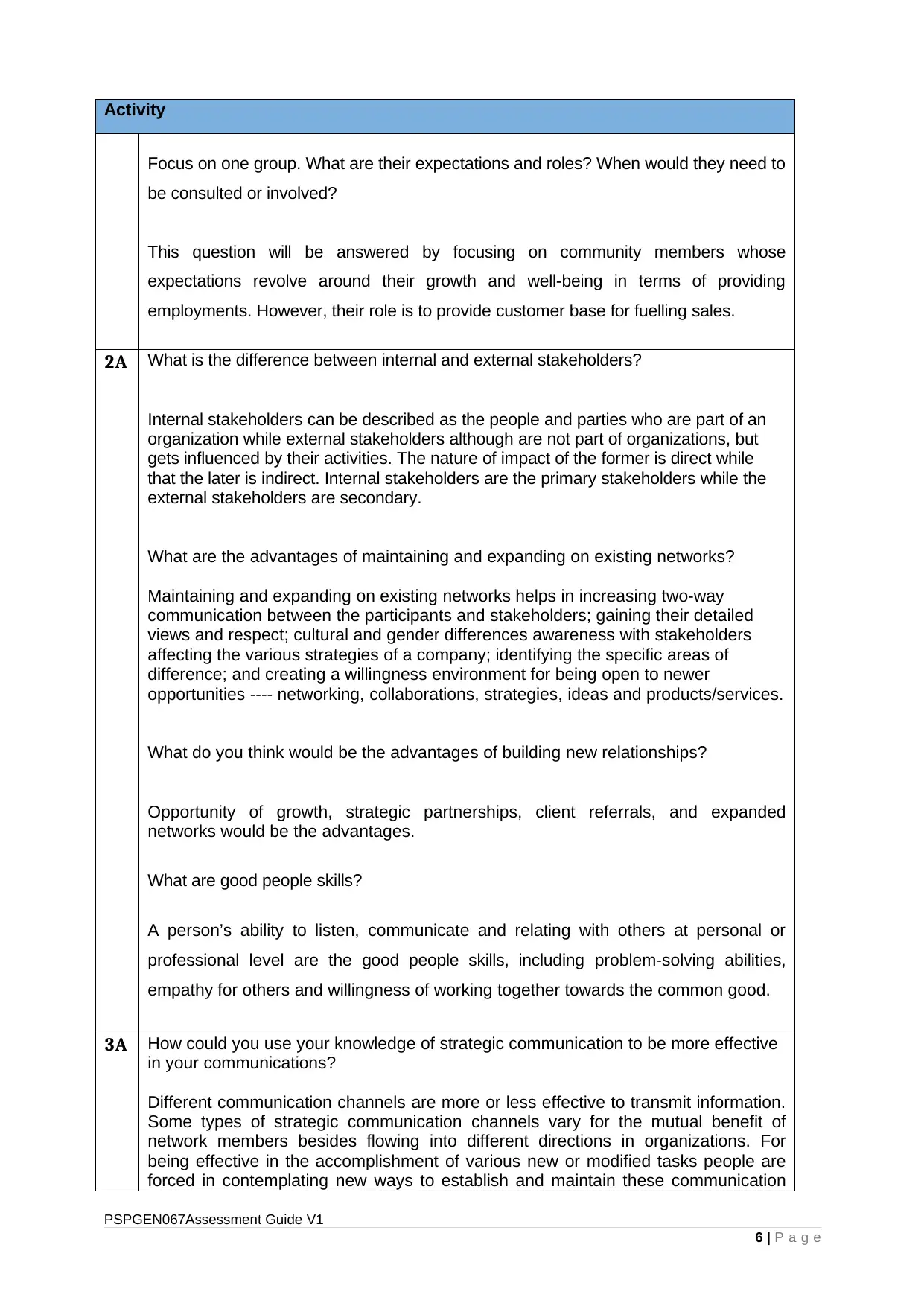
Focus on one group. What are their expectations and roles? When would they need to
be consulted or involved?
This question will be answered by focusing on community members whose
expectations revolve around their growth and well-being in terms of providing
employments. However, their role is to provide customer base for fuelling sales.
2A What is the difference between internal and external stakeholders?
Internal stakeholders can be described as the people and parties who are part of an
organization while external stakeholders although are not part of organizations, but
gets influenced by their activities. The nature of impact of the former is direct while
that the later is indirect. Internal stakeholders are the primary stakeholders while the
external stakeholders are secondary.
What are the advantages of maintaining and expanding on existing networks?
Maintaining and expanding on existing networks helps in increasing two-way
communication between the participants and stakeholders; gaining their detailed
views and respect; cultural and gender differences awareness with stakeholders
affecting the various strategies of a company; identifying the specific areas of
difference; and creating a willingness environment for being open to newer
opportunities ---- networking, collaborations, strategies, ideas and products/services.
What do you think would be the advantages of building new relationships?
Opportunity of growth, strategic partnerships, client referrals, and expanded
networks would be the advantages.
What are good people skills?
A person’s ability to listen, communicate and relating with others at personal or
professional level are the good people skills, including problem-solving abilities,
empathy for others and willingness of working together towards the common good.
3A How could you use your knowledge of strategic communication to be more effective
in your communications?
Different communication channels are more or less effective to transmit information.
Some types of strategic communication channels vary for the mutual benefit of
network members besides flowing into different directions in organizations. For
being effective in the accomplishment of various new or modified tasks people are
forced in contemplating new ways to establish and maintain these communication
PSPGEN067Assessment Guide V1
6 | P a g e
Focus on one group. What are their expectations and roles? When would they need to
be consulted or involved?
This question will be answered by focusing on community members whose
expectations revolve around their growth and well-being in terms of providing
employments. However, their role is to provide customer base for fuelling sales.
2A What is the difference between internal and external stakeholders?
Internal stakeholders can be described as the people and parties who are part of an
organization while external stakeholders although are not part of organizations, but
gets influenced by their activities. The nature of impact of the former is direct while
that the later is indirect. Internal stakeholders are the primary stakeholders while the
external stakeholders are secondary.
What are the advantages of maintaining and expanding on existing networks?
Maintaining and expanding on existing networks helps in increasing two-way
communication between the participants and stakeholders; gaining their detailed
views and respect; cultural and gender differences awareness with stakeholders
affecting the various strategies of a company; identifying the specific areas of
difference; and creating a willingness environment for being open to newer
opportunities ---- networking, collaborations, strategies, ideas and products/services.
What do you think would be the advantages of building new relationships?
Opportunity of growth, strategic partnerships, client referrals, and expanded
networks would be the advantages.
What are good people skills?
A person’s ability to listen, communicate and relating with others at personal or
professional level are the good people skills, including problem-solving abilities,
empathy for others and willingness of working together towards the common good.
3A How could you use your knowledge of strategic communication to be more effective
in your communications?
Different communication channels are more or less effective to transmit information.
Some types of strategic communication channels vary for the mutual benefit of
network members besides flowing into different directions in organizations. For
being effective in the accomplishment of various new or modified tasks people are
forced in contemplating new ways to establish and maintain these communication
PSPGEN067Assessment Guide V1
6 | P a g e
⊘ This is a preview!⊘
Do you want full access?
Subscribe today to unlock all pages.
Trusted by 1+ million students worldwide
Activity
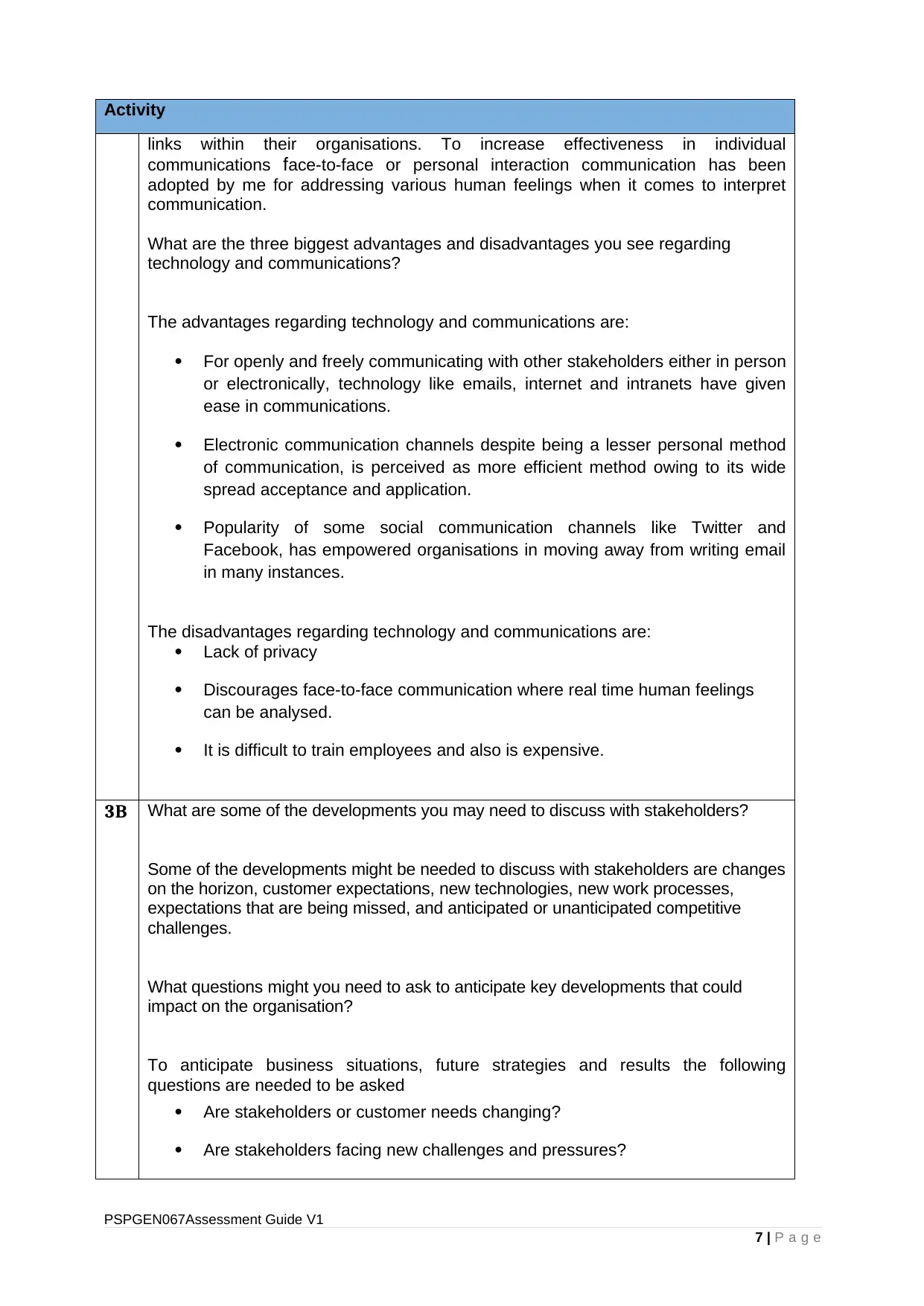
links within their organisations. To increase effectiveness in individual
communications face-to-face or personal interaction communication has been
adopted by me for addressing various human feelings when it comes to interpret
communication.
What are the three biggest advantages and disadvantages you see regarding
technology and communications?
The advantages regarding technology and communications are:
For openly and freely communicating with other stakeholders either in person
or electronically, technology like emails, internet and intranets have given
ease in communications.
Electronic communication channels despite being a lesser personal method
of communication, is perceived as more efficient method owing to its wide
spread acceptance and application.
Popularity of some social communication channels like Twitter and
Facebook, has empowered organisations in moving away from writing email
in many instances.
The disadvantages regarding technology and communications are:
Lack of privacy
Discourages face-to-face communication where real time human feelings
can be analysed.
It is difficult to train employees and also is expensive.
3B What are some of the developments you may need to discuss with stakeholders?
Some of the developments might be needed to discuss with stakeholders are changes
on the horizon, customer expectations, new technologies, new work processes,
expectations that are being missed, and anticipated or unanticipated competitive
challenges.
What questions might you need to ask to anticipate key developments that could
impact on the organisation?
To anticipate business situations, future strategies and results the following
questions are needed to be asked
Are stakeholders or customer needs changing?
Are stakeholders facing new challenges and pressures?
PSPGEN067Assessment Guide V1
7 | P a g e
links within their organisations. To increase effectiveness in individual
communications face-to-face or personal interaction communication has been
adopted by me for addressing various human feelings when it comes to interpret
communication.
What are the three biggest advantages and disadvantages you see regarding
technology and communications?
The advantages regarding technology and communications are:
For openly and freely communicating with other stakeholders either in person
or electronically, technology like emails, internet and intranets have given
ease in communications.
Electronic communication channels despite being a lesser personal method
of communication, is perceived as more efficient method owing to its wide
spread acceptance and application.
Popularity of some social communication channels like Twitter and
Facebook, has empowered organisations in moving away from writing email
in many instances.
The disadvantages regarding technology and communications are:
Lack of privacy
Discourages face-to-face communication where real time human feelings
can be analysed.
It is difficult to train employees and also is expensive.
3B What are some of the developments you may need to discuss with stakeholders?
Some of the developments might be needed to discuss with stakeholders are changes
on the horizon, customer expectations, new technologies, new work processes,
expectations that are being missed, and anticipated or unanticipated competitive
challenges.
What questions might you need to ask to anticipate key developments that could
impact on the organisation?
To anticipate business situations, future strategies and results the following
questions are needed to be asked
Are stakeholders or customer needs changing?
Are stakeholders facing new challenges and pressures?
PSPGEN067Assessment Guide V1
7 | P a g e
Paraphrase This Document
Need a fresh take? Get an instant paraphrase of this document with our AI Paraphraser
Activity
Is the economy of the business or a financial sector changing?
Is the business facing with new challenges and pressures derived from
certain key stakeholders?
Are information systems supporting the organisation?
Are key stakeholders aware if organisation is working in the right direction?
Is the strategy current and on track?
Is reviewing or evaluating the priorities needs?
Is there a concern about the current environment?
Is the decision-making process effective?
Are the business results on track?
Are key stakeholders concerned or happy with goals and objectives?
Are there areas of customer satisfaction that may need addressing?
Does financial targets needed to be adjusted?
Is the organisation staffed accordingly?
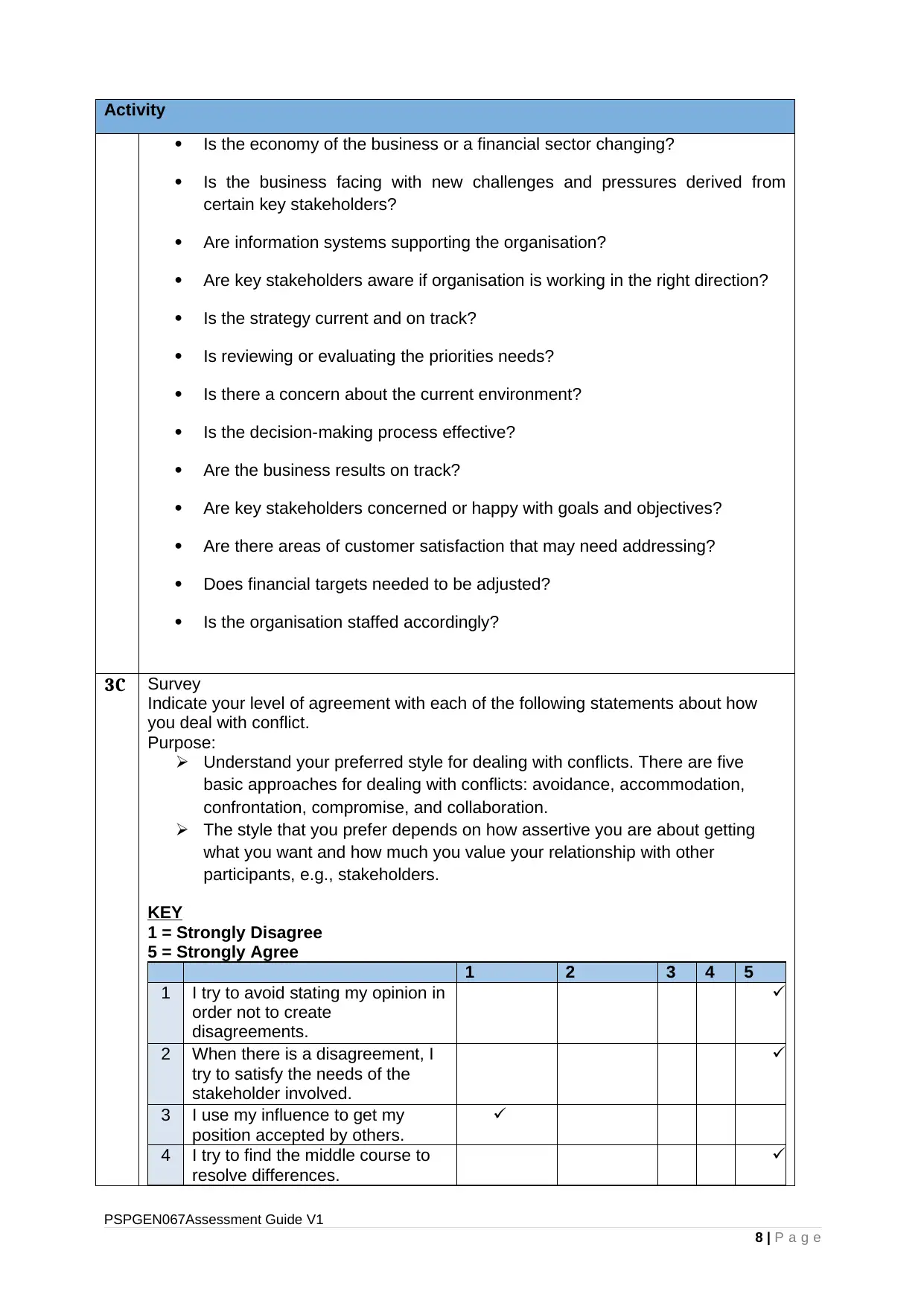
3C Survey
Indicate your level of agreement with each of the following statements about how
you deal with conflict.
Purpose:
Understand your preferred style for dealing with conflicts. There are five
basic approaches for dealing with conflicts: avoidance, accommodation,
confrontation, compromise, and collaboration.
The style that you prefer depends on how assertive you are about getting
what you want and how much you value your relationship with other
participants, e.g., stakeholders.
KEY
1 = Strongly Disagree
5 = Strongly Agree
1 2 3 4 5
1 I try to avoid stating my opinion in
order not to create
disagreements.
2 When there is a disagreement, I
try to satisfy the needs of the
stakeholder involved.
3 I use my influence to get my
position accepted by others.
4 I try to find the middle course to
resolve differences.
PSPGEN067Assessment Guide V1
8 | P a g e
Is the economy of the business or a financial sector changing?
Is the business facing with new challenges and pressures derived from
certain key stakeholders?
Are information systems supporting the organisation?
Are key stakeholders aware if organisation is working in the right direction?
Is the strategy current and on track?
Is reviewing or evaluating the priorities needs?
Is there a concern about the current environment?
Is the decision-making process effective?
Are the business results on track?
Are key stakeholders concerned or happy with goals and objectives?
Are there areas of customer satisfaction that may need addressing?
Does financial targets needed to be adjusted?
Is the organisation staffed accordingly?
3C Survey
Indicate your level of agreement with each of the following statements about how
you deal with conflict.
Purpose:
Understand your preferred style for dealing with conflicts. There are five
basic approaches for dealing with conflicts: avoidance, accommodation,
confrontation, compromise, and collaboration.
The style that you prefer depends on how assertive you are about getting
what you want and how much you value your relationship with other
participants, e.g., stakeholders.
KEY
1 = Strongly Disagree
5 = Strongly Agree
1 2 3 4 5
1 I try to avoid stating my opinion in
order not to create
disagreements.
2 When there is a disagreement, I
try to satisfy the needs of the
stakeholder involved.
3 I use my influence to get my
position accepted by others.
4 I try to find the middle course to
resolve differences.
PSPGEN067Assessment Guide V1
8 | P a g e
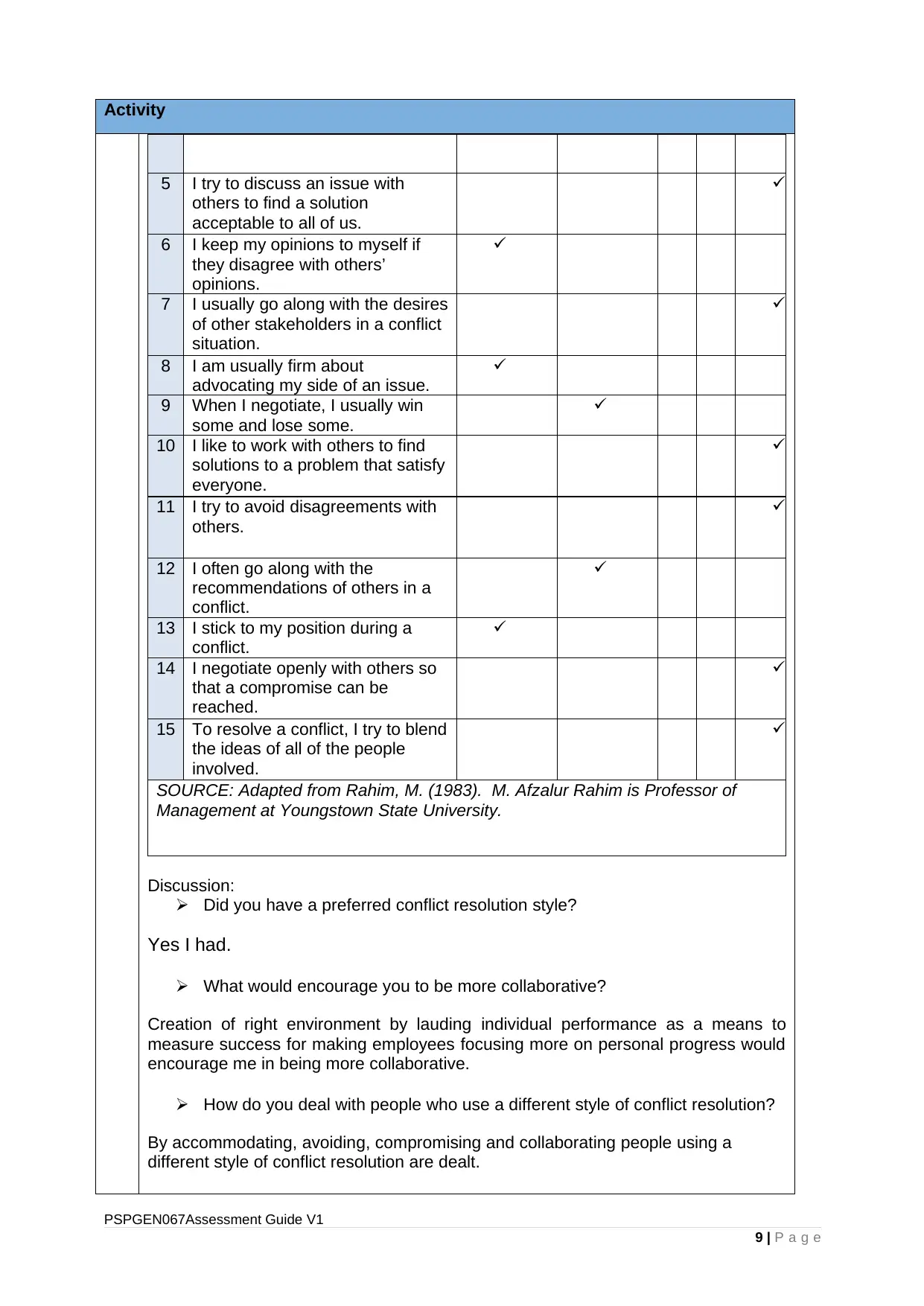
Activity
5 I try to discuss an issue with
others to find a solution
acceptable to all of us.
6 I keep my opinions to myself if
they disagree with others’
opinions.
7 I usually go along with the desires
of other stakeholders in a conflict
situation.
8 I am usually firm about
advocating my side of an issue.
9 When I negotiate, I usually win
some and lose some.
10 I like to work with others to find
solutions to a problem that satisfy
everyone.
11 I try to avoid disagreements with
others.
12 I often go along with the
recommendations of others in a
conflict.
13 I stick to my position during a
conflict.
14 I negotiate openly with others so
that a compromise can be
reached.
15 To resolve a conflict, I try to blend
the ideas of all of the people
involved.
SOURCE: Adapted from Rahim, M. (1983). M. Afzalur Rahim is Professor of
Management at Youngstown State University.
Discussion:
Did you have a preferred conflict resolution style?
Yes I had.
What would encourage you to be more collaborative?
Creation of right environment by lauding individual performance as a means to
measure success for making employees focusing more on personal progress would
encourage me in being more collaborative.
How do you deal with people who use a different style of conflict resolution?
By accommodating, avoiding, compromising and collaborating people using a
different style of conflict resolution are dealt.
PSPGEN067Assessment Guide V1
9 | P a g e
5 I try to discuss an issue with
others to find a solution
acceptable to all of us.
6 I keep my opinions to myself if
they disagree with others’
opinions.
7 I usually go along with the desires
of other stakeholders in a conflict
situation.
8 I am usually firm about
advocating my side of an issue.
9 When I negotiate, I usually win
some and lose some.
10 I like to work with others to find
solutions to a problem that satisfy
everyone.
11 I try to avoid disagreements with
others.
12 I often go along with the
recommendations of others in a
conflict.
13 I stick to my position during a
conflict.
14 I negotiate openly with others so
that a compromise can be
reached.
15 To resolve a conflict, I try to blend
the ideas of all of the people
involved.
SOURCE: Adapted from Rahim, M. (1983). M. Afzalur Rahim is Professor of
Management at Youngstown State University.
Discussion:
Did you have a preferred conflict resolution style?
Yes I had.
What would encourage you to be more collaborative?
Creation of right environment by lauding individual performance as a means to
measure success for making employees focusing more on personal progress would
encourage me in being more collaborative.
How do you deal with people who use a different style of conflict resolution?
By accommodating, avoiding, compromising and collaborating people using a
different style of conflict resolution are dealt.
PSPGEN067Assessment Guide V1
9 | P a g e
⊘ This is a preview!⊘
Do you want full access?
Subscribe today to unlock all pages.
Trusted by 1+ million students worldwide
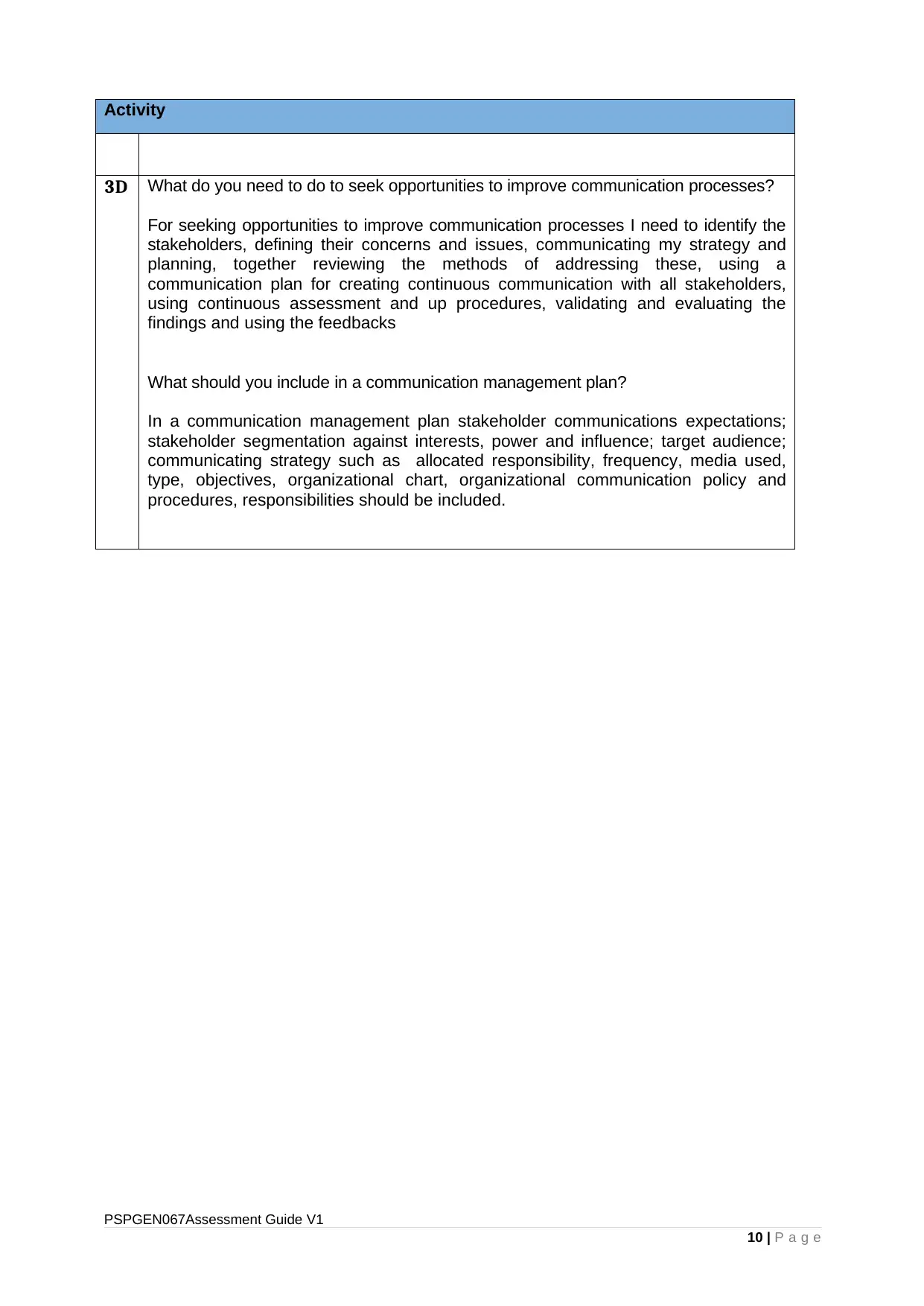
Activity
3D What do you need to do to seek opportunities to improve communication processes?
For seeking opportunities to improve communication processes I need to identify the
stakeholders, defining their concerns and issues, communicating my strategy and
planning, together reviewing the methods of addressing these, using a
communication plan for creating continuous communication with all stakeholders,
using continuous assessment and up procedures, validating and evaluating the
findings and using the feedbacks
What should you include in a communication management plan?
In a communication management plan stakeholder communications expectations;
stakeholder segmentation against interests, power and influence; target audience;
communicating strategy such as allocated responsibility, frequency, media used,
type, objectives, organizational chart, organizational communication policy and
procedures, responsibilities should be included.
PSPGEN067Assessment Guide V1
10 | P a g e
3D What do you need to do to seek opportunities to improve communication processes?
For seeking opportunities to improve communication processes I need to identify the
stakeholders, defining their concerns and issues, communicating my strategy and
planning, together reviewing the methods of addressing these, using a
communication plan for creating continuous communication with all stakeholders,
using continuous assessment and up procedures, validating and evaluating the
findings and using the feedbacks
What should you include in a communication management plan?
In a communication management plan stakeholder communications expectations;
stakeholder segmentation against interests, power and influence; target audience;
communicating strategy such as allocated responsibility, frequency, media used,
type, objectives, organizational chart, organizational communication policy and
procedures, responsibilities should be included.
PSPGEN067Assessment Guide V1
10 | P a g e
Paraphrase This Document
Need a fresh take? Get an instant paraphrase of this document with our AI Paraphraser
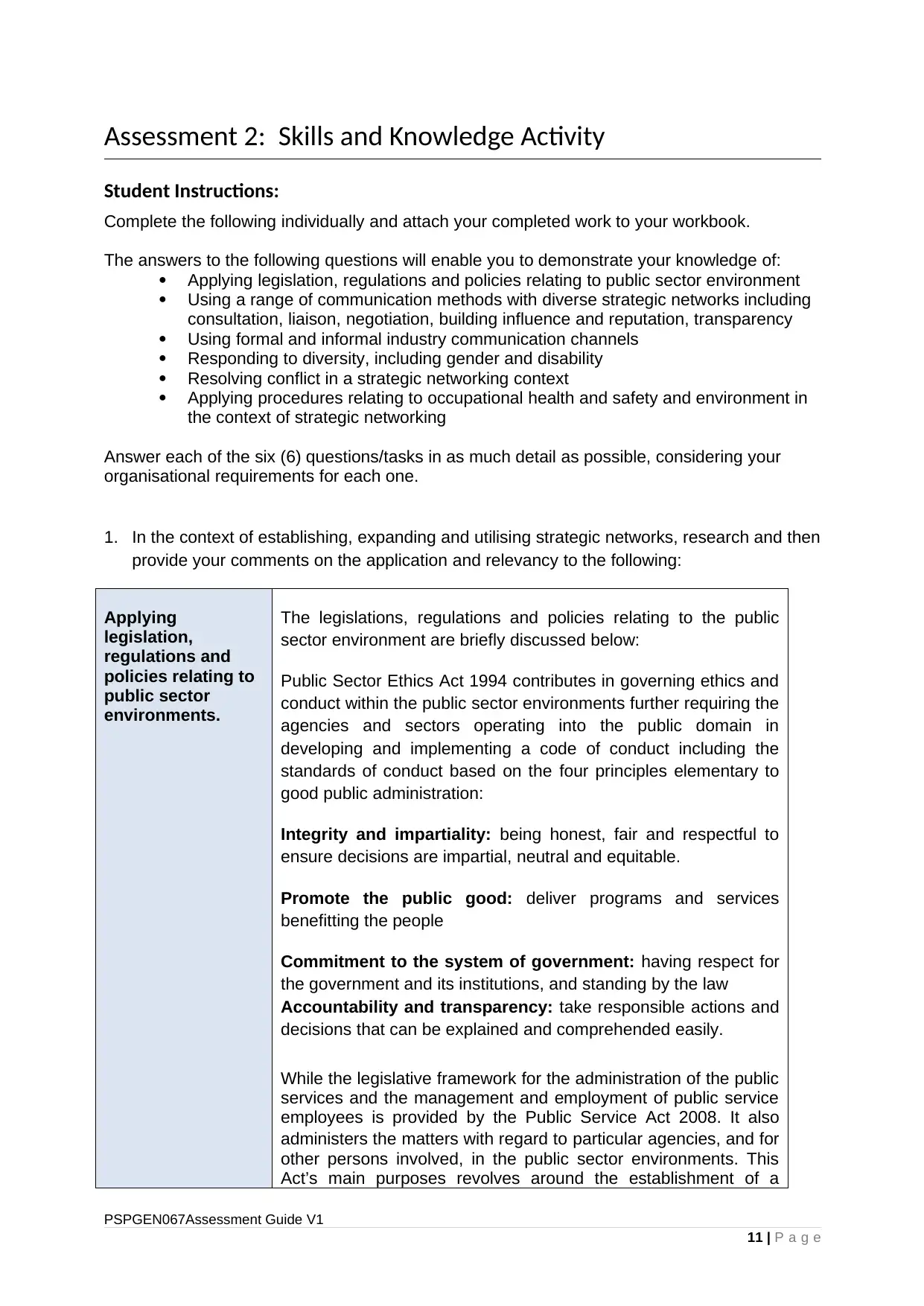
Assessment 2: Skills and Knowledge Activity
Student Instructions:
Complete the following individually and attach your completed work to your workbook.
The answers to the following questions will enable you to demonstrate your knowledge of:
Applying legislation, regulations and policies relating to public sector environment
Using a range of communication methods with diverse strategic networks including
consultation, liaison, negotiation, building influence and reputation, transparency
Using formal and informal industry communication channels
Responding to diversity, including gender and disability
Resolving conflict in a strategic networking context
Applying procedures relating to occupational health and safety and environment in
the context of strategic networking
Answer each of the six (6) questions/tasks in as much detail as possible, considering your
organisational requirements for each one.
1. In the context of establishing, expanding and utilising strategic networks, research and then
provide your comments on the application and relevancy to the following:
Applying
legislation,
regulations and
policies relating to
public sector
environments.
The legislations, regulations and policies relating to the public
sector environment are briefly discussed below:
Public Sector Ethics Act 1994 contributes in governing ethics and
conduct within the public sector environments further requiring the
agencies and sectors operating into the public domain in
developing and implementing a code of conduct including the
standards of conduct based on the four principles elementary to
good public administration:
Integrity and impartiality: being honest, fair and respectful to
ensure decisions are impartial, neutral and equitable.
Promote the public good: deliver programs and services
benefitting the people
Commitment to the system of government: having respect for
the government and its institutions, and standing by the law
Accountability and transparency: take responsible actions and
decisions that can be explained and comprehended easily.
While the legislative framework for the administration of the public
services and the management and employment of public service
employees is provided by the Public Service Act 2008. It also
administers the matters with regard to particular agencies, and for
other persons involved, in the public sector environments. This
Act’s main purposes revolves around the establishment of a
PSPGEN067Assessment Guide V1
11 | P a g e
Student Instructions:
Complete the following individually and attach your completed work to your workbook.
The answers to the following questions will enable you to demonstrate your knowledge of:
Applying legislation, regulations and policies relating to public sector environment
Using a range of communication methods with diverse strategic networks including
consultation, liaison, negotiation, building influence and reputation, transparency
Using formal and informal industry communication channels
Responding to diversity, including gender and disability
Resolving conflict in a strategic networking context
Applying procedures relating to occupational health and safety and environment in
the context of strategic networking
Answer each of the six (6) questions/tasks in as much detail as possible, considering your
organisational requirements for each one.
1. In the context of establishing, expanding and utilising strategic networks, research and then
provide your comments on the application and relevancy to the following:
Applying
legislation,
regulations and
policies relating to
public sector
environments.
The legislations, regulations and policies relating to the public
sector environment are briefly discussed below:
Public Sector Ethics Act 1994 contributes in governing ethics and
conduct within the public sector environments further requiring the
agencies and sectors operating into the public domain in
developing and implementing a code of conduct including the
standards of conduct based on the four principles elementary to
good public administration:
Integrity and impartiality: being honest, fair and respectful to
ensure decisions are impartial, neutral and equitable.
Promote the public good: deliver programs and services
benefitting the people
Commitment to the system of government: having respect for
the government and its institutions, and standing by the law
Accountability and transparency: take responsible actions and
decisions that can be explained and comprehended easily.
While the legislative framework for the administration of the public
services and the management and employment of public service
employees is provided by the Public Service Act 2008. It also
administers the matters with regard to particular agencies, and for
other persons involved, in the public sector environments. This
Act’s main purposes revolves around the establishment of a
PSPGEN067Assessment Guide V1
11 | P a g e
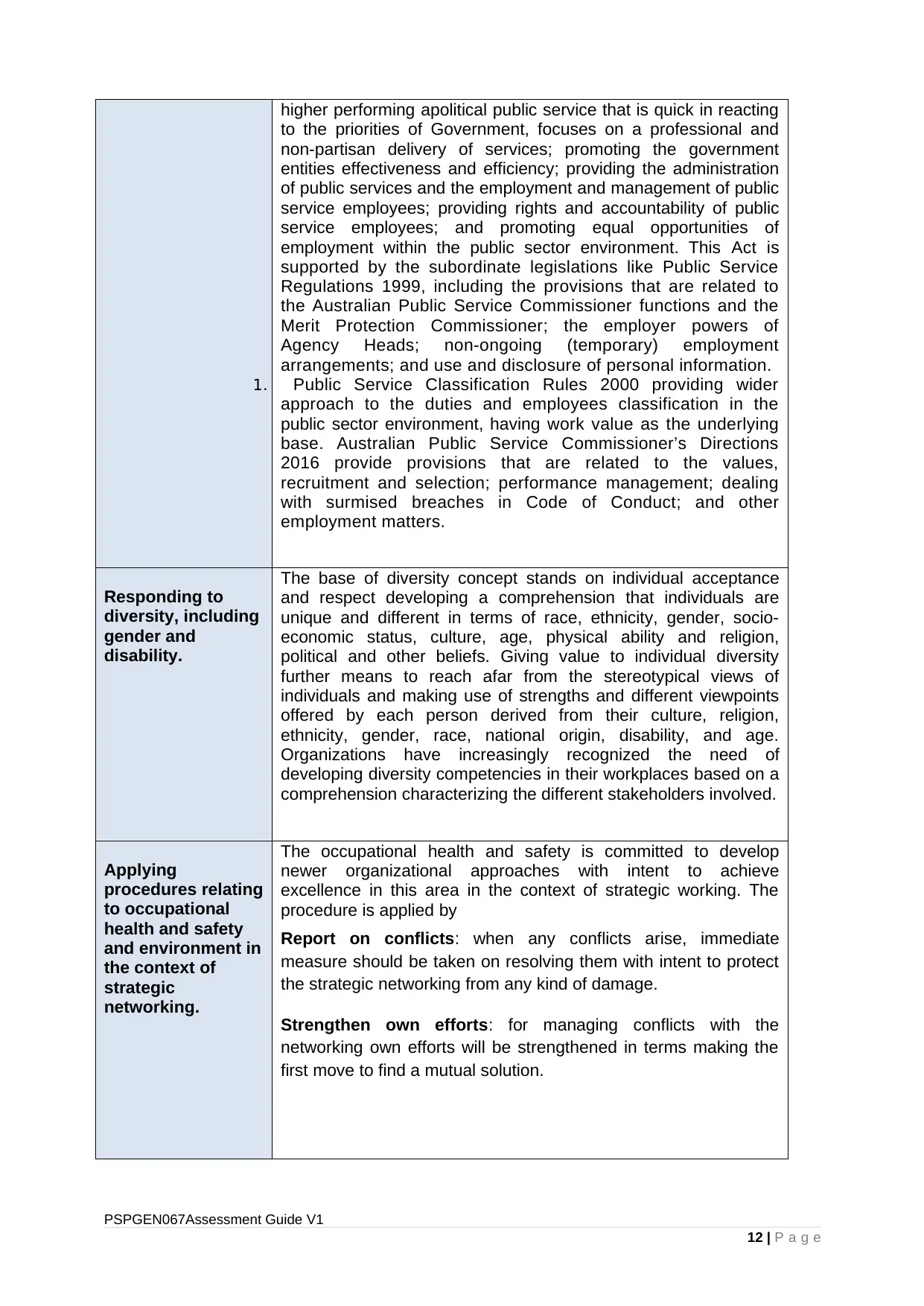
higher performing apolitical public service that is quick in reacting
to the priorities of Government, focuses on a professional and
non-partisan delivery of services; promoting the government
entities effectiveness and efficiency; providing the administration
of public services and the employment and management of public
service employees; providing rights and accountability of public
service employees; and promoting equal opportunities of
employment within the public sector environment. This Act is
supported by the subordinate legislations like Public Service
Regulations 1999, including the provisions that are related to
the Australian Public Service Commissioner functions and the
Merit Protection Commissioner; the employer powers of
Agency Heads; non-ongoing (temporary) employment
arrangements; and use and disclosure of personal information.
1. Public Service Classification Rules 2000 providing wider
approach to the duties and employees classification in the
public sector environment, having work value as the underlying
base. Australian Public Service Commissioner’s Directions
2016 provide provisions that are related to the values,
recruitment and selection; performance management; dealing
with surmised breaches in Code of Conduct; and other
employment matters.
Responding to
diversity, including
gender and
disability.
The base of diversity concept stands on individual acceptance
and respect developing a comprehension that individuals are
unique and different in terms of race, ethnicity, gender, socio-
economic status, culture, age, physical ability and religion,
political and other beliefs. Giving value to individual diversity
further means to reach afar from the stereotypical views of
individuals and making use of strengths and different viewpoints
offered by each person derived from their culture, religion,
ethnicity, gender, race, national origin, disability, and age.
Organizations have increasingly recognized the need of
developing diversity competencies in their workplaces based on a
comprehension characterizing the different stakeholders involved.
Applying
procedures relating
to occupational
health and safety
and environment in
the context of
strategic
networking.
The occupational health and safety is committed to develop
newer organizational approaches with intent to achieve
excellence in this area in the context of strategic working. The
procedure is applied by
Report on conflicts: when any conflicts arise, immediate
measure should be taken on resolving them with intent to protect
the strategic networking from any kind of damage.
Strengthen own efforts: for managing conflicts with the
networking own efforts will be strengthened in terms making the
first move to find a mutual solution.
PSPGEN067Assessment Guide V1
12 | P a g e
to the priorities of Government, focuses on a professional and
non-partisan delivery of services; promoting the government
entities effectiveness and efficiency; providing the administration
of public services and the employment and management of public
service employees; providing rights and accountability of public
service employees; and promoting equal opportunities of
employment within the public sector environment. This Act is
supported by the subordinate legislations like Public Service
Regulations 1999, including the provisions that are related to
the Australian Public Service Commissioner functions and the
Merit Protection Commissioner; the employer powers of
Agency Heads; non-ongoing (temporary) employment
arrangements; and use and disclosure of personal information.
1. Public Service Classification Rules 2000 providing wider
approach to the duties and employees classification in the
public sector environment, having work value as the underlying
base. Australian Public Service Commissioner’s Directions
2016 provide provisions that are related to the values,
recruitment and selection; performance management; dealing
with surmised breaches in Code of Conduct; and other
employment matters.
Responding to
diversity, including
gender and
disability.
The base of diversity concept stands on individual acceptance
and respect developing a comprehension that individuals are
unique and different in terms of race, ethnicity, gender, socio-
economic status, culture, age, physical ability and religion,
political and other beliefs. Giving value to individual diversity
further means to reach afar from the stereotypical views of
individuals and making use of strengths and different viewpoints
offered by each person derived from their culture, religion,
ethnicity, gender, race, national origin, disability, and age.
Organizations have increasingly recognized the need of
developing diversity competencies in their workplaces based on a
comprehension characterizing the different stakeholders involved.
Applying
procedures relating
to occupational
health and safety
and environment in
the context of
strategic
networking.
The occupational health and safety is committed to develop
newer organizational approaches with intent to achieve
excellence in this area in the context of strategic working. The
procedure is applied by
Report on conflicts: when any conflicts arise, immediate
measure should be taken on resolving them with intent to protect
the strategic networking from any kind of damage.
Strengthen own efforts: for managing conflicts with the
networking own efforts will be strengthened in terms making the
first move to find a mutual solution.
PSPGEN067Assessment Guide V1
12 | P a g e
⊘ This is a preview!⊘
Do you want full access?
Subscribe today to unlock all pages.
Trusted by 1+ million students worldwide

1 out of 17


Related Documents


Your All-in-One AI-Powered Toolkit for Academic Success.
+13062052269
info@desklib.com
Available 24*7 on WhatsApp / Email
![[object Object]](/_next/static/media/star-bottom.7253800d.svg)
Unlock your academic potential
Copyright © 2020–2026 A2Z Services. All Rights Reserved. Developed and managed by ZUCOL.