DAM762 Strategic Operational Management: Case Studies and Analysis
VerifiedAdded on 2023/04/22
|8
|2203
|468
Report
AI Summary
This report provides a comprehensive analysis of strategic operational management principles, applying them to real-world case studies of prominent global organizations such as HSBC, BMW, Procter & Gamble (P&G), and Samsung Electronics. The analysis includes a PESTLE analysis of HSBC's external environment, an evaluation of BMW's facilities and human resource management, and an application of Porter's Five Forces model to P&G. The report also examines IKEA's value chain and Samsung's strategic options through a SWOT analysis. Ultimately, the report aims to provide a thorough understanding of how these companies develop and implement their strategies in response to various internal and external factors, and it offers insights into the challenges and opportunities they face in the competitive global market. The analysis is supported by relevant academic sources and industry reports, demonstrating a strong understanding of strategic management concepts.
1Strategic operational management
Running Head: STRATEGIC OPERATIONAL MANAGEMENT
Strategic operational management
Name:
Course:
Running Head: STRATEGIC OPERATIONAL MANAGEMENT
Strategic operational management
Name:
Course:

Paraphrase This Document
Need a fresh take? Get an instant paraphrase of this document with our AI Paraphraser
2Strategic operational management
Q1-a
Business strategies formulation and implementation are of high importance because they
can put the organization on the competitive map (Blahová & Knápková, 2011). The HSBC
Holdings is the world's second largest bank, its origins belong to Hong Kong and Shanghai. The
bank refers to both Hong Kong and the United Kingdom to be the home markets. It operates in
80 countries within four business groups, including commercial, global, retail banking and
wealth management; and global private banking scale. The bank has developed a long-term
strategy that focuses on the development of its international network and to invest in wealth and
retail businesses on the local scale (HSBC Holdings plc, 2017).
1- Analyses of current general external environmental factors that could impact HSBC by using
PESTLE analysis
The PESTLE analysis could be used to scan the bank external environment. It is a useful
tool that assesses the political, economic, social, technological, legal and environmental aspects
where the organization operates (Downey, 2007).
Political: The bank operates according to the governmental policies issued in every country.
It formulates its protection strategies to avoid restrictions or limitations.
Economic: HSBC enjoys stable and successful economic stability across different world
markets.
Social: HSBC provides equal opportunities for each society to access the bank resources. It
maintains a good reputation in every society they operate within.
Technological: The bank adopts information technology developments and depends on
information systems to manage its affiliates and customers across the globe.
Legal: HSBC is protected by governmental regulations and policies across different
countries. It adapts its policies according to the governmental policies to ensure profitability
and survival.
Environmental: The Financial Stability Board of the bank has established climate-related
financial disclosures that ensures transparency, reduces exposure to thermal coal and
manages the transition process for high-carbon sectors.
2- Monitoring and evaluating the performance of the implemented strategy.
The feasibility of the evaluation criteria considers the two main strategies adopted by the
bank according to HSBC Holdings plc (2017), as follows:
Q1-a
Business strategies formulation and implementation are of high importance because they
can put the organization on the competitive map (Blahová & Knápková, 2011). The HSBC
Holdings is the world's second largest bank, its origins belong to Hong Kong and Shanghai. The
bank refers to both Hong Kong and the United Kingdom to be the home markets. It operates in
80 countries within four business groups, including commercial, global, retail banking and
wealth management; and global private banking scale. The bank has developed a long-term
strategy that focuses on the development of its international network and to invest in wealth and
retail businesses on the local scale (HSBC Holdings plc, 2017).
1- Analyses of current general external environmental factors that could impact HSBC by using
PESTLE analysis
The PESTLE analysis could be used to scan the bank external environment. It is a useful
tool that assesses the political, economic, social, technological, legal and environmental aspects
where the organization operates (Downey, 2007).
Political: The bank operates according to the governmental policies issued in every country.
It formulates its protection strategies to avoid restrictions or limitations.
Economic: HSBC enjoys stable and successful economic stability across different world
markets.
Social: HSBC provides equal opportunities for each society to access the bank resources. It
maintains a good reputation in every society they operate within.
Technological: The bank adopts information technology developments and depends on
information systems to manage its affiliates and customers across the globe.
Legal: HSBC is protected by governmental regulations and policies across different
countries. It adapts its policies according to the governmental policies to ensure profitability
and survival.
Environmental: The Financial Stability Board of the bank has established climate-related
financial disclosures that ensures transparency, reduces exposure to thermal coal and
manages the transition process for high-carbon sectors.
2- Monitoring and evaluating the performance of the implemented strategy.
The feasibility of the evaluation criteria considers the two main strategies adopted by the
bank according to HSBC Holdings plc (2017), as follows:
3Strategic operational management
Development of international network: The bank succeeded in serving enterprises across
markets and facilitate capital flows and international trade. Also, it could optimize its global
network by being able to reduce its footprint in 67 countries at end of 2017 compared to 73 at
end of 2014.
Investment in wealth and retail businesses with local scale: The bank could benefit from the
global social mobility and wealth creation in its retail banking and wealth management
markets. The group succeeded in reducing risk-weighted assets by $290bn and a further
reduction from management actions of $71bn in 2017.
Q1-b
BMW was founded in Germany to operate in the automotive industry. Currently, it
produces vehicles of BMW brand and it acquired Mini and Rolls-Royce (BMW Group, 2017).
1- BMW Facilities management
BMW operates in 14 countries, it has 30 assembly and manufacturing plants (BMW
Group, 2017). The engine plants are located in Munich, Austria and the UK, they are responsible
for supplying diesel and petrol engines. Engine plants in China were created to fulfill the local
production facilities. Dingolfing and Landshut in Germany are the main locations of electric
drivetrain systems used in the electrified vehicles (BMW Group, 2017).
2- BMW human resource management & job design
Workforce is the main reason for BMW success; employees can innovate and develop
new ideas due to their high-quality skills. They are selected to fulfill certain roles that match
their capabilities and they cooperate in harmony to fulfill the job requirements. Training and
development are offered across the company to ensure employees gain the latest knowledge
(BMW Group, 2017).
Development of international network: The bank succeeded in serving enterprises across
markets and facilitate capital flows and international trade. Also, it could optimize its global
network by being able to reduce its footprint in 67 countries at end of 2017 compared to 73 at
end of 2014.
Investment in wealth and retail businesses with local scale: The bank could benefit from the
global social mobility and wealth creation in its retail banking and wealth management
markets. The group succeeded in reducing risk-weighted assets by $290bn and a further
reduction from management actions of $71bn in 2017.
Q1-b
BMW was founded in Germany to operate in the automotive industry. Currently, it
produces vehicles of BMW brand and it acquired Mini and Rolls-Royce (BMW Group, 2017).
1- BMW Facilities management
BMW operates in 14 countries, it has 30 assembly and manufacturing plants (BMW
Group, 2017). The engine plants are located in Munich, Austria and the UK, they are responsible
for supplying diesel and petrol engines. Engine plants in China were created to fulfill the local
production facilities. Dingolfing and Landshut in Germany are the main locations of electric
drivetrain systems used in the electrified vehicles (BMW Group, 2017).
2- BMW human resource management & job design
Workforce is the main reason for BMW success; employees can innovate and develop
new ideas due to their high-quality skills. They are selected to fulfill certain roles that match
their capabilities and they cooperate in harmony to fulfill the job requirements. Training and
development are offered across the company to ensure employees gain the latest knowledge
(BMW Group, 2017).
⊘ This is a preview!⊘
Do you want full access?
Subscribe today to unlock all pages.

Trusted by 1+ million students worldwide
4Strategic operational management
Q2-a
Michael E. Porter has developed the five forces model that acts as an influential tool for
determining business strategic decision-making. The model is criticized for being static and does
not consider the development of the business environment over time. Adding the time dimension
enables the managers to consider the change of market trends including globalization that has an
impact on the existing five forces (Dälken, 2014).
Q2-b
1- Applying the five forces model to P&G
The Procter & Gamble Company is considered one of the world's largest organizations of
consumer goods. Using the five forces model enables the company's managers to identify the
factors that significantly affect the environment of consumer goods industry. It is analyzed
according to Thompson (2017), as follows:
Competitive rivalry (Strong): There exist in the consumer goods industry a large number of
firms, they are diversified and the switching costs are low.
Bargaining power of buyers (Weak): Switching costs are low, the substitutes are not highly
available and demand is high.
Bargaining power of suppliers (Weak): High level of supply takes place in the industry with
a moderate degree of forward integration.
The threat of substitutes (Weak): There exist low switching costs, substitutes are not highly
available and varieties are low.
The threat of new entrants (Moderate): There are moderate capital costs for new entrants
with moderate economies of scale.
2- Evaluation of the 5 forces model of P&G
The model is useful for the company to prioritize the microeconomic powers, by
considering the rivalry to be the highest intensity, followed by the threat of new entrants, then to
consider the other three forces with low intensity in its strategy formulation process. Despite this,
the analysis of the 5 forces model did not consider the effect of globalization and the company
needs for developing an online presence to improve revenues and increase its competitiveness in
the global market (Procter and Gamble, 2018).
Q2-a
Michael E. Porter has developed the five forces model that acts as an influential tool for
determining business strategic decision-making. The model is criticized for being static and does
not consider the development of the business environment over time. Adding the time dimension
enables the managers to consider the change of market trends including globalization that has an
impact on the existing five forces (Dälken, 2014).
Q2-b
1- Applying the five forces model to P&G
The Procter & Gamble Company is considered one of the world's largest organizations of
consumer goods. Using the five forces model enables the company's managers to identify the
factors that significantly affect the environment of consumer goods industry. It is analyzed
according to Thompson (2017), as follows:
Competitive rivalry (Strong): There exist in the consumer goods industry a large number of
firms, they are diversified and the switching costs are low.
Bargaining power of buyers (Weak): Switching costs are low, the substitutes are not highly
available and demand is high.
Bargaining power of suppliers (Weak): High level of supply takes place in the industry with
a moderate degree of forward integration.
The threat of substitutes (Weak): There exist low switching costs, substitutes are not highly
available and varieties are low.
The threat of new entrants (Moderate): There are moderate capital costs for new entrants
with moderate economies of scale.
2- Evaluation of the 5 forces model of P&G
The model is useful for the company to prioritize the microeconomic powers, by
considering the rivalry to be the highest intensity, followed by the threat of new entrants, then to
consider the other three forces with low intensity in its strategy formulation process. Despite this,
the analysis of the 5 forces model did not consider the effect of globalization and the company
needs for developing an online presence to improve revenues and increase its competitiveness in
the global market (Procter and Gamble, 2018).
Paraphrase This Document
Need a fresh take? Get an instant paraphrase of this document with our AI Paraphraser
5Strategic operational management
Q2-c
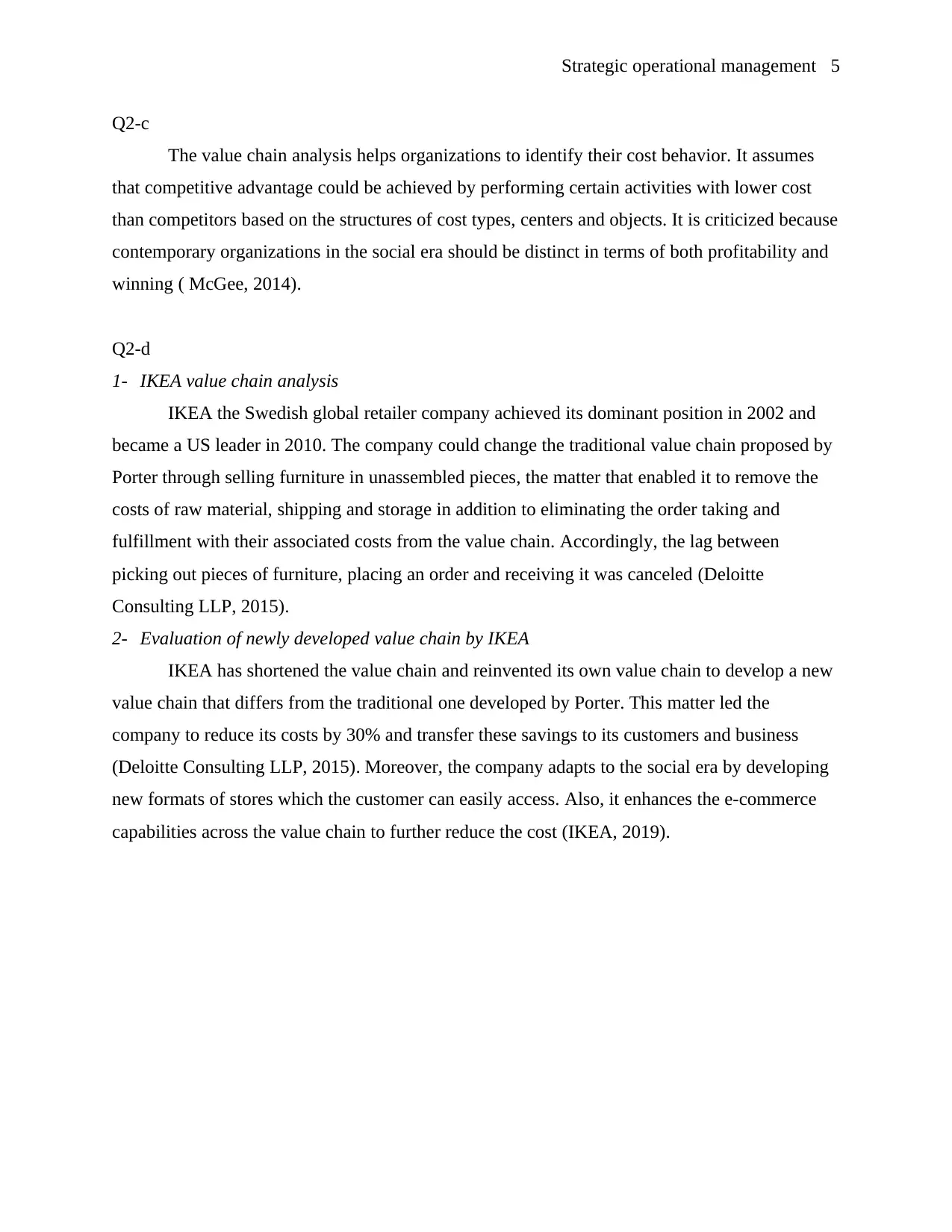
The value chain analysis helps organizations to identify their cost behavior. It assumes
that competitive advantage could be achieved by performing certain activities with lower cost
than competitors based on the structures of cost types, centers and objects. It is criticized because
contemporary organizations in the social era should be distinct in terms of both profitability and
winning ( McGee, 2014).
Q2-d
1- IKEA value chain analysis
IKEA the Swedish global retailer company achieved its dominant position in 2002 and
became a US leader in 2010. The company could change the traditional value chain proposed by
Porter through selling furniture in unassembled pieces, the matter that enabled it to remove the
costs of raw material, shipping and storage in addition to eliminating the order taking and
fulfillment with their associated costs from the value chain. Accordingly, the lag between
picking out pieces of furniture, placing an order and receiving it was canceled (Deloitte
Consulting LLP, 2015).
2- Evaluation of newly developed value chain by IKEA
IKEA has shortened the value chain and reinvented its own value chain to develop a new
value chain that differs from the traditional one developed by Porter. This matter led the
company to reduce its costs by 30% and transfer these savings to its customers and business
(Deloitte Consulting LLP, 2015). Moreover, the company adapts to the social era by developing
new formats of stores which the customer can easily access. Also, it enhances the e-commerce
capabilities across the value chain to further reduce the cost (IKEA, 2019).
Q2-c
The value chain analysis helps organizations to identify their cost behavior. It assumes
that competitive advantage could be achieved by performing certain activities with lower cost
than competitors based on the structures of cost types, centers and objects. It is criticized because
contemporary organizations in the social era should be distinct in terms of both profitability and
winning ( McGee, 2014).
Q2-d
1- IKEA value chain analysis
IKEA the Swedish global retailer company achieved its dominant position in 2002 and
became a US leader in 2010. The company could change the traditional value chain proposed by
Porter through selling furniture in unassembled pieces, the matter that enabled it to remove the
costs of raw material, shipping and storage in addition to eliminating the order taking and
fulfillment with their associated costs from the value chain. Accordingly, the lag between
picking out pieces of furniture, placing an order and receiving it was canceled (Deloitte
Consulting LLP, 2015).
2- Evaluation of newly developed value chain by IKEA
IKEA has shortened the value chain and reinvented its own value chain to develop a new
value chain that differs from the traditional one developed by Porter. This matter led the
company to reduce its costs by 30% and transfer these savings to its customers and business
(Deloitte Consulting LLP, 2015). Moreover, the company adapts to the social era by developing
new formats of stores which the customer can easily access. Also, it enhances the e-commerce
capabilities across the value chain to further reduce the cost (IKEA, 2019).
6Strategic operational management
Q3
1- Analysis and assessment:
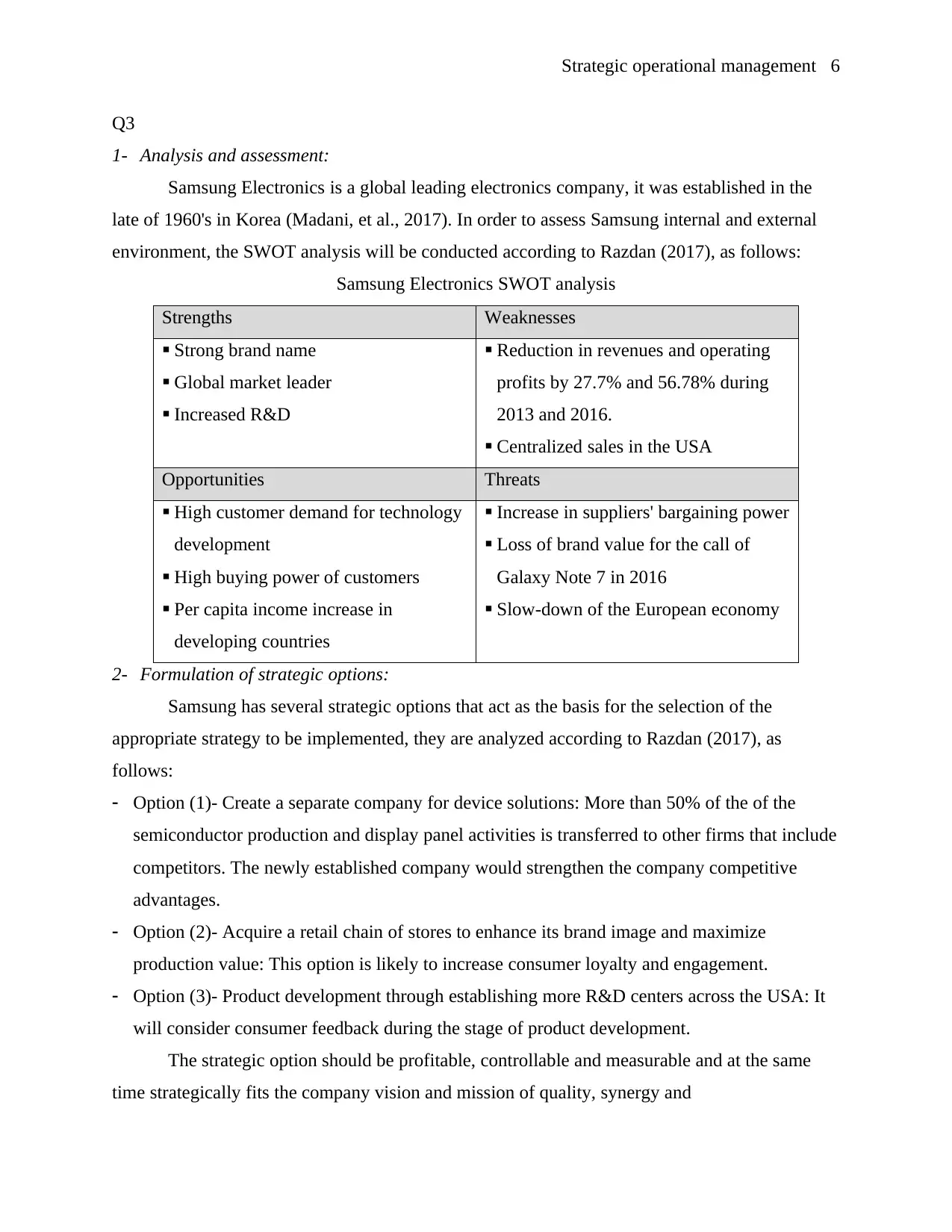
Samsung Electronics is a global leading electronics company, it was established in the
late of 1960's in Korea (Madani, et al., 2017). In order to assess Samsung internal and external
environment, the SWOT analysis will be conducted according to Razdan (2017), as follows:
Samsung Electronics SWOT analysis
Strengths Weaknesses
Strong brand name
Global market leader
Increased R&D
Reduction in revenues and operating
profits by 27.7% and 56.78% during
2013 and 2016.
Centralized sales in the USA
Opportunities Threats
High customer demand for technology
development
High buying power of customers
Per capita income increase in
developing countries
Increase in suppliers' bargaining power
Loss of brand value for the call of
Galaxy Note 7 in 2016
Slow-down of the European economy
2- Formulation of strategic options:
Samsung has several strategic options that act as the basis for the selection of the
appropriate strategy to be implemented, they are analyzed according to Razdan (2017), as
follows:
Option (1)- Create a separate company for device solutions: More than 50% of the of the
semiconductor production and display panel activities is transferred to other firms that include
competitors. The newly established company would strengthen the company competitive
advantages.
Option (2)- Acquire a retail chain of stores to enhance its brand image and maximize
production value: This option is likely to increase consumer loyalty and engagement.
Option (3)- Product development through establishing more R&D centers across the USA: It
will consider consumer feedback during the stage of product development.
The strategic option should be profitable, controllable and measurable and at the same
time strategically fits the company vision and mission of quality, synergy and
Q3
1- Analysis and assessment:
Samsung Electronics is a global leading electronics company, it was established in the
late of 1960's in Korea (Madani, et al., 2017). In order to assess Samsung internal and external
environment, the SWOT analysis will be conducted according to Razdan (2017), as follows:
Samsung Electronics SWOT analysis
Strengths Weaknesses
Strong brand name
Global market leader
Increased R&D
Reduction in revenues and operating
profits by 27.7% and 56.78% during
2013 and 2016.
Centralized sales in the USA
Opportunities Threats
High customer demand for technology
development
High buying power of customers
Per capita income increase in
developing countries
Increase in suppliers' bargaining power
Loss of brand value for the call of
Galaxy Note 7 in 2016
Slow-down of the European economy
2- Formulation of strategic options:
Samsung has several strategic options that act as the basis for the selection of the
appropriate strategy to be implemented, they are analyzed according to Razdan (2017), as
follows:
Option (1)- Create a separate company for device solutions: More than 50% of the of the
semiconductor production and display panel activities is transferred to other firms that include
competitors. The newly established company would strengthen the company competitive
advantages.
Option (2)- Acquire a retail chain of stores to enhance its brand image and maximize
production value: This option is likely to increase consumer loyalty and engagement.
Option (3)- Product development through establishing more R&D centers across the USA: It
will consider consumer feedback during the stage of product development.
The strategic option should be profitable, controllable and measurable and at the same
time strategically fits the company vision and mission of quality, synergy and
⊘ This is a preview!⊘
Do you want full access?
Subscribe today to unlock all pages.
Trusted by 1+ million students worldwide
7Strategic operational management
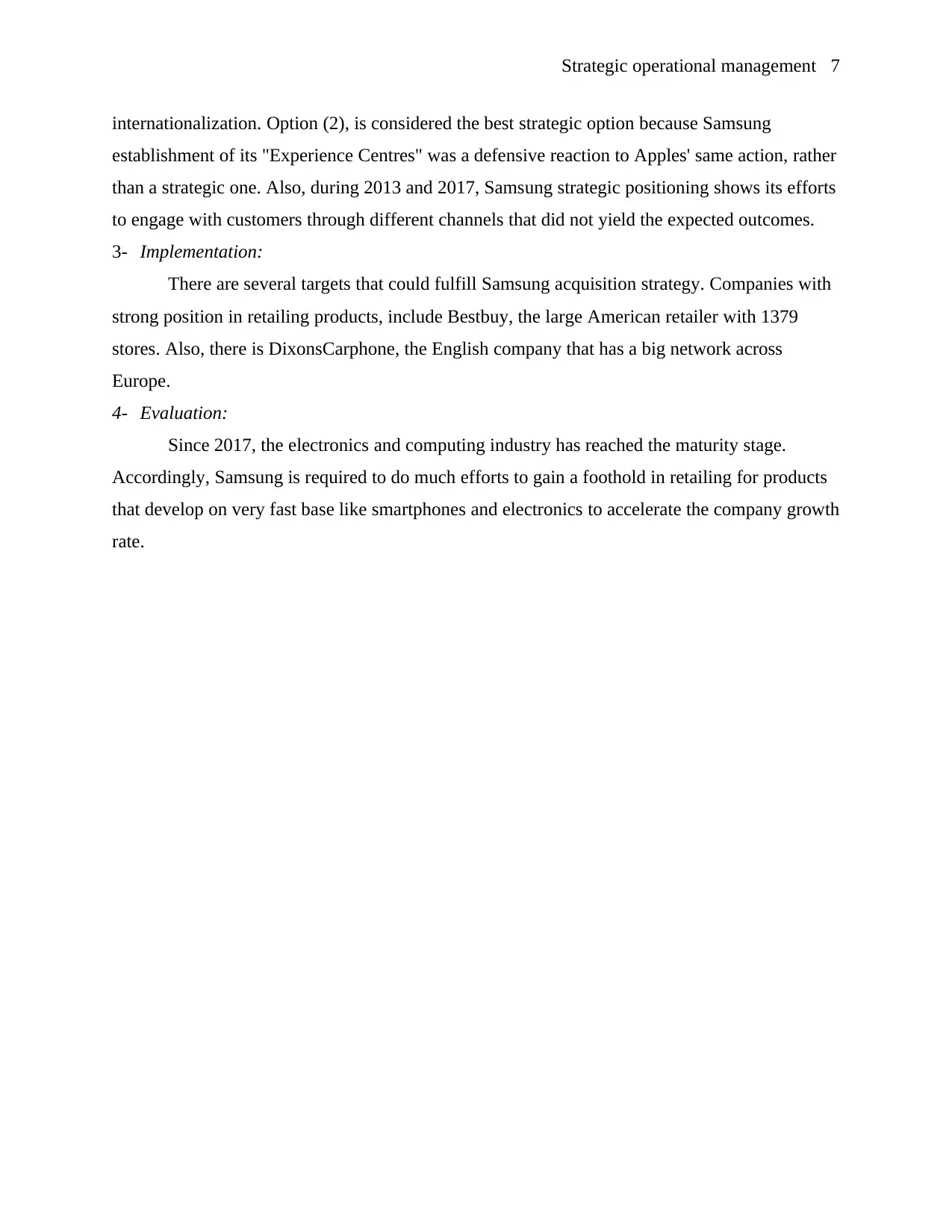
internationalization. Option (2), is considered the best strategic option because Samsung
establishment of its "Experience Centres" was a defensive reaction to Apples' same action, rather
than a strategic one. Also, during 2013 and 2017, Samsung strategic positioning shows its efforts
to engage with customers through different channels that did not yield the expected outcomes.
3- Implementation:
There are several targets that could fulfill Samsung acquisition strategy. Companies with
strong position in retailing products, include Bestbuy, the large American retailer with 1379
stores. Also, there is DixonsCarphone, the English company that has a big network across
Europe.
4- Evaluation:
Since 2017, the electronics and computing industry has reached the maturity stage.
Accordingly, Samsung is required to do much efforts to gain a foothold in retailing for products
that develop on very fast base like smartphones and electronics to accelerate the company growth
rate.
internationalization. Option (2), is considered the best strategic option because Samsung
establishment of its "Experience Centres" was a defensive reaction to Apples' same action, rather
than a strategic one. Also, during 2013 and 2017, Samsung strategic positioning shows its efforts
to engage with customers through different channels that did not yield the expected outcomes.
3- Implementation:
There are several targets that could fulfill Samsung acquisition strategy. Companies with
strong position in retailing products, include Bestbuy, the large American retailer with 1379
stores. Also, there is DixonsCarphone, the English company that has a big network across
Europe.
4- Evaluation:
Since 2017, the electronics and computing industry has reached the maturity stage.
Accordingly, Samsung is required to do much efforts to gain a foothold in retailing for products
that develop on very fast base like smartphones and electronics to accelerate the company growth
rate.
Paraphrase This Document
Need a fresh take? Get an instant paraphrase of this document with our AI Paraphraser
8Strategic operational management
References
McGee, J. (2014). Value chain. In Wiley Encyclopedia of Management. UK: John Wiley & Sons.
Blahová, M., & Knápková, A. (2011). Effective strategic action: From Formulation to
Implementation. International Conference on Economics, Business (pp. 61-65).
Philippines: IAC S IT Press.
BMW Group. (2017). Annual report. Germany: BMW Group.
Dälken, F. (2014). Are Porter’s five competitive forces still applicable? A critical examination
concerning the relevance for today’s business. Netherlands: University of Twente.
Deloitte Consulting LLP. (2015). Shorten the value chain - Transforming the stages of value
delivery. UK: Deloitte University Press.
Downey, J. (2007). Strategic Analysis Tools. UK: The Chartered Institute of Management
Accountants.
HSBC Holdings plc. (2017). Strategic report. London: HSBC Holdings plc.
IKEA. (2019, Feb. 21). Inter IKEA Group financial summary FY18. Retrieved from IKEA
Group: https://newsroom.inter.ikea.com/publications/all/inter-ikea-group-financial-
summary-fy18/s/a80ce9a8-1f0a-4e91-89e0-5458e367f692
Madani, F., Abdulai, M., Ha, J., & Koosawangsri, R. (2017). Samsung's innovation strategy in
smart phones market. USA: SSRN.
Procter and Gamble. (2018). Annual report. USA: Procter and Gamble.
Razdan, V. (2017). Analysis of Samsung Electronics’ Strategy for the period 2014-2017, and
development of strategic options for growth and sustainability. London: Brunel
University London.
Thompson, A. (2017, May 3). Procter & Gamble five forces analysis (Porter’s) &
recommendations. Retrieved from Panmore Institute: http://panmore.com/procter-
gamble-five-forces-analysis-porters-recommendations
References
McGee, J. (2014). Value chain. In Wiley Encyclopedia of Management. UK: John Wiley & Sons.
Blahová, M., & Knápková, A. (2011). Effective strategic action: From Formulation to
Implementation. International Conference on Economics, Business (pp. 61-65).
Philippines: IAC S IT Press.
BMW Group. (2017). Annual report. Germany: BMW Group.
Dälken, F. (2014). Are Porter’s five competitive forces still applicable? A critical examination
concerning the relevance for today’s business. Netherlands: University of Twente.
Deloitte Consulting LLP. (2015). Shorten the value chain - Transforming the stages of value
delivery. UK: Deloitte University Press.
Downey, J. (2007). Strategic Analysis Tools. UK: The Chartered Institute of Management
Accountants.
HSBC Holdings plc. (2017). Strategic report. London: HSBC Holdings plc.
IKEA. (2019, Feb. 21). Inter IKEA Group financial summary FY18. Retrieved from IKEA
Group: https://newsroom.inter.ikea.com/publications/all/inter-ikea-group-financial-
summary-fy18/s/a80ce9a8-1f0a-4e91-89e0-5458e367f692
Madani, F., Abdulai, M., Ha, J., & Koosawangsri, R. (2017). Samsung's innovation strategy in
smart phones market. USA: SSRN.
Procter and Gamble. (2018). Annual report. USA: Procter and Gamble.
Razdan, V. (2017). Analysis of Samsung Electronics’ Strategy for the period 2014-2017, and
development of strategic options for growth and sustainability. London: Brunel
University London.
Thompson, A. (2017, May 3). Procter & Gamble five forces analysis (Porter’s) &
recommendations. Retrieved from Panmore Institute: http://panmore.com/procter-
gamble-five-forces-analysis-porters-recommendations

1 out of 8


Related Documents


Your All-in-One AI-Powered Toolkit for Academic Success.
+13062052269
info@desklib.com
Available 24*7 on WhatsApp / Email
![[object Object]](/_next/static/media/star-bottom.7253800d.svg)
Unlock your academic potential
Copyright © 2020–2026 A2Z Services. All Rights Reserved. Developed and managed by ZUCOL.