Organizational Leadership: Strategic Influence and Maximizing Benefits

Verified

Added on  2021/04/17

|4
|864
|35
Essay
AI Summary
This essay delves into the concept of strategic influence within organizational leadership, emphasizing its importance in today's challenging business environment. It defines strategic influence as the process by which leaders foster commitment to the organization's strategic learning and direction. The essay outlines several key strategies for effective leadership, including involving employees in decision-making to generate diverse perspectives and improve strategies, building strong internal and external relationships based on trust and mutual understanding, and maintaining momentum to ensure long-term goals are not overshadowed by daily pressures. Furthermore, it addresses the importance of managing the political landscape and utilizing organizational systems and culture to align employees, customers, and other stakeholders with the firm's strategic plans. By implementing these strategies, leaders can effectively influence their organizations and maximize overall benefits.
Document Page
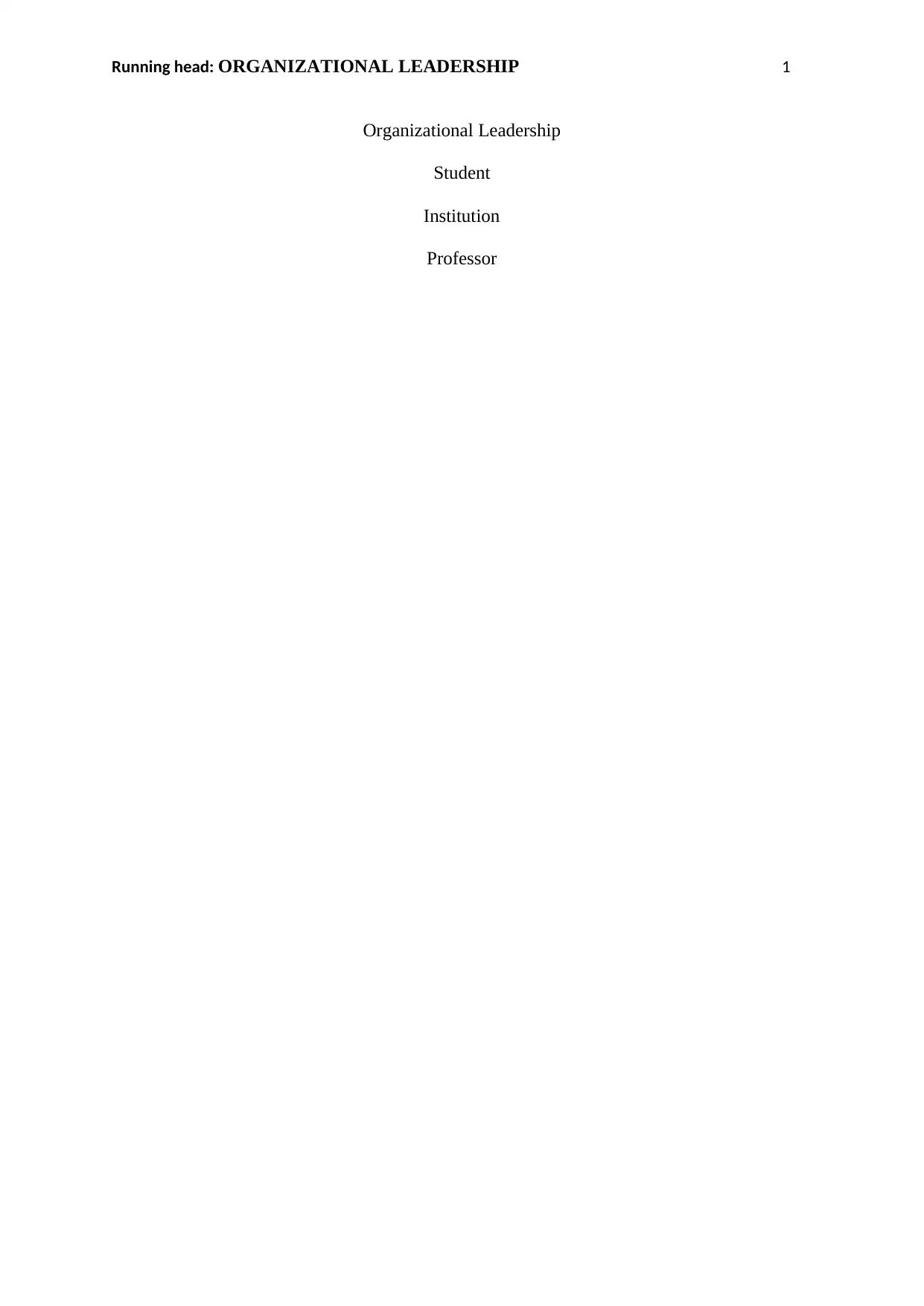
Running head: ORGANIZATIONAL LEADERSHIP 1
Organizational Leadership
Student
Institution
Professor
tabler-icon-diamond-filled.svg

Paraphrase This Document

Need a fresh take? Get an instant paraphrase of this document with our AI Paraphraser
Document Page
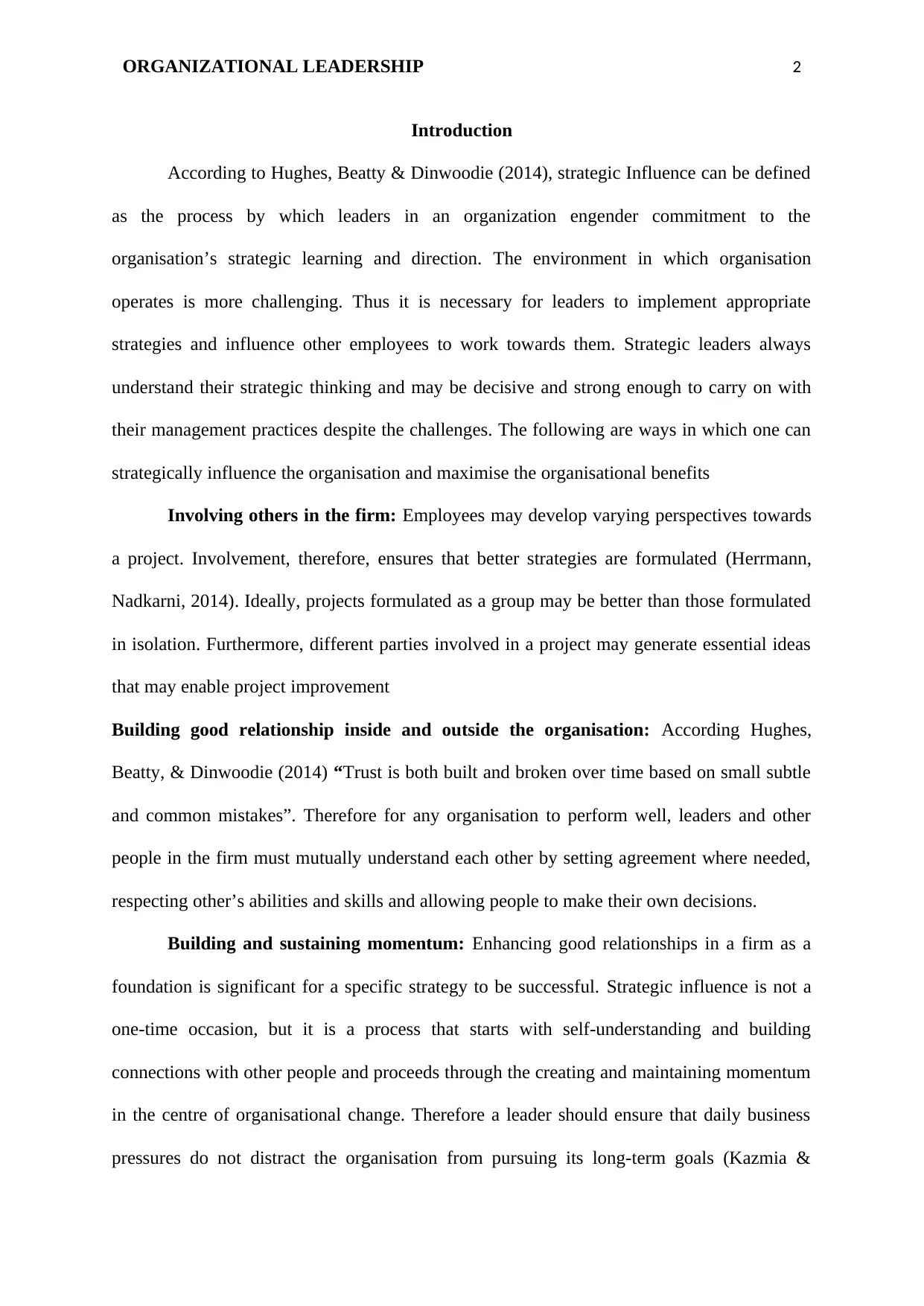
ORGANIZATIONAL LEADERSHIP 2
Introduction
According to Hughes, Beatty & Dinwoodie (2014), strategic Influence can be defined
as the process by which leaders in an organization engender commitment to the
organisation’s strategic learning and direction. The environment in which organisation
operates is more challenging. Thus it is necessary for leaders to implement appropriate
strategies and influence other employees to work towards them. Strategic leaders always
understand their strategic thinking and may be decisive and strong enough to carry on with
their management practices despite the challenges. The following are ways in which one can
strategically influence the organisation and maximise the organisational benefits
Involving others in the firm: Employees may develop varying perspectives towards
a project. Involvement, therefore, ensures that better strategies are formulated (Herrmann,
Nadkarni, 2014). Ideally, projects formulated as a group may be better than those formulated
in isolation. Furthermore, different parties involved in a project may generate essential ideas
that may enable project improvement
Building good relationship inside and outside the organisation: According Hughes,
Beatty, & Dinwoodie (2014) Trust is both built and broken over time based on small subtle
and common mistakes”. Therefore for any organisation to perform well, leaders and other
people in the firm must mutually understand each other by setting agreement where needed,
respecting other’s abilities and skills and allowing people to make their own decisions.
Building and sustaining momentum: Enhancing good relationships in a firm as a
foundation is significant for a specific strategy to be successful. Strategic influence is not a
one-time occasion, but it is a process that starts with self-understanding and building
connections with other people and proceeds through the creating and maintaining momentum
in the centre of organisational change. Therefore a leader should ensure that daily business
pressures do not distract the organisation from pursuing its long-term goals (Kazmia &
Document Page
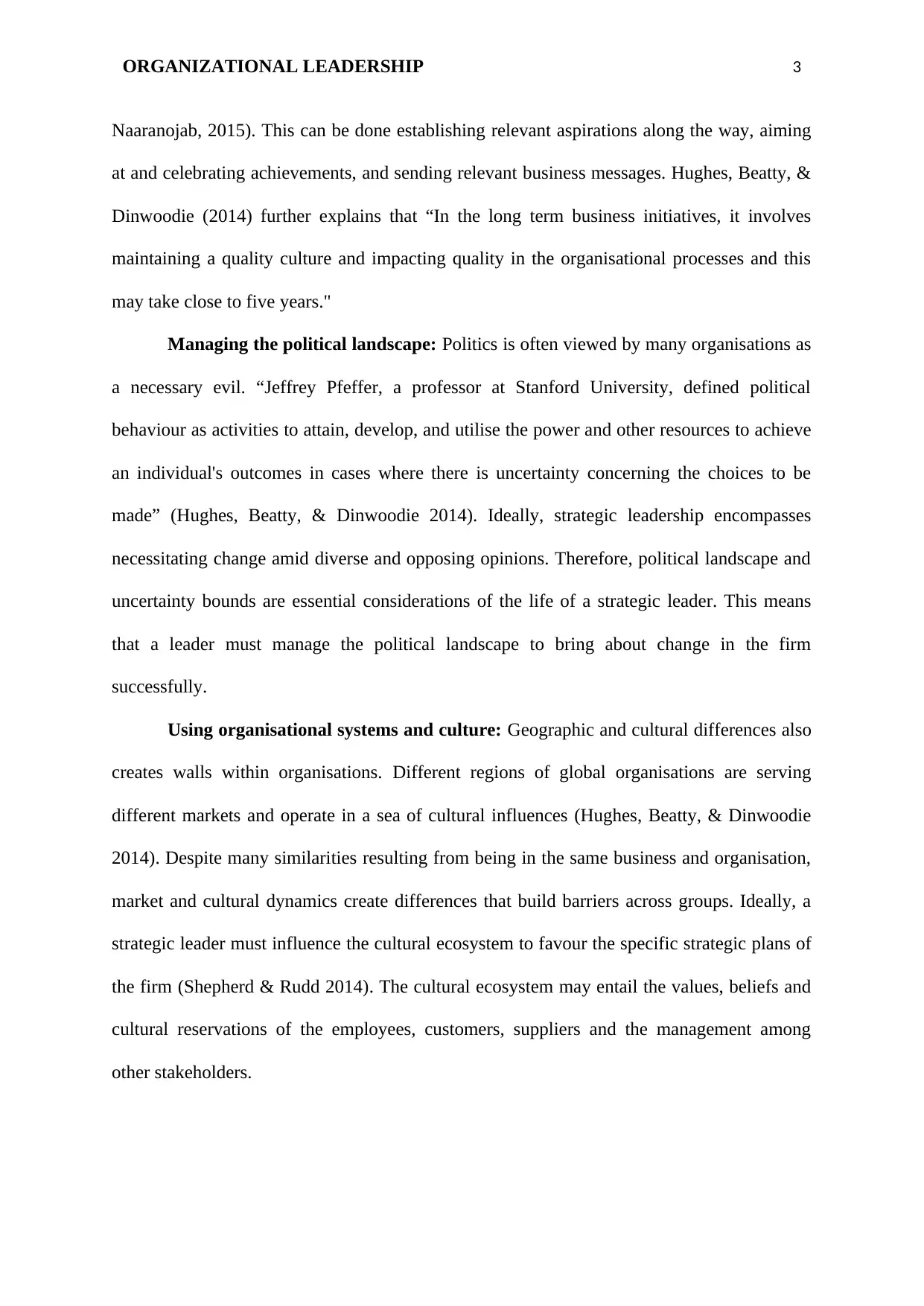
ORGANIZATIONAL LEADERSHIP 3
Naaranojab, 2015). This can be done establishing relevant aspirations along the way, aiming
at and celebrating achievements, and sending relevant business messages. Hughes, Beatty, &
Dinwoodie (2014) further explains that “In the long term business initiatives, it involves
maintaining a quality culture and impacting quality in the organisational processes and this
may take close to five years."
Managing the political landscape: Politics is often viewed by many organisations as
a necessary evil. “Jeffrey Pfeffer, a professor at Stanford University, defined political
behaviour as activities to attain, develop, and utilise the power and other resources to achieve
an individual's outcomes in cases where there is uncertainty concerning the choices to be
made” (Hughes, Beatty, & Dinwoodie 2014). Ideally, strategic leadership encompasses
necessitating change amid diverse and opposing opinions. Therefore, political landscape and
uncertainty bounds are essential considerations of the life of a strategic leader. This means
that a leader must manage the political landscape to bring about change in the firm
successfully.
Using organisational systems and culture: Geographic and cultural differences also
creates walls within organisations. Different regions of global organisations are serving
different markets and operate in a sea of cultural influences (Hughes, Beatty, & Dinwoodie
2014). Despite many similarities resulting from being in the same business and organisation,
market and cultural dynamics create differences that build barriers across groups. Ideally, a
strategic leader must influence the cultural ecosystem to favour the specific strategic plans of
the firm (Shepherd & Rudd 2014). The cultural ecosystem may entail the values, beliefs and
cultural reservations of the employees, customers, suppliers and the management among
other stakeholders.
Document Page
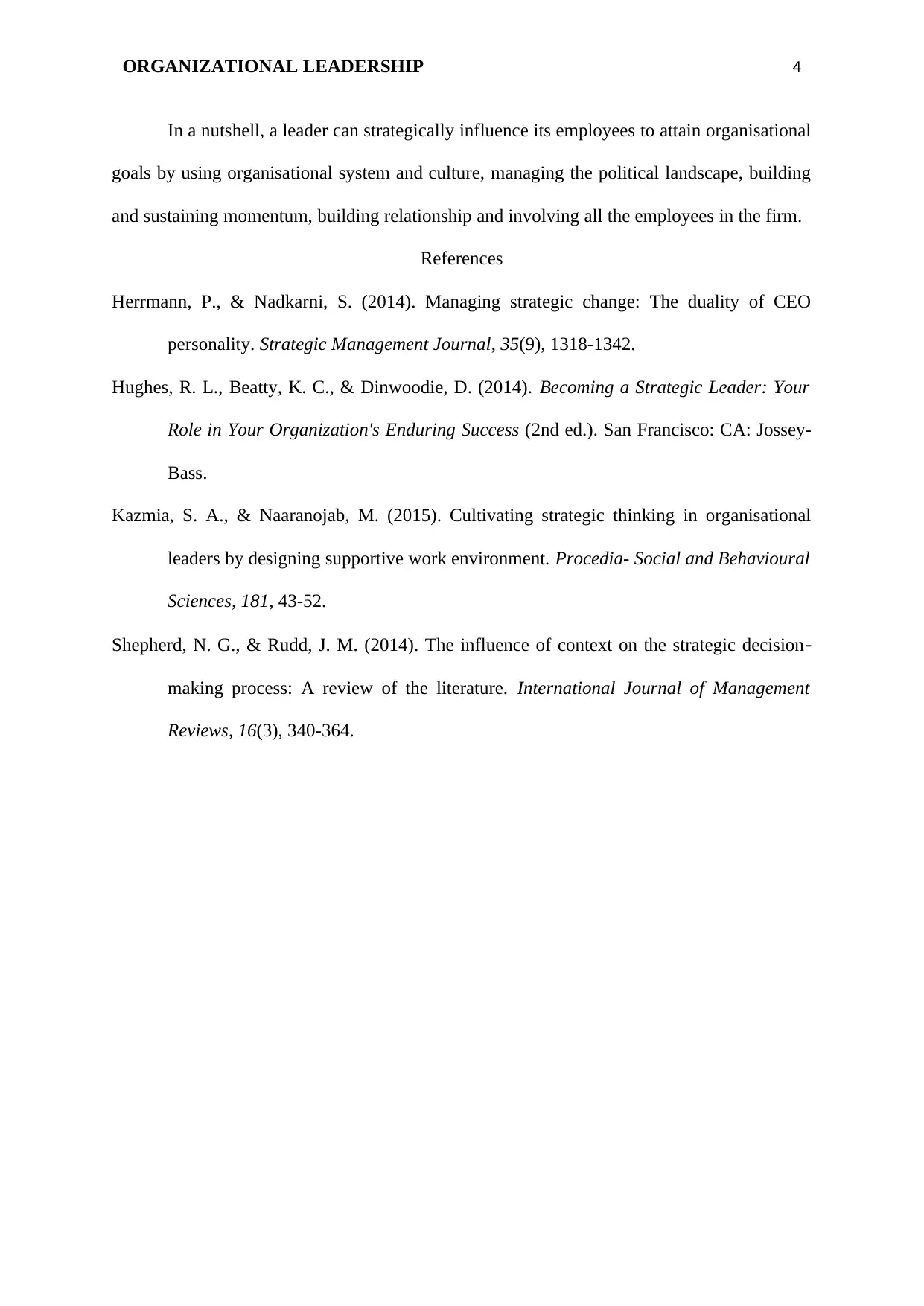
ORGANIZATIONAL LEADERSHIP 4
In a nutshell, a leader can strategically influence its employees to attain organisational
goals by using organisational system and culture, managing the political landscape, building
and sustaining momentum, building relationship and involving all the employees in the firm.
References
Herrmann, P., & Nadkarni, S. (2014). Managing strategic change: The duality of CEO
personality. Strategic Management Journal, 35(9), 1318-1342.
Hughes, R. L., Beatty, K. C., & Dinwoodie, D. (2014). Becoming a Strategic Leader: Your
Role in Your Organization's Enduring Success (2nd ed.). San Francisco: CA: Jossey-
Bass.
Kazmia, S. A., & Naaranojab, M. (2015). Cultivating strategic thinking in organisational
leaders by designing supportive work environment. Procedia- Social and Behavioural
Sciences, 181, 43-52.
Shepherd, N. G., & Rudd, J. M. (2014). The influence of context on the strategic decision
making process: A review of the literature. International Journal of Management
Reviews, 16(3), 340-364.
chevron_up_icon
1 out of 4
circle_padding
hide_on_mobile
zoom_out_icon
[object Object]