Advanced Diploma of Management - Strategic Planning Assessment 1
VerifiedAdded on 2020/06/04
|33
|9466
|259
Homework Assignment
AI Summary
This document presents the solutions to Assessment 1 of an Advanced Diploma of Management/Leadership and Management unit focusing on developing and implementing strategic plans. The assessment comprises theory-based questions covering core concepts such as the differences between strategic and business planning, the importance of strategic plans, and the meaning of organizational culture. It also explores how organizational culture is communicated in the workplace. Furthermore, the assignment delves into SWOT and PEST analyses, detailing internal and external factors organizations must consider. The document addresses the sources of supporting information for research accuracy, potential risks of joint ventures, and essential considerations for establishing due diligence in partnerships. It provides a comprehensive overview of key strategic planning principles and their practical application in a business context.
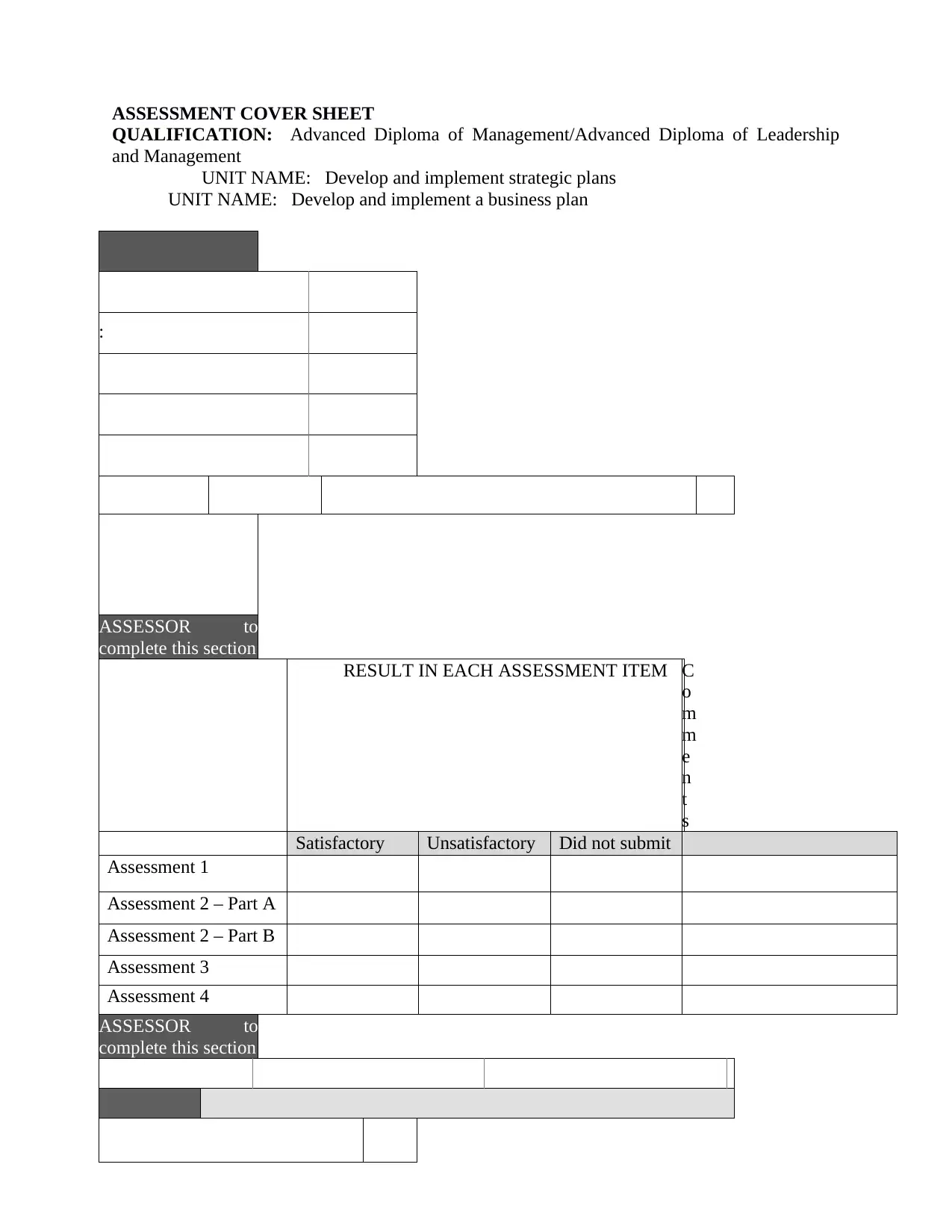
ASSESSMENT COVER SHEET
QUALIFICATION: Advanced Diploma of Management/Advanced Diploma of Leadership
and Management
UNIT NAME: Develop and implement strategic plans
UNIT NAME: Develop and implement a business plan
:
ASSESSOR to
complete this section
RESULT IN EACH ASSESSMENT ITEM C
o
m
m
e
n
t
s
Satisfactory Unsatisfactory Did not submit
Assessment 1
Assessment 2 – Part A
Assessment 2 – Part B
Assessment 3
Assessment 4
ASSESSOR to
complete this section
QUALIFICATION: Advanced Diploma of Management/Advanced Diploma of Leadership
and Management
UNIT NAME: Develop and implement strategic plans
UNIT NAME: Develop and implement a business plan
:
ASSESSOR to
complete this section
RESULT IN EACH ASSESSMENT ITEM C
o
m
m
e
n
t
s
Satisfactory Unsatisfactory Did not submit
Assessment 1
Assessment 2 – Part A
Assessment 2 – Part B
Assessment 3
Assessment 4
ASSESSOR to
complete this section

Paraphrase This Document
Need a fresh take? Get an instant paraphrase of this document with our AI Paraphraser

ASSESSMENT GUIDELINES FOR STUDENTS
You need to achieve a ‘Satisfactory’ grade in ALL the assessments items to be granted a
‘Competent’ grade in the unit.
In case you are not able to achieve a ‘Satisfactory’ grade in any assessment task, you will be given
three (3) attempts to resubmit your assessment. Your trainer will be available to assist you in any areas of
difficulty. Please discuss the assessment with your trainer to seek advice on how you can achieve
competency in the unit.
Where relevant, oral questions may be asked to gather more information on your knowledge,
skills and competence in the unit.
A holistic approach is used to assess your skills relevant to this qualification. The skills are
assessed across the different units offered within this qualification. Where a skill relevant to this unit is
not assessed within this assessment pack, please note that the skill will be assessed in another unit.
Additional guide to this assessment pack:
You need to demonstrate your competence so do not copy from the case study; reword the answers in
your own words.
Assessment Guide: Some questions will be theory based, others will require you to apply the theory to
the case study, and finally you may need to demonstrate a practical application of the theory:
Theory questions – you need to demonstrate that you understand the theory. Review your
PowerPoint handout and explain the theory in your own words.
Applying the theory to the case study – Review the theory in your PowerPoint handout
and read the case study. Your answer needs to show your ability to find the information from the
case study for example: What are the economic factors that Hair At home need to consider?
o The theory is…the economic climate at a local, national and international level. Can the
economy be described as being in a period of growth or in recession, consider things such as the
unemployment rate, interest rates and consumer confidence.
o To apply the theory your answer would look like….The current economic climate has been
slow over the past 12 months but Hair At Home has been able to maintain strong consumer
confidence. However there still is the potential for regular customers to reduce how frequently
they have their hair done if they find their family budget is under stress.
Practical application of the theory: Review the theory in your PowerPoint handout and
read the case study. Your answer needs to show your ability to use the theory and the case study to
form your answer for example: If you have identified that Jane wants to improve her profits,
what course of action can or strategy can you recommend?
o The theory is… think about how I can achieve my objective or goal. Identify if there is
more than one way to do this, what are the scenarios, what results can I picture, what resources
do I have or need and will it fit with the current economic climate?
o The practical application will look like this…Jane could improve her profits by increasing
retail sales or upselling hairdressing services this would give her additional income from the
same number of clients with very little additional expenses. Another option could be to review her
travel patterns between clients to see if she is traveling the least amount of distance in a day
saving her both travel time and motor vehicle expenses and petrol.
‘Competent’ grade in the unit.
In case you are not able to achieve a ‘Satisfactory’ grade in any assessment task, you will be given
three (3) attempts to resubmit your assessment. Your trainer will be available to assist you in any areas of
difficulty. Please discuss the assessment with your trainer to seek advice on how you can achieve
competency in the unit.
Where relevant, oral questions may be asked to gather more information on your knowledge,
skills and competence in the unit.
A holistic approach is used to assess your skills relevant to this qualification. The skills are
assessed across the different units offered within this qualification. Where a skill relevant to this unit is
not assessed within this assessment pack, please note that the skill will be assessed in another unit.
Additional guide to this assessment pack:
You need to demonstrate your competence so do not copy from the case study; reword the answers in
your own words.
Assessment Guide: Some questions will be theory based, others will require you to apply the theory to
the case study, and finally you may need to demonstrate a practical application of the theory:
Theory questions – you need to demonstrate that you understand the theory. Review your
PowerPoint handout and explain the theory in your own words.
Applying the theory to the case study – Review the theory in your PowerPoint handout
and read the case study. Your answer needs to show your ability to find the information from the
case study for example: What are the economic factors that Hair At home need to consider?
o The theory is…the economic climate at a local, national and international level. Can the
economy be described as being in a period of growth or in recession, consider things such as the
unemployment rate, interest rates and consumer confidence.
o To apply the theory your answer would look like….The current economic climate has been
slow over the past 12 months but Hair At Home has been able to maintain strong consumer
confidence. However there still is the potential for regular customers to reduce how frequently
they have their hair done if they find their family budget is under stress.
Practical application of the theory: Review the theory in your PowerPoint handout and
read the case study. Your answer needs to show your ability to use the theory and the case study to
form your answer for example: If you have identified that Jane wants to improve her profits,
what course of action can or strategy can you recommend?
o The theory is… think about how I can achieve my objective or goal. Identify if there is
more than one way to do this, what are the scenarios, what results can I picture, what resources
do I have or need and will it fit with the current economic climate?
o The practical application will look like this…Jane could improve her profits by increasing
retail sales or upselling hairdressing services this would give her additional income from the
same number of clients with very little additional expenses. Another option could be to review her
travel patterns between clients to see if she is traveling the least amount of distance in a day
saving her both travel time and motor vehicle expenses and petrol.
⊘ This is a preview!⊘
Do you want full access?
Subscribe today to unlock all pages.

Trusted by 1+ million students worldwide
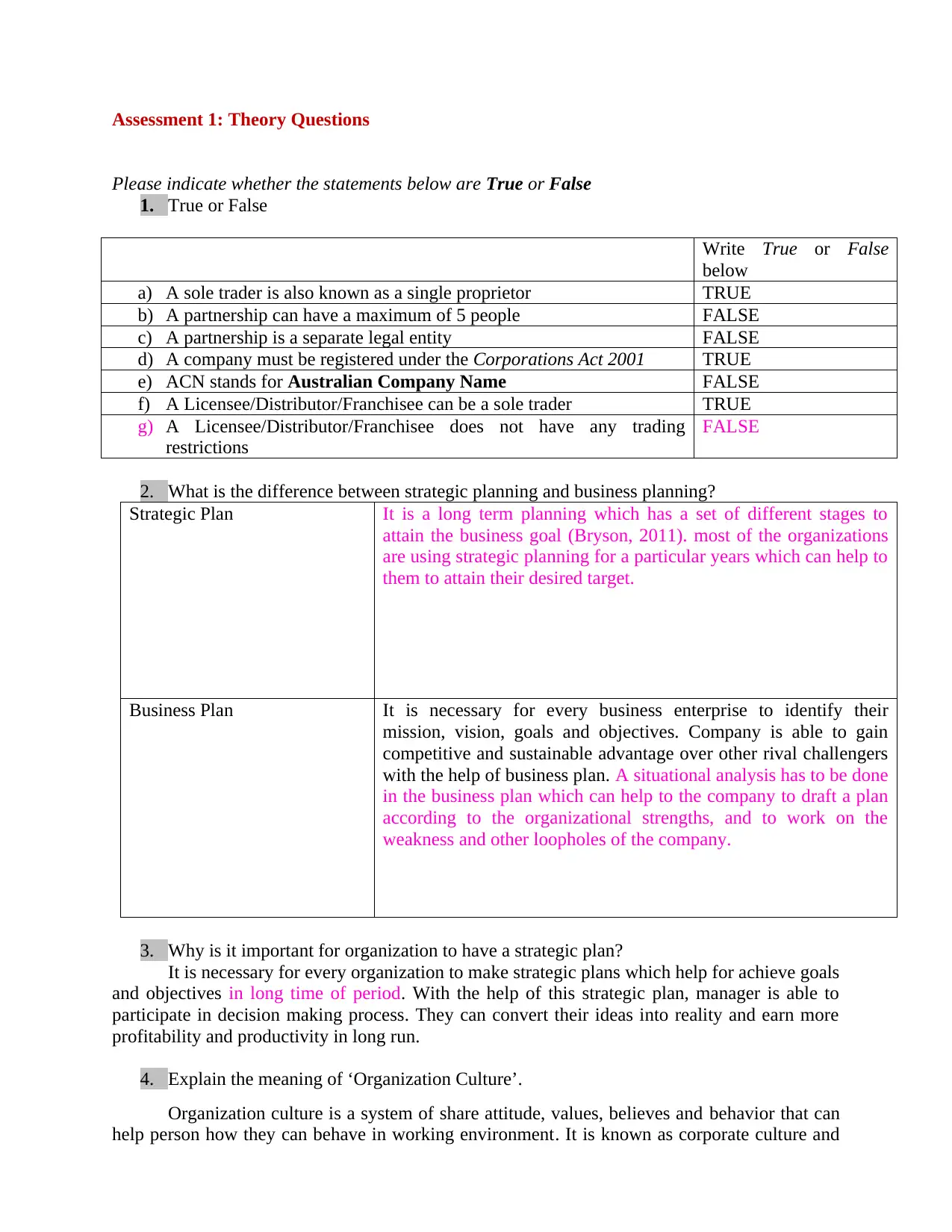
Assessment 1: Theory Questions
Please indicate whether the statements below are True or False
1. True or False
Write True or False
below
a) A sole trader is also known as a single proprietor TRUE
b) A partnership can have a maximum of 5 people FALSE
c) A partnership is a separate legal entity FALSE
d) A company must be registered under the Corporations Act 2001 TRUE
e) ACN stands for Australian Company Name FALSE
f) A Licensee/Distributor/Franchisee can be a sole trader TRUE
g) A Licensee/Distributor/Franchisee does not have any trading
restrictions
FALSE
2. What is the difference between strategic planning and business planning?
Strategic Plan It is a long term planning which has a set of different stages to
attain the business goal (Bryson, 2011). most of the organizations
are using strategic planning for a particular years which can help to
them to attain their desired target.
Business Plan It is necessary for every business enterprise to identify their
mission, vision, goals and objectives. Company is able to gain
competitive and sustainable advantage over other rival challengers
with the help of business plan. A situational analysis has to be done
in the business plan which can help to the company to draft a plan
according to the organizational strengths, and to work on the
weakness and other loopholes of the company.
3. Why is it important for organization to have a strategic plan?
It is necessary for every organization to make strategic plans which help for achieve goals
and objectives in long time of period. With the help of this strategic plan, manager is able to
participate in decision making process. They can convert their ideas into reality and earn more
profitability and productivity in long run.
4. Explain the meaning of ‘Organization Culture’.
Organization culture is a system of share attitude, values, believes and behavior that can
help person how they can behave in working environment. It is known as corporate culture and
Please indicate whether the statements below are True or False
1. True or False
Write True or False
below
a) A sole trader is also known as a single proprietor TRUE
b) A partnership can have a maximum of 5 people FALSE
c) A partnership is a separate legal entity FALSE
d) A company must be registered under the Corporations Act 2001 TRUE
e) ACN stands for Australian Company Name FALSE
f) A Licensee/Distributor/Franchisee can be a sole trader TRUE
g) A Licensee/Distributor/Franchisee does not have any trading
restrictions
FALSE
2. What is the difference between strategic planning and business planning?
Strategic Plan It is a long term planning which has a set of different stages to
attain the business goal (Bryson, 2011). most of the organizations
are using strategic planning for a particular years which can help to
them to attain their desired target.
Business Plan It is necessary for every business enterprise to identify their
mission, vision, goals and objectives. Company is able to gain
competitive and sustainable advantage over other rival challengers
with the help of business plan. A situational analysis has to be done
in the business plan which can help to the company to draft a plan
according to the organizational strengths, and to work on the
weakness and other loopholes of the company.
3. Why is it important for organization to have a strategic plan?
It is necessary for every organization to make strategic plans which help for achieve goals
and objectives in long time of period. With the help of this strategic plan, manager is able to
participate in decision making process. They can convert their ideas into reality and earn more
profitability and productivity in long run.
4. Explain the meaning of ‘Organization Culture’.
Organization culture is a system of share attitude, values, believes and behavior that can
help person how they can behave in working environment. It is known as corporate culture and
Paraphrase This Document
Need a fresh take? Get an instant paraphrase of this document with our AI Paraphraser
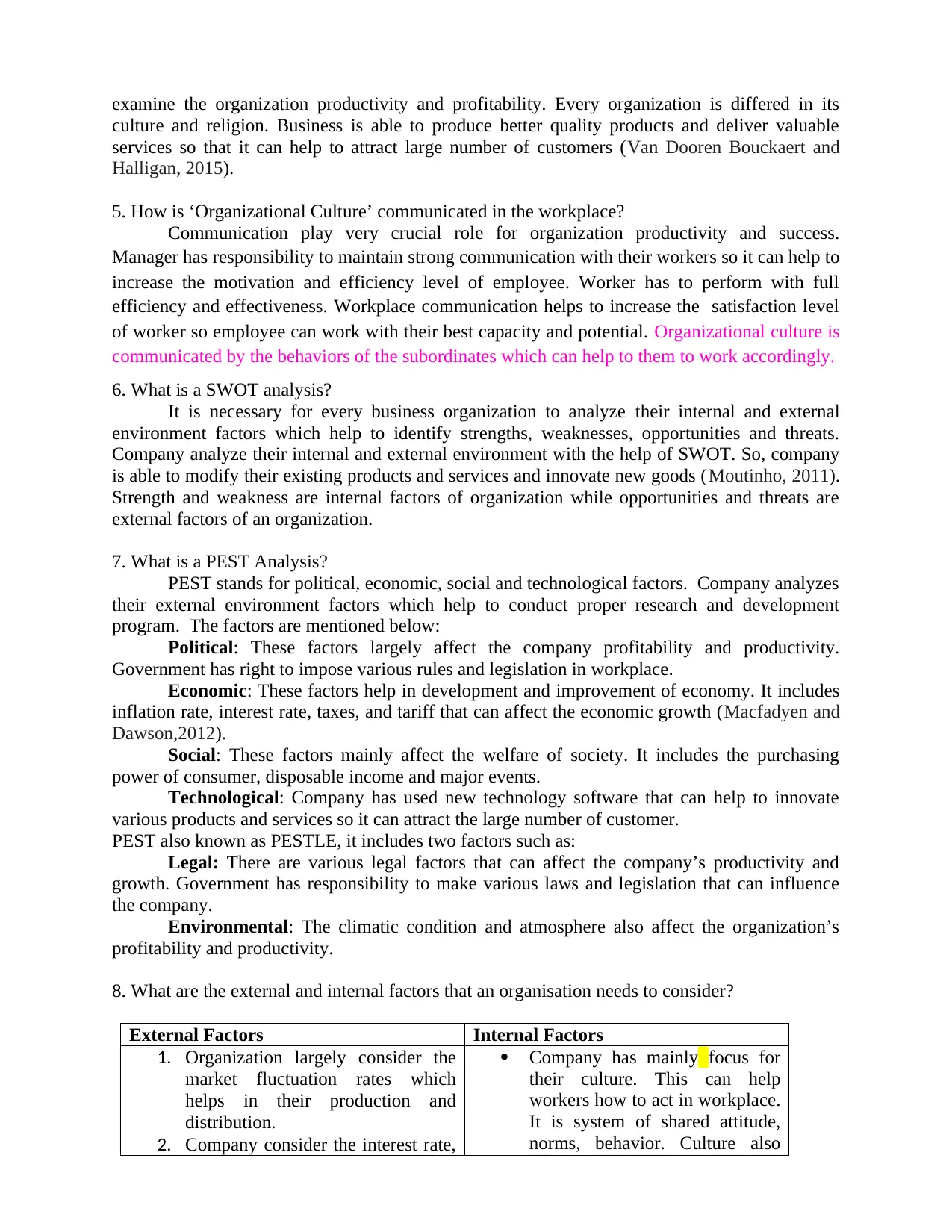
examine the organization productivity and profitability. Every organization is differed in its
culture and religion. Business is able to produce better quality products and deliver valuable
services so that it can help to attract large number of customers (Van Dooren Bouckaert and
Halligan, 2015).
5. How is ‘Organizational Culture’ communicated in the workplace?
Communication play very crucial role for organization productivity and success.
Manager has responsibility to maintain strong communication with their workers so it can help to
increase the motivation and efficiency level of employee. Worker has to perform with full
efficiency and effectiveness. Workplace communication helps to increase the satisfaction level
of worker so employee can work with their best capacity and potential. Organizational culture is
communicated by the behaviors of the subordinates which can help to them to work accordingly.
6. What is a SWOT analysis?
It is necessary for every business organization to analyze their internal and external
environment factors which help to identify strengths, weaknesses, opportunities and threats.
Company analyze their internal and external environment with the help of SWOT. So, company
is able to modify their existing products and services and innovate new goods (Moutinho, 2011).
Strength and weakness are internal factors of organization while opportunities and threats are
external factors of an organization.
7. What is a PEST Analysis?
PEST stands for political, economic, social and technological factors. Company analyzes
their external environment factors which help to conduct proper research and development
program. The factors are mentioned below:
Political: These factors largely affect the company profitability and productivity.
Government has right to impose various rules and legislation in workplace.
Economic: These factors help in development and improvement of economy. It includes
inflation rate, interest rate, taxes, and tariff that can affect the economic growth (Macfadyen and
Dawson,2012).
Social: These factors mainly affect the welfare of society. It includes the purchasing
power of consumer, disposable income and major events.
Technological: Company has used new technology software that can help to innovate
various products and services so it can attract the large number of customer.
PEST also known as PESTLE, it includes two factors such as:
Legal: There are various legal factors that can affect the company’s productivity and
growth. Government has responsibility to make various laws and legislation that can influence
the company.
Environmental: The climatic condition and atmosphere also affect the organization’s
profitability and productivity.
8. What are the external and internal factors that an organisation needs to consider?
External Factors Internal Factors
1. Organization largely consider the
market fluctuation rates which
helps in their production and
distribution.
2. Company consider the interest rate,
Company has mainly focus for
their culture. This can help
workers how to act in workplace.
It is system of shared attitude,
norms, behavior. Culture also
culture and religion. Business is able to produce better quality products and deliver valuable
services so that it can help to attract large number of customers (Van Dooren Bouckaert and
Halligan, 2015).
5. How is ‘Organizational Culture’ communicated in the workplace?
Communication play very crucial role for organization productivity and success.
Manager has responsibility to maintain strong communication with their workers so it can help to
increase the motivation and efficiency level of employee. Worker has to perform with full
efficiency and effectiveness. Workplace communication helps to increase the satisfaction level
of worker so employee can work with their best capacity and potential. Organizational culture is
communicated by the behaviors of the subordinates which can help to them to work accordingly.
6. What is a SWOT analysis?
It is necessary for every business organization to analyze their internal and external
environment factors which help to identify strengths, weaknesses, opportunities and threats.
Company analyze their internal and external environment with the help of SWOT. So, company
is able to modify their existing products and services and innovate new goods (Moutinho, 2011).
Strength and weakness are internal factors of organization while opportunities and threats are
external factors of an organization.
7. What is a PEST Analysis?
PEST stands for political, economic, social and technological factors. Company analyzes
their external environment factors which help to conduct proper research and development
program. The factors are mentioned below:
Political: These factors largely affect the company profitability and productivity.
Government has right to impose various rules and legislation in workplace.
Economic: These factors help in development and improvement of economy. It includes
inflation rate, interest rate, taxes, and tariff that can affect the economic growth (Macfadyen and
Dawson,2012).
Social: These factors mainly affect the welfare of society. It includes the purchasing
power of consumer, disposable income and major events.
Technological: Company has used new technology software that can help to innovate
various products and services so it can attract the large number of customer.
PEST also known as PESTLE, it includes two factors such as:
Legal: There are various legal factors that can affect the company’s productivity and
growth. Government has responsibility to make various laws and legislation that can influence
the company.
Environmental: The climatic condition and atmosphere also affect the organization’s
profitability and productivity.
8. What are the external and internal factors that an organisation needs to consider?
External Factors Internal Factors
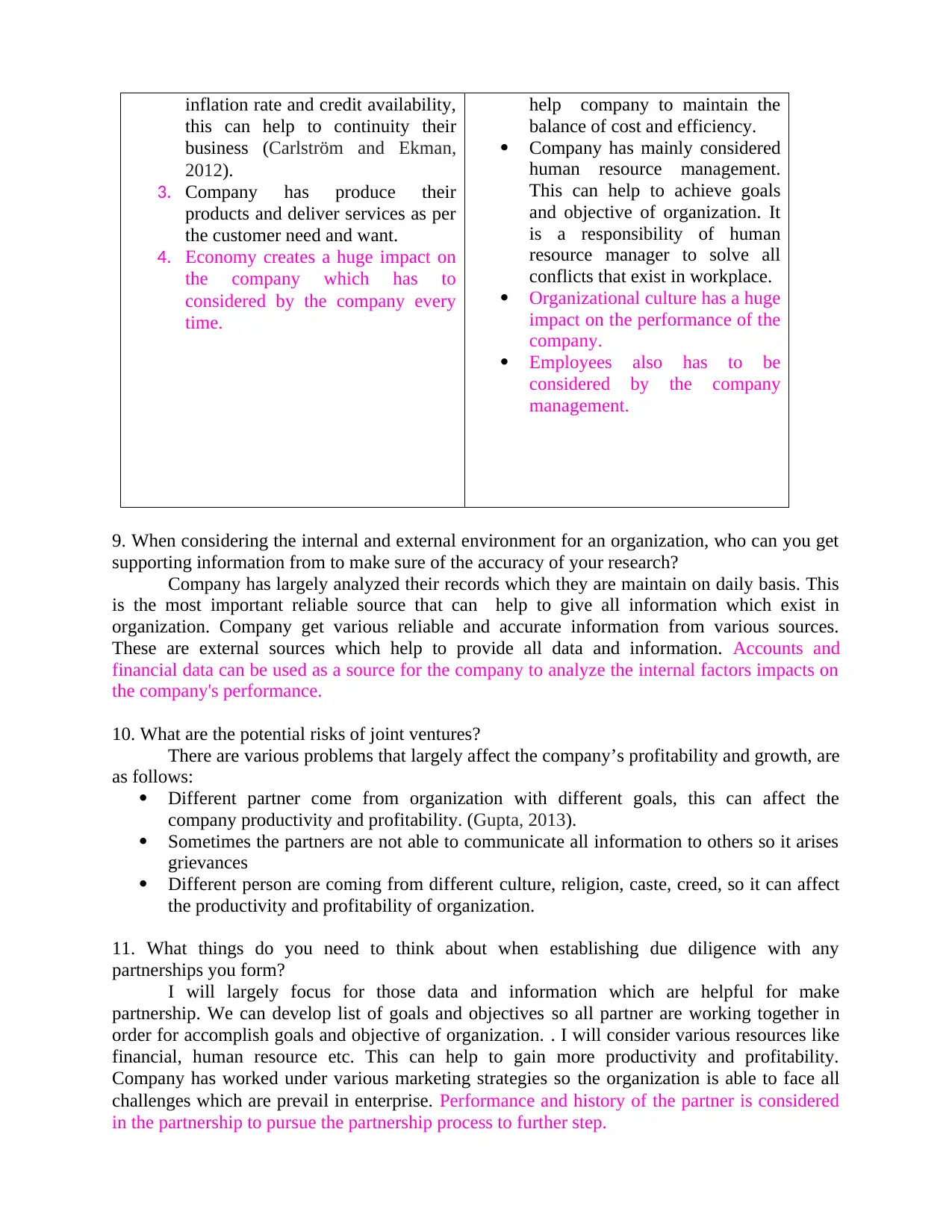
1. Organization largely consider the
market fluctuation rates which
helps in their production and
distribution.
2. Company consider the interest rate,
Company has mainly focus for
their culture. This can help
workers how to act in workplace.
It is system of shared attitude,
norms, behavior. Culture also
inflation rate and credit availability,
this can help to continuity their
business (Carlström and Ekman,
2012).
3. Company has produce their
products and deliver services as per
the customer need and want.
4. Economy creates a huge impact on
the company which has to
considered by the company every
time.
help company to maintain the
balance of cost and efficiency.
Company has mainly considered
human resource management.
This can help to achieve goals
and objective of organization. It
is a responsibility of human
resource manager to solve all
conflicts that exist in workplace.
Organizational culture has a huge
impact on the performance of the
company.
Employees also has to be
considered by the company
management.
9. When considering the internal and external environment for an organization, who can you get
supporting information from to make sure of the accuracy of your research?
Company has largely analyzed their records which they are maintain on daily basis. This
is the most important reliable source that can help to give all information which exist in
organization. Company get various reliable and accurate information from various sources.
These are external sources which help to provide all data and information. Accounts and
financial data can be used as a source for the company to analyze the internal factors impacts on
the company's performance.
10. What are the potential risks of joint ventures?
There are various problems that largely affect the company’s profitability and growth, are
as follows:
Different partner come from organization with different goals, this can affect the
company productivity and profitability. (Gupta, 2013).
Sometimes the partners are not able to communicate all information to others so it arises
grievances
Different person are coming from different culture, religion, caste, creed, so it can affect
the productivity and profitability of organization.
11. What things do you need to think about when establishing due diligence with any
partnerships you form?
I will largely focus for those data and information which are helpful for make
partnership. We can develop list of goals and objectives so all partner are working together in
order for accomplish goals and objective of organization. . I will consider various resources like
financial, human resource etc. This can help to gain more productivity and profitability.
Company has worked under various marketing strategies so the organization is able to face all
challenges which are prevail in enterprise. Performance and history of the partner is considered
in the partnership to pursue the partnership process to further step.
this can help to continuity their
business (Carlström and Ekman,
2012).
3. Company has produce their
products and deliver services as per
the customer need and want.
4. Economy creates a huge impact on
the company which has to
considered by the company every
time.
help company to maintain the
balance of cost and efficiency.
Company has mainly considered
human resource management.
This can help to achieve goals
and objective of organization. It
is a responsibility of human
resource manager to solve all
conflicts that exist in workplace.
Organizational culture has a huge
impact on the performance of the
company.
Employees also has to be
considered by the company
management.
9. When considering the internal and external environment for an organization, who can you get
supporting information from to make sure of the accuracy of your research?
Company has largely analyzed their records which they are maintain on daily basis. This
is the most important reliable source that can help to give all information which exist in
organization. Company get various reliable and accurate information from various sources.
These are external sources which help to provide all data and information. Accounts and
financial data can be used as a source for the company to analyze the internal factors impacts on
the company's performance.
10. What are the potential risks of joint ventures?
There are various problems that largely affect the company’s profitability and growth, are
as follows:
Different partner come from organization with different goals, this can affect the
company productivity and profitability. (Gupta, 2013).
Sometimes the partners are not able to communicate all information to others so it arises
grievances
Different person are coming from different culture, religion, caste, creed, so it can affect
the productivity and profitability of organization.
11. What things do you need to think about when establishing due diligence with any
partnerships you form?
I will largely focus for those data and information which are helpful for make
partnership. We can develop list of goals and objectives so all partner are working together in
order for accomplish goals and objective of organization. . I will consider various resources like
financial, human resource etc. This can help to gain more productivity and profitability.
Company has worked under various marketing strategies so the organization is able to face all
challenges which are prevail in enterprise. Performance and history of the partner is considered
in the partnership to pursue the partnership process to further step.
⊘ This is a preview!⊘
Do you want full access?
Subscribe today to unlock all pages.
Trusted by 1+ million students worldwide

Paraphrase This Document
Need a fresh take? Get an instant paraphrase of this document with our AI Paraphraser
Assessment 2: Case Study Applying the Theory
Part A - Case Study – Hair at Home
Introduction to Hair at Home
Hair at Home is a franchise organisation currently operating a mobile hairdressing service in
South East QLD from the Gold Coast to the Sunshine Coast and as far west as Toowoomba. The
current organisational goal is to expand into Central and North QLD next year and Sydney and
Melbourne two years later.
Hair at Home’s current market position is well established with a strong and stable clientele. The
current strategies are continuing to see expansion in both the company owned and franchise vans
with the coverage of Brisbane, the Gold Coast, Sunshine Coast and Toowoomba providing solid
income and profits for the staff, franchisee’s and Directors. It has allowed Hair at Home to
remain competitive and prosperous during hard financial times.
Hair at Home is now positioned for growth and has the capacity support the hairdressers working
for them. The structure and procedures for franchisees have been established and the only
limitation is regulation restrictions that occur in each city council for the operation of mobile
hairdressing. The parent company supports its franchisees in their initial set up and marketing
into any new region.
Hair at Home provides an extensive service range including:
Complete range of hairdressings to the elderly, housebound and disabled individuals.
Complete range of hairdressing to age care facilities, nursing homes, independent living
facilities and respite centers for the elderly and disabled.
Full hairdressing services to busy executives, families and individuals.
Office and executive at work customized range of services.
Specializing in wedding and formal hair and makeup services.
History of Hair at Home
Hair at Home was established as a company on 2/8/1990. The purpose was to provide
hairdressing services to an increasing ageing population in Brisbane and surrounding regions.
Over two years the operations increased to a level where the capacity of one mobile van was not
coping with the demand and a strategic objective was developed to handle the expansion of the
business.
In 1992 the organisational framework moved to established itself as a franchisee. Setting up the
structure to meet franchising requirements and establishing the appropriate supporting
procedures took 12 months. By 1994 there were 1 company owned van and 2 independent
franchise vans on the road.
Current Ownership & Structure
Hair at Home has 9 company owned vans and 12 Franchise vans in South East QLD and
provides a supportive structure for all its franchisees. A brief overview is supplied in the
organisational chart below.
Part A - Case Study – Hair at Home
Introduction to Hair at Home
Hair at Home is a franchise organisation currently operating a mobile hairdressing service in
South East QLD from the Gold Coast to the Sunshine Coast and as far west as Toowoomba. The
current organisational goal is to expand into Central and North QLD next year and Sydney and
Melbourne two years later.
Hair at Home’s current market position is well established with a strong and stable clientele. The
current strategies are continuing to see expansion in both the company owned and franchise vans
with the coverage of Brisbane, the Gold Coast, Sunshine Coast and Toowoomba providing solid
income and profits for the staff, franchisee’s and Directors. It has allowed Hair at Home to
remain competitive and prosperous during hard financial times.
Hair at Home is now positioned for growth and has the capacity support the hairdressers working
for them. The structure and procedures for franchisees have been established and the only
limitation is regulation restrictions that occur in each city council for the operation of mobile
hairdressing. The parent company supports its franchisees in their initial set up and marketing
into any new region.
Hair at Home provides an extensive service range including:
Complete range of hairdressings to the elderly, housebound and disabled individuals.
Complete range of hairdressing to age care facilities, nursing homes, independent living
facilities and respite centers for the elderly and disabled.
Full hairdressing services to busy executives, families and individuals.
Office and executive at work customized range of services.
Specializing in wedding and formal hair and makeup services.
History of Hair at Home
Hair at Home was established as a company on 2/8/1990. The purpose was to provide
hairdressing services to an increasing ageing population in Brisbane and surrounding regions.
Over two years the operations increased to a level where the capacity of one mobile van was not
coping with the demand and a strategic objective was developed to handle the expansion of the
business.
In 1992 the organisational framework moved to established itself as a franchisee. Setting up the
structure to meet franchising requirements and establishing the appropriate supporting
procedures took 12 months. By 1994 there were 1 company owned van and 2 independent
franchise vans on the road.
Current Ownership & Structure
Hair at Home has 9 company owned vans and 12 Franchise vans in South East QLD and
provides a supportive structure for all its franchisees. A brief overview is supplied in the
organisational chart below.
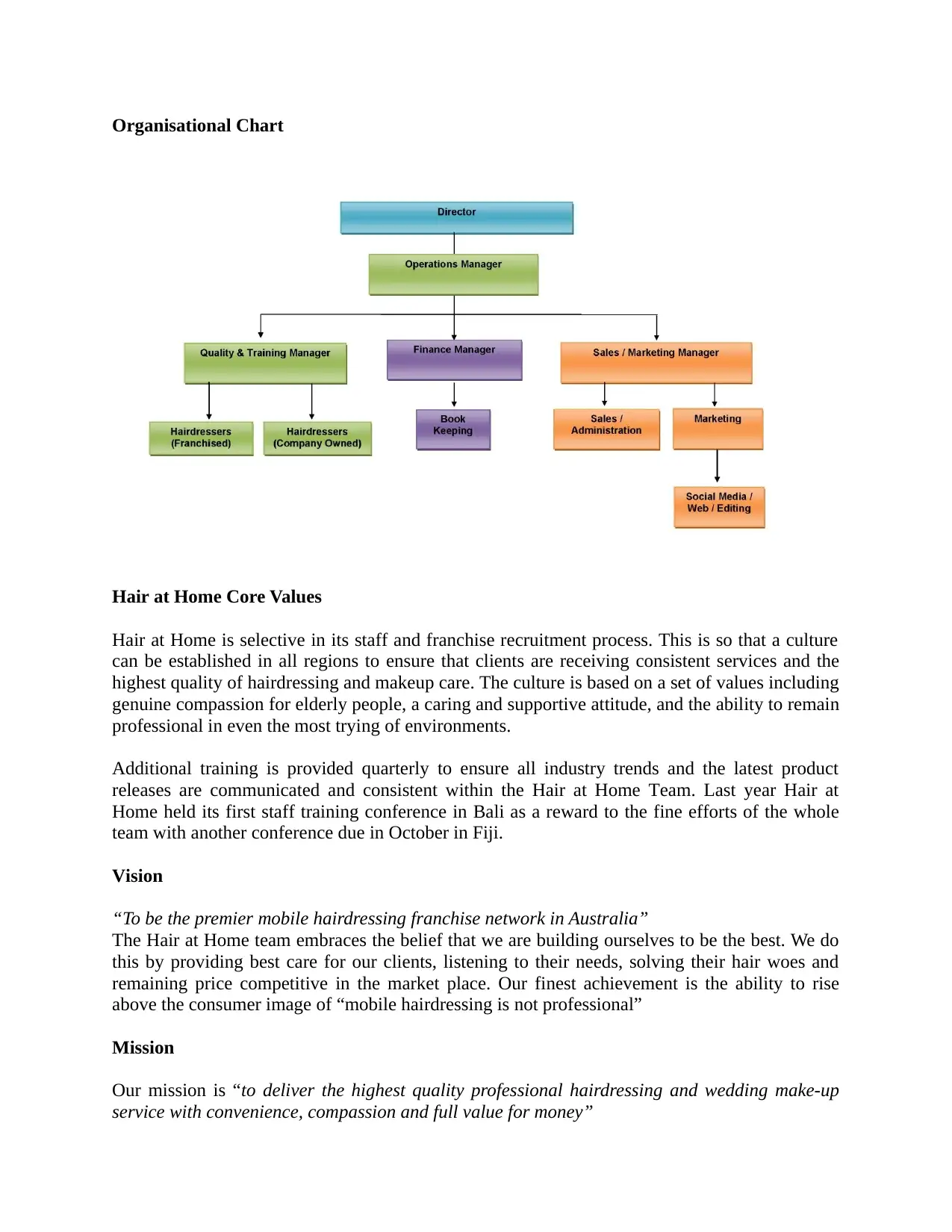
Organisational Chart
Hair at Home Core Values
Hair at Home is selective in its staff and franchise recruitment process. This is so that a culture
can be established in all regions to ensure that clients are receiving consistent services and the
highest quality of hairdressing and makeup care. The culture is based on a set of values including
genuine compassion for elderly people, a caring and supportive attitude, and the ability to remain
professional in even the most trying of environments.
Additional training is provided quarterly to ensure all industry trends and the latest product
releases are communicated and consistent within the Hair at Home Team. Last year Hair at
Home held its first staff training conference in Bali as a reward to the fine efforts of the whole
team with another conference due in October in Fiji.
Vision
“To be the premier mobile hairdressing franchise network in Australia”
The Hair at Home team embraces the belief that we are building ourselves to be the best. We do
this by providing best care for our clients, listening to their needs, solving their hair woes and
remaining price competitive in the market place. Our finest achievement is the ability to rise
above the consumer image of “mobile hairdressing is not professional”
Mission
Our mission is “to deliver the highest quality professional hairdressing and wedding make-up
service with convenience, compassion and full value for money”
Hair at Home Core Values
Hair at Home is selective in its staff and franchise recruitment process. This is so that a culture
can be established in all regions to ensure that clients are receiving consistent services and the
highest quality of hairdressing and makeup care. The culture is based on a set of values including
genuine compassion for elderly people, a caring and supportive attitude, and the ability to remain
professional in even the most trying of environments.
Additional training is provided quarterly to ensure all industry trends and the latest product
releases are communicated and consistent within the Hair at Home Team. Last year Hair at
Home held its first staff training conference in Bali as a reward to the fine efforts of the whole
team with another conference due in October in Fiji.
Vision
“To be the premier mobile hairdressing franchise network in Australia”
The Hair at Home team embraces the belief that we are building ourselves to be the best. We do
this by providing best care for our clients, listening to their needs, solving their hair woes and
remaining price competitive in the market place. Our finest achievement is the ability to rise
above the consumer image of “mobile hairdressing is not professional”
Mission
Our mission is “to deliver the highest quality professional hairdressing and wedding make-up
service with convenience, compassion and full value for money”
⊘ This is a preview!⊘
Do you want full access?
Subscribe today to unlock all pages.
Trusted by 1+ million students worldwide
We do this by ensuring our franchisees are selected from the finest hairdressers the industry has
to offer. We provide ongoing training and operational support and assist with all aspects of
business management where needed. Our structures and procedures mean that our staff can get
on with doing what they do best....hair, makeup and keeping clients happy.
Franchise Support Plan
Hair at Home has structure support plan which gives the best opportunity for success no matter
whether you are:
1. Employed in a company owned vehicles or as an apprentice
2. Self employed as a franchisee
The recruitment process has allowed Hair at Home to ensure the right fit to the business, the
geographical area and the client demographic in each area is achieved.
The key strategies to support employees and franchisees include:
1. A clear recruitment process so that the right person can be placed in the right area
2. Comprehensive induction training
3. Ongoing industry updates, training and conferencesCentralized client booking
management system with iPad immediate updates and notifications
4. Staff support in the case of illness and holidays
Initial Induction Training includes:
1. A mentor day on the road with an experience franchisee so the candidate can assess if the
role is what they are looking for and they will fit into our culture and expectations. This
is done before any commitment is made to working with Hair at Home or buying a
franchise.
2. Induction and operating a van on the road for one month preferably in the desired area.
This provides the opportunity to assess whether you do want to make the long-term
commitment prior to financial investment.
3. Monthly review process which is two way. This is the opportunity to discuss what has
worked and if any challenges or issues have occurred. We have the opportunity to
evaluate client feedback, administration feedback and feedback from the Quality and
Training Manager as to identify their suitability to the role. Offer of company area or
franchise area if the month is successful.
to offer. We provide ongoing training and operational support and assist with all aspects of
business management where needed. Our structures and procedures mean that our staff can get
on with doing what they do best....hair, makeup and keeping clients happy.
Franchise Support Plan
Hair at Home has structure support plan which gives the best opportunity for success no matter
whether you are:
1. Employed in a company owned vehicles or as an apprentice
2. Self employed as a franchisee
The recruitment process has allowed Hair at Home to ensure the right fit to the business, the
geographical area and the client demographic in each area is achieved.
The key strategies to support employees and franchisees include:
1. A clear recruitment process so that the right person can be placed in the right area
2. Comprehensive induction training
3. Ongoing industry updates, training and conferencesCentralized client booking
management system with iPad immediate updates and notifications
4. Staff support in the case of illness and holidays
Initial Induction Training includes:
1. A mentor day on the road with an experience franchisee so the candidate can assess if the
role is what they are looking for and they will fit into our culture and expectations. This
is done before any commitment is made to working with Hair at Home or buying a
franchise.
2. Induction and operating a van on the road for one month preferably in the desired area.
This provides the opportunity to assess whether you do want to make the long-term
commitment prior to financial investment.
3. Monthly review process which is two way. This is the opportunity to discuss what has
worked and if any challenges or issues have occurred. We have the opportunity to
evaluate client feedback, administration feedback and feedback from the Quality and
Training Manager as to identify their suitability to the role. Offer of company area or
franchise area if the month is successful.
Paraphrase This Document
Need a fresh take? Get an instant paraphrase of this document with our AI Paraphraser
Introducing the Regional Franchise Case Study
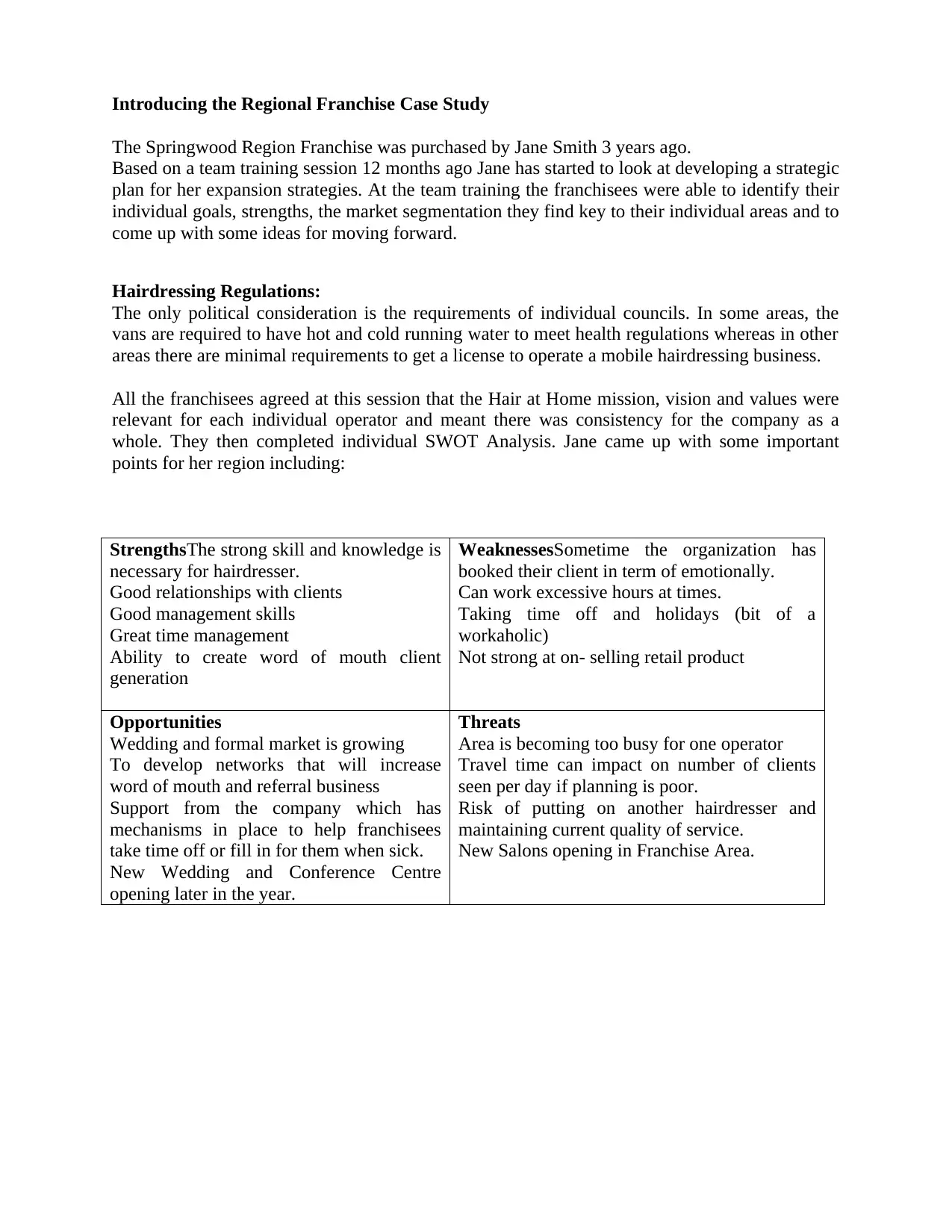
The Springwood Region Franchise was purchased by Jane Smith 3 years ago.
Based on a team training session 12 months ago Jane has started to look at developing a strategic
plan for her expansion strategies. At the team training the franchisees were able to identify their
individual goals, strengths, the market segmentation they find key to their individual areas and to
come up with some ideas for moving forward.
Hairdressing Regulations:
The only political consideration is the requirements of individual councils. In some areas, the
vans are required to have hot and cold running water to meet health regulations whereas in other
areas there are minimal requirements to get a license to operate a mobile hairdressing business.
All the franchisees agreed at this session that the Hair at Home mission, vision and values were
relevant for each individual operator and meant there was consistency for the company as a
whole. They then completed individual SWOT Analysis. Jane came up with some important
points for her region including:
StrengthsThe strong skill and knowledge is
necessary for hairdresser.
Good relationships with clients
Good management skills
Great time management
Ability to create word of mouth client
generation
WeaknessesSometime the organization has
booked their client in term of emotionally.
Can work excessive hours at times.
Taking time off and holidays (bit of a
workaholic)
Not strong at on- selling retail product
Opportunities
Wedding and formal market is growing
To develop networks that will increase
word of mouth and referral business
Support from the company which has
mechanisms in place to help franchisees
take time off or fill in for them when sick.
New Wedding and Conference Centre
opening later in the year.
Threats
Area is becoming too busy for one operator
Travel time can impact on number of clients
seen per day if planning is poor.
Risk of putting on another hairdresser and
maintaining current quality of service.
New Salons opening in Franchise Area.
The Springwood Region Franchise was purchased by Jane Smith 3 years ago.
Based on a team training session 12 months ago Jane has started to look at developing a strategic
plan for her expansion strategies. At the team training the franchisees were able to identify their
individual goals, strengths, the market segmentation they find key to their individual areas and to
come up with some ideas for moving forward.
Hairdressing Regulations:
The only political consideration is the requirements of individual councils. In some areas, the
vans are required to have hot and cold running water to meet health regulations whereas in other
areas there are minimal requirements to get a license to operate a mobile hairdressing business.
All the franchisees agreed at this session that the Hair at Home mission, vision and values were
relevant for each individual operator and meant there was consistency for the company as a
whole. They then completed individual SWOT Analysis. Jane came up with some important
points for her region including:
StrengthsThe strong skill and knowledge is
necessary for hairdresser.
Good relationships with clients
Good management skills
Great time management
Ability to create word of mouth client
generation
WeaknessesSometime the organization has
booked their client in term of emotionally.
Can work excessive hours at times.
Taking time off and holidays (bit of a
workaholic)
Not strong at on- selling retail product
Opportunities
Wedding and formal market is growing
To develop networks that will increase
word of mouth and referral business
Support from the company which has
mechanisms in place to help franchisees
take time off or fill in for them when sick.
New Wedding and Conference Centre
opening later in the year.
Threats
Area is becoming too busy for one operator
Travel time can impact on number of clients
seen per day if planning is poor.
Risk of putting on another hairdresser and
maintaining current quality of service.
New Salons opening in Franchise Area.
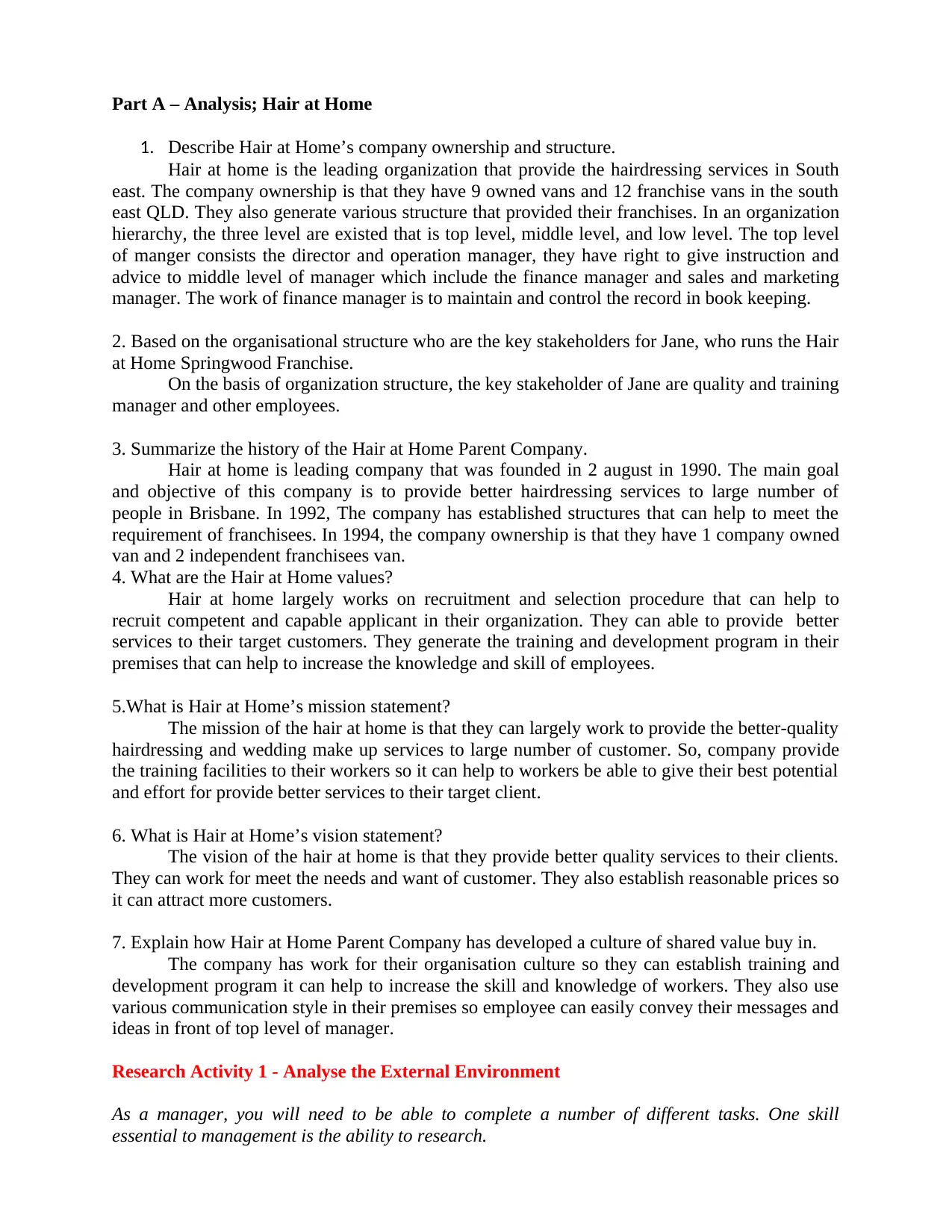
Part A – Analysis; Hair at Home
1. Describe Hair at Home’s company ownership and structure.
Hair at home is the leading organization that provide the hairdressing services in South
east. The company ownership is that they have 9 owned vans and 12 franchise vans in the south
east QLD. They also generate various structure that provided their franchises. In an organization
hierarchy, the three level are existed that is top level, middle level, and low level. The top level
of manger consists the director and operation manager, they have right to give instruction and
advice to middle level of manager which include the finance manager and sales and marketing
manager. The work of finance manager is to maintain and control the record in book keeping.
2. Based on the organisational structure who are the key stakeholders for Jane, who runs the Hair
at Home Springwood Franchise.
On the basis of organization structure, the key stakeholder of Jane are quality and training
manager and other employees.
3. Summarize the history of the Hair at Home Parent Company.
Hair at home is leading company that was founded in 2 august in 1990. The main goal
and objective of this company is to provide better hairdressing services to large number of
people in Brisbane. In 1992, The company has established structures that can help to meet the
requirement of franchisees. In 1994, the company ownership is that they have 1 company owned
van and 2 independent franchisees van.
4. What are the Hair at Home values?
Hair at home largely works on recruitment and selection procedure that can help to
recruit competent and capable applicant in their organization. They can able to provide better
services to their target customers. They generate the training and development program in their
premises that can help to increase the knowledge and skill of employees.
5.What is Hair at Home’s mission statement?
The mission of the hair at home is that they can largely work to provide the better-quality
hairdressing and wedding make up services to large number of customer. So, company provide
the training facilities to their workers so it can help to workers be able to give their best potential
and effort for provide better services to their target client.
6. What is Hair at Home’s vision statement?
The vision of the hair at home is that they provide better quality services to their clients.
They can work for meet the needs and want of customer. They also establish reasonable prices so
it can attract more customers.
7. Explain how Hair at Home Parent Company has developed a culture of shared value buy in.
The company has work for their organisation culture so they can establish training and
development program it can help to increase the skill and knowledge of workers. They also use
various communication style in their premises so employee can easily convey their messages and
ideas in front of top level of manager.
Research Activity 1 - Analyse the External Environment
As a manager, you will need to be able to complete a number of different tasks. One skill
essential to management is the ability to research.
1. Describe Hair at Home’s company ownership and structure.
Hair at home is the leading organization that provide the hairdressing services in South
east. The company ownership is that they have 9 owned vans and 12 franchise vans in the south
east QLD. They also generate various structure that provided their franchises. In an organization
hierarchy, the three level are existed that is top level, middle level, and low level. The top level
of manger consists the director and operation manager, they have right to give instruction and
advice to middle level of manager which include the finance manager and sales and marketing
manager. The work of finance manager is to maintain and control the record in book keeping.
2. Based on the organisational structure who are the key stakeholders for Jane, who runs the Hair
at Home Springwood Franchise.
On the basis of organization structure, the key stakeholder of Jane are quality and training
manager and other employees.
3. Summarize the history of the Hair at Home Parent Company.
Hair at home is leading company that was founded in 2 august in 1990. The main goal
and objective of this company is to provide better hairdressing services to large number of
people in Brisbane. In 1992, The company has established structures that can help to meet the
requirement of franchisees. In 1994, the company ownership is that they have 1 company owned
van and 2 independent franchisees van.
4. What are the Hair at Home values?
Hair at home largely works on recruitment and selection procedure that can help to
recruit competent and capable applicant in their organization. They can able to provide better
services to their target customers. They generate the training and development program in their
premises that can help to increase the knowledge and skill of employees.
5.What is Hair at Home’s mission statement?
The mission of the hair at home is that they can largely work to provide the better-quality
hairdressing and wedding make up services to large number of customer. So, company provide
the training facilities to their workers so it can help to workers be able to give their best potential
and effort for provide better services to their target client.
6. What is Hair at Home’s vision statement?
The vision of the hair at home is that they provide better quality services to their clients.
They can work for meet the needs and want of customer. They also establish reasonable prices so
it can attract more customers.
7. Explain how Hair at Home Parent Company has developed a culture of shared value buy in.
The company has work for their organisation culture so they can establish training and
development program it can help to increase the skill and knowledge of workers. They also use
various communication style in their premises so employee can easily convey their messages and
ideas in front of top level of manager.
Research Activity 1 - Analyse the External Environment
As a manager, you will need to be able to complete a number of different tasks. One skill
essential to management is the ability to research.
⊘ This is a preview!⊘
Do you want full access?
Subscribe today to unlock all pages.
Trusted by 1+ million students worldwide

1 out of 33


Related Documents


Your All-in-One AI-Powered Toolkit for Academic Success.
+13062052269
info@desklib.com
Available 24*7 on WhatsApp / Email
![[object Object]](/_next/static/media/star-bottom.7253800d.svg)
Unlock your academic potential
Copyright © 2020–2026 A2Z Services. All Rights Reserved. Developed and managed by ZUCOL.