Analysis of Strategic Quality and Systems Management at Sainsbury Plc
VerifiedAdded on 2021/02/21
|31
|8060
|54
Report
AI Summary
This report provides a comprehensive analysis of strategic quality and systems management at Sainsbury Plc. It begins by exploring the role of operations management in achieving organizational objectives, emphasizing its importance in increasing productivity and profitability, as well as its impact on employee performance and resource utilization. The report then evaluates the success of Sainsbury's existing operations management processes, highlighting the company's use of technology, benchmarking, and balanced scorecards to enhance efficiency and achieve strategic goals. Furthermore, the report delves into the significance of quality management, explaining its role in ensuring product credibility, customer loyalty, and employee satisfaction, with a focus on the Six Sigma DMAIC model. It assesses the success of Sainsbury's quality management processes, citing its positive impact on property portfolio growth, expansion, and sales. The report also addresses the challenges Sainsbury faces, such as global operations and transportation issues, and concludes by recommending areas for improvement to align with organizational objectives.
Unit 11: Strategic Quality and Systems
Management
1
Management
1

Paraphrase This Document
Need a fresh take? Get an instant paraphrase of this document with our AI Paraphraser
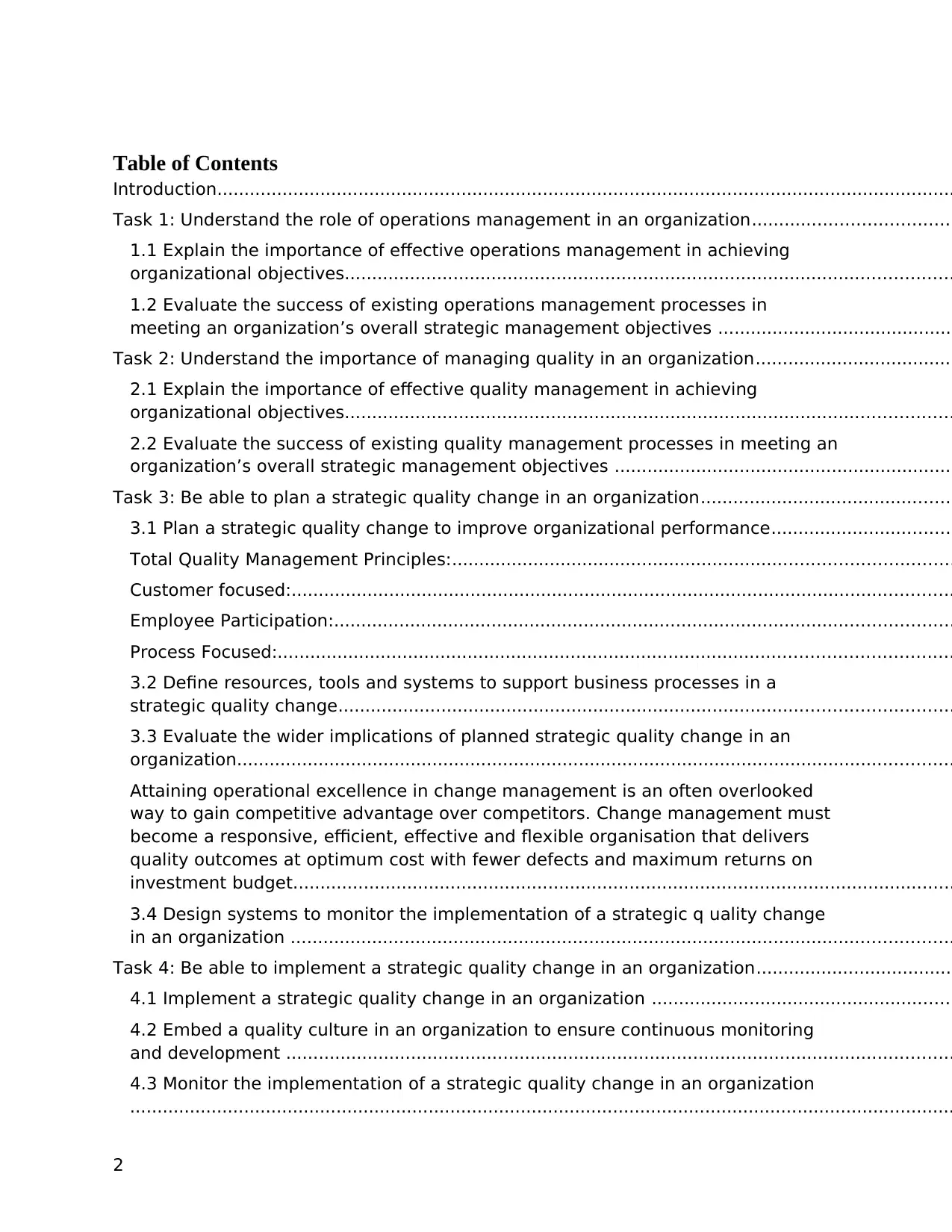
Table of Contents
Introduction........................................................................................................................................
Task 1: Understand the role of operations management in an organization.....................................
1.1 Explain the importance of effective operations management in achieving
organizational objectives................................................................................................................
1.2 Evaluate the success of existing operations management processes in
meeting an organization’s overall strategic management objectives ............................................
Task 2: Understand the importance of managing quality in an organization.....................................
2.1 Explain the importance of effective quality management in achieving
organizational objectives................................................................................................................
2.2 Evaluate the success of existing quality management processes in meeting an
organization’s overall strategic management objectives ...............................................................
Task 3: Be able to plan a strategic quality change in an organization...............................................
3.1 Plan a strategic quality change to improve organizational performance..................................
Total Quality Management Principles:............................................................................................
Customer focused:..........................................................................................................................
Employee Participation:..................................................................................................................
Process Focused:............................................................................................................................
3.2 Define resources, tools and systems to support business processes in a
strategic quality change.................................................................................................................
3.3 Evaluate the wider implications of planned strategic quality change in an
organization....................................................................................................................................
Attaining operational excellence in change management is an often overlooked
way to gain competitive advantage over competitors. Change management must
become a responsive, efficient, effective and flexible organisation that delivers
quality outcomes at optimum cost with fewer defects and maximum returns on
investment budget..........................................................................................................................
3.4 Design systems to monitor the implementation of a strategic q uality change
in an organization ..........................................................................................................................
Task 4: Be able to implement a strategic quality change in an organization.....................................
4.1 Implement a strategic quality change in an organization ........................................................
4.2 Embed a quality culture in an organization to ensure continuous monitoring
and development ...........................................................................................................................
4.3 Monitor the implementation of a strategic quality change in an organization
........................................................................................................................................................
2
Introduction........................................................................................................................................
Task 1: Understand the role of operations management in an organization.....................................
1.1 Explain the importance of effective operations management in achieving
organizational objectives................................................................................................................
1.2 Evaluate the success of existing operations management processes in
meeting an organization’s overall strategic management objectives ............................................
Task 2: Understand the importance of managing quality in an organization.....................................
2.1 Explain the importance of effective quality management in achieving
organizational objectives................................................................................................................
2.2 Evaluate the success of existing quality management processes in meeting an
organization’s overall strategic management objectives ...............................................................
Task 3: Be able to plan a strategic quality change in an organization...............................................
3.1 Plan a strategic quality change to improve organizational performance..................................
Total Quality Management Principles:............................................................................................
Customer focused:..........................................................................................................................
Employee Participation:..................................................................................................................
Process Focused:............................................................................................................................
3.2 Define resources, tools and systems to support business processes in a
strategic quality change.................................................................................................................
3.3 Evaluate the wider implications of planned strategic quality change in an
organization....................................................................................................................................
Attaining operational excellence in change management is an often overlooked
way to gain competitive advantage over competitors. Change management must
become a responsive, efficient, effective and flexible organisation that delivers
quality outcomes at optimum cost with fewer defects and maximum returns on
investment budget..........................................................................................................................
3.4 Design systems to monitor the implementation of a strategic q uality change
in an organization ..........................................................................................................................
Task 4: Be able to implement a strategic quality change in an organization.....................................
4.1 Implement a strategic quality change in an organization ........................................................
4.2 Embed a quality culture in an organization to ensure continuous monitoring
and development ...........................................................................................................................
4.3 Monitor the implementation of a strategic quality change in an organization
........................................................................................................................................................
2
Task 5: Be able to evaluate the outcomes of a strategic quality change in an
organization.......................................................................................................................................
5.1 evaluate the outcomes of a strategic quality change in an organization ................................
5.2 recommend areas for improvement to a strategic quality change that align
with organizational objectives .......................................................................................................
Reference...........................................................................................................................................
3
organization.......................................................................................................................................
5.1 evaluate the outcomes of a strategic quality change in an organization ................................
5.2 recommend areas for improvement to a strategic quality change that align
with organizational objectives .......................................................................................................
Reference...........................................................................................................................................
3
⊘ This is a preview!⊘
Do you want full access?
Subscribe today to unlock all pages.

Trusted by 1+ million students worldwide
·Introduction
UK’s second largest supermarket Sainsbury Plc was founded by John James Sainsbury in the
year 1869 and is head-quartered at London, UK. The format of Sainsbury stores is divided into
two and they are regular Sainsbury's supermarkets and Sainsbury's Local convenience stores.
The great emphasis on fresh food and improved product lines heightens the customer’s loyalty
towards Sainsbury. In this work, the strategic quality and systems management at Sainsbury will
be analyzed by the author.
·Task 1: Understand the role of operations management in an organization
·1.1 Explain the importance of effective operations management in achieving
organizational objectives
According to Meredith and Pilkington, (2018) Operations management is the activity of
managing all the functions which will benefit an organization to increase its productivity and
profitability. This means that operations management exists at all levels of the organization
whether it is directly related or otherwise. For example, marketing managers plan for their trips
to meet customers, this activity is an operations management one. On the other hand it has been
argued by Khanna, (2015) if operations are not managed effectively it will cause hindrances in
managing the daily activities of the organisation. It may also decrease overall productivity of
Sainsbury, there will be a huge gap between the input and output ratio. It may also decline of the
performance of the employees within the company. Various activities of business will also come
to halt and resources of the organisation will not be used properly. Due to poor operations
management strategies company will not be able to achieve its goals and objectives which will
result in the loss of the company. In the view of Heizer and Render (2013) Operations
management is the core part of an organization and it is devoted to production and delivery of
goods and services.
In the view of Konopaske (2013) organizational objectives are particular aims and objectives set
by the company, required to achieve it in the future for their organizational benefits. As per the
4
UK’s second largest supermarket Sainsbury Plc was founded by John James Sainsbury in the
year 1869 and is head-quartered at London, UK. The format of Sainsbury stores is divided into
two and they are regular Sainsbury's supermarkets and Sainsbury's Local convenience stores.
The great emphasis on fresh food and improved product lines heightens the customer’s loyalty
towards Sainsbury. In this work, the strategic quality and systems management at Sainsbury will
be analyzed by the author.
·Task 1: Understand the role of operations management in an organization
·1.1 Explain the importance of effective operations management in achieving
organizational objectives
According to Meredith and Pilkington, (2018) Operations management is the activity of
managing all the functions which will benefit an organization to increase its productivity and
profitability. This means that operations management exists at all levels of the organization
whether it is directly related or otherwise. For example, marketing managers plan for their trips
to meet customers, this activity is an operations management one. On the other hand it has been
argued by Khanna, (2015) if operations are not managed effectively it will cause hindrances in
managing the daily activities of the organisation. It may also decrease overall productivity of
Sainsbury, there will be a huge gap between the input and output ratio. It may also decline of the
performance of the employees within the company. Various activities of business will also come
to halt and resources of the organisation will not be used properly. Due to poor operations
management strategies company will not be able to achieve its goals and objectives which will
result in the loss of the company. In the view of Heizer and Render (2013) Operations
management is the core part of an organization and it is devoted to production and delivery of
goods and services.
In the view of Konopaske (2013) organizational objectives are particular aims and objectives set
by the company, required to achieve it in the future for their organizational benefits. As per the
4
Paraphrase This Document
Need a fresh take? Get an instant paraphrase of this document with our AI Paraphraser
annual report of Sainsbury plc (2014) the business strategy and objectives of Sainsbury includes
following:
·Compelling general merchandize and clothing
Operations management helps the organization to increase their productions with
minimum cost through effective utilization of all the available resources. The sales
growth of Sainsbury has increased twice over the rate of food through the economic
offering of high quality products to customers at supermarket prices. The great
performance of sales in the Sainsbury is from the areas of cookware, kitchen electrical
and clothing (Sainsbury, 2014).
·Great food
Effective operations management helps the organization to provide quality products to
customers. Sainsbury produces quality products by combining their ethical standards
with strong supplier relationship (Sainsbury, 2014).
·Developing new business
As per the annual report of Sainsbury (2014) the company considers developing new
business and investing beyond their core as part of long term strategy for future.
·Growing space & creating property value
The annual report of Sainsbury (2014) mentions that the company has clear vision on
growing their stores and store portfolio. The effective operations management of
Sainsbury accredits the company to add space to existing stores through extensions.
·Complementary channels and services
5
following:
·Compelling general merchandize and clothing
Operations management helps the organization to increase their productions with
minimum cost through effective utilization of all the available resources. The sales
growth of Sainsbury has increased twice over the rate of food through the economic
offering of high quality products to customers at supermarket prices. The great
performance of sales in the Sainsbury is from the areas of cookware, kitchen electrical
and clothing (Sainsbury, 2014).
·Great food
Effective operations management helps the organization to provide quality products to
customers. Sainsbury produces quality products by combining their ethical standards
with strong supplier relationship (Sainsbury, 2014).
·Developing new business
As per the annual report of Sainsbury (2014) the company considers developing new
business and investing beyond their core as part of long term strategy for future.
·Growing space & creating property value
The annual report of Sainsbury (2014) mentions that the company has clear vision on
growing their stores and store portfolio. The effective operations management of
Sainsbury accredits the company to add space to existing stores through extensions.
·Complementary channels and services
5
The operations management helps the company to boost their sales and enhance the
means for the distribution of products. Sainsbury Plc develops and maintains various
channels and services that acts complement with their existing super market business and
thus the company is able to drive sales through increasing customer loyalty (Sainsbury,
2014).
The Telegraph (2014) reports that company’s passion for maintaining health, safe, fresh and
tasty food during the economic conditions has grabbed customer’s credit worthiness and loyalty
towards it. Sainsbury has also given more importance for opening new stores at different areas,
where the customers can easily reach, and along with it the company also aims to provide
satisfied shopping experience to customers.
Even at the economic recession period, the company took great care to maintain quality in their
products through giving utmost importance to hygiene and safety. As per the annual report of
Sainsbury (2014) the industrial advancement paved the company to try their best to supply
goods and services according to changing needs and demands of the customers. The effective
operations management has increased the company’s productivity and profitability through
sales. For this purpose Sainsbury recruited more than 10000 employees all across the stores to
handle customers without losing them at the checkpoint.
l壱1.2 Evaluate the success of existing operations management processes in meeting an
organization’s overall strategic management objectives
The existing operations management of Sainsbury enabled the company to achieve £120 million
of operational cost. According to Pyzdek and Keller (2014), efficiency of management and
innovative technologies to reduce cost and time is the primary concern for all organizations. As
a result of effective operations management, the Sainsbury possess advance technologies and
efficient management to generate growth on sales and income for the company. Bench marking
process made the Sainsbury competitive through implementing targets and objectives, by
comparing with the performance of other similar organization. Effective benchmarking system
provided, Sainsbury to identify and prioritize the opportunities more easily for increasing
6
means for the distribution of products. Sainsbury Plc develops and maintains various
channels and services that acts complement with their existing super market business and
thus the company is able to drive sales through increasing customer loyalty (Sainsbury,
2014).
The Telegraph (2014) reports that company’s passion for maintaining health, safe, fresh and
tasty food during the economic conditions has grabbed customer’s credit worthiness and loyalty
towards it. Sainsbury has also given more importance for opening new stores at different areas,
where the customers can easily reach, and along with it the company also aims to provide
satisfied shopping experience to customers.
Even at the economic recession period, the company took great care to maintain quality in their
products through giving utmost importance to hygiene and safety. As per the annual report of
Sainsbury (2014) the industrial advancement paved the company to try their best to supply
goods and services according to changing needs and demands of the customers. The effective
operations management has increased the company’s productivity and profitability through
sales. For this purpose Sainsbury recruited more than 10000 employees all across the stores to
handle customers without losing them at the checkpoint.
l壱1.2 Evaluate the success of existing operations management processes in meeting an
organization’s overall strategic management objectives
The existing operations management of Sainsbury enabled the company to achieve £120 million
of operational cost. According to Pyzdek and Keller (2014), efficiency of management and
innovative technologies to reduce cost and time is the primary concern for all organizations. As
a result of effective operations management, the Sainsbury possess advance technologies and
efficient management to generate growth on sales and income for the company. Bench marking
process made the Sainsbury competitive through implementing targets and objectives, by
comparing with the performance of other similar organization. Effective benchmarking system
provided, Sainsbury to identify and prioritize the opportunities more easily for increasing
6
⊘ This is a preview!⊘
Do you want full access?
Subscribe today to unlock all pages.
Trusted by 1+ million students worldwide
productivity and profitability of the company. According to Hammer,(2015) balance score card
tool helps the managers of a company to track the activities of employees and to monitor the
consequences of their activities. Being a strategic performance management tool, balance score
card benefited the Sainsbury to measure their performance in finance, customers, internal
business process and learning and growth. The success of operations management is reflected in
every aspect of the organizational activities of Sainsbury.
In the views of Domínguez-Mayo and et.al., (2015) if operations management process is
poorly managed it will result in inability of the organisation in achieving their strategic
management objectives. If management of operations are not effectively managed it will result
poor implementation of strategies and this will result poor product and service quality of the
organisation which will dissatisfy the customers. When the strategic objectives are not met
effectively it will decrease the profitability of Sainsbury. Due to poor operations management
strategy it will also increase the waste as company will not be ale to put control on its wastages.
So it is important for the company to track the success of its operations management process.
There has been an issue in the operations management process of Sainsbury is that company has
failed to operate the business at global level in a successful manner as they have been facing
problems is dealing with operations like the transportation, information technologies, etc.
7
tool helps the managers of a company to track the activities of employees and to monitor the
consequences of their activities. Being a strategic performance management tool, balance score
card benefited the Sainsbury to measure their performance in finance, customers, internal
business process and learning and growth. The success of operations management is reflected in
every aspect of the organizational activities of Sainsbury.
In the views of Domínguez-Mayo and et.al., (2015) if operations management process is
poorly managed it will result in inability of the organisation in achieving their strategic
management objectives. If management of operations are not effectively managed it will result
poor implementation of strategies and this will result poor product and service quality of the
organisation which will dissatisfy the customers. When the strategic objectives are not met
effectively it will decrease the profitability of Sainsbury. Due to poor operations management
strategy it will also increase the waste as company will not be ale to put control on its wastages.
So it is important for the company to track the success of its operations management process.
There has been an issue in the operations management process of Sainsbury is that company has
failed to operate the business at global level in a successful manner as they have been facing
problems is dealing with operations like the transportation, information technologies, etc.
7
Paraphrase This Document
Need a fresh take? Get an instant paraphrase of this document with our AI Paraphraser
·Task 2: Understand the importance of managing quality in an organization
·2.1 Explain the importance of effective quality management in achieving organizational
objectives
Effective quality management in an organization ensures credibility and consistency in the
products they produced and developed. According to Pyzdek and Keller (2014), the ‘Six Sigma’
quality models is the discipline set by Sainsbury to measure the quality standards and efficiency
of the organization. Effective quality management serves as a tool for Sainsbury in ensuring the
quality of business operations are managed effectively and help ensuring high customer loyalty.
Thus it helps in increasing the cash flow for the company and increases the performance of
employees within the organisation which results in the satisfaction of employees in an
organisation. Effective quality management process can help in making a company a better
place to work as there will occur less errors and quality of performance and products will be
improved. It also play a crucial role in the growth and reputation of a company and is a key
resources for facing competition within the market.
The six sigma or the DMAIC model has five processes to check the quality of the
operations in an organization- Define, Measure, Analyze, Improve and Control.
8
·2.1 Explain the importance of effective quality management in achieving organizational
objectives
Effective quality management in an organization ensures credibility and consistency in the
products they produced and developed. According to Pyzdek and Keller (2014), the ‘Six Sigma’
quality models is the discipline set by Sainsbury to measure the quality standards and efficiency
of the organization. Effective quality management serves as a tool for Sainsbury in ensuring the
quality of business operations are managed effectively and help ensuring high customer loyalty.
Thus it helps in increasing the cash flow for the company and increases the performance of
employees within the organisation which results in the satisfaction of employees in an
organisation. Effective quality management process can help in making a company a better
place to work as there will occur less errors and quality of performance and products will be
improved. It also play a crucial role in the growth and reputation of a company and is a key
resources for facing competition within the market.
The six sigma or the DMAIC model has five processes to check the quality of the
operations in an organization- Define, Measure, Analyze, Improve and Control.
8
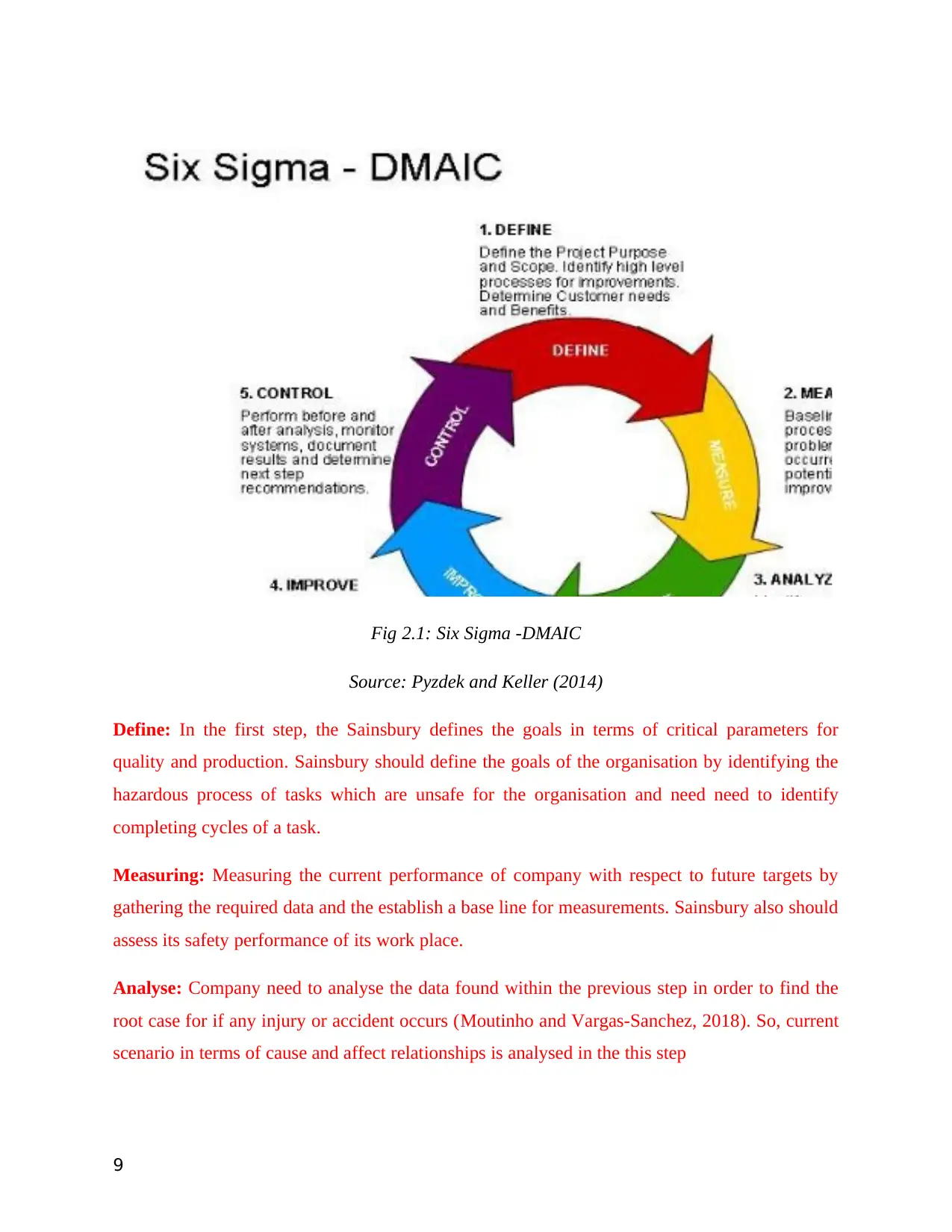
Fig 2.1: Six Sigma -DMAIC
Source: Pyzdek and Keller (2014)
Define: In the first step, the Sainsbury defines the goals in terms of critical parameters for
quality and production. Sainsbury should define the goals of the organisation by identifying the
hazardous process of tasks which are unsafe for the organisation and need need to identify
completing cycles of a task.
Measuring: Measuring the current performance of company with respect to future targets by
gathering the required data and the establish a base line for measurements. Sainsbury also should
assess its safety performance of its work place.
Analyse: Company need to analyse the data found within the previous step in order to find the
root case for if any injury or accident occurs (Moutinho and Vargas-Sanchez, 2018). So, current
scenario in terms of cause and affect relationships is analysed in the this step
9
Source: Pyzdek and Keller (2014)
Define: In the first step, the Sainsbury defines the goals in terms of critical parameters for
quality and production. Sainsbury should define the goals of the organisation by identifying the
hazardous process of tasks which are unsafe for the organisation and need need to identify
completing cycles of a task.
Measuring: Measuring the current performance of company with respect to future targets by
gathering the required data and the establish a base line for measurements. Sainsbury also should
assess its safety performance of its work place.
Analyse: Company need to analyse the data found within the previous step in order to find the
root case for if any injury or accident occurs (Moutinho and Vargas-Sanchez, 2018). So, current
scenario in terms of cause and affect relationships is analysed in the this step
9
⊘ This is a preview!⊘
Do you want full access?
Subscribe today to unlock all pages.
Trusted by 1+ million students worldwide
Improve: Once the root cause has been identified then company need to eliminate the causes of
the defects. So, elimination of defects detected is dealt within this stage of six sigma quality
model.
Controlling: In this stage when changes are verified after its implementation then revaluation
should be done. It is important for Sainsbury to control the future targets into right path before
gets deviated is the final stage of this quality model.
All of these steps help in meeting the organisational objective if these steps are
implemented in well planned manner.
In the view of Gygi, Williams and Decarlo (2013) Implementation of Six sigma system ensures
quality of products better than the previous quality services already granted by the company to
the customers.
l壱2.2 Evaluate the success of existing quality management processes in meeting an
organization’s overall strategic management objectives
According to the annual reports of Sainsbury (2014), the existing quality management helped
the company to improve their performance through maintaining the quality and customer
satisfaction. The annual reports of Sainsbury (2013) points out that, for past five years the
quality management at the organization has added $ 4 billion to their property portfolio, which
grew to $11.5 billion at present. Through the effective quality management, the Sainsbury Plc
expanded their growth through adding additional supermarkets and convenience store to their
existing outlets, and thereby paved the way for easy reach of customers and increased sales.
According to Butler and Rankin (2013) Sainsbury is able to successfully fight off with
competition from larger competitors TESCO and ASDA. The capability to survive against the
competitors is acquired by Sainsbury through effective quality management in service and
production. Total quality management and business reengineering process is integrated with the
success of organizational objectives of Sainsbury. Both these measures continually improved the
quality management of Sainsbury through improving work processes, production, growth, sales
etc.
10
the defects. So, elimination of defects detected is dealt within this stage of six sigma quality
model.
Controlling: In this stage when changes are verified after its implementation then revaluation
should be done. It is important for Sainsbury to control the future targets into right path before
gets deviated is the final stage of this quality model.
All of these steps help in meeting the organisational objective if these steps are
implemented in well planned manner.
In the view of Gygi, Williams and Decarlo (2013) Implementation of Six sigma system ensures
quality of products better than the previous quality services already granted by the company to
the customers.
l壱2.2 Evaluate the success of existing quality management processes in meeting an
organization’s overall strategic management objectives
According to the annual reports of Sainsbury (2014), the existing quality management helped
the company to improve their performance through maintaining the quality and customer
satisfaction. The annual reports of Sainsbury (2013) points out that, for past five years the
quality management at the organization has added $ 4 billion to their property portfolio, which
grew to $11.5 billion at present. Through the effective quality management, the Sainsbury Plc
expanded their growth through adding additional supermarkets and convenience store to their
existing outlets, and thereby paved the way for easy reach of customers and increased sales.
According to Butler and Rankin (2013) Sainsbury is able to successfully fight off with
competition from larger competitors TESCO and ASDA. The capability to survive against the
competitors is acquired by Sainsbury through effective quality management in service and
production. Total quality management and business reengineering process is integrated with the
success of organizational objectives of Sainsbury. Both these measures continually improved the
quality management of Sainsbury through improving work processes, production, growth, sales
etc.
10
Paraphrase This Document
Need a fresh take? Get an instant paraphrase of this document with our AI Paraphraser
When an organization is often seen to be throwing away food products as part of its quality
management system, it may be argued that its quality management is not up to date elsewhere.
For example, food being a perishable commodity may be delivered in such quantities that all
deliveries are picked up by customers with very little or no wastage occurring. The other side is
perhaps to be seen in terms of the unpredictable nature of the production and delivery system
which might create wastage in the system.
It could be therefore said that the organization currently makes huge profits with minimum
losses and therefore managing its operations affairs in an excellent way.
Strengths and weaknesses of existing quality management of Sainsbury can be explained as
follows:
Strengths of existing quality management: One of the major strength of existing quality
management is that it will help the company to improve its performance by maintaining the
quality as well as customer satisfaction. Existing quality management has also helped Sainsbury
to generate more and more revenue and this has resulted in high profits for the organisation.
Due to the effective quality management of the organisation, Sainsbury has been able to expand
in supermarkets by opening convenience stores and also company been able to face the tough
competition within the industry due to existing quality management.
Weaknesses: Though existing quality management of Sainsbury have been beneficial for the
organisation but there are certain weaknesses in it. Quality management of Sainsbury is not up
to date as they are facing the problems with the perishable good. Perishable goods are the most
consumed goods by the customers so it is important for the organisation to maintain the proper
quality system within the organisation. Also, existing quality management of the organisation is
unable to predict the nature of its production process and its delivery system.
It can be concluded that effective quality management process is help for the
organisation, as it can help in achieving the strategic objectives of the Sainsbury as due to
quality management company will make fewer errors and will also increase the performance of
the employees in the organisation. There are some weaknesses related to existing quality
11
management system, it may be argued that its quality management is not up to date elsewhere.
For example, food being a perishable commodity may be delivered in such quantities that all
deliveries are picked up by customers with very little or no wastage occurring. The other side is
perhaps to be seen in terms of the unpredictable nature of the production and delivery system
which might create wastage in the system.
It could be therefore said that the organization currently makes huge profits with minimum
losses and therefore managing its operations affairs in an excellent way.
Strengths and weaknesses of existing quality management of Sainsbury can be explained as
follows:
Strengths of existing quality management: One of the major strength of existing quality
management is that it will help the company to improve its performance by maintaining the
quality as well as customer satisfaction. Existing quality management has also helped Sainsbury
to generate more and more revenue and this has resulted in high profits for the organisation.
Due to the effective quality management of the organisation, Sainsbury has been able to expand
in supermarkets by opening convenience stores and also company been able to face the tough
competition within the industry due to existing quality management.
Weaknesses: Though existing quality management of Sainsbury have been beneficial for the
organisation but there are certain weaknesses in it. Quality management of Sainsbury is not up
to date as they are facing the problems with the perishable good. Perishable goods are the most
consumed goods by the customers so it is important for the organisation to maintain the proper
quality system within the organisation. Also, existing quality management of the organisation is
unable to predict the nature of its production process and its delivery system.
It can be concluded that effective quality management process is help for the
organisation, as it can help in achieving the strategic objectives of the Sainsbury as due to
quality management company will make fewer errors and will also increase the performance of
the employees in the organisation. There are some weaknesses related to existing quality
11

management of Sainsbury, but company needs to overcome these weaknesses and has the
capability to do so. This will further improve the performance of organisation for the long term.
12
capability to do so. This will further improve the performance of organisation for the long term.
12
⊘ This is a preview!⊘
Do you want full access?
Subscribe today to unlock all pages.
Trusted by 1+ million students worldwide

1 out of 31


Related Documents


Your All-in-One AI-Powered Toolkit for Academic Success.
+13062052269
info@desklib.com
Available 24*7 on WhatsApp / Email
![[object Object]](/_next/static/media/star-bottom.7253800d.svg)
Unlock your academic potential
Copyright © 2020–2026 A2Z Services. All Rights Reserved. Developed and managed by ZUCOL.