Strategic Talent Management: Royal Lancaster London Research Project
VerifiedAdded on 2023/01/13
|23
|5444
|43
Report
AI Summary
This research project investigates talent management as a strategic priority, focusing on a case study of Royal Lancaster London. The report includes an introduction highlighting the importance of talent management within the hospitality industry, followed by a rationale for the research and defined aims and objectives. It explores research ethics and provides a comprehensive literature review on strategic talent management and related strategies. The methodology section details the research methods, data sources, philosophy (positivism), approach, design, and strategy. The report also identifies stakeholders, communication modes, and offers recommendations. Finally, it concludes with a reflection and provides a list of references.

Research Project

Paraphrase This Document
Need a fresh take? Get an instant paraphrase of this document with our AI Paraphraser
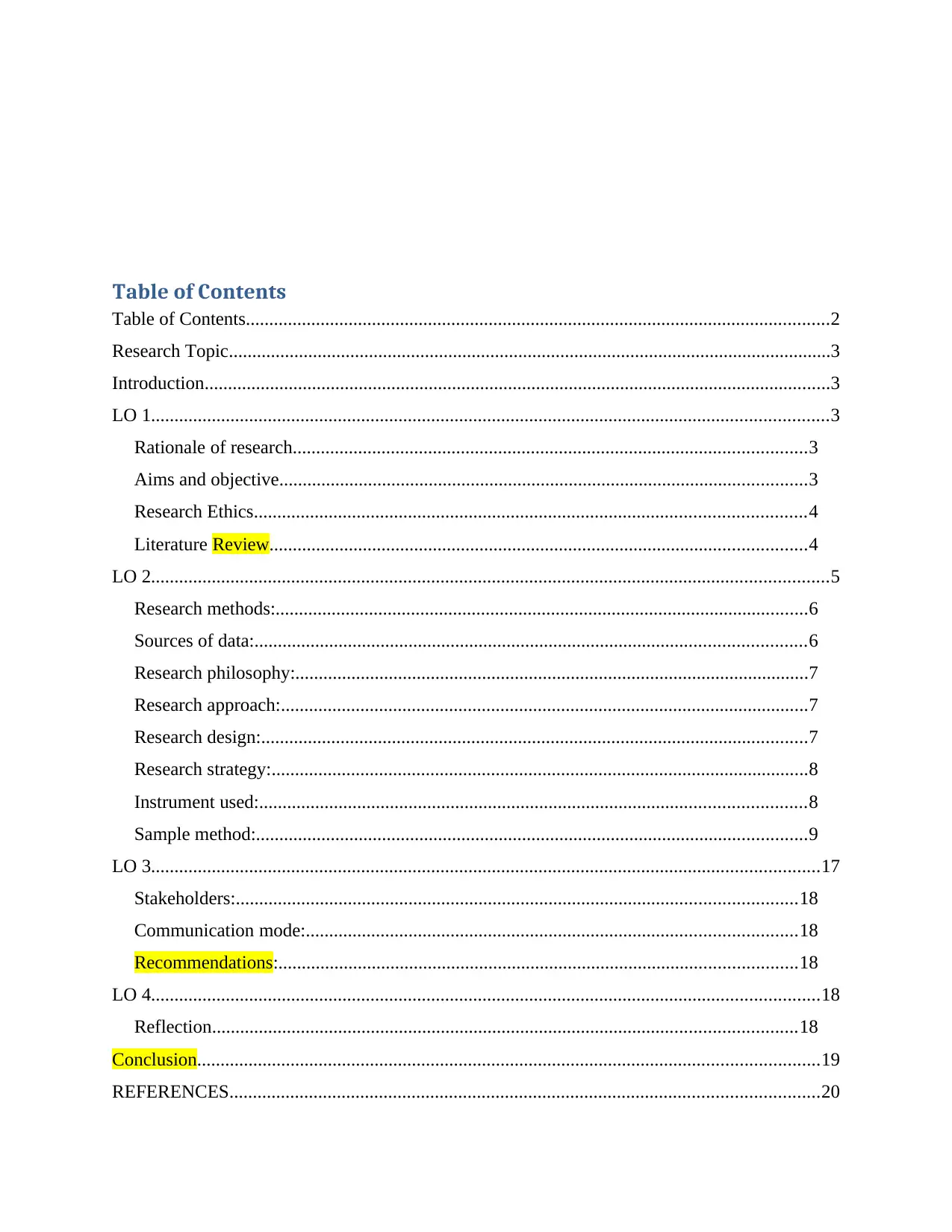
Table of Contents
Table of Contents.............................................................................................................................2
Research Topic.................................................................................................................................3
Introduction......................................................................................................................................3
LO 1.................................................................................................................................................3
Rationale of research..............................................................................................................3
Aims and objective.................................................................................................................3
Research Ethics......................................................................................................................4
Literature Review...................................................................................................................4
LO 2.................................................................................................................................................5
Research methods:..................................................................................................................6
Sources of data:......................................................................................................................6
Research philosophy:..............................................................................................................7
Research approach:.................................................................................................................7
Research design:.....................................................................................................................7
Research strategy:...................................................................................................................8
Instrument used:.....................................................................................................................8
Sample method:......................................................................................................................9
LO 3...............................................................................................................................................17
Stakeholders:........................................................................................................................18
Communication mode:.........................................................................................................18
Recommendations:...............................................................................................................18
LO 4...............................................................................................................................................18
Reflection.............................................................................................................................18
Conclusion.....................................................................................................................................19
REFERENCES..............................................................................................................................20
Table of Contents.............................................................................................................................2
Research Topic.................................................................................................................................3
Introduction......................................................................................................................................3
LO 1.................................................................................................................................................3
Rationale of research..............................................................................................................3
Aims and objective.................................................................................................................3
Research Ethics......................................................................................................................4
Literature Review...................................................................................................................4
LO 2.................................................................................................................................................5
Research methods:..................................................................................................................6
Sources of data:......................................................................................................................6
Research philosophy:..............................................................................................................7
Research approach:.................................................................................................................7
Research design:.....................................................................................................................7
Research strategy:...................................................................................................................8
Instrument used:.....................................................................................................................8
Sample method:......................................................................................................................9
LO 3...............................................................................................................................................17
Stakeholders:........................................................................................................................18
Communication mode:.........................................................................................................18
Recommendations:...............................................................................................................18
LO 4...............................................................................................................................................18
Reflection.............................................................................................................................18
Conclusion.....................................................................................................................................19
REFERENCES..............................................................................................................................20

⊘ This is a preview!⊘
Do you want full access?
Subscribe today to unlock all pages.

Trusted by 1+ million students worldwide
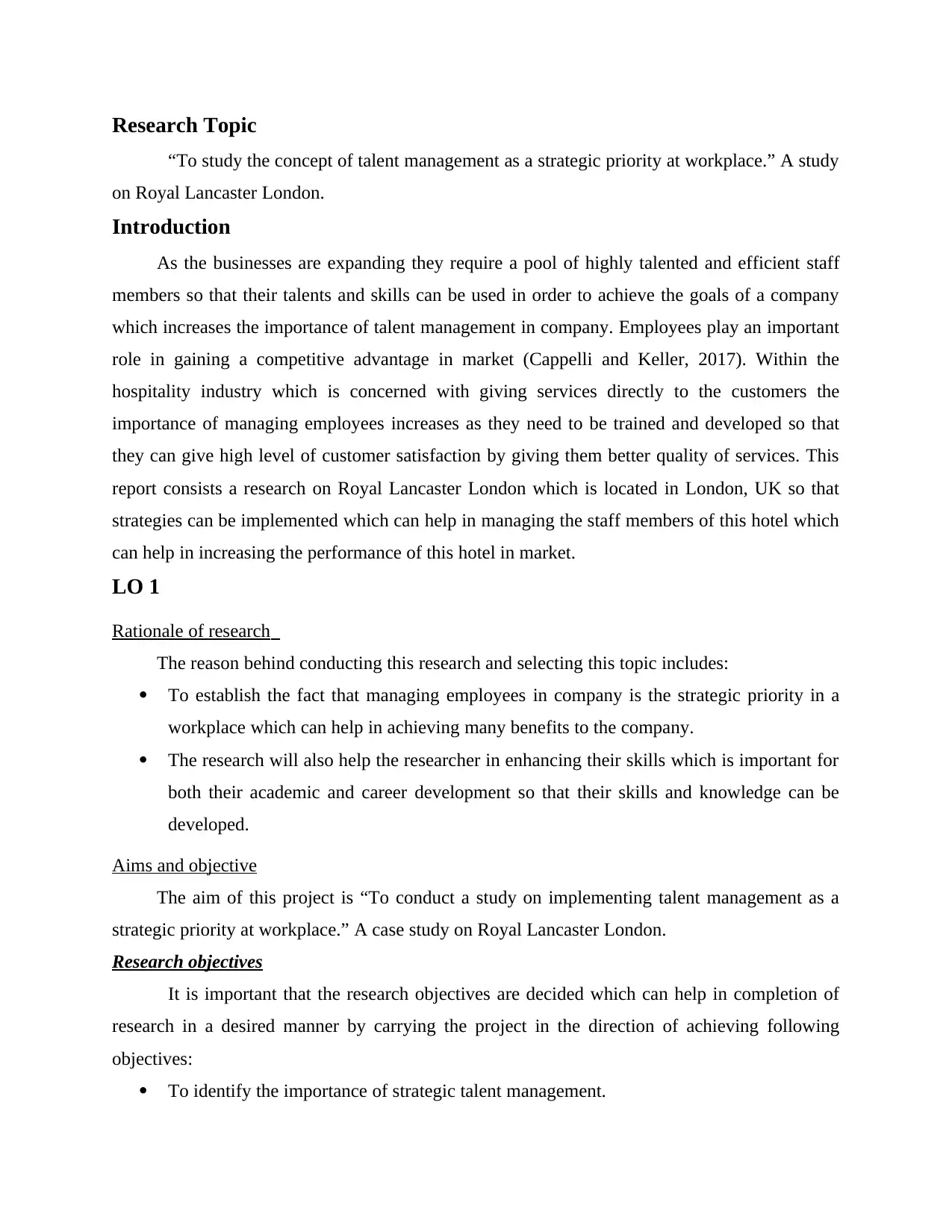
Research Topic
“To study the concept of talent management as a strategic priority at workplace.” A study
on Royal Lancaster London.
Introduction
As the businesses are expanding they require a pool of highly talented and efficient staff
members so that their talents and skills can be used in order to achieve the goals of a company
which increases the importance of talent management in company. Employees play an important
role in gaining a competitive advantage in market (Cappelli and Keller, 2017). Within the
hospitality industry which is concerned with giving services directly to the customers the
importance of managing employees increases as they need to be trained and developed so that
they can give high level of customer satisfaction by giving them better quality of services. This
report consists a research on Royal Lancaster London which is located in London, UK so that
strategies can be implemented which can help in managing the staff members of this hotel which
can help in increasing the performance of this hotel in market.
LO 1
Rationale of research
The reason behind conducting this research and selecting this topic includes:
To establish the fact that managing employees in company is the strategic priority in a
workplace which can help in achieving many benefits to the company.
The research will also help the researcher in enhancing their skills which is important for
both their academic and career development so that their skills and knowledge can be
developed.
Aims and objective
The aim of this project is “To conduct a study on implementing talent management as a
strategic priority at workplace.” A case study on Royal Lancaster London.
Research objectives
It is important that the research objectives are decided which can help in completion of
research in a desired manner by carrying the project in the direction of achieving following
objectives:
To identify the importance of strategic talent management.
“To study the concept of talent management as a strategic priority at workplace.” A study
on Royal Lancaster London.
Introduction
As the businesses are expanding they require a pool of highly talented and efficient staff
members so that their talents and skills can be used in order to achieve the goals of a company
which increases the importance of talent management in company. Employees play an important
role in gaining a competitive advantage in market (Cappelli and Keller, 2017). Within the
hospitality industry which is concerned with giving services directly to the customers the
importance of managing employees increases as they need to be trained and developed so that
they can give high level of customer satisfaction by giving them better quality of services. This
report consists a research on Royal Lancaster London which is located in London, UK so that
strategies can be implemented which can help in managing the staff members of this hotel which
can help in increasing the performance of this hotel in market.
LO 1
Rationale of research
The reason behind conducting this research and selecting this topic includes:
To establish the fact that managing employees in company is the strategic priority in a
workplace which can help in achieving many benefits to the company.
The research will also help the researcher in enhancing their skills which is important for
both their academic and career development so that their skills and knowledge can be
developed.
Aims and objective
The aim of this project is “To conduct a study on implementing talent management as a
strategic priority at workplace.” A case study on Royal Lancaster London.
Research objectives
It is important that the research objectives are decided which can help in completion of
research in a desired manner by carrying the project in the direction of achieving following
objectives:
To identify the importance of strategic talent management.
Paraphrase This Document
Need a fresh take? Get an instant paraphrase of this document with our AI Paraphraser
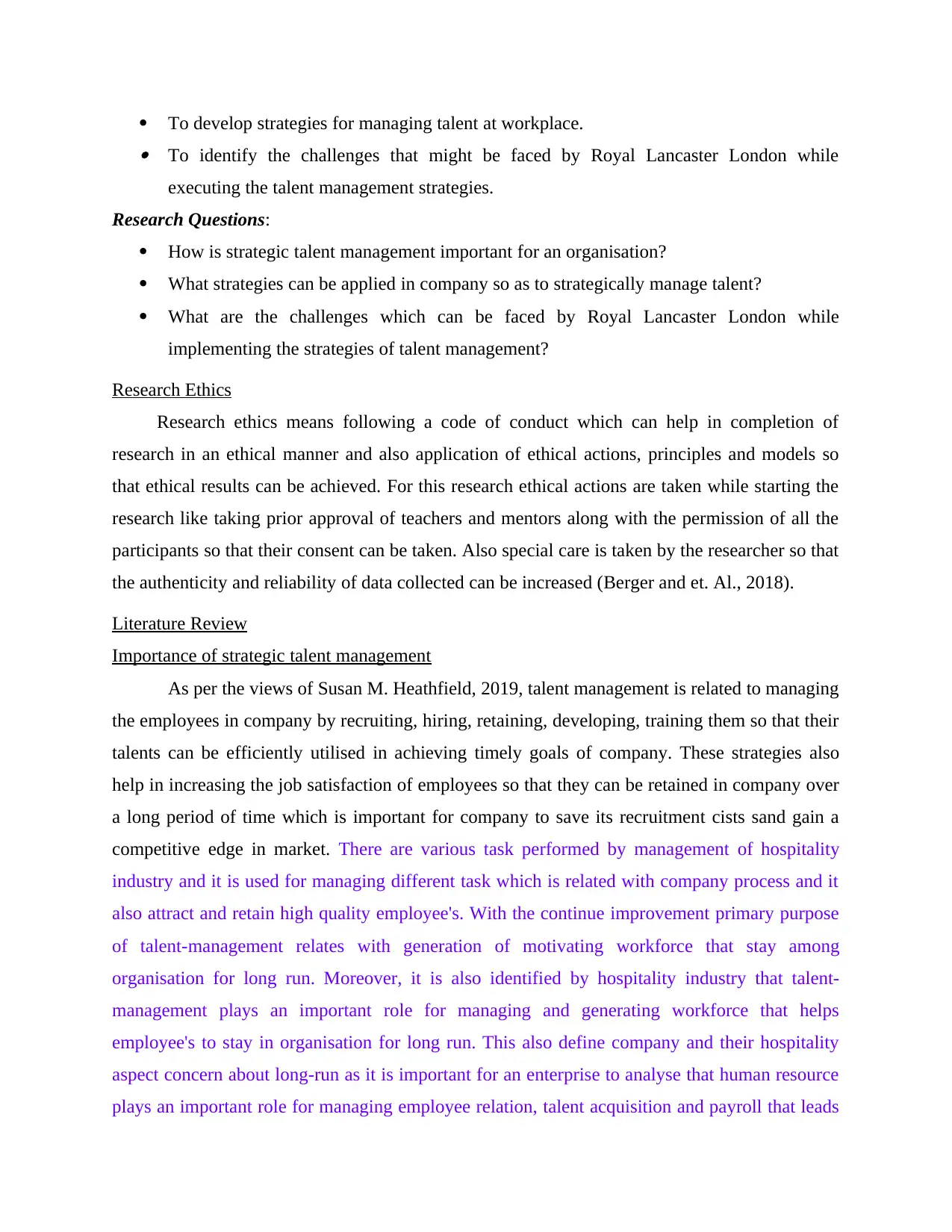
To develop strategies for managing talent at workplace. To identify the challenges that might be faced by Royal Lancaster London while
executing the talent management strategies.
Research Questions:
How is strategic talent management important for an organisation?
What strategies can be applied in company so as to strategically manage talent?
What are the challenges which can be faced by Royal Lancaster London while
implementing the strategies of talent management?
Research Ethics
Research ethics means following a code of conduct which can help in completion of
research in an ethical manner and also application of ethical actions, principles and models so
that ethical results can be achieved. For this research ethical actions are taken while starting the
research like taking prior approval of teachers and mentors along with the permission of all the
participants so that their consent can be taken. Also special care is taken by the researcher so that
the authenticity and reliability of data collected can be increased (Berger and et. Al., 2018).
Literature Review
Importance of strategic talent management
As per the views of Susan M. Heathfield, 2019, talent management is related to managing
the employees in company by recruiting, hiring, retaining, developing, training them so that their
talents can be efficiently utilised in achieving timely goals of company. These strategies also
help in increasing the job satisfaction of employees so that they can be retained in company over
a long period of time which is important for company to save its recruitment cists sand gain a
competitive edge in market. There are various task performed by management of hospitality
industry and it is used for managing different task which is related with company process and it
also attract and retain high quality employee's. With the continue improvement primary purpose
of talent-management relates with generation of motivating workforce that stay among
organisation for long run. Moreover, it is also identified by hospitality industry that talent-
management plays an important role for managing and generating workforce that helps
employee's to stay in organisation for long run. This also define company and their hospitality
aspect concern about long-run as it is important for an enterprise to analyse that human resource
plays an important role for managing employee relation, talent acquisition and payroll that leads
executing the talent management strategies.
Research Questions:
How is strategic talent management important for an organisation?
What strategies can be applied in company so as to strategically manage talent?
What are the challenges which can be faced by Royal Lancaster London while
implementing the strategies of talent management?
Research Ethics
Research ethics means following a code of conduct which can help in completion of
research in an ethical manner and also application of ethical actions, principles and models so
that ethical results can be achieved. For this research ethical actions are taken while starting the
research like taking prior approval of teachers and mentors along with the permission of all the
participants so that their consent can be taken. Also special care is taken by the researcher so that
the authenticity and reliability of data collected can be increased (Berger and et. Al., 2018).
Literature Review
Importance of strategic talent management
As per the views of Susan M. Heathfield, 2019, talent management is related to managing
the employees in company by recruiting, hiring, retaining, developing, training them so that their
talents can be efficiently utilised in achieving timely goals of company. These strategies also
help in increasing the job satisfaction of employees so that they can be retained in company over
a long period of time which is important for company to save its recruitment cists sand gain a
competitive edge in market. There are various task performed by management of hospitality
industry and it is used for managing different task which is related with company process and it
also attract and retain high quality employee's. With the continue improvement primary purpose
of talent-management relates with generation of motivating workforce that stay among
organisation for long run. Moreover, it is also identified by hospitality industry that talent-
management plays an important role for managing and generating workforce that helps
employee's to stay in organisation for long run. This also define company and their hospitality
aspect concern about long-run as it is important for an enterprise to analyse that human resource
plays an important role for managing employee relation, talent acquisition and payroll that leads
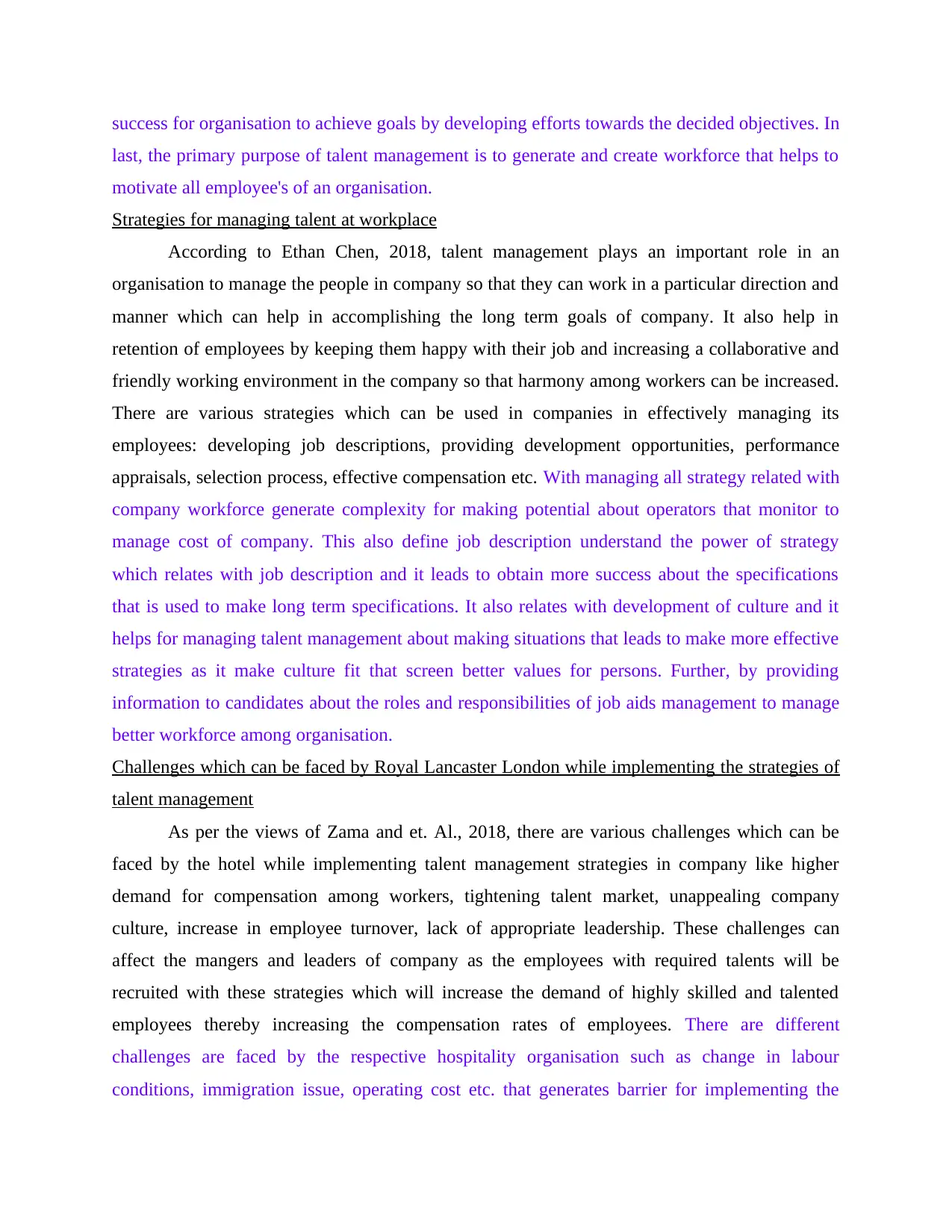
success for organisation to achieve goals by developing efforts towards the decided objectives. In
last, the primary purpose of talent management is to generate and create workforce that helps to
motivate all employee's of an organisation.
Strategies for managing talent at workplace
According to Ethan Chen, 2018, talent management plays an important role in an
organisation to manage the people in company so that they can work in a particular direction and
manner which can help in accomplishing the long term goals of company. It also help in
retention of employees by keeping them happy with their job and increasing a collaborative and
friendly working environment in the company so that harmony among workers can be increased.
There are various strategies which can be used in companies in effectively managing its
employees: developing job descriptions, providing development opportunities, performance
appraisals, selection process, effective compensation etc. With managing all strategy related with
company workforce generate complexity for making potential about operators that monitor to
manage cost of company. This also define job description understand the power of strategy
which relates with job description and it leads to obtain more success about the specifications
that is used to make long term specifications. It also relates with development of culture and it
helps for managing talent management about making situations that leads to make more effective
strategies as it make culture fit that screen better values for persons. Further, by providing
information to candidates about the roles and responsibilities of job aids management to manage
better workforce among organisation.
Challenges which can be faced by Royal Lancaster London while implementing the strategies of
talent management
As per the views of Zama and et. Al., 2018, there are various challenges which can be
faced by the hotel while implementing talent management strategies in company like higher
demand for compensation among workers, tightening talent market, unappealing company
culture, increase in employee turnover, lack of appropriate leadership. These challenges can
affect the mangers and leaders of company as the employees with required talents will be
recruited with these strategies which will increase the demand of highly skilled and talented
employees thereby increasing the compensation rates of employees. There are different
challenges are faced by the respective hospitality organisation such as change in labour
conditions, immigration issue, operating cost etc. that generates barrier for implementing the
last, the primary purpose of talent management is to generate and create workforce that helps to
motivate all employee's of an organisation.
Strategies for managing talent at workplace
According to Ethan Chen, 2018, talent management plays an important role in an
organisation to manage the people in company so that they can work in a particular direction and
manner which can help in accomplishing the long term goals of company. It also help in
retention of employees by keeping them happy with their job and increasing a collaborative and
friendly working environment in the company so that harmony among workers can be increased.
There are various strategies which can be used in companies in effectively managing its
employees: developing job descriptions, providing development opportunities, performance
appraisals, selection process, effective compensation etc. With managing all strategy related with
company workforce generate complexity for making potential about operators that monitor to
manage cost of company. This also define job description understand the power of strategy
which relates with job description and it leads to obtain more success about the specifications
that is used to make long term specifications. It also relates with development of culture and it
helps for managing talent management about making situations that leads to make more effective
strategies as it make culture fit that screen better values for persons. Further, by providing
information to candidates about the roles and responsibilities of job aids management to manage
better workforce among organisation.
Challenges which can be faced by Royal Lancaster London while implementing the strategies of
talent management
As per the views of Zama and et. Al., 2018, there are various challenges which can be
faced by the hotel while implementing talent management strategies in company like higher
demand for compensation among workers, tightening talent market, unappealing company
culture, increase in employee turnover, lack of appropriate leadership. These challenges can
affect the mangers and leaders of company as the employees with required talents will be
recruited with these strategies which will increase the demand of highly skilled and talented
employees thereby increasing the compensation rates of employees. There are different
challenges are faced by the respective hospitality organisation such as change in labour
conditions, immigration issue, operating cost etc. that generates barrier for implementing the
⊘ This is a preview!⊘
Do you want full access?
Subscribe today to unlock all pages.
Trusted by 1+ million students worldwide
talent management strategy. Changing labour conditions of hospitality industry face labour and
human resource challenges it includes compression and shirking of employee's because change
management is a long process. So most of the employee's face challenges to adopt changes and it
reduce or slow down the company process. Compression of labour force make the traditional
changes as it is used for making change about the fewer persons that contribute about the
operations which leads in distribution of hospitality task. So the change in labour conditions
create long term issue that escalate and reduce adoption of talent management in company. In the
concern the process of talent-management generate challenges for organisation.
LO 2
Research methodology is the specific procedure which needs to be followed by the
researcher so that required information on a particular topic can be collected and by using certain
tools and techniques the data which i collected can be interpreted so that desired information can
be gathered. The methodology opted by the researcher decides the direction of the project and
the steps which will be taken so that the research gets completed effectively and help in
achieving the objectives and aims of the research. It is thus important that a correct research
method is chosen by the researcher as the results will depend on the method selected along with
the quality of results that will be derived. The various methods and tools which will be used by
the researcher are mentioned as follows:
Research methods:
The methods of collecting the data so that results can be drawn from the collected
information depend on the method which is chosen by the researcher. There are two types of
methods of conducting a research which are qualitative and quantitative methods which
determine the way and the type of information which will be collected. Qualitative method can
be used when deep information about a topic is to be gained by gathering information by the way
of open ended questions or conversations so that the views of population about the researched
topic can be gained (Collings, Mellahi and Cascio, 2017). The data collected by this method
cannot be depicted in the form of graphs or tables. Quantitative method on the other hand helps
in gathering information which can be illustrated in the form of graphs, pie charts, tables etc. In
order to collect information related to this topic the method adopted by the researcher is
quantitative method which can help in collection of data that is more authentic and can be
interpreted on graphs and also help in increasing the accuracy of information which is collected.
human resource challenges it includes compression and shirking of employee's because change
management is a long process. So most of the employee's face challenges to adopt changes and it
reduce or slow down the company process. Compression of labour force make the traditional
changes as it is used for making change about the fewer persons that contribute about the
operations which leads in distribution of hospitality task. So the change in labour conditions
create long term issue that escalate and reduce adoption of talent management in company. In the
concern the process of talent-management generate challenges for organisation.
LO 2
Research methodology is the specific procedure which needs to be followed by the
researcher so that required information on a particular topic can be collected and by using certain
tools and techniques the data which i collected can be interpreted so that desired information can
be gathered. The methodology opted by the researcher decides the direction of the project and
the steps which will be taken so that the research gets completed effectively and help in
achieving the objectives and aims of the research. It is thus important that a correct research
method is chosen by the researcher as the results will depend on the method selected along with
the quality of results that will be derived. The various methods and tools which will be used by
the researcher are mentioned as follows:
Research methods:
The methods of collecting the data so that results can be drawn from the collected
information depend on the method which is chosen by the researcher. There are two types of
methods of conducting a research which are qualitative and quantitative methods which
determine the way and the type of information which will be collected. Qualitative method can
be used when deep information about a topic is to be gained by gathering information by the way
of open ended questions or conversations so that the views of population about the researched
topic can be gained (Collings, Mellahi and Cascio, 2017). The data collected by this method
cannot be depicted in the form of graphs or tables. Quantitative method on the other hand helps
in gathering information which can be illustrated in the form of graphs, pie charts, tables etc. In
order to collect information related to this topic the method adopted by the researcher is
quantitative method which can help in collection of data that is more authentic and can be
interpreted on graphs and also help in increasing the accuracy of information which is collected.
Paraphrase This Document
Need a fresh take? Get an instant paraphrase of this document with our AI Paraphraser
Sources of data:
In order to collect information related to a certain topic various sources can be explored
by the researcher so that authentic and reliable information can be acquired. There are two types
of sources from where information can be collected which are primary and secondary sources of
data. The primary sources are the ones from where the researcher collects firsthand information
by the way of questionnaires, surveys etc. which help in collecting accurate and fresh data
(Meyers, 2019). This help in reaching to the population directly so that data can be collected
directly from them which help in increasing the accuracy and reliability of information so
collected. Secondary sources are the ones from where researcher collects information which has
already been depicted by other researcher like from newspaper articles, magazines, internet etc.
The data contained on these sites are the views of other authors and can also be out dated which
affect the quality of information so collected. Tin this research the researcher is going to collect
information from primary sources.
Research philosophy:
It is related with the principles and procedures that are concerned with the stance and
view for which the research is conducted by researcher. It is belief concerning the way in which
data must be collected, analysed and used. There are two terms which help in determining the
various philosophies on conducting a research which are epistemology and ontology. Ontology is
concerned with authenticity and reliability of the information which is collected for conducting
the research (Skuza, McDonnell and Scullion, 2018). Epistemology on the other hand is
concerned with validity and reliability of the data which i collected so that specific conclusions
can be reached. Further the research philosophy is also divided into two parts which are
interpretivism and positivism. In this positivism is related with the fact that the knowledge which
is gained by the way of research is independent of the subject or theories which are being
studied. On the other hand interpretivism is concerned with the perception of each and every
individual and their understanding about the reality which is different from one another. In this
research the researcher will use positivism research philosophy so that the principles and theories
can be used which can help in gaining ore scientific and practical results which is important for
increasing the quality of results which are achieved.
In order to collect information related to a certain topic various sources can be explored
by the researcher so that authentic and reliable information can be acquired. There are two types
of sources from where information can be collected which are primary and secondary sources of
data. The primary sources are the ones from where the researcher collects firsthand information
by the way of questionnaires, surveys etc. which help in collecting accurate and fresh data
(Meyers, 2019). This help in reaching to the population directly so that data can be collected
directly from them which help in increasing the accuracy and reliability of information so
collected. Secondary sources are the ones from where researcher collects information which has
already been depicted by other researcher like from newspaper articles, magazines, internet etc.
The data contained on these sites are the views of other authors and can also be out dated which
affect the quality of information so collected. Tin this research the researcher is going to collect
information from primary sources.
Research philosophy:
It is related with the principles and procedures that are concerned with the stance and
view for which the research is conducted by researcher. It is belief concerning the way in which
data must be collected, analysed and used. There are two terms which help in determining the
various philosophies on conducting a research which are epistemology and ontology. Ontology is
concerned with authenticity and reliability of the information which is collected for conducting
the research (Skuza, McDonnell and Scullion, 2018). Epistemology on the other hand is
concerned with validity and reliability of the data which i collected so that specific conclusions
can be reached. Further the research philosophy is also divided into two parts which are
interpretivism and positivism. In this positivism is related with the fact that the knowledge which
is gained by the way of research is independent of the subject or theories which are being
studied. On the other hand interpretivism is concerned with the perception of each and every
individual and their understanding about the reality which is different from one another. In this
research the researcher will use positivism research philosophy so that the principles and theories
can be used which can help in gaining ore scientific and practical results which is important for
increasing the quality of results which are achieved.
Research approach:
It is the approach which needs to be taken by investigator so that the research can be
carried out in a particular direction and data collection can be dine based on certain assumptions
and methods so that it can be analysed and interpreted so that efficient results can be drawn.
There are various approaches of research approach depending on the nature and kind of problem
which is to be solved by the way of conducting research (Sheehan, Grant and Garavan, 2018). I
this research project the investigator will use deductive research approach that focuses on
developing a hypothesis based on literature review. The inductive research approach is the other
approach which is associated wit creation of a new theory. As this report is based on proving a
certain hypothesis the deductive approach will be used by the researcher.
Research design:
It is the framework which includes a combination of methods and techniques which are
can be chosen by the researcher as to conduct the research effectively. There are two types of
research designs which are descriptive and experimental. As the descriptive research design is
made up of tools which help in doing current investigation and also help in facilitating the better
use of observations, surveys etc. so that better interpretations of the data collected can be gained
this is chosen by the investigator in order to complete this research project.
Research strategy:
These are the strategies or action plans which are to be followed by the researcher so that
the data which is collected by the way of surveys, observations, interviews etc. can be collected
from authentic sources so that the quality of research can be increased. In this research the data
will bee collected by the investigator by the way of asking certain questions to the respondents
by the way of questionnaire which will contain questions to be answered by them (Böhmer and
Schinnenburg, 2016).
Instrument used:
This is about the way in which data will be gathered like in this research questionnaire is
the instrument which will be used by the investigator. A questionnaire is a document which
contains certain pre determined questions along with multiple answers which help in collecting
quantitative information from respondents. The respondents answer the questions by selecting
the option they feel most suitable for the question. As the respondents are directly engaged in
It is the approach which needs to be taken by investigator so that the research can be
carried out in a particular direction and data collection can be dine based on certain assumptions
and methods so that it can be analysed and interpreted so that efficient results can be drawn.
There are various approaches of research approach depending on the nature and kind of problem
which is to be solved by the way of conducting research (Sheehan, Grant and Garavan, 2018). I
this research project the investigator will use deductive research approach that focuses on
developing a hypothesis based on literature review. The inductive research approach is the other
approach which is associated wit creation of a new theory. As this report is based on proving a
certain hypothesis the deductive approach will be used by the researcher.
Research design:
It is the framework which includes a combination of methods and techniques which are
can be chosen by the researcher as to conduct the research effectively. There are two types of
research designs which are descriptive and experimental. As the descriptive research design is
made up of tools which help in doing current investigation and also help in facilitating the better
use of observations, surveys etc. so that better interpretations of the data collected can be gained
this is chosen by the investigator in order to complete this research project.
Research strategy:
These are the strategies or action plans which are to be followed by the researcher so that
the data which is collected by the way of surveys, observations, interviews etc. can be collected
from authentic sources so that the quality of research can be increased. In this research the data
will bee collected by the investigator by the way of asking certain questions to the respondents
by the way of questionnaire which will contain questions to be answered by them (Böhmer and
Schinnenburg, 2016).
Instrument used:
This is about the way in which data will be gathered like in this research questionnaire is
the instrument which will be used by the investigator. A questionnaire is a document which
contains certain pre determined questions along with multiple answers which help in collecting
quantitative information from respondents. The respondents answer the questions by selecting
the option they feel most suitable for the question. As the respondents are directly engaged in
⊘ This is a preview!⊘
Do you want full access?
Subscribe today to unlock all pages.
Trusted by 1+ million students worldwide
answering these questions, the authenticity of information increases. Also this method is both
time and cost effective method of data collection.
Time horizons and activities:
By using certain tools the activities of research can be allocated based on time which will
be required to complete those activities. Cross-sectional is associated with aligning activities
with a single point of time. Longitudinal is based on arranging activities based on certain
months, years or days. In order to conduct this research the cross-sectional time horizon is made
and the project management tool which is Gantt Chart is used so that the activities can be
allocated in reference with time so that relation with time and with each activity can be
established. Following is a Gantt Chart with reference to activities and time that will help in
completion of the complete research project:
Sample method:
It is a process through which out a large population having common characteristics a
sample population is selected which will be used for collecting the data and the data which is
collected from them can be applied to the entire population. In this research the investigator uses
random sampling method in which the questions will be asked to a random sample of people in
order to collect information for the questionnaire. A sample size of 30 is taken by the researcher
from the number of employees who work at Royal Lancaster London.
Questionnaire:
It is an instrument which will be used by researcher so as to gather information related to the
topic from the employees of company so that research objectives can be effectively achieved
time and cost effective method of data collection.
Time horizons and activities:
By using certain tools the activities of research can be allocated based on time which will
be required to complete those activities. Cross-sectional is associated with aligning activities
with a single point of time. Longitudinal is based on arranging activities based on certain
months, years or days. In order to conduct this research the cross-sectional time horizon is made
and the project management tool which is Gantt Chart is used so that the activities can be
allocated in reference with time so that relation with time and with each activity can be
established. Following is a Gantt Chart with reference to activities and time that will help in
completion of the complete research project:
Sample method:
It is a process through which out a large population having common characteristics a
sample population is selected which will be used for collecting the data and the data which is
collected from them can be applied to the entire population. In this research the investigator uses
random sampling method in which the questions will be asked to a random sample of people in
order to collect information for the questionnaire. A sample size of 30 is taken by the researcher
from the number of employees who work at Royal Lancaster London.
Questionnaire:
It is an instrument which will be used by researcher so as to gather information related to the
topic from the employees of company so that research objectives can be effectively achieved
Paraphrase This Document
Need a fresh take? Get an instant paraphrase of this document with our AI Paraphraser
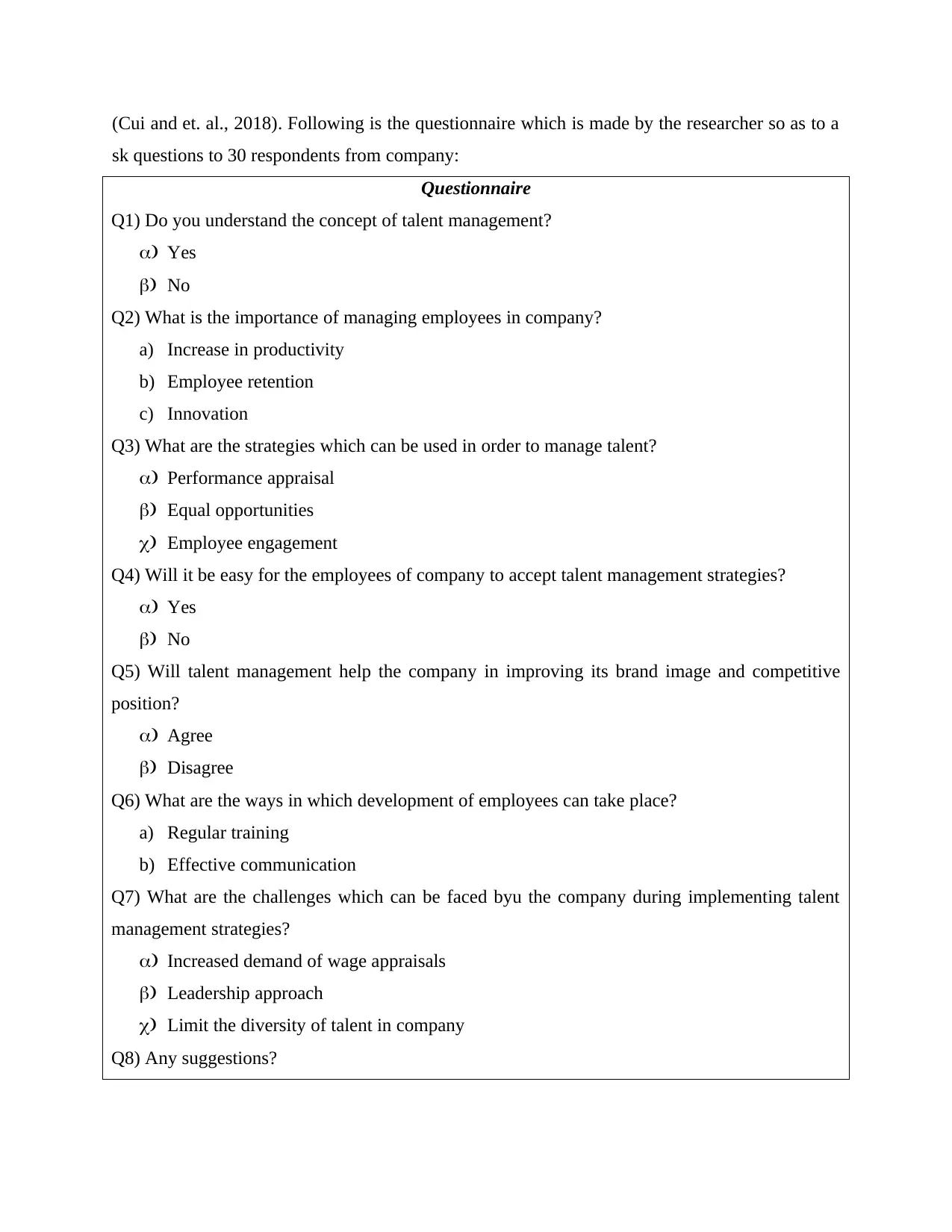
(Cui and et. al., 2018). Following is the questionnaire which is made by the researcher so as to a
sk questions to 30 respondents from company:
Questionnaire
Q1) Do you understand the concept of talent management?
a) Yes
b) No
Q2) What is the importance of managing employees in company?
a) Increase in productivity
b) Employee retention
c) Innovation
Q3) What are the strategies which can be used in order to manage talent?
a) Performance appraisal
b) Equal opportunities
c) Employee engagement
Q4) Will it be easy for the employees of company to accept talent management strategies?
a) Yes
b) No
Q5) Will talent management help the company in improving its brand image and competitive
position?
a) Agree
b) Disagree
Q6) What are the ways in which development of employees can take place?
a) Regular training
b) Effective communication
Q7) What are the challenges which can be faced byu the company during implementing talent
management strategies?
a) Increased demand of wage appraisals
b) Leadership approach
c) Limit the diversity of talent in company
Q8) Any suggestions?
sk questions to 30 respondents from company:
Questionnaire
Q1) Do you understand the concept of talent management?
a) Yes
b) No
Q2) What is the importance of managing employees in company?
a) Increase in productivity
b) Employee retention
c) Innovation
Q3) What are the strategies which can be used in order to manage talent?
a) Performance appraisal
b) Equal opportunities
c) Employee engagement
Q4) Will it be easy for the employees of company to accept talent management strategies?
a) Yes
b) No
Q5) Will talent management help the company in improving its brand image and competitive
position?
a) Agree
b) Disagree
Q6) What are the ways in which development of employees can take place?
a) Regular training
b) Effective communication
Q7) What are the challenges which can be faced byu the company during implementing talent
management strategies?
a) Increased demand of wage appraisals
b) Leadership approach
c) Limit the diversity of talent in company
Q8) Any suggestions?
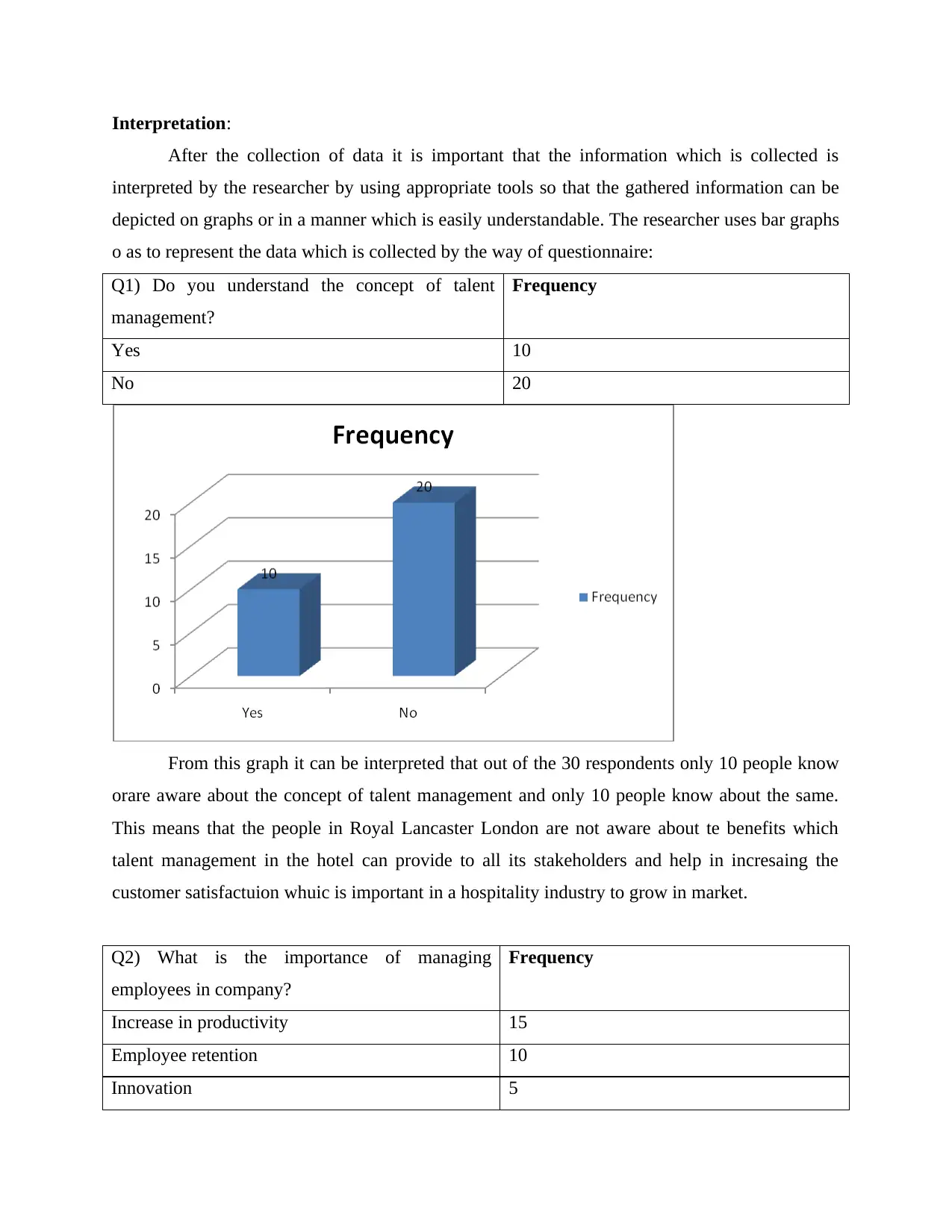
Interpretation:
After the collection of data it is important that the information which is collected is
interpreted by the researcher by using appropriate tools so that the gathered information can be
depicted on graphs or in a manner which is easily understandable. The researcher uses bar graphs
o as to represent the data which is collected by the way of questionnaire:
Q1) Do you understand the concept of talent
management?
Frequency
Yes 10
No 20
From this graph it can be interpreted that out of the 30 respondents only 10 people know
orare aware about the concept of talent management and only 10 people know about the same.
This means that the people in Royal Lancaster London are not aware about te benefits which
talent management in the hotel can provide to all its stakeholders and help in incresaing the
customer satisfactuion whuic is important in a hospitality industry to grow in market.
Q2) What is the importance of managing
employees in company?
Frequency
Increase in productivity 15
Employee retention 10
Innovation 5
After the collection of data it is important that the information which is collected is
interpreted by the researcher by using appropriate tools so that the gathered information can be
depicted on graphs or in a manner which is easily understandable. The researcher uses bar graphs
o as to represent the data which is collected by the way of questionnaire:
Q1) Do you understand the concept of talent
management?
Frequency
Yes 10
No 20
From this graph it can be interpreted that out of the 30 respondents only 10 people know
orare aware about the concept of talent management and only 10 people know about the same.
This means that the people in Royal Lancaster London are not aware about te benefits which
talent management in the hotel can provide to all its stakeholders and help in incresaing the
customer satisfactuion whuic is important in a hospitality industry to grow in market.
Q2) What is the importance of managing
employees in company?
Frequency
Increase in productivity 15
Employee retention 10
Innovation 5
⊘ This is a preview!⊘
Do you want full access?
Subscribe today to unlock all pages.
Trusted by 1+ million students worldwide

1 out of 23


Related Documents


Your All-in-One AI-Powered Toolkit for Academic Success.
+13062052269
info@desklib.com
Available 24*7 on WhatsApp / Email
![[object Object]](/_next/static/media/star-bottom.7253800d.svg)
Unlock your academic potential
Copyright © 2020–2026 A2Z Services. All Rights Reserved. Developed and managed by ZUCOL.