MSN Program Discussion: Strategies for Addressing Questions - Week 3
VerifiedAdded on 2022/09/03
|4
|838
|32
Discussion Board Post
AI Summary
This discussion post, created for a Master of Science in Nursing (MSN) program, explores strategies for addressing questions and concerns that arise during the program. The post highlights the importance of building a supportive network and encourages students to share their questions, fostering a collaborative learning environment. It references the differences between online and traditional courses, the role of emotional intelligence in online learning, and the impact of technology on education. The post emphasizes the value of seeking assistance from various resources, including peers, faculty, and university departments, to navigate challenges and achieve success in the MSN program. The provided solution references several academic papers and articles to support the points made in the discussion post.

Running head: DISCUSSION POST
DISCUSSION POST
Name of the student
Name of the university
Author note
DISCUSSION POST
Name of the student
Name of the university
Author note
Paraphrase This Document
Need a fresh take? Get an instant paraphrase of this document with our AI Paraphraser

1DISCUSSION POST
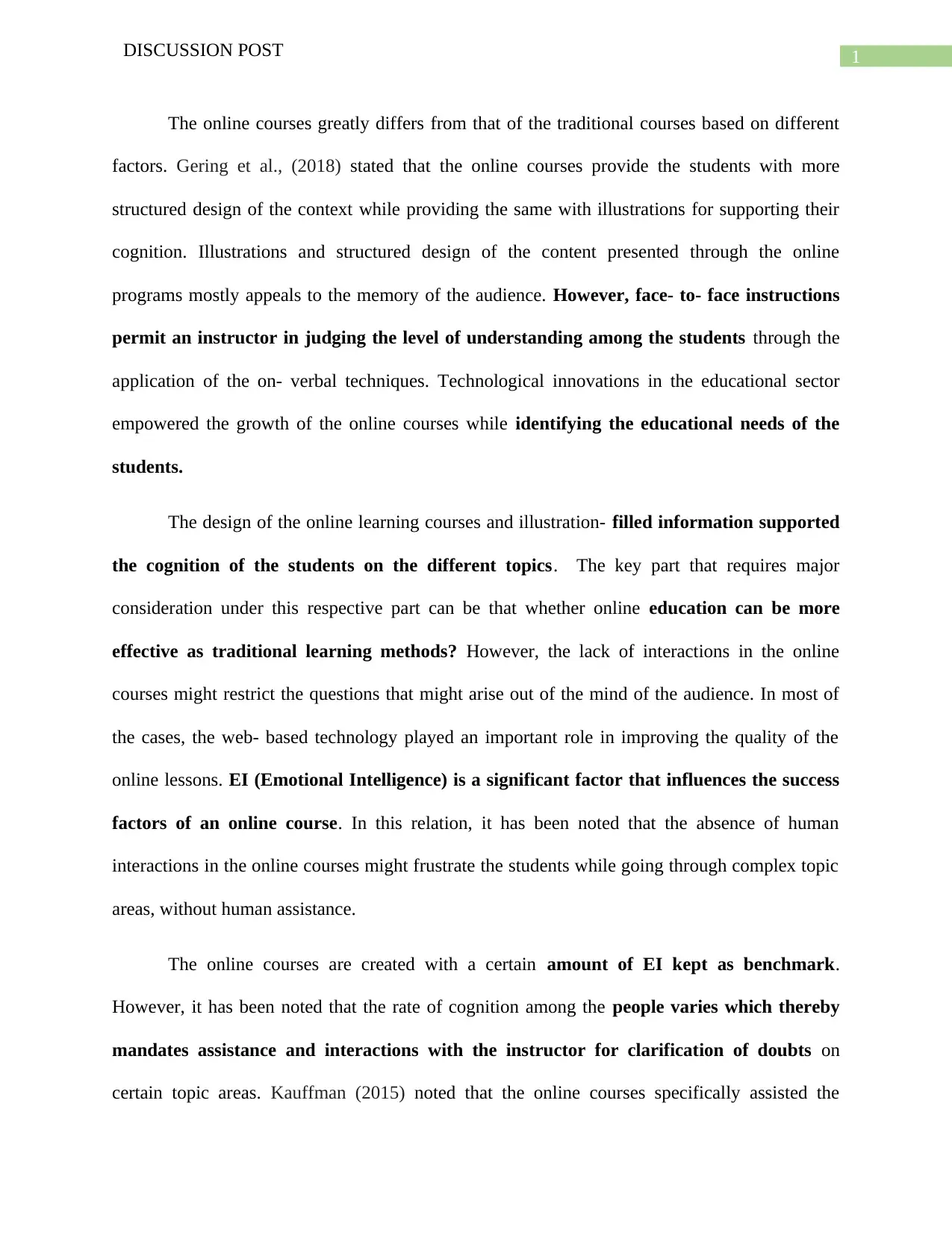
The online courses greatly differs from that of the traditional courses based on different
factors. Gering et al., (2018) stated that the online courses provide the students with more
structured design of the context while providing the same with illustrations for supporting their
cognition. Illustrations and structured design of the content presented through the online
programs mostly appeals to the memory of the audience. However, face- to- face instructions
permit an instructor in judging the level of understanding among the students through the
application of the on- verbal techniques. Technological innovations in the educational sector
empowered the growth of the online courses while identifying the educational needs of the
students.
The design of the online learning courses and illustration- filled information supported
the cognition of the students on the different topics. The key part that requires major
consideration under this respective part can be that whether online education can be more
effective as traditional learning methods? However, the lack of interactions in the online
courses might restrict the questions that might arise out of the mind of the audience. In most of
the cases, the web- based technology played an important role in improving the quality of the
online lessons. EI (Emotional Intelligence) is a significant factor that influences the success
factors of an online course. In this relation, it has been noted that the absence of human
interactions in the online courses might frustrate the students while going through complex topic
areas, without human assistance.
The online courses are created with a certain amount of EI kept as benchmark.
However, it has been noted that the rate of cognition among the people varies which thereby
mandates assistance and interactions with the instructor for clarification of doubts on
certain topic areas. Kauffman (2015) noted that the online courses specifically assisted the
The online courses greatly differs from that of the traditional courses based on different
factors. Gering et al., (2018) stated that the online courses provide the students with more
structured design of the context while providing the same with illustrations for supporting their
cognition. Illustrations and structured design of the content presented through the online
programs mostly appeals to the memory of the audience. However, face- to- face instructions
permit an instructor in judging the level of understanding among the students through the
application of the on- verbal techniques. Technological innovations in the educational sector
empowered the growth of the online courses while identifying the educational needs of the
students.
The design of the online learning courses and illustration- filled information supported
the cognition of the students on the different topics. The key part that requires major
consideration under this respective part can be that whether online education can be more
effective as traditional learning methods? However, the lack of interactions in the online
courses might restrict the questions that might arise out of the mind of the audience. In most of
the cases, the web- based technology played an important role in improving the quality of the
online lessons. EI (Emotional Intelligence) is a significant factor that influences the success
factors of an online course. In this relation, it has been noted that the absence of human
interactions in the online courses might frustrate the students while going through complex topic
areas, without human assistance.
The online courses are created with a certain amount of EI kept as benchmark.
However, it has been noted that the rate of cognition among the people varies which thereby
mandates assistance and interactions with the instructor for clarification of doubts on
certain topic areas. Kauffman (2015) noted that the online courses specifically assisted the

2DISCUSSION POST
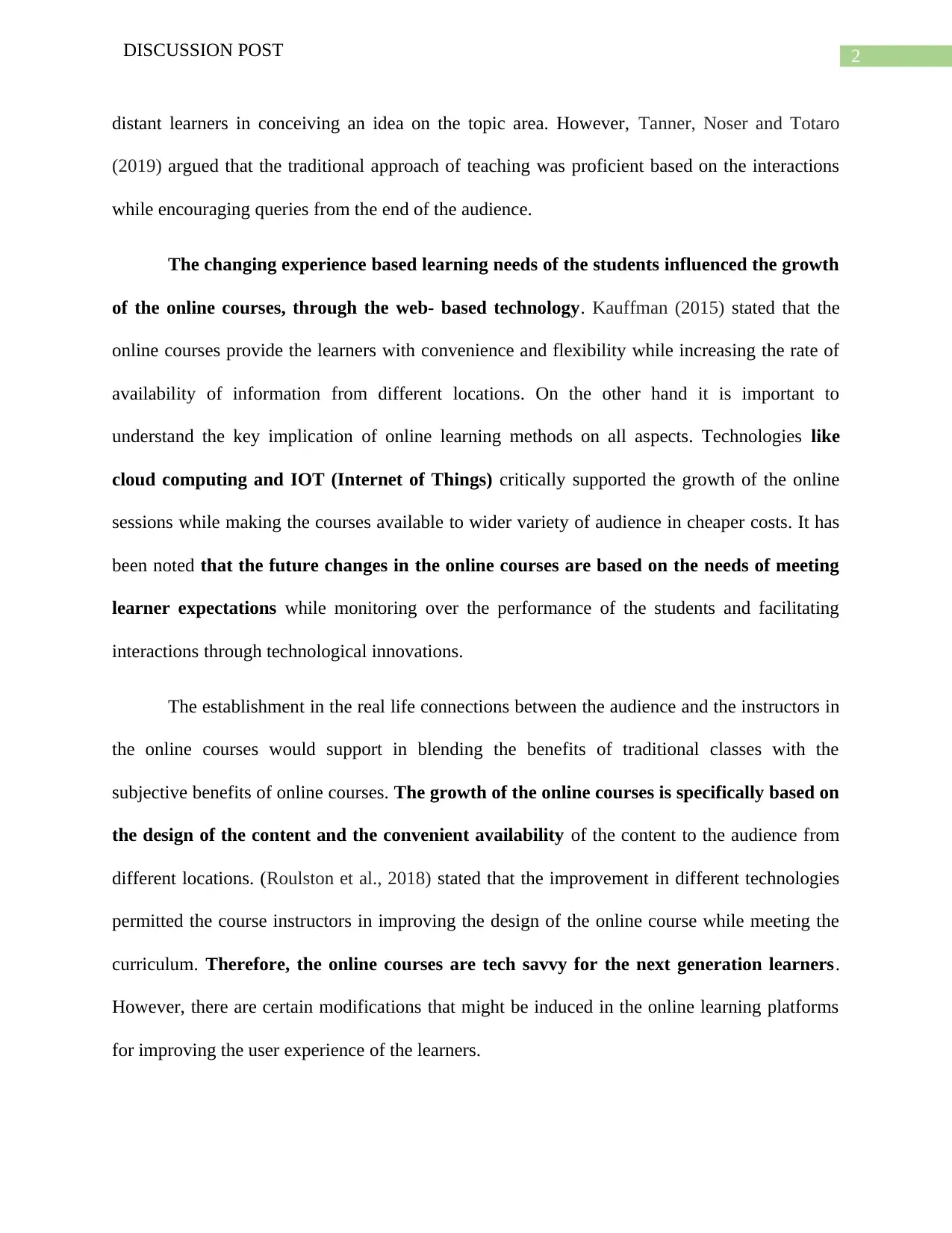
distant learners in conceiving an idea on the topic area. However, Tanner, Noser and Totaro
(2019) argued that the traditional approach of teaching was proficient based on the interactions
while encouraging queries from the end of the audience.
The changing experience based learning needs of the students influenced the growth
of the online courses, through the web- based technology. Kauffman (2015) stated that the
online courses provide the learners with convenience and flexibility while increasing the rate of
availability of information from different locations. On the other hand it is important to
understand the key implication of online learning methods on all aspects. Technologies like
cloud computing and IOT (Internet of Things) critically supported the growth of the online
sessions while making the courses available to wider variety of audience in cheaper costs. It has
been noted that the future changes in the online courses are based on the needs of meeting
learner expectations while monitoring over the performance of the students and facilitating
interactions through technological innovations.
The establishment in the real life connections between the audience and the instructors in
the online courses would support in blending the benefits of traditional classes with the
subjective benefits of online courses. The growth of the online courses is specifically based on
the design of the content and the convenient availability of the content to the audience from
different locations. (Roulston et al., 2018) stated that the improvement in different technologies
permitted the course instructors in improving the design of the online course while meeting the
curriculum. Therefore, the online courses are tech savvy for the next generation learners.
However, there are certain modifications that might be induced in the online learning platforms
for improving the user experience of the learners.
distant learners in conceiving an idea on the topic area. However, Tanner, Noser and Totaro
(2019) argued that the traditional approach of teaching was proficient based on the interactions
while encouraging queries from the end of the audience.
The changing experience based learning needs of the students influenced the growth
of the online courses, through the web- based technology. Kauffman (2015) stated that the
online courses provide the learners with convenience and flexibility while increasing the rate of
availability of information from different locations. On the other hand it is important to
understand the key implication of online learning methods on all aspects. Technologies like
cloud computing and IOT (Internet of Things) critically supported the growth of the online
sessions while making the courses available to wider variety of audience in cheaper costs. It has
been noted that the future changes in the online courses are based on the needs of meeting
learner expectations while monitoring over the performance of the students and facilitating
interactions through technological innovations.
The establishment in the real life connections between the audience and the instructors in
the online courses would support in blending the benefits of traditional classes with the
subjective benefits of online courses. The growth of the online courses is specifically based on
the design of the content and the convenient availability of the content to the audience from
different locations. (Roulston et al., 2018) stated that the improvement in different technologies
permitted the course instructors in improving the design of the online course while meeting the
curriculum. Therefore, the online courses are tech savvy for the next generation learners.
However, there are certain modifications that might be induced in the online learning platforms
for improving the user experience of the learners.
⊘ This is a preview!⊘
Do you want full access?
Subscribe today to unlock all pages.

Trusted by 1+ million students worldwide

3DISCUSSION POST
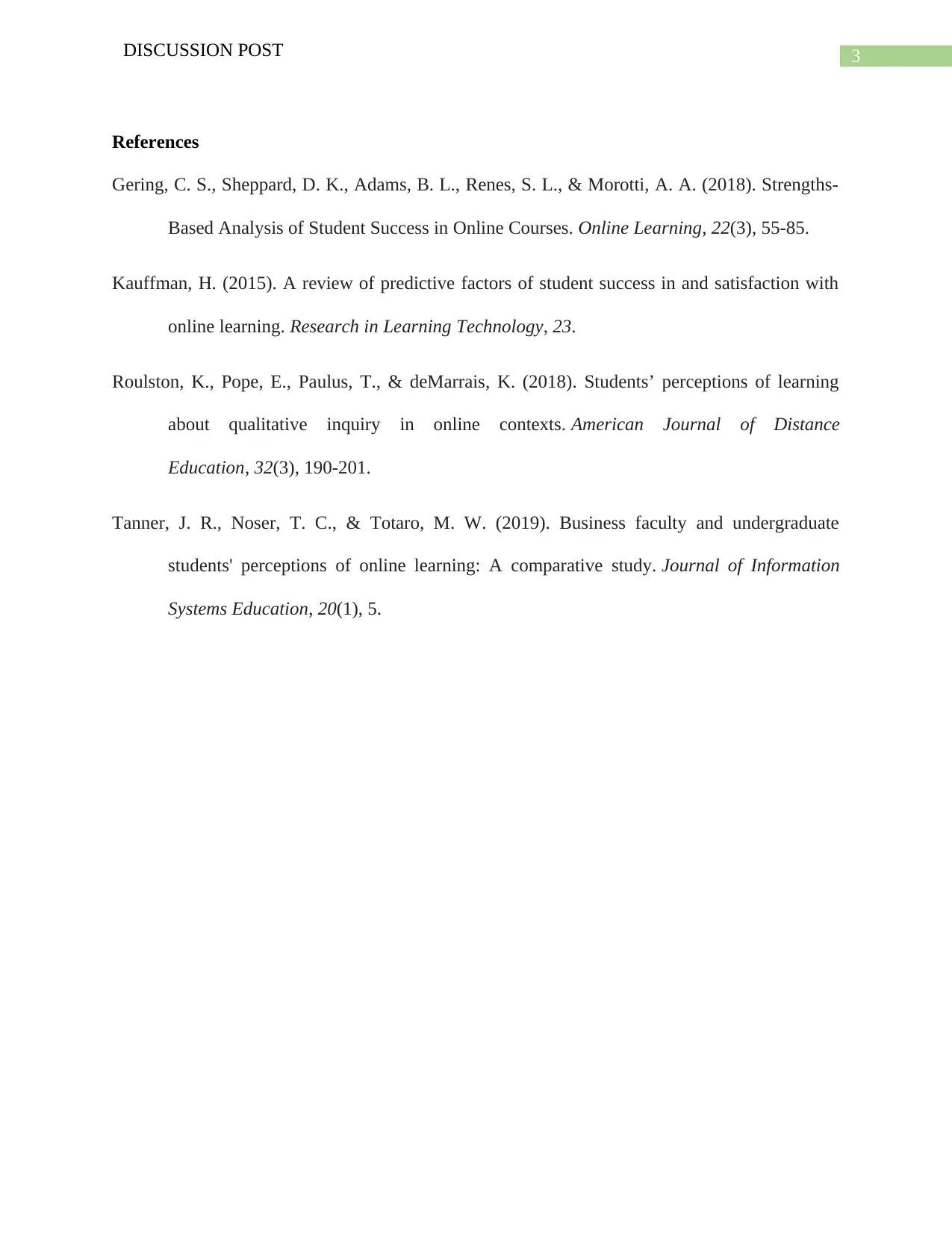
References
Gering, C. S., Sheppard, D. K., Adams, B. L., Renes, S. L., & Morotti, A. A. (2018). Strengths-
Based Analysis of Student Success in Online Courses. Online Learning, 22(3), 55-85.
Kauffman, H. (2015). A review of predictive factors of student success in and satisfaction with
online learning. Research in Learning Technology, 23.
Roulston, K., Pope, E., Paulus, T., & deMarrais, K. (2018). Students’ perceptions of learning
about qualitative inquiry in online contexts. American Journal of Distance
Education, 32(3), 190-201.
Tanner, J. R., Noser, T. C., & Totaro, M. W. (2019). Business faculty and undergraduate
students' perceptions of online learning: A comparative study. Journal of Information
Systems Education, 20(1), 5.
References
Gering, C. S., Sheppard, D. K., Adams, B. L., Renes, S. L., & Morotti, A. A. (2018). Strengths-
Based Analysis of Student Success in Online Courses. Online Learning, 22(3), 55-85.
Kauffman, H. (2015). A review of predictive factors of student success in and satisfaction with
online learning. Research in Learning Technology, 23.
Roulston, K., Pope, E., Paulus, T., & deMarrais, K. (2018). Students’ perceptions of learning
about qualitative inquiry in online contexts. American Journal of Distance
Education, 32(3), 190-201.
Tanner, J. R., Noser, T. C., & Totaro, M. W. (2019). Business faculty and undergraduate
students' perceptions of online learning: A comparative study. Journal of Information
Systems Education, 20(1), 5.
1 out of 4
Related Documents
Your All-in-One AI-Powered Toolkit for Academic Success.
+13062052269
info@desklib.com
Available 24*7 on WhatsApp / Email
Unlock your academic potential
Copyright © 2020–2025 A2Z Services. All Rights Reserved. Developed and managed by ZUCOL.