Strategies for Online Education: Course Name, Semester, University

Verified

Added on  2022/08/12

|3
|558
|14
Report
AI Summary
This report delves into the realm of online education strategies, exploring various aspects that contribute to effective learning environments. The report examines the significance of academic motivation, the role of peer assessment, and the impact of curriculum revisions on student outcomes. It highlights the importance of instructor involvement in fostering student engagement and providing constructive feedback. The report also discusses the implications of motivational factors on student success, and the importance of clear communication and encouragement. References to relevant research papers are provided, offering a comprehensive overview of the key elements of online education and their impact on student performance and overall learning experience. The report emphasizes the significance of understanding student needs and tailoring strategies to enhance their educational journey.
Document Page
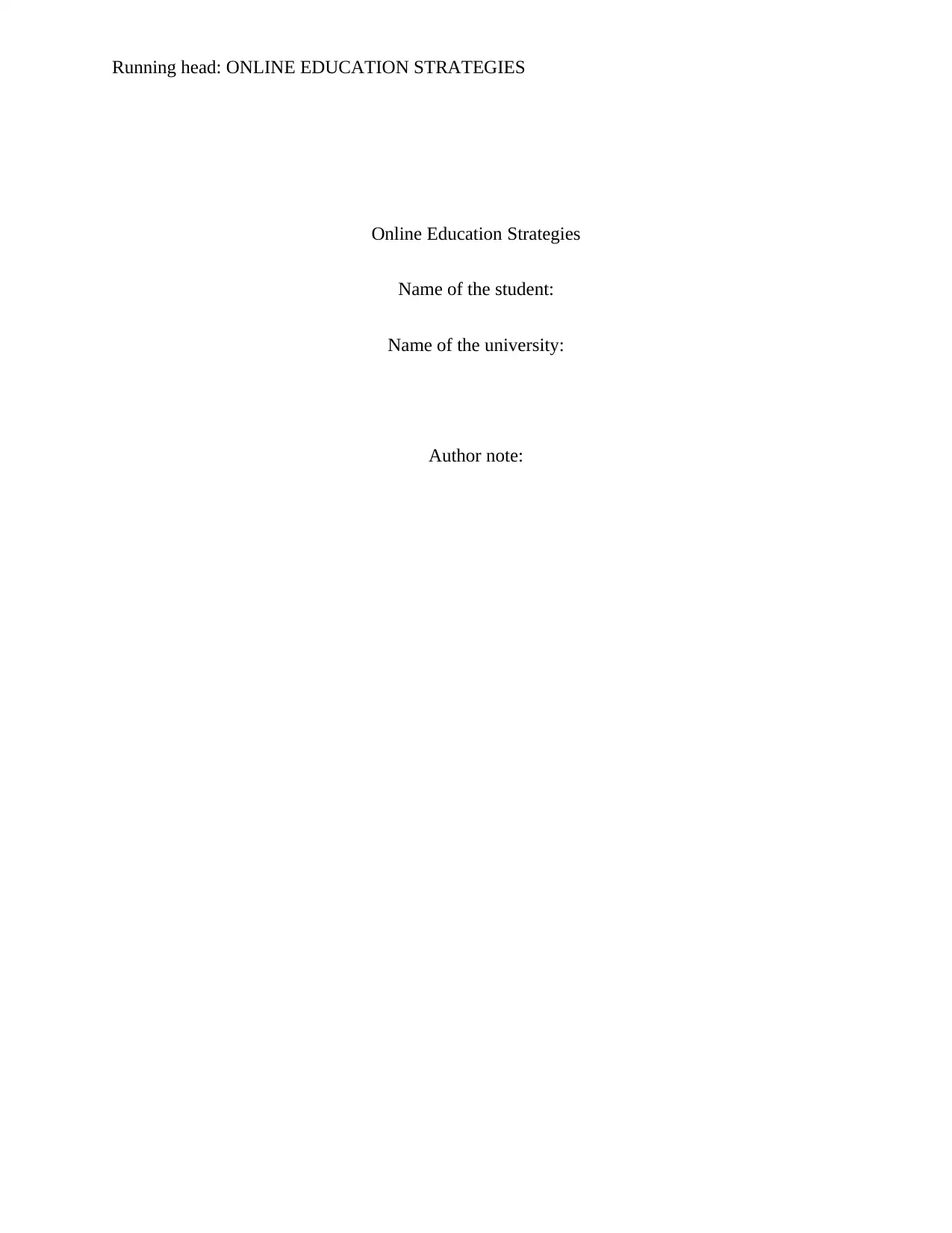
Running head: ONLINE EDUCATION STRATEGIES
Online Education Strategies
Name of the student:
Name of the university:
Author note:
tabler-icon-diamond-filled.svg

Paraphrase This Document

Need a fresh take? Get an instant paraphrase of this document with our AI Paraphraser
Document Page
1ONLINE EDUCATION STRATEGIES
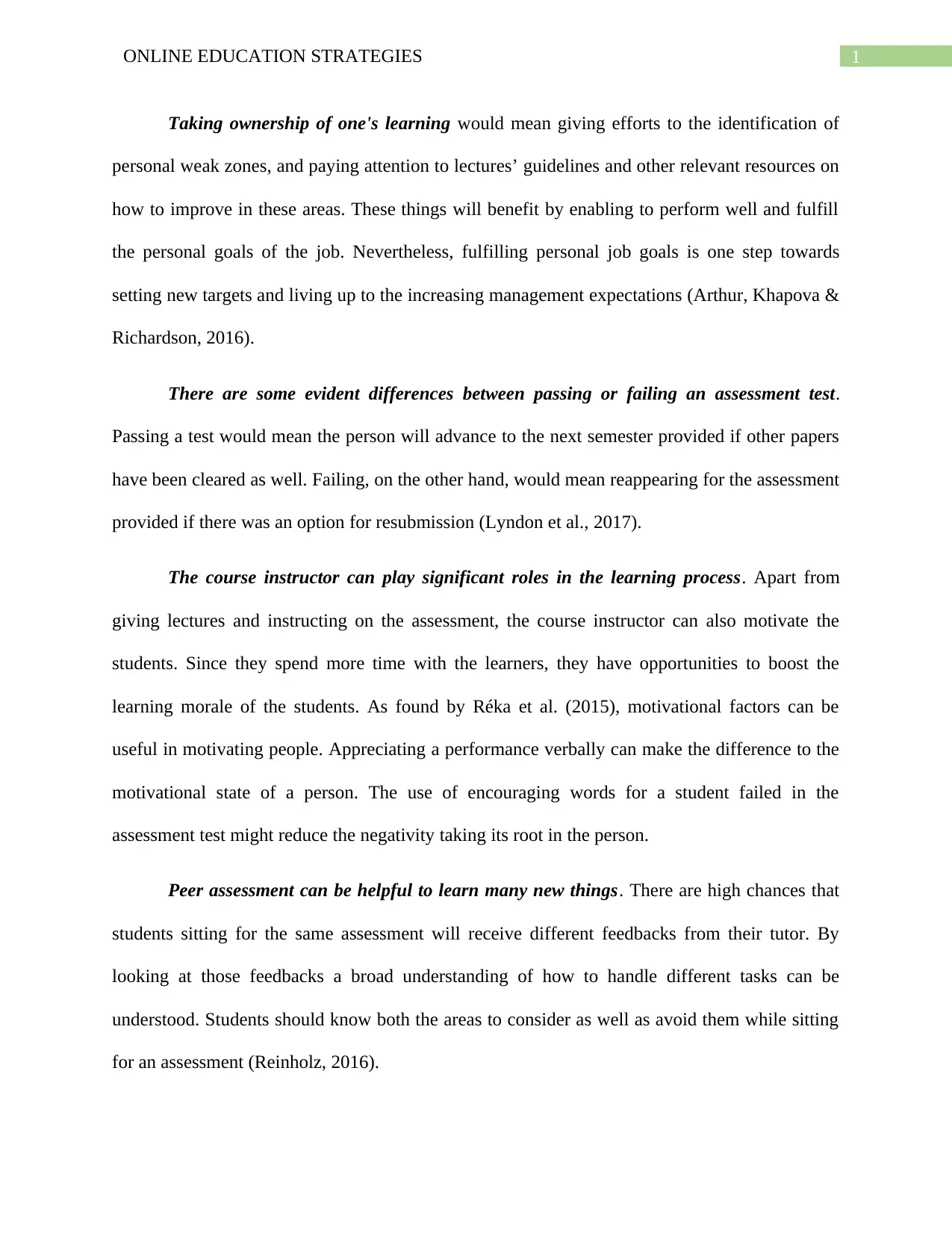
Taking ownership of one's learning would mean giving efforts to the identification of
personal weak zones, and paying attention to lectures’ guidelines and other relevant resources on
how to improve in these areas. These things will benefit by enabling to perform well and fulfill
the personal goals of the job. Nevertheless, fulfilling personal job goals is one step towards
setting new targets and living up to the increasing management expectations (Arthur, Khapova &
Richardson, 2016).
There are some evident differences between passing or failing an assessment test.
Passing a test would mean the person will advance to the next semester provided if other papers
have been cleared as well. Failing, on the other hand, would mean reappearing for the assessment
provided if there was an option for resubmission (Lyndon et al., 2017).
The course instructor can play significant roles in the learning process. Apart from
giving lectures and instructing on the assessment, the course instructor can also motivate the
students. Since they spend more time with the learners, they have opportunities to boost the
learning morale of the students. As found by Réka et al. (2015), motivational factors can be
useful in motivating people. Appreciating a performance verbally can make the difference to the
motivational state of a person. The use of encouraging words for a student failed in the
assessment test might reduce the negativity taking its root in the person.
Peer assessment can be helpful to learn many new things. There are high chances that
students sitting for the same assessment will receive different feedbacks from their tutor. By
looking at those feedbacks a broad understanding of how to handle different tasks can be
understood. Students should know both the areas to consider as well as avoid them while sitting
for an assessment (Reinholz, 2016).
Document Page
2ONLINE EDUCATION STRATEGIES
References
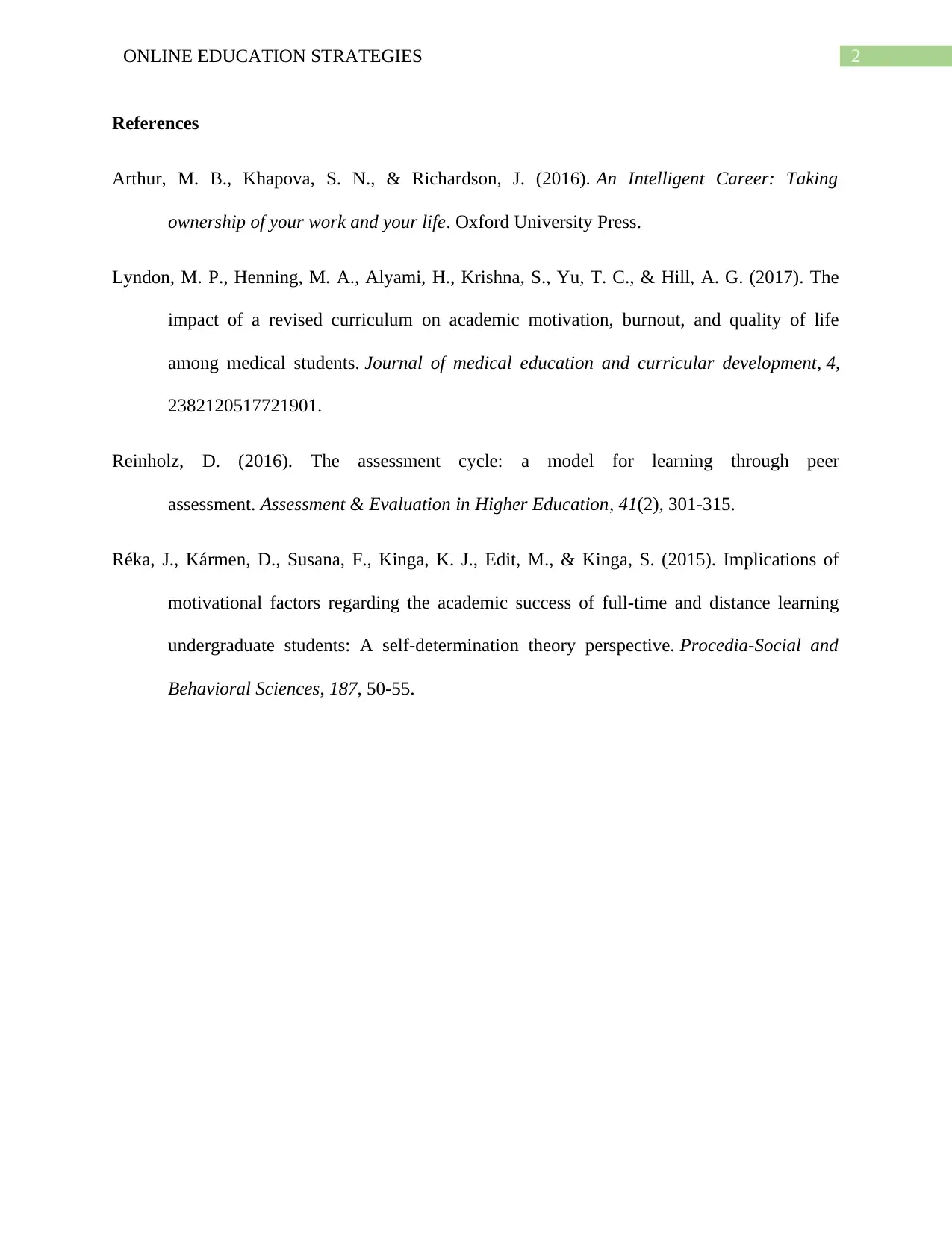
Arthur, M. B., Khapova, S. N., & Richardson, J. (2016). An Intelligent Career: Taking
ownership of your work and your life. Oxford University Press.
Lyndon, M. P., Henning, M. A., Alyami, H., Krishna, S., Yu, T. C., & Hill, A. G. (2017). The
impact of a revised curriculum on academic motivation, burnout, and quality of life
among medical students. Journal of medical education and curricular development, 4,
2382120517721901.
Reinholz, D. (2016). The assessment cycle: a model for learning through peer
assessment. Assessment & Evaluation in Higher Education, 41(2), 301-315.
Réka, J., Kármen, D., Susana, F., Kinga, K. J., Edit, M., & Kinga, S. (2015). Implications of
motivational factors regarding the academic success of full-time and distance learning
undergraduate students: A self-determination theory perspective. Procedia-Social and
Behavioral Sciences, 187, 50-55.
chevron_up_icon
1 out of 3
circle_padding
hide_on_mobile
zoom_out_icon
[object Object]